

Archetype Data vs Apollo.io: Are You Even Comparing the Right Tools?
Here's the thing - if you're trying to compare Archetype Data and Apollo.io, you've probably already noticed the search results are a mess. The current top result compares Baidu Apollo (an autonomous vehicle platform) to Archetype AI (an AI sensor-data company). Neither is what you're looking for.
So let's clear this up fast: Archetype Data and Apollo.io aren't competitors. Different categories, different buyers, different jobs entirely.
30-Second Verdict
Archetype Data (formerly Linq360) is a data licensing provider for analytics and data science teams, especially in insurance and financial services. It links business owner and executive profiles to consumer data profiles. It's not a sales prospecting tool.
Apollo.io is a sales engagement and prospecting platform with a 275M+ contact database and built-in sequencing. But independent user tests show "verified" emails testing at just 19% valid through third-party verification.
If you need verified B2B contact data for outbound, skip both.
What Is Archetype Data?
Archetype Data (formerly Linq360) is a B2B-to-consumer data licensing provider. Its core product links business owner and executive profiles to consumer data profiles - firmographics and classification codes on the business side, paired with 300+ consumer attributes covering demographics, behavioral and intent signals, and purchase history on the personal side.
The company distributes datasets through the Databricks Marketplace and licensing agreements, with 700+ custom digital audiences for campaigns across digital, social, and TV. Their executive team brings nearly 50 years of cumulative data experience, concentrated in insurance and financial services.
This isn't a tool you log into to find someone's email. It's a data asset you license for underwriting models, acquisition analytics, and audience segmentation. Archetype Data has no public review footprint - the G2 "Archetype" listing is actually an unrelated branding agency. Pricing is custom-quoted; expect mid-five-figures to low-six-figures annually based on coverage and licensing scope, which is standard for linked identity datasets.
What Is Apollo.io?
Apollo.io is the default sales engagement platform for teams that want prospecting, sequencing, and a contact database in one place. The database covers 275M+ contacts across 73M+ companies, with email sequences, a built-in dialer, and enrichment workflows.
Pricing is credit-based with four main tiers: Free ($0), Basic ($49/user/month billed annually), Professional ($79/user/month billed annually), and Organization ($119/user/month billed annually, minimum 3 seats). The free tier is genuinely usable for early-stage teams, though mobile and export credits are tightly capped.
Side-by-Side Comparison
| Dimension | Archetype Data | Apollo.io | Prospeo |
|---|---|---|---|
| Data type | B2B + consumer (linked) | B2B contacts | B2B contacts |
| Primary use case | Analytics, modeling | Outbound sales | Email finding, outbound |
| Target buyer | Data teams, insurance/FS | SDRs, sales teams | Sales teams, agencies |
| Pricing | ~$50K-$200K+/year | $0-$149/user/mo | ~$0.01/email, free tier |
| Distribution | Databricks, licensing | Self-serve SaaS | Self-serve SaaS |
| Email accuracy | N/A | 19% valid (user-tested) | 98% verified |
| Data refresh | Undisclosed | 6-9 months stale | 7 days |
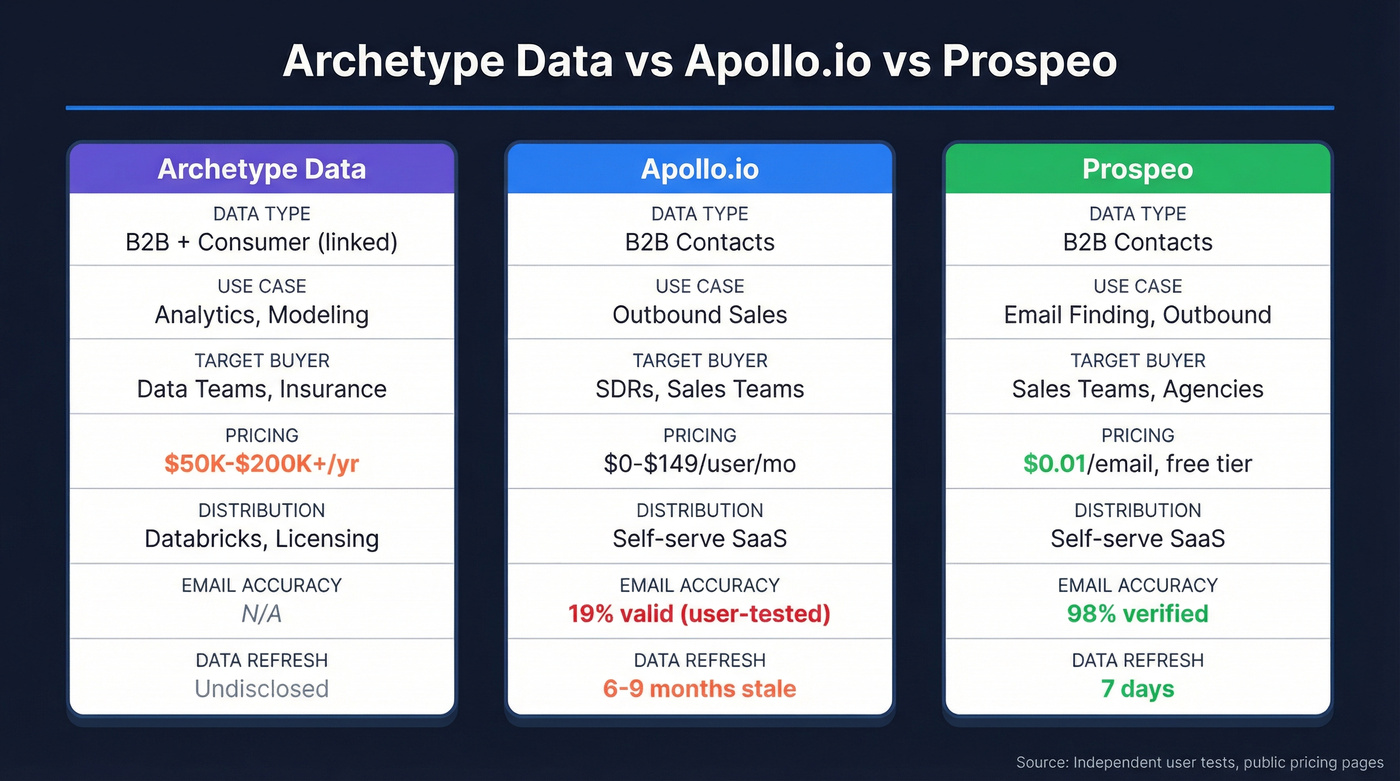
The mismatch is obvious. Archetype Data doesn't have an email accuracy row because it's not an email tool. Apollo has one, but the numbers aren't flattering.

Apollo users need 10,000+ exports to get 2,000 valid emails. Prospeo delivers 98% accuracy from 300M+ profiles refreshed every 7 days - not every 6-9 months. At $0.01/email, you stop paying for bounces and start booking meetings.
Stop verifying Apollo's homework. Start with clean data.
Are These Even Comparable?
No. Comparing Archetype Data to Apollo.io is like comparing a raw materials supplier to a retail storefront. One sells linked identity datasets to data science teams building underwriting models. The other gives SDRs a search bar and a sequence builder.
If you landed on this comparison because a search engine surfaced both, the real question is probably: "What's the best tool for finding accurate B2B contact data?" That question has a much clearer answer.
Apollo.io's Data Quality Problems
Apollo's database is massive, but size doesn't equal accuracy. The community feedback on r/coldemail is brutal and specific.
One user exported roughly 900 Apollo leads marked "Verified," then ran them through MillionVerifier. The result: about 19% valid, 21% invalid, and 60% catch-all or risky. To get 2,000 genuinely valid leads, they'd need to pull 10,000+ from Apollo. Another practitioner reported 18% hard bounces on day one plus around 25% of replies saying the contact had left the company. An agency flagged that 80-90% of profiles from Apollo lists appeared abandoned - no profile pictures, inactive for months.
Apollo's 7-step verification process falls short of providers running 16+ steps, and data staleness of 6-9 months is a recurring theme in G2 reviews.
Look - Apollo is a good workflow tool pretending to be a good data tool. We've seen teams get real value from its sequencing engine when they bring clean contacts from elsewhere. But don't trust it as your source of truth for email addresses. If you're trying to reduce bounces, start with email verification and a real email deliverability baseline.
When to Use Each Tool
Use Archetype Data if you're on a data science or analytics team in insurance or financial services, building consumer-linked models, underwriting workflows, or digital audience segments. It's a specialized data licensing play, not a prospecting tool.
Use Apollo.io if you're an early-stage team that needs a free-tier starting point with built-in sequencing and you're willing to add a third-party verification layer on top. Teams already running sequences in Apollo get value from keeping everything in one platform, even if the data needs cleanup.
Skip both if your primary need is accurate, verified B2B emails and direct dials for outbound campaigns.
What to Use for Outbound Instead
If your actual need is verified emails and direct dials for outbound, neither Archetype Data nor Apollo.io is the right answer.

Prospeo covers 300M+ professional profiles with 98% email accuracy, built on proprietary email-finding infrastructure with a 5-step verification process that includes catch-all handling, spam-trap removal, and honeypot filtering. The 7-day data refresh cycle means you're not emailing someone who left six months ago - a problem that came up constantly in our testing of Apollo exports. Mobile coverage runs 125M+ verified numbers with a 30% pickup rate.
Pricing starts free with 75 emails and 100 Chrome extension credits per month, scales at roughly $0.01/email, and requires no contracts or sales calls. One customer, Snyk, dropped their bounce rate from 35-40% to under 5% and saw AE-sourced pipeline jump 180% after switching. Stack Optimize built from $0 to $1M ARR while keeping client deliverability above 94% and bounce rates under 3% with zero domain flags.
If you're building a full outbound stack, pair clean data with proven sales prospecting techniques and a repeatable B2B cold email sequence.
Snyk's 50 AEs dropped their bounce rate from 35-40% to under 5% and grew AE-sourced pipeline 180% after switching. Stack Optimize hit $1M ARR with zero domain flags. The difference isn't effort - it's data quality.
75 free emails, 98% accuracy, no credit card required.
FAQ
Is Archetype Data the same as Archetype AI?
No. Archetype AI builds sensor-data foundation models for physical environments. Archetype Data (formerly Linq360) is a B2B + consumer data licensing provider focused on insurance and financial services. The G2 listing for "Archetype" is also unrelated - it's a branding agency.
Does Apollo.io have accurate email data?
Independent user tests show as low as 19% valid emails from "Verified" exports, with 60% landing in catch-all or risky categories. Always add a third-party verification step before launching any sequences from Apollo.