

Automated Sales Forecasting: What It Costs, What Breaks It, and How to Get It Right
Your CRO told the board you'd close $4.2M this quarter. Your pipeline says $5.1M. Your reps say $3.8M. Finance is using last year's number plus 12%. Everyone's forecasting - nobody agrees.
Automated sales forecasting promises to fix this. Sometimes it does.
Only 7% of sales organizations achieve 90%+ forecast accuracy. McKinsey's latest global survey found that just 39% of companies report any EBIT impact from AI, with most seeing less than 5%. AI-driven forecasting tools deliver real improvements when the data underneath is clean. Most implementations fail because the data isn't.
What You Need (Quick Version)
- Messy CRM data? No AI tool will save your forecast. Fix data first.
- Enterprise teams (100+ reps) should evaluate Clari or Gong. Mid-market teams should start with CRM-native forecasting.
- Before spending $100K+ on a platform, verify your pipeline contacts are real. B2B data decays at 2.1% per month, and stale contacts mean stale predictions.
How AI-Powered Forecasting Actually Works
Automated sales forecasting replaces the "ask every rep and roll it up" approach with machine learning models that analyze CRM data, deal activity, and historical patterns to predict revenue outcomes. If you've ever spent a Sunday night wrangling spreadsheets, you already know why manual methods break down at scale - they're slow, subjective, and impossible to audit.
Good automated systems calculate two probabilities simultaneously: the likelihood a deal closes at all, and the likelihood it closes in the predicted month. That dual-probability approach separates real forecasting from weighted pipeline math.
Time-series models handle seasonal patterns well. Tree-based models like XGBoost excel with tabular CRM data and leading indicators. Neural networks only add value with very large datasets. You don't need to understand the math - you need to understand that the model is only as good as the data feeding it.
Realistic Accuracy Benchmarks
Vendors love throwing around "95% accuracy" claims. That's marketing fiction - undefined time horizon, cherry-picked cohort.
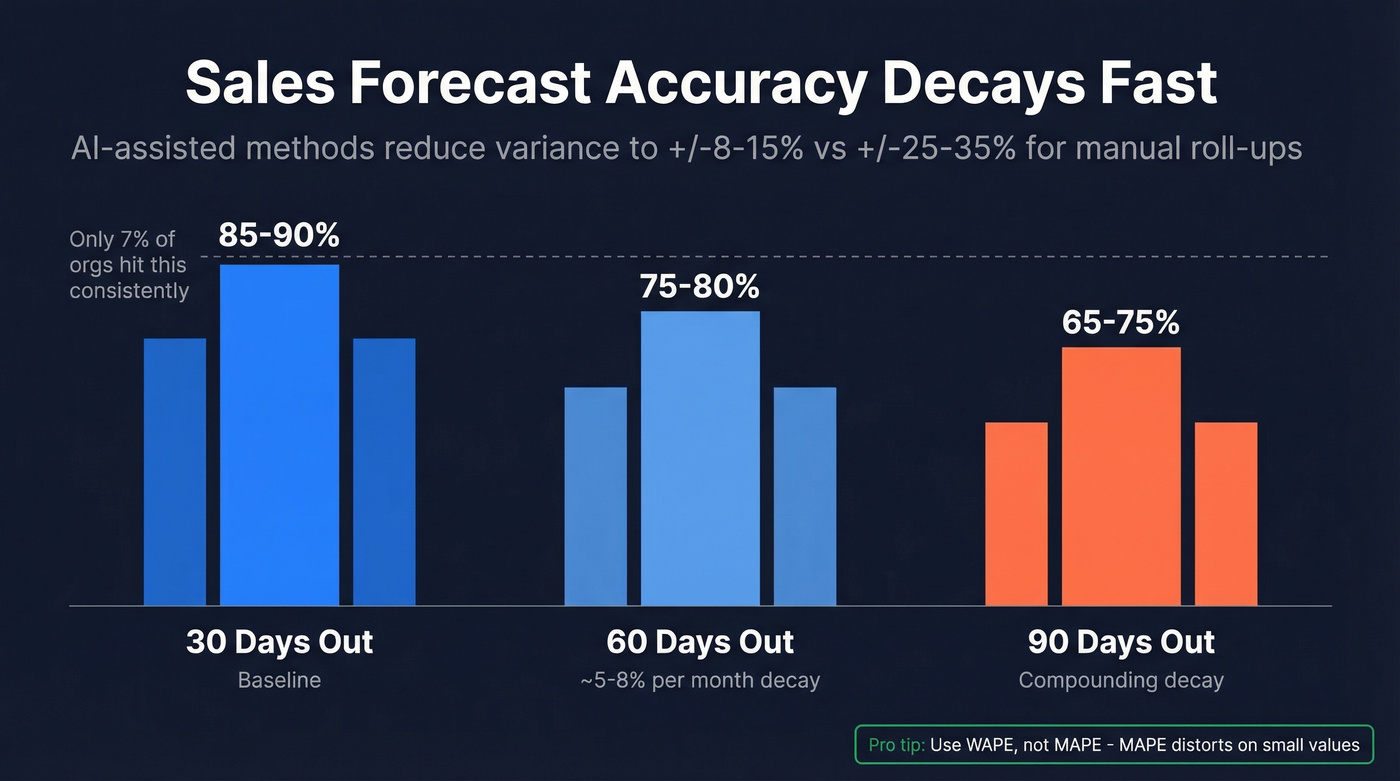
| Forecast Horizon | Realistic Accuracy | Decay Rate |
|---|---|---|
| 30 days out | 85-90% | Baseline |
| 60 days out | 75-80% | ~5-8%/month |
| 90 days out | 65-75% | Compounding |
AI-assisted methods typically reduce variance to +/-8-15%, compared to +/-25-35% for rep roll-ups. Revenue forecasting automation narrows that gap further when paired with clean activity data, but it's still a meaningful improvement - not the crystal ball vendors sell.
Here's the thing: don't use MAPE for sales forecasting. It distorts badly when actual values are small or zero, which happens constantly with individual deal forecasts. Use WAPE or WMAPE instead, and track forecast bias separately. Bias tells you direction; accuracy tells you magnitude.

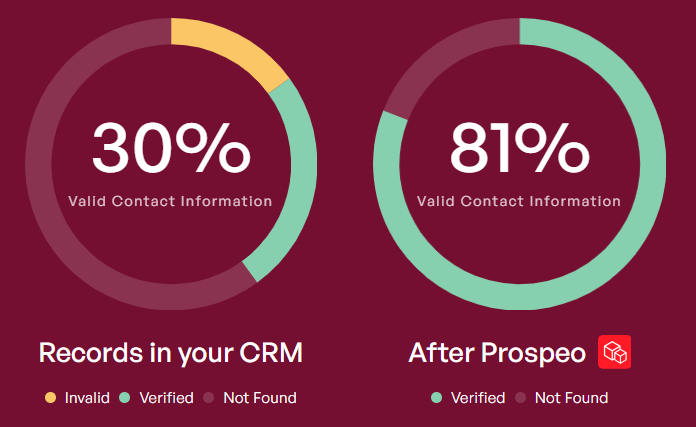
B2B data decays at 2.1% per month. Your forecasting model is training on contacts who've changed jobs, emails that bounce, and phone numbers that ring out. Prospeo's 7-day refresh cycle and 98% email accuracy keep your pipeline reflecting real, reachable buyers - so your AI forecast actually has something true to predict.
Fix the data under your forecast before you pay six figures for a better model.
Five Things That Break Forecasts
Finance just asked why you're paying $120K/year for Clari when your forecast was off by 22% last quarter. The answer probably isn't the tool.
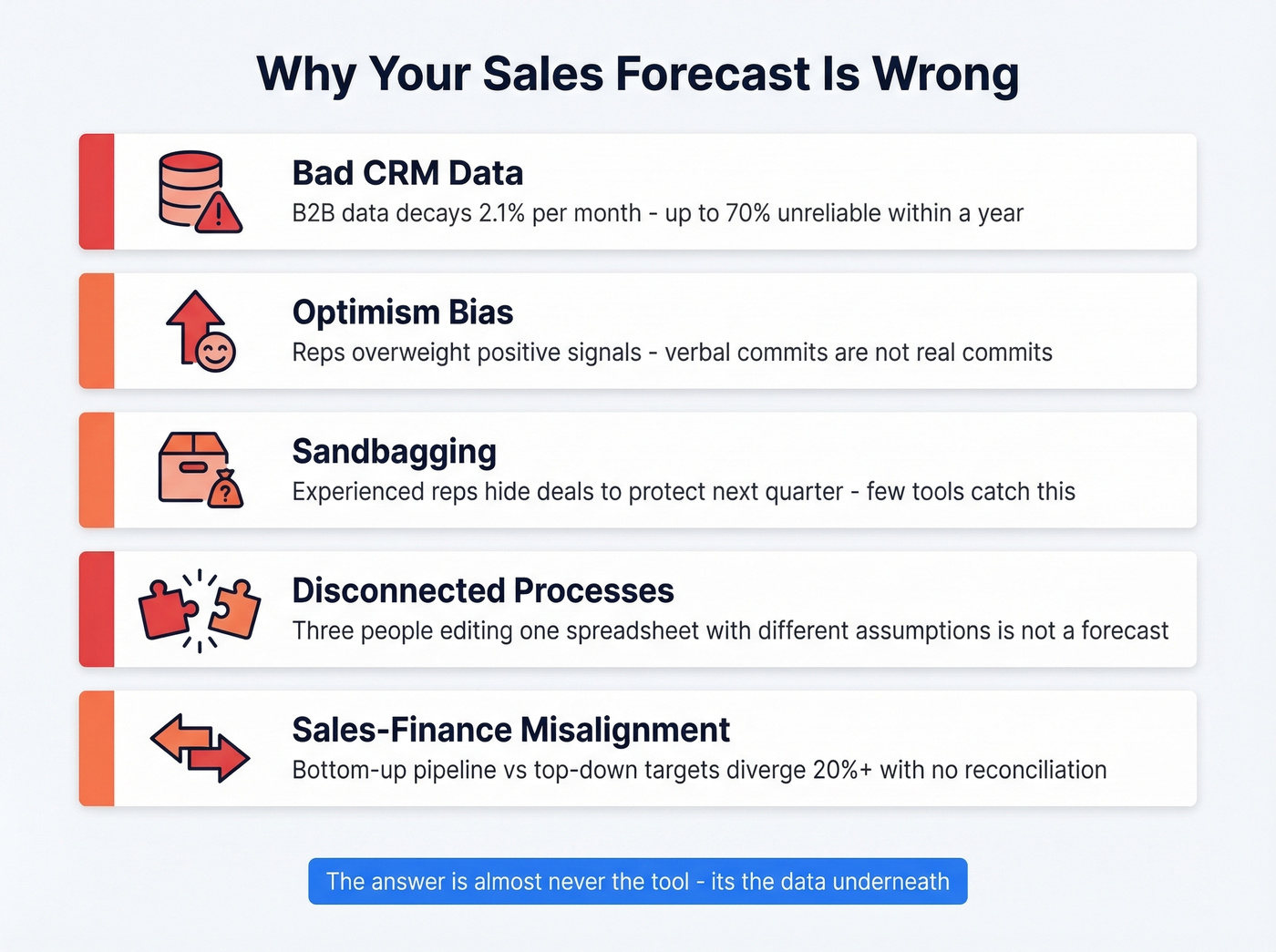
Bad CRM data. B2B contact data decays at 2.1% per month. Within a year, up to 70% of your database is unreliable. Your AI model is training on ghosts. Running your pipeline through an enrichment tool that verifies emails on a weekly refresh cycle - rather than the 6-week industry average - keeps your pipeline reflecting real, reachable buyers.
Optimism bias. Reps overweight positive signals. That "verbal commit" from a champion who hasn't looped in procurement isn't a commit.
Sandbagging. Experienced reps hide deals to protect next quarter's number. Every sales leader knows this happens, and very few forecasting tools account for it well.
Disconnected processes. If your forecast lives in a spreadsheet that three people edit with different assumptions, you have version control chaos, not a forecast.
Sales-finance misalignment. Sales forecasts bottom-up from pipeline. Finance forecasts top-down from targets. When these diverge by 20%+ and nobody reconciles, the board gets a number that satisfies neither. (If you need to align definitions internally, start with sales forecast vs sales goal.)
Forecasting Tools With Real Pricing
The category is consolidating fast. The Clari-Salesloft merger closed in December 2025 (~$450M ARR combined). Gartner published its first Magic Quadrant for Revenue Action Orchestration the same month.
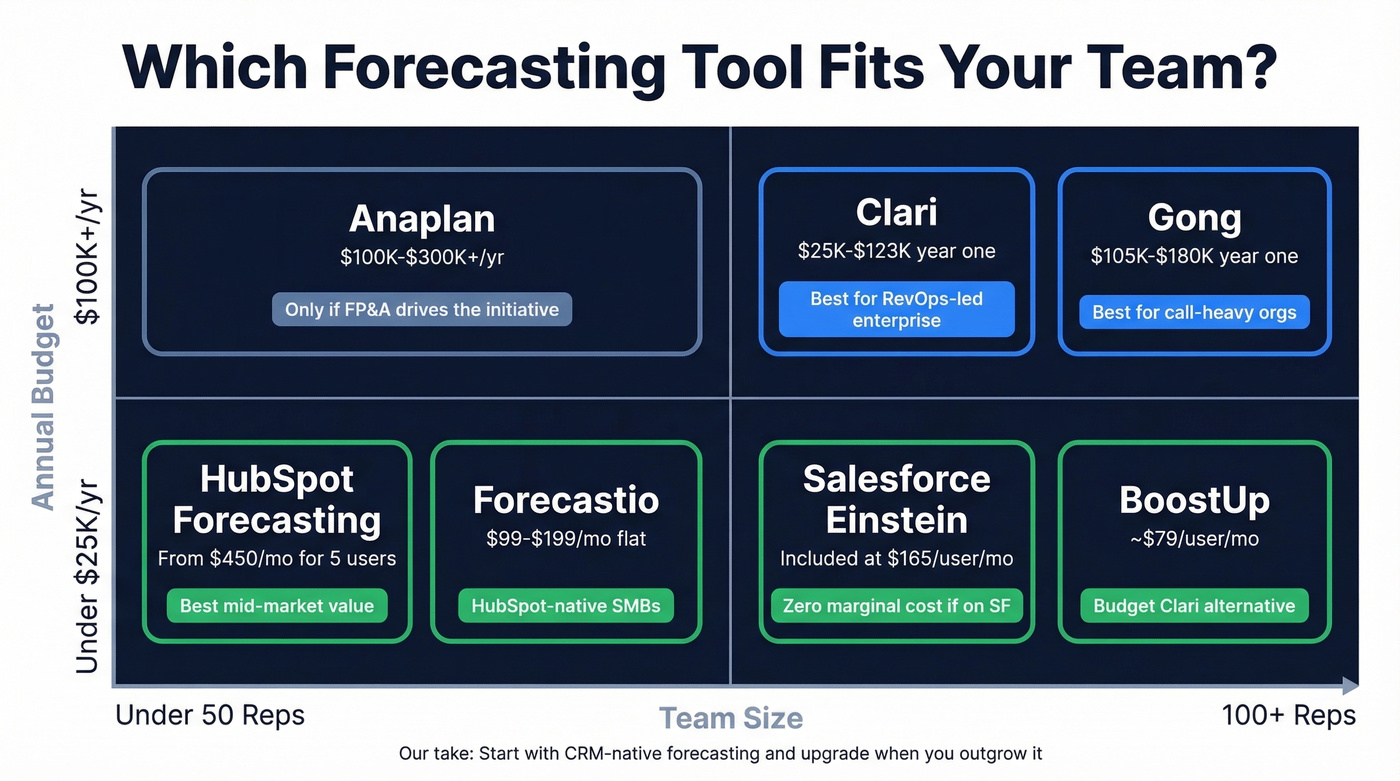
| Tool | Best For | Starting Price | CRM Integration | Forecasting Features |
|---|---|---|---|---|
| Clari | Enterprise RevOps | ~$200-400/user/mo | Salesforce, HubSpot | Pipeline + deal scoring + conversation AI |
| Gong | Call-heavy orgs | ~$1,298-3,000/user/yr | Salesforce, HubSpot | Pipeline + deal scoring + conversation AI |
| SF Einstein | Salesforce shops | Included at $165/user/mo | Native | Pipeline + deal scoring |
| HubSpot | Mid-market | From $20/user/mo; forecasting ~$450/mo (5 users) | Native | Pipeline + deal scoring |
| BoostUp | Budget-conscious | ~$79/user/mo | Salesforce, HubSpot | Pipeline + deal scoring |
| Forecastio | HubSpot SMBs | ~$99-199/mo | HubSpot | Pipeline scoring |
| Anaplan | Finance-led FP&A | $100K-300K+/yr | Via connectors | Pipeline + scenario modeling |

Clari
The default for enterprise revenue operations - and it earns that position. Core forecasting runs $100-$120/user/month. Add Copilot at $60-$100/user/month, professional services at $10K-$25K, and 10-15 hours/week of admin time. Realistic year-one for 10 users on Core: $25K-$40K. Full stack for 25 users: $78K-$123K. Expect 10-20% renewal increases.
We've seen Clari work best when RevOps owns the implementation end to end, rather than splitting it between sales ops and IT. For teams investing in forecasting infrastructure for the long haul, it remains the most complete standalone option.
Gong
Where Clari leads with pipeline visibility, Gong's edge is conversation intelligence. If your deals involve lots of recorded calls, Gong's forecasting draws on signals no spreadsheet captures - things like competitor mentions, pricing objections, and stakeholder sentiment shifts across a deal cycle.
A mandatory platform fee ($5K-$50K/year) layers on top of per-seat licensing ($1,360-$1,600/user/year for sub-50 seat teams). A 50-user deployment runs $105K-$180K in year one. Contracts lock you in for 2-3 years with 5-15% renewal uplift. Skip Gong if your team doesn't record calls consistently - you'd be paying for its strongest feature without feeding it data.
Salesforce Einstein & HubSpot
Already on Salesforce Enterprise at $165/user/month? Einstein forecasting is included. It's not as deep as Clari, but it's zero marginal cost and surprisingly decent for teams under 50 reps.
HubSpot Sales Hub starts from $20/user/month, with forecasting features kicking in around $450/month for 5 paid users. Same logic: good enough for mid-market, and you're already paying for the CRM. (If you're comparing stacks, see Salesforce pricing and examples of a CRM.)
Quick Mentions
BoostUp (~$79/user/month) is the budget Clari alternative with solid pipeline inspection. Forecastio targets HubSpot-native teams at ~$99-199/month flat. Anaplan ($100K-$300K+/year) is a finance-led planning platform - only relevant if FP&A drives the initiative.
Our Take
Let's be honest: Clari and Gong are excellent if you can justify $100K+ in year one. For teams under 50 reps, the ROI math rarely works. We've seen teams cut forecast error by 15%+ just by enforcing weekly CRM hygiene - before touching any AI tool. One r/sales thread described forecast error dropping from ~15% to 5% after revamping call scoring methodology. No new tool required.
Start with your CRM's native forecasting and upgrade when you've genuinely outgrown it. If you want a broader shortlist, compare sales forecasting solutions or best sales forecasting tools.
A Practical Implementation Workflow
Step 1: Audit and clean your data. Run your pipeline through Prospeo's enrichment API to flag stale contacts and fill missing fields before your forecasting model trains on them. With a 92% API match rate and 50+ data points returned per contact, you're patching the gaps that silently wreck predictions. Standardize opportunity fields using MEDDIC or BANT. No tool survives garbage data.
Step 2: Choose your approach. Teams under 50 reps should use embedded CRM AI. Teams over 100 reps with complex deal cycles should evaluate standalone platforms like Clari. The middle ground is genuinely hard; default to CRM-native and revisit quarterly.
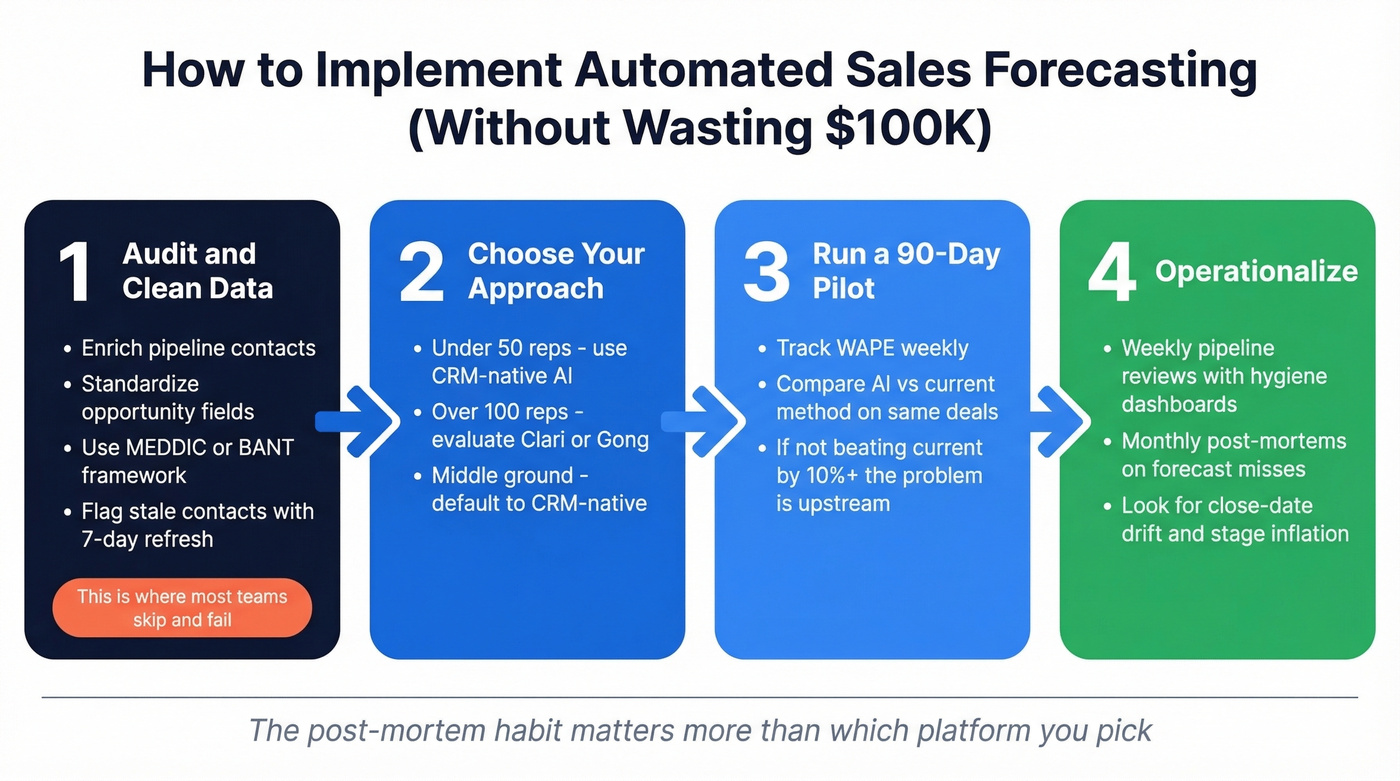
Step 3: Set a 90-day pilot. Track WAPE weekly. Compare AI-assisted forecasts against your existing method on the same deals. If the AI isn't beating your current approach by at least 10% on WAPE within 90 days, the problem is upstream - not in the tool.
Step 4: Operationalize. Weekly pipeline reviews with hygiene dashboards. Monthly post-mortems on forecast misses, not to assign blame, but to identify systemic patterns like close-date drift, stage inflation, and missing activity. In our experience, the post-mortem habit matters more than which platform you pick. (To tighten the operating cadence, use sales operations metrics and a simple pipeline health scorecard.)
Every stale contact in your CRM is a ghost deal inflating your forecast. Prospeo enriches your pipeline with 50+ verified data points per contact at a 92% match rate - for roughly $0.01 per email. That's the cheapest forecast accuracy improvement you'll ever make.
Stop forecasting on bad data. Enrich your CRM in minutes.
FAQ
How accurate is AI sales forecasting?
Expect 85-90% accuracy at 30 days, 75-80% at 60 days, and 65-75% at 90 days. Only 7% of organizations hit 90%+ consistently. Accuracy decays roughly 5-8% per month as you extend the horizon. Measure with WAPE, not MAPE - MAPE distorts badly on small or zero actuals.
How much does forecasting software cost?
Clari starts at $100-$120/user/month, with realistic year-one costs of $25K-$40K for 10 users. Gong runs $105K-$180K year-one for 50 users. HubSpot starts from $20/user/month with forecasting at ~$450/month for 5 users. Budget 40-60% above seat math for implementation, platform fees, and admin overhead.
What's the biggest reason sales forecasts fail?
Bad data - specifically, stale pipeline contacts. B2B contact data decays at 2.1% per month, making up to 70% of your database unreliable within a year. Fix data quality first, then invest in forecasting platforms. Weekly data refreshes make a bigger difference than a fancier algorithm.
Should I replace manual forecasting entirely?
Run automated and manual forecasts in parallel for at least one quarter before switching. This lets you benchmark the AI against your existing process, identify where the model outperforms human judgment, and build trust with reps and leadership before fully retiring spreadsheet-based roll-ups.