

Average Cost Per Lead by Industry: 2026 Benchmarks & How to Cut Yours
That $198.44 "average cost per lead" figure - originally from a 2017 HubSpot survey of 350+ companies - keeps getting recycled into "2026 benchmark" articles without a single update. Even HubSpot itself has published updated benchmarks and moved on.
The actual average cost per lead by industry varies so wildly that a single cross-industry number helps nobody make a real decision. One compiled 2026 cross-industry average is $213.60, but a blended figure that lumps eCommerce ($91) with Higher Education ($982) is a meaningless statistic dressed up as a benchmark.
If your average deal size is under $10K, you probably don't need to obsess over CPL at all. Track cost per qualified lead instead - it's the only number that connects marketing spend to revenue.
What Is Cost Per Lead?
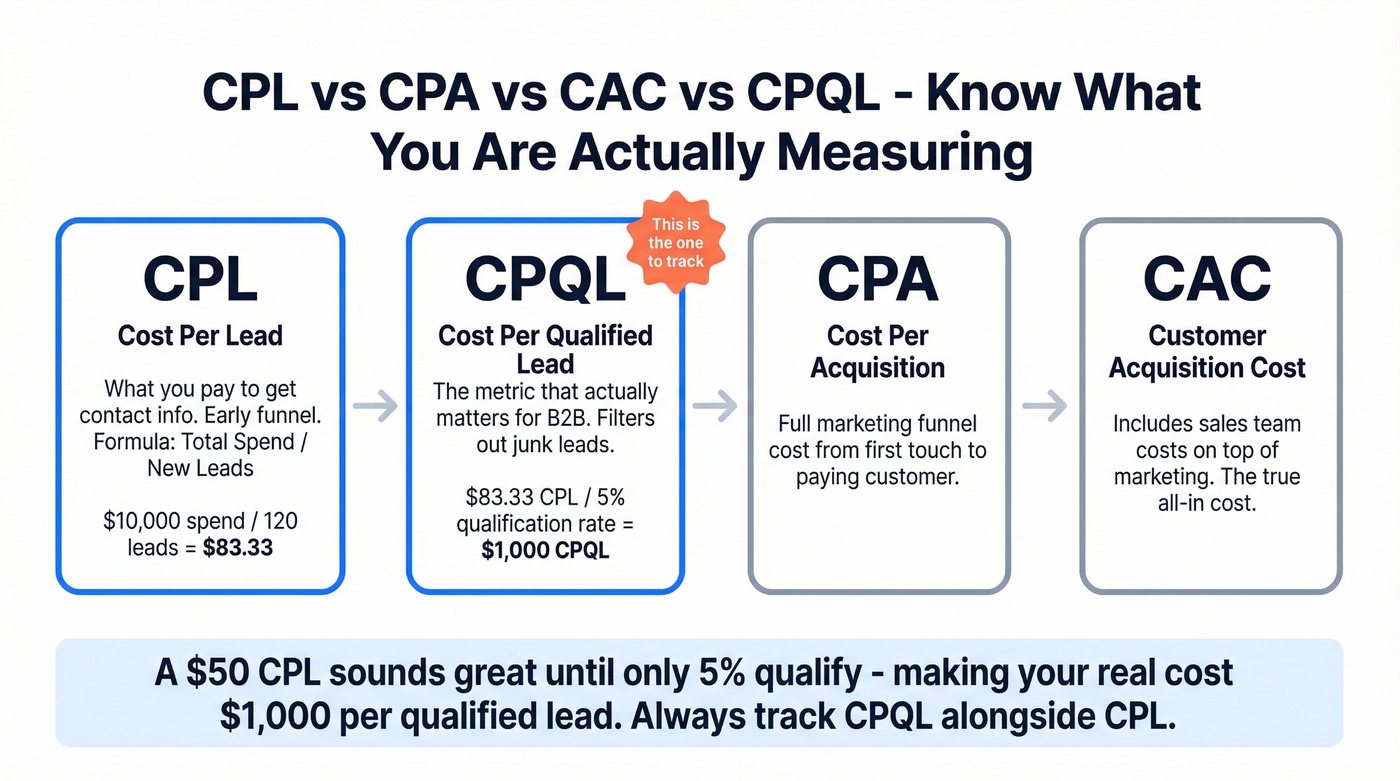
The formula is simple: Total Marketing Spend / New Leads = CPL. Spend $10,000 on Google Ads, generate 120 leads, and your CPL is $83.33.
First Page Sage defines a lead as "a direct connection via email, phone, or in-person introduction to a prospective customer" - more restrictive than "anyone who filled out a form," and that distinction matters when comparing benchmarks.
Three metrics get confused constantly. CPL measures early-funnel cost, what you pay to get someone's contact info. CPA (cost per acquisition) measures the full funnel, from first touch to paying customer. CAC (customer acquisition cost) includes sales costs and measures what it takes to turn leads into closed customers.
Here's the thing: none of these tell you much without qualification rates. A $50 CPL sounds great until you realize only 5% of those leads are sales-qualified, making your real cost per qualified lead (CPQL) $1,000. CPQL is the metric that actually matters for B2B, and we'll come back to it.
Your CPL calculation is only as accurate as your lead count. If a chunk of your "leads" have bad contact data - invalid emails, disconnected phones - you're paying for leads you can't even reach. Real-time email verification catches this before it compounds.
2026 CPL Benchmarks by Industry
First Page Sage's 2026 report - covering data collected from January 2022 through June 2025 - is one of the clearest benchmarks available because it defines "lead" explicitly and separates paid vs. organic vs. blended CPL.
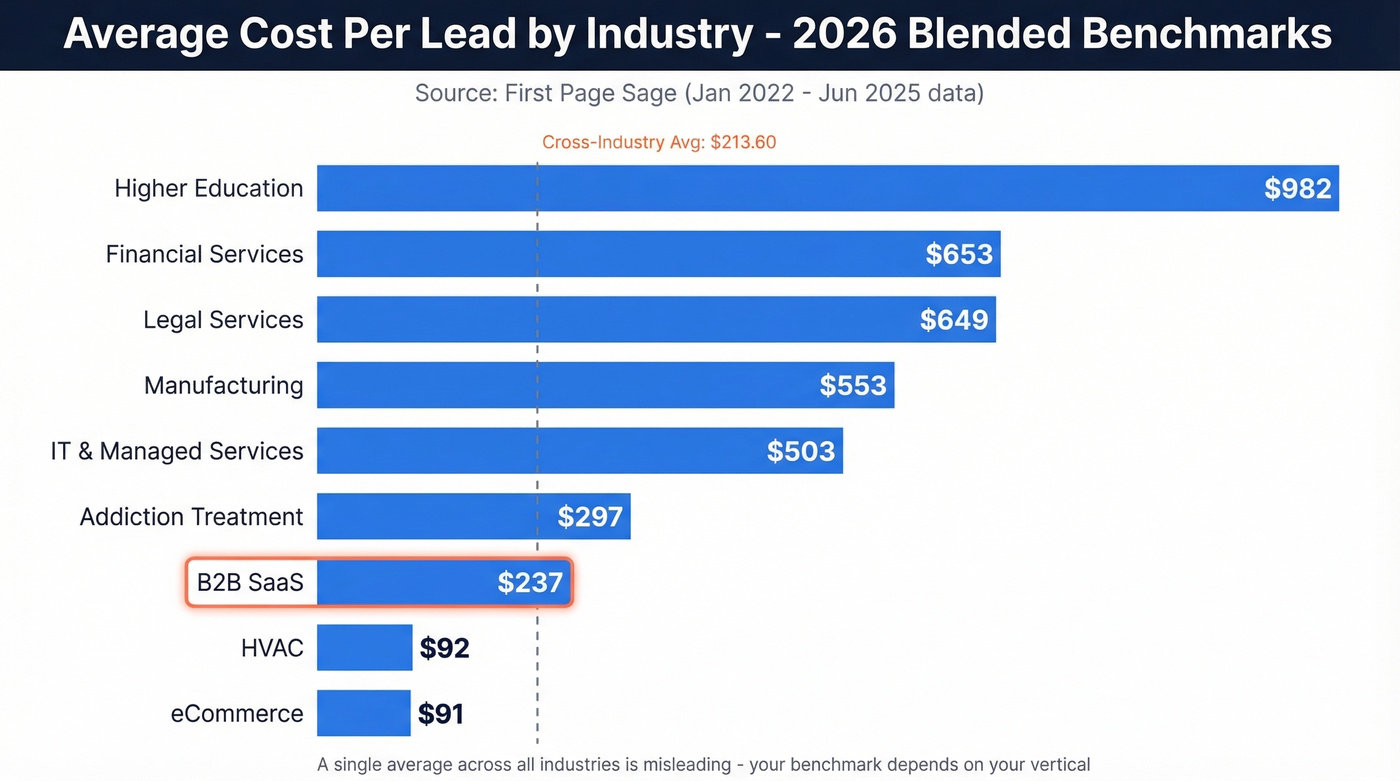
Below are the First Page Sage blended CPL benchmarks:
| Industry | Blended CPL (2026) |
|---|---|
| Higher Education | $982 |
| Financial Services | $653 |
| Legal Services | $649 |
| Manufacturing | $553 |
| IT & Managed Services | $503 |
| Addiction Treatment | $297 |
| B2B SaaS | $237 |
| HVAC | $92 |
| eCommerce | $91 |
Look at the extremes. eCommerce and HVAC sit under $100 blended because they're high-volume, transactional businesses with low buyer intent complexity. Legal and Financial Services push past $600 because the leads are high-value, the competition is fierce, and the sales cycles are long. Finance consistently ranks among the highest across every dataset we've reviewed, driven by strict compliance requirements and intense competition for high-net-worth prospects.
If you're in B2B SaaS at $237 blended, you're in the middle of the pack - but that number swings wildly depending on whether you're selling $5K ACV or $50K ACV deals. Technology companies see similar variance based on whether they're targeting SMBs with self-serve products or enterprise buyers with six-figure contracts.
CPL by Marketing Channel
Channel choice drives CPL more than almost any other variable.
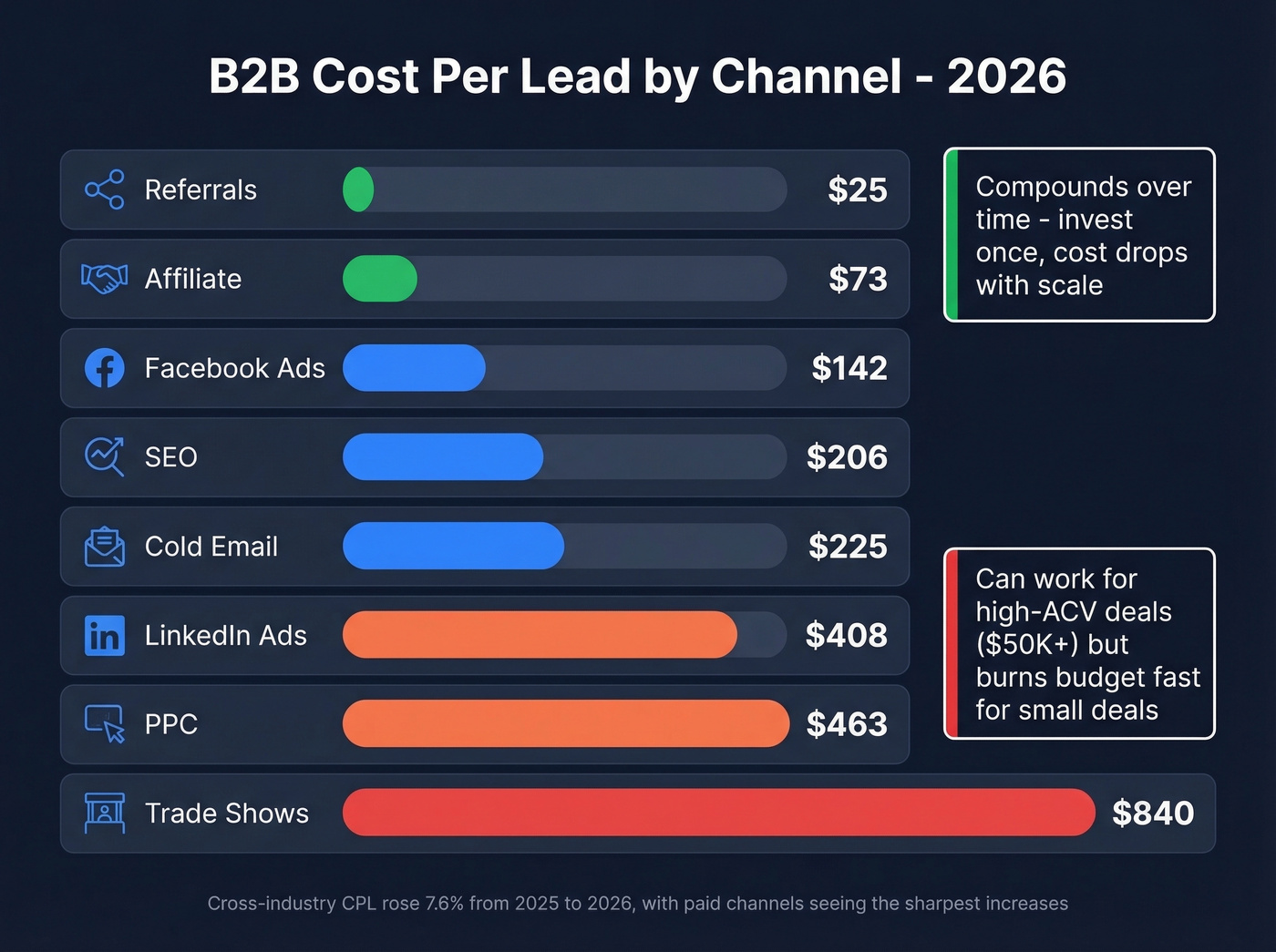
Here are Sopro's B2B channel benchmarks:
| Channel | Avg B2B CPL |
|---|---|
| Referrals | $25 |
| Affiliate | $73 |
| Paid Facebook advertising | $142 |
| SEO | $206 |
| Cold email | $225 |
| Paid LinkedIn advertising | $408 |
| PPC | $463 |
| Trade shows / in-person events | $840 |
Amra & Elma's compiled 2026 analysis also tracks year-over-year changes for common channels:
- Facebook Ads: $21.98 to $26.43 (+20.2%)
- Google Ads: $66.69 to $79.14 (+18.7%)
- SEO & retargeting: $31.00 to $36.80 (+18.7%)
- Events/trade shows: $811 to $934 (+15.2%)
The cheapest channels - referrals, SEO, email - compound over time. You invest upfront and the marginal cost per lead drops as your content library and referral network grow. The most expensive channels can absolutely be worth it for high-ACV deals where a single closed-won customer covers hundreds of leads. A $408 LinkedIn lead that converts into a $120K contract is a bargain. A $408 LinkedIn lead for a $3K product? Disaster.
Cross-industry CPL climbed 7.6% from 2025 to 2026 in that compiled dataset, with paid social and search showing some of the sharpest increases.
Google Ads CPL by Industry
LocaliQ analyzed 16,000+ campaigns running from April 2024 through March 2025. The overall search ads CPL came in at $70.11, but the industry spread is enormous:
| Industry | Search Ads CPL |
|---|---|
| Attorneys & Legal | $131.63 |
| Real Estate | $100.48 |
| Home & Home Improvement | $90.92 |
| Education & Instruction | $90.02 |
| Dentists & Dental | $83.93 |
| Finance & Insurance | $81.25 |
| Travel | $73.70 |
| Health & Fitness | $57.40 |
| Shopping & Retail | $46.18 |
| Sports & Recreation | $42.90 |
| Animals & Pets | $31.82 |
| Arts & Entertainment | $30.27 |
| Automotive Repair | $28.50 |
Year-over-year search CPL increases averaged about 5%, with 13 of 23 industries seeing increases. That's milder than the prior year's ~25% average jump, but the trend is still upward.
Real talk: broad matching and loose query expansion can be a hidden CPL killer. Practitioners on r/PPC have documented CPL jumps of 30-50% when ads start showing on low-intent informational queries. If you aren't aggressively managing negative keywords, you'll burn budget on traffic that was never going to convert.

Bad contact data inflates your real CPL. If 20% of your leads have invalid emails, you're paying 20% more per reachable lead - and torching your domain reputation. Prospeo's 5-step verification delivers 98% email accuracy at ~$0.01 per email, so every dollar you spend on lead gen actually connects to a real person.
Stop paying for leads you can't reach. Verify before you send.
Facebook & LinkedIn CPL
Facebook/Meta Ads
Facebook Lead Ads average $28-$42 per lead in 2026, making them one of the more affordable paid channels.
| Industry | Facebook CPL |
|---|---|
| Restaurants & Food | $3.16 |
| Real Estate | $16.61 |
| E-commerce | $17.50 |
| Home Services | $41.26 |
| Attorneys & Legal | $62.50 |
| B2B/SaaS | $63.40 |
Ad format matters more than most teams realize. Instant Forms cost $34.10 on average - the baseline. Single image ads run 13% higher, carousel 22% higher, and video 34% higher. Funnel stage matters even more: BOFU campaigns average $33.15 per lead versus $51.40 for TOFU - 35% cheaper. Q4 CPL runs 25-40% higher than Q1 thanks to holiday ad competition, so time your campaigns accordingly.
LinkedIn Ads
LinkedIn is expensive, and I'd argue it's worth it for fewer teams than the platform's sales reps would have you believe. The range runs $15 to $350+, and Sopro's B2B average lands at $408.
Regional differences are stark, based on $1M in analyzed spend over six months:
| Region | Avg CPL |
|---|---|
| NAMER | $230 |
| EMEA | $120 |
| APAC | $80 |
| LATAM | $60 |
LinkedIn's CPL is justified when you're selling six-figure deals to senior buyers. For teams with smaller deal sizes, the math rarely works unless your targeting is surgical.
How to Cut Your CPL
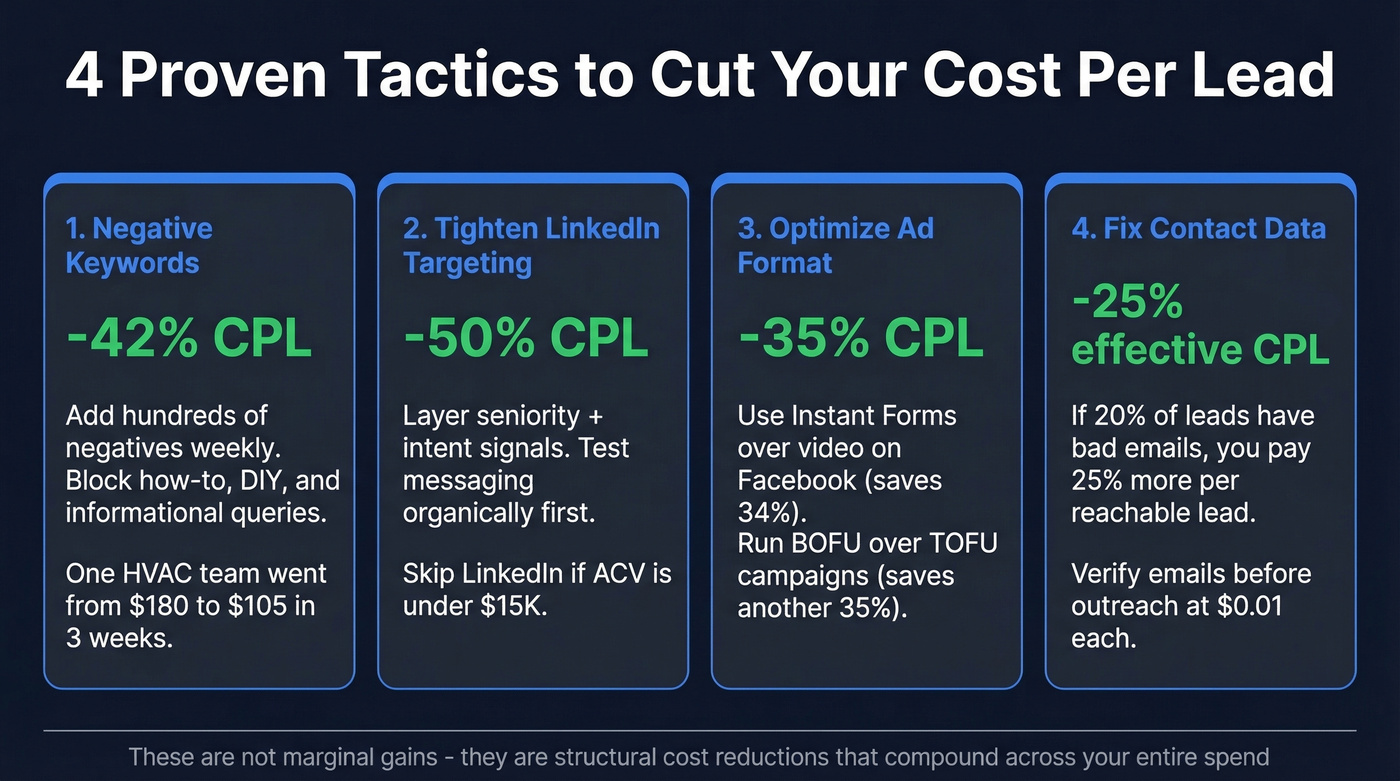
Benchmarks are useful for context, but the real question is how to push your number down. These four tactics consistently deliver measurable results.
Negative keywords, aggressively
An HVAC practitioner on Reddit shared a case study worth memorizing: spending $15K/month on Google Ads, CPL had crept to $180. After adding hundreds of negative keywords - "how to," "why does," "best way to," "DIY" - and updating the list weekly, CPL dropped to $105 in about three weeks. That's a 42% reduction from keyword hygiene alone.
Tighten LinkedIn targeting
One B2B marketer cut LinkedIn CPL by over 50% by layering seniority filters with buyer intent signals, testing messaging organically before spending on paid, retargeting engaged non-converters, and restructuring offers beyond the generic "book a demo." Skip LinkedIn entirely if your ACV is under $15K - the economics just don't support it.
Optimize ad format and funnel stage
On Facebook, switching from video to Instant Forms saves 34% per lead. Running BOFU campaigns instead of TOFU saves another 35%. These aren't marginal gains - they're structural cost reductions that compound across your entire spend.
Fix your contact data
This is the lever most teams ignore, and in our experience it's the fastest win available. If 20% of your leads have invalid emails or disconnected phone numbers, you're effectively paying 25% more per reachable lead than your dashboard shows. Every bounced email is a lead you paid for but can't reach. Healthcare teams are especially sensitive to this - strict regulations mean every wasted outreach attempt carries compliance risk on top of the financial loss.
We've seen teams using Prospeo's email verification cut their bounce rates from 35% to under 4%, which immediately drops their effective CPL. At roughly $0.01 per verified email, verification costs a fraction of a single wasted ad click. If you want to go deeper on bounce mechanics, see email bounce rate and the full email deliverability stack.
LinkedIn ads at $408/lead only make sense if those leads convert. Teams using Prospeo book 35% more meetings than Apollo users - not by spending more, but by reaching verified buyers with direct dials. 125M+ verified mobiles with a 30% pickup rate turn expensive leads into actual conversations.
Lower your cost per qualified lead by reaching the right people the first time.
CPL by Company Size
Bigger companies pay more per lead. The data is consistent on this, and the reasons are structural rather than inefficiency.
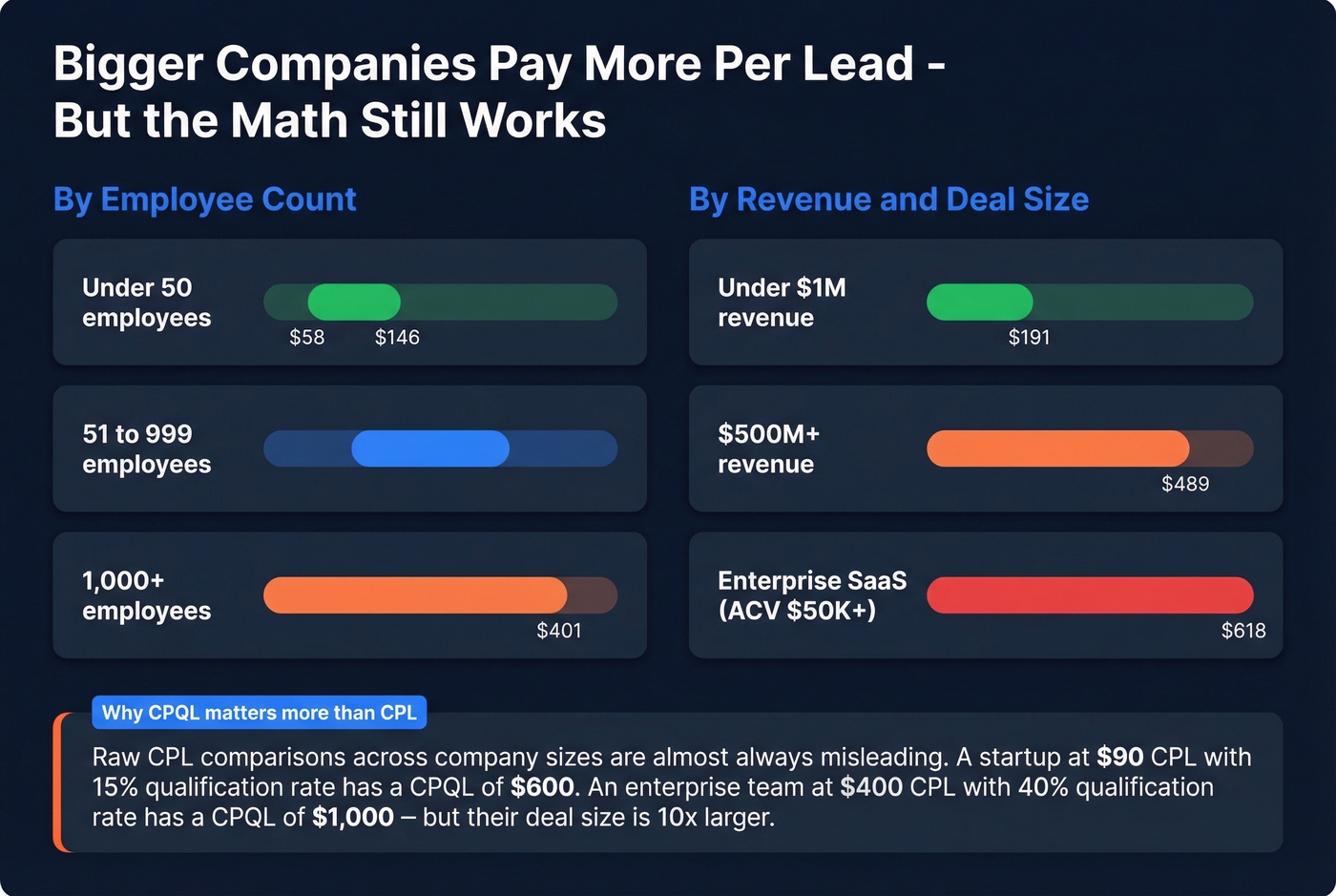
| Segment | Avg CPL |
|---|---|
| Under 50 employees | $58 - $146 |
| 1,000+ employees | $401 |
| Under $1M revenue | $191 |
| $500M+ revenue | $489 |
| Enterprise SaaS (ACV $50K+) | $618 |
The direction is clear: larger companies pay more because they're targeting larger deals, competing in more saturated channels, and running longer sales cycles that require more touches per conversion. An enterprise SaaS company averaging $618 per lead isn't overspending - they're playing a different game where a single deal can be worth $500K+.
This is also where the CPL-versus-CPQL distinction becomes critical. A startup spending $90 per lead with a 15% qualification rate has a CPQL of $600. An enterprise team spending $400 per lead with a 40% qualification rate has a CPQL of $1,000 - but their average deal size is 10x larger. Raw CPL comparisons across company sizes are almost always misleading.
Why CPL Benchmarks Conflict
You'll find Legal Services listed at $131 on one page, $649 on another, and $784 on a third. None of them are wrong - they're measuring different things.
The discrepancies come from lead definitions (MQL vs. any form fill), channel mixes (blended vs. paid-only vs. organic-only), time windows, B2B vs. B2C mix within the same industry label, and company size skew. That $198.44 figure appears everywhere because it's easy to copy from a dated survey - not because it reflects 2026 reality.
Let's be honest about benchmarks: they're directional, not prescriptive. The practical move is to benchmark against your own historical data first, use industry ranges for context, and if you're in B2B, stop obsessing over CPL and start tracking CPQL. A $300 lead that converts at 20% is cheaper than a $50 lead that converts at 2%. If you need a tighter system, build around lead generation metrics and a consistent lead scoring model.
FAQ
What is a good cost per lead?
It depends entirely on your vertical and deal size. B2B SaaS averages $237 blended, eCommerce averages $91. A useful rule: your customer lifetime value should be at least 3x your fully loaded customer acquisition cost, which includes CPL plus sales costs.
How do I calculate CPL?
Divide total marketing spend by the number of leads generated. $10,000 spent on Google Ads producing 120 leads equals an $83.33 CPL. Include all channel costs - ad spend, agency fees, tool subscriptions - for an accurate figure.
Why is my CPL increasing?
The most common culprit is broad match expansion pulling in low-intent queries - check your search terms report first. Other drivers include Q4 seasonal spikes (25-40% higher), LinkedIn audience expansion defaults, and the overall 5% YoY rise in search ad CPLs documented by LocaliQ.
How does bad data inflate CPL?
If 20% of your leads have invalid emails or wrong phone numbers, your effective cost per reachable lead is 25% higher than your dashboard shows. Real-time verification at $0.01 per email eliminates this hidden cost before it compounds across your pipeline.
What's the difference between CPL and CAC?
CPL measures the cost to generate a single lead at the top of the funnel. CAC includes every downstream expense - sales salaries, tools, onboarding - required to convert that lead into a paying customer. CAC is always higher and is the better metric for profitability analysis.