

B2B Audience Research: The Practitioner's Playbook
Customer acquisition costs have risen roughly 60% over five years. Buying committees now run 7 to 20 people deep. And businesses lose 30%+ of revenue annually to bad data.
If your B2B audience research isn't sharp, you're burning budget on the wrong accounts, the wrong personas, and the wrong messages.
Here's the take most guides dance around: the biggest research failures aren't methodology problems. They're data problems. Fix your data first. Everything else follows.
What You Need (Quick Version)
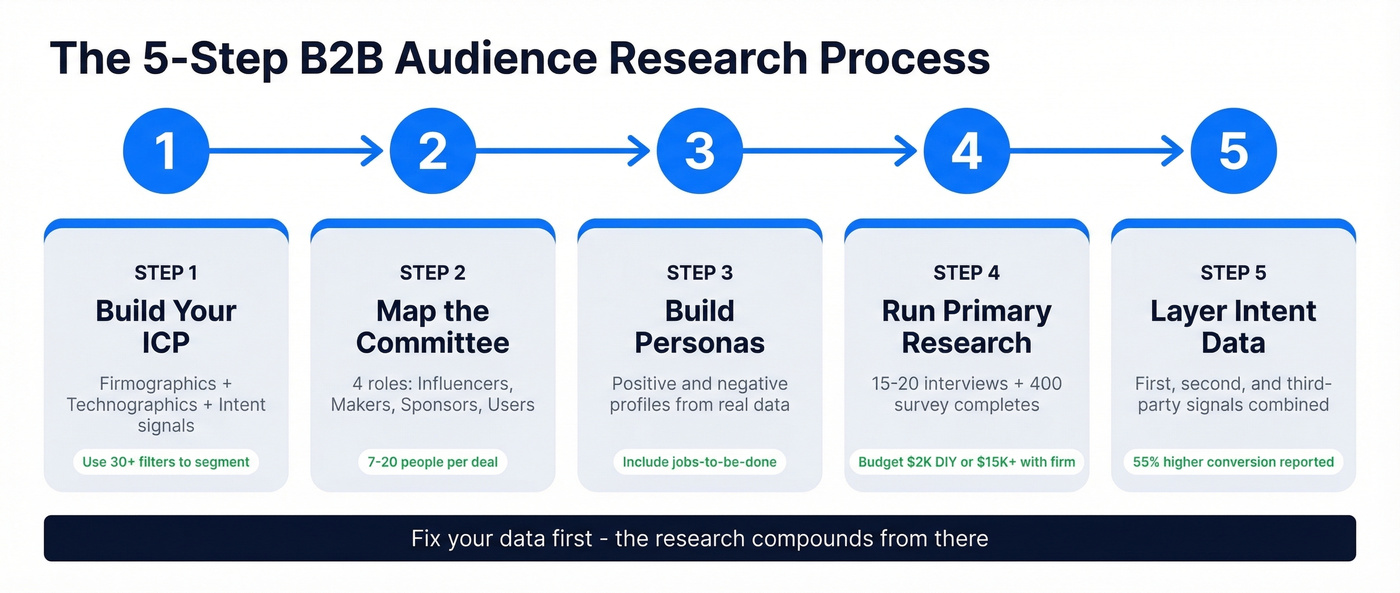
- Define your ICP using firmographics, technographics, and intent signals before committing research dollars.
- Run 15-20 customer interviews and one quantitative survey targeting 400 completes.
- Layer in intent data only after you've validated segments with primary research.
Total cost for a lean team: under $2K if you DIY recruiting. $15K+ with a recruiting firm - expect $490-$590 per participant for qual interviews.
The 5-Step Research Process
Step 1: Build Your ICP
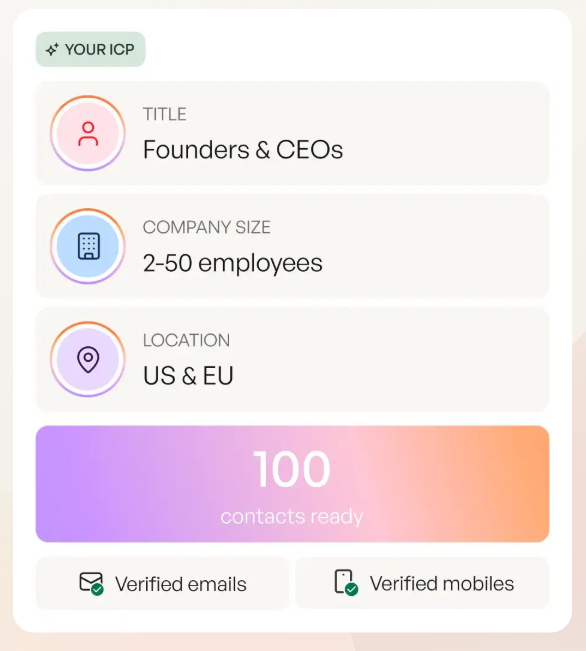
Start with firmographics - industry, headcount, revenue. Layer in technographics: what tools do they already use? Then add intent signals to find companies actively researching your category right now.
Prospeo's 30+ search filters cover buyer intent, job changes, and headcount growth on a 7-day refresh cycle, which makes it a strong starting point for building segments before you spend $490-$590 per participant on interviews.
Step 2: Map the Buying Committee
B2B buying committees average 7 to 20 individuals. Map them into four roles: purchase influencers, decision-makers, decision sponsors, and end users. Each role carries different pain points, evaluation criteria, and objections - and your research plan needs to cover all four, not just the person who signs the contract.
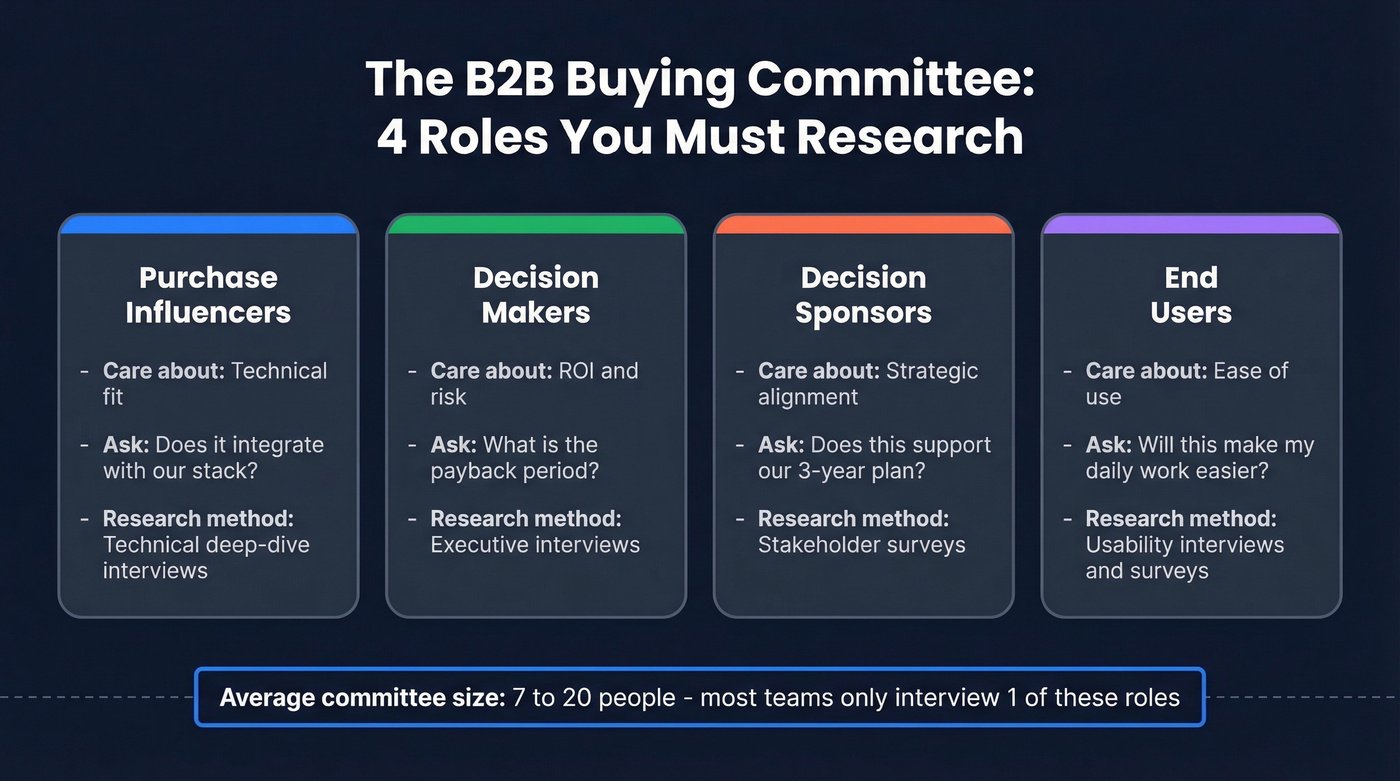
Let's be honest: most teams only interview the economic buyer and call it a day. That's how you end up with messaging that resonates in the boardroom but falls flat with the people actually evaluating your product.
Step 3: Build Buyer Personas
Go beyond demographics. A useful B2B persona includes firmographics, KPIs, challenges, decision criteria, buying triggers, committee role, and jobs-to-be-done - the specific outcome the buyer is hiring your product for. Synthesize interview transcripts, CRM data, and behavioral signals into profiles that actually predict buying behavior, not just describe it.
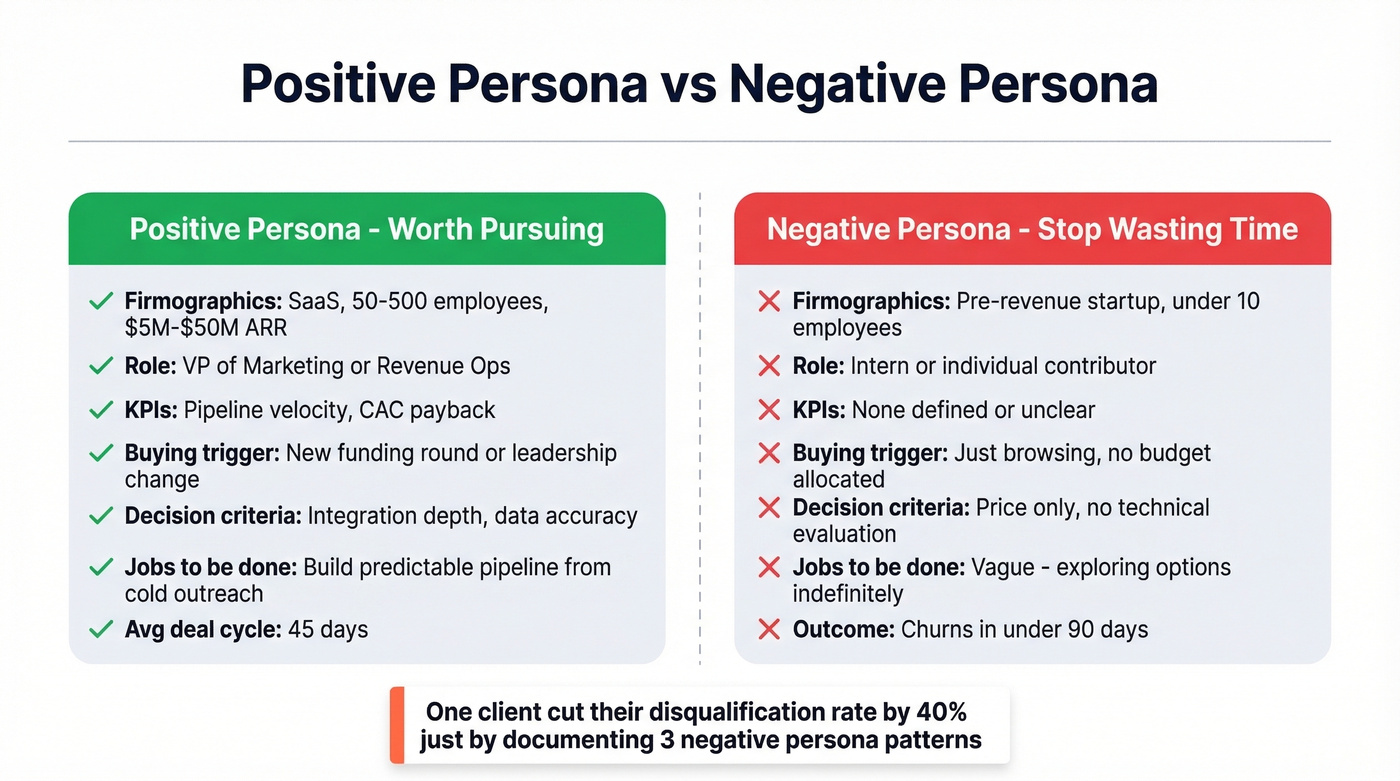
Just as important: build negative personas. These are profiles that look like your ICP but never convert - tire-kickers, wrong-seniority contacts, companies that churn in 90 days. In our experience, negative personas save more pipeline than positive ones. We had one client who cut their disqualification rate by 40% just by documenting three negative persona patterns from their lost-deal data.
Step 4: Run Primary Research
Secondary data only gets you so far. You need direct conversations and survey data. Plan for roughly 400 completed responses to hit ±5% margin of error at 95% confidence.
Budget your outreach based on realistic response rates:
| Channel | Avg Response Rate |
|---|---|
| Face-to-face | 57% |
| SMS | 40-50% |
| 15-25% | |
| In-app/web | 20-30% |
| Phone | 18% |
Source: SurveySparrow benchmarks
For senior B2B participants, non-cash incentives like benchmarking data or early report access often outperform gift cards. Surveys for B2B audiences work best when they're short, role-specific, and tied to a clear value exchange - generic 30-question blasts get ignored. If you need a question bank, ContentLift's 184 B2B interview questions is a solid starting point.
Step 5: Layer in Intent Data
Intent data tells you which companies are actively researching your category. Three tiers exist, and they aren't interchangeable.
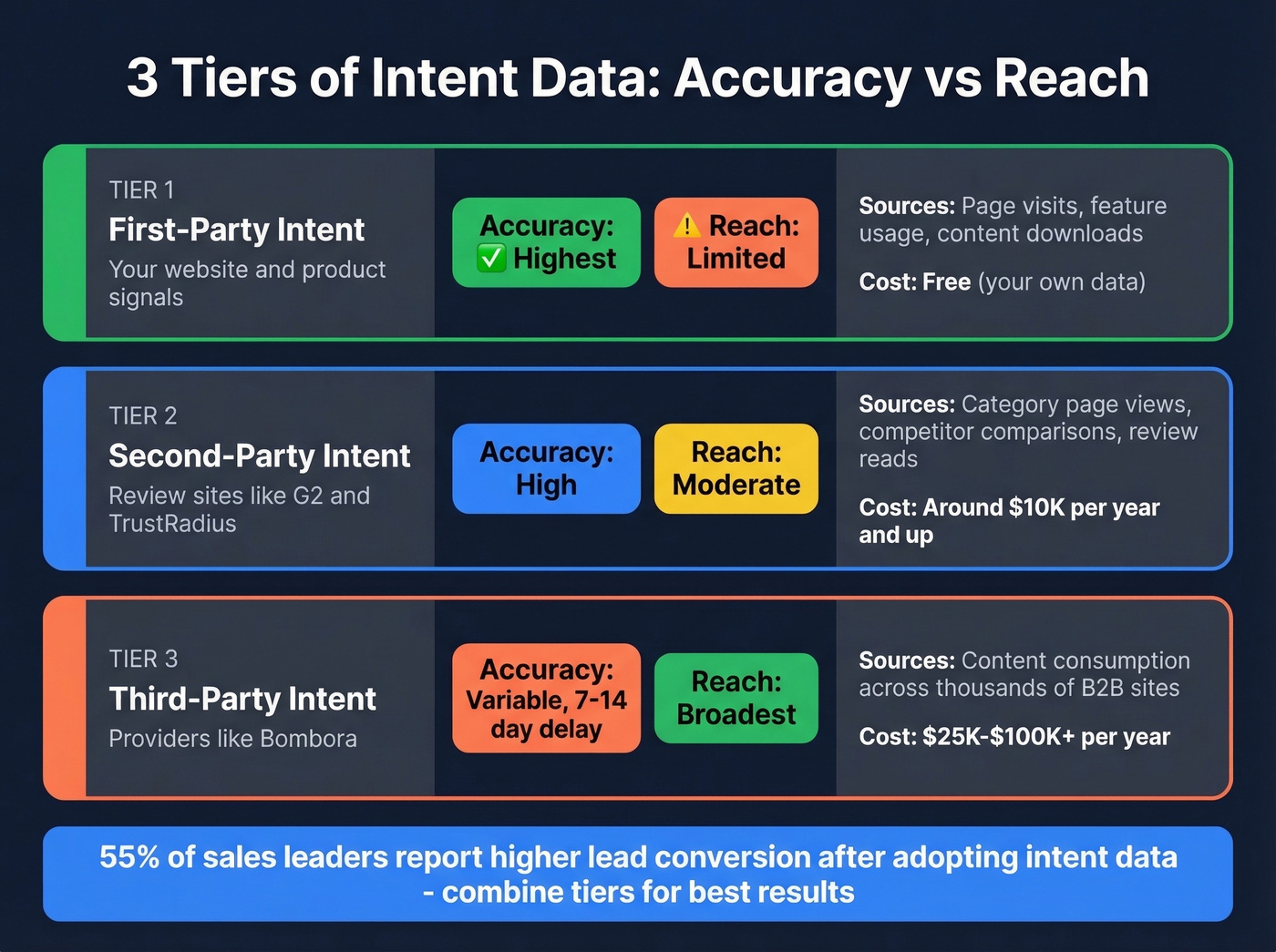
First-party intent from your own website and product signals offers the highest accuracy but limited reach. Second-party intent from review sites like G2 and TrustRadius captures in-market buyers you wouldn't otherwise see. Third-party intent from providers like Bombora offers broad reach but can carry 7-14 day delays.
Third-party intent runs $25K-$100K+/year. The payoff? 55% of sales leaders report higher lead conversion after adopting it. Combine third-party with your first-party signals for the strongest demand generation layer.

You just read that bad data costs businesses 30%+ of revenue annually. Prospeo's 5-step verification delivers 98% email accuracy on 300M+ profiles - refreshed every 7 days, not every 6 weeks. Build research-ready segments with 30+ filters including buyer intent, technographics, and headcount growth.
Stop burning research budget on stale contacts. Start with verified data.
Tools Worth Using
| Category | Tool | Best For | Starting Price |
|---|---|---|---|
| B2B Data | Prospeo | Verified segments, 98% email accuracy, 7-day refresh | Free (75 emails/mo) |
| Survey | SurveyMonkey | Quant surveys at scale | Free; ~$25/mo paid |
| Survey | Typeform | High-completion surveys | Free; ~$25/mo paid |
| Audience Intel | SparkToro | Digital footprint + influencer data | Free; paid from ~$50/mo |
| Social Listening | Brandwatch | Sentiment + social signals | ~$800+/mo |
| Intent Data | Bombora | 3rd-party intent, broadest topic coverage | ~$25K/yr+ |
| Intent Data | G2 Buyer Intent | 2nd-party in-market buyers | ~$10K/yr+ |
Skip Brandwatch if you're a team under 50 people - the price-to-insight ratio doesn't make sense until you're tracking multiple product lines or geographies.
7 Mistakes That Kill Results
1. Only surveying existing customers. You'll confirm what you already know. Allocate 30%+ of interviews to churned accounts, lost deals, and prospects who never engaged.
2. Using B2C panels for niche B2B roles. The consensus on r/UXResearch is that general panels don't cut it for targets like "logistics managers in retail." Recruit directly from your CRM or use specialized B2B firms.
3. Bad survey design. Keep open-ended questions at 10% or less of your total. Front-load closed-ended questions, save open-ended for the end.
4. Too-small samples. Fifteen survey responses don't tell you anything statistically valid. Target 400 completes for quantitative work. Anything less and you're making strategy decisions on noise.
5. Treating research as one-off. Markets shift. Buying committees change. Refresh your segmentation quarterly, or at minimum twice a year.
6. Ignoring data quality. That 30% revenue loss to bad data starts here - stale contacts, wrong titles, dead emails. We've seen teams waste entire quarters on account-based campaigns built on firmographics that were accurate two years ago. It's infuriating to watch, and it's entirely preventable.

7. Skipping the buying committee. Researching only the economic buyer misses the 6-19 other people who influence the deal. Map all four role categories before you design a single interview guide.
Start With the Data
Most B2B audience research guides tell you to start with frameworks. I'd argue the opposite: fix your data first. The most elegant persona framework is useless if you're building it on unverified contacts and firmographics from 2024. Clean, current data is the foundation - the customer journey mapping, the segmentation, the persona work all compound from there. If you're building outbound lists alongside research, use a repeatable lead generation workflow and keep your CRM clean with data enrichment.
Mapping a 7-to-20-person buying committee means nothing if half your contact data bounces. Prospeo gives you verified emails at $0.01 each and 125M+ direct dials - so your audience research actually reaches the right people across every committee role.
Reach every buyer on the committee, not just the one who signs.