

B2B Buyer Personas: The Practitioner's Guide to Building Ones That Don't Collect Dust
"Buyer personas are dead." You'll hear this from the same people who built a persona called "Marketing Mary," gave her two kids and a golden retriever, and then wondered why sales never opened the document. Lazy personas deserve to die. Evidence-based B2B buyer personas still drive pipeline.
As one r/b2bmarketing poster put it, personas built without talking to actual customers are "fairytale" documents that collect dust. The debate isn't whether personas work - it's whether yours are built on interviews and CRM data, or on a brainstorming session with sticky notes and wishful thinking.
Already know what a persona is? Start with CRM win/loss data and 8-12 customer interviews. Limit yourself to 2-3 personas mapped to buying committee roles. Include buying triggers and decision criteria, not hobbies. Wire the persona into your CRM and outbound sequences the day you finish it.
What a Buyer Persona Is (and Isn't)
A buyer persona is a semi-fictional representation of a specific decision-maker or influencer within your target accounts, built from real data - interviews, CRM patterns, and behavioral signals. It describes a person. Not a company, not a market segment.
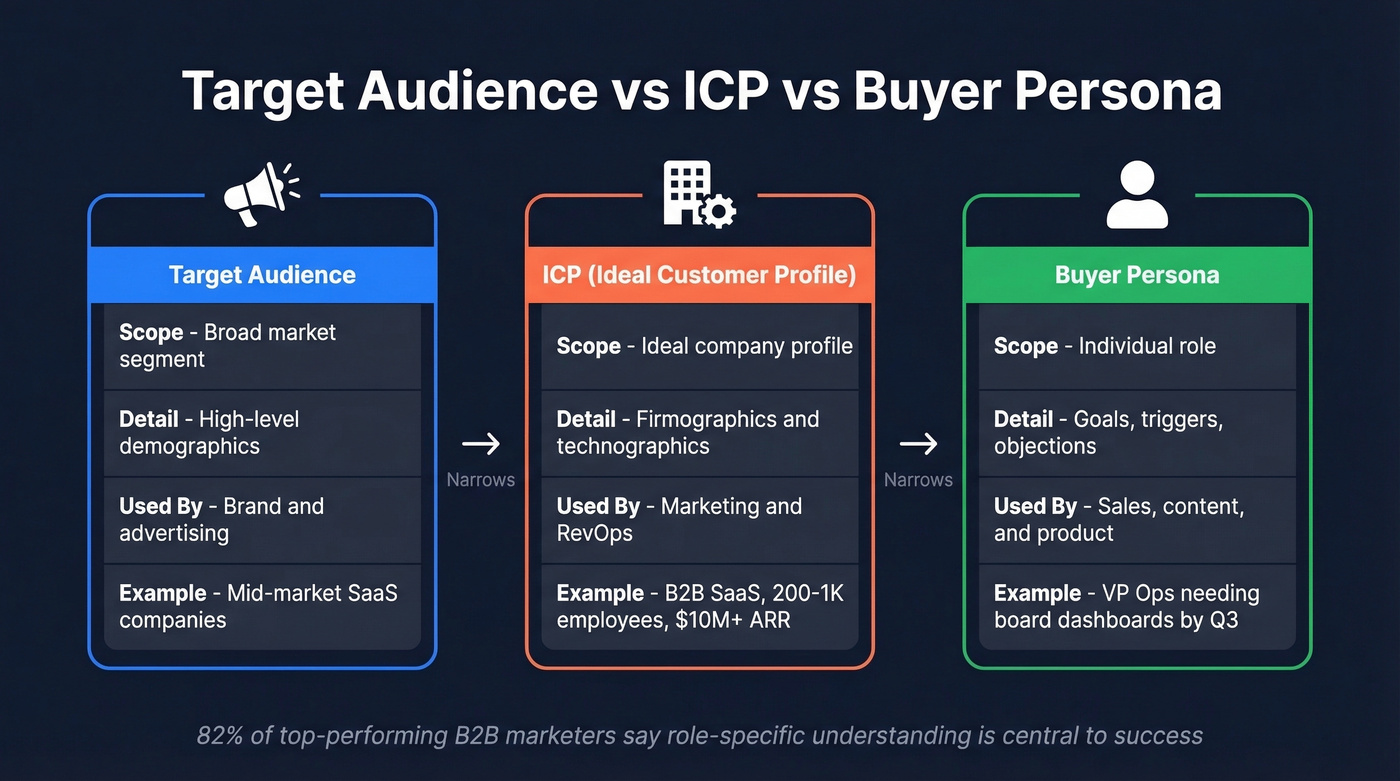
Three terms get used interchangeably, and they shouldn't.
| Target Audience | ICP | Buyer Persona | |
|---|---|---|---|
| Scope | Broad market segment | Ideal company profile | Individual role |
| Detail | High-level demographics | Firmographics + technographics | Goals, triggers, objections |
| Who uses it | Brand/advertising | Marketing + RevOps | Sales + content + product |
| Example | "Mid-market SaaS" | "B2B SaaS, 200-1K employees, $10M+ ARR" | "VP Ops needing board dashboards by Q3" |
82% of top-performing B2B marketers say understanding their audience at a detailed, role-specific level is central to success. That's the persona layer.
Why B2B Personas Differ From B2C
B2C personas can often get away with demographics and psychographics. B2B usually can't, because you're not selling to a person - you're selling to a committee.
"The typical buying group involves six to ten decision-makers, each armed with four or five pieces of information they've gathered independently and must deconflict with the group." - Gartner
Tape that quote to your monitor. It means your persona isn't just "who buys." It's "who influences, who blocks, who champions, and who signs."
The buying environment has shifted in ways that make personas more important, not less. 96% of prospects research companies before engaging with a sales rep. 71% prefer independent research over talking to one. 94% of buyers now use LLMs during their buying process, the average sales cycle runs 10.1 months, and 86% of B2B purchases stall - often because the buying committee can't align internally. And 81% of buyers end up dissatisfied with the provider they chose, a clear signal that sellers aren't matching buyer needs.
This is why personas built around "pain points and demographics" fail. You need to map decision criteria, internal politics, and the information each role gathers independently. HubSpot found that persona-driven messaging changes lifted conversion rates by 40% in one campaign test. Not because they knew the buyer's favorite podcast - because they understood the buyer's decision criteria.
Here's the thing: most B2B teams don't have a persona problem. They have an operationalization problem. The persona exists; it just lives in a Google Doc that nobody opens after the offsite where it was created. If your SDRs can't name your top two personas from memory, you've wasted the work.
How to Build Personas B2B Teams Actually Use
Mine Your CRM and Win/Loss Data First
Start with what you already have. Segment closed-won deals by industry, company size, deal size, and sales cycle length. Look for patterns: which titles show up repeatedly? Which industries close fastest? Where do deals stall?
Skipping this step and jumping straight to brainstorming is how you get fairytale personas. If your CRM data is thin, use an enrichment tool to fill in firmographic and technographic gaps before you start building. Prospeo returns 50+ data points per contact with an 83% enrichment match rate, which makes the gap-filling step fast.
Interview 8-12 Customers and Prospects
Analytics tell you what happened. Interviews tell you why.
You need both, but the "why" is where persona gold lives - the buying trigger that made someone finally prioritize your category, the internal objection they had to overcome, the competitor they almost chose instead. Eight to twelve interviews is the sweet spot. Fewer and you're guessing. More and you're usually hearing the same themes repeated. Mix in a few closed-lost prospects for contrast; they'll tell you things your happiest customers never will.
Map the Buying Committee
For each deal, identify who was actually involved. The decision-maker signs the contract and cares about ROI, risk, and strategic alignment. The champion drives the deal internally and needs ammunition to sell up and across. Influencers and evaluators run the technical or functional assessment - they want proof it works. The end-user will live in the product daily and cares about UX and workflow fit. And the blocker - finance, legal, IT security - needs risk mitigation and compliance answers.
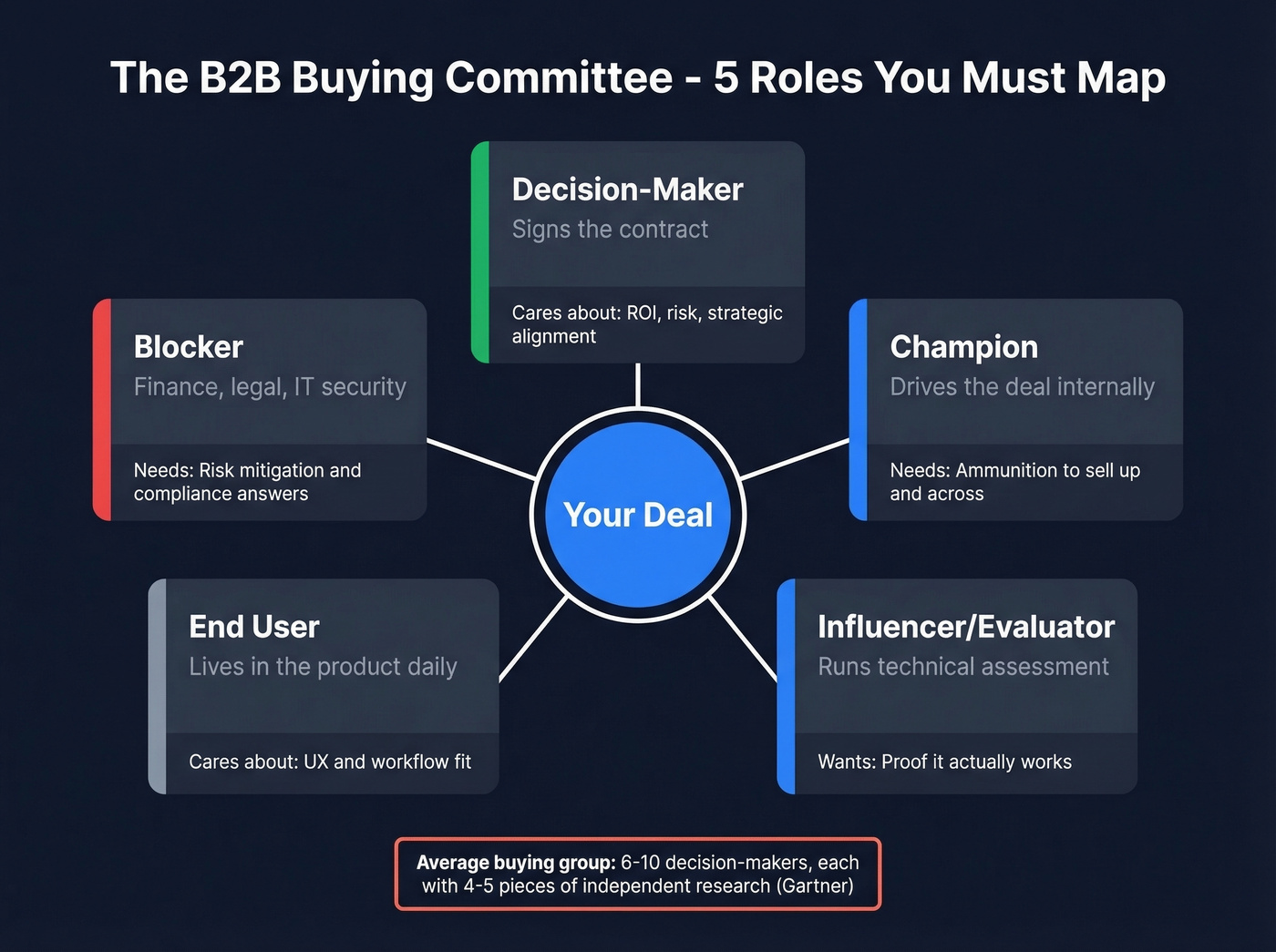
Build one persona per active buying committee role. In our experience, the best results come when teams start with 2-3 personas and expand only when data justifies it.
Define Persona Fields
Most templates go wrong here. They include "hobbies" and "favorite social media" while skipping the fields that actually drive deals. Required fields for a B2B persona your team can act on:
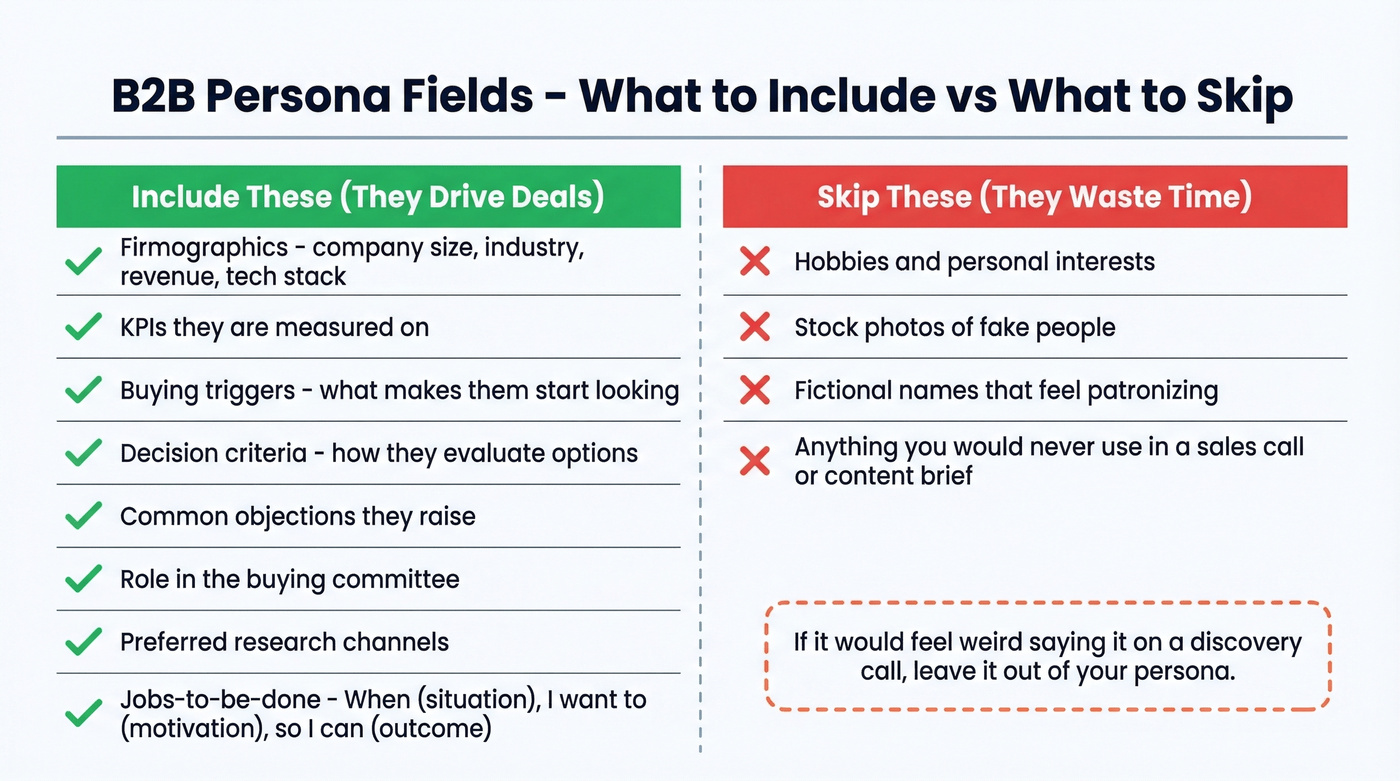
- Firmographics - company size, industry, revenue range, tech stack (firmographic and technographic basics matter here)
- KPIs they're measured on
- Buying triggers - what makes them start looking (see how teams handle identifying buying signals)
- Decision criteria - how they evaluate options
- Common objections
- Role in the buying committee
- Preferred research channels
- Jobs-to-be-done - frame as "When [situation], I want to [motivation], so I can [outcome]"
Explicitly exclude: hobbies, stock photos, fictional names that feel patronizing, and anything you wouldn't use in a sales call or content brief.
Validate and Operationalize
Test your draft persona against five recent closed-won and five closed-lost deals. If the persona doesn't match the patterns you see, revise it. A persona that contradicts your actual deal data is worse than no persona at all.
Then wire it into your systems the same day. Map persona fields to CRM properties. Build outbound sequences targeting each persona's triggers and objections. Update your content calendar to address each persona's decision criteria. Some teams go further - printing persona posters for the office, creating internal Slack channels per persona, or running role-play exercises where reps practice selling to each persona.
A persona that lives in a PDF is already dead.
Persona Research: What to Ask
Good interviews follow themes, not scripts. Here's a curated question bank we've refined over dozens of customer research projects:
Role & Responsibilities
- What does a typical day look like in your role?
- What KPIs are you personally measured on?
Pain Points & Buying Triggers
- What was happening internally when you started looking for a solution?
- What would've happened if you'd done nothing?
- Was there a specific event or deadline that forced the decision?
Evaluation & Decision Process
- How did you first hear about solutions in this category?
- Who else was involved in the decision? What did each person care about?
- What were your top three criteria when comparing options?
Competitive Landscape
- Which alternatives did you seriously evaluate?
- What did you like about the option you didn't choose?
Success Metrics
- How do you define success with this purchase six months in?
Record every interview with permission, research the interviewee's background beforehand, and practice active listening. The best insights come from follow-up questions, not from your script.

Your personas are only as good as the data behind them. Prospeo enriches every contact with 50+ data points - firmographics, technographics, job changes, and more - at an 83% match rate. Stop building personas on guesswork.
Turn your buyer personas into enriched, actionable prospect lists today.
Persona Template + Filled Examples
Here's a fully filled-out persona based on the Selling Signals template framework:
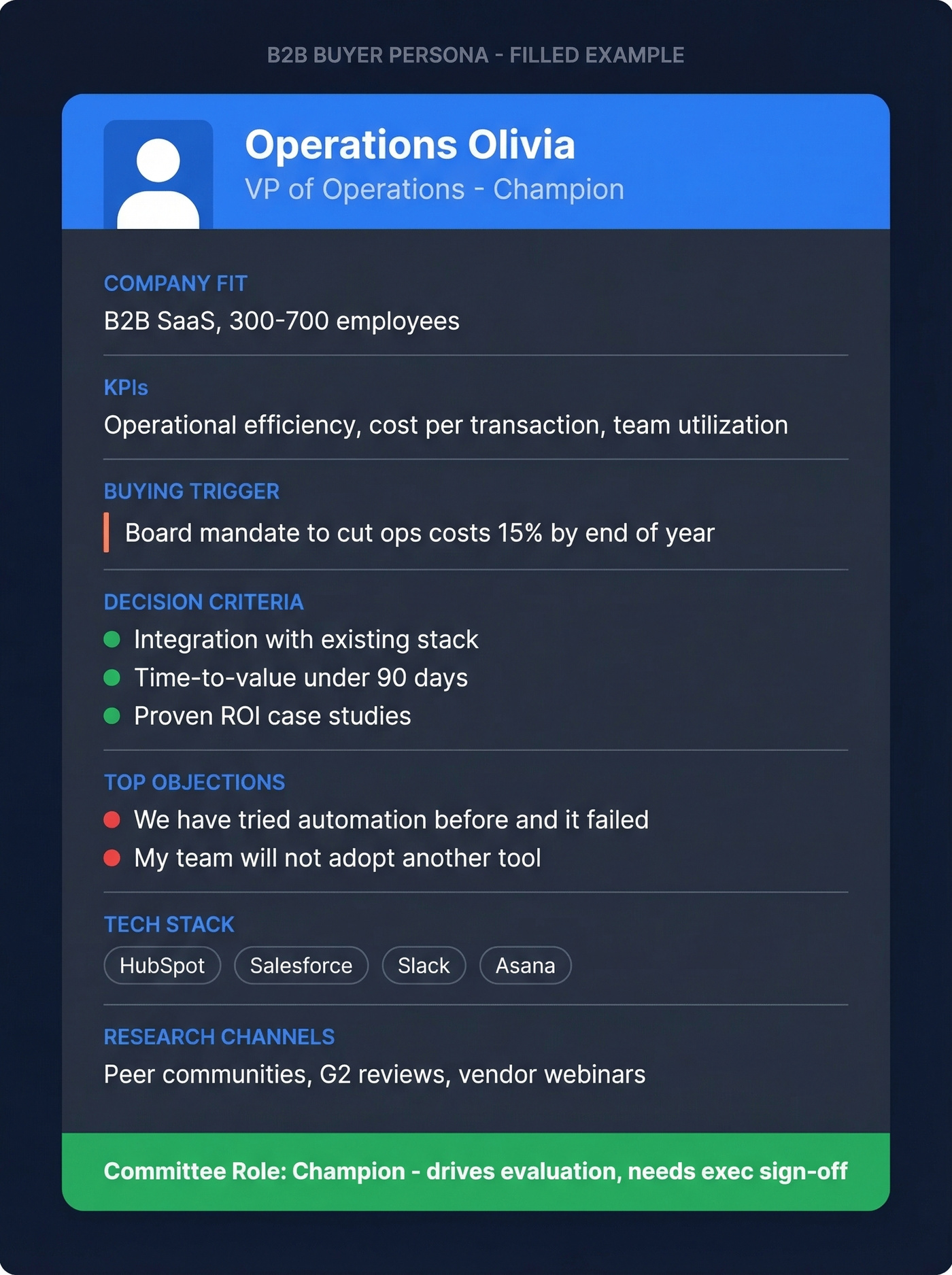
"Operations Olivia" - VP of Operations, Champion
| Field | Detail |
|---|---|
| Title | VP of Operations |
| Company | B2B SaaS, 300-700 employees |
| KPIs | Operational efficiency, cost per transaction, team utilization |
| Buying trigger | Board mandate to cut ops costs 15% by EOY |
| Decision criteria | Integration with existing stack, time-to-value under 90 days, proven ROI case studies |
| Objections | "We've tried automation before and it failed," "My team won't adopt another tool" |
| Role in committee | Champion - drives evaluation, needs exec sign-off |
| Tech stack | HubSpot, Salesforce, Slack, Asana |
| Channels | Peer communities, G2 reviews, vendor webinars |
Now a second persona for a different committee role:
"Finance Frank" - CFO, Decision-Maker
Frank doesn't care about features. He cares about payback period, contract flexibility, and whether this purchase displaces an existing line item. His buying trigger is the board asking why ops costs are 20% above benchmark. He'll evaluate based on total cost of ownership over 24 months, not monthly subscription price.
His objection: "Why can't we build this internally?" His preferred research channel is analyst reports and peer CFO references - not your blog.
Skip this if you already define negative personas, but if you don't: "Startup Steve" is a founder at a pre-revenue company with fewer than 10 employees, no budget, and no buying committee. He'll download every free resource, request a demo, and never close. Disqualify early - company size under 15 employees, no funding, single decision-maker who's also the end-user. Defining who you don't sell to saves as much pipeline time as defining who you do.
There are six template types worth knowing: General, B2B, Sales, Decision-maker, Influencer, and Negative. Start with the B2B and Decision-maker templates.
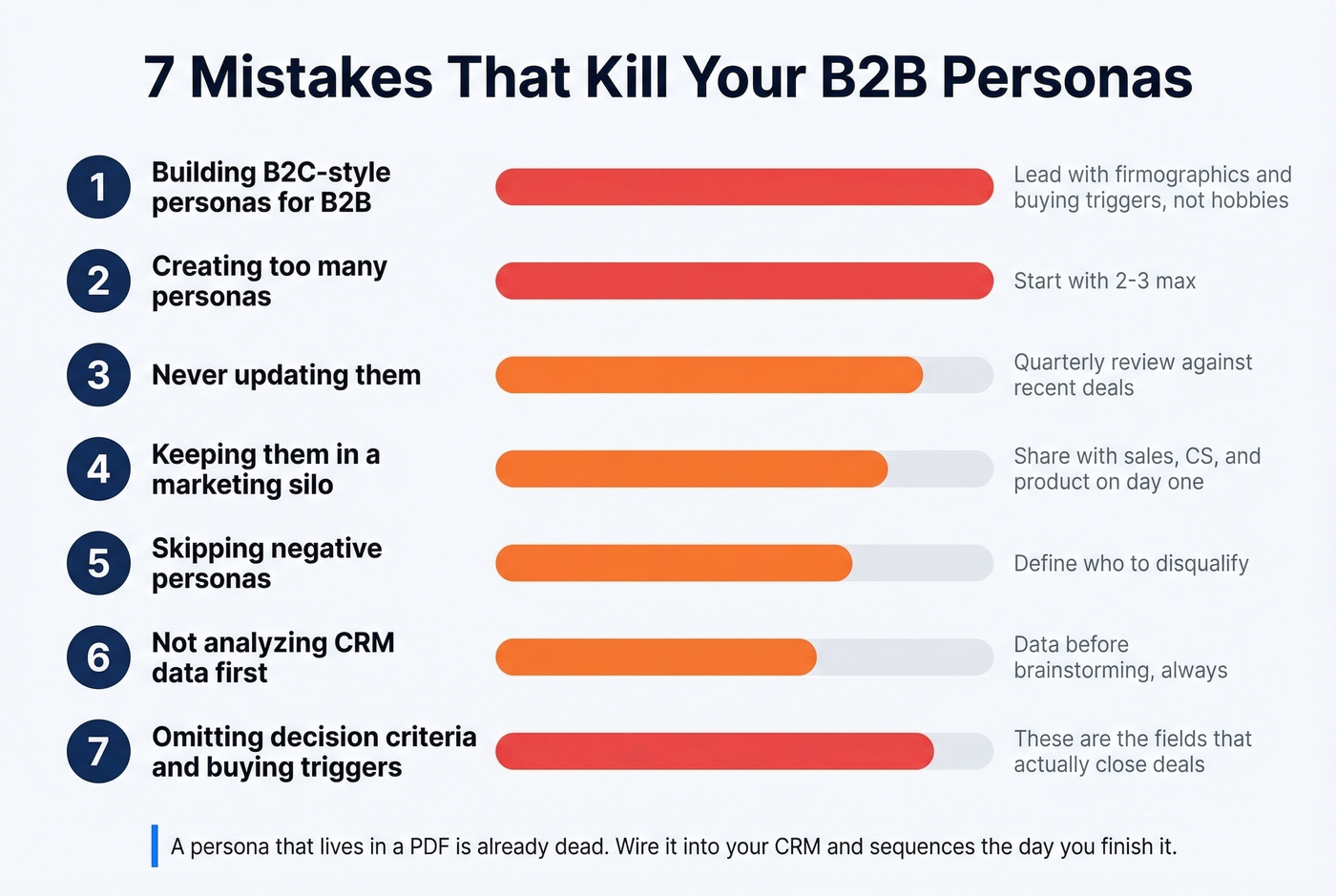
Mistakes That Kill Your Personas
- Building B2C-style personas for B2B. Lead with firmographics and buying triggers, not demographics and hobbies.
- Creating too many. Start with 2-3 max. Twelve personas means nobody reads any of them.
- Never updating them. Quarterly informal review against recent deals, annual formal audit with fresh interviews, and trigger-based updates when your market shifts.
- Keeping them in a marketing silo. Share with sales, CS, and product on day one. If your SDRs haven't read the persona, it doesn't exist.
- Skipping negative personas. Define who to disqualify. It's as valuable as defining who to target.
- Not analyzing existing CRM data first. Data before brainstorming. Always.
- Omitting decision criteria and buying triggers. These are the two most important fields in any B2B persona. If you only fill in two things, fill in these.
From Personas to Prospect Lists
Every persona guide stops at "create the persona." Nobody shows you how to actually find and reach those people.
Map your persona fields directly to actionable systems. Job title becomes a CRM field and an outbound targeting criterion. Company size becomes a database filter. Tech stack becomes a technographic filter. Buying signals - like hiring for specific roles or surging on relevant topics - become intent data filters. Most teams apply personas to five core assets: homepage messaging, outbound sequences, the core sales deck, key landing pages, and objection-handling collateral.
For the database step, filter by your persona's job title, company size, technographics, and buyer intent signals. Include headcount growth and funding data if your persona targets fast-scaling companies. Then export a verified prospect list directly into your outbound sequences. With Prospeo, 98% email accuracy means your outbound doesn't bounce, and 30+ search filters - including intent data tracking 15,000 topics via Bombora - map directly to the persona attributes you've already defined.

The persona-to-prospecting bridge is where most teams drop the ball. You've done the hard work of understanding your buyer. Don't let that insight die in a slide deck.
AI Tools for Persona Creation
HubSpot Make My Persona is the best free option, no contest. Completely free, no signup required, generates a persona with demographics, goals, pain points, and communication preferences. Export as PDF or share a link. It's the fastest way to get a structured first draft.
Beyond HubSpot: UXPressia, Juma (Team-GPT), Voila AI, and FounderPal are all worth a look if you want more flexibility, collaboration, or faster iteration across multiple personas.
When evaluating any AI persona tool, look for three things: inputs that go beyond demographics, output flexibility by use case, and collaboration features for team consistency.
Let's be honest: AI generators are useful for a first draft, not a final product. We've tested several, and a persona built without customer interviews and CRM data is still a guess - it's just a well-formatted guess. Gartner's research on buying groups confirms that the nuance of internal committee dynamics can't be captured by a prompt.
You mapped the buying committee. Now reach every role with 98% accurate emails and 125M+ verified mobile numbers. Prospeo's 30+ search filters let you target by job title, department headcount, intent signals, and tech stack - the exact fields your personas are built on.
Find decision-makers, champions, and blockers in a single search.
FAQ
How many B2B buyer personas do I need?
Start with 2-3 mapped to core buying committee roles (champion, decision-maker, evaluator). Expand only when CRM data shows a distinct role influencing deals differently. Twelve personas means nobody reads any of them.
What's the difference between an ICP and a buyer persona?
An ICP describes the ideal company - industry, size, revenue, tech stack. A buyer persona describes the individual inside that company - role, goals, objections, decision criteria. You need both: the ICP narrows your account list, the persona shapes your messaging.
How often should I update my personas?
Quarterly informal reviews against recent closed-won and closed-lost deals. Annual formal audits with 5-8 fresh interviews. Trigger-based updates when your market shifts - a new competitor entering, a product launch, or AI adoption reshaping how buyers evaluate vendors.
Can AI build my buyer persona?
AI tools like HubSpot Make My Persona generate a structured first draft in under 10 minutes. But without customer interviews and CRM validation, the output is an educated guess. Use AI for structure and speed, humans for the insight that actually differentiates your messaging.
How do I turn a persona into a prospect list?
Map your persona's firmographic and behavioral attributes - job title, company size, tech stack, intent signals - to B2B database filters. Export verified contacts into outbound sequences via Salesforce, HubSpot, or tools like Instantly and Lemlist. The key is making sure persona fields translate directly into search filters so you're not manually guessing at who to target.