

The B2B Buying Process in 2026: How It Really Works
A typical B2B deal now involves 13 internal stakeholders and 9 external influencers. That's 22 people who need to agree before anyone signs anything. And 40-60% of the time, after all that effort, the outcome is "no decision." The B2B buying process isn't a funnel - it's a negotiation with itself.
The Short Version
- It's not linear. Buyers loop through six "buying jobs" - problem identification, solution exploration, requirements building, supplier selection, validation, and consensus creation - revisiting each at least once.
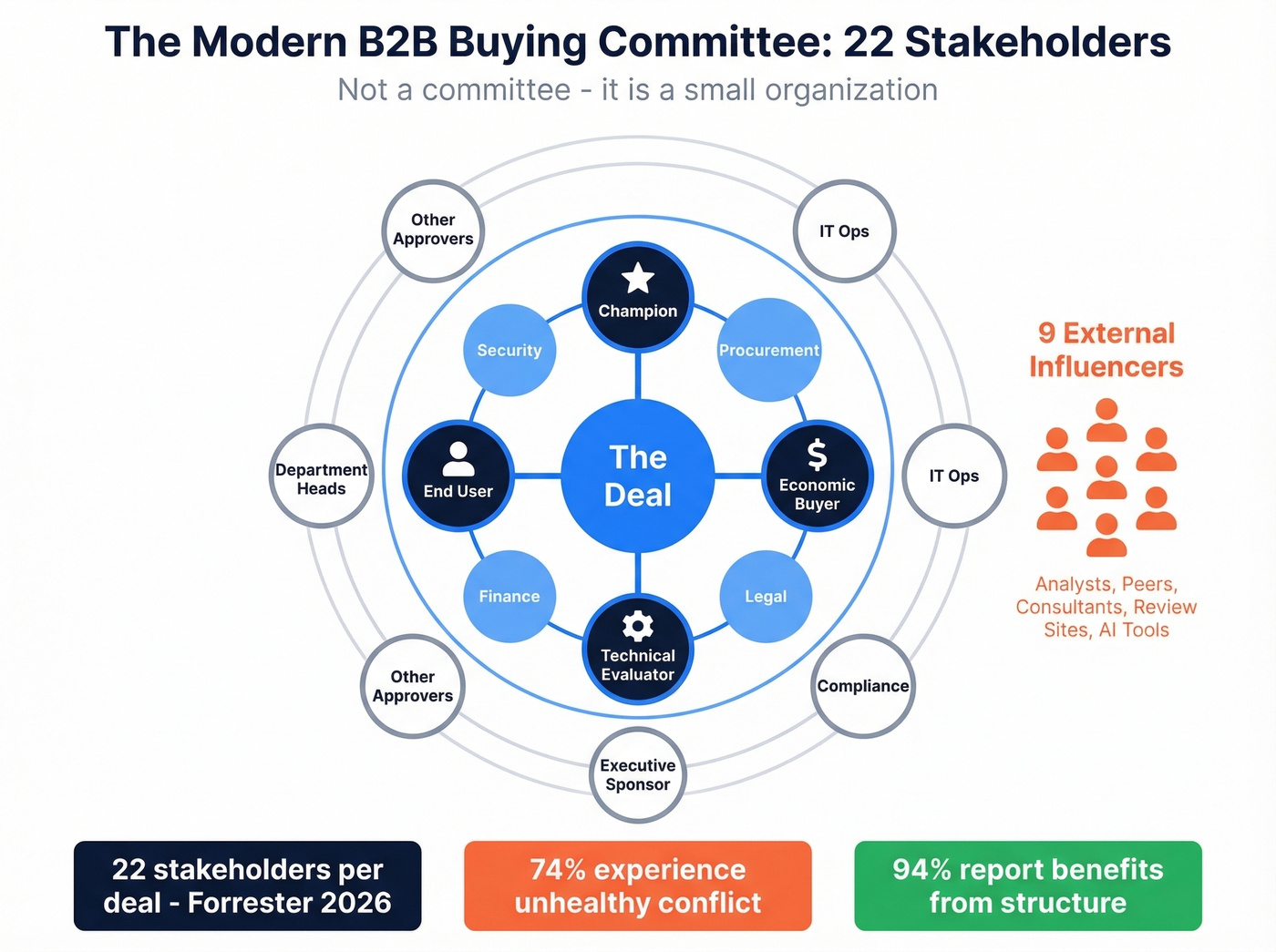
- Committees are massive. Forrester's 2026 data shows 22 stakeholders on a typical deal. Complex purchases can hit 25.
- Timeline benchmarks: Mid-market deals close in 2-4 months. Enterprise deals take 6-12+ months. The average sales cycle sits around 6.5 months.
- Hybrid wins. 67% of buyers prefer a rep-free experience, yet buyers who combine digital tools with a rep are 1.8x more likely to complete a high-quality deal.
- "No decision" is the real competitor. 40-60% of qualified pipeline ends in no decision. Consensus failure is a leading cause.
What This Term Actually Means
On paper, it's simple: a business identifies a need, evaluates options, and buys. Three things make it exponentially harder than B2C.
First, the risk is higher - a bad SaaS contract can cost hundreds of thousands of dollars and months of wasted implementation. Second, the stakeholder count is much larger. A consumer buys shoes alone; a VP of Engineering buying a DevOps platform needs sign-off from security, procurement, finance, legal, and the team who'll actually use it. Third, the cycle is longer - months, not minutes. Not all purchases are equal, either. A straight rebuy of existing software licenses follows a different path than a first-time platform purchase the company has never evaluated before.
What's changed in 2026 is sheer information volume. Buyers research independently, consult more sources, and involve more people earlier. The journey that used to be "champion finds tool, gets budget, buys" now looks more like a committee navigating a maze while the maze keeps changing shape.
Why It's Never Linear
Every textbook presents the buying process as a neat sequence: awareness, consideration, decision. That model is wrong. Not slightly wrong - fundamentally misleading.
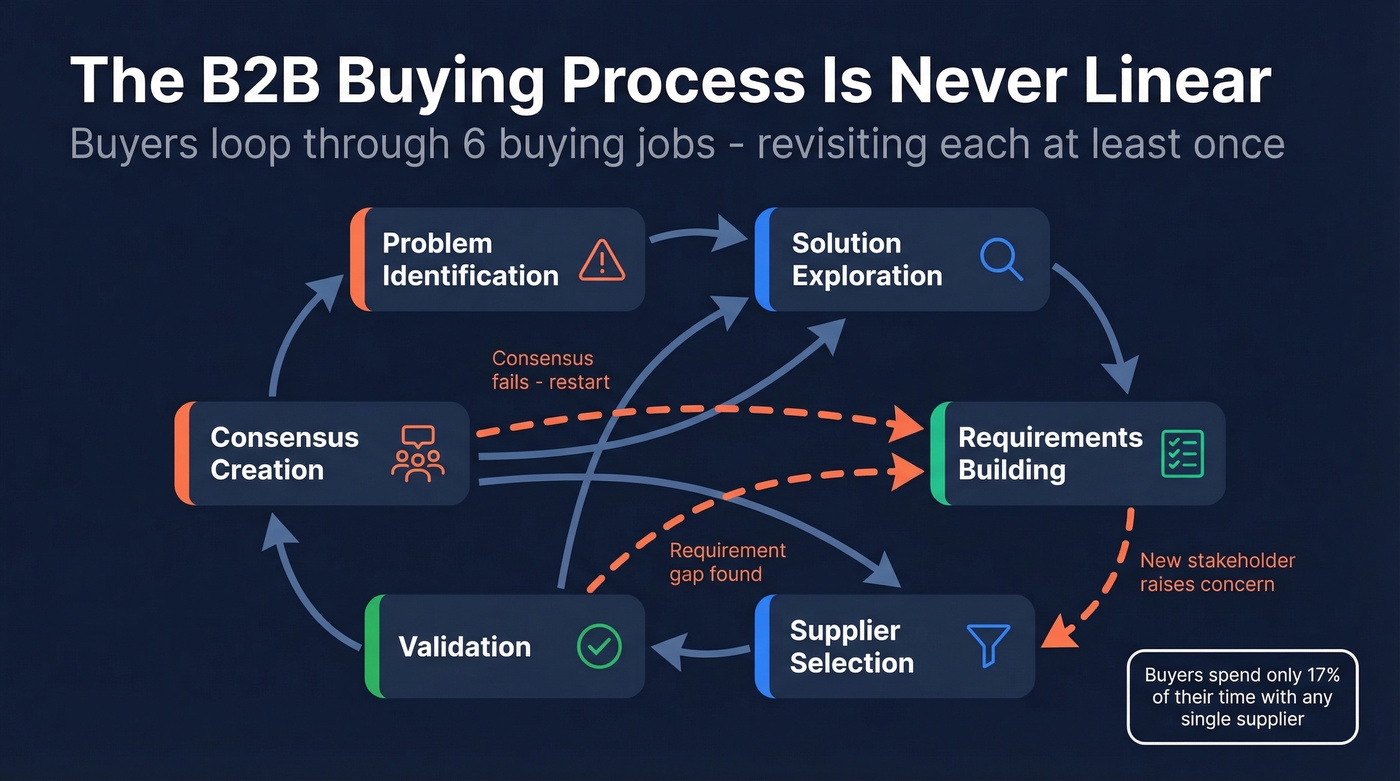
Gartner's research shows buyers loop through six buying jobs at least once during a typical purchase. A team might reach supplier selection, then circle back to requirements building because a new stakeholder raised a concern nobody anticipated. They might validate a solution, realize it doesn't meet a requirement they forgot to define, and restart solution exploration entirely.
Here's what makes it worse: different stakeholders are in different jobs at the same time. The champion might be building consensus while the security lead is still defining requirements. If you're gating content by "funnel stage," you're forcing a linear model onto a non-linear process. Your SDRs who only engage at "awareness" are missing the moments when a buyer loops back and needs help with validation.
The Six Buying Jobs
Buyers spend 17% of their total buying time with any single supplier. Knowing what each buying job demands helps you make that window count.
Problem Identification
A trigger event - missed quota, compliance deadline, competitor move - forces the team to acknowledge a problem. Sellers should provide industry benchmarks and cost-of-inaction calculators. Don't pitch your product here. Help them articulate the problem.
Solution Exploration
Self-serve research dominates this phase. Buyers read G2 reviews, watch demos, ask peers on Slack and Reddit, and increasingly use AI to synthesize options. Provide ungated comparison content, transparent pricing, and product tours. If your website makes buyers fill out a form to see a feature list, you've already lost ground - the consensus on r/sales is that gated feature pages are an instant disqualifier for most modern buyers.
Requirements Building
Every new stakeholder adds requirements. Security wants SOC 2 Type II. Legal wants specific data processing terms. End users want a feature you don't have. Requirements creep is the silent killer of deal velocity. Have integration documentation and security packages ready before they're requested.
Supplier Selection
The shortlist forms. RFPs go out. Procurement is a decision-maker in 53% of buying cycles, engaging from the start - not just rubber-stamping at the end. Provide competitive differentiation that's specific and honest, reference customers in the buyer's industry, and a procurement-friendly pricing structure.
Validation
Over 60% of buyers use a trial to evaluate solutions; for purchases over $10M, that number jumps to 78%. Offer a frictionless trial, a clear success criteria framework, and references who'll actually pick up the phone.
Consensus Creation
The most underestimated job. 74% of buying teams experience unhealthy conflict during this phase, and it peaks roughly a third of the way into the process - which means sellers who wait until the end to address consensus are already too late. Provide executive summaries tailored to each stakeholder's concerns. Help the champion sell internally. That's your real job.
Who's Really on the Buying Committee
The "buying committee" isn't a formal group that meets in a conference room. It's a loose network of people with varying influence, different entry points, and competing agendas.
| Role | What They Care About | Proof They Need | Common Objection |
|---|---|---|---|
| Champion | Solving the problem | Peer case studies | "Can I stake my rep on this?" |
| Economic Buyer | ROI, total cost | Financial models | "Why not the cheaper option?" |
| Technical Evaluator | Integration, security | Architecture docs | "Won't work with our stack" |
| End User | Daily workflow, UX | Hands-on trial | "Harder than current tool" |
| Procurement | Terms, compliance | Vendor risk profile | "Non-standard contract terms" |
| Legal | Data, liability | DPA, privacy docs | "GDPR exposure is too high" |
| Finance | Budget timing | Payment flexibility | "Not in this quarter's budget" |
| Security | Risk posture | SOC 2, pen test results | "Failed our security review" |
Forrester puts the typical count at 22 stakeholders; other industry benchmarks put complex deals at 25, up from 16 in 2017. That's not a committee - it's a small organization.
Here's the counterintuitive part: 94% of companies with six or more buying groups report clear benefits from the structure. Larger committees slow things down, but they also produce better purchasing decisions when managed well. To map stakeholders fast, build an org chart hypothesis based on company size, industry, and product category. A 200-person SaaS company buying a security tool will involve the CISO, VP Engineering, a procurement lead, and probably the CFO. Validate through signals - who's attending meetings, who's asking questions in the trial, who's cc'd on emails. Then multi-thread your outreach so you're not dependent on a single champion who might leave or lose internal influence.

With 22 stakeholders on every deal, reaching the right people with verified data isn't optional - it's how deals close. Prospeo gives you 98% accurate emails and 125M+ verified mobile numbers so you can map and reach the entire buying committee, not just the champion.
Stop losing deals to contacts you can't reach. Start with data that connects.
How Long It Takes
The average B2B sales cycle runs 6.5 months, up from 4.9 months in 2019. But averages obscure more than they reveal.
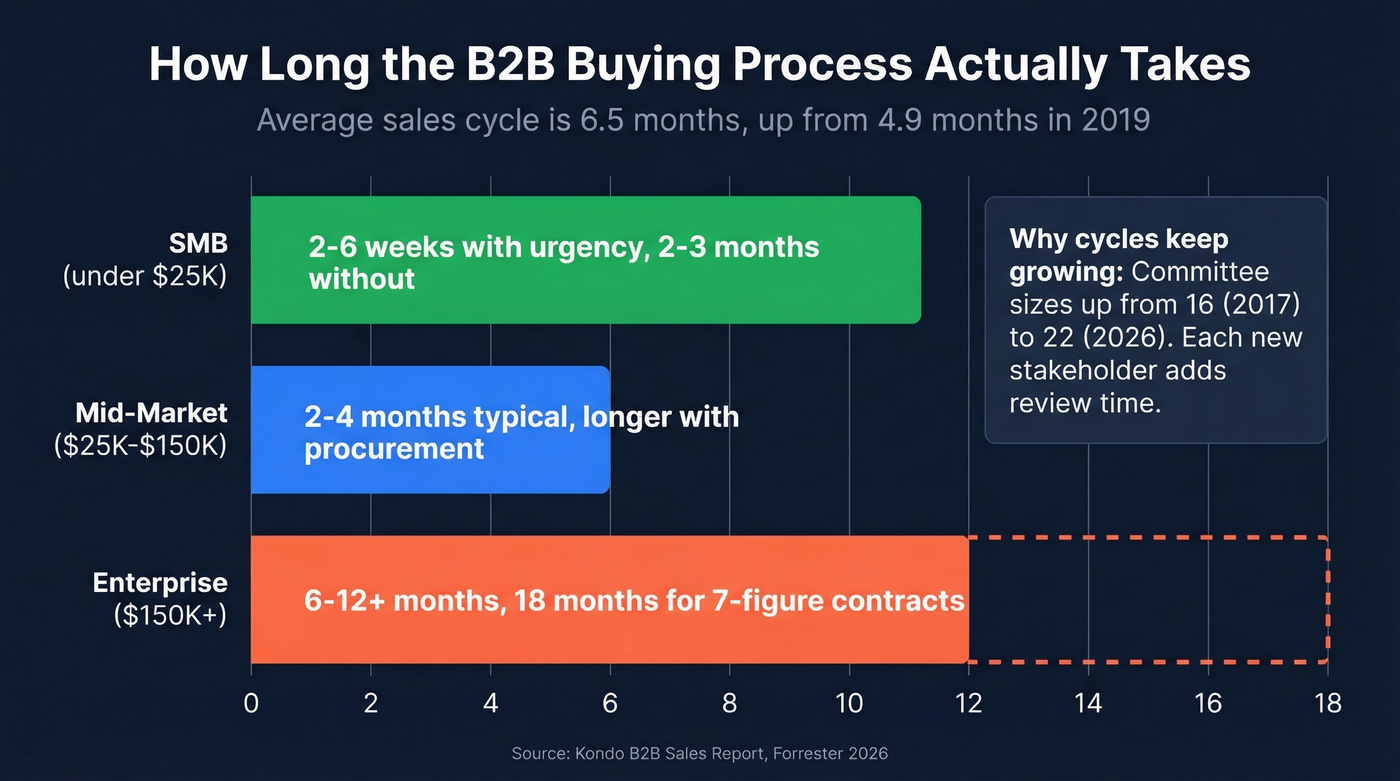
- SMB (sub-$25k deals): 2-6 weeks with urgency, 2-3 months without
- Mid-market ($25k-$150k): 2-4 months typical, longer with procurement
- Enterprise ($150k+): 6-12+ months; 18 months isn't unusual for seven-figure contracts
Most practitioners we've talked to say cycles are getting longer despite more tools and data - largely because committee sizes keep growing and each new stakeholder adds review time. Understanding the timeline at each tier helps sellers set realistic forecasts instead of chasing arbitrary close dates (and tightening sales forecasting discipline).
Self-Serve vs. Hybrid
67% of B2B buyers prefer a rep-free experience. That stat gets quoted constantly, and it's real. But it doesn't mean what most people think.
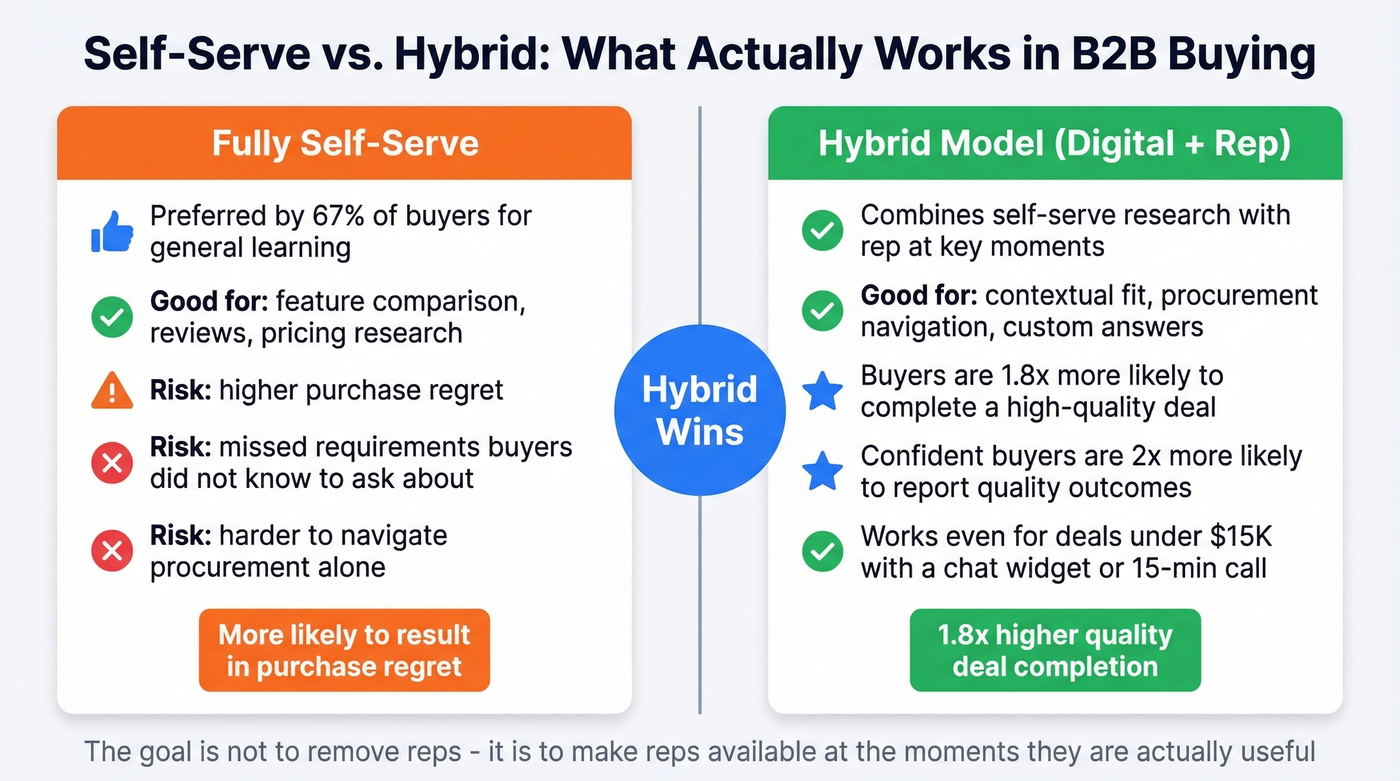
Buyers prefer self-service for general learning - understanding what a product does, comparing features, reading reviews. They prefer reps for contextual intelligence - figuring out whether the product fits their specific environment, navigating procurement, and getting answers that aren't on the website.
Here's the thing: self-service digital purchases are more likely to result in purchase regret. Buyers who go fully rep-free often miss requirements they didn't know to ask about. The hybrid model - digital tools paired with a knowledgeable rep - produces buyers who are 1.8x more likely to complete a high-quality deal. Gartner's 2026 survey data goes further: confident buyers are 2x more likely to report a high-quality deal outcome.
The winning play isn't "remove reps." It's "make reps available at the moments they're actually useful and get out of the way the rest of the time."
If your deal size is under $15k, you probably don't need a full sales team - but you absolutely need a hybrid model. A well-timed chat widget or 15-minute consultation call converts better than either a pure self-serve flow or a traditional AE-led process. We've seen this pattern repeatedly across the companies we work with.
Why Deals Stall
Let's be honest: 86% of B2B purchases stall at some point, and 40-60% of qualified pipeline ends in outright "no decision." High-friction buying environments reduce purchase likelihood by 43%. Not a competitor win. Not a budget cut. Just... nothing.
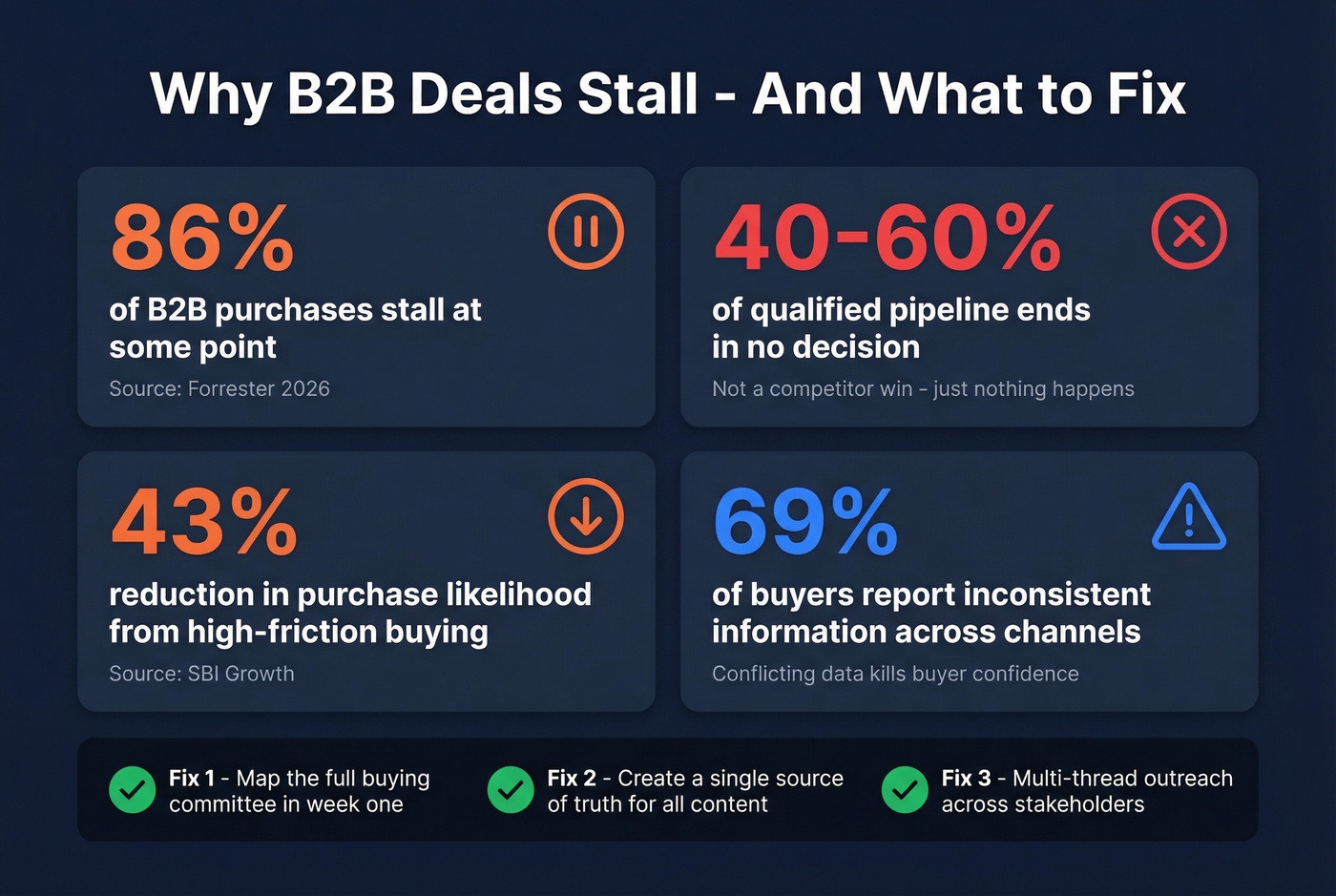
Requirements churn. A new stakeholder enters late and reopens settled decisions. The fix: map the full buying committee in week one. Ask your champion directly: "Who else will need to approve this?" Then verify independently.
Information inconsistency. 69% of buyers report inconsistencies between what a vendor's website says and what the sales rep tells them. That kills trust instantly. Audit your website against your sales deck quarterly. If a buyer can find a contradiction in 10 minutes, they will.
Consensus failure. 74% of buying teams experience unhealthy conflict. Different stakeholders have legitimate but competing priorities, and nobody's job is to resolve the conflict. Provide stakeholder-specific materials - a security brief for the CISO, an ROI model for the CFO, a workflow comparison for end users. These materials give each stakeholder the evidence they need to say yes, which directly influences whether the deal moves forward or dies in committee.
What Sellers Get Wrong
Targeting the wrong people. 73% of B2B buyers actively avoid suppliers that send irrelevant outreach. Bad data is the root cause. Outdated job titles, wrong email addresses, and missing stakeholders mean your outreach hits people who can't buy and misses people who can. This is where lead enrichment and data enrichment services stop being "nice to have" and become table stakes.
Single-threading the deal. You've got one champion. They leave the company. Deal's dead. With 13+ internal stakeholders on a typical deal, relying on a single contact is reckless. Multi-threading - building relationships with 3-5 stakeholders across different functions - is the only way to survive committee dynamics (especially in enterprise B2B sales).
Running meetings that waste the buyer's time. 58% of sales meetings aren't valuable to buyers. Every meeting should deliver something the buyer couldn't get from your website (use a tighter product demo checklist and better software demo tips).
In our experience, the #1 reason deals go dark is incomplete stakeholder mapping. You can't multi-thread a deal if you don't have verified contact information for the buying committee. Prospeo covers 300M+ professional profiles with 98% email accuracy and a 7-day refresh cycle, so you're reaching the right people with current information - not bouncing off stale records. When you're mapping a 22-person buying committee, every bounced email is a stakeholder you've lost access to.
Consensus creation fails when sellers can't engage every stakeholder directly. Prospeo's 300M+ profiles with 30+ filters - including job title, department, and company - let you identify and contact every decision-maker on the committee before the deal stalls.
Reach all 22 stakeholders, not just the one who replied to your cold email.
How to Support Buyers
Selling into the modern B2B buying process means supporting the buyer's internal work, not just pitching your product.
Map the committee early. Don't wait for stakeholders to reveal themselves. Build a hypothesis of who's involved based on deal size and product category, then validate through signals. Skip this step if you're selling a sub-$5k tool with a single decision-maker - but for anything with a real committee, early mapping is non-negotiable.
Align your website and your reps. 69% of buyers find inconsistencies. Audit quarterly. If your pricing page says one thing and your AE says another, you've created a trust problem no demo can fix.
Build stakeholder-specific content. The CFO doesn't care about your API documentation. The engineer doesn't care about your ROI model. Create modular content packages the champion can distribute to each stakeholder. We've found that deals with stakeholder-specific materials close 30-40% faster than those relying on a single generic deck.
Support multi-user evaluation. Buying teams need multi-user accounts, role-based permissions, and approval workflows. If your trial only supports a single login, you're forcing a committee to evaluate through one person's lens.
Help build consensus. Provide executive summaries, comparison matrices, and risk assessments the champion can use to align the group. The purchase journey doesn't end at signature, either - implementation success determines whether the buyer becomes a reference or a detractor. Your job is to arm the champion, not replace them.
FAQ
How many stages are in the B2B buying process?
Gartner identifies six "buying jobs" that buyers loop through non-linearly: problem identification, solution exploration, requirements building, supplier selection, validation, and consensus creation. Sequential stage models misrepresent how purchase decisions actually happen - expect buyers to revisit each job at least once.
How long does a typical deal take in 2026?
The average B2B sales cycle is 6.5 months. Mid-market deals ($25k-$150k) close in 2-4 months. Enterprise procurement cycles ($150k+) take 6-12 months or longer, with seven-figure contracts sometimes stretching to 18 months.
Why do so many deals end in "no decision"?
40-60% of qualified pipeline ends in no decision because buying committees can't reach consensus. With 22+ stakeholders, competing priorities create conflict that nobody's empowered to resolve. Providing stakeholder-specific evidence - ROI models, security briefs, workflow comparisons - is the best way to prevent stalls.
How do you identify everyone in the buying committee?
Start with an org chart hypothesis based on deal size and product category, then validate through meeting attendance, email cc's, and trial usage patterns. A B2B data platform like Prospeo lets you find verified contacts across functions using 30+ search filters - department, seniority, company size - so you can build a complete committee picture before your champion even makes introductions.
What's the difference between the buying process and the sales process?
The buying process is the buyer's internal journey - identifying a problem, evaluating solutions, building consensus across stakeholders. The sales process is the seller's workflow designed to support that journey. They should align, but they're fundamentally different perspectives on the same transaction.