

B2B Customer Loyalty: The Data-Backed Guide for 2026
Your best customer just renewed - and then quietly started evaluating your competitor. You didn't see it coming because you were measuring the wrong things.
The global loyalty management market is projected to hit $41.21B by 2032, up from an estimated $15.19B in 2025, growing at a 15.3% CAGR. That's not consumer punch cards driving the growth. It's B2B companies finally realizing that retention economics dwarf acquisition economics, and 65% of firms now plan to launch or upgrade a loyalty program.
Most of those programs will fail. Not because the strategy is wrong, but because the execution skips the boring parts.
The Short Version
Your board doesn't care about NPS. They care about Net Revenue Retention - the single metric that ties loyalty to valuation multiples. Track NRR. Report NRR. Build your loyalty program around improving NRR.
Pick the right program type for your business model. Points-based, tiered, growth-based, certification, or referral - each fits a different revenue structure. Choosing wrong is worse than not starting.
Fix your data before you launch anything. Personalized loyalty emails mean nothing if they're bouncing or hitting the wrong contact. Clean your CRM first with an enrichment tool so your communications actually land.
What B2B Loyalty Actually Means
B2B customer loyalty isn't B2C loyalty with bigger invoices. The mechanics are fundamentally different, and treating them the same is the fastest way to waste budget.
| Dimension | B2C | B2B |
|---|---|---|
| Decision maker | Individual | Buying committee (3-10 people) |
| Purchase cycle | Days-weeks | Months-years |
| Motivation | Emotional | Economic |
| Switching cost | Low | High |
| Relationship depth | Transactional | Strategic |
| Key metric | Repeat purchase | Net Revenue Retention |
| Reward type | Discounts, perks | Training, co-marketing |
There's also a distinction most articles miss: loyalty programs and incentive programs aren't the same thing. A loyalty program creates mindshare - it thanks customers and returns value to reinforce retention. An incentive program drives growth toward a specific benchmark, with rewards earned at defined thresholds. The best B2B programs blend both, but confusing the two leads to misaligned goals from day one.
The Metric That Actually Matters
Every loyalty conversation eventually lands on NPS. Wrong destination.
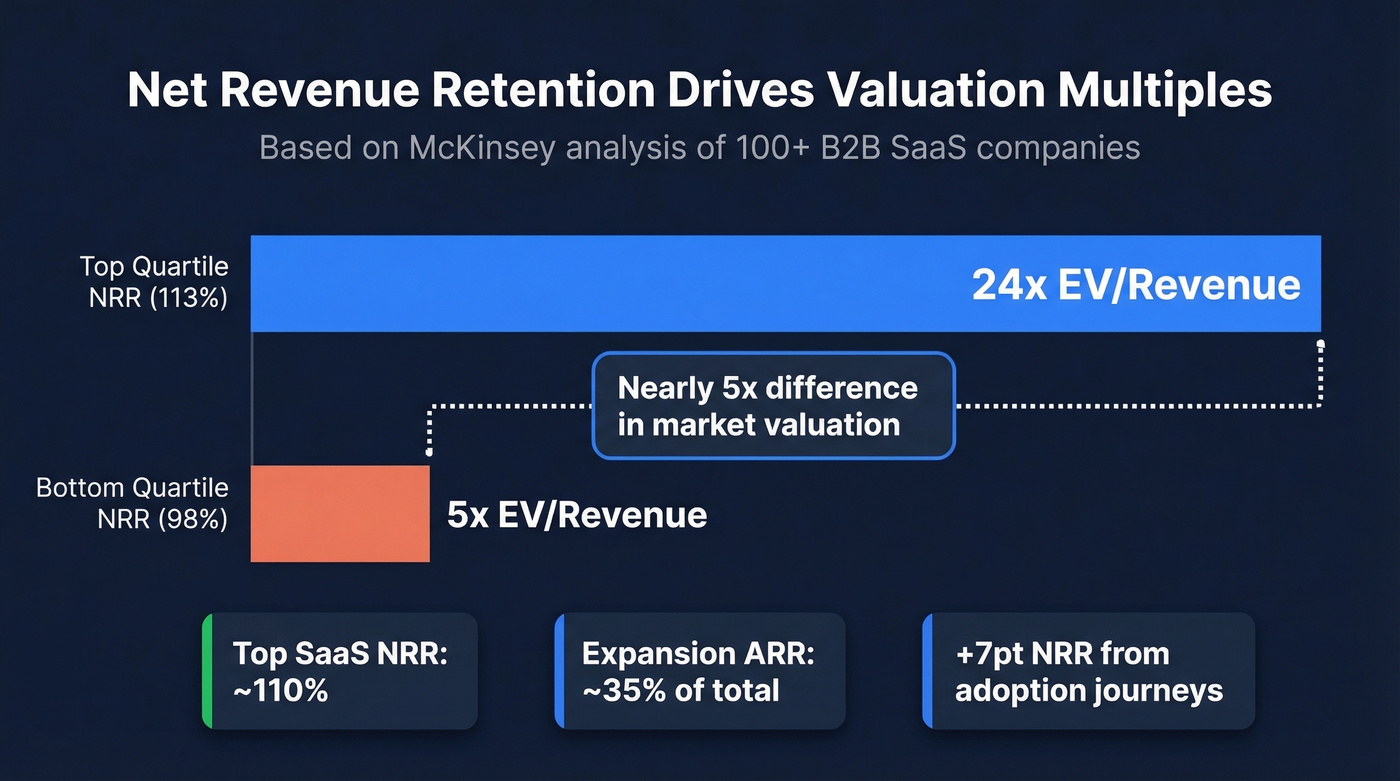
Net Revenue Retention is the metric that connects customer loyalty to the number your CFO actually tracks: enterprise value. McKinsey's analysis of 100+ B2B SaaS companies makes the case definitively. Top-quartile companies by NRR (113%) trade at a median 24x EV/Revenue. Bottom-quartile companies (98% NRR) trade at 5x. That's a nearly 5x difference in how the market values your business, driven largely by whether existing customers expand or contract.
The gap isn't just about having a good product. Companies with sophisticated adoption journeys - onboarding sequences, value realization milestones, proactive expansion motions - produce roughly 7 percentage points higher NRR than peers running basic renewal playbooks. Top-tier SaaS companies reported ~110% NRR in 2025, with expansion ARR accounting for ~35% and new business ARR ~53%. For the repeat business SaaS companies depend on, that expansion revenue is the clearest signal that loyalty is translating into growth.
Here's the thing: NRR is a lagging indicator. By the time it drops, the damage is done. Which is why measuring loyalty requires leading indicators too.
Measuring Loyalty Beyond NPS
NPS has its place - as a diagnostic, not a destination. CustomerGauge's benchmark study across 776 B2B companies assessed from Jan 2019 to Jul 2021 found massive variance by industry: Healthcare median NPS sits at 58, while Telecommunications languishes at 31. The best B2B companies treat NPS as an early warning system, not a board metric.
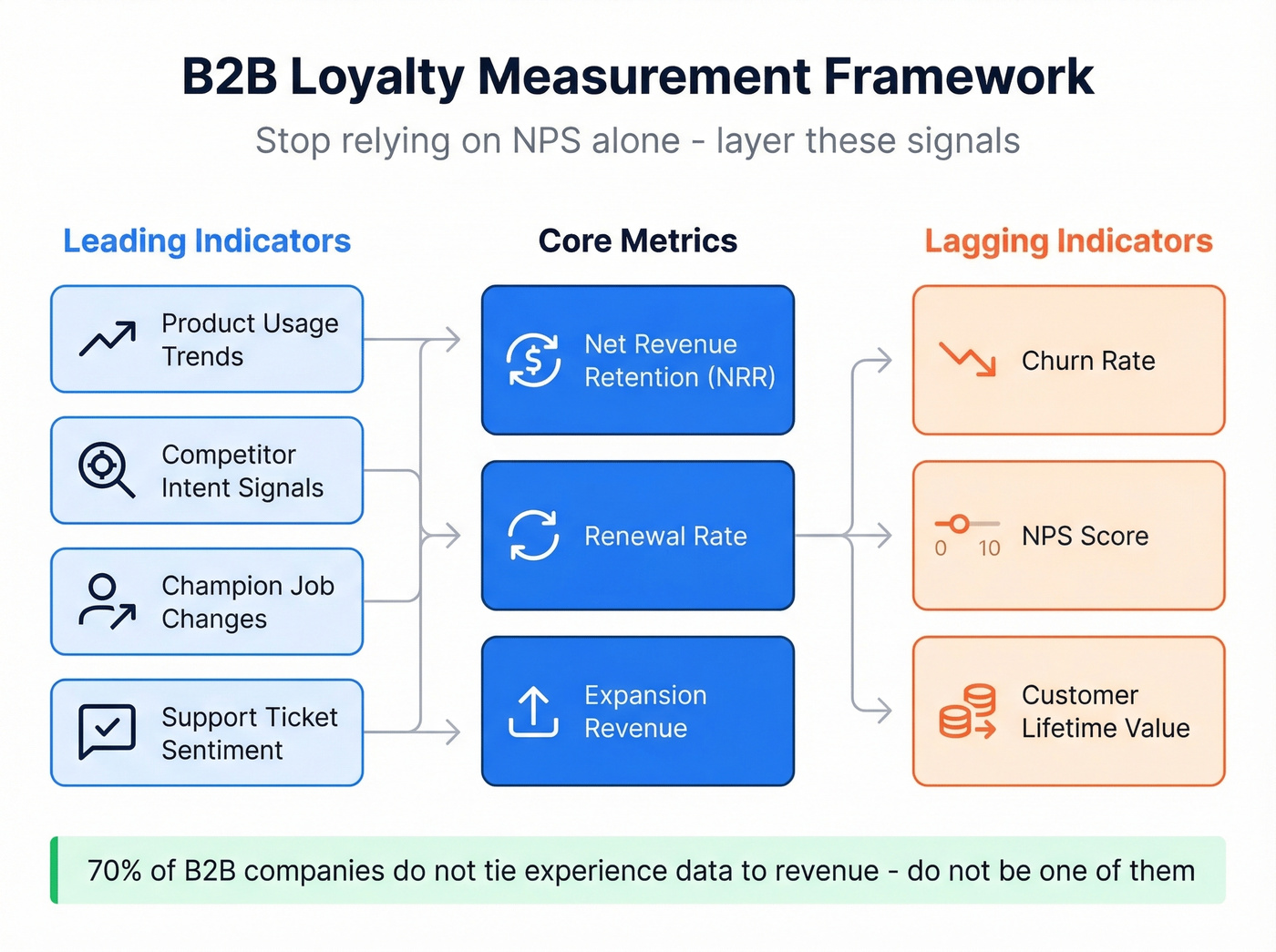
The real problem? [70% of B2B companies don't tie their experience data to revenue](https://www.bain.com/about/media-center/press-releases/20252/70-of-companies-struggle-to-integrate-their-sales-plays-into-crm-and-revenue-technologies-finds-bain - company-survey/). They collect NPS scores, file them in a dashboard nobody checks, and then act surprised when a top account churns.
A more sophisticated approach layers multiple signals. Renewal rate and expansion revenue are table stakes. Product usage trends catch disengagement before it becomes a cancellation. And intent data - tracking whether your customers are actively researching competitors - is the most underused churn signal in B2B. Prospeo surfaces buyer intent across 15,000 Bombora topics, which means you can flag early churn signals before the renewal conversation even starts.
For companies with high-value accounts, consider an Account-Based Loyalty approach: treating each strategic account as its own loyalty segment with tailored engagement plans, dedicated success resources, and custom expansion paths. It's more resource-intensive, but in our experience, it produces the highest NRR lift for enterprise segments.

Your loyalty program is only as good as the data behind it. If personalized retention emails are bouncing or hitting stale contacts, NRR suffers silently. Prospeo enriches your CRM with 50+ data points per contact at a 92% match rate - on a 7-day refresh cycle, not the 6-week industry average.
Fix your customer data before your next renewal cycle starts.
Loyalty Program Types That Work
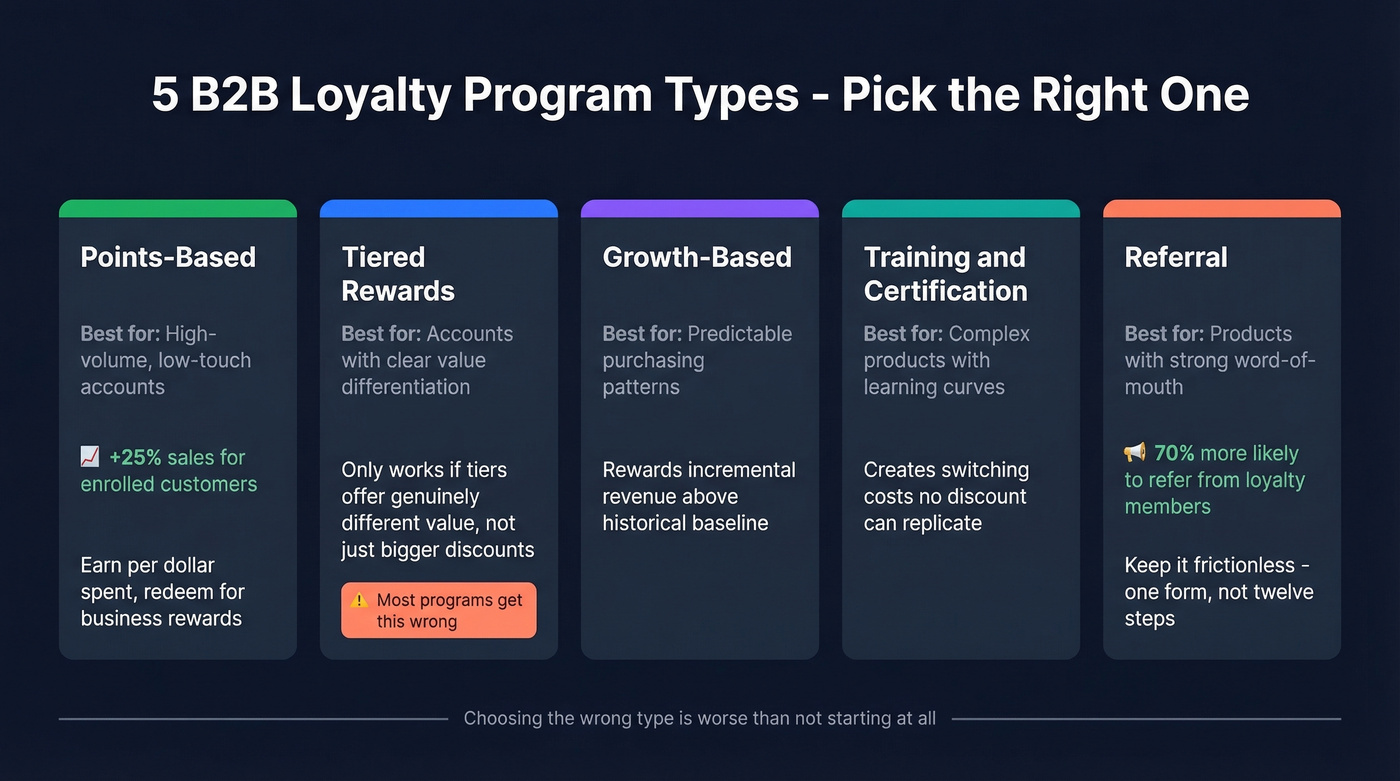
Not every program fits every business. Here are the five structures that produce results in B2B.
Points-Based Programs
The most common structure, and for good reason - it's intuitive and measurable. Customers earn points per dollar spent, redeemable for rewards aligned to their business needs.
A Canadian regional distributor launched a points-based program targeting smaller, low-touch accounts. Enrolled customers grew sales by 25% on average, compared to just 5% for non-enrolled. Customer acquisition doubled after launch. The program used double and triple bonus multipliers for priority brands, plus activity-based engagement like content consumption and surveys. That 20-point gap between enrolled and non-enrolled customers is the kind of result that justifies program investment on its own.
Tiered Rewards (But Only If You Can Differentiate)
Silver, Gold, Platinum - the psychology is straightforward. Customers see what the next level unlocks and adjust behavior accordingly.
Let's be honest: most B2B tiered programs are lazy. If the only difference between tiers is a bigger discount, you're training customers to negotiate harder, not building loyalty. Tiered programs only work when higher tiers offer genuinely differentiated value - dedicated support engineers, early access to features, or co-marketing budgets. If you can't offer that, pick a different model.
Growth-Based Programs
Remember the loyalty/incentive distinction from earlier? This is where it matters most. Growth-based programs use historical sales baselines and set realistic growth targets. Customers earn rewards on "growth dollars" - the incremental revenue above their baseline. Distributors like Ferguson, CDW, and Beacon Roofing have used this model effectively because it rewards behavior change, not just existing spend. We've seen this structure work best for companies with predictable purchasing patterns and clear upsell paths.
Training and Certification
For complex products, education is the stickiest loyalty mechanism. HubSpot's Academy and Salesforce's Trailhead are the obvious examples, but the model works for any product with a learning curve. Certified users become internal advocates who've invested time learning your platform. That investment creates switching costs no discount can replicate - and it's one of the most effective ways to build long-term relationships that survive champion turnover.
Referral Programs
Members of loyalty programs are 70% more likely to refer than non-members. The consensus on r/SaaS leans toward a commission structure of 10% on discovery engagements and 5-10% on upgrades. The key is making the referral process frictionless: a single form, not a 12-step qualification process. Referrals are also a leading indicator of repeat business - customers who refer others tend to renew at significantly higher rates themselves.
Why Most Programs Fail
Effective B2B loyalty programs deliver 13% better customer retention. But most programs never get there. Here are the six failure modes we see repeatedly.
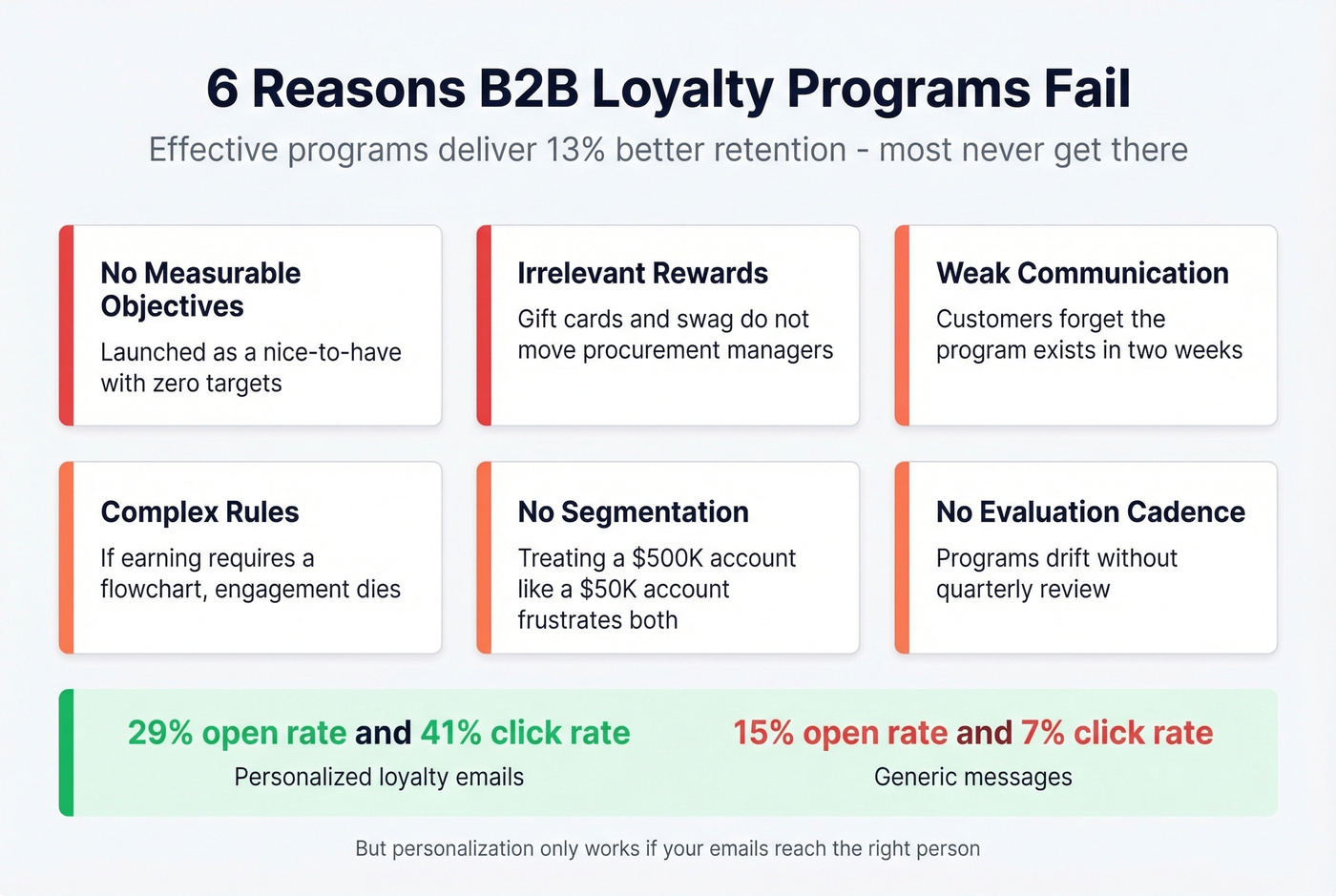
No measurable objectives. The program launches as a "nice to have" with no targets. Define specific goals before launch - repeat purchases up 20%, NRR improvement of 3 points, whatever fits your model.
Irrelevant rewards. B2C-style gift cards and swag don't move the needle for a procurement manager. Align rewards to operational needs: training credits, extended support, margin improvements, co-marketing budgets.
Weak communication. Customers forget the program exists two weeks after enrollment. Promote across every surface - website, email sequences, invoices, shared Slack or Teams channels, even email signatures. Apex Loyalty's research specifically calls out multi-surface promotion as a differentiator between programs that stick and programs that fade.
Complex rules. If earning and redemption require a flowchart, engagement dies. Simplify to one or two earning mechanics and instant or near-instant redemption.
No segmentation. Treating a $500K account the same as a $50K account frustrates both. Tier by value and behavior, with differentiated rewards and communication cadences.
No evaluation cadence. Programs drift without regular review. Run quarterly evaluations, especially when running time-bound bonus offers. Track redemption rates, inactivity, and program ROI against your defined objectives.
One stat that underscores the communication point: personalized loyalty emails generate 29% open rates and 41% click rates, compared to 15% opens and 7% clicks for generic messages. But personalization only works if your emails actually reach the right person.
The Data Foundation Nobody Talks About
Your best customer just churned and nobody saw it coming. Their champion left three months ago and nobody updated the CRM. The loyalty emails kept going to a dead inbox. The renewal conversation happened with someone who'd never used your product.
This is the unsexy truth about retention programs: it doesn't matter how sophisticated your strategy is if your contact data is stale. Personalized emails bounce. Tiered communications hit the wrong stakeholder. Intent signals go unmonitored because nobody's watching the right accounts.
Before you invest in a loyalty platform, verify your contact data. A 7-day data refresh cycle catches job changes and role shifts before they become blind spots - compare that to the 6-week industry average, and you start to see why so many "personalized" loyalty programs are really just automated messages to dead inboxes.

Catching churn signals before they become cancellations requires intent data you can act on. Prospeo tracks 15,000 Bombora topics so you can see which accounts are researching competitors - then layer that with job changes, headcount shifts, and technographic signals to prioritize your at-risk accounts.
Stop losing accounts you could have saved with better signals.
Building a Retention Strategy That Scales
Don't try to launch a full enterprise loyalty program in one sprint. Phase it.
Phase 1: Audit and clean your contact data. Get your CRM accurate before anything else. Enrichment tools start as low as ~$0.01/email with no contracts.
Phase 2: Define measurable objectives. NRR target, retention improvement, expansion revenue goal. Write them down. Get leadership buy-in.
Phase 3: Select your program type based on your business model and customer base. Skip this if you haven't completed Phase 2 - launching without targets is how programs die quietly.
Phase 4: Pilot with your middle-60% accounts. Not your top tier (they're already loyal) and not your bottom tier (they aren't worth the investment). In our experience, the middle is where loyalty programs create the most incremental value.
Phase 5: Quarterly evaluation cadence. Review, adjust, iterate. The companies that sustain long-term customer relationships treat their loyalty program as a living system, not a set-and-forget initiative.
| Component | Mid-Market | Enterprise |
|---|---|---|
| Loyalty platform | $500-$2,000/mo | $25K-$250K+/yr |
| Reward budget | 1-3% of revenue | 3-5% of revenue |
| Data foundation | Free-$100/mo | $200-$500/mo |
| Timeline to pilot | 4-8 weeks | 3-6 months |
The biggest risk isn't picking the wrong loyalty platform. It's launching before your data foundation is solid and watching personalization fall flat from day one.
If you want a tighter retention operating system, start with churn analysis and a clean definition of what churn means for your business.
FAQ
What's the difference between B2B and B2C loyalty programs?
B2B programs target buying committees on contract cycles measured in months or years, rewarding economic value like training and co-marketing. Switching costs are inherently higher, so programs focus on deepening strategic partnerships rather than preventing defection through discounts.
How do you measure B2B customer loyalty?
Net Revenue Retention is the primary metric - top-quartile B2B SaaS companies at 113% NRR trade at 24x EV/Revenue versus 5x for bottom-quartile. Layer in product usage trends, expansion revenue as a percentage of ARR, and intent data to detect early churn signals. NPS serves as a diagnostic, not a goal.
How much does a B2B loyalty program cost?
Mid-market platforms run $500-$2,000/mo while enterprise implementations range from $25K-$250K+/year depending on complexity. Budget 1-5% of influenced revenue for rewards. Data foundation tools start free, with paid plans from ~$39/mo.
What's the first step before launching a loyalty program?
Clean your contact data. Every personalization tactic depends on reaching the right person at the right time. CRM enrichment tools with weekly refresh cycles ensure your communications reach current decision-makers, not stale inboxes left behind after job changes.