

Best B2B Data Providers in 2026 (Tested & Compared)
A RevOps lead we know ran a three-tool bake-off last quarter. The "best" database - biggest brand name, fattest contract - created 4,000 duplicate contacts in Salesforce in five days. The cheapest tool had better phone connect rates. The lesson: brand recognition doesn't equal data quality, and price doesn't predict accuracy.
B2B data is a market where at least 23% of your email list degrades every year. That means roughly a quarter of the contacts you're paying for right now are already dead. Bad data costs U.S. businesses an estimated $3.1 trillion annually, and most of that damage happens quietly - bounced emails, wasted rep time, torched sender reputation.
Here's the thing most vendors won't tell you: the best data stack for 90% of teams isn't one all-in-one platform. It's a strong primary database paired with a verification layer. The all-in-one pitch exists because it's easier to sell, not because it produces better results.
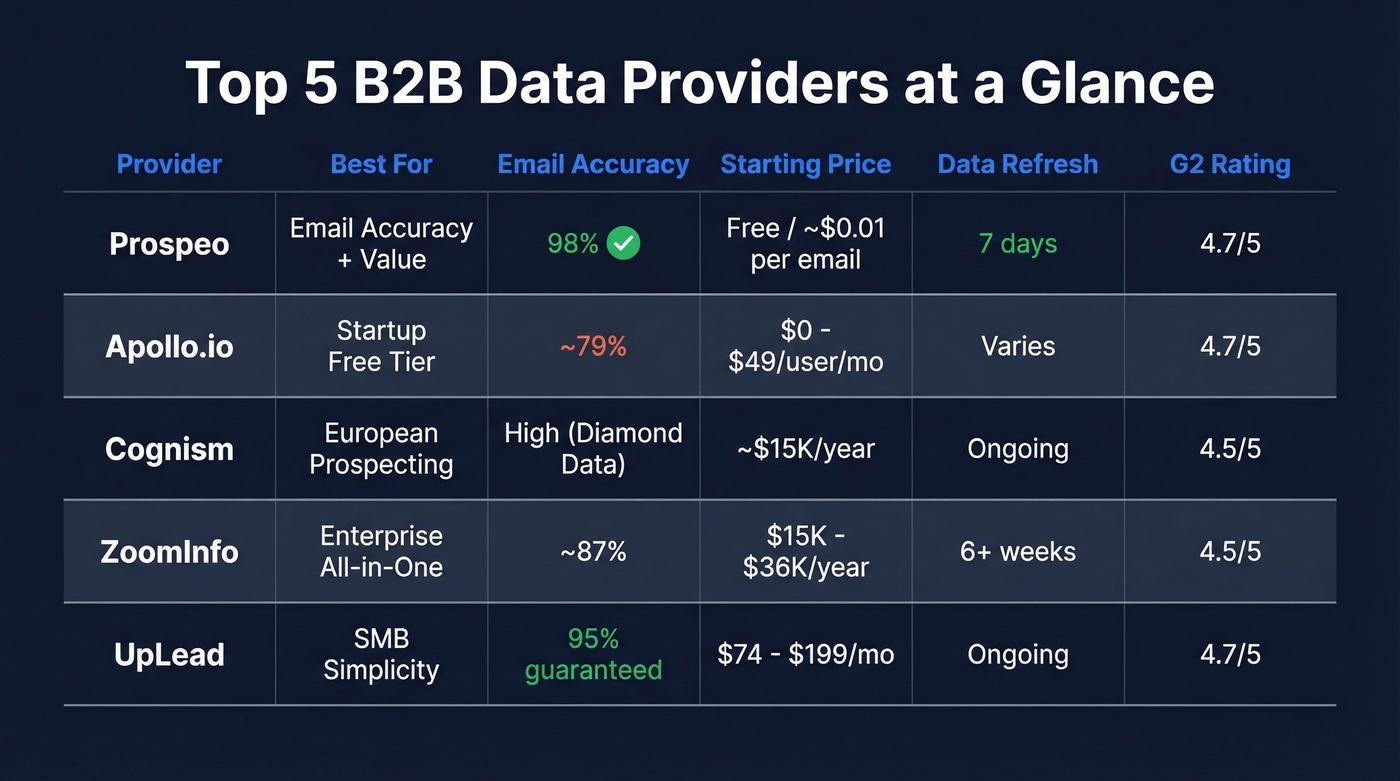
Our Picks (TL;DR)
| Use Case | Pick | Why |
|---|---|---|
| Email accuracy + value | Prospeo | 98% email accuracy, 7-day refresh, starts free |
| Free tier for startups | Apollo.io | Generous free plan + built-in sequencing |
| European prospecting | Cognism | Diamond Data for EMEA mobile numbers |
| Enterprise all-in-one | ZoomInfo | Deepest feature set - if you can stomach the price |
| SMB simplicity | UpLead | Clean UI, 95% accuracy guarantee, transparent pricing |
How We Evaluated
We didn't just read feature pages. Six things determine whether a data provider helps or hurts your pipeline:
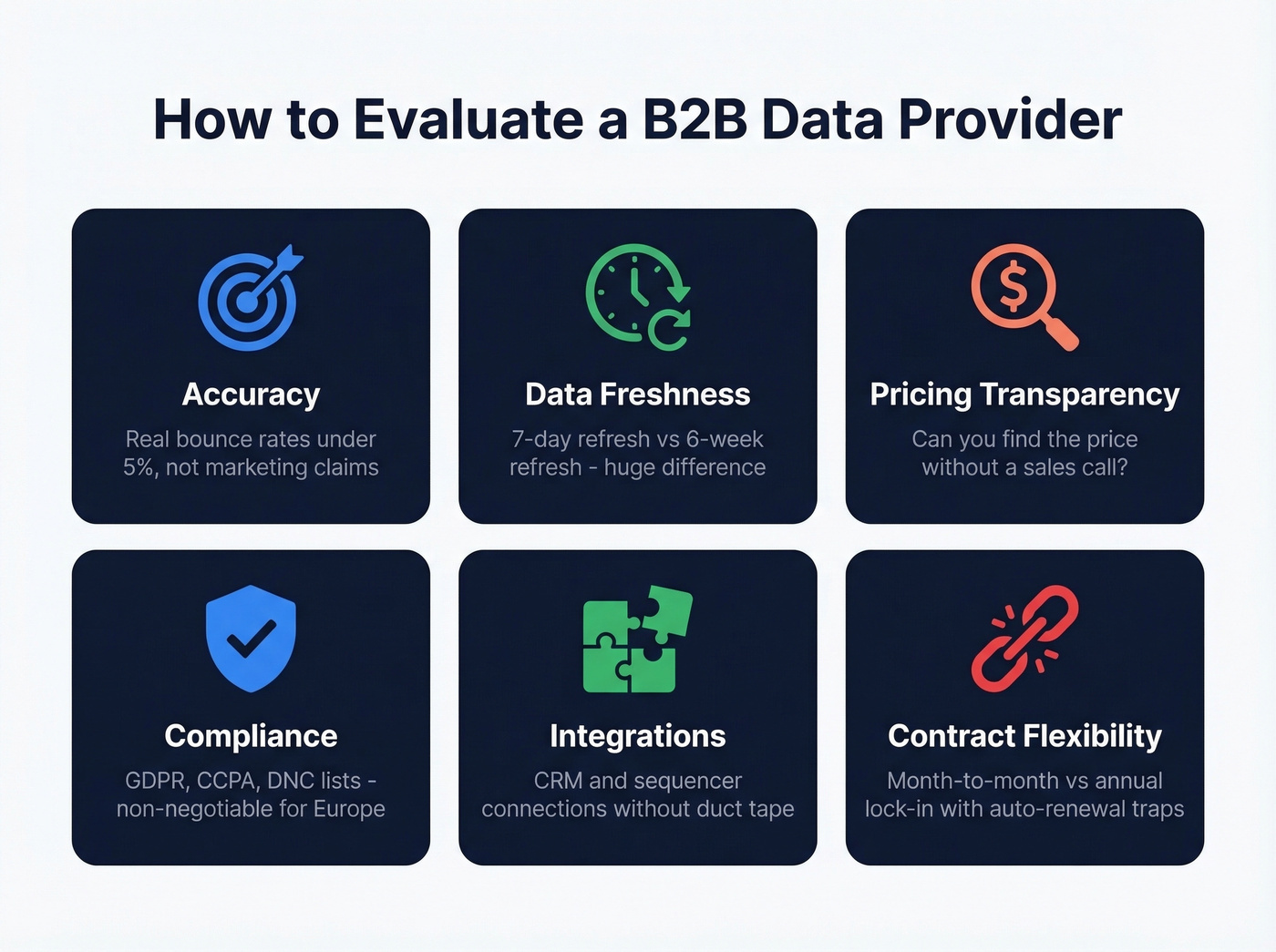
- Accuracy - measured by real bounce rates, not marketing claims. Any provider saying "95%+" should deliver under 5% bounces on a clean test.
- Data freshness - how often records get refreshed. A 7-day cycle and a 6-week cycle produce very different results.
- Pricing transparency - can you find the price without a sales call? Credit mechanics, rollover rules, and overage costs matter.
- Compliance - GDPR, CCPA, DNC list handling. Non-negotiable if you sell into Europe (see B2B compliance).
- Integration ecosystem - does it plug into your CRM and sequencer without duct tape?
- Contract flexibility - annual lock-in with auto-renewal traps vs. month-to-month self-serve.
Getting this right upfront saves you from expensive mistakes six months into a contract.
The Best B2B Data Providers in 2026
Prospeo - Best for Email Accuracy
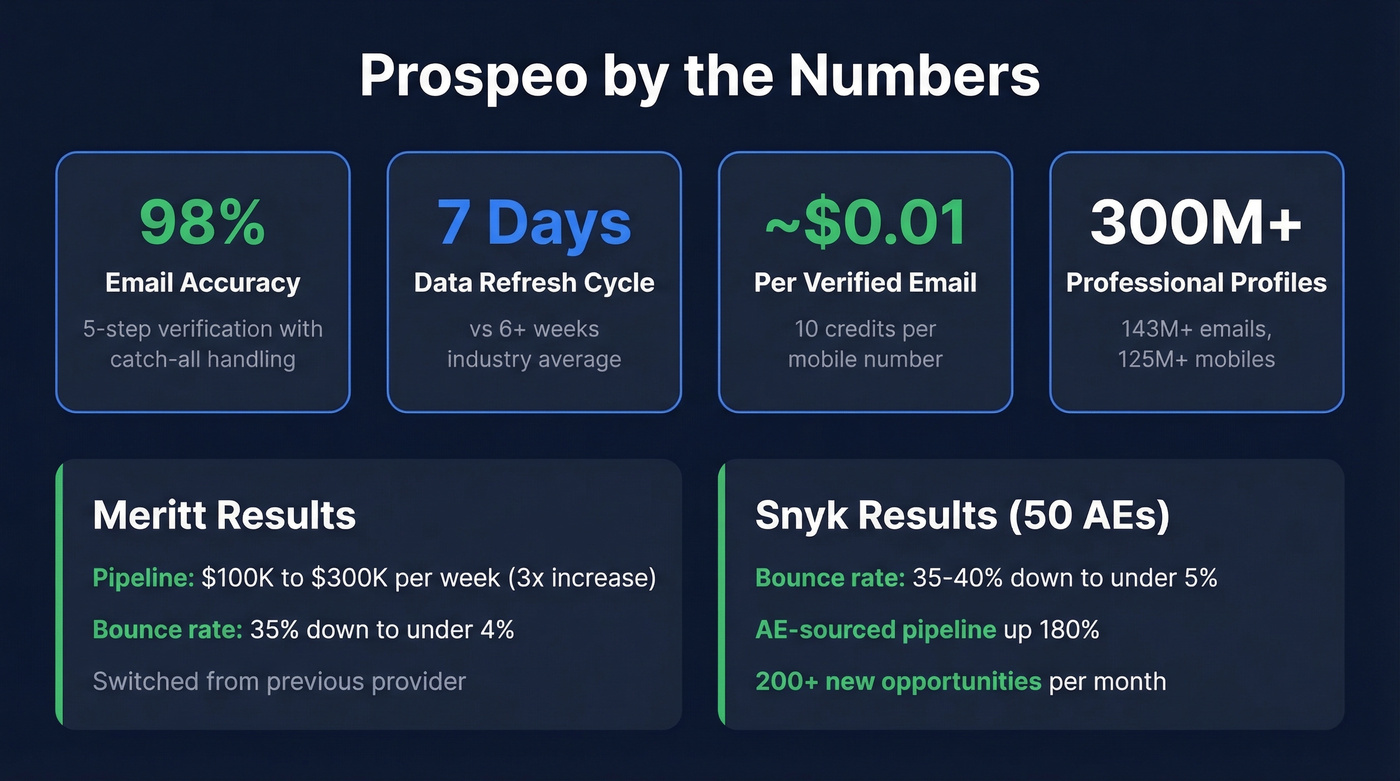
Prospeo delivers 98% verified email accuracy through a proprietary 5-step verification process with catch-all handling, spam-trap removal, and honeypot filtering - all running on its own email-finding infrastructure rather than relying on third-party providers. The database covers 300M+ professional profiles, 143M+ verified emails, and 125M+ verified mobile numbers with a 30% pickup rate, refreshed on a 7-day cycle. Over 15,000 companies use it, with 40,000+ Chrome extension users.

The 30+ search filters - buyer intent across 15,000 Bombora topics, technographics, job changes, headcount growth, funding - let you build precise ICP lists without exporting garbage. Native integrations with Salesforce, HubSpot, Lemlist, Instantly, Smartlead, Clay, and Zapier keep your workflow clean.
Pair with a sequencer if you want end-to-end outbound. Prospeo handles the data; your sequences actually land because the emails are verified (more on picking a verifier in our guide to the best email verifier tools).
The proof is in the numbers. Meritt tripled their pipeline from $100K to $300K/week after switching, with bounce rates dropping from 35% to under 4%. Snyk's 50 AEs saw bounce rates fall from 35-40% to under 5%, with AE-sourced pipeline up 180% and 200+ new opportunities per month. At ~$0.01 per email and 10 credits per mobile, the unit economics crush anything else on this list. Free tier: 75 emails and 100 Chrome extension credits monthly - no contract, no sales call.

You just read that 23% of your email list decays every year. Prospeo refreshes every 7 days - not 6 weeks like the industry average. That's why Snyk's 50 AEs saw bounce rates drop from 35-40% to under 5% and added 200+ new opportunities per month.
Run your next provider bake-off with data that's actually fresh.
ZoomInfo - The Enterprise Tax
ZoomInfo is the default. It's also the platform most teams realize they're overpaying for within six months.
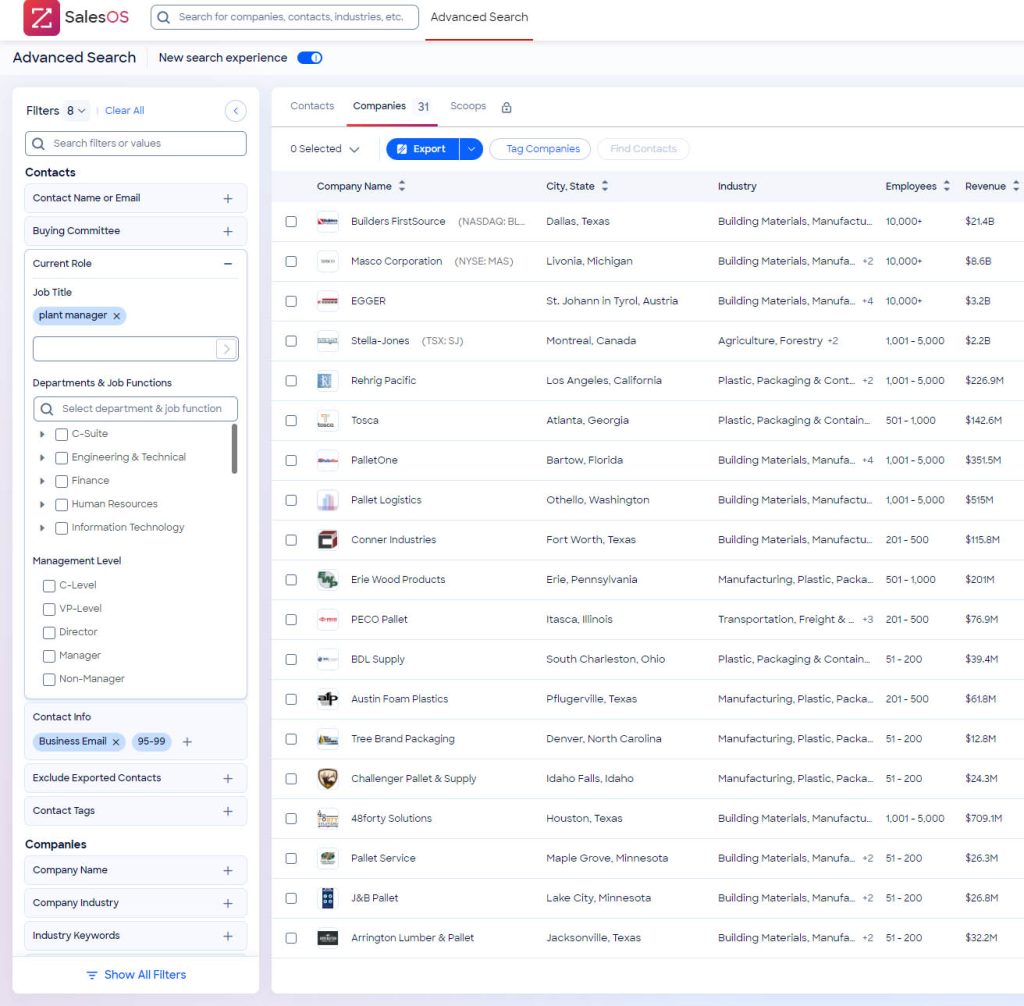
The feature set is unmatched for mid-market and enterprise teams that need intent data, engagement tools, website visitor tracking, and deep firmographic coverage under one roof. Nobody else bundles this much into a single contract (if you're evaluating broader options, see our roundup of the best B2B databases).
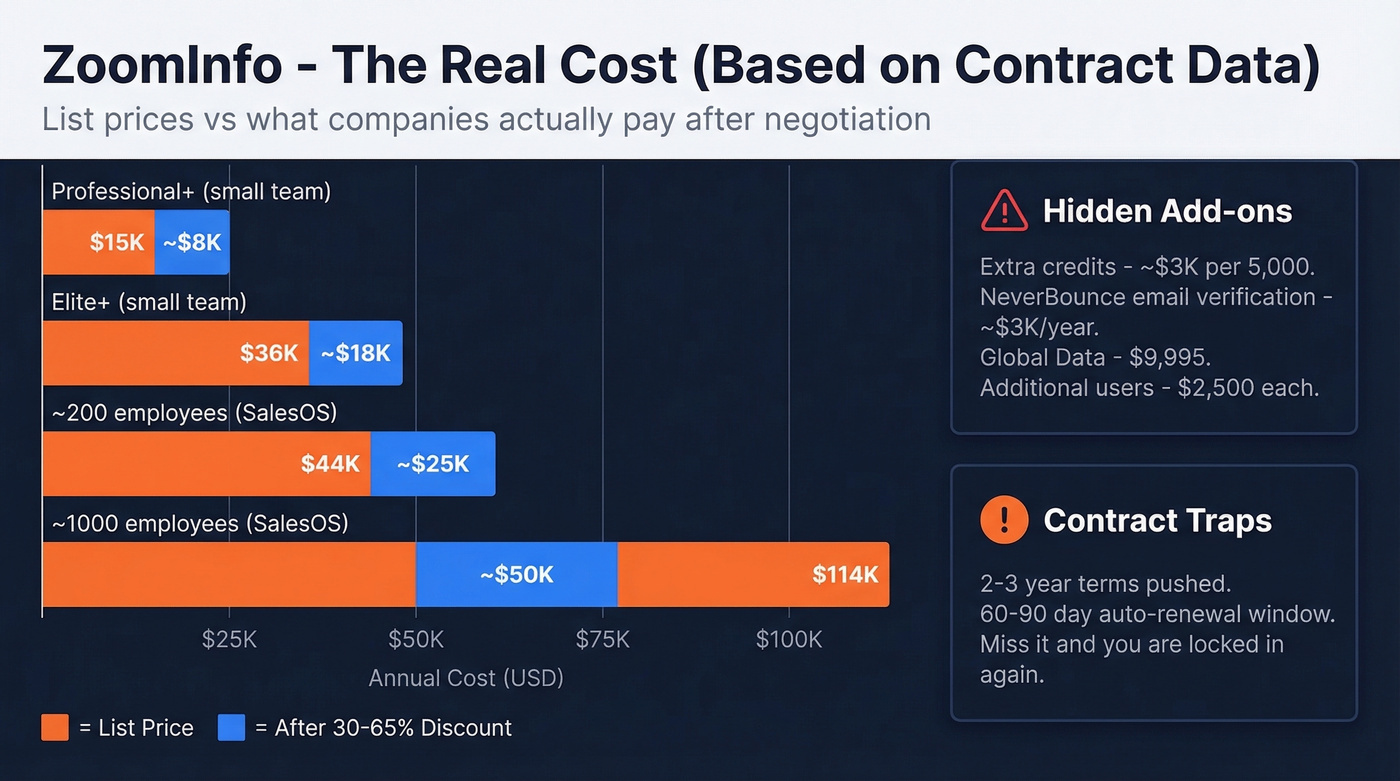
The real cost is where it gets ugly. Tropic's analysis of real contracts shows list prices of $14,995/year (Professional+) to $35,995/year (Elite+), with additional users at $2,500 each and Global Data at $9,995. Need extra credits? That's ~$3,000 per 5,000 credits. Want email verification? NeverBounce adds another ~$3,000/year. Vendr data puts the real spend for ~200-employee companies at $24,800-$44,200 for SalesOS; at ~1,000 employees, $50,200-$113,800. Discounts of 30-65% are common, but you'll fight for them.
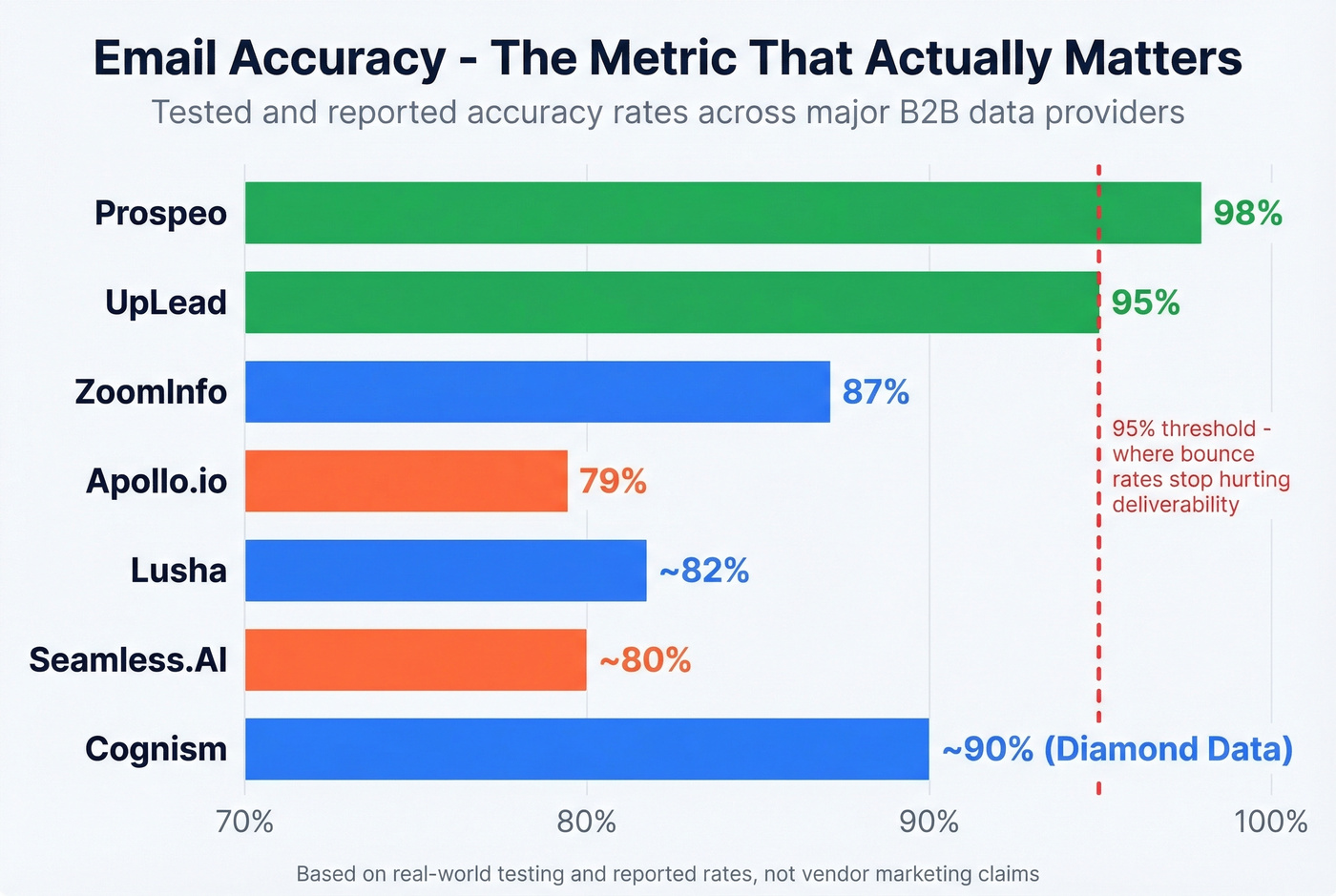
The contract structure is the real gotcha. ZoomInfo pushes 2-3 year terms with auto-renewal windows of 60-90 days. Miss that window and you're locked in for another year at a higher rate. Email accuracy sits around 87% - solid but not exceptional given the price tag. G2: 4.5/5 across 8,875 reviews. The most common complaint? Price.
Skip this if you're a Series A company or a team under 20 reps. A 10-seat contract with intent data and mobile numbers can run $25K-$45K/year after negotiating.
Apollo.io - Best Free Tier for Startups
Apollo is the obvious starting point for most SMB teams, and for good reason. The free tier is genuinely useful - not a teaser, but a real prospecting tool with built-in sequencing. Paid plans run $49/user/month (Basic), $79/user/month (Professional), and $119/user/month (Organization, minimum 3 seats).
Use this if: You're a startup or small team that needs a database and a sequencer in one tool without paying for two platforms (for more outbound tooling options, see outbound email automation). Apollo's G2 rating of 4.7/5 across 9,250 reviews reflects genuine user satisfaction.
Skip this if: Email accuracy is your top priority. Apollo's email accuracy sits around 79% in practice - run a 5,000-contact campaign and you'll feel the difference. Credits don't roll over, so unused credits evaporate at the end of each billing cycle. That's real money disappearing if your team has an off month.
Cognism - Best for European Prospecting
We've watched teams spend three months trying to make ZoomInfo work for UK and DACH prospecting before switching to Cognism. The difference in mobile connect rates was immediate.
Cognism's Diamond Data is the differentiator - human-verified mobile numbers focused on EMEA markets. They track 20,000+ technologies and layer Bombora intent data (up to 12 topics from 11,000+ options) on top. For European prospecting, nobody else comes close (if you're deciding between the two, see Cognism vs Prospeo).
Where Cognism wins: EMEA compliance, mobile verification, and GDPR-first data sourcing. Diamond Data mobile numbers in the UK and DACH are genuinely superior to anything ZoomInfo offers in those regions.
Where it falls short: US coverage is noticeably weaker. The platform fee model - estimated at ~$15K/year (Grow) to ~$25K/year (Elevate) plus $1,500-$2,500/user/year - gets expensive fast for small teams. Export limits are strict: Grow gives you 3 lists with 250 contacts per list; Elevate bumps that to 10 lists with 500 contacts per list. A "fair use" policy caps most users at roughly 2,000 records/user/month, and hidden costs like onboarding ($2,000-$5,000) and API overages ($5,000-$15,000/year) can surprise you. G2: 4.5/5 across 1,200 reviews.
Lusha - Best for Quick Lookups
Lusha's credit system is straightforward: 1 credit per email, 10 credits per phone number. The free plan gives you 70 credits monthly, and on monthly paid plans, unused credits roll over up to 2x your limit - a nice touch that Apollo doesn't offer. Pro runs $22.45/user/month and Premium $52.45/user/month on annual billing.
The Chrome extension is fast and the UI is clean, but accuracy is the weak spot. The consensus on r/sales is lukewarm - one user put it bluntly: they'd been using Lusha and "haven't been too impressed." Renewal hikes of 8-15% are commonly reported, so budget accordingly. Salesforce and HubSpot integrations are gated to the Scale plan (custom pricing, typically $40-$60/user/month). G2: 4.3/5 across 1,566 reviews - the lowest rating among Tier 1 providers here.
UpLead - Best for SMB Simplicity
You're an SMB that wants transparent pricing and a clean interface without credit complexity? This is your pick. UpLead's pricing page is refreshingly clear: Essentials at $99/month (170 credits), Plus at $199/month (400 credits), or $74/month billed annually for 2,040 credits. They guarantee 95% email accuracy - and in our experience, they deliver close to it. The 7-day free trial with 5 credits lets you test before committing. G2: 4.7/5 across 780 reviews.
Skip this if you need intent data, engagement tools, or a massive database. UpLead is a focused data tool, not a platform play.
Seamless.AI - Real-Time Search
Real-time search engine that finds data on demand rather than pulling from a static database. Reps who prospect directly - rather than building lists in bulk - tend to like the workflow. Free tier gives you 50 credits. Pro and Enterprise pricing is via sales; typically ~$147-$300/month. The most consistent complaints on review sites are aggressive upselling and contract lock-in. G2: 4.2/5 across 1,400 reviews.
Lead411 - Intent on a Budget
Plans start around $49-$99/month depending on tier, and Bombora intent data is included at higher tiers. For teams that want to prioritize accounts showing buying signals without ZoomInfo pricing, it's a solid mid-market option. Database is smaller than top-tier vendors, which means more gaps in niche industries. G2: 4.5/5 across 460 reviews.
RocketReach - One-Off Lookups
Basic runs $48/month (1,200 exports/year), Pro at $108/month, Ultimate at $249/month (10,000 exports/year). Decent for individual contact discovery in sales research or recruiting. Not a prospecting platform - lacks sequencing, intent, and enrichment. G2: 4.5/5 across 700 reviews.
Hunter - Email-Only Discovery
Free tier gives you 50 verifications/month. Paid plans start at $34/month. No phone numbers, no intent data - just email finding done well. Best for marketers and link builders who don't need a full sales stack. G2: 4.4/5 across 550 reviews.
Kaspr - EU Phone Numbers
Free plan available, paid plans start at $49/user/month. Strong for European phone numbers via Chrome extension - focused, affordable, but limited compared to full platforms. G2: 4.4/5 across 890 reviews.
Clay - Enrichment Orchestration
Clay isn't a data provider - it's an orchestration layer running waterfall enrichment across 75+ data sources. Starting at $149/month, it's best for RevOps teams building automated enrichment workflows (see our deeper guide on data enrichment tools). Teams choosing a database API for programmatic enrichment often pair Clay with a verification tool to ensure quality. G2: 4.8/5 across 174 reviews.
Demandbase - Enterprise ABM
Enterprise ABM platform with intent data and advertising capabilities. Custom pricing, typically $30K-$100K+/year. Best for marketing-led ABM strategies, not individual prospecting. If your SDRs are asking for Demandbase, someone's confused about the use case.
6sense - Predictive Revenue AI
Revenue AI platform with predictive intent modeling. Free plan available for basic features; enterprise pricing runs $30K-$100K+/year. Best for large revenue teams running full-funnel ABM with predictive scoring. Overkill for anything under 500 employees.
Most B2B data providers charge $1/lead and still bounce at 13-21%. Prospeo hits 98% email accuracy at ~$0.01/lead with 125M+ verified mobiles and a 30% pickup rate. No contracts, no sales calls - 75 free emails to prove it.
Stop subsidizing bad data. Compare the numbers yourself.
Provider Comparison Table
All 14 providers, compared on the numbers that matter:

| Provider | Starting Price | Accuracy | Database Size | Best For |
|---|---|---|---|---|
| Prospeo | Free / ~$0.01/email | 98% | 300M+ profiles | Email accuracy + value |
| ZoomInfo | ~$15K/yr | 87% | 500M+ contacts | Enterprise all-in-one |
| Apollo.io | Free / $49/mo | 79% | 275M+ contacts | Startups + sequencing |
| Cognism | ~$15K/yr | ~90% (EMEA) | Not public | European prospecting |
| Lusha | Free / $22.45/mo | ~85% | Not public | Chrome extension lookups |
| UpLead | $99/mo | 95% guaranteed | 160M+ contacts | SMB simplicity |
| Seamless.AI | Free / via sales | Varies | Not public | Direct prospecting |
| Lead411 | $49-$99/mo | ~90% | Not public | Intent + mid-market |
| RocketReach | $48/mo | ~85% | 700M+ profiles | One-off lookups |
| Hunter | Free / $34/mo | ~90% (email) | Not public | Email-only |
| Kaspr | Free / $49/mo | ~85% (EU) | 120M+ EU contacts | EU phone numbers |
| Clay | $149/mo | Multi-source | 75+ sources | Enrichment workflows |
| Demandbase | ~$30K+/yr | Not public | Not public | ABM + advertising |
| 6sense | Free / ~$30K+/yr | Not public | Not public | Predictive ABM |
The Hidden Cost of B2B Data
The sticker price on a data vendor is almost never what you actually pay.
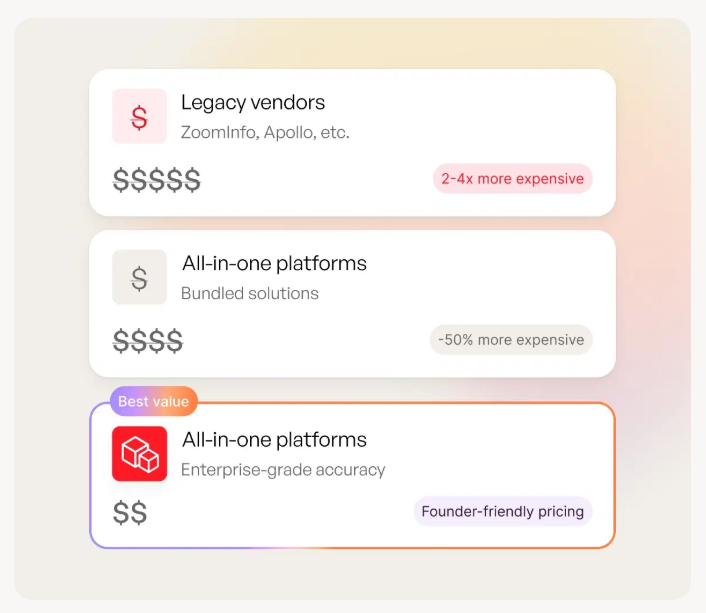
Credit mechanics are where providers make their money. Apollo's credits don't roll over - miss a month of heavy prospecting and those credits vanish. Lusha's monthly credits roll over up to 2x your limit, which is better, but phone numbers cost 10 credits each. That 70-credit free plan gets you exactly 7 phone numbers.
Contract traps compound the problem. ZoomInfo's auto-renewal windows run 60-90 days before your contract ends. Miss the cancellation window and you're locked in for another year at a higher rate. Lusha users report renewal hikes of 8-15%.
Let's do the math that actually matters. ZoomInfo's Professional plan works out to roughly $3 per credit when you divide the $15K annual cost by 5,000 credits. Add the NeverBounce email verification add-on (~$3,000/year) and a single extra credit pack (~$3,000 per 5,000 credits), and you're looking at $21K before you've even added a second user. Compare that to a tool charging $0.01 per verified email and the gap is staggering.
Per ZeroBounce's 2026 report, only 62% of emails submitted for verification were actually valid. That means roughly 38% of the data you're paying for at most providers is worthless. Add in the 9%+ of emails that are catch-alls - which can't be fully validated without sending - and the true cost of cheap data gets expensive fast (and if you're troubleshooting deliverability, start with inbox placement).
How to Choose the Right Provider
Picking a data vendor doesn't need to be a six-month procurement project. Five steps will get you to the right answer:
Test accuracy before committing. Export 100-200 contacts from your ICP, run them through an independent email verifier, and measure the bounce rate. Any provider claiming 95%+ accuracy should deliver under 5% bounces. If they don't, walk away.
Calculate cost per verified contact, not cost per credit. A $0.60 credit that returns a bounced email costs infinity. A $0.01 credit that returns a verified, deliverable email costs $0.01. The denominator matters.
Check refresh cycles. Ask every provider: "How often is this data updated?" The difference between a 7-day refresh and a 6-week refresh is the difference between reaching someone at their current job and emailing a dead address.
Confirm compliance. If you're selling into Europe, GDPR compliance isn't optional. Look for vendors that offer DPAs, enforce opt-outs globally, and source data from publicly available business information (use this GDPR compliant database checklist to sanity-check claims).
Stack two tools, not fifteen. In our experience, the best results come from teams that use one strong database for discovery and a second tool for verification before anything hits a sequence. A primary database plus a verification layer beats any single all-in-one platform for deliverability.
FAQ
What is a B2B data provider?
A company that sells verified business contact information - emails, phone numbers, firmographic data, and sometimes intent signals - to help sales and marketing teams find and reach buyers. The best ones refresh records on short cycles (7 days or less) to minimize decay and keep deliverability high.
How much does B2B data cost?
Free tiers exist at Apollo, Prospeo, and Lusha. Enterprise platforms like ZoomInfo and Demandbase run $15K-$100K+/year. Most mid-market teams spend $5K-$25K/year. Always check rollover rules, overage charges, and auto-renewal windows before signing.
How do I pick the right data vendor for my team?
Test accuracy with a small ICP export, then calculate cost per verified contact - not cost per credit. Evaluate refresh cycles, compliance certifications, and CRM integration support. The right choice depends on your prospecting geography, volume, and budget rather than brand name alone.
Can I use multiple providers together?
Yes - and most high-performing teams do. Use one provider as your primary database and a second for verification or gap-filling. A tool priced at ~$0.01/email makes an excellent verification layer that catches invalid records before they damage sender reputation.
Are these providers GDPR compliant?
Most major vendors claim GDPR compliance, but implementation varies widely. Look for Data Processing Agreements, globally enforced opt-outs, and data sourced from publicly available business information rather than scraped personal data. Cognism is particularly strong on European compliance, and Prospeo enforces opt-outs globally with DPAs available on request.