

Best B2B Email Data Providers in 2026: Pricing, Accuracy, and Real Bounce Rates
You export 1,000 leads on Monday. By Thursday, 340 have bounced, your domain reputation is flagged, and your sequences are landing in spam. That's not a hypothetical - B2B email data decays at roughly 22.5% per year, with ~2.1% of your list going stale every month. A study of 1,000 business cards found 70.8% had at least one change within 12 months, and 37.3% of those changes were email addresses.
The cost hits your team everywhere: burned sender domains, wasted sequences, reps spending hours chasing dead leads. Scale that across every sales org in the country and IBM's $3.1 trillion annual cost-of-bad-data figure starts making sense. Gartner puts it at $15M per year for the average enterprise. This isn't about buying static lists - those are compliance nightmares with 30%+ bounce rates. We're evaluating platforms that maintain verified email databases and refresh data continuously.
Our Picks (TL;DR)
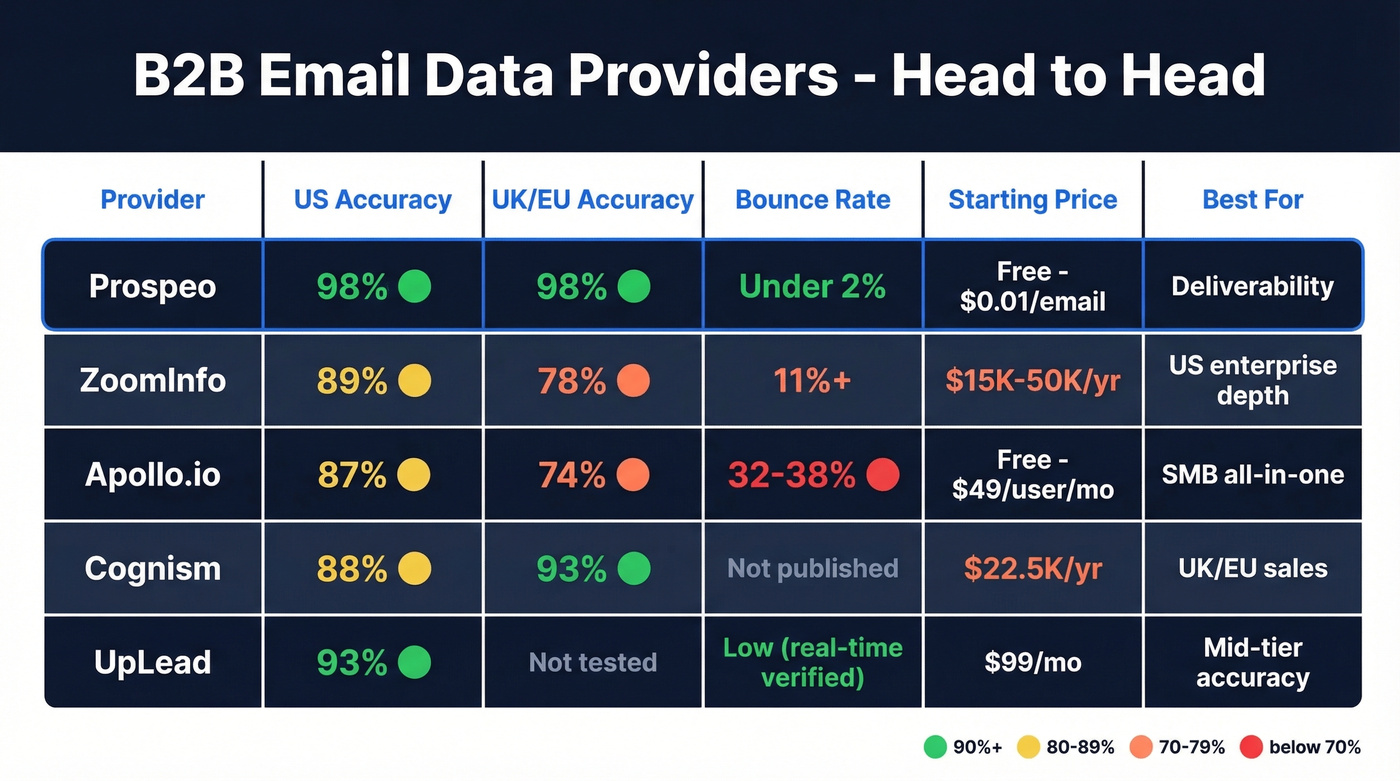
| Tool | Best For | Accuracy | Starting Price | Verdict |
|---|---|---|---|---|
| Prospeo | Email accuracy + freshness | 98% verified | Free -> ~$0.01/email | Best for deliverability |
| Apollo.io | All-in-one on a budget | ~87% (US) | Free -> $49/user/mo | Best free tier |
| UpLead | Real-time verification | ~93% (US) | $99/mo | Best mid-tier accuracy |
How We Evaluated
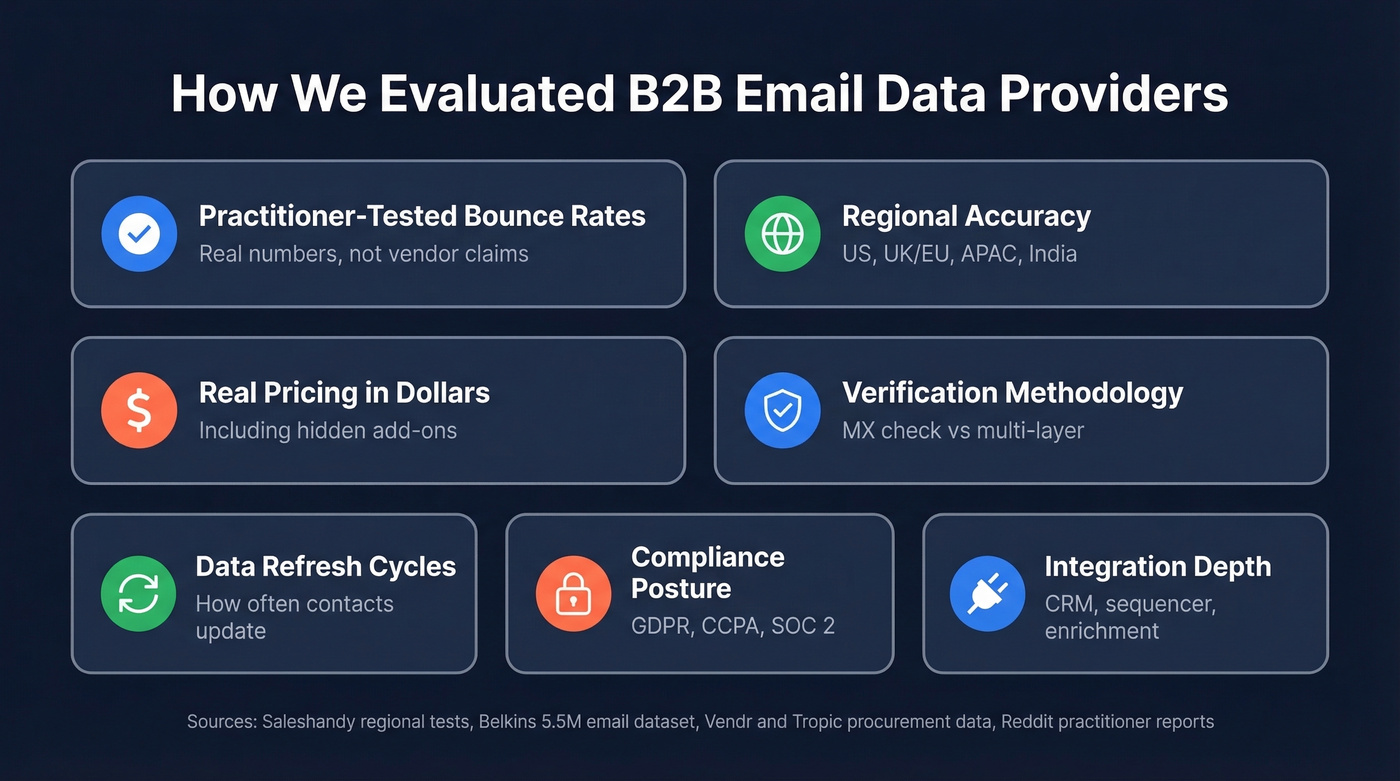
We ranked on practitioner-tested bounce rates (not vendor claims), regional accuracy breakdowns, real pricing in dollars, verification methodology, data refresh cycles, compliance posture, and integration depth. We pulled from Saleshandy's regional accuracy tests - their own tool ranked highest in their study, so take that with appropriate skepticism - along with Reddit practitioner reports, Belkins' 5.5M-email deliverability dataset, and procurement intelligence from Vendr and Tropic. Where we had gaps, we estimated from community discussions and our own bake-offs.
Best B2B Email Data Providers
Prospeo - Best for Verified Email Accuracy
Prospeo's database covers 300M+ professional profiles, 143M+ verified email addresses, and 125M+ verified mobile numbers - all on a 7-day refresh cycle. That refresh cadence matters more than raw database size.
The 98% email accuracy comes from a proprietary 5-step verification process that includes catch-all domain handling, spam-trap removal, and honeypot filtering. This isn't an MX-record check. It's multi-layer infrastructure Prospeo owns, independent of third-party email providers. Search filters span 30+ options: buyer intent powered by 15,000 Bombora topics, technographics, job change signals, headcount growth, and funding data.

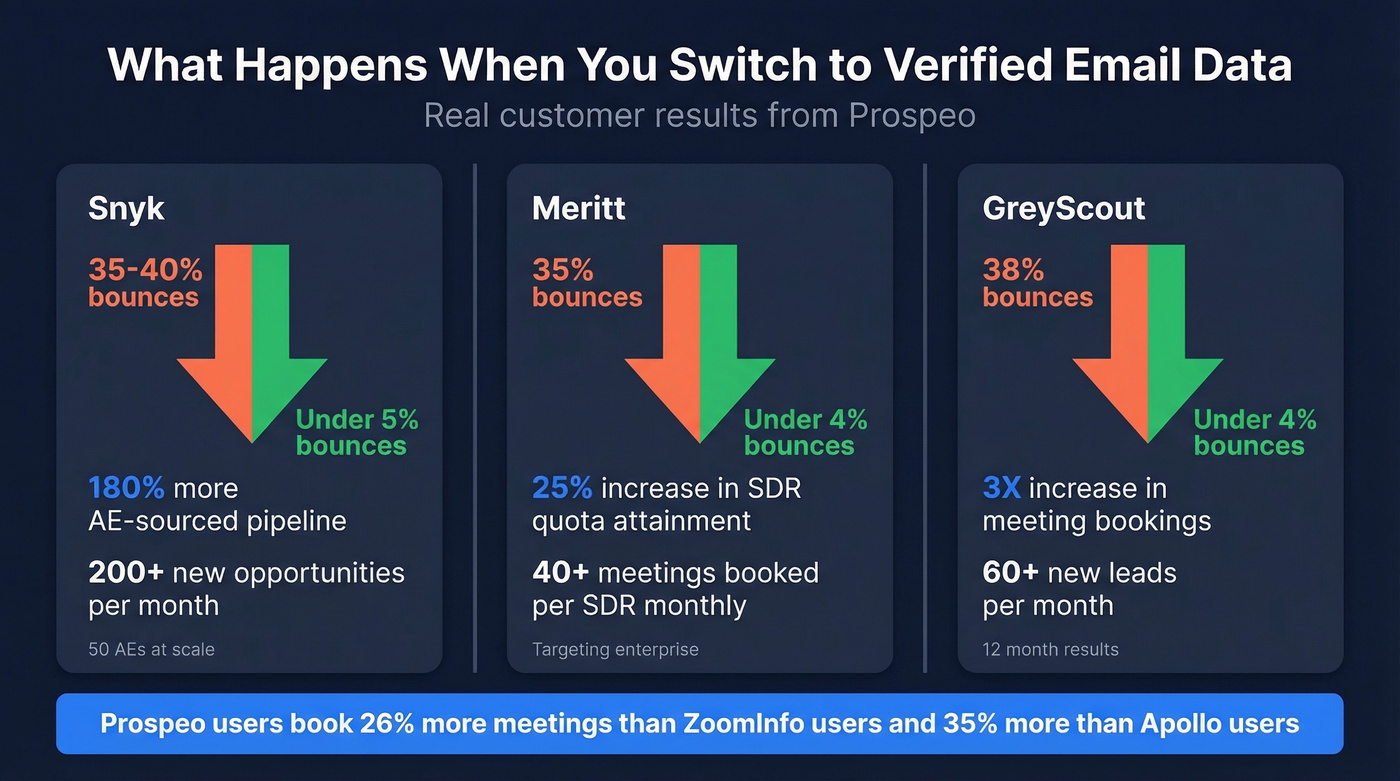
Customer results tell the story better than we can. Meritt dropped bounces from 35% to under 4%. Snyk went from 35-40% bounces across 50 AEs down to under 5%, which translated into 180% more AE-sourced pipeline and 200+ new opportunities per month. GreyScout saw 38% collapse to under 4%. Teams using Prospeo book 26% more meetings than ZoomInfo users and 35% more than Apollo users - a direct consequence of higher deliverability.
Pricing starts free (75 emails/month), paid plans run ~$0.01 per email with no contracts. Integrations cover Salesforce, HubSpot, Smartlead, Instantly, Lemlist, Clay, and Zapier.
ZoomInfo
ZoomInfo is the incumbent, and the pricing reflects it. Professional starts at $14,995/year for 3 seats, Advanced at $29,995, Elite at $35,995. Add Global Data ($9,995), extra credits (~$3,000 per 5,000), and NeverBounce verification (~$3,000), and many teams report paying $40K-$50K+ annually.
You can negotiate 30-65% discounts, especially at renewal. But credit economics are brutal - at Professional tier, you're paying roughly $3/credit, and we've seen teams where 60% of credits expired unused last quarter.
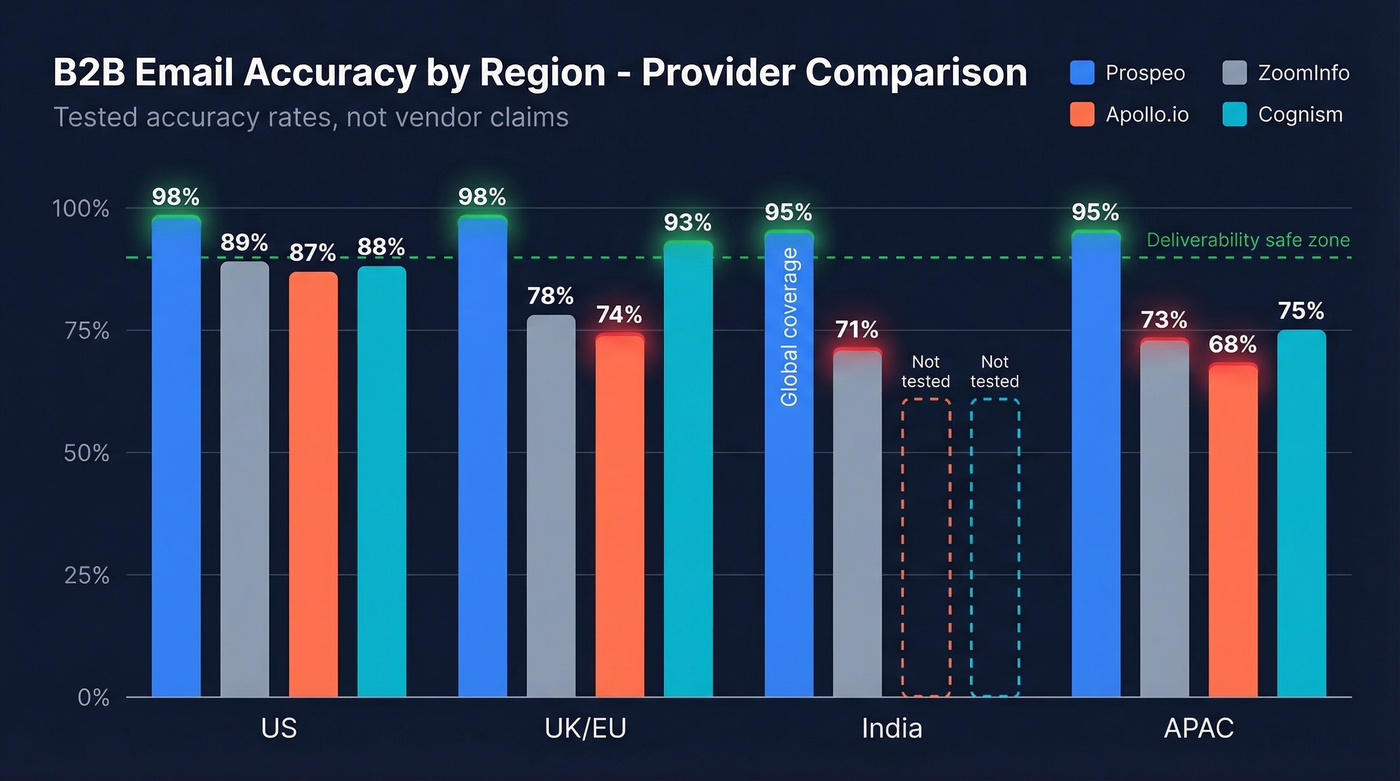
Tested accuracy runs 89% in the US, 78% in UK/EU, 71% in India, and 73% in APAC. ZoomInfo's MCP access for AI agents is interesting, but irrelevant if the underlying data bounces at 11%+ outside the US. Where ZoomInfo still wins: US business email database depth, intent data maturity, and workflow breadth. Where it loses: price-to-accuracy ratio and anything outside North America.
Watch out for: Annual contracts with auto-renewal. Read the terms before you sign.
Apollo.io
Apollo is the default starting point for SMB teams. The free tier is functional enough to run up to 2 sequences with limited contact access. Paid plans run $49/mo (Basic), $79/mo (Professional), $119/mo (Organization, minimum 3 seats).
Here's the thing: Apollo's contact data needs external verification. Practitioner tests on r/coldemail show bounce rates of 32-38% on exported lists verified through NeverBounce. Regional accuracy tested at 87% US, 74% UK/EU, 68% APAC. If you're relying on Apollo as your sole email database, expect to layer a verification tool on top (or pick from the best email verifier tools).
The credit system is the other trap. Credits don't roll over, phone number reveals cost 5 credits each, and the "new credit system" migration has created confusion about what you actually get per plan. Apollo is excellent for prospecting workflows and sequencing - just don't trust the emails without a verification layer.
Cognism
Use this if: You sell into the UK and EU and need GDPR-compliant verified email leads with strong mobile numbers.
Skip this if: Your ICP is primarily US-based or you're budget-conscious.
Cognism's tested accuracy hits 93% in UK/EU - the best number in that region among the providers we compared. US accuracy drops to 88%, APAC to 75%. Grow runs ~$22,500/year for 5 users, Elevate ~$37,500/year, with onboarding adding $2K-$5K. Diamond Data (human-verified mobile numbers) and intent data are paid add-ons. Vendr data shows you can negotiate Grow down 28-43% and Elevate 36-52%. Cognism is the right choice for EU-first teams and nobody else.
UpLead
UpLead validates emails in real time before download, giving you verified contacts rather than guessed patterns. Tested accuracy hits 93% in the US. Essentials starts at $99/mo, Plus at $199/mo, with a 7-day free trial.
It's the strongest accuracy guarantee among mid-tier tools and a solid middle ground between "cheap but bouncy" and "enterprise but expensive." The trade-off: UpLead is a data tool, not a full prospecting platform. No sequences, no CRM workflows. For teams that just need clean emails and don't want to build an entire tech stack around it, that's fine.
Lead411
Lead411 positions itself as the affordable ZoomInfo alternative, and the pricing backs it up: free 7-day trial, Basic around $99/mo, unlimited email exports on certain plans. Job change alerts and company funding data come included - no enterprise add-on fees. It won't match ZoomInfo's database depth, but for teams that need intent-enriched contact data without a five-figure contract, Lead411 is worth a trial.
Lusha
SOC 2 Type II certified, ISO 31700, GDPR compliant (ePrivacyseal), CCPA compliant (TrustArc). Practitioner-tested bounce rates of 22-28% - better than Apollo. Free tier with 5 phone credits, Pro at $36/user/mo, Premium at $59/user/mo. Credits burn fast, especially on the free tier. Better for mobile numbers and personal emails than bulk list building. Lusha is the compliance-first pick for teams that need a defensible contact database with auditable sourcing.
Hunter.io
Hunter built its reputation on domain-level email discovery - type in a company domain, get back every email pattern and address associated with it. Free tier gives 50 credits/month, Starter $38/mo, Growth $149/mo, Business $299/mo.
The domain search is still best-in-class for that specific use case. The problem: Hunter relies heavily on pattern guessing, and practitioner tests show 28-35% bounce rates on guessed emails. Great for domain-level research, not for building verified lists at scale (see more options in our Hunter alternatives).
Seamless.AI
Real-time search model with mixed accuracy results. Free tier is limited, Pro runs ~$147/mo annually. Seamless.AI doesn't publish pricing, which makes comparison shopping harder. Practitioner tests showed bounce rates around 20%, though results varied by segment.
RocketReach
700M+ profiles with a free tier (5 lookups/month) and paid plans starting at $39/mo. Better for one-off lookups than bulk prospecting - a research tool, not a list-building platform.
Kaspr
Free tier, Starter at $49/user/mo, Business at $79/user/mo. Strong Chrome extension for European contacts with solid mobile number coverage. US coverage is limited. When your ICP is European SMBs, Kaspr punches above its weight.

The article opens with 340 bounces out of 1,000 leads. Prospeo customers like Snyk and Meritt cut bounce rates from 35%+ to under 5% - across 50 AEs, at scale. That's what 98% verified email accuracy and a 7-day data refresh cycle deliver.
Stop paying for emails that bounce. Start at $0.01 per verified address.
What B2B Email Data Actually Costs
| Tool | Starting Price | Mid-Tier | Notes |
|---|---|---|---|
| Prospeo | Free (75/mo) | ~$0.01/email | No contracts |
| ZoomInfo | ~$15K/yr (3 seats) | $30-50K/yr | Add-ons extra |
| Apollo.io | Free (50 credits) | $49-79/user/mo | Credits expire |
| Cognism | ~$22.5K/yr (5 seats) | ~$37.5K/yr | Platform + per-user |
| UpLead | $99/mo | $199/mo | Verification included |
| Lead411 | ~$99/mo | Unlimited exports | Certain plans |
| Lusha | Free (5 credits) | $36-59/user/mo | Credits burn fast |
| Hunter.io | Free (50/mo) | $38-299/mo | Domain search focus |
| Seamless.AI | Free (limited) | ~$147/mo | Pricing opaque |
| RocketReach | Free (5/mo) | Starting at $39/mo | Lookup-focused |
| Kaspr | Free | $49-79/user/mo | EU-focused |
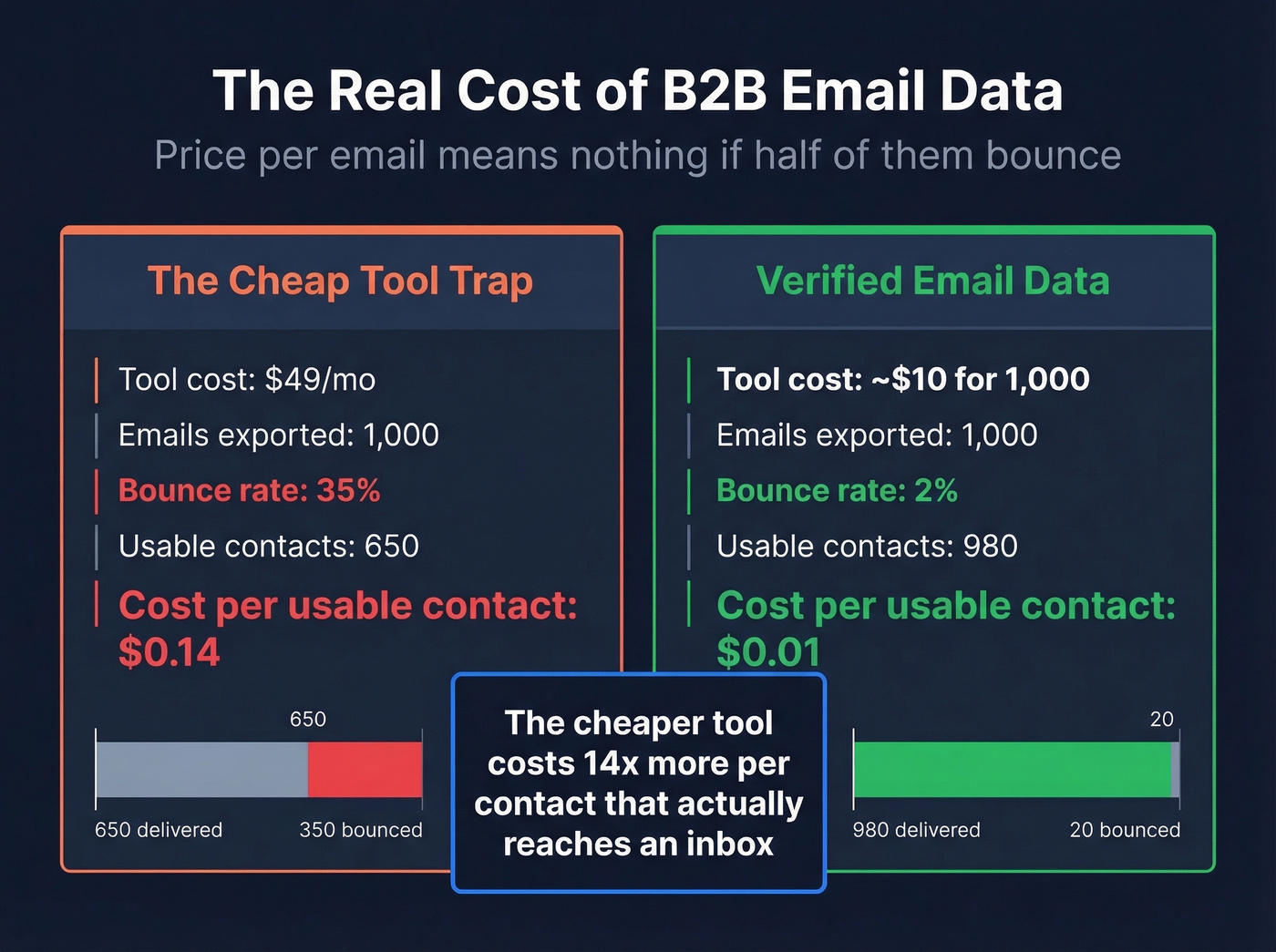
Let's talk about the math that actually matters. Apollo at $49/mo with a 35% bounce rate means 350 out of every 1,000 emails are wasted - cost per usable contact lands around $0.14. A tool charging $0.01/email with a 2% bounce rate gives you 980 usable contacts per 1,000. The "cheaper" tool is more expensive per usable lead, and it's not even close.
Hot take: If your average deal size is under $10K, you almost certainly don't need ZoomInfo-level data. You need verified emails that actually reach inboxes. Those are different things, and the price gap between them is $15K-$50K per year.
Layering a separate verification tool on top of your B2B email data provider means extra cost and extra friction. Prospeo's proprietary 5-step verification - catch-all handling, spam-trap removal, honeypot filtering - is built in. 143M+ emails, already verified, refreshed weekly.
Clean B2B email data without the verification tax. 75 free emails to prove it.
Real-World Bounce Rates
Vendor accuracy claims are marketing. Practitioner-tested bounce rates are reality.
| Source | Bounce Rate |
|---|---|
| Apollo.io (practitioner test) | 32-38% |
| Hunter/Snov (practitioner) | 28-35% |
| Lusha (practitioner) | 22-28% |
| Seamless.AI (practitioner) | ~20% |
| Waterfall enrichment (Clay + 3-4 sources) | 10-14% |
| Meritt (Prospeo case study) | Under 4% |
| Snyk (Prospeo, 50 AEs) | Under 5% |
| GreyScout (Prospeo case study) | Under 4% |
The 2% total bounce threshold is the operational standard for cold email. Anything above 5% risks domain reputation damage. Above 10% and you're actively hurting future deliverability (see: email reputation check and how to check domain reputation).
Waterfall enrichment - running contacts through Clay with 3-4 data sources stacked - gets bounce down to 10-14%. That's the best result most teams achieve with multi-tool setups. The Reddit consensus on r/coldemail is clear: no single provider is perfect, but single-source verified output beating waterfall results at under 4% without the complexity or multi-tool cost is the exception worth paying attention to.
Belkins' analysis of 5.5 million emails adds another wrinkle. Gmail addresses bounce at just 1.96% on average, while Outlook bounces at 6.95% - roughly 3x higher. Seasonality matters too: deliverability peaked at 99.19% in January and dropped to 92.53% by November. Plan your biggest campaigns for Q1.
Data Freshness Beats Database Size
Database size is the most overrated metric in B2B data.
RocketReach touts 700M+ profiles. Apollo covers 275M+ contacts. But if those records were last verified six months ago, a significant chunk is already dead. We've run into this ourselves - a massive database sounds impressive until you realize you're paying for records that haven't been touched since last summer.
Contact records decay at ~2.1% per month. With 15-20% of professionals changing jobs each year and 10-15% of email addresses changing, a database that refreshes every six weeks is already serving stale records. The gap between a 7-day refresh cycle and the 6-week industry average is the difference between emailing someone at their current company and emailing a dead address at a company they left two months ago. 143M verified addresses refreshed weekly beats 700M records on a six-week cycle - that's the core argument for freshness over raw volume (and why teams invest in data enrichment tools and verified contact databases).
GDPR Compliance Checklist
GDPR treats names, work emails, and job titles as personal data - even in B2B contexts. Any provider serving as your data source needs to meet these standards:
- Lawful basis documented. Legitimate interest works for B2B outreach, but you need a documented assessment showing relevance to the recipient's professional role.
- Transparency on first contact. Your email must identify who you are and why you're reaching out.
- Clear opt-out in every message. One click, no friction. Honor it immediately.
- Suppression list maintained. When someone opts out, they stay out - across all campaigns, permanently.
- Data minimization practiced. Only collect and store what you need. Hoarding 50 fields "just in case" is a compliance risk.
FAQ
Is it legal to buy B2B email lists?
Yes, under GDPR's legitimate interest basis, provided the outreach is relevant to the recipient's professional role, you're transparent about who you are, and you include a clear opt-out. CAN-SPAM requires accurate headers, a physical address, and an unsubscribe mechanism. The key distinction is between buying a static list and using a platform that provides verified addresses with ongoing compliance controls.
What's a good bounce rate for B2B email campaigns?
Keep total bounces below 2% and hard bounces under 1%. Anything above 5% risks domain reputation damage that affects all future sends. Practitioner tests show unverified lists from popular tools regularly hit 20-38% bounce rates.
How often should I refresh my contact data?
At minimum quarterly. B2B contact data decays at ~2.1% per month, so a 10,000-contact list loses roughly 210 valid entries every month. Tools with weekly refresh cycles handle this automatically, which is why refresh frequency matters more than database size.
What's the difference between email finding and email verification?
Email finding discovers a person's work email from their name and company domain. Email verification checks whether that address is actually deliverable. The best providers do both before you export - the rest make you pay for a separate verification tool on top.
Why do bounce rates vary so much between providers?
Verification methodology. Some providers guess email patterns (first.last@company.com) and call it a day. Others verify in real time against mail servers with multi-step processes including catch-all handling and spam-trap removal. Guessed emails bounce 28-38%. Verified emails from proper infrastructure bounce under 5%.