

B2B Email Verification: A Practitioner's Guide (2026)
Your B2B email database decays at 2.1% per month - roughly 22.5% annually. That means a big chunk of the contacts you're emailing today will go stale before the year's out. B2B email verification isn't optional; it's the difference between a healthy sender reputation and tanking inbox placement.
Here's the thing: most teams treat verification as a cleanup task. It's not. It's infrastructure. If you're verifying after you've already collected bad data, you've already lost time and money. The winning move is verifying at the point of collection.
What Email Verification Actually Does
B2B email verification is a data-quality process that checks whether an address is real, active, and safe to send to - before you burn a send on it. A complete pipeline runs five steps: syntax check, DNS/MX lookup, SMTP mailbox probe, catch-all detection, and spam-trap filtering. Skip any step and you're flying partially blind.
At its core, verification protects your sender reputation and keeps your pipeline clean. (If you want the bigger picture, start with an email deliverability baseline.)
The Cost of Bad Data
One r/coldemail practitioner tested six Apollo alternatives using 500-1,000 leads per tool, verified with NeverBounce, then ran test sends. Apollo exports bounced at 32-38%. Hunter and Snov.io came in at 28-35%. Even Lusha hit 22-28%.

Globally, 1 in 6 emails never reaches the inbox - Gmail sits at ~87.2% inbox placement, Microsoft at ~75.6%. As a practical rule, keep hard bounces under 2% to avoid deliverability problems that compound fast.
And the ops burden is real. Managing SPF records, inbox rotation, and warmup on top of bad data is expensive in both time and money. Without reliable contact verification, those costs only multiply.
How Verification Works Under the Hood
Every verification follows the same SMTP handshake your email server uses to confirm a mailbox exists:
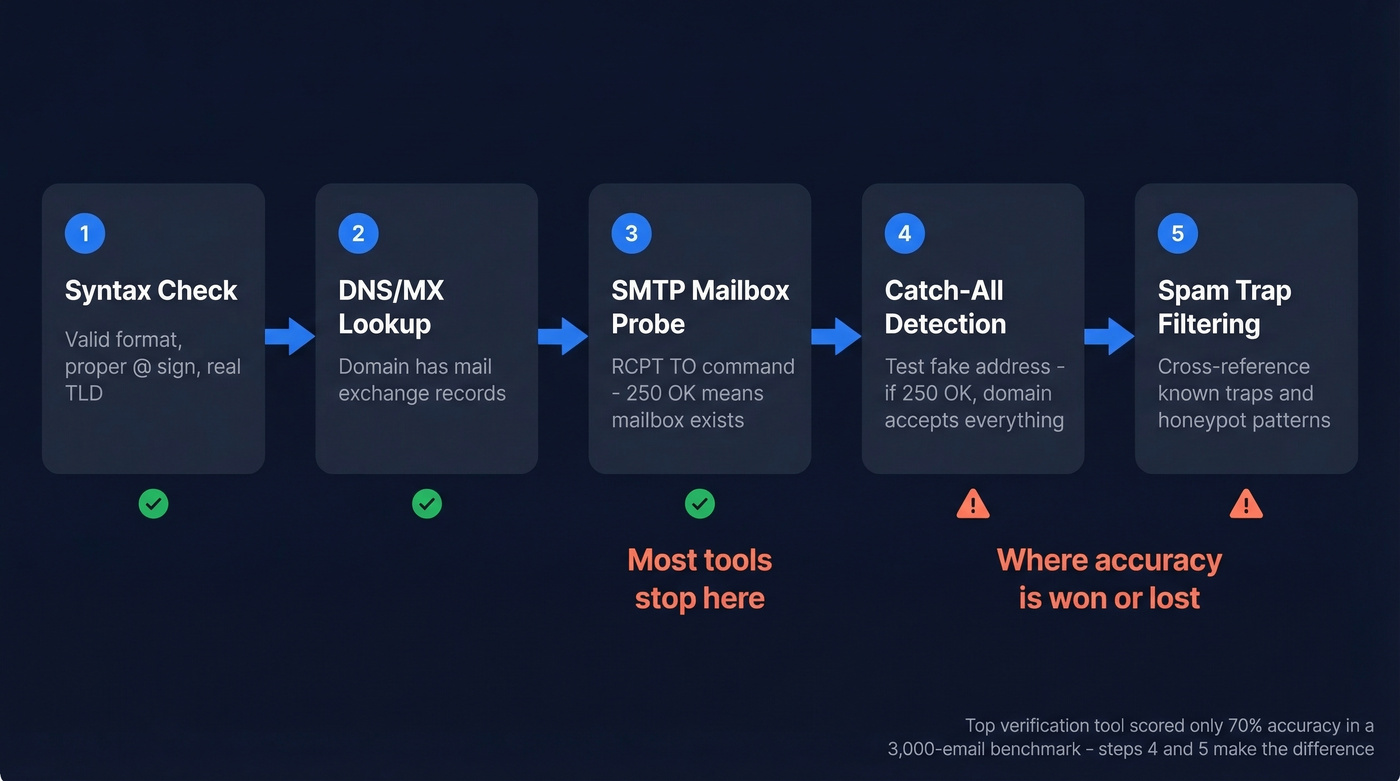
- Syntax check - confirms valid formatting: proper @ placement, valid TLD, no illegal characters.
- DNS/MX lookup - queries the domain's mail exchange records to confirm it actually receives email.
- SMTP mailbox probe - opens a connection and issues a RCPT TO command. A 250 response means the server accepted the recipient; 550 typically indicates a non-existent mailbox; 450 is commonly used for temporary failures like greylisting.
- Catch-all detection - sends a RCPT TO for a randomly generated fake address. If the server returns 250, the domain accepts everything, making individual mailbox verification unreliable.
- Spam-trap and honeypot filtering - cross-references known trap addresses and patterns indicating recycled or planted addresses.
In one benchmark of 15 verification tools across 3,000 real business emails, the top scorer hit only 70% accuracy. That tells you how much catch-all resolution and trap filtering matter beyond basic SMTP probes. (For bounce codes and what they mean operationally, see email bounce rate.)

Most verification tools punt on catch-all domains and leave a third of your list in limbo. Prospeo resolves catch-alls during its 5-step verification process and delivers 98% email accuracy - so you skip the guesswork entirely.
Stop quarantining a third of your list. Verify with confidence.
The Catch-All Problem
Catch-all domains are the single biggest gap in most verification workflows. On a typical B2B list, 30-40% of addresses sit on catch-all domains. The server returns 250 OK for every address - real or fake - so standard SMTP probes can't distinguish valid from invalid mailboxes.
If you're building lists from multiple sources, a waterfall approach can reduce how many catch-alls you have to gamble on in the first place.
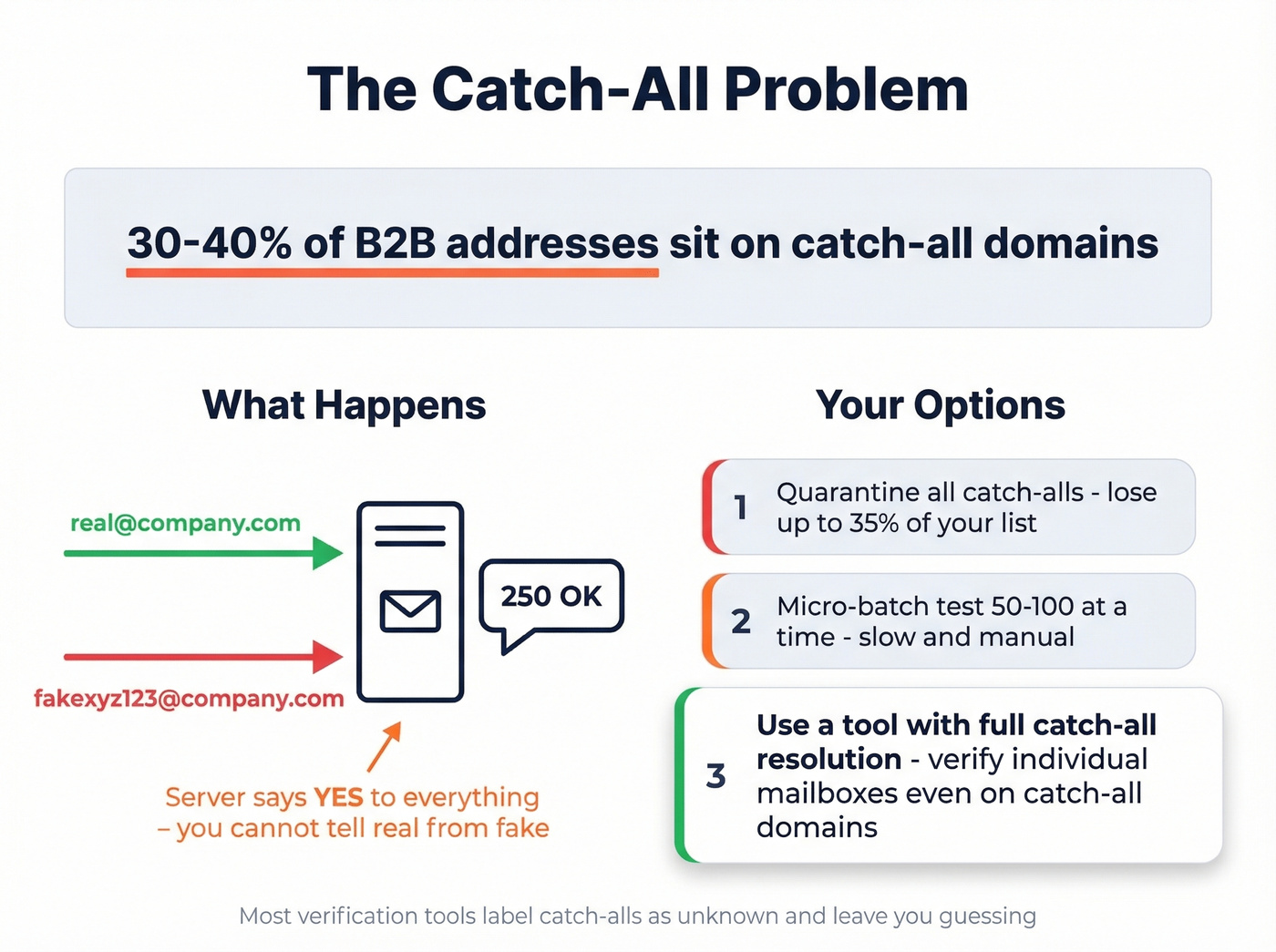
Most tools punt. They label catch-alls "unknown" and leave you to decide. We've run verification on lists where 35% came back unknown - that's not a result, that's a shrug. Your options become quarantining them entirely and losing a third of your list, micro-batch testing 50-100 at a time, or capping catch-all share per sequence at 10-15%.
Choosing the Right Verification Tool
Cheapest doesn't mean best if the tool marks everything it can't confirm as "unknown." Catch-all resolution and accuracy matter far more than sticker price.
If you're comparing vendors, it helps to separate pure verification from broader data enrichment services (which can improve match rates but still need verification).
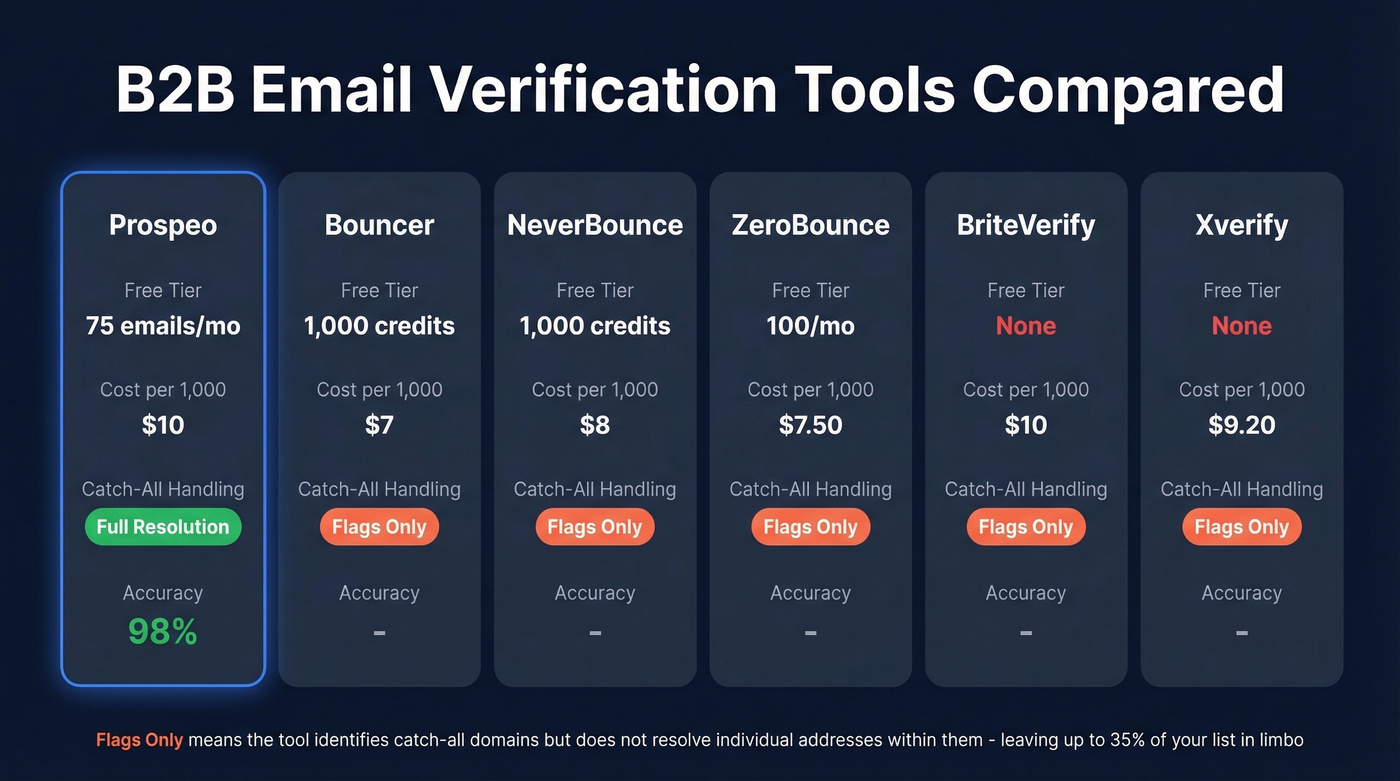
| Tool | Free Tier | Per-1,000 Cost | Catch-All Handling | Notable Feature |
|---|---|---|---|---|
| Prospeo | 75 emails/mo | ~$10 | Full resolution | Verifies at collection; 98% accuracy |
| Bouncer | 1,000 credits | $7 | Flags only | GDPR compliant; budget pick |
| NeverBounce | 1,000 credits | $8 | Flags only | 80+ integrations |
| ZeroBounce | 100/mo | $7.50 (min $15) | Flags only | AI scoring features |
| BriteVerify | None | $10 | Flags only | Enterprise-focused |
| Xverify | None | $9.20 | Flags only | Pay-as-you-go only |
"Flags only" means the tool identifies catch-all domains but doesn't resolve individual addresses within them. In our testing, catch-all resolution was the single biggest differentiator between tools that looked similar on paper. Any verifier that punts on catch-alls is leaving a third of your list in limbo.
How Often to Verify
A single pass isn't enough when your database decays 22.5% annually.
If you're running outbound sequences, pair verification with good sequence management so you can quarantine unknowns without breaking your cadence.
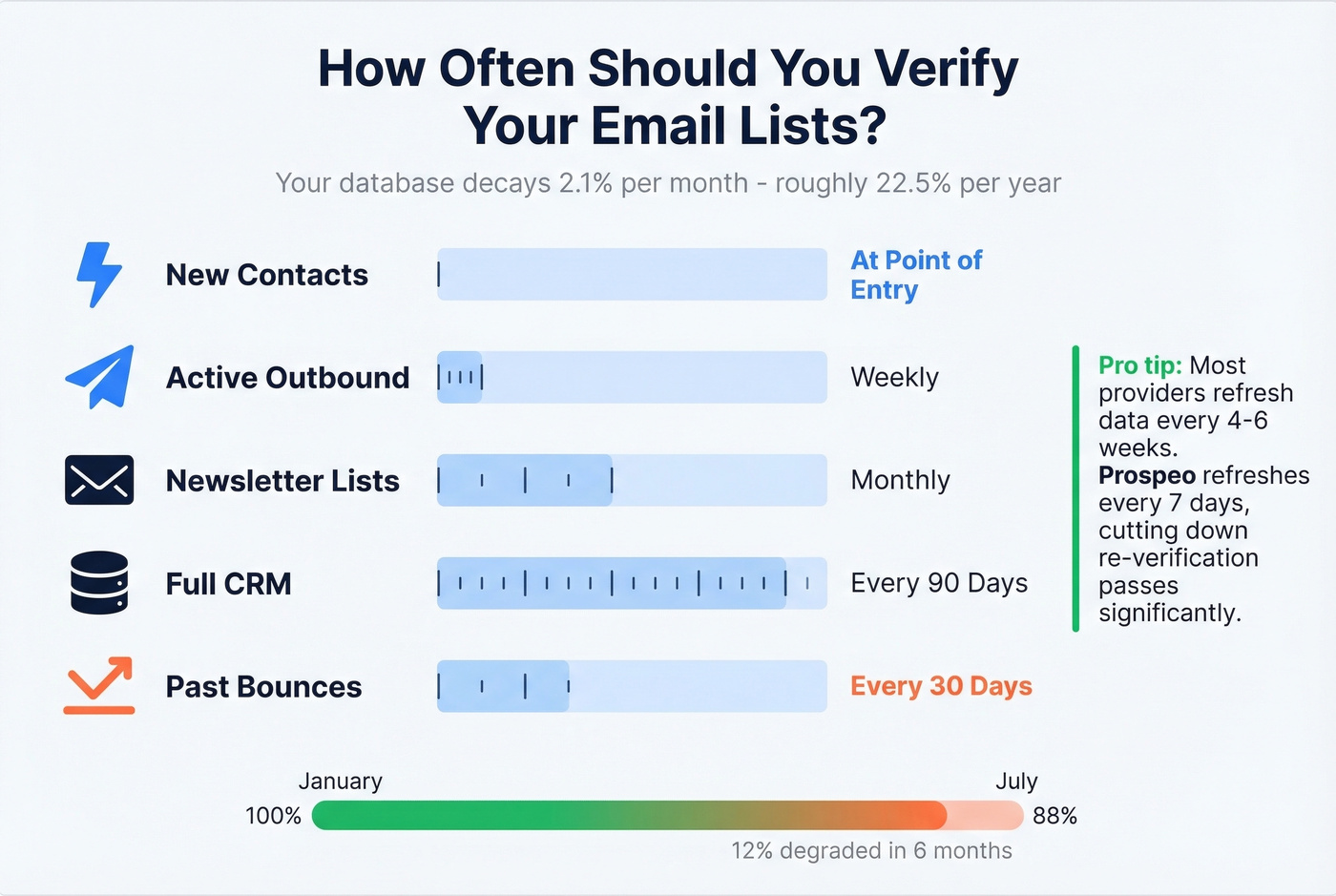
| List Type | Frequency |
|---|---|
| New contacts | At point of entry |
| Active outbound | Weekly |
| Newsletter lists | Monthly |
| Full CRM | Every 90 days |
| Past bounces | Every 30 days |
Most providers refresh their data every 4-6 weeks. Prospeo runs on a 7-day refresh cycle, which cuts down on the need for constant re-verification significantly. If you're running high-volume outbound, that difference matters more than you'd think.
Mistakes That Kill Deliverability
These patterns show up repeatedly in teams with sender reputation problems:
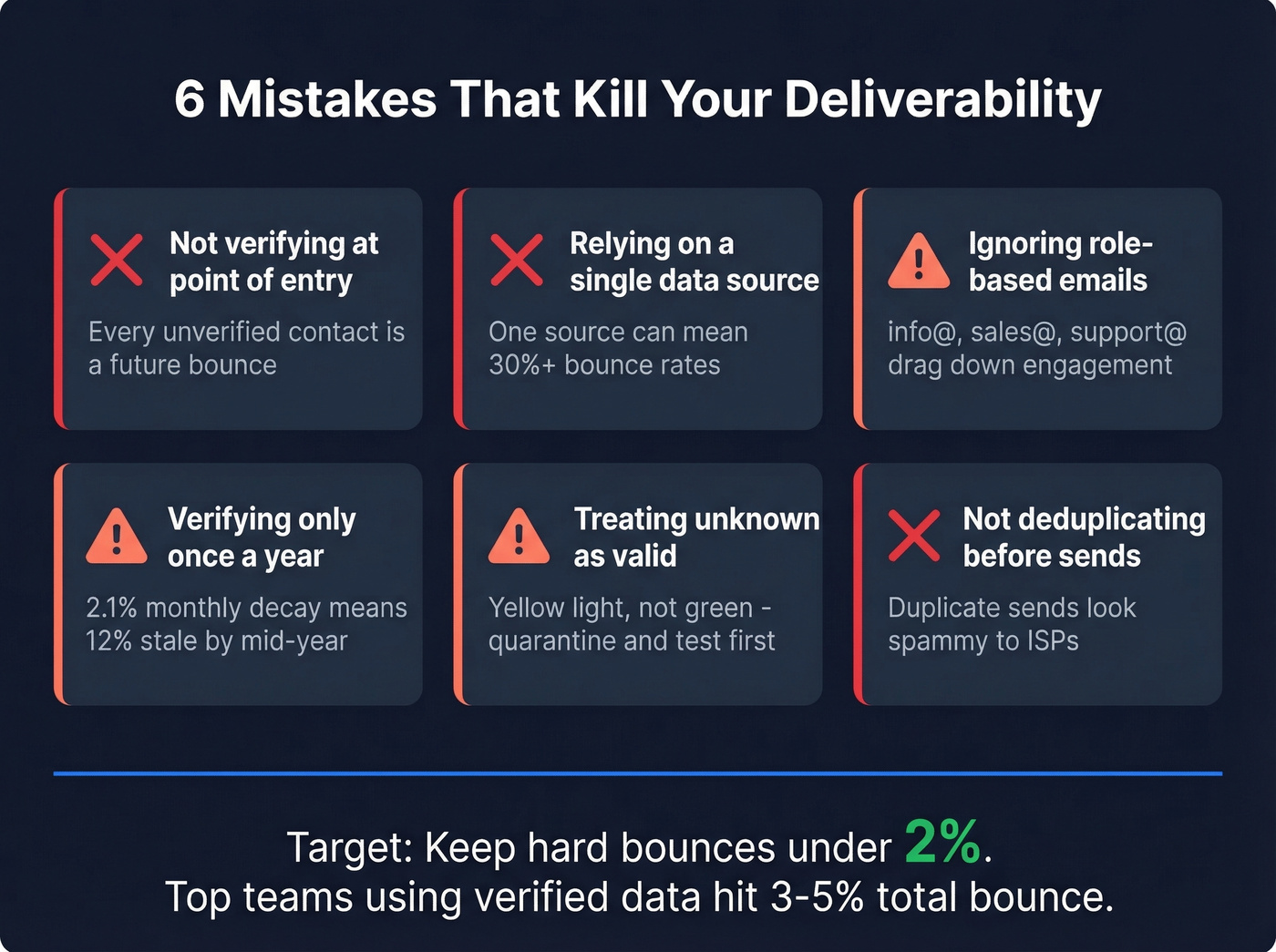
Not verifying at point of entry. Every unverified contact is a future bounce. This is the most common mistake we see, and it's the easiest to fix.
Relying on a single data source. A waterfall approach - stacking multiple sources and cross-referencing - can materially reduce effective bounce rates. One practitioner test landed around 10-14% total bounce using this method, down from 30%+ with a single provider.
Ignoring disposable and role-based emails. Addresses like info@, sales@, and support@ drag down engagement metrics and often trigger spam filters. Strip them. (More on list-building hygiene in our guide to email list providers.)
Verifying once a year. With 2.1% monthly decay, a January list is ~12% degraded by July. Quarterly full-CRM passes are the minimum.
Treating "unknown" as "valid." That's a yellow light, not green. Quarantine unknowns and test in small batches before scaling sends.
Not deduplicating before sends. Duplicate sends to the same address look spammy to ISPs and waste credits. Clean before you send.
FAQ
What's a good bounce rate for B2B outbound?
Keep hard bounces under 2%. Top-performing teams using verified data and waterfall enrichment hit 3-5% total bounce. Anything above 10% signals a data quality problem that needs immediate attention.
Should I send to catch-all emails?
Not blindly. Quarantine catch-all addresses, test micro-batches of 50-100, and monitor bounces before scaling. Or use a tool that resolves catch-alls during verification so you don't have to guess.
Is email verification GDPR compliant?
Yes, when done properly. Email addresses are personal data under GDPR, so your provider must act as a data processor with appropriate DPAs in place. With cumulative GDPR fines reaching ~EUR 5.88B, compliance isn't optional. This applies whether you're running bulk list cleans or real-time API checks.
What's a good free tool for verifying business emails?
Hunter offers 25 free searches per month but caps enrichment features. Prospeo's free plan includes 75 verified emails monthly with full catch-all resolution - a stronger option for small teams running real outbound. ZeroBounce gives 100 free credits monthly but only flags catch-alls without resolving them.
Let's be honest: if you're verifying fewer than 75 emails a month, a free tier is fine. Once you're past that, the cost of bounces from bad data dwarfs any verification spend.
Your database decays 22.5% per year. Most providers refresh every 4-6 weeks - Prospeo refreshes every 7 days. That means fewer re-verification passes, fewer bounces, and a sender reputation that stays intact.
Weekly-fresh data at $0.01 per email. No contracts, no sales calls.