

B2B Financial Services Marketing: What Actually Works in 2026
A RevOps lead we know switched from SaaS to financial services last year. Within 90 days, his summary: "Email responses are nonexistent, phones are dead, and closed-lost leads are completely dark." The only pipeline? Inbound demo submissions. Generic B2B playbooks collapse in financial services. The buyers are different, the rules are different, and the timelines will test your patience.
Three Things Before Anything Else
- Lead with ABM, not spray-and-pray outbound. 71% of B2B organizations run ABM strategies, and the average ROI sits at 137%.
- Learn two compliance frameworks. FINRA Rule 2210 and the SEC Marketing Rule (206(4)-1)-1) govern most marketing communications you'll publish. Ignore them and legal will kill your campaign before it launches.
- Fix your contact data first. Bad data is the single biggest reason financial services outbound fails. If your bounce rate is above 5%, nothing else matters.
Why Financial Services Buyers Are Different
This isn't just "harder B2B." It's a structurally different game.
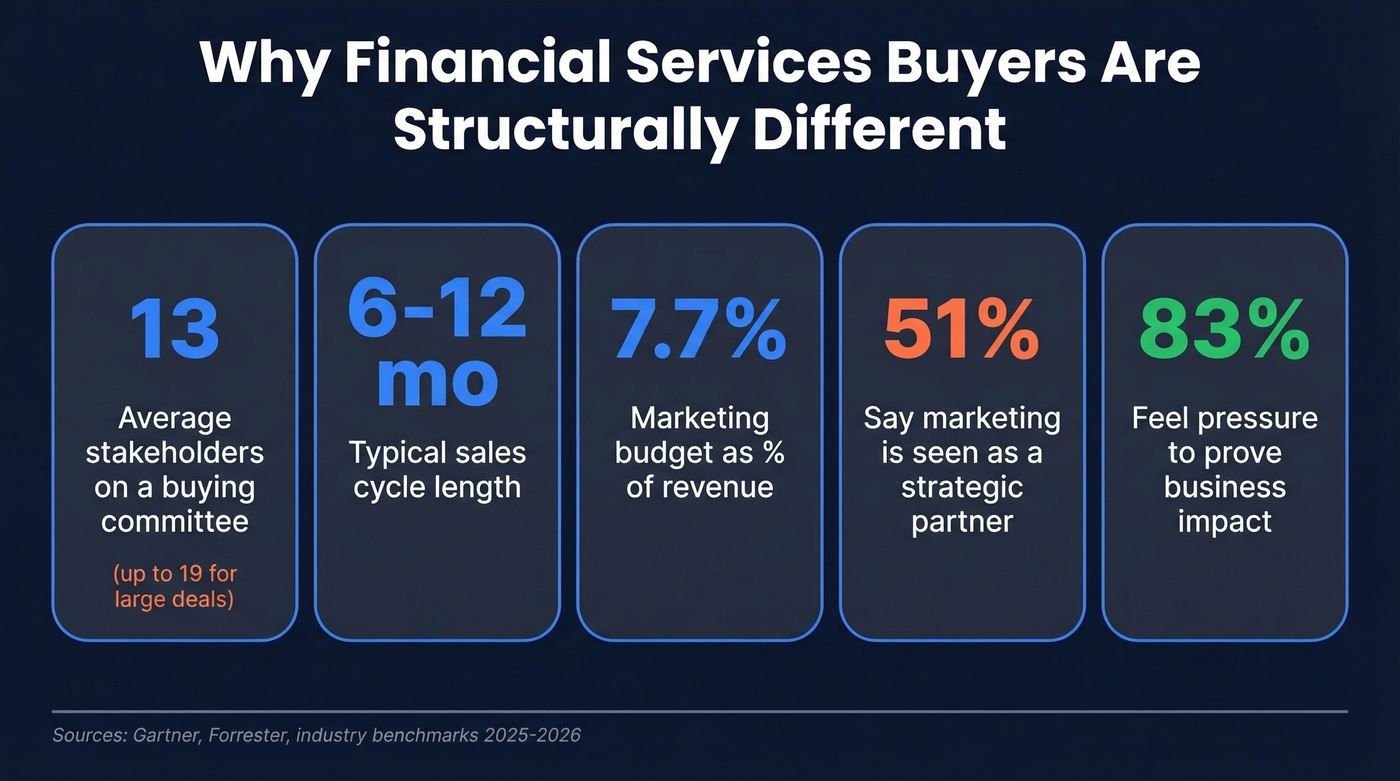
You're selling commoditized products under heavy regulation, which means your differentiation levers are limited and your messaging gets scrutinized before it ships. Buying committees average 13 stakeholders - sometimes stretching to 19 for large purchases. Sales cycles run 6-12 months. And 83% of marketing professionals feel increasing pressure to prove business impact, yet only 51% say their organization views marketing as a strategic partner. Marketing budgets average 7.7% of revenue, which isn't small, but it's not generous when you're trying to influence a 13-person committee over a year-long cycle.
Trust-based marketing isn't a nice-to-have here. It's the only approach that survives scrutiny from compliance officers, CFOs, and procurement teams simultaneously.

Bad contact data kills financial services outbound before compliance even gets a chance to review it. Prospeo's 5-step verification delivers 98% email accuracy and bounce rates under 4% - exactly what regulated industries demand. Layer intent data across 15,000 Bombora topics to find which financial institutions are actively researching your solution.
Stop blasting stale lists. Start reaching verified financial services buyers.
Strategies That Drive Pipeline
Account-Based Marketing
ABM isn't optional in financial services - it's the default. The winning channels are email (92% of teams use it) and in-person events (72%). Nearly 50% of teams plan to increase ABM budgets this year, and 79% already incorporate AI into their workflows.
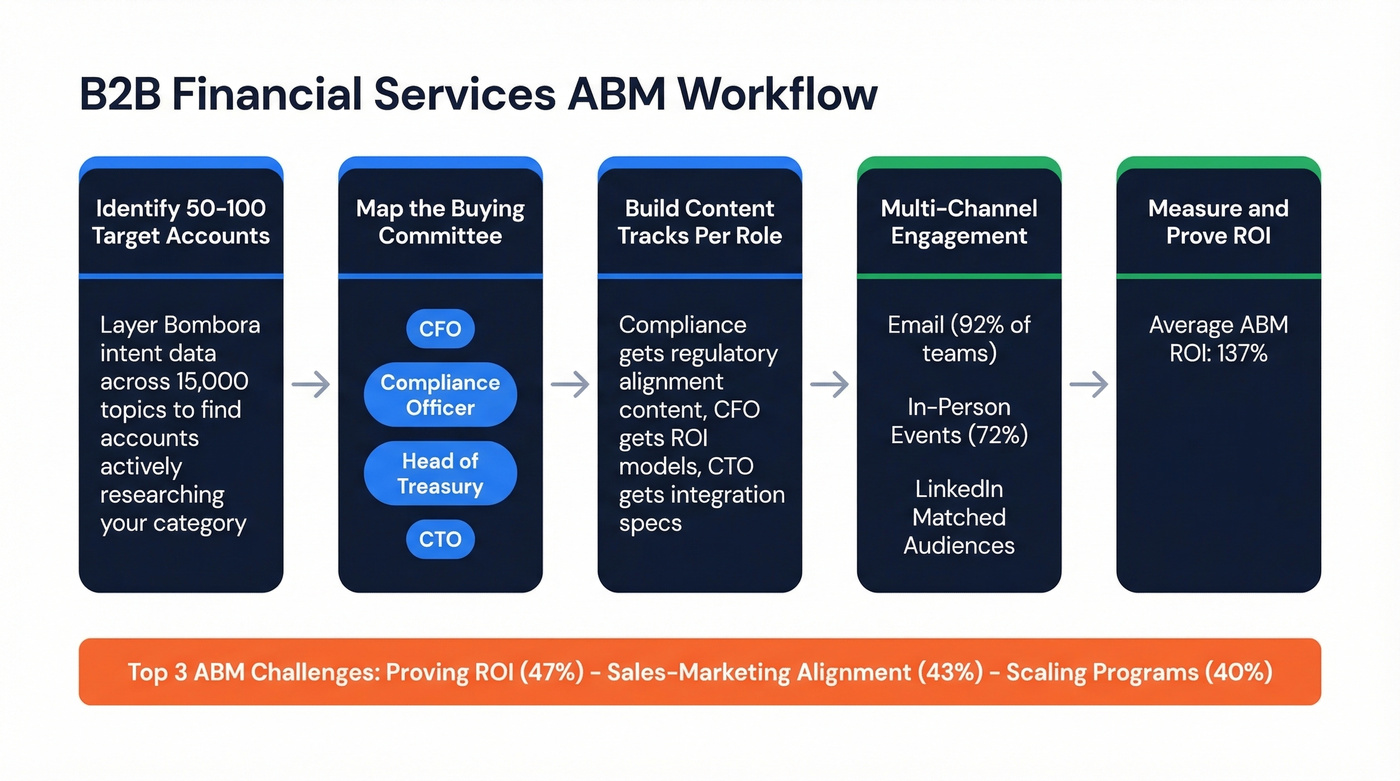
The challenges are real: proving ROI (47% cite it), sales-marketing alignment (43%), and scaling programs (40%). But here's the nuance - while 45% of marketers see AI's promise for ABM personalization, nearly 70% find its current effectiveness limited. Don't over-automate. Financial services ABM works when you name the buying committee roles upfront - CFO, compliance officer, head of treasury, CTO - and build content tracks for each. Layer intent data to identify which accounts are actively researching solutions before you spend a dollar on outreach. We've found that teams who narrow their target list to 50-100 named accounts outperform those blasting thousands of generic contacts, even with smaller budgets.
Content Marketing
SoFi's content transformation is the case study worth studying. They shifted from SEO-product content to editorial storytelling - debt, salary, investing, member spotlights - and saw +970% site traffic and +247% monthly conversions. The lesson: financial services buyers respond to content that builds trust and demonstrates expertise, not content that pushes features.
The SEC Marketing Rule now allows testimonials and endorsements with proper disclosures. Client stories, case studies, video testimonials - all fair game. That's a massive content unlock most financial services marketers still haven't exploited.
LinkedIn (Organic + Paid)
LinkedIn ad budget share in B2B grew from 31% to 39% in recent years, and for good reason - it's where decision-makers spend time. But it's expensive.
Expect sponsored content CTR of 0.4-0.6%, CPC averaging $5-$7 (financial services targeting pushes this to $20+), and CPL ranging $60-$150 for mid-market, $200+ for enterprise. Each additional form field reduces completion by roughly 5%, so keep forms tight. If you're running LinkedIn alongside ABM, use matched audiences to retarget named accounts rather than broad industry targeting - the CPL difference is dramatic.
SEO + Pain-Point Content
The financial services website conversion rate averages 1.9%, so you need serious traffic volume to generate pipeline from organic alone. The highest-converting play right now is pain-point SEO: build pages around the specific problems your buyers search at 11 PM - "how to reduce wire fraud losses," "treasury management RFP template," "SOC 2 compliance for fintechs." These pages attract buyers with active intent, not casual browsers.
Also invest in generative engine optimization. AI engines pull from "vs" comparison pages, directories, and authoritative guest posts, not just your domain. If you're not building those content types, you're invisible to a growing share of research behavior.
AI Personalization
Morgan Stanley deployed GPT-4 with internal data so wealth management advisors could generate customized client messages in seconds. That's the ceiling. The floor? A 2024 IIF and EY study found the top two blockers for AI in financial services are data quality and data availability - not model sophistication.
AI personalization is only as good as the data feeding it. If your CRM is full of stale contacts and unverified emails, no amount of GPT integration will save your outbound. Let's be honest: most teams skip this step and wonder why their AI-powered sequences get 0.3% reply rates.
| Metric | FS Benchmark |
|---|---|
| Website conversion rate | 1.9% |
| LinkedIn CTR (sponsored) | 0.4-0.6% |
| LinkedIn CPC | $5-$7 (FS: $20+) |
| LinkedIn CPL | $60-$150 (enterprise: $200+) |
| ABM adoption rate | 71% |
| ABM average ROI | 137% |
| Marketing budget (% of revenue) | 7.7% |
| Buying committee size | 13 avg |
Compliance as a Marketing Advantage
Most guides on marketing to financial institutions treat compliance as a constraint. It is - but it's also a differentiator.
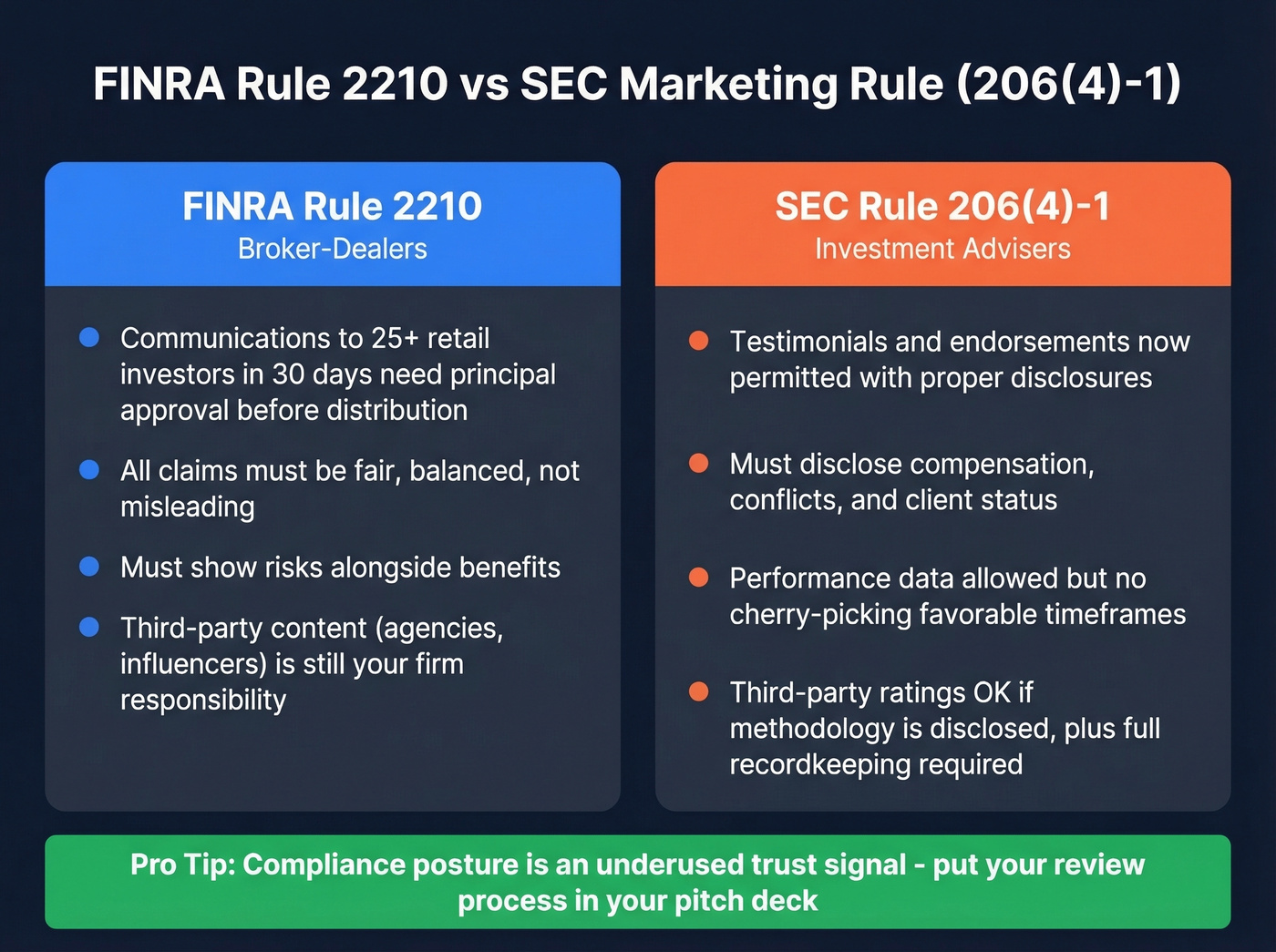
FINRA Rule 2210 - the core advertising rule for broker-dealers. Any written communication sent to 25+ retail investors within 30 days requires principal approval before distribution. All communications must be fair, balanced, and not misleading - risks alongside benefits. And third-party content like agency posts or influencer content? Still your firm's responsibility.
SEC Marketing Rule (206(4)-1) - updated rules for investment advisers. Testimonials and endorsements are now permitted with disclosure of compensation, conflicts, and client status. Performance data is allowed but you can't cherry-pick favorable timeframes. Third-party ratings are fair game if you disclose methodology. Every claim, testimonial, and performance figure requires recordkeeping.
Build compliance into your workflow from day one. We've seen campaigns die in legal review because the team treated regulatory compliance as a final checkbox instead of a design constraint.
Here's the thing: compliance posture is an underused trust signal. Put your FINRA review process in your pitch deck. Mention your SEC-compliant testimonial framework in sales conversations. Buyers in financial services want to work with vendors who understand their regulatory world - showing you do is a competitive advantage most marketers ignore entirely.
Fix Your Data Before You Market
Every strategy above - ABM, content, LinkedIn, AI personalization - depends on reaching the right people with accurate contact information. The consensus in sales communities on Reddit is that cold outbound in financial services is dying, and the data backs it up: data quality and availability are the top AI blockers, not model sophistication. Teams invest in sophisticated ABM platforms, then feed them stale lists with high bounce rates. Sender reputation tanks, deliverability craters, and the whole investment unravels.

Prospeo addresses this at the foundation level - 300M+ professional profiles with 98% email accuracy and a 7-day data refresh cycle versus the six-week industry average. Its 30+ search filters let you slice by buyer intent, technographics, job changes, headcount growth, and funding stage, which is critical for targeting the right stakeholders on a 13-person buying committee. Intent data powered by Bombora tracks 15,000 topics, so you can layer in-market signals before spending on outreach. The free tier gives you 75 verified emails per month plus 100 Chrome extension credits with no contract and no sales call required - enough to test your targeting before scaling spend.
If you're evaluating vendors, start with a shortlist of data enrichment services and a dedicated sales prospecting database that fits regulated outreach.
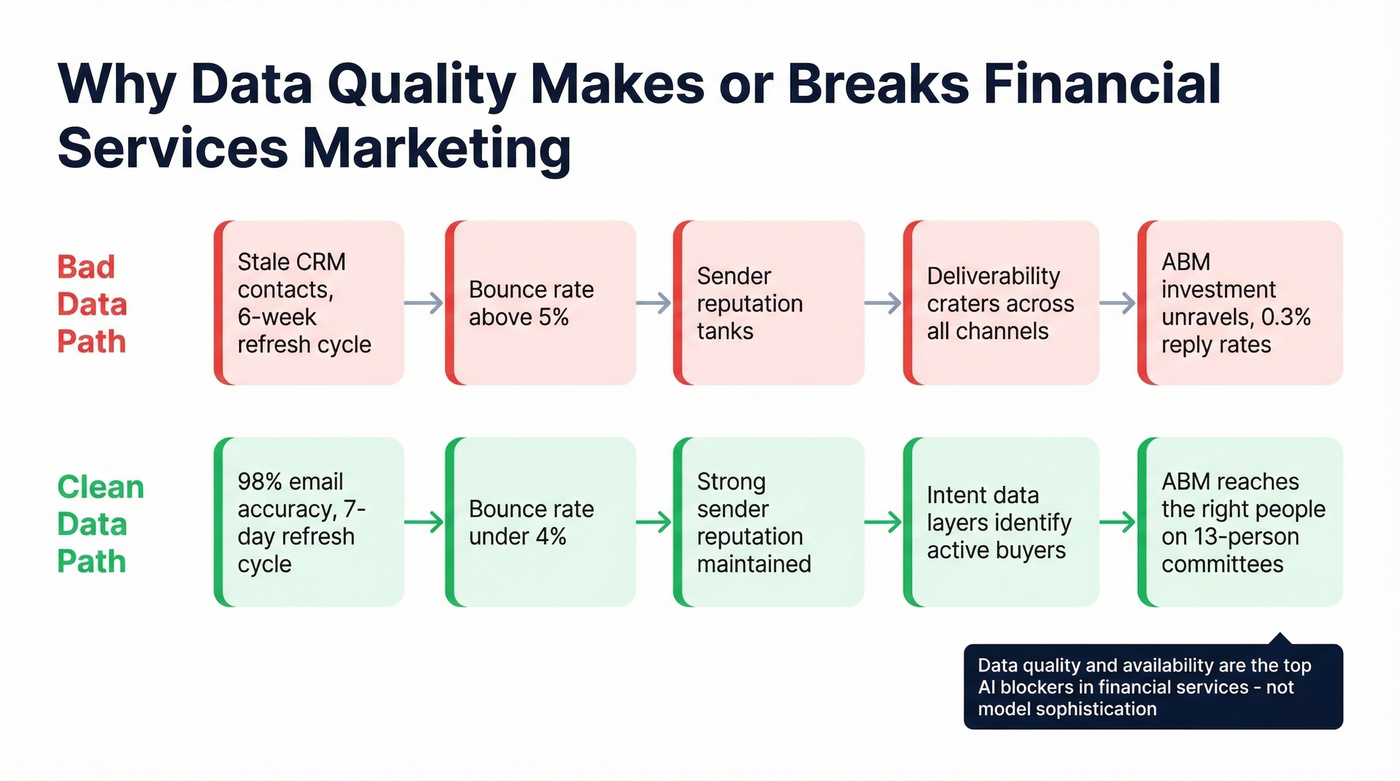
Your AI personalization is only as good as the data feeding it. Prospeo enriches CRM records with 50+ data points at a 92% match rate - refreshed every 7 days, not every 6 weeks. For $0.01 per email, you get cleaner data than platforms charging 90x more.
Feed your ABM engine data that 13-person buying committees actually respond to.
FAQ
What makes B2B financial services marketing different from regular B2B?
Regulation is the biggest differentiator - FINRA and SEC rules constrain what you can say and who approves it. Buying committees average 13 stakeholders, sales cycles run 6-12 months, and buyers are far more risk-averse than in tech. Plan for longer nurture sequences and compliance review at every stage.
How much should a financial services firm spend on marketing?
Gartner benchmarks put marketing budgets at 7.7% of revenue for financial services. Allocate heavily toward ABM and content - both compound over time. LinkedIn paid runs $60-$200+ per lead, so balance paid channels with organic pipeline plays like pain-point SEO.
How do you build an accurate prospect list for financial services outbound?
Start with a verified B2B database that refreshes data weekly and delivers 98%+ email accuracy. Layer intent data to target accounts actively researching your category. Keep bounce rates under 5%; anything higher degrades deliverability fast.
Is ABM worth the investment for mid-market financial services companies?
Yes. ABM delivers an average 137% ROI across B2B, and financial services benefits disproportionately because of long sales cycles and large buying committees. Even mid-market teams with 2-3 reps see results when they focus on 50-100 named accounts instead of blasting thousands of generic contacts. Skip ABM only if you're selling a low-ACV product with a single decision-maker - and in financial services, that's rare.