

B2B Influencer Marketing: How to Build a Program That Actually Drives Pipeline
A RevOps lead at a Series B SaaS company spent $12,000 on three micro-influencer campaigns last year. The result: 47,000 impressions, a nice bump in social engagement, and exactly zero pipeline. The problem wasn't the channel - it was treating B2B influencer marketing like B2C and optimizing for eyeballs instead of revenue.
Here's the thing: 75% of B2B marketers already use influencer marketing, and Gartner predicts 80% of enterprise marketers will integrate it by 2027. The channel works. But calling it "influencer marketing" is part of the problem. What actually drives pipeline in B2B is expert partnerships - practitioners, customer advocates, and niche authorities who shape how your buyers think. Not creators who shape what they scroll past.
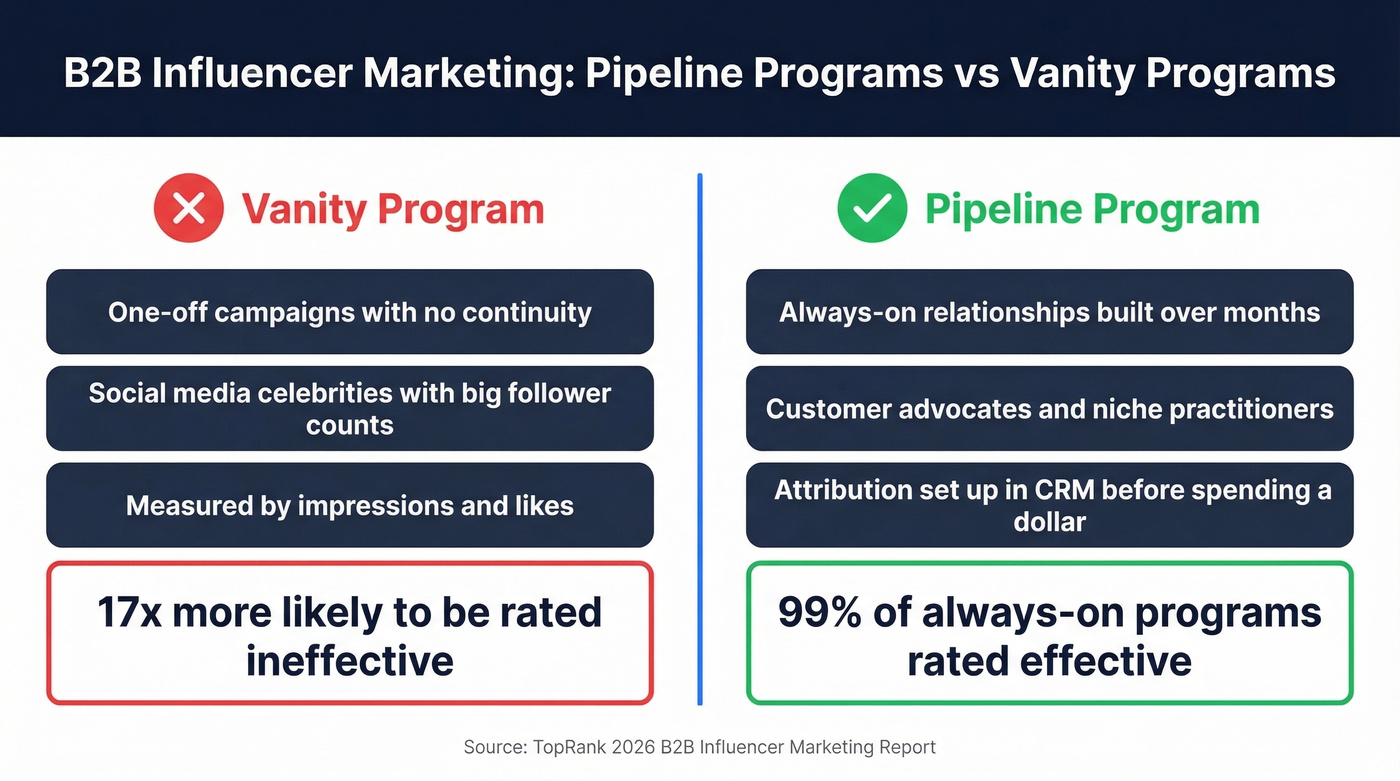
Three Things That Separate Pipeline Programs from Vanity Programs
- Always-on relationships, not one-off campaigns. 99% of B2B teams running always-on programs rate them effective. Teams without always-on are 17x more likely to report their program is ineffective.
- Niche experts and customer advocates, not social media celebrities. Customer advocates drive 89.7% of successful B2B influencer campaigns. Traditional social influencers account for just 2.3%.
- Attribution set up in your CRM before you spend a dollar. 98% of marketers say attribution is crucial, but 70%+ fall short of their strategic goals. If you can't trace an influencer touchpoint to pipeline, you're flying blind.
What B2B Influencer Marketing Actually Is
B2B influencer marketing is partnering with subject-matter experts, practitioners, and customer advocates to create content that influences buying decisions within your target accounts. No dance videos. No unboxing.

The distinction from B2C matters because B2B buying cycles are longer, involve multiple decision-makers, and require genuine expertise to influence. HockeyStack's analysis of B2B buying journeys found the average deal involves 266 touchpoints before closing. A single sponsored post isn't moving that needle - but a trusted expert's endorsement can shift an entire buying committee. According to the Demand Gen Report, 87% of B2B buyers give more credence to content featuring trusted industry experts.
The hierarchy of influencer types that actually work in B2B:
- Customer advocates (89.7% of successful campaigns) - your happiest customers talking about real results
- Executive thought leaders (82.2%) - C-suite and VP-level voices with credibility in your space
- Industry analysts and practitioners - people your ICP already reads and trusts
- Employee advocates - your own team members building authority in their domains (Gong and Clari have turned this into a competitive advantage)
- Traditional social influencers (2.3%) - almost irrelevant in B2B
The best B2B influencers often have small followings. A former VP of Engineering with 3,000 newsletter subscribers in your exact ICP is worth more than a creator with 200,000 followers and a generic audience.
The Case for Always-On Programs
The data is overwhelming. TopRank's 2026 B2B Influencer Marketing Report found that 99% of teams running always-on influencer programs rate them effective. Non-always-on teams are 17x more likely to call their program ineffective.
The gap is stark: 43% of all B2B influencer programs report outstanding results. Among mature, always-on programs, that number jumps to 79%.
Always-on means ongoing relationship building, engagement, and activation - not a quarterly campaign burst. You're building community, co-creating content, and developing brand advocacy over months and years. Right now, 58% of B2B marketing teams use an always-on approach, and 49% plan to implement one in the coming year. Among the most advanced programs, 81% run always-on.
Let's be honest: if you're only willing to run a one-off campaign, you're better off spending that budget on paid media. Influencer marketing compounds. One-offs don't.
When Expert Partnerships Fail
A thread on r/DigitalMarketing shows a common failure mode - a practitioner tried micro-influencers in their niche, got views, but generated no leads. That's what happens when you optimize for attention without building a conversion mechanism that fits B2B buying behavior.
The anti-patterns that kill programs repeatedly:
- Goal mismatch. Running a brand awareness campaign but measuring it on lead gen. If your CFO asks about ROI and your answer involves impressions, you've already lost.
- Choosing influencers without data. Picking someone because your VP likes their content, not because their audience overlaps with your ICP.
- Transactional engagement. Sending impersonal forms and treating influencers like ad inventory instead of building real relationships.
- Fear of commitment. Running a single pilot, seeing mediocre results, and concluding the channel doesn't work. Always-on programs outperform one-offs by 17x. One campaign isn't a fair test.
- Nowhere to publish. Creating influencer content with no owned hub, no SEO strategy, and no way to extend shelf life beyond a social post.
- Management by spreadsheet. Fine for your first two influencers. Falls apart at ten.
The two biggest challenges teams report: 48% struggle to find and qualify the right influencers, and 47% struggle to measure results. Both are solvable.

48% of teams struggle to find and qualify the right influencers. Prospeo's 300M+ profile database with 30+ filters lets you identify niche experts by job title, seniority, industry, and company size - then gives you their verified email at 98% accuracy. Build your influencer target list in minutes, not weeks.
Stop guessing who influences your buyers. Search, filter, and reach them directly.
How to Build a B2B Influencer Program
Set Goals That Map to Pipeline
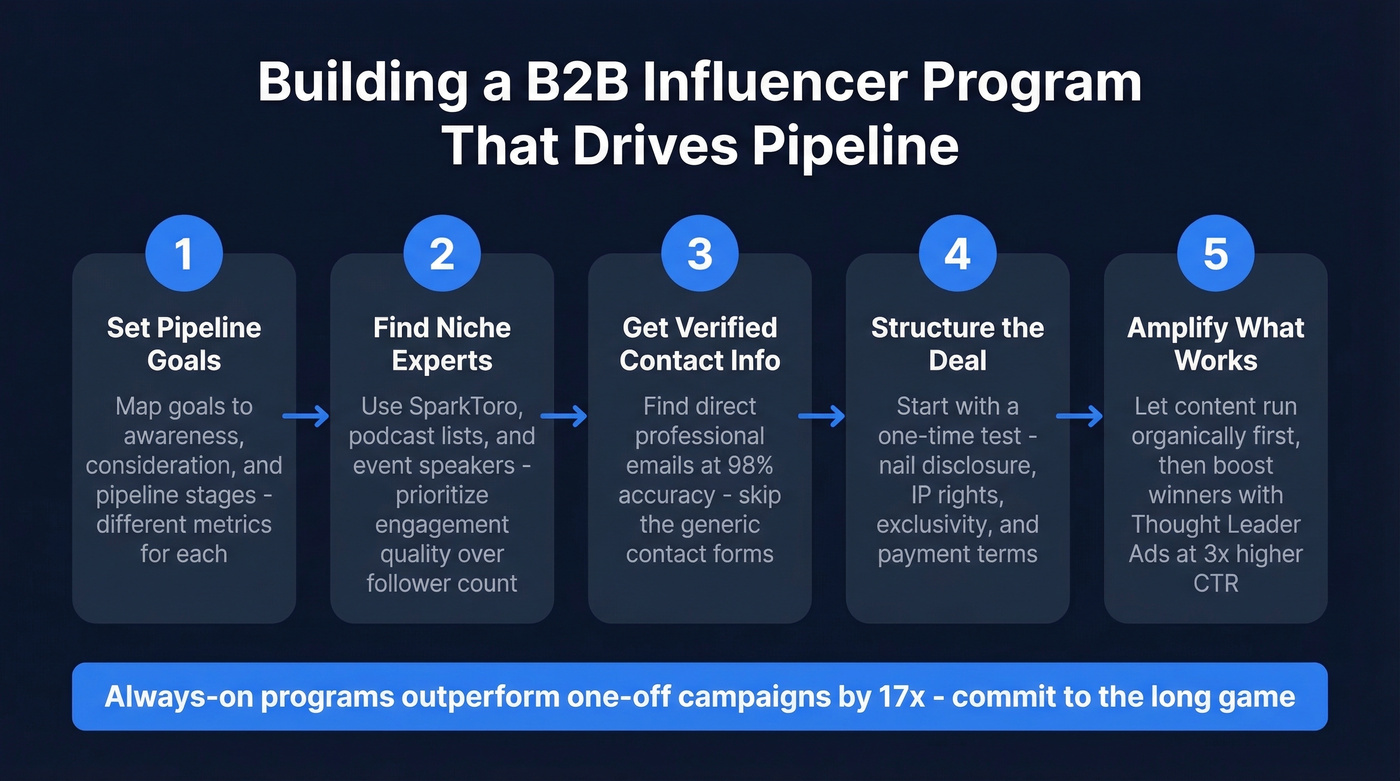
Start with a goal hierarchy: awareness, consideration, pipeline. Each stage needs different influencers, different content formats, and different metrics. If you need a clean way to define stages and KPIs, use a simple B2B sales funnel view to keep marketing and sales aligned.
The most common mistake is setting lead-gen goals on awareness campaigns. A co-hosted webinar with a thought leader might generate 200 registrants and 15 qualified opportunities. A sponsored post from the same person might generate 50,000 impressions and zero direct leads - but influence three people on a buying committee who see the post before your AE's outreach lands. Both are valuable. Neither should be measured by the other's metrics.
Find the Right Influencers
You've found the perfect partner - a former VP of Sales with 8,000 followers and a newsletter your ICP reads every Tuesday. Now you need their email. Not the generic contact form on their website. Their actual professional email, so your outreach lands in their inbox instead of a black hole.
Discovery starts with audience research. SparkToro is a strong tool for identifying who your ICP follows, reads, and listens to. Social listening, industry events, and podcast guest lists are other rich sources. In B2B, newsletter and podcast creators are often higher-intent partners than social-only plays. When vetting candidates, prioritize engagement quality over follower count, content relevance to your buyers' problems, and audience seniority.
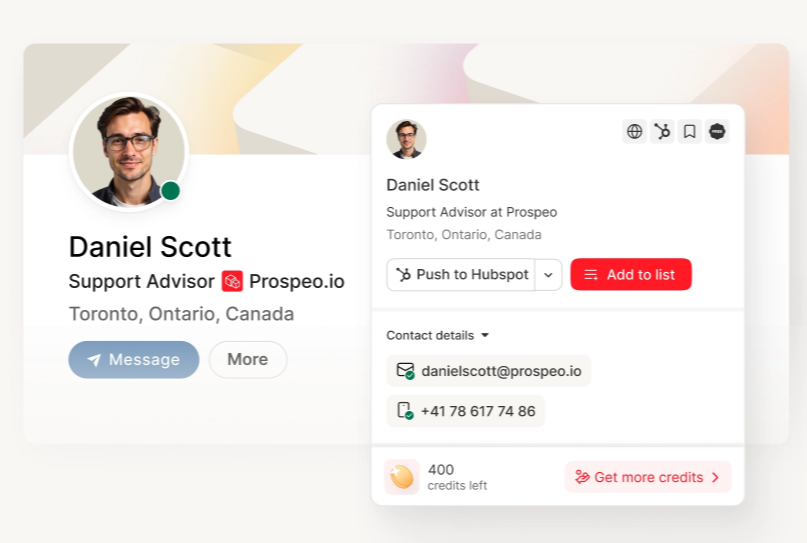
Once you've built your target list, the discovery-to-outreach gap is where most programs stall. We've seen teams spend weeks building perfect influencer shortlists only to lose momentum because they couldn't find direct contact information. Prospeo's Chrome extension makes this a one-click process - find a professional page, grab the verified email, and start the conversation. With 98% email accuracy, your pitch actually reaches their inbox instead of bouncing. If you're building lists at scale, a lightweight lead generation workflow keeps research, enrichment, and outreach from breaking.
Structure the Partnership
The best advice from practitioners: provide a detailed brief with examples, but allow creative freedom so the content matches the influencer's usual style. The moment content sounds like a press release, you've lost the audience's trust.
Start with a one-time test before committing to a long-term relationship. This protects both sides and gives you real performance data before scaling spend.
Contract essentials to nail down upfront:
- Disclosure requirements - FTC and ASA rules require clear sponsorship disclosure. Non-negotiable.
- IP and usage rights - can you repurpose their content in ads? For how long?
- Exclusivity - are they working with your competitors simultaneously?
- Payment terms - net 30 is standard; some influencers require upfront payment for first engagements.
For content formats, prioritize owned audiences first. Newsletters, podcasts, and webinars are high-intent formats in B2B. An influencer's newsletter with 5,000 subscribers in your ICP is more valuable than a post that reaches 50,000 random professionals.
Amplify with Thought Leader Ads
LinkedIn Thought Leader Ads let you promote personal posts through your company's ad account. The content looks organic - it's a person's post, not a brand ad - but with paid targeting behind it.
Agency benchmarks show up to 3x higher CTR and 40% lower CPL compared to standard company page ads.
The smart play: let influencer content run organically first. Identify the posts that get natural traction, then amplify those with paid spend. Pair with retargeting to catch people who engaged but didn't convert. You're only putting budget behind content that's already proven it resonates.
What to Pay B2B Influencers
B2B influencer compensation is the least transparent part of this space. Unlike B2C, where published cost-per-engagement ranges exist - Instagram runs $0.59-$0.95, TikTok $0.06-$2, YouTube $0.11-$0.25 per CreatorIQ benchmarks - B2B rates are negotiated individually based on audience quality, niche expertise, and deliverable complexity.
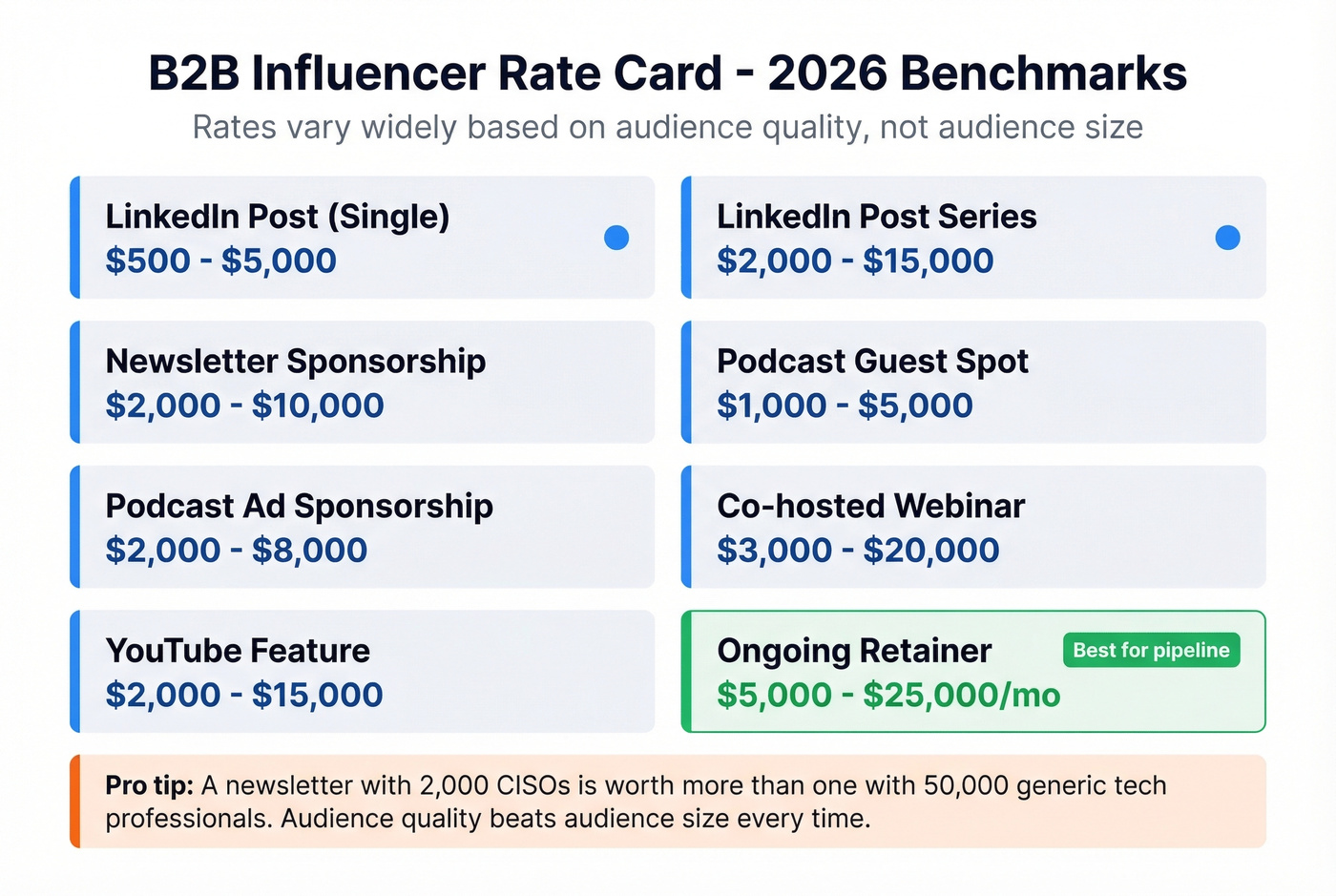
Here's a rate card synthesized from industry benchmarks and practitioner reports:
| Deliverable | Typical Range |
|---|---|
| LinkedIn post (single) | $500-$5,000 |
| LinkedIn post series | $2,000-$15,000 |
| Newsletter sponsorship | $2,000-$10,000 |
| Podcast guest spot | $1,000-$5,000 |
| Podcast ad sponsorship | $2,000-$8,000 |
| Co-hosted webinar | $3,000-$20,000 |
| YouTube feature | $2,000-$15,000 |
| Ongoing retainer | $5,000-$25,000/mo |
These ranges are wide because audience quality matters more than audience size. A newsletter with 2,000 CISOs is worth more than one with 50,000 generic "tech professionals."
The smartest B2B programs also use non-cash compensation. Affiliate or revenue-share models align incentives beautifully - the influencer earns more when they drive real results. Product access, advisory equity, and co-marketing opportunities work well for early-stage companies where cash is tight but upside is real.
Budget momentum is clear: 77% of B2B teams now have a dedicated influencer budget, and 53% say it's growing. If you want to sanity-check performance, compare against average B2B lead conversion rate benchmarks so you don't overpay for vanity outcomes.
How to Measure Influencer ROI
The attribution gap isn't conceptual - everyone knows measurement matters. 98% of marketers say attribution is crucial, but 70%+ fall short of their strategic goals. The gap is operational.
Last-click attribution breaks for influencer marketing because influencer content isn't designed to generate immediate clicks. It builds trust, shapes perception, and primes buying committees over time. If you're only counting direct clicks from an influencer's post to your demo page, you're missing 90% of the value.
For many teams, you don't need complex multi-touch modeling to get started. Self-reported attribution plus UTMs will get you most of the way there, and you can level up the model as deal size and buying-cycle complexity increase.
Match your attribution model to your goal:
| Goal | Model | Why |
|---|---|---|
| Awareness | First-touch | Credits the influencer touchpoint that started the relationship |
| Balanced | U-shaped | Weights first + last touch, captures influence and conversion |
| Full-cycle | Data-driven | ML-weighted across all touches for complete visibility |
Set this up in your CRM before you spend a dollar. Track these milestones across the journey: first engagement, last marketing interaction, opportunity created, opportunity closed. Create custom fields for influencer source, build a consistent UTM structure (utm_source=influencer&utm_medium=newsletter&utm_campaign=partnername), and add a self-reported attribution question to your demo request form: "How did you first hear about us?" If your CRM setup is messy, it’s worth standardizing your sales operations metrics so attribution doesn’t die in reporting.
That last one captures dark social influence. When someone hears about you in a Slack community, a private DM, or a podcast they listened to on a run, UTMs won't catch it. Self-reported attribution will. It's imperfect, but it's the best signal you'll get for channels that don't generate trackable clicks.
Real-World Campaign Examples
Lenovo - Late Night I.T. Lenovo partnered with influencers for a campaign that generated 300M impressions (70% above industry norm), 72M video views (11x benchmark), and a +7 point lift in brand consideration. Enterprise-scale proof that expert partnerships drive measurable brand metrics.
LinkedIn - #MyMarketingStory. LinkedIn's own influencer program built relationships with 75+ influencers and drove +239% reactions, +348% comments, +150% shares, and 5.84M reach. Even the platform itself uses expert partnerships to drive engagement, not just ads.
Engine - Paid Media Efficiency. This is the case study that makes CFOs pay attention. Engine achieved a $51.75 CPA through influencer marketing versus an $8,900 CPA through LinkedIn ads alone. That's not a marginal improvement - it's a 170x difference in acquisition efficiency. If you’re pressure-testing spend, map it back to cost to acquire customer so finance buys in.
Dell - Data Paradox. Influencer content drove 2x higher engagement than previous campaigns and 8,000+ landing page views (276% of prior benchmarks). The key was partnering with data and analytics thought leaders whose audiences matched Dell's enterprise buyer profile.
Sprinklr - Across the Socialverse. A multi-influencer campaign that drove 5,000+ registrations, 23.4M reach, and roughly 100,000 engagements alongside a strong pipeline of qualified leads and new revenue.
Tools You Actually Need
Most B2B teams don't need a $50,000 influencer management platform. Here's what we'd recommend based on program maturity:
| Platform | Starting Price | Best For |
|---|---|---|
| Prospeo | Free tier (75 emails/mo) | Influencer outreach and email verification |
| SparkToro | Free tier; paid from ~$50/mo | Audience research |
| Heepsy | $49/mo | Budget discovery |
| Modash | $99/mo | Creator analytics |
| Influencity | $168/mo | Mid-market management |
| HypeAuditor | $299/mo | Fraud detection |
| Brandwatch | ~$800+/mo | Social listening |
| Traackr | ~$1,500+/mo | Enterprise management |
Our honest recommendation: SparkToro for discovery, Prospeo for outreach, your CRM for measurement. That's the entire stack most B2B teams need until you're managing 10+ relationships simultaneously. We've run outreach for dozens of influencer campaigns, and verified email is the single biggest factor in whether an outreach sequence gets replies or gets ignored. If you want to tighten outreach performance, borrow proven sales follow-up templates and adapt them for influencer partnerships.
Skip the enterprise platforms until workflow automation becomes a bottleneck. If you're spending $1,500/month on Traackr to manage three influencer relationships, your money is better spent on the influencers themselves.
You found the perfect B2B influencer - a practitioner your ICP trusts. Don't lose them to a generic contact form. Prospeo's Chrome extension lets you pull verified emails and direct dials from any profile or website in one click. 40,000+ users already prospect this way.
Get any influencer's real email in one click for $0.01.
FAQ
Does B2B influencer marketing actually work?
Yes - 99% of teams running always-on programs rate them effective, and mature programs report outstanding results at nearly 2x the rate of newer ones. Programs fail when they optimize for impressions instead of pipeline and skip attribution setup entirely.
How much should you pay a B2B influencer?
$500-$5,000 for a single LinkedIn post, $2,000-$10,000 for a newsletter sponsorship, $3,000-$20,000 for a co-hosted webinar. Start with a one-off test before committing to retainers ($5,000-$25,000/mo). Audience quality matters more than follower count.
How do you find and contact B2B influencers?
Use SparkToro to identify who your ICP follows, then verify contact info with a tool like Prospeo's email finder. Prioritize niche experts with engaged audiences over high-follower creators. Industry events and podcast guest lists are strong discovery channels.
What's the best platform for B2B influencer content?
Newsletters and podcasts drive the highest intent in B2B because audiences actively opt in. LinkedIn is the dominant social channel. YouTube works for technical deep-dives. Instagram and TikTok are supplementary at best for enterprise buying committees.
How do you measure ROI on influencer campaigns?
Combine UTM-tagged links with self-reported attribution on your demo form to capture both trackable and dark-social influence. Set up influencer source fields in your CRM before spending, and track from first engagement through closed-won. A U-shaped model works well for balanced visibility.