

B2B Inside Sales vs Outside Sales: The Data-Backed Guide for 2026
Only 16% of B2B reps hit quota last year. Meanwhile, the average sales cycle has ballooned to 6.5 months, buying committees have swelled to 25 stakeholders, and 75%+ of B2B buyers and sellers now prefer digital self-serve and remote interactions over sitting across from a field rep. This isn't an academic debate - it's a resource allocation decision that determines whether your team makes number or misses by a mile.
The Quick Version
Three rules cover 80% of the decision:
- Deals under $50K ACV - build inside-first.
- Deals over $200K ACV - field reps paired with inside support.
- Everything in between - hybrid model with clear handoff triggers.
The hidden variable nobody talks about? Data quality. Your model doesn't matter if reps are dialing dead numbers and bouncing emails all day.
The 2026 Reality
Pure field selling is dying for most companies. Not all, but most. When three-quarters of buyers prefer remote interactions and only 17% of the purchase journey involves direct seller contact, maintaining a full outside team for mid-market deals is increasingly hard to justify.
Reps spend just 28-30% of their week actually selling. The rest disappears into CRM updates, internal meetings, and chasing bad data. Layer on the fact that 81% of sales teams now use AI in some capacity, and the question shifts from "where do reps sit?" to "where does face time actually change the outcome?"
The model mix also varies by company size. Among B2B orgs with mixed teams, small companies have the highest share of inside reps - about 47% of the sales force. At companies over $500M in revenue, outside sales makes up more than half the headcount.
Let's be honest: most articles on this topic give you Wikipedia-style definitions and call it a day. You don't need definitions. You need math.
Core Differences at a Glance
This is the comparison table that should be pinned to every VP of Sales's wall:
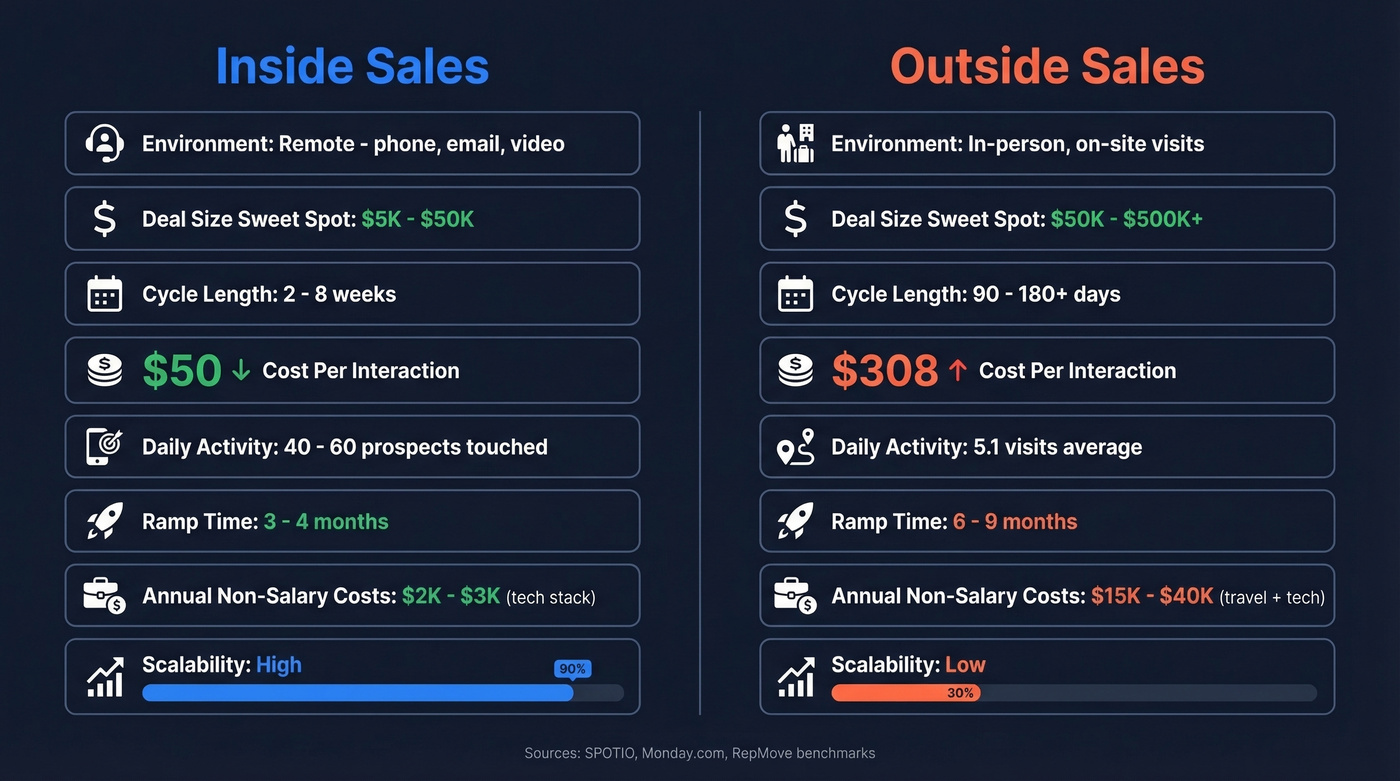
| Dimension | Inside Sales | Outside Sales |
|---|---|---|
| Environment | Remote (phone, email, video) | In-person, on-site |
| Deal Size Sweet Spot | $5K-$50K | $50K-$500K+ |
| Cycle Length | 2-8 weeks | 90-180+ days |
| Cost Per Interaction | ~$50 | ~$308 |
| Daily Activity | 40-60 prospects | ~5.1 visits (avg) |
| Ramp Time | 3-4 months | 6-9 months |
| Annual Non-Salary Costs | $2K-$3K (tech) | $15K-$40K (travel + tech) |
| Scalability | High | Low |
| Buyer Access | Broad, digital-first | Deep, relationship-driven |
The cost-per-interaction benchmarks come from SPOTIO's operational framework. Activity expectations align with what Monday.com and RepMove benchmark.
Inside Sales - The Numbers
An inside B2B rep working a solid tech stack can engage 40-60 prospects per day, make 50-80 calls, and often reach productivity within six weeks of onboarding. A field rep takes 6-9 months to ramp and averages 5.1 client visits daily. The velocity difference is enormous.
Run the ROI math. If your average deal is $15K and it takes three meetings to close, the inside cost to close is roughly $150 (3 x $50 per interaction) - that's 1% of deal value. For a team of 10 reps closing 4 deals per month each, you're looking at $6,000/month in interaction costs generating $600K in revenue. Hard to argue with those unit economics.
Tech overhead runs $2K-$3K per rep per year. Compare that to the $15K-$40K annual expense load for a field rep's travel, vehicle, and entertainment budget.
But inside selling has a real downside that comp plans don't capture: burnout. One thread on r/sales describes an inside rep fielding calls where "80% were hostile" - a function of bad product-market fit and sketchy lead sources, not the model itself. Inside sales amplifies whatever you feed it. Good data and clear ICP targeting make reps productive. Bad data makes them miserable, and they leave.
Quick ROI Box: $15K deal x 3 inside meetings = $150 cost to close (1%). $200K deal x 8 field visits = $2,464 cost to close (1.2%). Inside wins on efficiency. Outside wins on deal size - but only if you're actually closing $200K+ deals.

You just saw the math: inside reps touch 40-60 prospects daily, but bad data turns that velocity into bounced emails and dead dials. Prospeo delivers 98% email accuracy and 125M+ verified mobile numbers - refreshed every 7 days - so your inside team actually connects instead of churning through garbage lists.
Stop burning inside rep hours on data that doesn't connect.
Outside Sales - Field Benchmarks
Field sales isn't dead. It's just expensive, and the productivity variance between top and bottom performers is staggering.
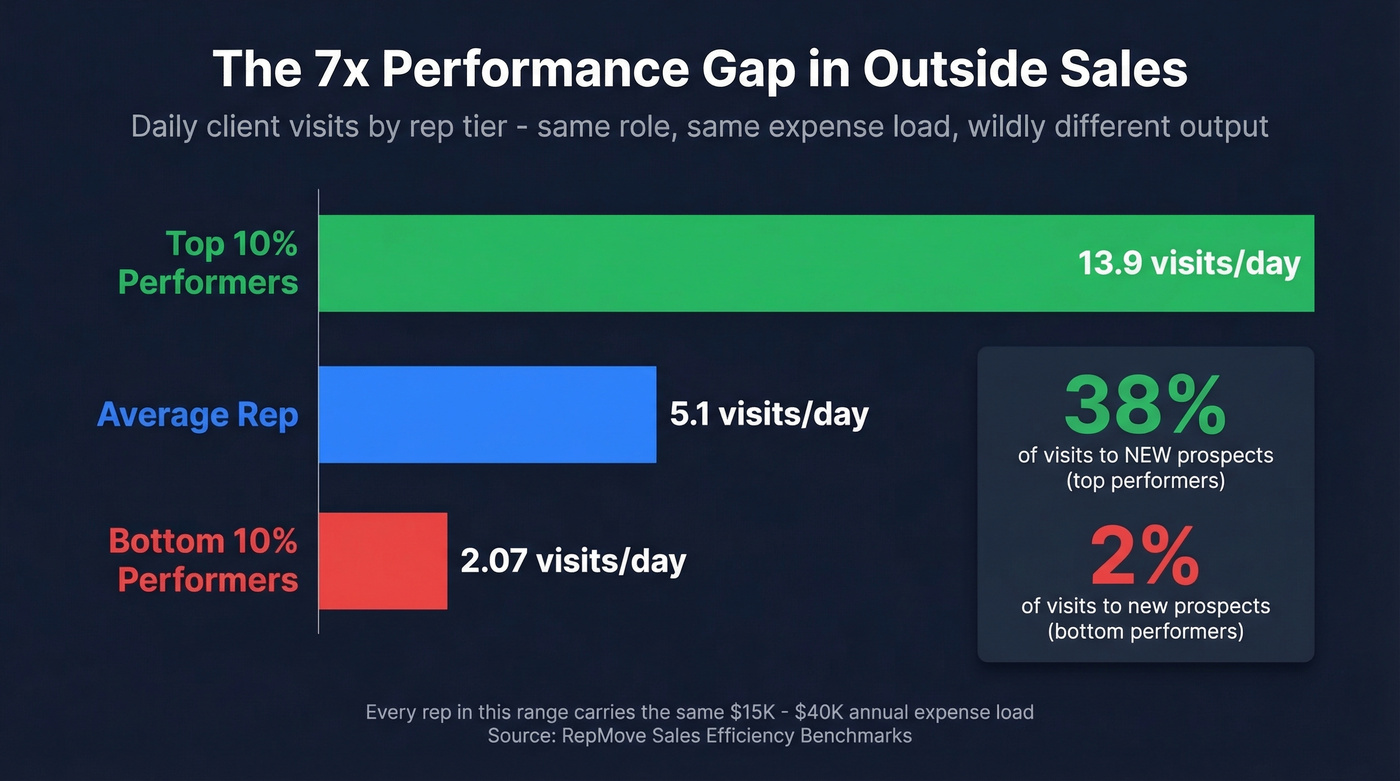
RepMove's benchmarks show the average outside rep makes 5.1 visits per day. Top 10% performers hit 13.9 visits. Bottom 10%? Just 2.07. That's a nearly 7x spread, and every one of those reps carries the same expense load. The prospecting gap is even starker: top performers devote 38% of visits to new prospects vs. roughly 2% for bottom performers.
Outside reps spend 60-70% of their time in face-to-face meetings and travel. Territory planning matters enormously here - manual planning yields just 78.2% territory coverage, while graph-based optimization pushes that to 91.4% and cuts travel distance by 40.8%.
The face-to-face advantage is real. In-person meetings are roughly 34x more effective than email at generating a positive response, but at 6x the cost per interaction. That trade-off only pencils out when deal sizes justify it.
Use field reps if: ACV exceeds $200K, the buying committee requires in-person validation, your product needs on-site demos, or you're selling into handshake-culture industries like construction, manufacturing, or healthcare.
Skip field reps if: ACV sits below $50K, your buyer persona is a digital-native VP who'd rather do a 30-minute Zoom than block two hours for lunch, or you're a seed-stage company that can't absorb $15K-$40K per rep in travel costs before they close a single deal.
The lifestyle cost is real too. One r/sales poster earning ~$100K left outside sales entirely because weekly travel was unsustainable with a baby on the way. That's not an edge case - it's a retention risk baked into the model.
Compensation Breakdown
Here's what the market pays across the inside-to-outside spectrum, based on Everstage's comp data and cross-referenced with Forbes Advisor benchmarks:
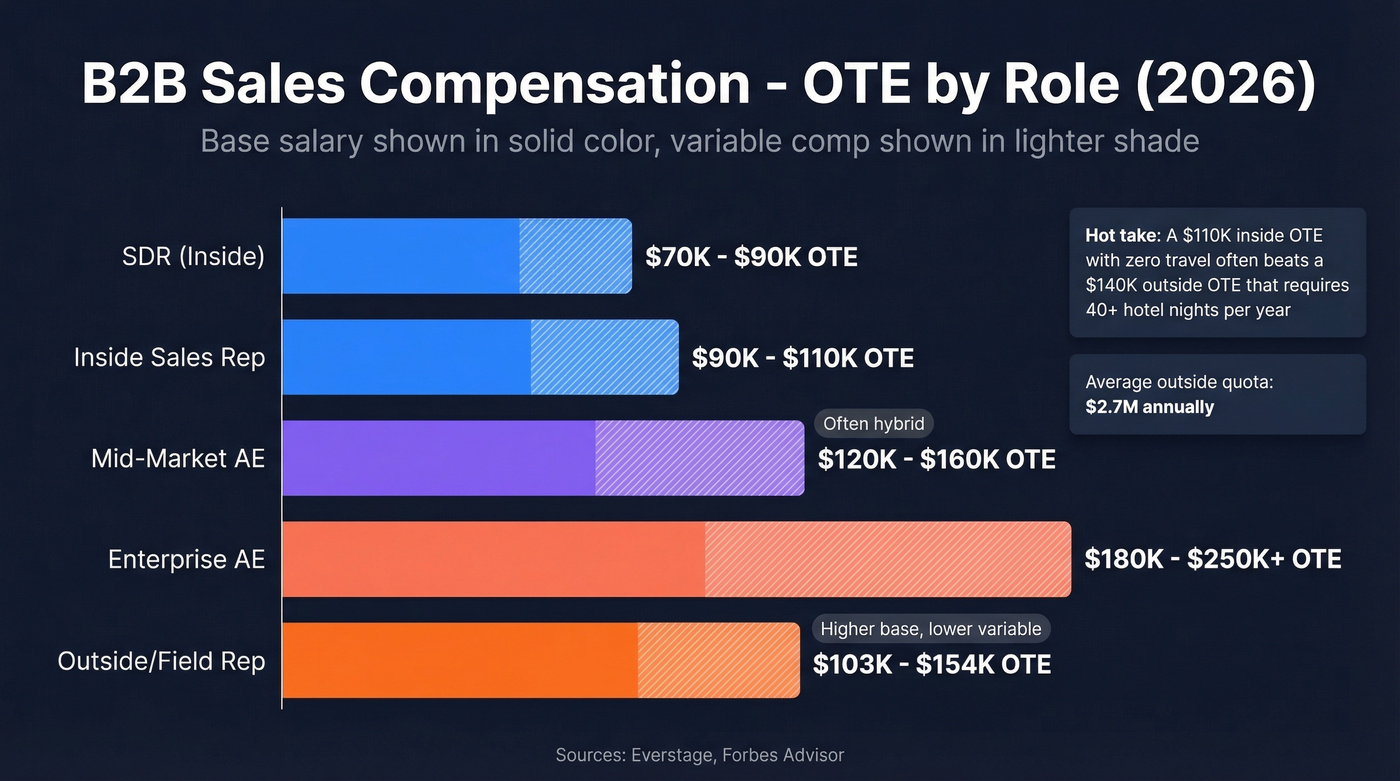
| Role | OTE Range | Base (Typical) | Notes |
|---|---|---|---|
| SDR (Inside) | $70K-$90K | ~$45K-$55K | High activity, entry point |
| Inside Sales Rep | $90K-$110K | ~$52K | 50/50 to 60/40 split |
| Mid-Market AE | $120K-$160K | ~$70K-$90K | Often hybrid |
| Enterprise AE | $180K-$250K+ | ~$100K-$130K | Complex, multi-thread |
| Outside/Field Rep | $103K-$154K | ~$85K-$103K | Higher base, lower variable |
Outside reps carry higher base salaries because their variable comp is harder to control - you can't dial 80 calls a day in the field. They also carry higher quotas, averaging $2.7M annually. The trade-off is that inside reps with strong variable plans often out-earn field reps at the same experience level. They just have more at-bats.
When you factor in lifestyle costs - travel wear, time away from family, the health impact of constant road work - the effective comp gap narrows further. A $110K inside OTE with zero travel days beats a $140K outside OTE that requires 40+ nights in hotels per year for most people.
How to Choose Your Sales Model
Stop treating this as a philosophical debate. Run it through a scoring matrix.
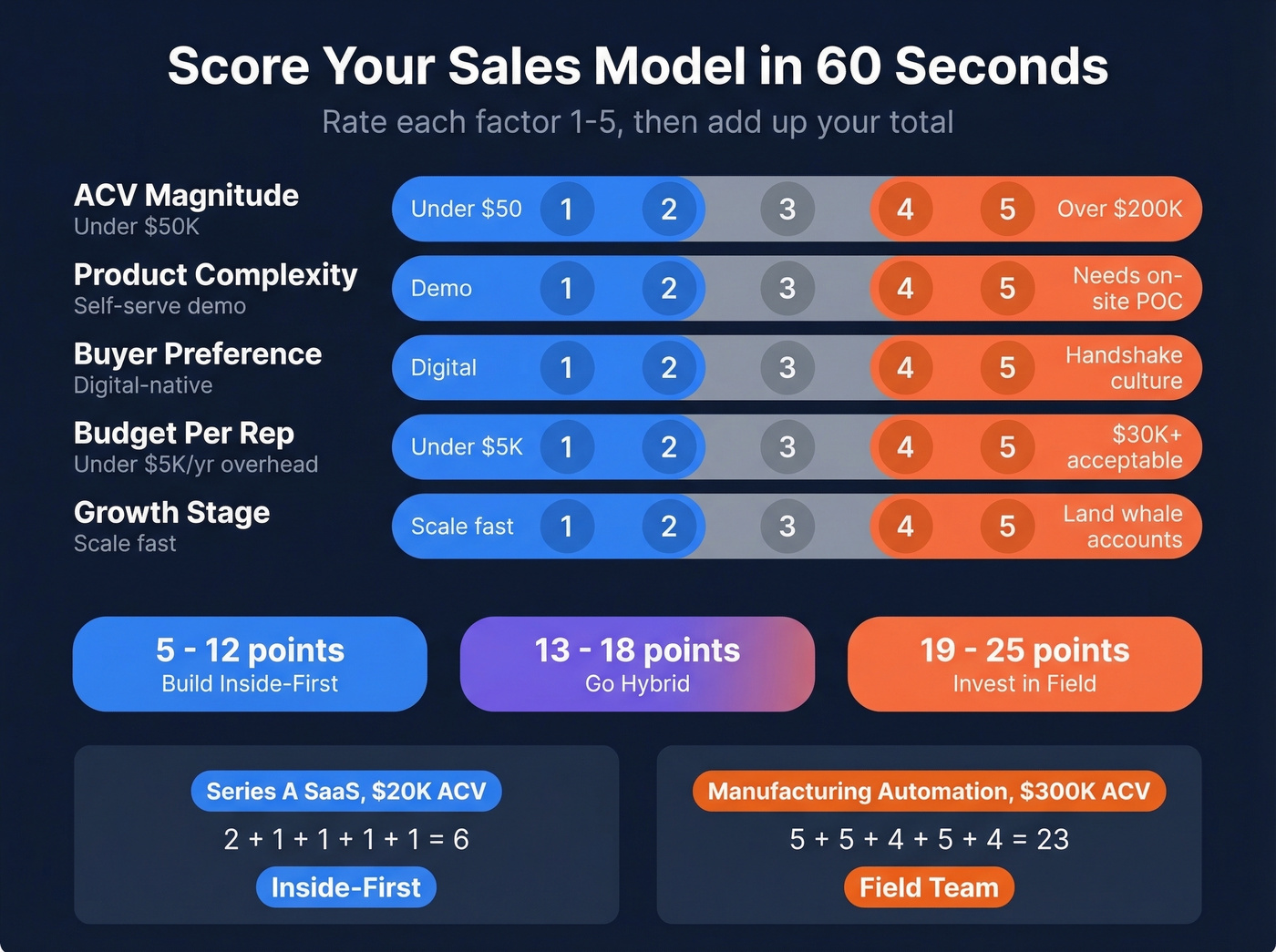
Score each factor 1-5 for your business:
- ACV magnitude - Under $50K (score 1-2, inside) vs. over $200K (score 4-5, outside)
- Product complexity - Self-serve demo (1) vs. requires on-site POC (5)
- Buyer preference - Digital-native (1) vs. handshake culture (5)
- Budget per rep - Under $5K/year overhead (1) vs. $30K+ acceptable (5)
- Growth stage - Need to scale fast (1, inside) vs. land whale accounts (5, outside)
Total score 5-12: build inside-first. 13-18: hybrid. 19-25: invest in field.
Here's what this looks like in practice. A Series A SaaS company selling a $20K ACV product scores: ACV = 2, complexity = 1, buyer = 1, budget = 1, stage = 1. Total: 6. Inside-first, no question.
A manufacturing automation vendor selling $300K implementations? ACV = 5, complexity = 5, buyer = 4, budget = 5, stage = 4. Total: 23. Field team with inside support.
The scenario that plays out constantly: your CFO pulls up the numbers and sees the 8-person outside team closed fewer total deals than the 4-person inside team - at 3x the cost per rep. The field team's deals were bigger, sure, but not big enough to justify the delta. That's the moment most companies start building hybrid.
The Hybrid Model
The question isn't whether to go hybrid. It's where to set the handoff triggers.
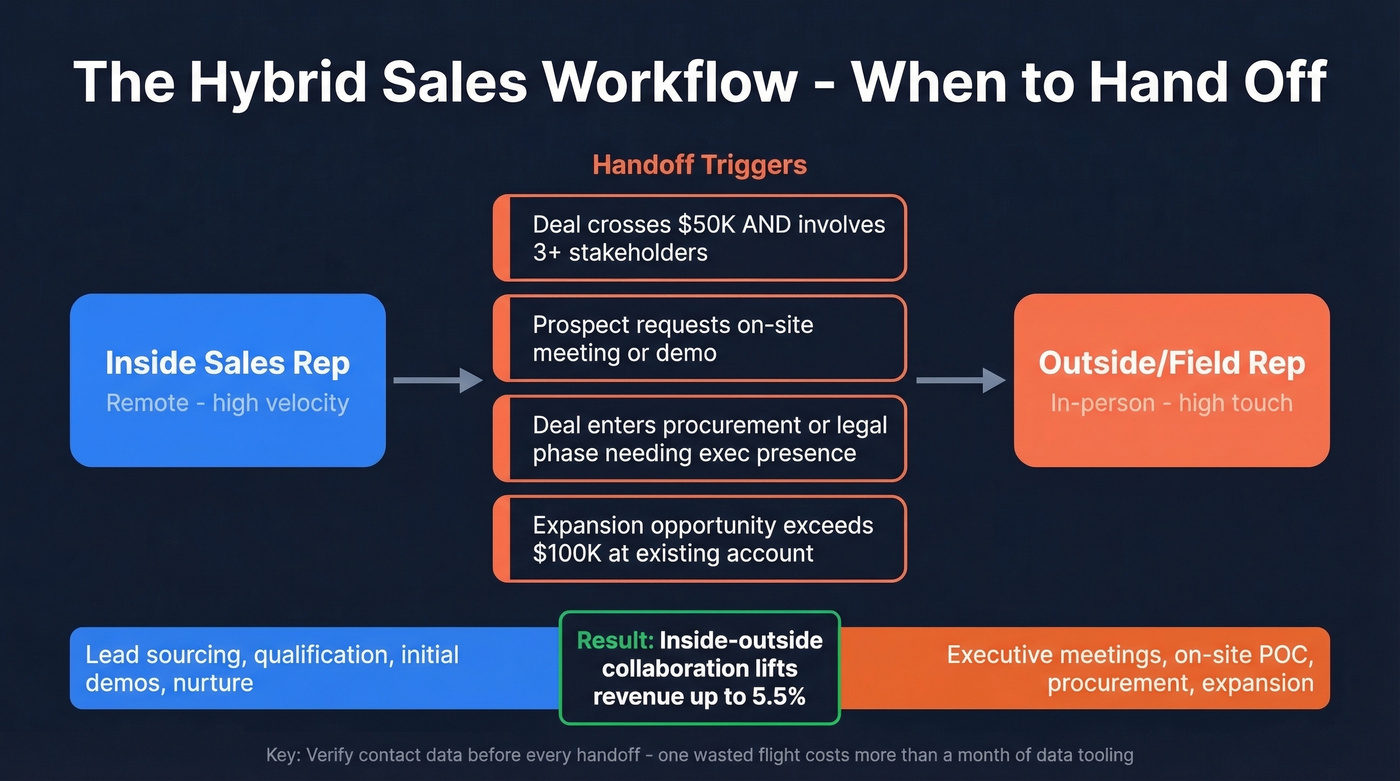
Research shows inside-outside collaboration on the same accounts lifts revenue up to 5.5%. In high-tech and finance, hybrid roles account for nearly half of sales positions. This isn't a trend - it's the operating standard. Companies that blend remote selling motions with strategic field visits consistently outperform teams locked into a single channel.
Handoff triggers that work in practice:
- Deal crosses $50K and involves 3+ stakeholders - field rep joins
- Prospect explicitly requests an on-site meeting or demo
- Deal enters procurement/legal phase requiring executive presence
- Expansion opportunity at existing account exceeds $100K
One framework worth stealing: stop thinking in titles and start thinking in workflows. Your "outside rep" might spend 60% of their time on Zoom. Your "inside rep" might fly to a prospect's office for a critical demo. The labels matter less than the workflow design - lead sourcing, qualification, demo, negotiation, procurement, expansion. Map the workflow, then assign the right motion to each stage.
Before passing a lead from inside to outside, verify the contact data is current. Stale records waste field reps' limited face-to-face time, and a single wasted flight costs more than a month of data tooling.
Data Quality - The Hidden Variable
Look, here's a hot take: the inside vs. outside debate is the wrong debate. If your average contract value is under $10K, you probably don't need to agonize over sales models at all - you need a self-serve funnel. And for ACVs between $10K and $200K, the biggest performance lever isn't where your reps sit. It's whether they're reaching real humans.
Reps spend 70% of their time not selling, and bad data is a major contributor. We've seen teams where the "top inside rep" quit because she spent half her week calling disconnected numbers. That's not a performance problem. It's a data problem.

The proof is in the ramp times. GreyScout cut rep ramp from 8-10 weeks to 4 weeks and saw pipeline jump 140% after switching to Prospeo for verified contact data. Their bounce rate dropped from 38% to under 4%. With 300M+ professional profiles refreshed on a 7-day cycle and 98% email accuracy, the platform eliminates the data decay that silently kills both inside and outside motions. Bain research ties data-driven sales guidance to a 12-point win rate advantage - but that only works when the underlying contact data is accurate.
And 81% of teams are now using AI to prioritize accounts, write sequences, and score leads. AI on bad data doesn't just waste time - it amplifies waste at scale. If you're building your stack now, start with data enrichment and a repeatable lead generation workflow.
Field reps cost $308 per interaction and average 5.1 visits a day. Every wasted visit on a wrong contact destroys your unit economics. Prospeo's 30+ filters - buyer intent, headcount growth, technographics - let you pre-qualify accounts before your outside team ever books a flight.
Make every $308 field visit count with data you can trust.
FAQ
What's the difference between B2B inside sales and outside sales?
Inside sales reps work remotely - phone, email, video - and handle higher volumes at ~$50 per interaction. Outside reps meet prospects in person at ~$308 per interaction and close larger deals. The right model depends on your ACV, product complexity, and buyer preferences, not on which sounds more impressive.
Is inside sales easier than outside sales?
Neither is easier. Inside sales demands 50-80 calls per day and constant rejection tolerance. Outside sales requires travel stamina, longer relationship cycles, and the ability to read a room in person. The better question: which fits your product's ACV and your reps' strengths?
What's the real salary difference?
Inside sales reps earn $90K-$110K OTE. Outside/field reps earn $103K-$154K. Enterprise AEs in hybrid roles can reach $250K+. The gap narrows significantly when you factor in travel costs and the higher variable upside available to high-performing inside reps.
Do I need both inside and outside reps?
If your ACV spans $25K-$200K+, yes. Research shows inside-outside collaboration lifts revenue up to 5.5%. The key is defining clear handoff triggers - deal size thresholds, stakeholder count, and buyer requests for in-person engagement.
How do I keep contact data clean across both teams?
Use a platform with automated verification and frequent refresh cycles. A 7-day refresh cadence and 98%+ email accuracy are the benchmarks to aim for - critical when inside reps burn through 50+ contacts daily and field reps can't afford a wasted site visit.
The Bottom Line
Stop debating B2B inside sales vs outside sales as an either-or question. The real differentiator in 2026 isn't where your reps sit - it's whether they're reaching real humans with accurate information. To tighten execution, standardize your sales activities, improve sales prospecting, and fix sales pipeline challenges before you add headcount. Get the data right, match the sales motion to your ACV, and the model question answers itself.