

B2B Introduction Email Templates: 5 Frameworks That Actually Get Replies
The average cold email reply rate in 2026 is 3.43%. Elite campaigns - the top 10% - hit 10.7%+. That's a 3x gap, and it doesn't come from a better template alone.
Here's the thing: templates are maybe 20% of the equation. The other 80% is data quality and deliverability - whether your email reaches a real person's inbox in the first place. We've watched teams rewrite subject lines for weeks while sending to addresses that haven't been valid since 2023. Fix the data first, then worry about the words.
You don't need 14 templates. You need five frameworks you can adapt to any situation, a clean list, and the discipline to follow up.
Before You Write a Word
- Pick a framework. Choose one of the five templates below, personalize it, send.
- Verify before you send. A bounce rate above 2% damages your domain. Prospeo's free tier covers 75 email verifications a month - enough to validate your first campaign. (If you want options, see our roundup of email validators.)
- Follow up. 42% of replies come from follow-ups, not the first email. Don't send one message and call it a day.
What Makes an Introduction Email Work
Six principles separate emails that get replies from emails that get archived.

Keep it under 80 words. Best-performing campaigns keep first-touch emails short. You're earning a reply, not closing a deal.
Lead with their problem, not your product. Nobody cares about your platform's features in an intro email. They care about the thing keeping them up at night.
One CTA, framed as a question. "Would it make sense to chat Thursday?" beats "Book a demo" every time. Questions lower the commitment threshold. (More examples: how to ask for a meeting via email.)
Personalize beyond first name. Personalized subject lines are 37% more likely to be opened. Personalized CTAs convert 202% better. Reference a recent hire, a funding round, or a specific pain point - anything that proves you did your homework. And personalization starts with accurate data: if your contact list is stale, even the best template won't reach the right person. (Related: personalization in outbound sales.)
Keep subject lines around 35-50 characters. Many mobile email clients truncate longer ones, and every extra word past the cutoff is a word your prospect never sees. (See also: words to avoid in email subject lines.)
Send Tuesday or Wednesday, 9-11 AM in their time zone. Wednesday pulls the highest reply rates across Instantly's dataset. Monday inboxes are too crowded. Friday brains are already checked out. (More timing guidance: best time to send prospecting emails.)

5 Cold Email Frameworks (Copy-Ready)
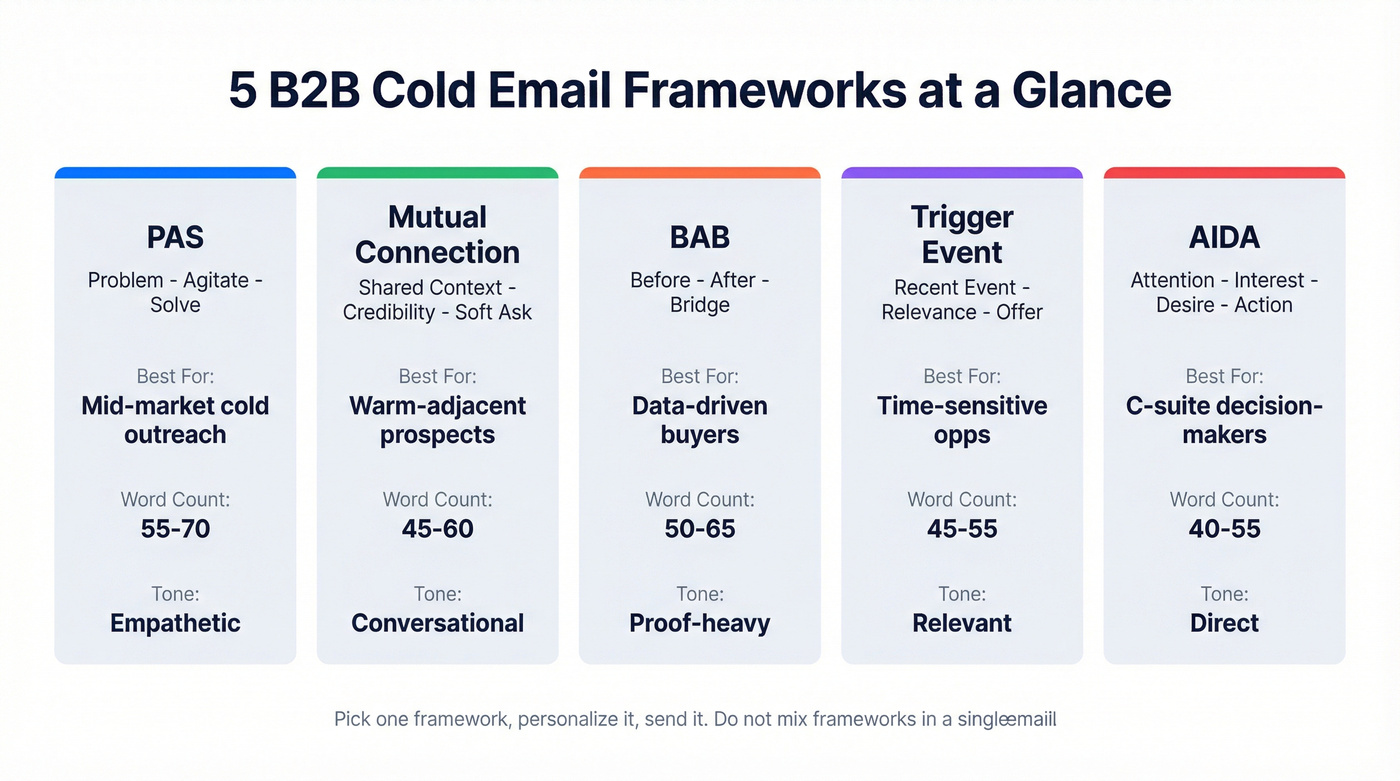
1. The Problem-First Opener (PAS)
Problem, Agitate, Solve. Name the pain, twist the knife, offer the fix. In our experience, PAS outperforms every other framework for cold outreach to mid-market because it forces you to prove you understand the problem before you pitch anything.
Subject: {{pain point}} eating your Q3 pipeline?
Hi {{first name}},
A lot of {{role}} teams at {{company size}} companies get stuck doing {{specific pain}} manually - and it quietly drains time from the work that actually moves pipeline.
We built {{product}} to fix exactly that - {{one-line result}}.
Worth a 15-minute call this week?
Why it works: You've shown you understand their world before you pitch. (If you want more structures, see sales email structure.)
Common mistake: Going vague on the pain point. "Struggling with growth" means nothing. "Losing hours a week to manual list building" means everything.
2. The Mutual Connection
Shared context, credibility, soft ask. A warm reference cuts through inbox noise faster than any subject line hack.
Subject: {{mutual connection}} suggested I reach out
Hi {{first name}},
{{Mutual connection}} mentioned you're tackling {{challenge}} at {{company}}. We helped their team {{specific result}} in {{timeframe}}.
Happy to share what worked - would a quick call Thursday or Friday make sense?
Skip this template if you don't have a genuine mutual connection. Fabricating one is the fastest way to destroy trust before you've built any.
3. The Quick Value Drop (BAB)
Before, After, Bridge. Paint the gap, then fill it. This is a strong framework for data-driven buyers who respond to concrete proof over storytelling.
Subject: {{company}} + {{specific metric}} improvement
Hi {{first name}},
Before working with us, {{similar company}} was stuck at {{before metric}}. Within {{timeframe}}, they hit {{after metric}}.
The bridge? {{One-sentence explanation of how}}.
Want me to walk you through it in 10 minutes?
The stronger your proof point, the higher your reply rate. "Increased pipeline 40%" beats "improved results significantly" every single time.
4. The Trigger Event
Recent event, relevance, offer. Timing is everything with this one.
Subject: Congrats on the {{funding round / new hire / expansion}}
Hi {{first name}},
Saw {{company}} just {{trigger event}}. When {{similar company}} hit that stage, they ran into {{common challenge that follows}}.
We helped them {{specific outcome}}. Worth comparing notes?
When to use this: Within 48 hours of the trigger event. A week later, you're not timely - you're just another cold email referencing old news. Set up Google Alerts or use intent data to catch these moments in real time. (More on signals: intent signals.)
5. The Direct Ask (AIDA)
Attention, Interest, Desire, Action. No fluff, straight to the point. This is the template for C-suite prospects who get a high volume of email and will delete anything that wastes their first three seconds.
Subject: Quick question about {{specific process}}
Hi {{first name}},
{{Company}} is scaling {{department}} - which usually means {{common bottleneck}}.
We help teams like yours {{one-line value prop}}, and {{proof point: customer name or metric}}.
Open to a 10-minute call next week?
| Template | Best For | Avg. Words | Tone |
|---|---|---|---|
| PAS | Mid-market cold outreach | 55-70 | Empathetic |
| Social Proof | Warm-adjacent prospects | 45-60 | Conversational |
| BAB | Data-driven buyers | 50-65 | Proof-heavy |
| Trigger Event | Time-sensitive opportunities | 45-55 | Relevant |
| AIDA | C-suite / senior decision-makers | 40-55 | Direct |

Every template above falls flat if it bounces. Prospeo verifies emails at 98% accuracy with a 7-day refresh cycle - so the contacts you personalize for actually receive your message. Start with 75 free verifications, no credit card required.
Fix the data first. The replies will follow.
Follow-Up Strategy That Doubles Replies
58% of replies come from the first email, but 42% come from follow-ups. If you're sending one email and moving on, you're leaving almost half your replies on the table. (More: when should you follow up on an email.)
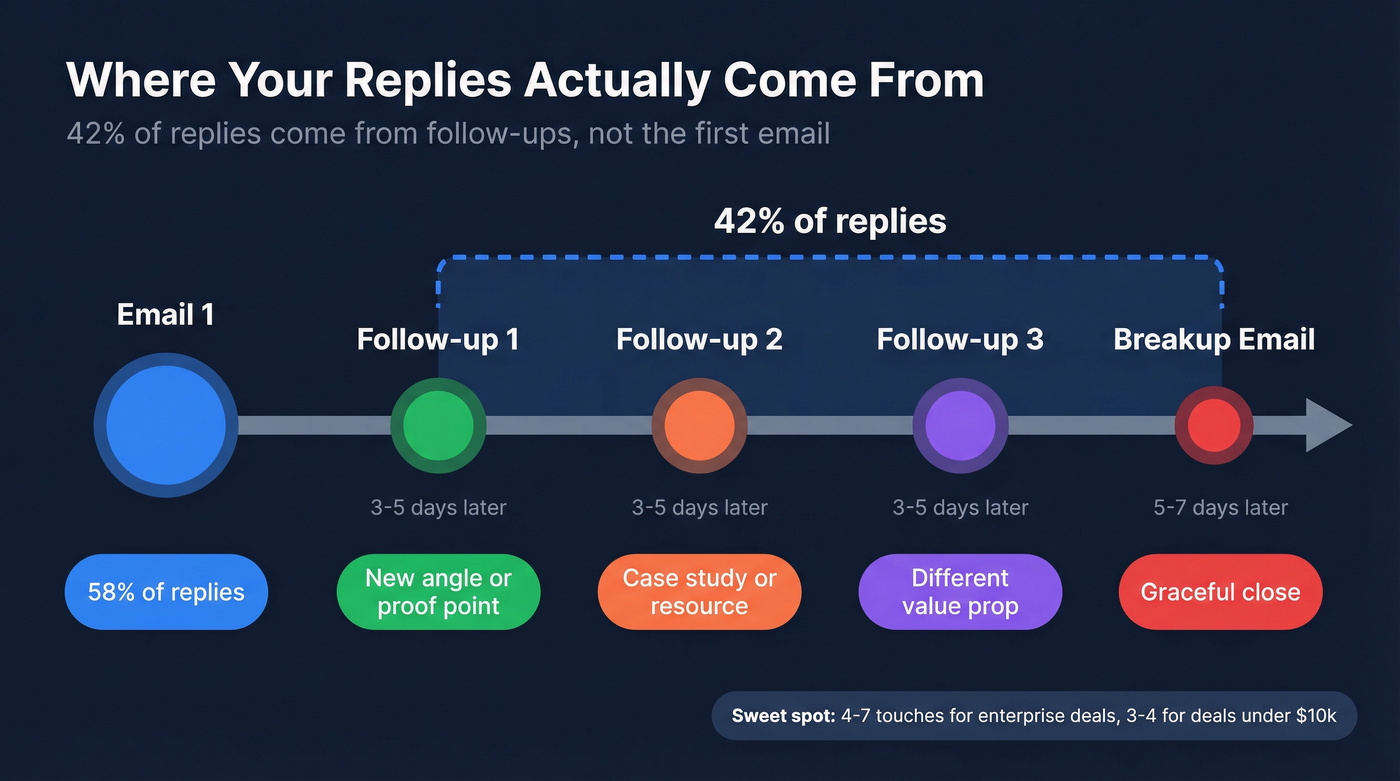
The sweet spot is 4-7 touchpoints. Under four gives up too early. Beyond seven shows diminishing returns unless each touch adds genuine new value - a relevant case study, a different angle on their problem, a useful resource. "Just checking in" is the fastest way to get marked as spam.
Space follow-ups 3-5 days apart. Each one should introduce something the prospect hasn't seen yet.
Let's be honest about deal size, though. If your average deal is under $10k, you probably don't need seven touchpoints. Three emails and a breakup message is often enough to see if there's real interest. Save the elaborate sequences for enterprise deals where the payoff justifies the persistence.
The Deliverability Checklist
None of this template advice matters if your emails land in spam. We've seen teams with genuinely great copy get 0.5% reply rates because they skipped this step entirely. Run through this before every campaign: (Full playbook: email deliverability checklist.)

- Authenticate your domain. SPF + DKIM + DMARC are non-negotiable. Without all three, Gmail and Outlook will throttle or block you more aggressively. (Setup help: SPF, DKIM, DMARC explained.)
- Warm up new domains. Start at 5-10 emails per day and ramp over 4-6 weeks. Jumping to 50/day on a fresh domain is a fast path to the spam folder. (More: automated email warmup.)
- Keep bounce rate under 2%. Anything above that signals to mailbox providers that you're sending to bad lists. This is where most campaigns silently die - and it's the easiest problem to prevent with email verification.
- Keep spam complaints under 0.3%. One complaint per 300 emails is the ceiling.
- Use a branded CNAME tracking domain. Shared tracking domains pool your reputation with everyone else using the same tool.
- Target 80%+ inbox placement. The global average sits around 83-85% for bulk email. Below 80% means something's broken.
- Include one-click unsubscribe. RFC 8058 compliance isn't optional - Google and Yahoo enforce it.
- Verify every email address before sending. This single step prevents the bounce-rate spiral that kills domain reputation. Prospeo verifies emails at 98% accuracy on a 7-day refresh cycle, and the free tier covers 75 emails a month - enough to validate your first outbound list without spending a dollar. (More: email verification for outreach.)
Trigger events, mutual connections, pain points - great personalization requires great data. Prospeo's 300M+ profiles with 30+ filters let you find the right prospect, verify their email, and send with confidence for roughly $0.01 per contact.
Stop rewriting subject lines and start reaching real inboxes.
Compliance in 60 Seconds
Ignoring compliance isn't just risky - it's expensive. CAN-SPAM penalties run up to $53,088 per violation. GDPR fines can hit EUR 20M or 4% of global annual turnover, whichever is higher.
CAN-SPAM checklist:
- Truthful "From" and "Reply-To" headers
- Non-deceptive subject lines
- Your physical postal address included
- Clear opt-out mechanism in every email
- Honor opt-out requests within 10 business days
If you're emailing prospects in the EU or UK, the rules are stricter. GDPR requires opt-in consent, not just an opt-out link. That's a fundamentally different model than the US approach - don't assume CAN-SPAM compliance covers you internationally.
FAQ
How long should a B2B introduction email be?
Under 80 words for the first touch. Shorter emails consistently outperform longer ones in cold outreach reply rates - aim for 50-70 words to earn a response, not close a deal.
What's a good reply rate for cold B2B emails?
The 2026 average is 3.43%. Top-quartile campaigns hit 5.5%+, and elite campaigns reach 10.7%+. If you're below 2%, check your list quality and deliverability before rewriting copy.
What should a B2B introduction email include?
A specific pain point, one clear value proposition, a proof point or social proof element, and a single low-commitment CTA framed as a question. Every strong intro email contains all four in under 80 words.
How do I make sure my intro emails don't bounce?
Verify every address before sending. Bounce rates above 2% damage your domain reputation and push future emails to spam. A verification tool with high accuracy and frequent data refreshes - like Prospeo's 98% accuracy on a 7-day cycle - catches bad addresses before they cost you.