

The 10 Best B2B Lead Finders in 2026
A RevOps lead we know ran a three-tool bake-off last quarter. The tool with the biggest database created a mess of duplicate contacts in Salesforce within days. That's the B2B lead finder market in a nutshell - bigger doesn't mean better, and expensive doesn't mean accurate.
Only 23.6% of B2B marketers verify their email lists before hitting send. The rest are gambling with their domain reputation every time they launch a sequence. One Reddit user summed up the frustration after trying Apollo, ZoomInfo, and Cognism: "90% of what I find aren't the right fit" - and they resorted to manual Googling. The tool you pick matters enormously.
Our Picks (TL;DR)
| Use Case | Pick | Why |
|---|---|---|
| Best for accuracy & value | Prospeo | 98% email accuracy, 7-day refresh, ~$0.01/email, free tier |
| Best free tier for volume | Apollo.io | 275M+ contacts, generous free plan, but expect 65-80% accuracy |
| Best for EMEA & compliance | Cognism | GDPR-native, Diamond Data phone verification, 120M+ European contacts |
Prospeo wins on data quality per dollar. Apollo wins on getting started fast with zero budget. Cognism wins if you're selling into Europe and can't afford compliance headaches. Every other tool fills a more specific niche - keep reading to find yours.
What to Look For in a B2B Lead Finder
Six criteria separate a reliable prospecting tool from a database that'll tank your deliverability.

Email accuracy and verification method. The B2B bounce rate benchmark is 2%. If your lead finder delivers data that bounces above 3-4%, you're actively damaging your sender reputation. Ask how the tool verifies - real-time SMTP checks, catch-all handling, and spam-trap removal are table stakes. For deeper deliverability fundamentals, see our Email Deliverability Guide.
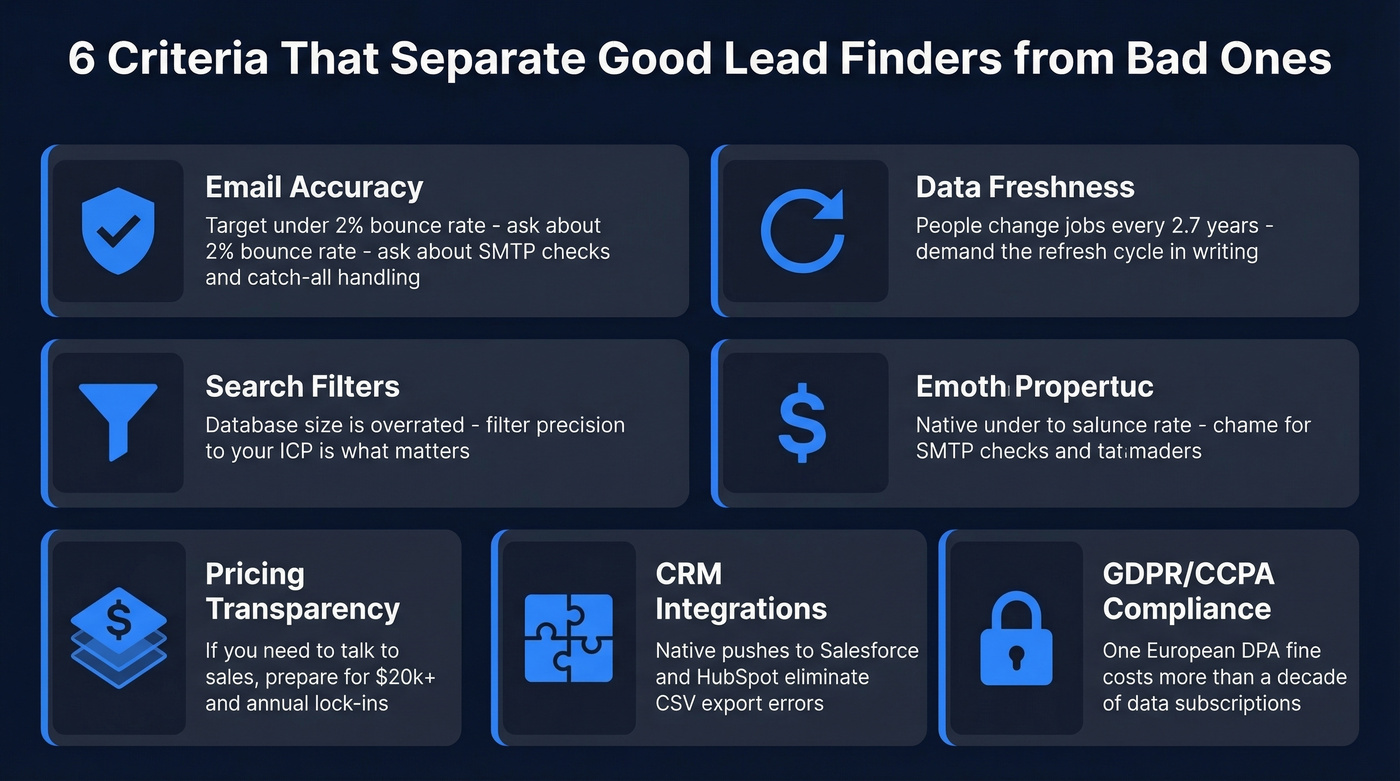
Data freshness and refresh cycle. People change jobs every 2.7 years on average. A database that refreshes every six weeks (the industry norm) is serving you stale contacts constantly. Ask for the refresh cycle in writing. If they won't tell you, assume the worst.
Search filters and targeting precision. Raw database size is the most overrated metric in this space. Instantly advertises 450M+ leads, but the "verified leads" figure is closer to 160M+. The number that matters is how precisely you can filter to your ICP - by intent signals, technographics, headcount growth, funding stage, and department size. If you need a framework for defining and scoring your ICP, use this Ideal Customer Profile template.
Pricing model transparency. If you need to "talk to sales" to find out what a database costs, prepare for $20k+ and an annual lock-in. Credit-based models let you pay for what you use. Seat-based models punish you for growing the team.
CRM integrations. Your lead finder is only as useful as its connection to your workflow. Native pushes to Salesforce, HubSpot, and your sequencer eliminate manual CSV exports that introduce errors and waste time. If you're standardizing your stack, our guide on how to connect outreach tool to CRM can help.
Compliance (GDPR/CCPA). If you're prospecting in Europe, this isn't optional. Look for tools that enforce opt-out globally, offer DPAs, and scrub against do-not-call lists. A fine from a European DPA will cost more than a decade of data subscriptions.
The 10 Best B2B Lead Finding Tools
1. Prospeo
Best for: Teams that can't afford bounces - agencies, founders, and outbound teams where every email needs to land.
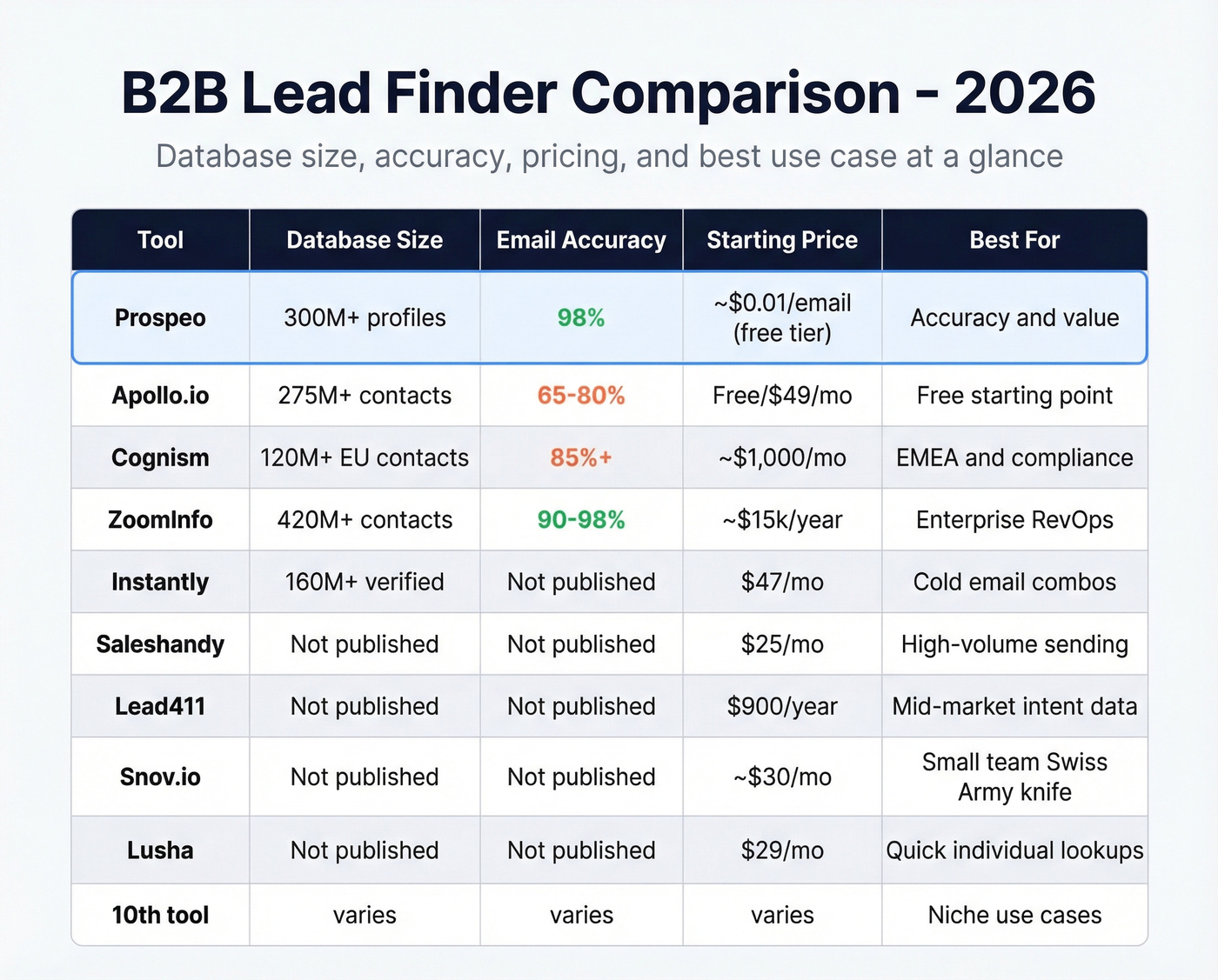
Prospeo's database covers 300M+ professional profiles with 143M+ verified emails and 125M+ verified mobile numbers. Email accuracy sits at 98%, backed by a proprietary 5-step verification process that includes catch-all handling, spam-trap removal, and honeypot filtering. No third-party email providers in the chain. The Chrome extension (40K+ users) lets reps find verified contacts from any website or CRM in one click. If you’re comparing broader data vendors, see our roundup of B2B company data providers.

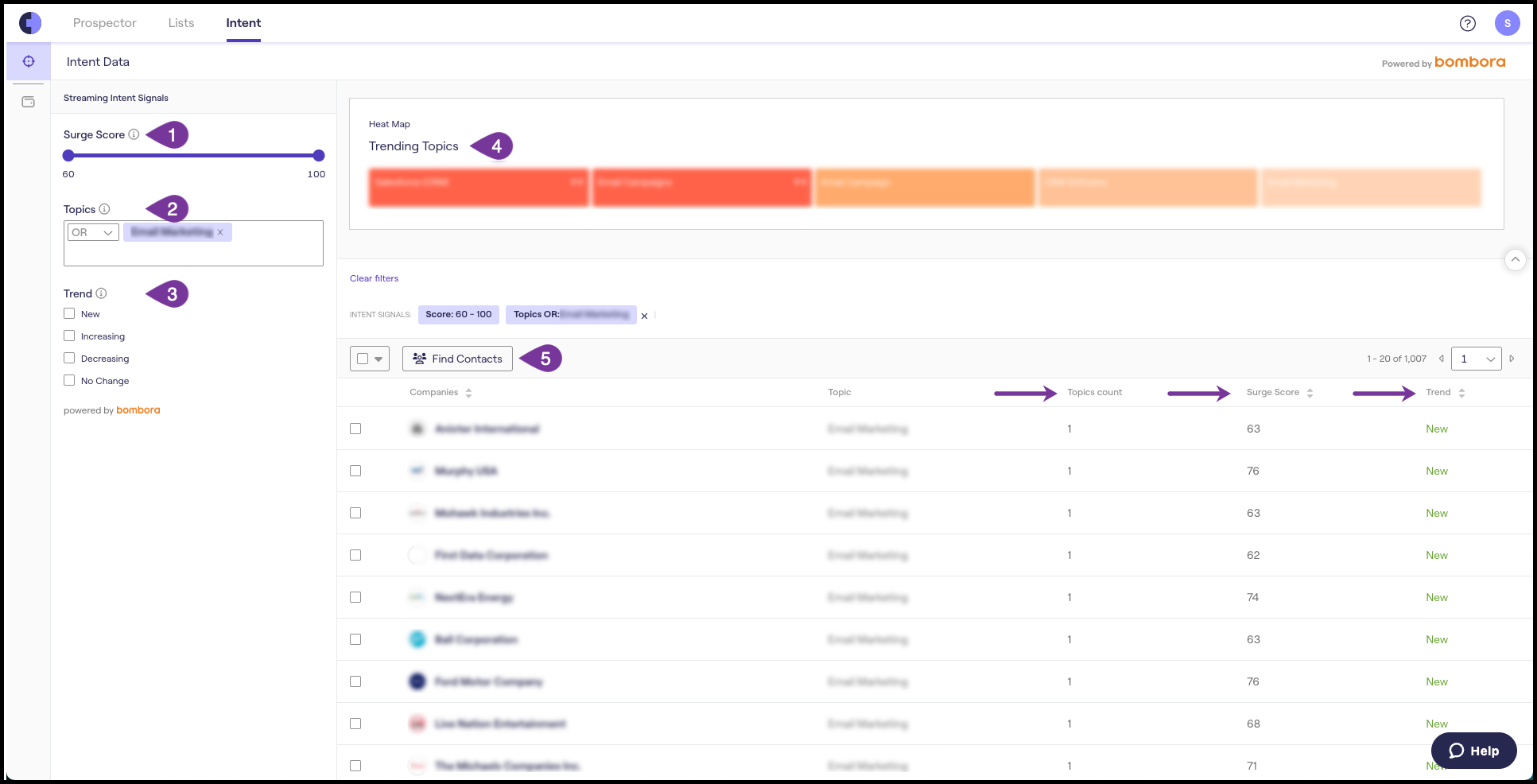
The 7-day data refresh cycle is the standout. Most competitors refresh every four to six weeks, meaning Prospeo catches job changes weeks before other tools even know they happened. The 30+ search filters include buyer intent powered by Bombora across 15,000 topics, technographics, job change signals, headcount growth, and funding data. Mobile numbers hit a 30% pickup rate - critical for reps who actually cold call. If calling is a core motion for you, build a repeatable cold calling system alongside your data workflow.
The proof point: Snyk's 50 AEs dropped their bounce rate from 35-40% to under 5% and generated 200+ new opportunities per month after switching.
Pricing: ~$0.01 per email, 10 credits per mobile number. Free tier gives you 75 emails and 100 Chrome extension credits per month. No contracts, cancel anytime. Native integrations with Salesforce, HubSpot, Smartlead, Instantly, Lemlist, Clay, Zapier, and Make.
Skip if: You need an all-in-one outreach + data platform with built-in email sequences. Pair with your sequencer of choice instead.
2. Apollo.io
Best for: Early-stage teams that need a free starting point with built-in sequencing.
Apollo is the single-platform play - prospecting, filtering, and sending sequences without paying a dime upfront. The free tier gives you access to 275M+ contacts with basic filtering and limited email credits. Paid plans run $49-$149/mo per user and unlock more credits, advanced filters, and integrations.
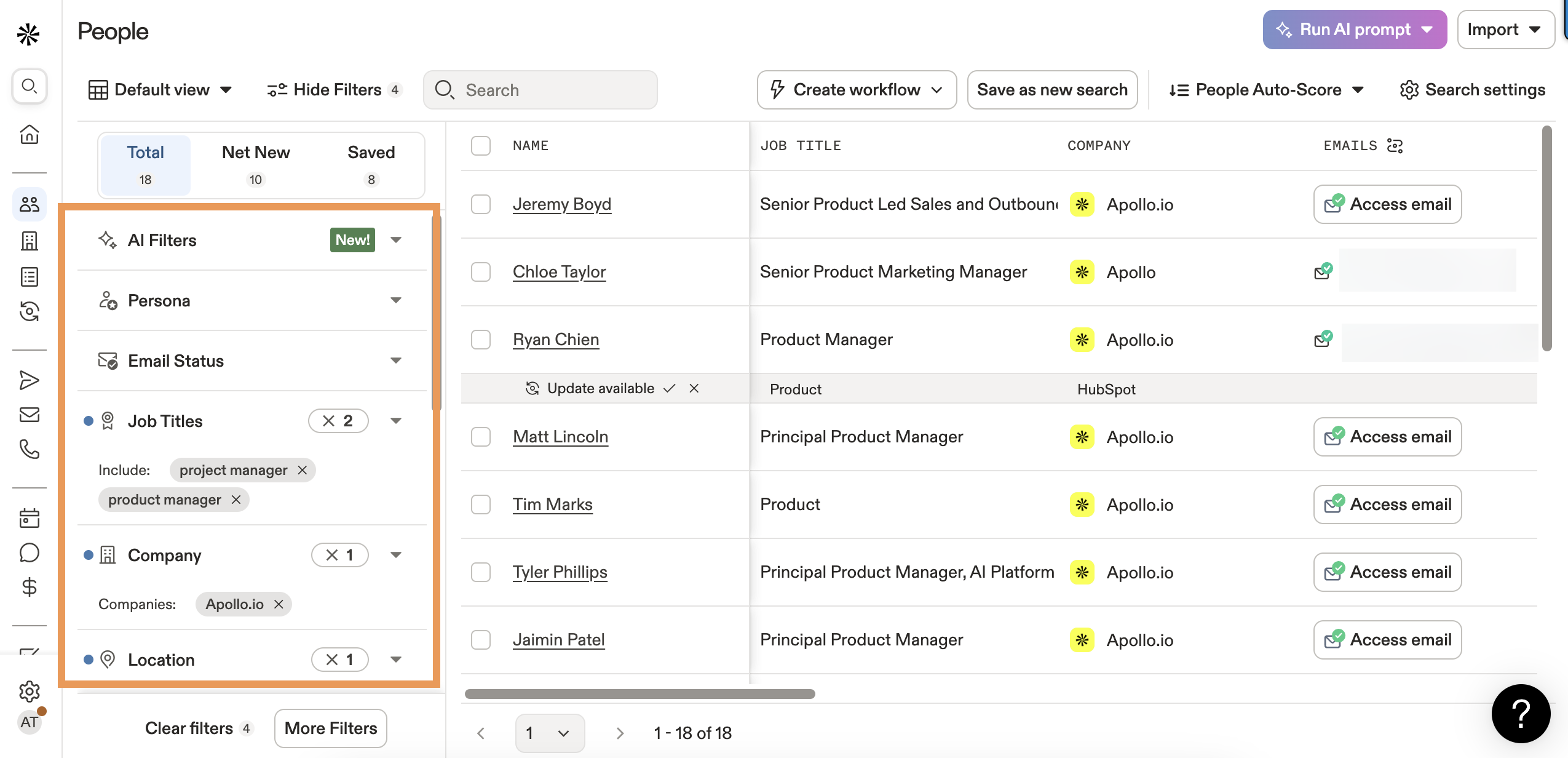
The accuracy trade-off is real, though. Third-party comparisons put Apollo's email accuracy in the 65-80% range, and bounce rates can hit 35% on unverified exports. For a free prospecting tool, that's a reasonable trade-off. For paid outbound at scale, those bounces will damage your domain fast. The smart play for many teams: use Apollo for prospecting and sequencing workflows, then verify your lists through a dedicated tool before sending. If you want more options at $0, compare other free lead generation tools.
Pricing: Free tier available. Paid plans from $49-$149/mo per user. Annual billing saves ~20%.
3. Cognism
Best for: Teams selling into Europe who need GDPR-native data and verified phone numbers.
Cognism's Diamond Data is the real differentiator. They manually verify mobile numbers by actually calling them and checking against do-not-call lists. That's expensive to do at scale, which is why Cognism's pricing reflects it - but if your reps are cold calling into the UK, Germany, or France, the connect rate difference is massive.
The database covers 120M+ contacts in Europe and 50M+ US mobile numbers. Accuracy runs 85%+ overall, with Diamond Data numbers performing significantly higher. GDPR and CCPA compliance are baked in, not bolted on.
Where Cognism wins over ZoomInfo: EMEA coverage, mobile verification quality, and compliance infrastructure. Where ZoomInfo still wins: US database depth, workflow breadth, and intent data sophistication.
Pricing: Custom pricing, typically $1,000-$3,000/mo for small teams. Annual contracts required. Push back on the fair usage policy for exports.
4. ZoomInfo
Best for: Enterprise sales orgs that need the broadest US database and a full RevOps platform.
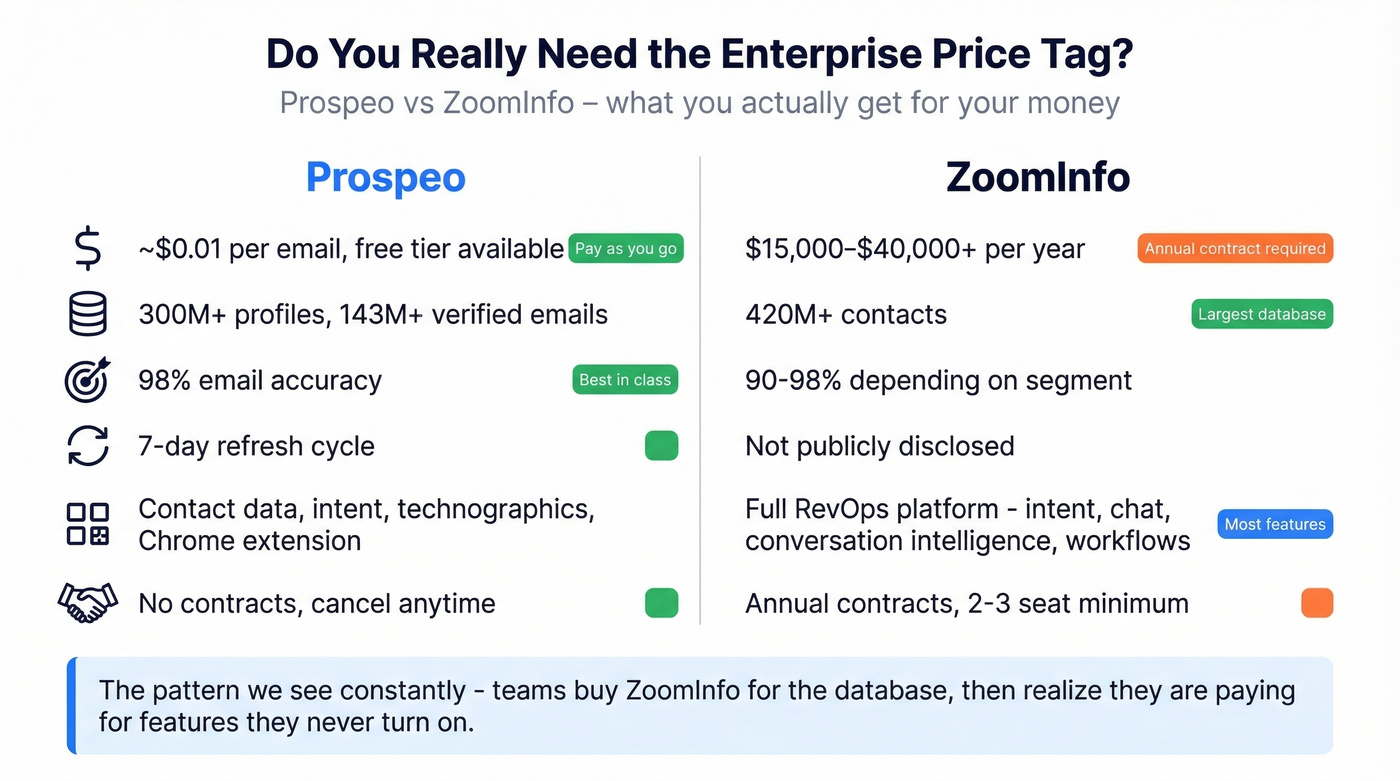
ZoomInfo is still the most complete all-in-one platform. But most teams don't need all-in-one. The 420M+ contact database is the largest in the space, accuracy runs 90-98% depending on segment and region, and the platform includes intent data, conversation intelligence, website visitor tracking, and workflow automation.
The problem is price. Professional runs ~$15k-$20k per user/year, Advanced $25k-$35k, and Elite north of $40k. Annual contracts, minimum two to three seats, no published pricing page. The fact that ZoomInfo still won't publish pricing in 2026 tells you everything about their sales motion.
Here's the thing: we see this pattern constantly. Teams buy ZoomInfo for the database, then realize they're paying for intent, chat, and workflow features they never turn on. If all you need is accurate contact data, you're overpaying by 10x. A tool advertised at $99/mo can become $3,452 in year one after add-ons, fees, and annual requirements - and ZoomInfo's contracts make that math even worse.
Pricing: $15,000-$40,000+/year. Annual contracts required. Minimum 2-3 seats.
5. Instantly
Instantly combines outreach sending and lead data in one platform, which makes it appealing for teams that hate managing multiple subscriptions. Lead Finder plans start at $47/mo (Growth) and $97/mo (Supersonic). Outreach sending is sold separately starting at $37/mo monthly or $30/mo on annual billing.
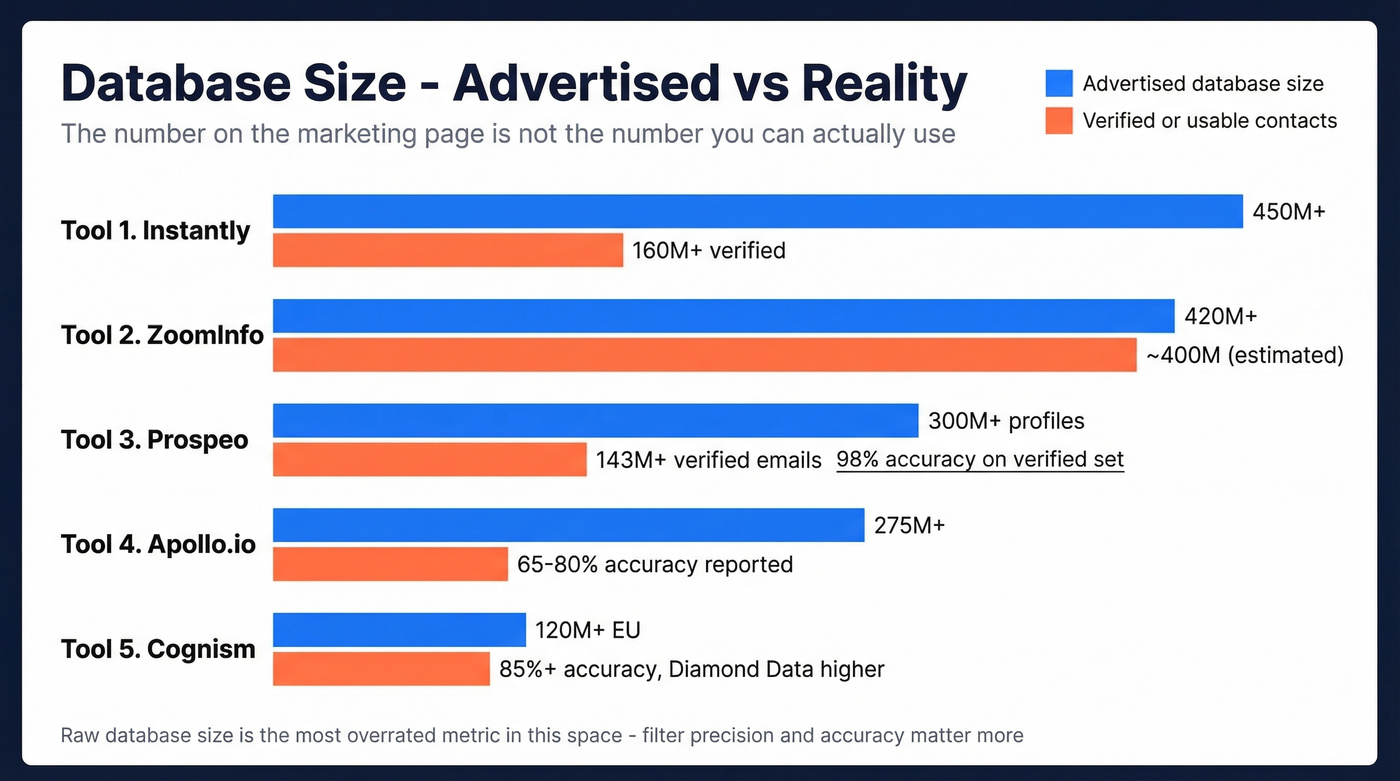
The database size gap is worth noting. Instantly advertises 450M+ leads, but the verified number is closer to 160M+. The tool works well as a send-and-find combo for high-volume cold email, but don't expect ZoomInfo-level accuracy on every export. If you’re building a modern outbound stack, compare more outbound lead generation tools.
Pricing: Lead Finder from $47/mo; outreach from $30/mo (annual). Budget ~$77-$194/mo total.
6. Saleshandy
The verdict on Saleshandy is simple: it's a sending tool that bolted on lead finding, not the other way around. Starting at $25/mo (annual) for the Outreach Starter plan, you get 50 Lead Finder credits and 6,000 emails per month - enough to test, not enough to scale. Each combined email + phone reveal costs 7 credits, so those 50 credits go fast.
Where Saleshandy shines is email sending volume. Pro ($69/mo annual) handles 150,000 emails/month, and Scale ($139/mo annual) pushes 240,000/mo. If you already have a data source and need a high-volume sender, Saleshandy delivers. If you need a serious lead database, look elsewhere.
Pricing: $25-$199/mo depending on tier and billing. Annual billing recommended.
7. Lead411
Lead411's marketing says "unlimited." The fine print disagrees.
Basic Plus starts at $900/year with 2,400 annual exports (200/month) and unlimited email/phone views - not exports. Overages run $0.40-$0.50 per export. The Pro tier with Bombora intent data starts around $3,000/year with 10,000 annual exports. True unlimited exports require the Blaze tier at an estimated $6,000+/year.
That said, if you want intent data bundled with your contact database at a mid-market price, Lead411 is one of the few options between Apollo's free tier and ZoomInfo's enterprise pricing. The intent signals are genuinely useful for prioritizing outreach.
Pricing: $900-$6,000+/year depending on tier and export volume.
8. Snov.io
Snov.io bundles email finding, verification, and drip campaigns into one credit-based platform. Free trial includes 50 credits, and it's GDPR compliant. Paid plans start around $30/mo with tiered credit allotments.
Best for small teams that want a Swiss Army knife rather than a specialized tool. The all-in-one approach means no single feature is best-in-class, but the breadth is hard to beat at this price point.
Pricing: Free trial available. Paid plans from ~$30/mo.
9. Lusha
Lusha is the quick-lookup tool for individual SDRs who need a phone number or email fast. The interface is dead simple - search, click, reveal. Plans run $29-$99/mo per user.
Best for reps doing one-off research, not teams building lists at scale. If your average deal size is modest, you probably don't need ZoomInfo-level data - Lusha's speed-to-contact is hard to beat for ad hoc prospecting.
Pricing: $29-$99/mo per user.
10. Kaspr
Kaspr uses real-time multi-source verification with a strong European focus. Think of it as a lighter, more affordable alternative to Cognism for teams prospecting in EMEA who don't need the full Diamond Data treatment. Pricing starts around $45/mo per user, making it accessible for smaller teams testing European expansion.
Pricing: ~$45/mo per user.

You just read that 76% of B2B teams don't verify their lists before sending. Prospeo's 5-step verification does it for you - 98% email accuracy, catch-all handling, spam-trap removal, and a 7-day refresh cycle that catches job changes weeks before other lead finders.
Find leads that actually land in inboxes - starting at $0.01 each.
Pricing Comparison
Raw monthly prices are misleading when these tools use different credit models, export caps, and contract structures. The cost-per-verified-contact column is what actually matters for your budget.
| Tool | Starting Price | Credit Model | ~Cost/Contact | Contract? |
|---|---|---|---|---|
| Apollo.io | Free tier available | Per-credit | ~$0.10-$0.30 | No |
| Cognism | ~$1,000/mo | Custom/annual | ~$0.30-$0.80 | Yes (annual) |
| ZoomInfo | ~$15,000/yr | Annual license | ~$0.50-$1.00+ | Yes (annual) |
| Instantly | $47/mo (leads) | Per-credit | ~$0.03-$0.05 | No |
| Saleshandy | $25/mo (annual) | Per-credit | ~$0.50-$1.00 | No |
| Lead411 | $900/yr | Export-capped | ~$0.38-$0.50 | Annual |
| Snov.io | ~$30/mo | Per-credit | ~$0.10-$0.20 | No |
| Lusha | $29/mo | Per-credit | ~$0.30-$0.60 | No |
| Kaspr | ~$45/mo | Per-credit | ~$0.15-$0.30 | No |
A tool that charges $0.03 per contact but bounces 20% of them actually costs $0.04+ per deliverable contact - plus the domain reputation damage you can't put a price on. Pricing opacity remains a red flag: if a vendor won't tell you what their tool costs, they're optimizing for their sales team's commission, not your budget. If you want to sanity-check bounce math, see our guide to email bounce rate.
Accuracy & Data Freshness
Stop comparing database sizes. Start comparing bounce rates.
| Tool | Email Accuracy | Data Refresh | Bounce Risk |
|---|---|---|---|
| Prospeo | 98% | 7 days | Very low |
| ZoomInfo | 90-98% | Not published | Low-moderate |
| Cognism | 85%+ | Not published | Moderate |
| Apollo.io | 65-80% | Not published | High |
The 7-day refresh cycle from Prospeo is the only published refresh frequency in the table above. The B2B bounce rate benchmark sits at 2%. With Apollo's reported accuracy range, you're looking at 20-35% bounces on a raw export. That's not a data problem - that's a deliverability crisis.
Here's a stat that should worry you: only 7.6% of B2B domains enforce DMARC. That means bad data doesn't just bounce - it can land in spam traps that permanently damage your sender score. The cost of bad data isn't the subscription. It's the months of domain warmup you'll need to recover. If you’re tightening authentication, start with DMARC alignment.
Let's be honest about what "verified" actually means in this space. It varies wildly. Some tools check if an email format exists at a domain. Others do full SMTP verification with catch-all handling. The word "verified" on a marketing page is meaningless without understanding the method behind it.
Every B2B lead finder on this list makes big database claims. Prospeo backs theirs with results: Snyk's 50 AEs cut bounce rates from 35% to under 5% and generated 200+ opportunities per month. 300M+ profiles, 30+ filters, 125M+ verified mobiles - no contracts required.
Test the #1 pick on this list with 75 free verified emails today.
How to Test Before You Commit
Don't trust marketing pages. Don't trust this article. Trust your own data. Here's a four-step bake-off framework that takes about two hours.
Step 1: Export 100 contacts from each tool's free tier. Target the same ICP across all tools - same titles, same industries, same company size. Most tools on this list offer free tiers or trials.
Step 2: Run every export through an independent email verifier. Don't use the tool's own verification. Use a third party like NeverBounce or ZeroBounce to get an unbiased read on deliverability. Compare valid, risky, and invalid rates side by side. If you’re evaluating verifiers, start with these Bouncer alternatives.
Step 3: Send a small test campaign and measure actual bounce rates. Verification tools catch most bad emails, but real-world bounce rates are the ultimate truth. Send 50 emails from each export through your actual sequencer.
Step 4: Calculate cost per deliverable contact. Take the tool's price per contact and divide by the percentage that actually delivered. A $0.03 contact that bounces 20% of the time costs more than a $0.01 contact that lands 98% of the time. This number should drive your decision - not database size, not feature lists, not the sales rep's demo. In our experience, teams that run this test almost always end up choosing a different tool than the one they assumed was best going in.
FAQ
How big does a B2B lead finder database need to be?
Database size is the most overrated metric in B2B data. A database of 300M verified, regularly refreshed contacts beats 450M unverified records every time. Focus on accuracy, filter quality, and how well the tool targets your specific ICP rather than chasing the biggest number on a marketing page.
What's a good email bounce rate for outbound?
The B2B benchmark is 2%. If your contact data bounces above 3-4%, you're actively damaging your domain reputation. Anything above 5% means stop sending immediately, verify your list, and consider switching providers.
Can I use a B2B lead finder for free?
Yes. Prospeo offers 75 verified emails plus 100 Chrome extension credits monthly at no cost - enough to run a real bake-off. Apollo has a generous free plan with database access, and most others offer 7-day trials. Test before committing budget.
What's the difference between "verified" and "enriched" contacts?
Verified means the email or phone number has been confirmed as deliverable through active checks like SMTP validation. Enriched means additional data points - title, company, revenue, technographics - were appended to an existing record. You want both, but verification is non-negotiable. Enrichment without verification just gives you a detailed profile attached to a dead email address.