

The Best B2B Mailing List Providers for 2026
You bought a list of 5,000 "verified" contacts last quarter. Loaded them into your sequencer, hit send, and watched 400 emails bounce before lunch. Your domain reputation took a hit, your reply rate cratered, and you spent the next two weeks cleaning up the mess.
That's the reality of most B2B mailing list purchases - and it's why picking the right provider matters more than picking the biggest one. Roughly 17% of cold emails never reach the inbox at all, and the average cold list bounces at 7-8%. Reddit users on r/b2bmarketing put it bluntly: big databases are stuffed with outdated contacts, generic inboxes like info@ and support@, and leads every competitor is already hammering. One recurring complaint - "70% of phone numbers are wrong" - captures the frustration perfectly. The problem isn't finding contacts. It's finding contacts that are real, current, and worth emailing.
We evaluated 9 providers across accuracy, pricing, and compliance. Here's what we found.
Our Top Picks
| Provider | Best For | Starting Price |
|---|---|---|
| Prospeo | Email accuracy + data freshness | Free (75 emails/mo) |
| Apollo.io | Free starting point | Free (10,000 email credits/mo) |
| Cognism | EMEA compliance | ~$22,500/yr (5 users) |
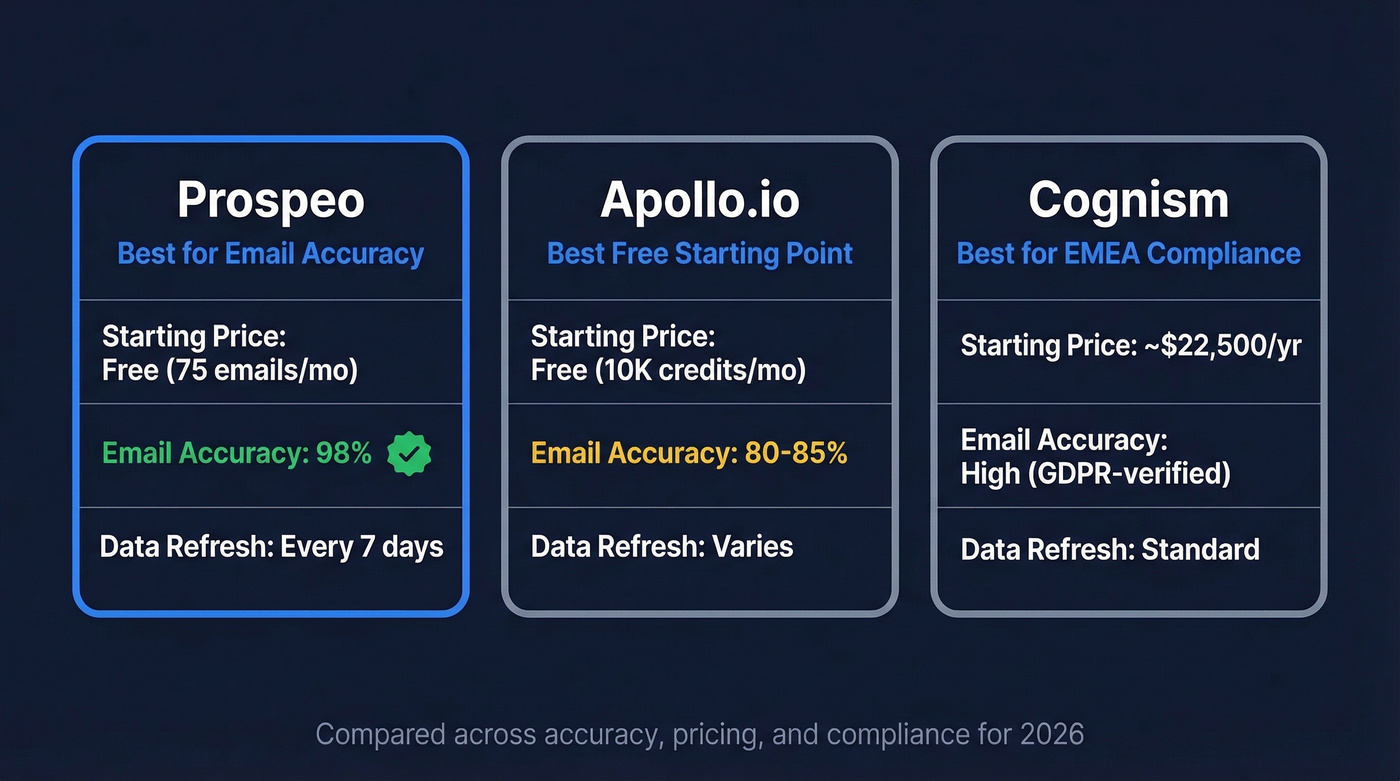
Hot take: if you're paying $15K+/year for ZoomInfo and only exporting a few thousand contacts per quarter, you're overspending by 10-50x on a per-lead basis. Most teams with fewer than 20 reps don't need an enterprise data platform - they need accurate emails and a good sending tool.
What Makes a Business Mailing List Worth It
Three things separate a useful contact list from an expensive CSV of dead ends: refresh frequency, verification methodology, and deliverability impact.
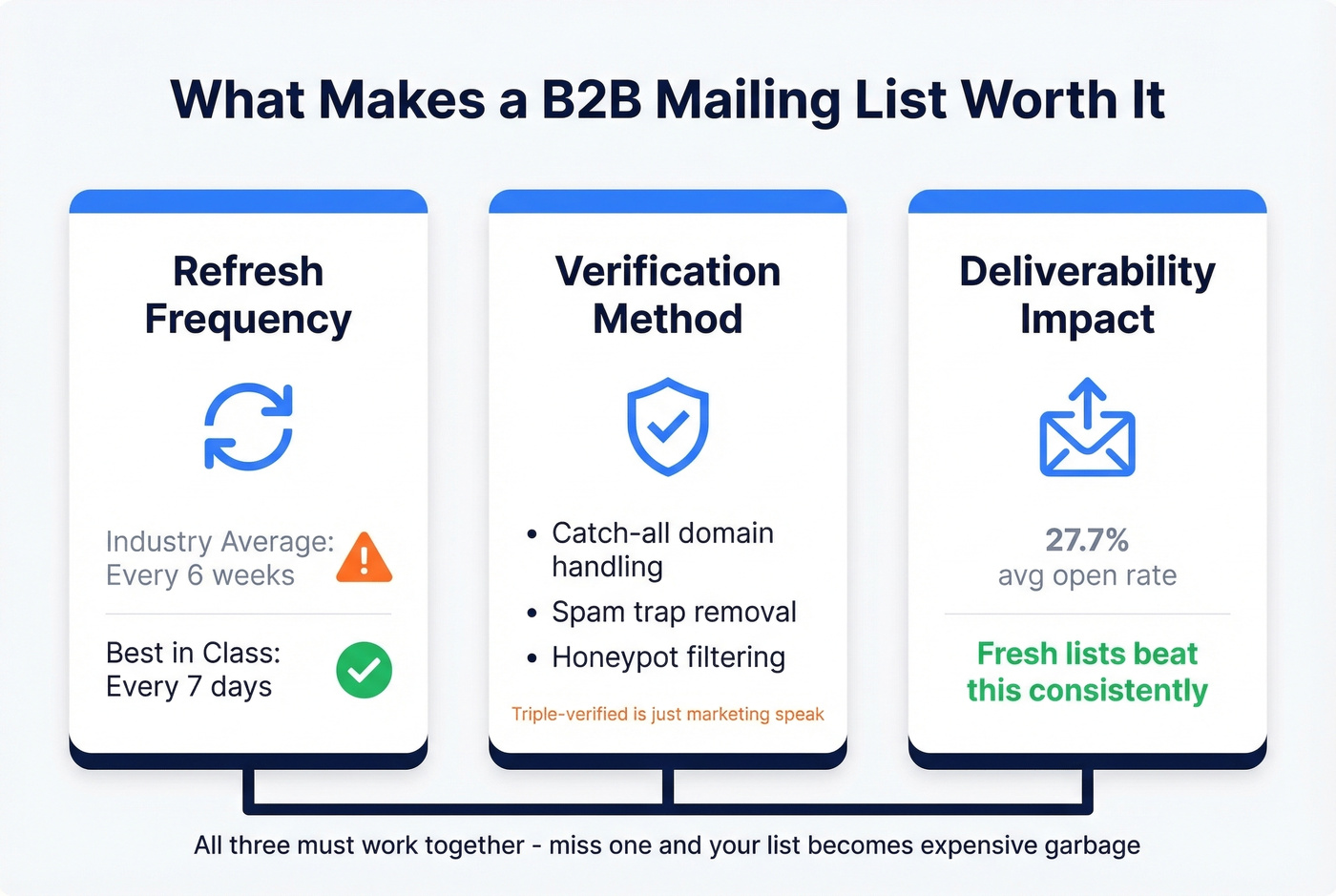
Most providers refresh their data around every 6 weeks. In that window, people change jobs, companies get acquired, and email servers get reconfigured. That decay compounds fast - a list that's 6 weeks stale has meaningfully more dead contacts than one refreshed weekly.

Verification methodology matters just as much. "Triple-verified" is a marketing term that means different things to different vendors. What you actually want is catch-all domain handling so you're not blindly sending to domains that accept everything, plus spam-trap removal and honeypot filtering. Without those, your "verified" list will still bounce.
The benchmarks tell the story: cold email averages sit around a 27.7% open rate and 3.43% reply rate. Teams running verified, fresh lists consistently beat those numbers. Teams running stale lists consistently underperform them.
Best B2B Contact List Providers
Prospeo
Prospeo's database covers 300M+ professional profiles, 143M+ verified emails, and 125M+ verified mobile numbers. The 98% email accuracy comes from a proprietary 5-step verification process - not a third-party email provider bolted on as an afterthought. Every record refreshes on a 7-day cycle, which is roughly six times faster than the industry average.

Search filters go 30+ deep: buyer intent powered by Bombora across 15,000 topics, technographics, job changes, funding events, and headcount growth. The Chrome extension has 40K+ users and works across company websites and professional profiles. CRM enrichment returns 50+ data points per contact, and the API match rate sits at 92%.
The results back it up. Snyk's team of 50 AEs cut bounce rates from 35-40% to under 5%, and AE-sourced pipeline jumped 180% - generating 200+ new opportunities per month. Across the board, teams using Prospeo book 26% more meetings than ZoomInfo users and 35% more than Apollo users.
Pricing runs about $0.01 per email with a free tier of 75 emails plus 100 Chrome extension credits monthly. No contracts, no sales calls required.
Use it if: you need the highest email accuracy at the lowest cost-per-lead.
Skip it if: you need sending built into the same tool - though the Instantly and Lemlist integrations are straightforward.
Apollo.io
What does a $0 prospecting budget actually get you? More than you'd expect. Apollo's free tier gives you 10,000 email credits per month and 5 mobile credits, plus built-in sequences so you can prospect and send from one platform.
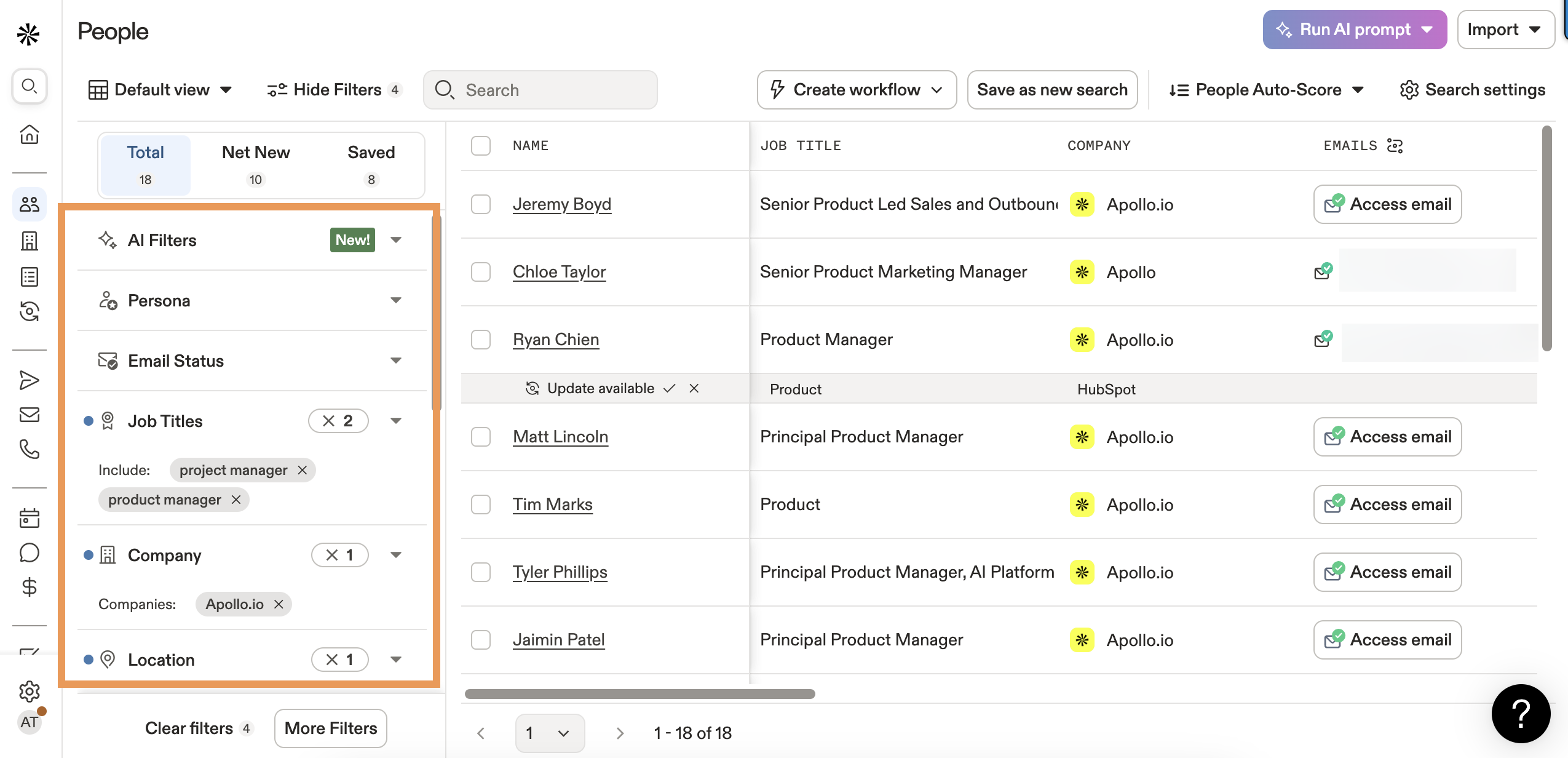
Paid plans run $49/user/month (Basic), $79 (Professional), and $119 (Organization, min. 3 users) on annual billing. The credit system is where it gets tricky - exporting leads and viewing mobile numbers burn credits fast, with overage costs of $0.03-$0.10 per additional credit.
The data quality gap is the real issue. Bounce rates hit 15-20% in certain segments, particularly outside North America. For a free tool, that's acceptable. For paid plans at scale, it starts to hurt your domain reputation.
Use it if: you're starting from zero budget and need to move fast.
Skip it if: you need reliable data at scale - the bounce rates will cost you more than the subscription saves.
ZoomInfo
Let's start with the math. If you pay $28K/year and only export 3,000 contacts in a quarter, that works out to roughly $2.33 per lead. Export less and the per-lead cost climbs fast - which is why renewal quotes are a recurring pain point on Reddit, with teams reporting 10-20% uplifts that catch them off guard.
ZoomInfo is the enterprise benchmark for a reason: massive database, org charts, intent data, and workflow tools that integrate with everything. Professional starts around $15,000/year, Advanced runs $22,000-$28,000, and Elite hits $35,000-$45,000+. Annual contracts only. Additional users cost $2,500 each at list price, though discounts of 30-65% are common if you negotiate hard.
Use it if: you're enterprise with 50+ reps and need org charts, intent, and deep workflow integration.
Skip it if: you're a team under 20 - you'll pay for modules you never activate.
Cognism
If you sell into Europe, compliance isn't optional - it's existential. Cognism is built for this reality, with GDPR compliance baked into the product rather than bolted on.
Pricing lands around $22,500/year for Grow (5 users) and $37,500/year for Elevate. Bombora intent data lets you track up to 12 topics from 11,000+ available, and the technographic database tracks 20,000+ technologies. The catch: Grow caps exports at 3 lists of 250 contacts each, which is tight for high-volume outbound.
Where Cognism wins over ZoomInfo: EMEA data quality and compliance posture. Where ZoomInfo still wins: US database depth and export volume.
Use it if: you sell into Europe and need bulletproof compliance.
Skip it if: you need high-volume exports or US-focused data.
ListKit
ListKit takes a different approach - credit-based, seatless pricing that lets unlimited users share one account. Plans start free with 100 credits, then $83/month for 24,000 credits, $253/month for 120,000, and $508/month for 600,000 on annual billing. The credit math matters: 1 credit per business email, 5 per mobile number, and 2 per intent signal.
Use it if: you want unlimited users on one account with predictable credit costs.
Skip it if: you need a Chrome extension or CRM enrichment workflows.
Hunter.io
Lightweight email finder and verifier. Free tier available, paid plans run from $49/month up to around $299/month. Best for finding individual emails from a domain, not for building large prospecting lists.
Use it if: you need quick domain-level email lookups. Skip it if: you're building outbound lists at scale.
Snov.io
All-in-one outreach suite that combines finding, verifying, and sending. Free tier available, paid plans start around $39/month. Solid for solopreneurs who want one tool for the entire workflow, but the database depth doesn't match dedicated providers.
Use it if: you're a solopreneur who wants prospecting and sending in one tool. Skip it if: you need deep database coverage or enterprise-grade accuracy.
UpLead
UpLead offers a 95% accuracy guarantee with real-time email verification on export. Pricing starts at $99/month for 170 credits, with higher tiers around $199/month. Good for small teams wanting simplicity, but the credit allotment is thin for serious outbound.
Use it if: you want real-time verification baked into every export. Skip it if: you need volume - 170 credits/month won't fuel a real outbound motion.
Also worth a look: Lead411 and Lusha both appear frequently in B2B prospecting discussions. Lead411 paid plans start around $99/month per user. Lusha is popular for quick contact lookups with a free tier of about 40 credits/month and paid plans from roughly $69.90/month.

You read the stats: the average cold list bounces at 7-8%, and most providers refresh every 6 weeks. Prospeo refreshes every 7 days, delivers 98% email accuracy through 5-step verification, and costs roughly $0.01 per email. No contracts, no sales calls.
Build a B2B mailing list that actually lands in inboxes.
What B2B Email Lists Actually Cost
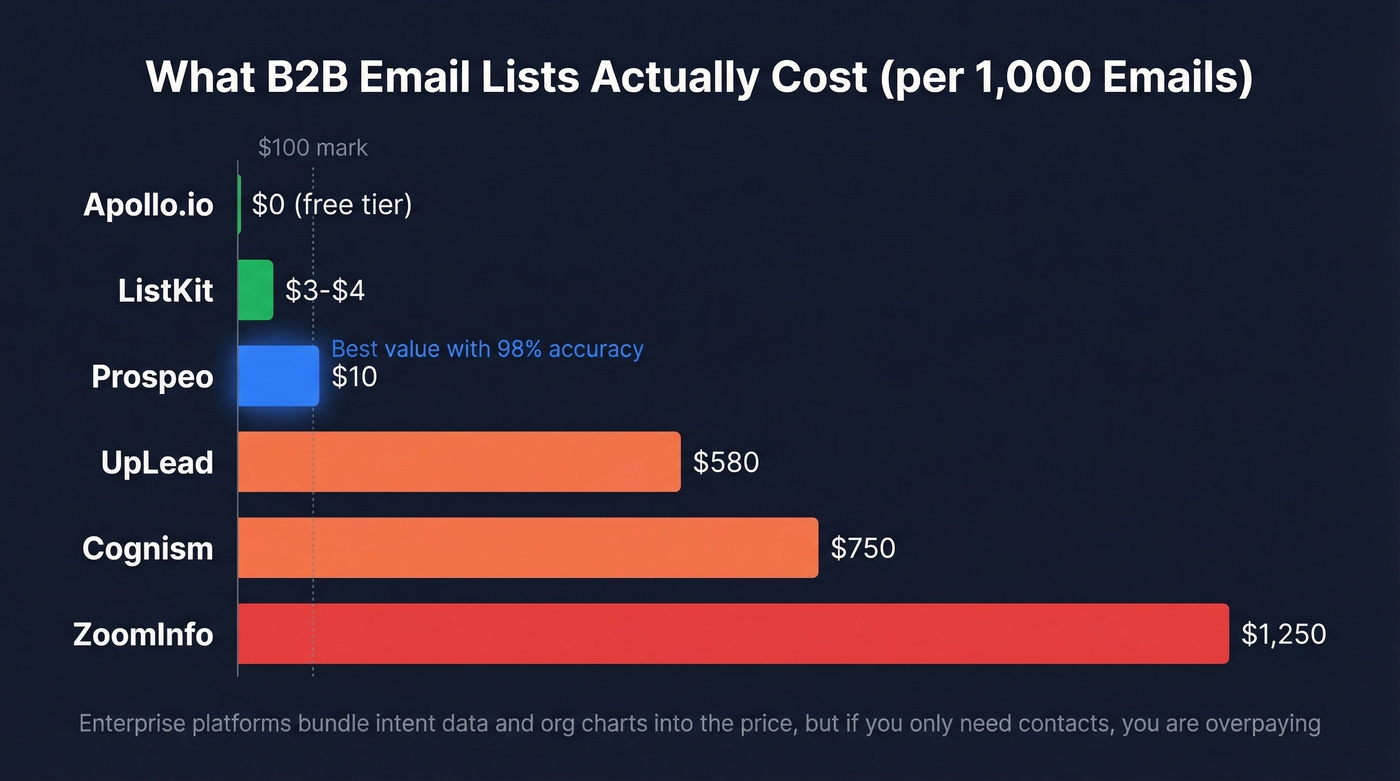
The per-lead economics vary wildly. This table normalizes the comparison for business emails where we have clear pricing benchmarks.
| Provider | ~Cost per 1K Emails | Pricing Model |
|---|---|---|
| Prospeo | ~$10 | Credit-based, no contract |
| Apollo.io | $0 (free tier) | Freemium + per-seat |
| ListKit | ~$3-$4 | Credit bundles (yearly), unlimited users |
| UpLead | ~$580 | Credit-based |
| Cognism | ~$750 | Annual contract |
| ZoomInfo | ~$1,250 | Annual contract |
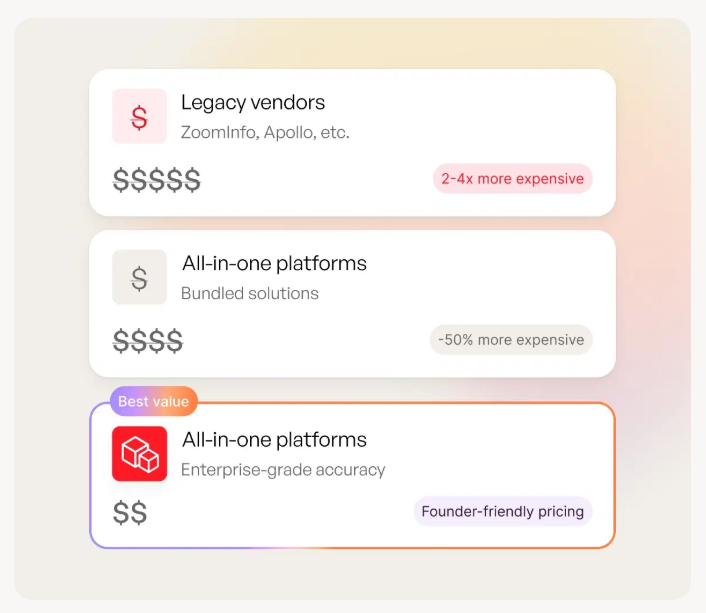
Enterprise platforms bundle intent data, org charts, and workflow tools into that price. But if you're primarily buying a contact database, you're paying for features you'll never touch.
If you're comparing vendors beyond this shortlist, see our breakdown of the best B2B databases and pay-as-you-go B2B data.
How to Build a B2B Mailing List That Lasts
A mailing list isn't a one-time purchase. It's a living asset that decays the moment you export it. Here's the process that actually works:
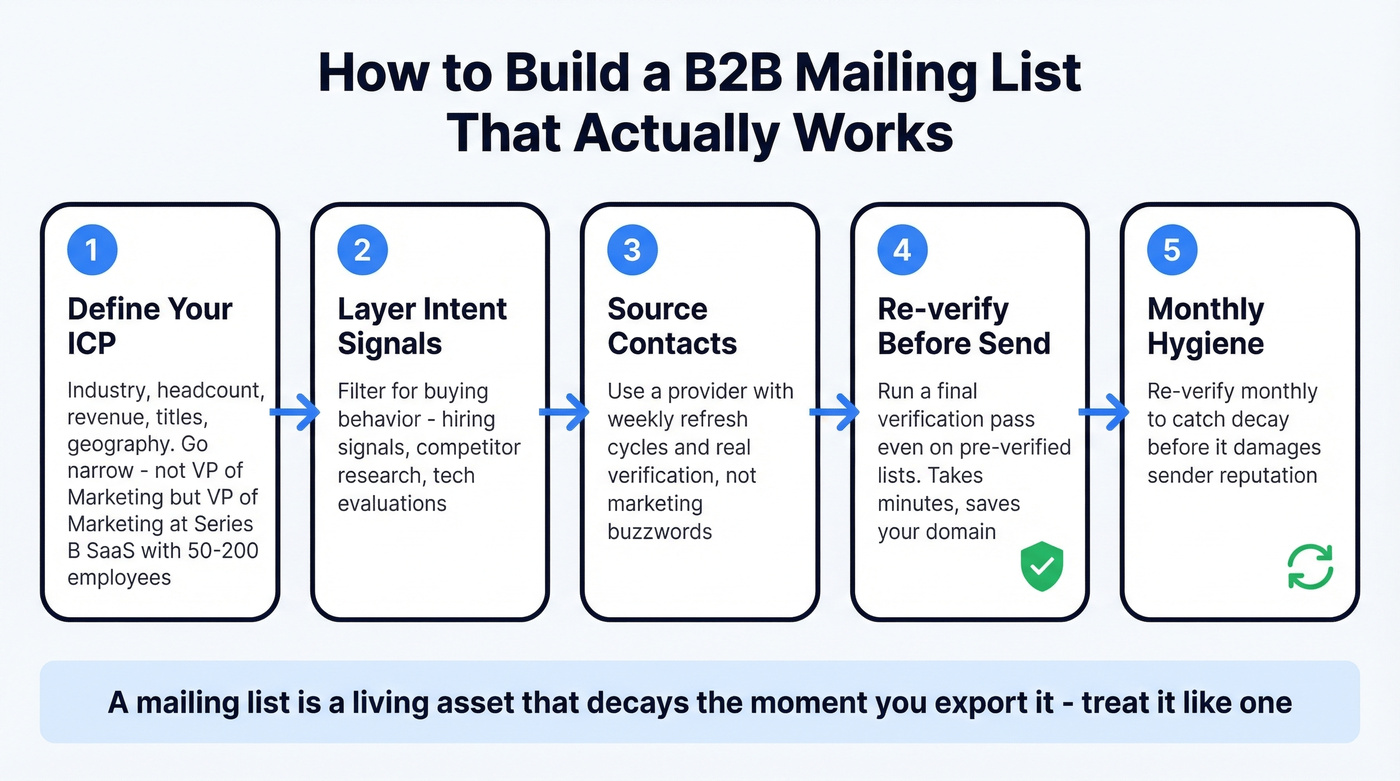
Define your ICP tightly. Industry, headcount, revenue range, job titles, geography. The narrower your filters, the higher your reply rates. We've seen teams double their response rates just by going from "VP of Marketing" to "VP of Marketing at SaaS companies with 50-200 employees that recently raised Series B." (If you need a framework, start with an ideal customer profile.)
Layer intent signals. Filter for companies showing buying behavior - hiring for relevant roles, evaluating competitor technologies, or researching your category. This alone separates warm prospects from cold names in a spreadsheet.
Re-verify before every send. Even "pre-verified" lists from providers should get a final check before hitting your sequencer. It takes minutes and saves your domain reputation. If you want a deeper tool comparison, see our guide to the best email verifier.
Run monthly hygiene passes. A monthly re-verification catches decay before it damages your sender reputation. Providers with weekly refresh cycles reduce this burden, but the extra step is still worth it.
Stack your tools. The best setup is a data provider for sourcing, a verification layer for accuracy, and a sending platform for delivery. A popular community stack is Clay + Instantly for teams that want maximum flexibility. Trying to do all three in one tool usually means compromising on at least one. (If you're evaluating platforms, compare outbound email automation options.)
Don't overlook inbound methods either - gated content, webinars, and lead magnets build lists that complement purchased data and often convert at higher rates.
Compliance Essentials
Cold outreach penalties are real, and the cost of getting it wrong is severe.
| Regulation | Max Penalty | Key Requirement |
|---|---|---|
| CAN-SPAM | $53,088 per email | Opt-out honored in 10 business days |
| GDPR | EUR 20M or 4% of turnover | Legitimate interest basis |
| TCPA | $500-$1,500 per violation | Prior express consent for calls |
Here's the thing: 1,000 contacts with TCPA violations could mean $500K-$1.5M in exposure. Include a physical address in emails, process opt-outs within 10 business days, and make sure your provider offers DPA agreements if you're touching EU data. The FTC's CAN-SPAM guide, the ICO's GDPR guidance, and the FCC's TCPA page are worth bookmarking.
FAQ
Is it legal to buy a B2B email list?
Yes, in most jurisdictions, provided you comply with CAN-SPAM (include opt-out, honor unsubscribes within 10 business days) and GDPR (legitimate interest basis for EU outreach). Verify your provider follows these standards - and that they offer DPA agreements - before purchasing.
What's a good bounce rate for a B2B mailing list?
Under 2% is the target for any serious outbound campaign. The cold email average sits at 7-8%, and anything above 5% signals data quality problems. If you're consistently above 3%, switch providers or add a dedicated verification step before sending.
How often should I clean my contact list?
Monthly at minimum. Providers with weekly refresh cycles reduce this burden significantly, but a monthly re-verification pass is still smart practice to catch job changes and domain reconfigurations.
What's the difference between buying a list and building one?
Buying gives you a static CSV that decays immediately. Building means using a data platform with filters, real-time verification, and refresh cycles to maintain a living database. The cost difference is smaller than you'd think; the quality difference is enormous.
How many contacts do I need for an outbound campaign?
Quality beats quantity every time. 500 highly targeted, verified contacts will outperform 5,000 generic ones. Start with your tightest ICP definition, validate with a small batch of 200-300 sends, then expand once you see reply rates above 3%.