

The B2B Marketing Funnel: A Practitioner's Guide for 2026
A RevOps lead we know ran a full-funnel audit last quarter. Traffic was up. MQLs looked healthy. Pipeline was flat. The culprit: roughly 35-40% of their "verified" emails were bouncing, and nurture sequences were hitting dead inboxes. The funnel wasn't broken - it was starving.
That's the reality most funnel content ignores. Everyone wants to talk about content strategy and lead magnets. Almost nobody talks about the data rot quietly killing conversions at every stage.
The Short Version
- The funnel is a planning tool, not a description of how buyers actually behave. 85% of your TAM is out-of-market at any given time, and a lot of buying research happens in places you can't track.
- Only 5 metrics matter: stage-to-stage conversion rates, pipeline velocity, time-to-convert, win rate, and pipeline coverage ratio.
- Start simple: 1 inbound channel + 1 outbound channel per lane. Master before expanding.
- Bad contact data is a silent funnel killer. Fix data before optimizing content.
- Benchmarks below so you know what "good" looks like at every stage.
What Is a B2B Marketing Funnel?
A B2B marketing funnel maps the journey from "never heard of you" to "signed contract and telling peers about you." The classic framework breaks into three layers: top-of-funnel (TOFU) for awareness, middle-of-funnel (MOFU) for evaluation, and bottom-of-funnel (BOFU) for decision and purchase.
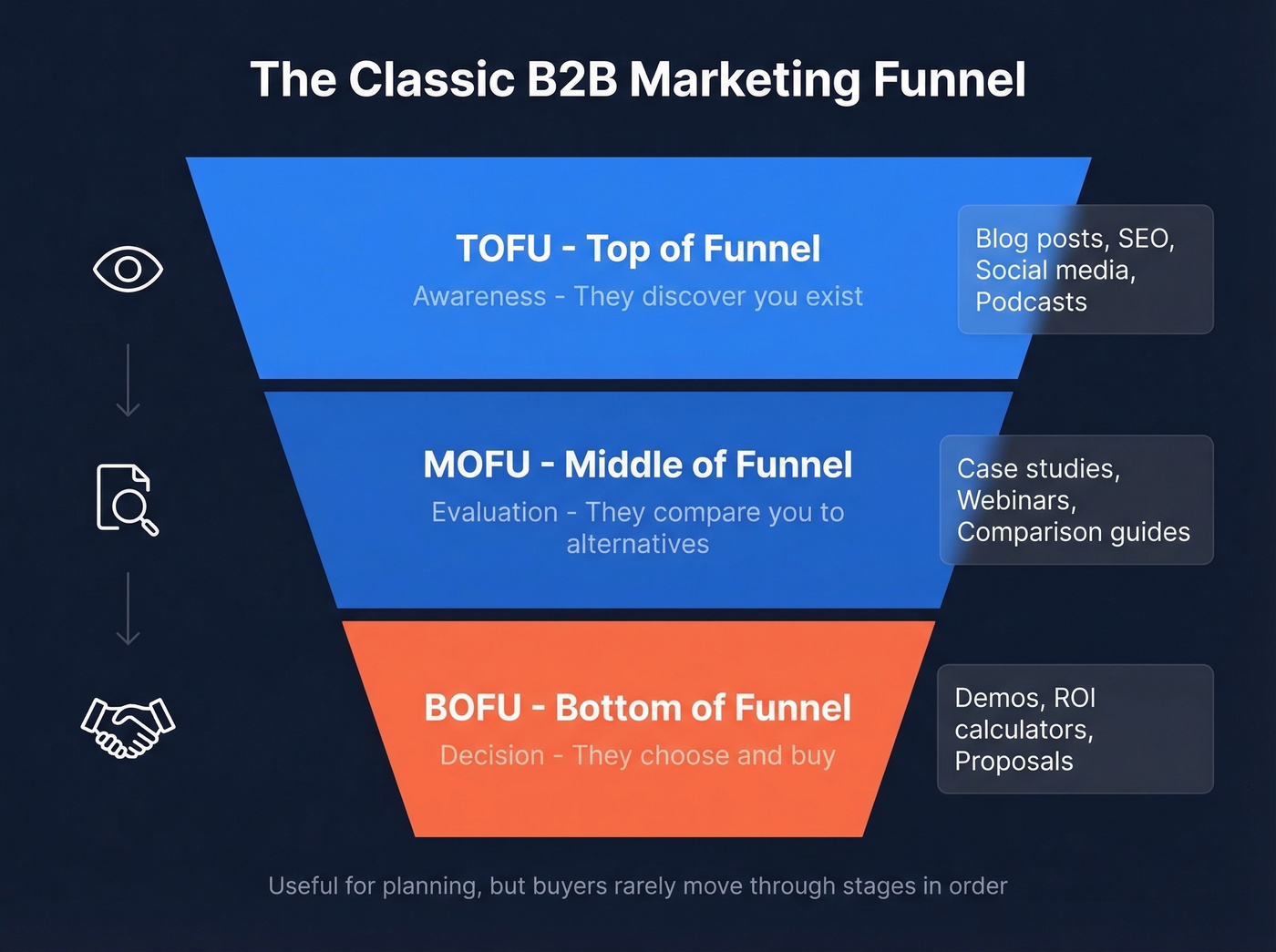
The B2B funnel differs from B2C in three fundamental ways. Cycles are longer. Decisions involve committees. And buying is rational and ROI-driven, not impulse-driven. A consumer sees an ad and buys shoes. A VP of Engineering sees an ad, bookmarks it, loops in procurement, runs a multi-month evaluation, and maybe buys software six months later. Different animal entirely.
That three-layer model is still useful for planning. But it's incomplete - and if you treat it as gospel, you'll misallocate budget and misread your pipeline.
Why the Traditional Funnel Is Incomplete
BCG published a framework arguing that marketers "force-fit touchpoints into a linear funnel" when buyers actually stream, scroll, search, and shop across the entire journey simultaneously. The neat stage-gate model where prospects move from awareness to consideration to decision in order? That's a planning fiction.
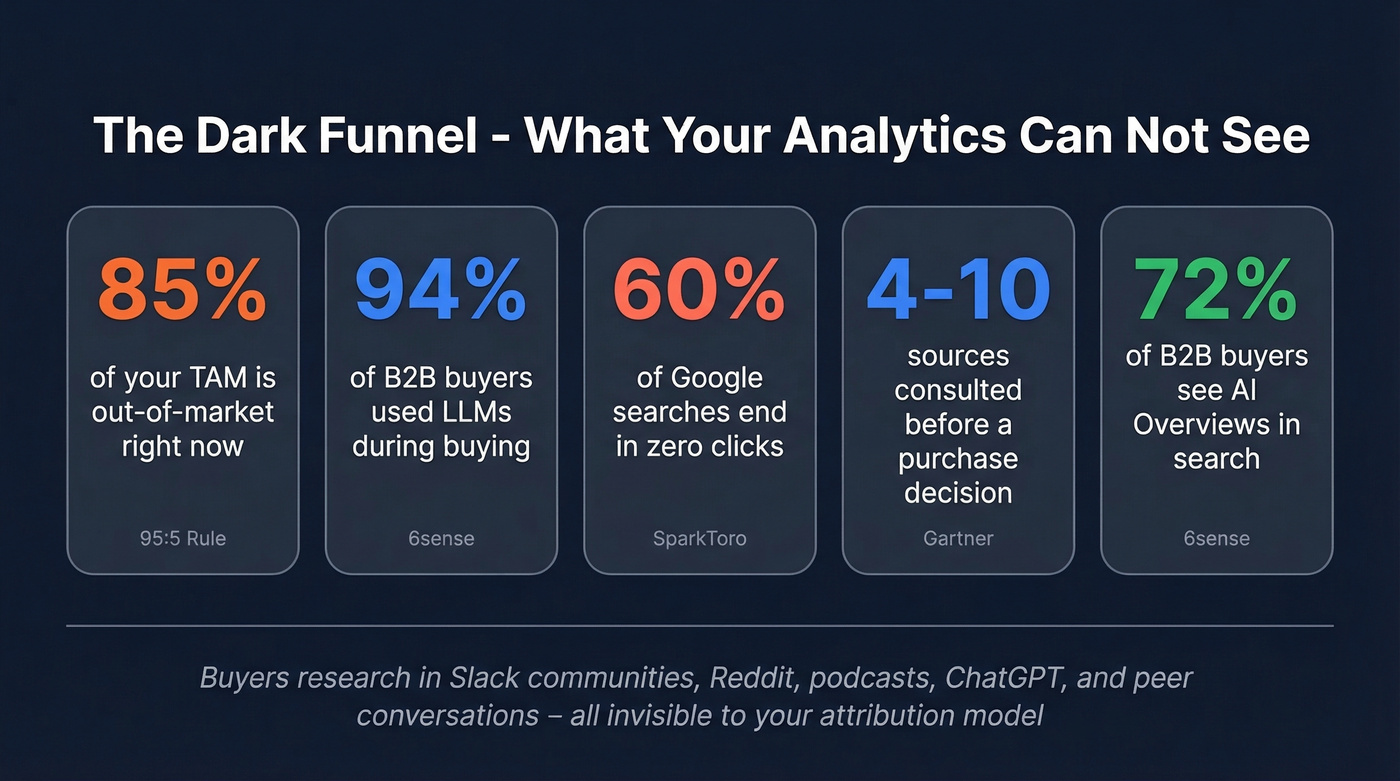
HubSpot's CEO Yamini Rangan put it bluntly: "The top of the funnel, awareness has scattered... Buyers are on TikTok, YouTube, Reddit, podcasts, everywhere." Meanwhile, 60% of Google searches end in zero clicks. Your carefully optimized blog post might generate the awareness - but the click and the conversion happen somewhere you can't see.
Here's what makes this worse. 94% of B2B buyers used LLMs during the buying process, per 6sense research. They're asking ChatGPT to compare vendors, summarize G2 reviews, and draft requirements docs - all before they ever hit your website. 72% of B2B buyers now encounter AI Overviews in search results, with 90% clicking through to at least one cited source. Your content still matters, but the path to it has fundamentally changed. Your funnel analytics show none of this.
This is the dark funnel: the research, peer conversations, Slack communities, and AI-mediated discovery that happens entirely off your radar. Buyers consult 4-10 sources before deciding, and 33% spend 3-9 hours per month researching new technologies. All invisible to your attribution model.
The 95:5 rule makes this concrete. Roughly 15% of your total addressable market is actively in-market at any given time. The other 85% isn't ignoring you - they're just not ready to buy. If your entire strategy optimizes for capturing in-market demand, you're ignoring the vast majority of future pipeline.
None of this means the funnel is useless. It means you need to treat it as a planning scaffold, not a measurement system. Plan content and campaigns by stage. Measure by conversion rate between stages. But don't pretend the journey is linear.
Modern Funnel Stages Explained
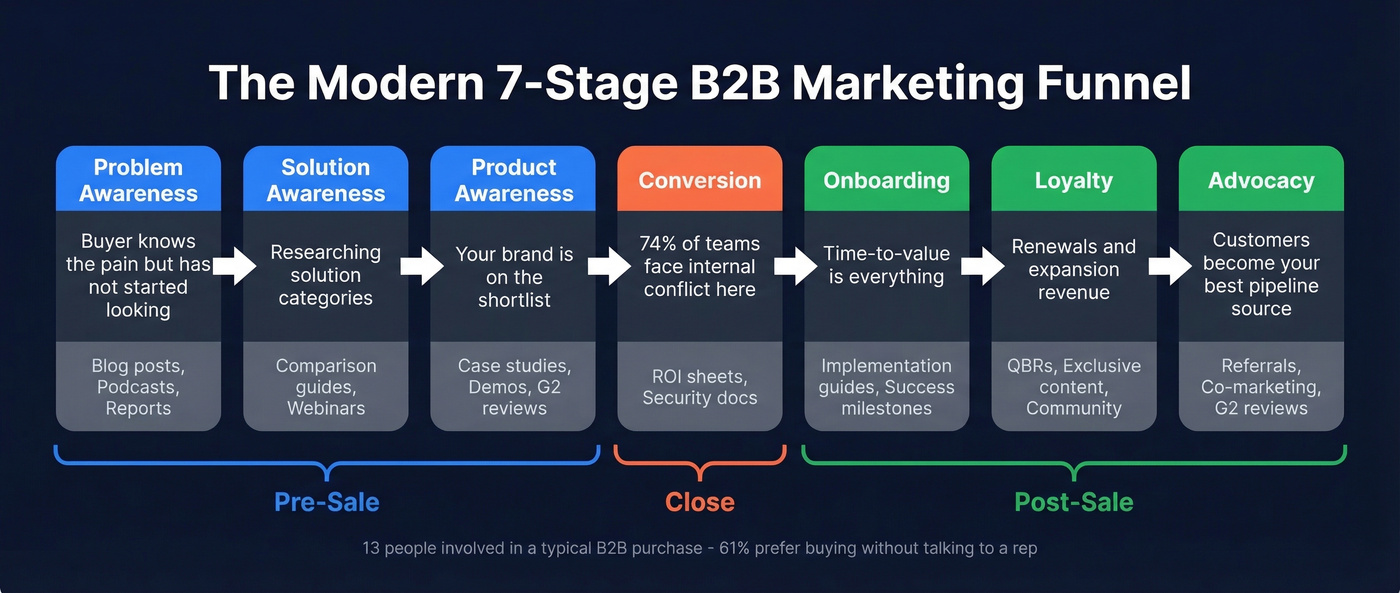
The Insight Collective's 7-stage model extends the classic funnel past the sale, which is where most B2B models fall short. As a Goldman Sachs Asset Management marketing leader told them: "We're missing advocacy... loyalty... continued relationship... complexity of the actual journey." Here's how each stage works in practice.
Problem Awareness
The buyer knows they have a pain but hasn't started evaluating solutions. Educational blog posts, podcasts, industry reports, and thought leadership that names the problem without pitching a product all perform well here. Track impressions, organic traffic, and content engagement.
Solution Awareness
Now the buyer is researching solution categories - Googling "how to fix X" and asking peers what tools exist. Comparison guides, webinars, and analyst reports pull them in. Measure new leads generated, email signups, and content downloads.
Product Awareness
Your brand is on the shortlist. The buyer is reading your case studies, watching demos, and checking G2 reviews. This is where buying committees start forming - and they're big. About 13 people are involved in a typical B2B purchase, with over half including VP-level decision-makers. 61% of buyers prefer to buy without talking to a rep, and they spend only about 17% of their total buying time with suppliers.
What closes deals at this stage isn't more awareness content. It's product comparisons, ROI calculators, and customer stories segmented by role. Track demo requests, free trial starts, and content engagement by persona.
Conversion
74% of buying teams experience unhealthy internal conflict during this stage. That single stat explains why so many qualified deals die - it's not your product, it's the committee.
For SaaS funnels, MQL-to-SQL conversion often takes 8-15 days. Enterprise opportunities take roughly 120 days to close; SMB deals move faster at 30-45 days. Consensus-building content is what gets deals across the line: security docs for IT, ROI sheets for finance, workflow guides for operators. If you're only creating top-of-funnel content, you're feeding the wrong end of the pipeline.
Onboarding
Post-purchase, but still marketing's problem. Onboarding sequences, implementation guides, and success milestones reduce churn and set up expansion revenue. Track time-to-value, activation rate, and support ticket volume.
Loyalty and Advocacy
Why do most B2B funnel models stop at "closed-won"? Because they were designed by demand gen teams, not revenue teams. The real money is here.
Loyalty programs, exclusive content, QBRs, and community access keep customers engaged and renewing. Referral programs, co-marketing, and case study participation turn happy customers into pipeline. A single enterprise advocate who posts a G2 review, refers peers, and speaks at your event can generate more pipeline than many paid campaigns. Measure NPS, renewal rate, referrals generated, and reviews posted.

The article opened with a funnel starving on 35-40% bounce rates. That's what happens when contact data decays faster than your nurture sequences run. Prospeo refreshes every record on a 7-day cycle - not the 6-week industry average - so your MQLs reach real inboxes. 98% email accuracy, 125M+ verified mobiles, and 30+ filters to target the 15% of your TAM that's actually in-market.
Stop feeding your funnel dead data. Start with 75 free verified emails.
Funnel Benchmarks That Matter
Benchmarks give you a baseline. Without them, you're optimizing blind.
Stage-by-Stage Conversion Rates
First Page Sage's benchmark report draws from data spanning 2017-2026, with roughly 65% B2B clients:
| Industry | Lead-to-MQL | MQL-to-SQL | SQL-to-Opp | SQL-to-Closed |
|---|---|---|---|---|
| B2B SaaS | 39% | 38% | 42% | 37% |
| Professional Services | 31% | 29% | 38% | 27% |
| Financial Services | 28% | 25% | 35% | 22% |
| Healthcare/IT | 33% | 30% | 40% | 30% |
General Orientation Bands
If you don't have industry-specific data, these ranges give you a starting point:
| Stage | Typical Range | Top Performers |
|---|---|---|
| Visitor-to-Lead | 0.8-2.5% | 3-5% |
| Lead-to-MQL | 20-40% | 40%+ |
| MQL-to-SQL | 20-35% | 35%+ |
| SQL-to-Opp | 30-50% | 50%+ |
| Opp-to-Won | 20-35% | 35%+ |
Enterprise visitor-to-lead rates run around 0.7%, while SMB/mid-market hits about 1.4%. Top 10% performers push 8-15% visitor-to-lead - but that's rare and usually driven by high-intent paid traffic.
Channel Performance
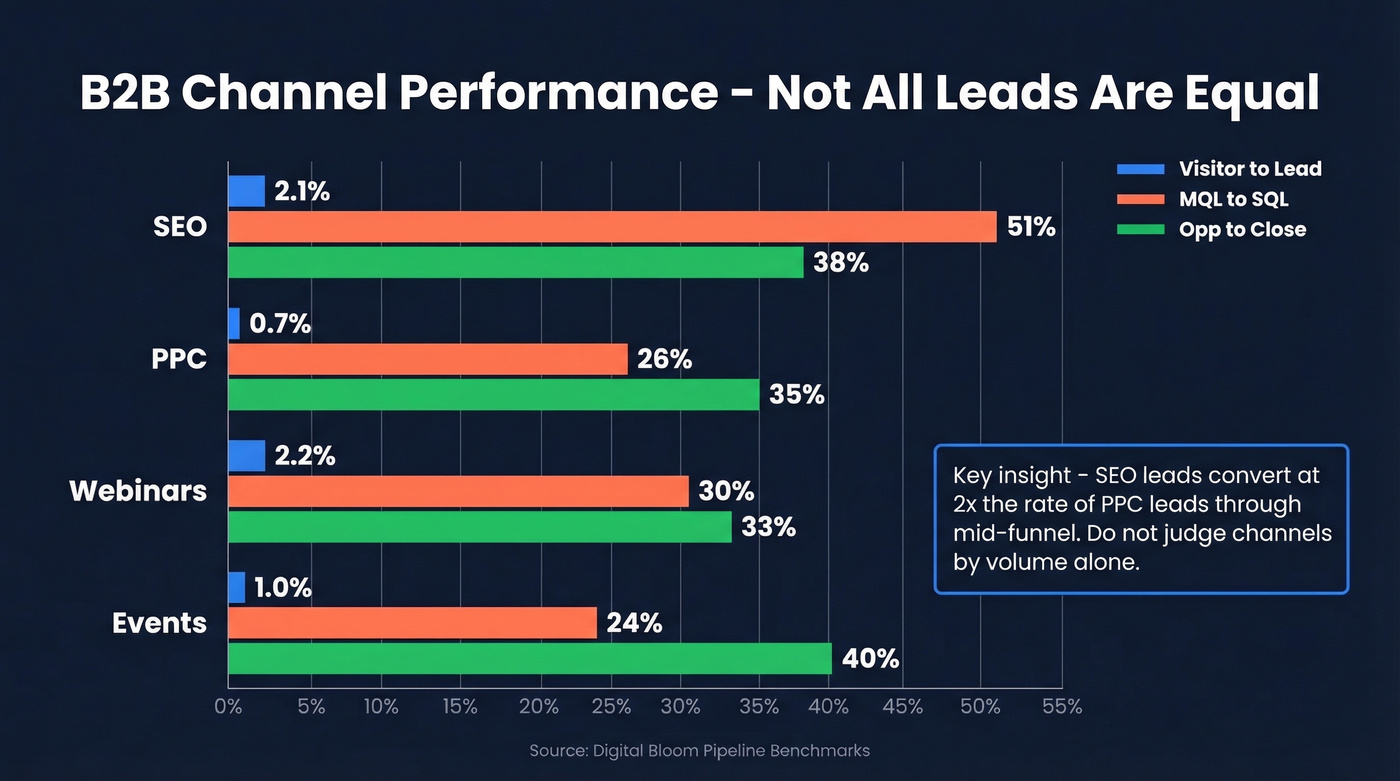
Not all channels convert equally. Digital Bloom's pipeline benchmarks break it down:
| Channel | Visitor-to-Lead | MQL-to-SQL | Opp-to-Close |
|---|---|---|---|
| SEO | 2.1% | 51% | 38% |
| PPC | 0.7% | 26% | 35% |
| Webinars | 2.2% | 30% | 33% |
| Events | 1.0% | 24% | 40% |
SEO leads convert at about 2x the rate of PPC leads through the mid-funnel. Events close at the highest rate but generate fewer leads. Don't judge channels by volume alone - a channel that generates 100 leads at 51% MQL-to-SQL is worth more than one generating 500 leads at 26%.
How to Build a B2B Sales and Marketing Funnel
Theory is nice. Let's build the thing.
Define Your ICP
Everything downstream depends on this. Your ideal customer profile isn't "companies with 50+ employees." It's specific: industry, headcount range, tech stack, funding stage, growth signals, and the job titles that actually sign contracts.
Interview your best 10 customers. Find the patterns. Write them down. If your ICP is vague, every stage of the funnel will underperform because you're attracting the wrong people from the start.
Map Content to Each Stage
Once you know who you're targeting, map content to each of the 7 stages. Problem awareness gets educational content. Solution awareness gets comparison guides. Product awareness gets case studies and demos. Conversion gets ROI calculators and security docs. Post-purchase gets onboarding sequences and community access. Don't create content without knowing which stage it serves - that's the difference between teams that generate pipeline and teams that generate blog traffic.
Pick Your Channels
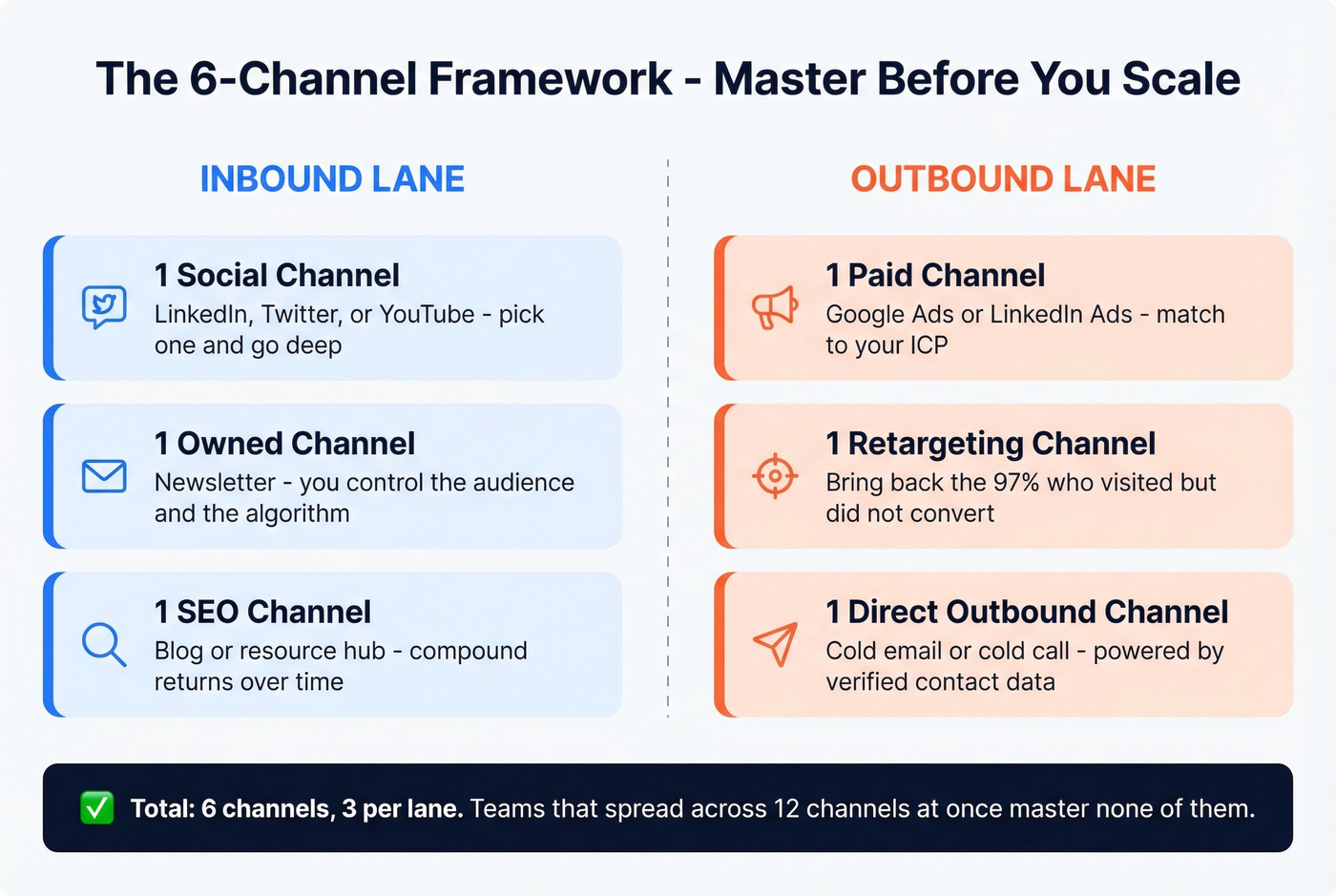
The best framework we've seen on r/sales is dead simple: pick 1 social channel + 1 owned channel (newsletter) + 1 SEO channel for inbound. Then pick 1 paid channel + 1 retargeting channel + 1 direct outbound channel. Six channels total, three per lane. Master each one before adding more. Teams that spread across 12 channels at once master none of them.
Build Your Prospect List
Your ICP definition is useless without verified contact data to act on it. This is where most funnels quietly break - teams build beautiful content, nail their channel strategy, then feed outbound sequences with garbage data.

Prospeo's database covers 300M+ professional profiles with 30+ search filters - buyer intent, technographics, job changes, and funding stage. Define your ICP, set the filters, and export a verified list. With 98% email accuracy and a 7-day data refresh cycle, the contacts you pull actually reach real inboxes instead of bouncing into the void.
Set Up Measurement
Five metrics. That's it.
- Stage-to-stage conversion rates - where the funnel leaks
- Pipeline velocity - (Opportunities x Deal Value x Win Rate) / Cycle Length - how fast revenue moves through the system
- Time-to-convert per stage - flags bottlenecks before they become crises
- Win rate - should land between 20-30% for most B2B teams
- Pipeline coverage ratio - should sit at 3-4x quota; anything less means you're flying without a safety net
Track these weekly. Everything else is a vanity metric until these five are healthy. (If you want a deeper KPI list, see funnel metrics and pipeline health.)
Run the Math
Here's what this looks like for a real team. A mid-market SaaS company gets 10,000 monthly visitors. At a 1.5% visitor-to-lead rate, that's 150 leads. Apply a 35% MQL-to-SQL conversion and a 25% win rate on a $30K ACV, and you're generating roughly $394K in monthly pipeline.
Now improve visitor-to-lead to 2.5% - same traffic, same close rates - and pipeline jumps to $656K. That's a 67% increase from fixing one conversion point. This is why benchmarks matter: they tell you which lever to pull.
Diagnosing a Broken Funnel
Most funnel problems aren't mysterious. They follow predictable patterns.
TOFU: Traffic Up, Leads Are Garbage
If you're generating traffic but leads don't match your ICP, you have a targeting problem, not a volume problem. Go back to customer interviews, shift SEO toward intent-based long-tail keywords, and tighten firmographic targeting on paid channels. Broad awareness content attracts broad audiences - that's not a win if none of them buy.
MOFU: MQLs Up, SQL Conversion Below 20%
This usually means your nurture sequences are generic or your lead scoring is miscalibrated. Buying committees have 13 people with different concerns. A single nurture track that sends the same emails to the CFO and the engineering lead will underperform every time. Build role-specific content paths. Recalibrate scoring to weight engagement depth over volume.
BOFU: SQLs Created, Deals Stall
86% of B2B purchases stall. That's not a typo. The most common cause is failure to build consensus across the buying committee. Multi-stakeholder content - security reviews, compliance docs, executive summaries - breaks the logjam.
There's a silent killer here too. If 35-40% of your emails are bouncing, your nurture sequences aren't reaching anyone. We've seen teams cut bounce rates from that range to under 5% just by switching to a provider with weekly data refreshes instead of monthly ones. One customer, Snyk, had 50 AEs prospecting 4-6 hours a week and saw AE-sourced pipeline jump 180% after fixing their contact data quality.
Vanity Metrics Masking Real Problems
The most common complaint about B2B funnels on Reddit? Teams tracking impressions and clicks instead of stage-to-stage conversion rates. Traffic dashboards look green while pipeline starves. Only 2-3% of visitors buy on first visit. Most sales happen on the 5th-7th touchpoint. If you're not retargeting, you're leaving the majority of potential conversions on the table.
Here's a hot take: keep your funnel to 3-4 measurable steps max. Every additional stage you add creates a new place for data to get messy and attribution to break. Simplicity isn't lazy - it's operationally sound. For deals under $25K, you probably don't need a 7-stage measurement model. Plan with 7 stages, measure with 3.
Beyond the Funnel
The ABM "Flipped Funnel"
Account-based marketing inverts the traditional funnel. Instead of casting wide and filtering down, you start with a target account list and expand within those accounts. 76% of marketers report higher ROI with ABM, and the approach makes particular sense for enterprise deals where a single account can represent six or seven figures of ARR.
The practical framework maps to intent stages: early intent triggers demand-gen education and light sales outreach, rising intent activates targeted campaigns, high intent gets executive content and case studies, and in-pipeline accounts get acceleration campaigns and multi-stakeholder expansion. Whether you use a traditional funnel or an ABM model, the underlying principle is the same - match content intensity to buyer readiness. (If you're building this motion, start with account-based selling best practices.)
Designing for the Dark Funnel
You can't track the dark funnel, but you can design for it. The 85% of your TAM that's out-of-market right now is still forming opinions through peer conversations, community discussions, LLM queries, and review sites. Your job is to create demand for that 85% while capturing demand from the 15% that's in-market.
Intent data bridges the gap. When an account starts researching topics related to your solution - even if they haven't visited your site - intent signals let you activate outreach before competitors know the account is in play. Sales cycles compressed from 11.3 to 10.1 months between 2024 and 2025, partly because teams using intent data engage buyers earlier in the journey. That trend has only accelerated into 2026.
You just read that 13 people sit on a typical B2B buying committee, and 61% prefer zero rep contact. That means your outbound needs to reach the right stakeholders with verified contact data - not spray bounced emails at generic inboxes. Prospeo gives you direct dials with a 30% pickup rate and decision-maker emails at $0.01 each, filtered by job title, department headcount, buyer intent, and 27 other signals.
Reach every stakeholder on the buying committee with data that actually connects.
FAQ
What are the stages of a B2B marketing funnel?
Seven stages: Problem Awareness, Solution Awareness, Product Awareness, Conversion, Onboarding, Loyalty, and Advocacy. The first four map to TOFU/MOFU/BOFU; the last three cover retention and referral - where most expansion revenue lives.
What's a good MQL-to-SQL conversion rate?
B2B SaaS averages 38% MQL-to-SQL; across industries, 20-40% is healthy. Below 20% usually signals miscalibrated lead scoring or generic nurture content that doesn't address role-specific concerns.
How long is the average B2B sales cycle?
Enterprise opportunities typically close in about 120 days; SMB deals can close in 30-45 days. Across B2B, average cycle length dropped from 11.3 months to 10.1 months between 2024 and 2025, driven partly by intent data and earlier buyer engagement.
How do you fix bad data killing your funnel?
Replace stale contact lists with a provider that refreshes weekly, not monthly. A 7-day refresh cycle and 98%+ email accuracy can cut bounce rates from 35-40% to under 5% - which is the difference between nurture sequences that reach people and sequences that hit dead inboxes.
How can a B2B marketing funnel help your business?
A well-built funnel gives you a repeatable system for turning strangers into customers and customers into advocates. It surfaces exactly where prospects drop off so you allocate budget to the stages that move revenue. Teams that fix stage-by-stage conversion rates routinely see 30-60% pipeline improvements without increasing traffic.