

B2B Meaning: What It Is, How It Works, and Why It's a $36 Trillion Market
B2B stands for business-to-business - any transaction where one company sells products or services to another company instead of to an individual consumer. That's the dictionary version. The reality is a $36 trillion global e-commerce market where deals involve half a dozen decision-makers, sales cycles stretch for months, and buyers define 83% of their requirements before they ever talk to a salesperson.
Most articles on this topic stop at the definition. This one won't.
What Does B2B Actually Mean?
B2B describes commerce between two companies. When Salesforce sells CRM software to a manufacturing firm, that's B2B. When Samsung supplies display panels to Apple for iPhone production, that's B2B. When a consulting firm advises a bank on regulatory compliance, same thing.
The contrast is B2C (business-to-consumer), where a company sells directly to individual buyers. Nike selling sneakers on its website is B2C. Nike buying raw materials from a chemical supplier is B2B.
Three misconceptions come up constantly in founder communities and on r/startups:
"B2B means bulk orders." It doesn't. A single $500/month SaaS subscription sold to a company is B2B. Volume has nothing to do with it - the buyer's identity does.
"A company is either B2B or B2C." Wrong. Amazon runs one of the world's largest B2C marketplaces and Amazon Business, a dedicated B2B platform. Plenty of companies operate in both worlds simultaneously.
"B2B can't be e-commerce." B2B e-commerce alone hit $33T in 2025. Marketplaces, self-serve SaaS signups, and digital procurement portals are all e-commerce. The paper-catalog era is dead.
The Numbers at a Glance
- B2B = one business selling to another business. It's a $33T+ e-commerce market projected to hit $36.86T in 2026.
- Buying committees run 6-10 people on a typical deal. Enterprise deals can involve 20+.
- 83% of buyers define their requirements before ever engaging a salesperson.
- Sales cycles range from 25 to 270 days depending on deal size and company complexity.
- Digital channels dominate. Over 90% of B2B companies shifted to virtual selling models since 2020.
B2B vs B2C: The Real Differences
The business-to-business vs business-to-consumer distinction isn't just about who's buying. It reshapes everything - how you sell, how long deals take, how you market, and how you get paid.
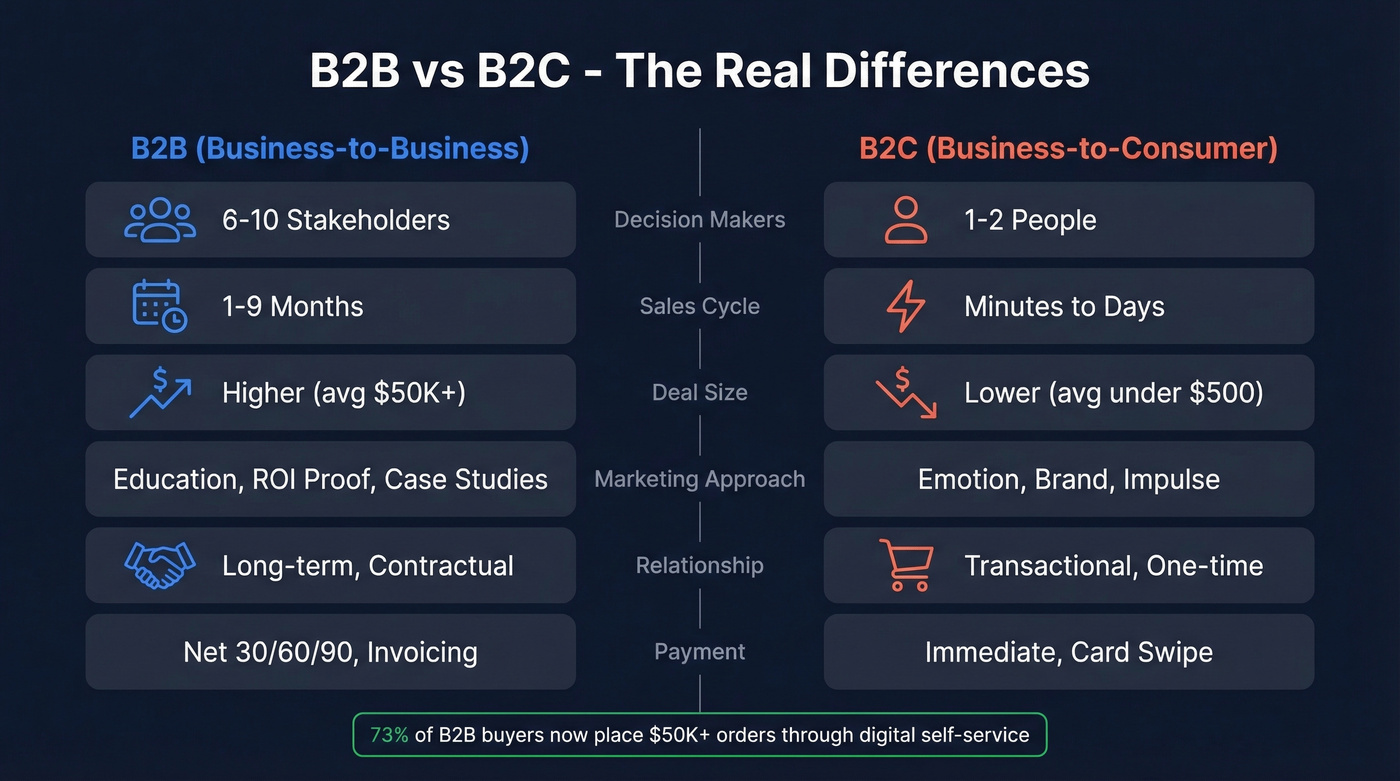
| Dimension | B2B | B2C |
|---|---|---|
| Decision-makers | 6-10 stakeholders | 1-2 people |
| Sales cycle | 1-9 months | Minutes to days |
| Deal size | Higher | Lower |
| Marketing | Education, ROI proof | Emotion, brand |
| Relationship | Long-term, contractual | Transactional |
| Payment terms | Net 30/60/90, invoicing | Immediate |
The stakeholder count is the biggest structural difference. When you're selling to a consumer, you need to convince one person - maybe two if a spouse weighs in. In B2B, you're navigating a buying committee: the end user, their manager, procurement, legal, finance, and often IT security. Each has different concerns, and any one of them can stall or kill a deal.
Sales cycle length follows directly from that complexity. A $50K SaaS deal doesn't close in a week because five people need to evaluate it, legal needs to review the contract, and finance needs to approve the budget.
Payment terms are another underappreciated difference. B2C is instant - swipe a card, done. B2B runs on invoices, net-30 or net-60 terms, and bank transfers that account for 40.68% of all B2B e-commerce payments. Cash flow management becomes a core business skill, not an afterthought. And here's a stat that should change how you think about self-serve: 73% of B2B buyers are now willing to place $50K+ orders through digital self-service channels. The line between B2B and B2C buying behavior is blurring fast, even if the structural differences remain.
B2B Examples Across Industries
B2B isn't one industry - it's the connective tissue of the entire economy.
Manufacturing and supply chains. Samsung is one of Apple's largest suppliers, providing displays and memory chips for iPhones. Every physical product you've ever bought passed through a chain of business-to-business transactions before it reached you.
SaaS and technology. Salesforce sells CRM to sales teams. HubSpot sells marketing automation to growth teams. Snowflake sells data warehousing to analytics teams. The entire cloud infrastructure layer - AWS, Azure, GCP - is fundamentally a B2B business, and it's worth hundreds of billions annually.
Marketplaces. Amazon Business is a dedicated B2B marketplace serving millions of business buyers with bulk pricing, purchase approvals, and tax-exempt purchasing. Alibaba connects manufacturers with distributors globally. Marketplaces account for 65.12% of B2B e-commerce.
Professional services. Law firms advising corporations on M&A. McKinsey consulting on strategy. Deloitte running audits. These are pure B2B relationships built on expertise, trust, and long-term contracts.
2026 Market Data
B2B e-commerce dwarfs B2C in raw scale. One clarification before the numbers: these figures represent B2B e-commerce specifically - digital transactions between businesses. Total commerce including offline channels is significantly larger.
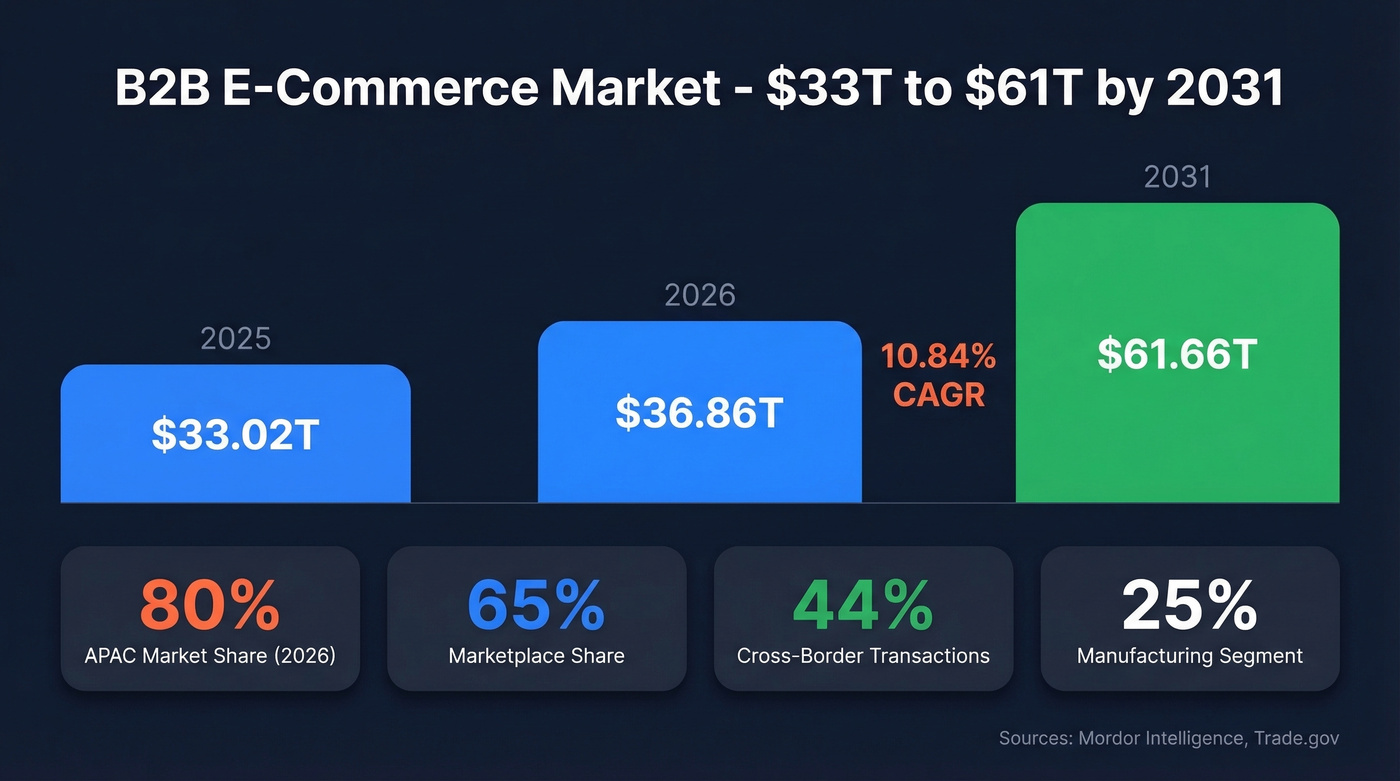
| Metric | Value |
|---|---|
| Global B2B e-commerce GMV (2025) | $33.02T |
| Projected GMV (2026) | $36.86T |
| Projected GMV (2031) | $61.66T |
| Growth rate (2026-2031) | 10.84% CAGR |
| APAC share (2025) | 69.23% |
| APAC share (2026 forecast) | 80% |
| Marketplace share (2025) | 65.12% |
| Cross-border share (2025) | 44.32% |
| Manufacturing share (2025) | 24.67% |
Asia-Pacific dominates. Trade.gov projects APAC will comprise 80% of B2B market share by 2026. North America is growing at 12.09% CAGR, but the sheer volume is in Asia.
Cross-border transactions make up nearly half of all B2B e-commerce volume. If you're building a business-to-business company in 2026, your addressable market isn't limited by geography the way it was a decade ago.
From $33T to $61T in six years. That's not incremental - it's a structural shift driven by digital self-service, marketplace consolidation, and the death of the paper-catalog era. Healthcare and life sciences is the fastest-growing vertical at 11.68% CAGR through 2031, while manufacturing remains the largest single segment at nearly a quarter of all revenue.

B2B deals involve 6-10 decision-makers. You need verified contact data for every one of them. Prospeo gives you 300M+ professional profiles with 30+ filters - buyer intent, job changes, headcount growth, technographics - so you reach the full buying committee, not just one gatekeeper.
Stop guessing who's on the buying committee. Find them all at once.
How B2B Buying Actually Works
Here's the thing most people get wrong about B2B: they think of it as "like B2C but with bigger checks." The buying process is fundamentally different.
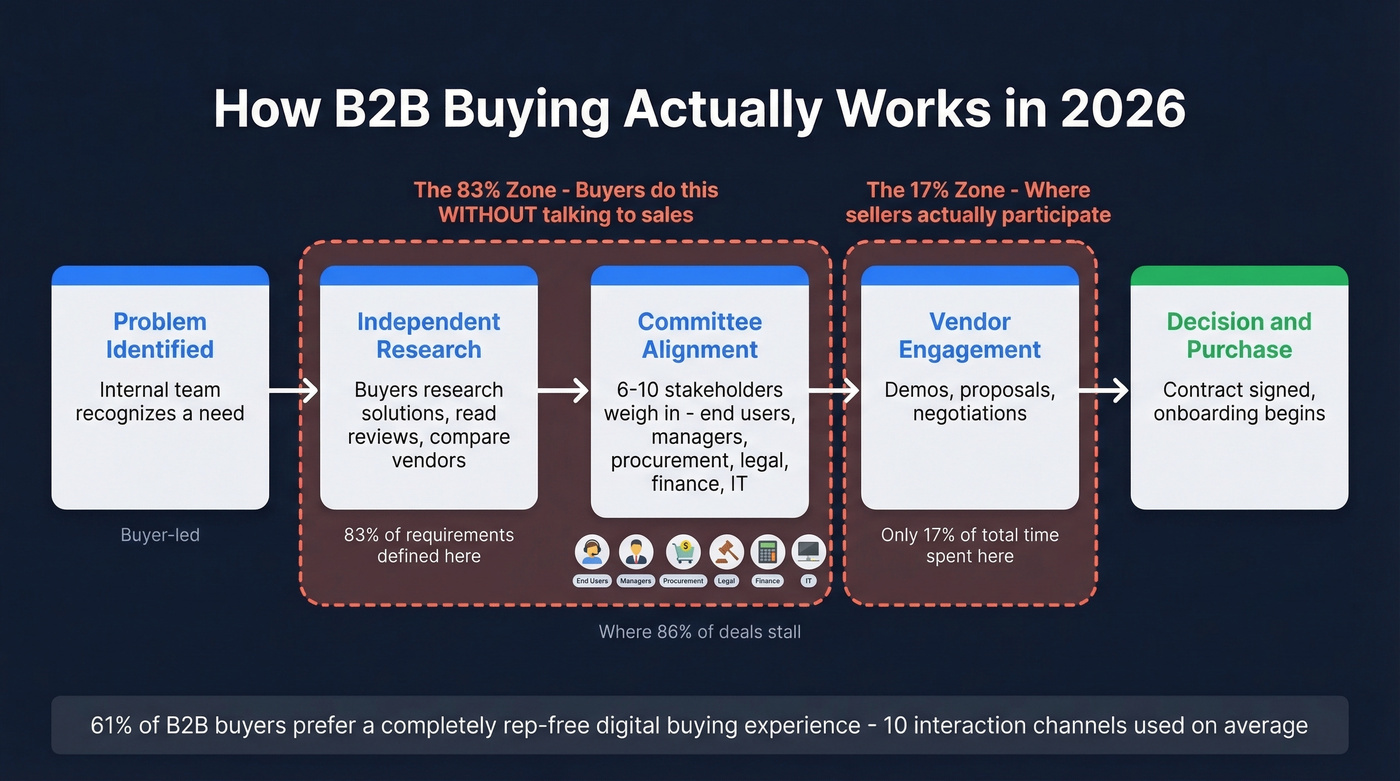
A typical purchase involves 6-10 stakeholders. For enterprise deals, that number climbs to 20+. Each stakeholder brings different priorities - the end user cares about usability, the CFO cares about ROI, procurement cares about contract terms, and IT security cares about SOC 2 compliance.
The most important stat in modern B2B: buyers define their requirements 83% of the time before ever speaking with sales. That number, from 6sense's 2025 research, reshapes everything about go-to-market. By the time a prospect books a demo, they've already researched your product, compared you to three competitors, and built an internal business case. You're not educating them - you're confirming their decision.
This is why 61% of B2B buyers now prefer a rep-free digital buying experience. Buyers use 10 interaction channels on average, up from 5 in 2016. McKinsey's "rule of thirds" captures the split: roughly equal time between in-person, remote, and digital self-serve.
Yet despite all this digital sophistication, 86% of purchases stall at some point - and 81% of buyers end up dissatisfied with the provider they chose. Buyers spend only 17% of their total buying time actually meeting with potential suppliers. The rest is internal research, committee alignment, and bureaucratic navigation. We've seen this play out repeatedly: a champion loves your product, but the deal dies in procurement because nobody mapped the internal approval process early enough.
Sales Cycles: How Long Deals Take
Sales cycle length is one of the most misunderstood aspects of selling to other businesses.
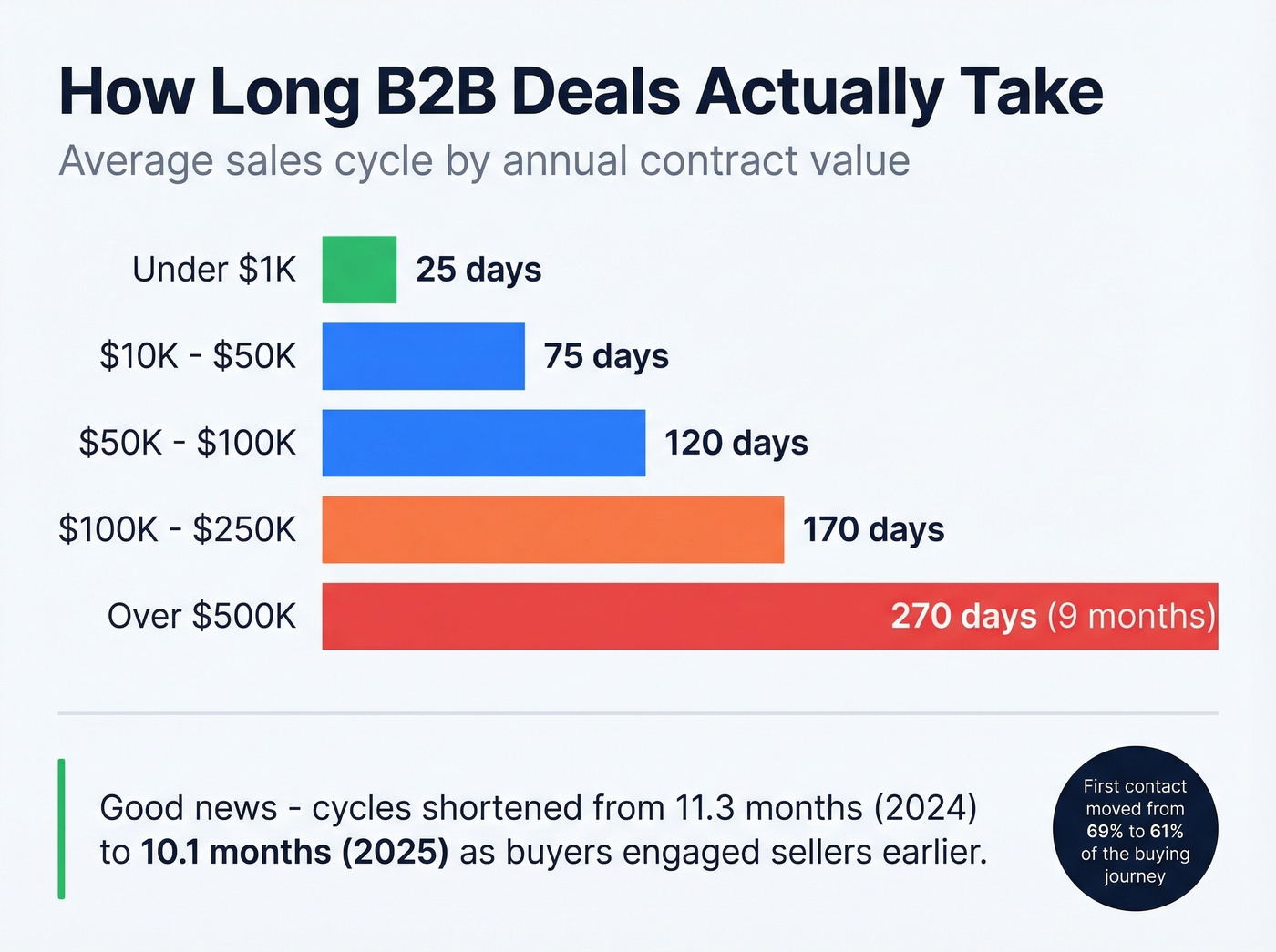
By deal size:
| Annual Contract Value | Avg Cycle (Days) |
|---|---|
| Under $1K | 25 |
| $10K-$50K | 75 |
| $50K-$100K | 120 |
| $100K-$250K | 170 |
| Over $500K | 270 |
By prospect company size:
| Company Size | Avg Cycle (Days) |
|---|---|
| 1-10 employees | 38 |
| 11-50 employees | 52 |
| 51-200 employees | 78 |
| 201-1,000 employees | 110 |
| 1,001-10,000 employees | 145 |
| 10,001+ employees | 185 |
Data from Focus Digital's 2025 benchmarks.
An interesting trend: average sales cycles shortened from 11.3 months in 2024 to 10.1 months in 2025. Economic pressure pushed buyers to engage sellers earlier - first contact moved from 69% of the buying journey to 61%, pulling outreach earlier by roughly six weeks. When budgets tighten, buyers want answers faster.
Let's be honest: if you're selling a $50K+ deal to a company with 1,000+ employees, plan for a 4-6 month cycle minimum. Anything faster is a pleasant surprise, not a baseline expectation. Teams that forecast based on their best-case close time end up with wildly inaccurate pipelines.
Building a Strategy That Works
Understanding what B2B means is one thing. Actually selling in a business-to-business environment is another. The biggest practical challenge is reaching those 6-10 decision-makers when you don't know who they are or whether they're even in-market.
Modern prospecting looks nothing like the old playbook. Cold calling a switchboard and asking to be transferred is mostly dead. Today's outbound teams use data platforms to identify the right people, verify their contact information, and reach them through personalized sequences across email, phone, and social channels. A strong go-to-market strategy combines these data-driven outreach methods with content that educates buyers during the 83% of the journey they complete on their own.

Here's a short walkthrough of what this looks like in practice:
Our team uses Prospeo for this exact workflow. The platform covers 300M+ professional profiles with 98% email accuracy, 143M+ verified emails, and 125M+ verified mobile numbers. You search by 30+ filters - job title, industry, company size, technographics, headcount growth, funding stage, and buyer intent across 15,000 topics - then export verified contacts directly into your sequencer or CRM. Data refreshes every 7 days, which matters because the industry average is 6 weeks and stale data means bounced emails and burned sender reputation.
In a $36T market where 83% of buyers define requirements before talking to sales, showing up late with bad data isn't an option. Prospeo delivers 98% email accuracy, 125M+ verified mobile numbers, and a 7-day data refresh cycle - all at $0.01 per email. No contracts, no sales calls required.
Enterprise-grade B2B data without enterprise pricing. Start free today.
Common Mistakes to Avoid
If you're entering the B2B world for the first time - especially as a founder - skip this section at your own risk. These are the mistakes that sink companies:
Outsourcing sales too early. As Celonis cofounder Alexander Rinke put it: sales is too important to hand off before you understand it yourself. Founder-led sales isn't optional in the early stages.
Charging too little. New companies consistently underprice. Low prices signal low value in business-to-business deals, and they make it impossible to fund the long sales cycles your product requires.
Mistaking pilots for customers. A pilot isn't a sale. We've watched teams celebrate 15 "customers" that were actually free trials with no conversion path. That's not traction - it's a vanity metric.
Targeting too broadly. "We sell to enterprises" isn't a segment. "We sell compliance automation to mid-market fintech companies with 50-200 employees" is. Narrow wins. (If you need a framework, start with an ideal customer profile.)
Ignoring customer concentration risk. If one client represents 30%+ of your revenue, you don't have a business - you have a dependency. Diversify your book early, even if it means slower growth.
Not pushing for a "no" early. A fast "no" is worth more than a slow "maybe" that ties up your best rep for a quarter.
Look, most B2B companies don't have a lead generation problem. They have a qualification problem. They're spending months nurturing prospects who were never going to buy, while ignoring signals - budget authority, timeline, technical fit - that would tell them in week one whether a deal is real. Fix your disqualification process before you spend another dollar on top-of-funnel.
Beyond B2B: Related Models
B2B is the biggest model, but it's not the only one worth understanding.
B2B2C (Business-to-Business-to-Consumer). A business sells to another business, which then sells to the end consumer. A coffee roaster sells beans to a cafe chain, which serves them to customers. The roaster's customer is the cafe, but the end consumer drives demand.
B2G (Business-to-Government). Businesses selling to government entities through formal procurement processes - a tech firm upgrading a city's dispatch system, or a construction company building a public hospital wing. Longer cycles than B2B, heavier compliance requirements.
D2C (Direct-to-Consumer). Brands selling directly to consumers without intermediaries. D2C isn't the same as B2C - it specifically means cutting out the middleman.
C2C (Consumer-to-Consumer). Peer-to-peer marketplaces like eBay, Poshmark, or Facebook Marketplace. One individual selling to another, usually facilitated by a platform.
B2E and C2B complete the picture - businesses selling to their own employees (corporate perks, internal tools) and consumers selling value back to businesses (influencer marketing, user-generated content platforms).
FAQ
What does B2B stand for?
B2B stands for business-to-business, describing any transaction where one company sells products, services, or solutions to another company rather than to an individual consumer. The term covers everything from raw materials supply chains to SaaS subscriptions to professional consulting engagements.
What's the difference between B2B and B2C?
B2B sells to businesses with longer sales cycles (1-9 months), multiple decision-makers (6-10 per deal), and higher contract values. B2C sells to individual consumers with shorter cycles, emotional buying triggers, and lower price points. Many companies like Amazon operate in both models simultaneously.
Is Amazon a B2B or B2C company?
Both. Amazon.com is B2C, serving individual shoppers. Amazon Business is a dedicated B2B marketplace with bulk pricing, purchase approval workflows, and tax-exempt purchasing for millions of business buyers. The two operate as distinct platforms under one parent company.
How big is the B2B market in 2026?
Global B2B e-commerce hit $33.02T in 2025 and is projected to reach $36.86T in 2026, growing to $61.66T by 2031. That's roughly 5-6x the size of global B2C e-commerce, making business-to-business the dominant force in digital commerce.
How do you find B2B customers?
Modern prospecting uses data platforms to identify decision-makers by role, industry, company size, and buyer intent - then verifies contact information before outreach. Tools like Prospeo cover 300M+ profiles with 30+ filters and 98% email accuracy, letting teams export verified emails and direct dials straight into a CRM or sequencer.