

The B2B Prospecting Playbook: Benchmarks, Cadences, and Tools for 2026
A RevOps lead we know ran a 3-tool bake-off last quarter. The "best" database created 4,000 duplicate contacts in Salesforce in five days. The cheapest tool had better phone connect rates. The expensive one? Reps only used the search bar. B2B prospecting isn't about having the most tools or the biggest database - it's about building a system where every piece actually works together.
What B2B Prospecting Actually Is
B2B prospecting is the act of identifying, qualifying, and initiating contact with potential buyers. That's it. It's not lead generation - lead gen includes inbound channels where prospects come to you through content, ads, or referrals. Prospecting is the outbound half: you pick the target, you do the research, you make the first move.
The distinction matters because it changes how you measure success. Lead gen teams optimize for volume - more MQLs, more form fills. Prospecting teams optimize for precision - fewer contacts, higher conversion, better pipeline quality. When you blur the two, you end up with SDRs blasting 500 emails a day and calling it "prospecting" when it's really just spam with a CRM attached.
Real prospecting means finding the right 50 accounts, mapping the buying committee, and running a multi-channel cadence that earns a conversation.
The Short Version
If you're pressed for time, here's the playbook compressed into five moves:
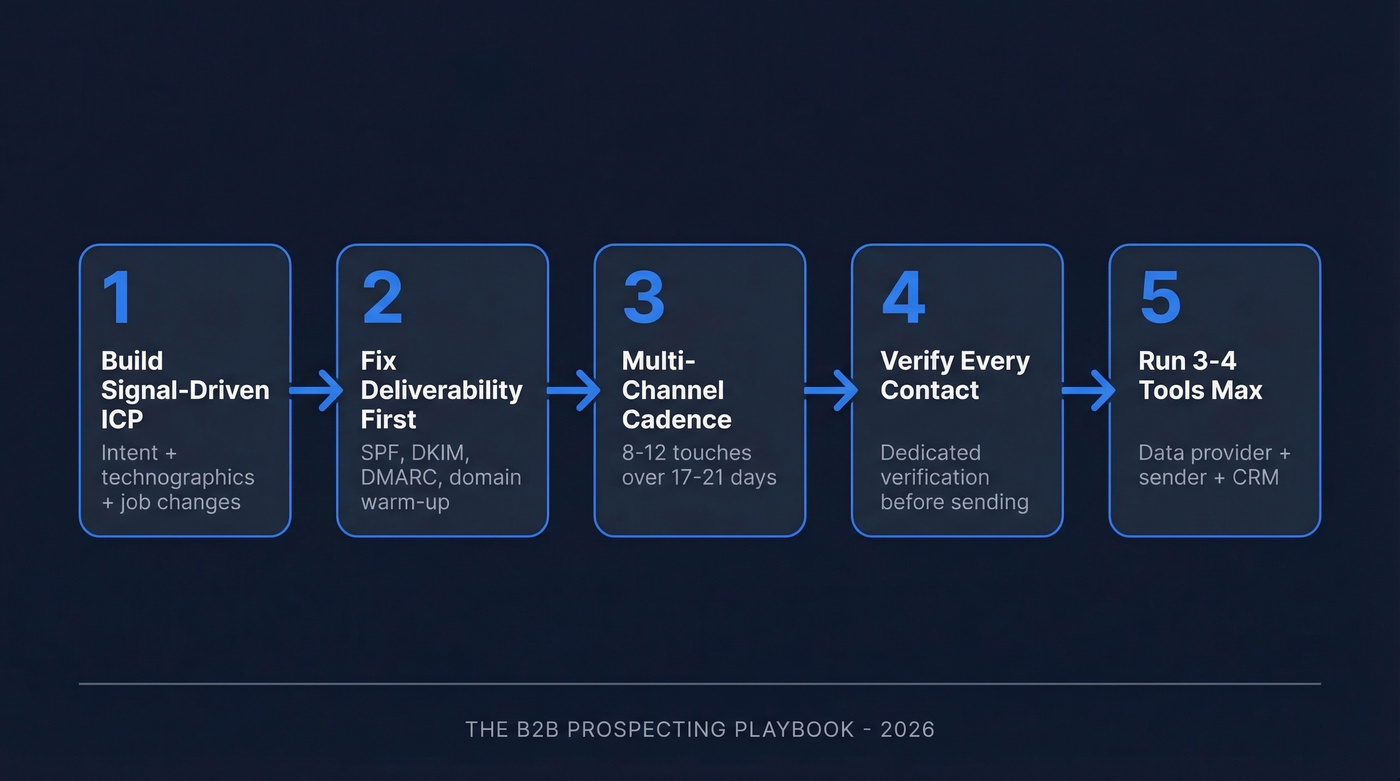
- Build a signal-driven ICP before touching any tool. Firmographics alone aren't enough - layer in intent data, technographics, and job-change signals.
- Fix your deliverability infrastructure first. Inbox placement can sit near 50% in some providers. Authentication (SPF/DKIM/DMARC) and domain warm-up aren't optional anymore.
- Use a multi-channel cadence of 8-12 touches over 17-21 days. Email alone won't cut it.
- Verify every contact list through a dedicated tool before sending. Bad data destroys domain reputation faster than bad copy.
- Run 3-4 tools max - not 15. A data provider, a sending platform, and a CRM. That's the core stack.
Why Outbound Prospecting Changed in 2026
Collin Stewart, CEO of Predictable Revenue, put it bluntly: "Predictable Revenue was never meant to be about brute-force outreach - it was about focus." Somewhere along the way, teams took "predictable" to mean "more dials, more emails, more sequences." That era is over.
Inbox placement is collapsing. Delivery rate and inbox placement are two very different numbers. Your ESP might report a 98% delivery rate, but Office365 inbox placement fell from 77.43% to 50.70% year-over-year. Outlook/Hotmail dropped from 49.33% to 26.77%. Gmail dipped from 58.72% to 53.70%. Google and Yahoo enforced SPF/DKIM/DMARC requirements for bulk senders in February 2024, and [Microsoft followed in May 2025](https://techcommunity.microsoft.com/blog/microsoftdefenderforoffice365blog/strengthening-email-ecosystem-outlook%E2%80%99s-new-requirements-for-high%E2%80%90volume-senders/4399730. If you haven't locked down authentication, you're sending into a void - it's entirely possible to have "delivered" email while a huge chunk never hits the inbox.
Buying committees keep growing. The average B2B purchase now involves 11 to 13 stakeholders, each consuming 4-5 pieces of content independently before a group decision. Single-threaded outreach - one email to one VP - is a losing strategy when a dozen people can kill your deal.
Signal-based targeting is replacing spray-and-pray. Intent data, job-change alerts, technographic signals, and funding events let you reach buyers when they're actually in-market. The teams winning in 2026 aren't sending more emails. They're sending fewer, better-timed messages to accounts showing buying signals.
Build Your ICP First
Most teams skip this step. It's the single biggest reason their outbound fails.
Here's the thing: if your average deal size sits below $10k, you probably don't need ZoomInfo-level data. What you need is a tight ICP and a verified list. The companies spending $40k/year on data platforms and still missing quota almost always have an ICP problem, not a data problem.
ICP Checklist:
- Industry and sub-industry
- Company size (headcount range) and revenue range
- Geography and market segment
- Technology stack (what tools do your best customers run?)
- Hiring signals (roles that indicate a need for your product)
- Funding or growth triggers (recent raise, headcount surge)
- Intent signals (actively researching your category)
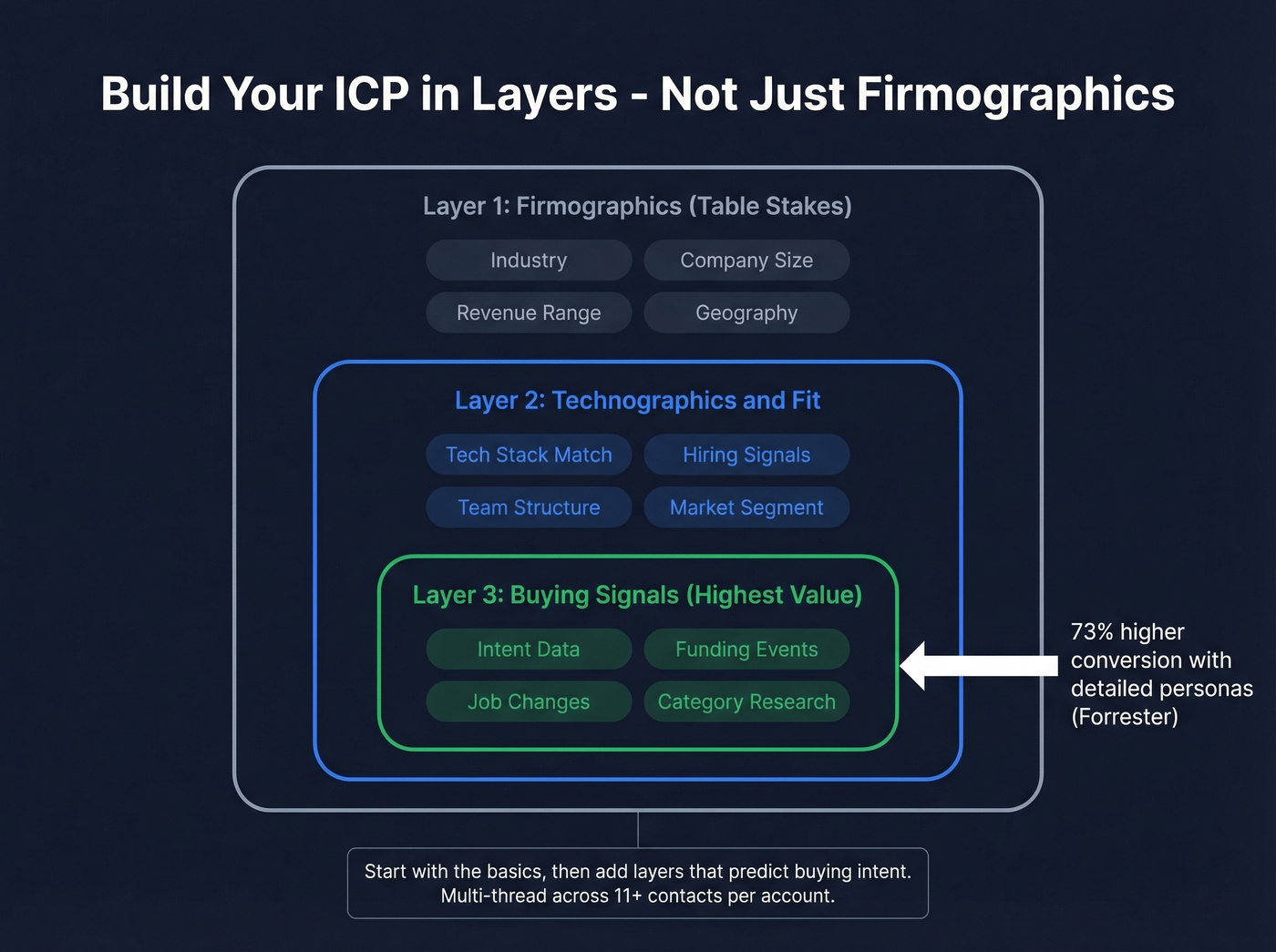
Start with the basics, then add the layers that actually predict buying intent. Forrester research shows companies using detailed buyer personas see 73% higher conversion rates from response to MQL. That's not a marginal improvement - it's the difference between a pipeline that converts and one that doesn't.
For mid-market deals, plan to multi-thread across 11+ contacts per account. Map the buying committee by role: the economic buyer, the technical evaluator, the end user, the internal champion. Each gets different messaging. And 57% of C-level buyers prefer phone contact, so your channel mix should vary by persona, not just by what's easiest for your reps.
Five Methods That Still Work
Cold Email
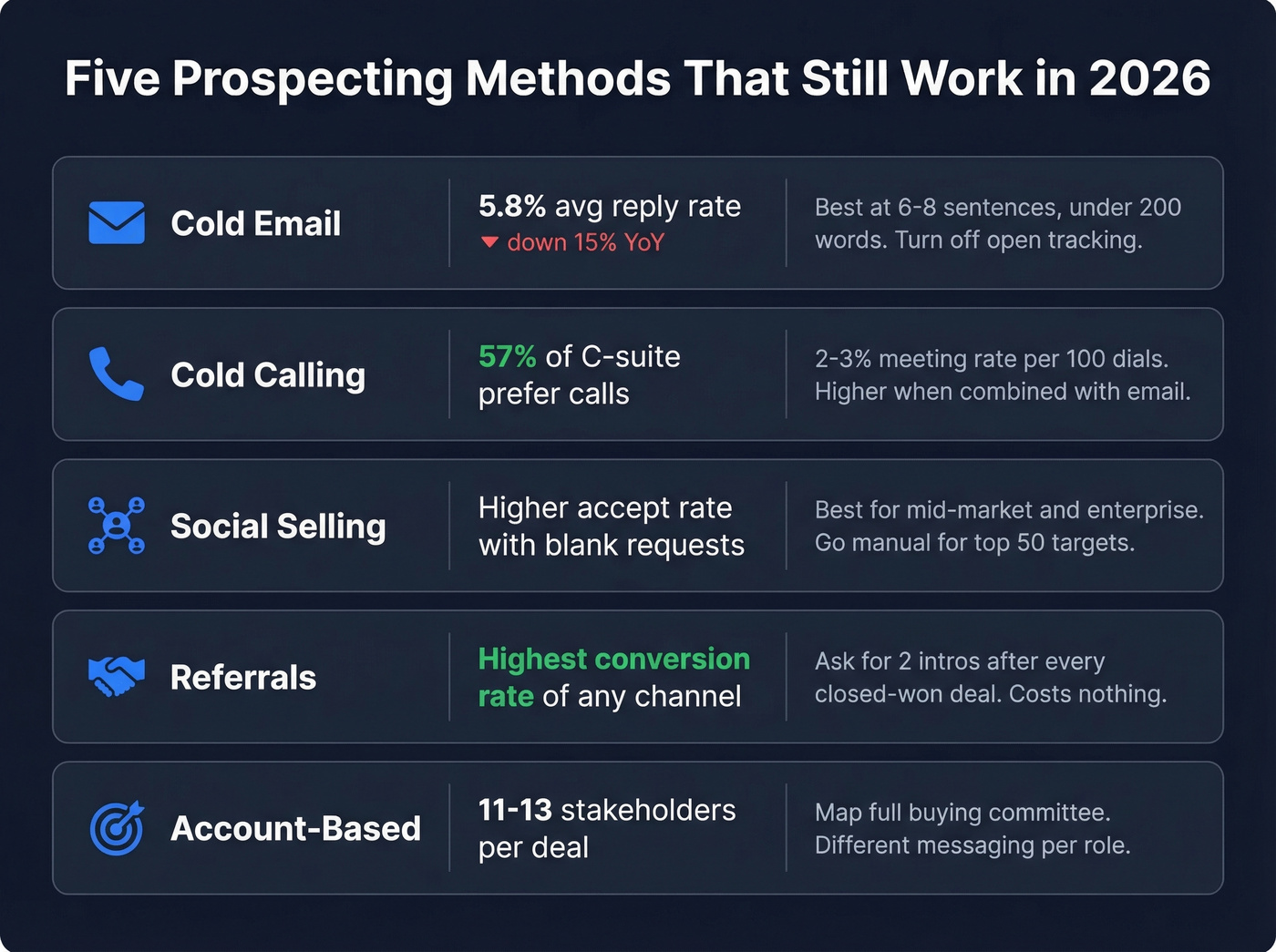
Cold email still works, but the margins are thinner than ever. Belkins analyzed 16.5 million cold emails sent between January and December 2024. The average reply rate was 5.8%, down 15% from 6.8% the year before.
The data reveals some counterintuitive patterns. One-touch campaigns - a single email with no follow-up - actually had the highest reply rate at 8.4%. Adding a third email can drop reply rates by up to 20%. Spam complaints rise from 0.5% on the first email to 1.6% by the fourth. The lesson isn't "never follow up." It's "follow up with new value, not just a bump."
Best-performing emails ran 6-8 sentences and stayed under 200 words, hitting a 6.9% reply rate. Turning off open tracking improved response rates by roughly 3%. The consensus on r/sales echoes this - open and click trackers tank deliverability, and the data you get from them isn't worth the cost.
Cold Calling
Phone isn't dead. For C-suite targets, it's actually the preferred channel - 57% of C-level buyers say they'd rather get a call than an email. The challenge is infrastructure: VoIP numbers from providers like Twilio get flagged as spam constantly. Apollo's built-in dialer uses Twilio, and practitioners warn those numbers burn fast.
Expect roughly a 2-3% meeting rate per 100 dials on cold lists. That number climbs significantly when you're calling into accounts that have already engaged with your emails or content.
Social Selling
Skip this if you're only targeting SMBs - it pays off most for mid-market and enterprise. The tactic that keeps working: send a blank connection request with no note. The data shows higher acceptance rates without a message attached. Once connected, you've earned the right to message directly.
For automation at scale, HeyReach handles adding connections and sending messages. For your top 50 targets, go manual. Personalized video messages and thoughtful comments on their posts outperform any automated sequence.
Referrals and Warm Intros
Referrals convert at the highest rate of any prospecting channel, yet most teams treat them as happy accidents rather than a repeatable process. Systematize it: after every closed-won deal, ask for two introductions. Build referral requests into your QBR cadence. Create a simple Slack workflow where AEs can request intros from CSMs who have relationships at target accounts. This costs nothing and consistently outperforms cold outreach.
Account-Based Prospecting
When a deal involves 11-13 stakeholders, single-contact prospecting is a coin flip. Account-based prospecting means mapping the full buying committee and running coordinated outreach across all of them. The CFO hears about ROI. The technical lead hears about integration. The end user hears about workflow improvements. Multi-threading isn't optional for mid-market and enterprise deals - it's the baseline.

This playbook says verify every contact list before sending. Prospeo's 5-step verification delivers 98% email accuracy - the same data that helped Snyk's 50 AEs cut bounce rates from 35% to under 5% and generate 200+ new opportunities per month.
Stop destroying your domain reputation with unverified data.
The Deliverability Crisis
Your emails might be "delivered" and still never seen. A 98% delivery rate sounds great until you realize that delivery just means the receiving server accepted the message. It doesn't mean it hit the inbox.
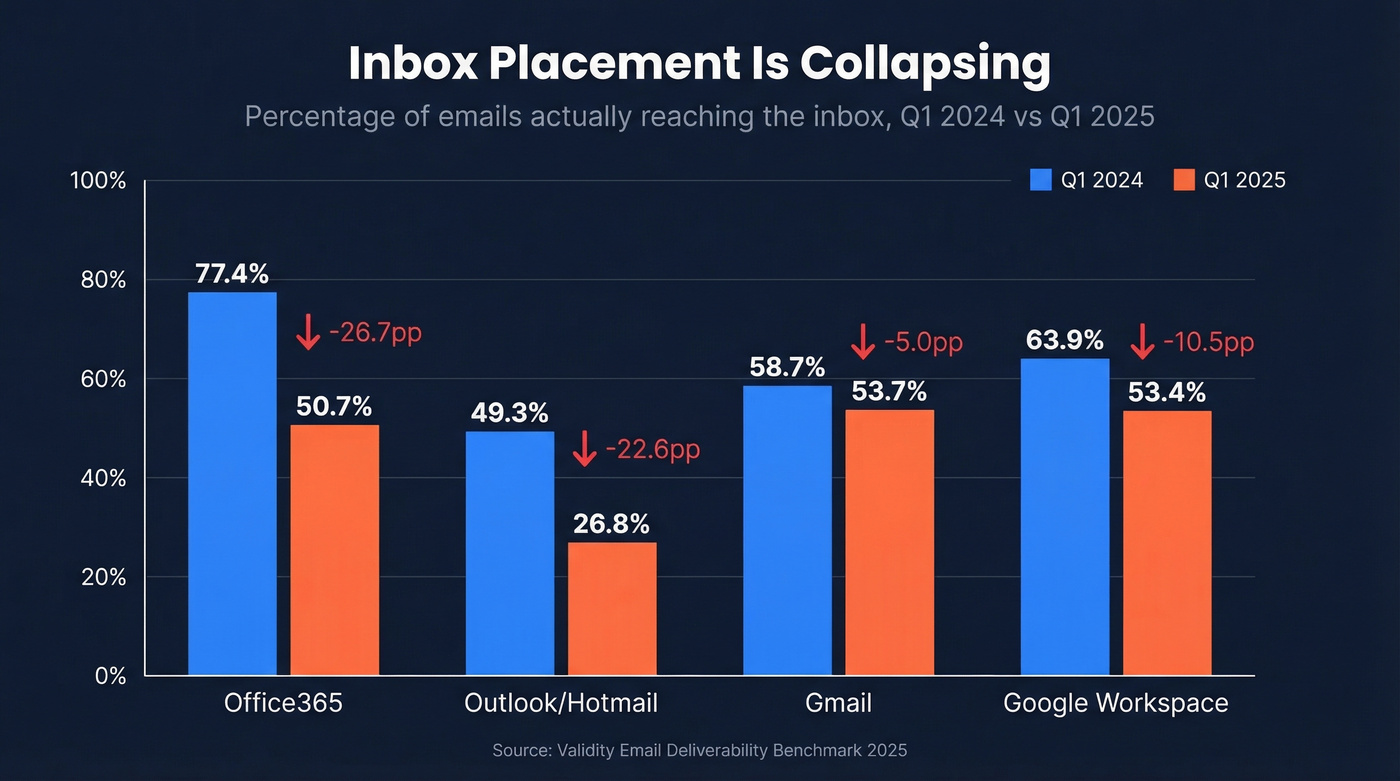
The inbox placement numbers tell a different story:
| Provider | Q1 2024 | Q1 2025 | Drop |
|---|---|---|---|
| Office365 | 77.43% | 50.70% | -26.73 pp |
| Outlook/Hotmail | 49.33% | 26.77% | -22.56 pp |
| Gmail | 58.72% | 53.70% | -5.02 pp |
| Google Workspace | 63.85% | 53.36% | -10.49 pp |
Only 7.6% of domains enforce DMARC with a quarantine or reject policy. The vast majority of senders haven't completed the basic authentication requirements that Google, Yahoo, and Microsoft now mandate.
Your operational thresholds need to be tight: bounce rate under 2%, spam complaint rate under 0.1%. Warm-up volume counts toward your daily send limits - if you're sending 30 emails a day, that's 25 outreach plus 5 warm-up, not 30 plus 5. New domains face roughly a 30-point inbox placement penalty versus mature domains, though full authentication plus proper warm-up can restore 85-95% placement.
Data Quality Is the Whole Game
Most deliverability problems trace back to data quality. Bad emails bounce. Bounces damage your sender reputation. Damaged reputation means your good emails land in spam. It's a death spiral, and it starts the moment you send to an unverified list.
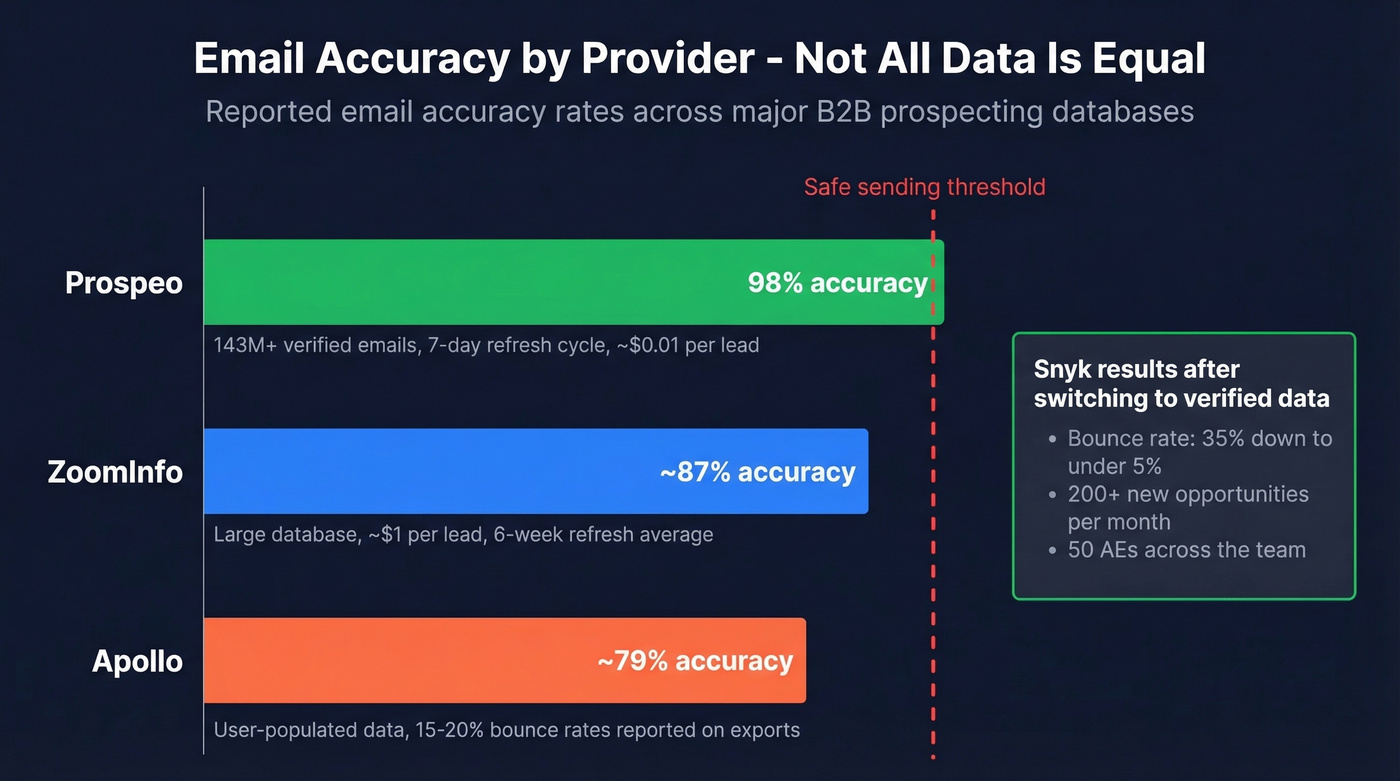
Apollo's database covers 275M+ profiles, but practitioners describe the data as user-populated and not verified by Apollo itself. On r/sales, it's consistently called a "jack of all trades, master of none." Tool comparisons regularly cite 15-20% bounce rates on Apollo exports versus 5-8% on premium tools. The standard advice from experienced outbound operators: use at least two verifiers before you send anything.
We've seen this play out firsthand. Prospeo runs every record through a 5-step verification process with proprietary infrastructure - catch-all domain handling, spam-trap removal, and honeypot filtering. The result is 98% email accuracy on 143M+ verified emails, refreshed on a 7-day cycle while the industry average sits at six weeks. For context, ZoomInfo's email accuracy is roughly 87%, Apollo's around 79%.
The proof is in production. Snyk's team of 50 AEs cut bounce rates from 35-40% to under 5% after switching, generating 200+ new opportunities per month. Stack Optimize built their agency to $1M ARR while maintaining 94%+ deliverability across all clients with zero domain flags. At roughly $0.01 per lead versus ZoomInfo's ~$1 per lead, verification is the highest-ROI step in any prospecting workflow.
You need a tight ICP, not 15 tools. Prospeo gives you 30+ filters - buyer intent, technographics, job changes, funding signals, headcount growth - across 300M+ profiles. Layer the exact signals this playbook recommends, at $0.01 per email.
Build signal-driven prospect lists in minutes, not hours.
Two Cadences You Can Copy
The 17-21 Day Cadence (8-12 Touches)
This framework comes from Morgan J Ingram and Florin Tatulea. The core principle: use multiple channels and double down on whichever one gets responses.
| Day | Channel | Action |
|---|---|---|
| 1 | Social | Blank connection request (no note) |
| 2 | 75-100 words, no meeting ask - ask for interest | |
| 3 | Phone + Email | Call, leave voicemail, send "following up" email |
| 5 | Phone | Call attempt |
| 7 | Phone | Call attempt |
| 7-10 | Video | Send if engagement detected |
| 10 | Personalized follow-up with new value |
The first email shouldn't ask for a meeting. Ask for permission: "Are you open to a quick email exchange on [topic]?" This lowers the commitment threshold and gets more replies. Keep it to 75-100 words - 75 is the sweet spot.
The 7-Touch Sprint (10 Days)
For faster-moving deals or when you need to test messaging quickly:
| Day | Channel | Action |
|---|---|---|
| 1 | Intro email (under 100 words) | |
| 2 | Social | Connection request |
| 3 | Phone | Call + voicemail |
| 5 | Value-add email (case study or insight) | |
| 7 | Social | Direct message |
| 9 | Phone | Follow-up call |
| 10 | Break-up email |
Before launching either cadence, verify your list. Prospeo's API match rate is 92%, enrichment returns 50+ data points per contact, and 83% of leads come back with contact data. Loading unverified data into your sequencer is how you burn domains.
The 2026 B2B Prospecting Tool Stack
RevPartners calls this the "connected prospecting stack" - specialized tools linked end-to-end from discovery through outreach to CRM sync, rather than one monolithic platform trying to do everything poorly.
| Tool | Category | Best For | Pricing From | Key Note |
|---|---|---|---|---|
| Prospeo | Data + Verification | Verified data, no contracts | Free; ~$0.01/email | 98% accuracy, 7-day refresh |
| Apollo.io | Data + Engagement | SMB all-in-one | Free; $49-59/user/mo | Verify data separately |
| ZoomInfo | Data + Intent | Enterprise teams | ~$15-40k+/yr | Deep US data, opaque pricing |
| Cognism | Data | EMEA coverage | ~$15k+/yr custom | Strong mobile data in Europe |
| LinkedIn Sales Nav | Data + Social | Social selling | ~$99/user/mo | Best paired with a data provider |
| Hunter.io | Email Finder | Quick lookups | $56/mo | Lighter database |
| Lusha | Data | Fast lookups | $49/user/mo | Simple Chrome extension |
| Instantly | Sending | Cold email infra | $37-47/mo flat | Mailbox rotation built in |
| Smartlead | Sending | Cold email infra | ~$39+/mo | Similar to Instantly |
| Outreach | Engagement | Enterprise multi-channel | Custom pricing | Heavy implementation |
| Salesloft | Engagement | Enterprise multi-channel | Custom pricing | Heavy implementation |
| Clay | Enrichment | Workflow automation | $149/mo | Powerful but expensive |
| HubSpot | CRM | SMB/mid-market | Free; $15/seat/mo | Popular free CRM |
| Salesforce | CRM | Enterprise | $25/user/mo | Industry standard |
| Bombora | Intent Data | In-market signals | ~$25k+/yr | Leading intent provider |
| 6sense | Intent + ABM | Enterprise ABM | ~$50k+/yr | Enterprise only |
You need three to four tools, not sixteen. The recommended stack for most teams: a data provider with built-in verification, Instantly or Smartlead for sending, and HubSpot or Salesforce for CRM. That covers discovery through delivery.
Let's be honest - the fact that ZoomInfo and Cognism still won't publish transparent pricing is frustrating. ZoomInfo contracts with intent data and mobile numbers can run $40k+/year. That's real money for a Series A company, especially when self-serve tools deliver better accuracy at a fraction of the cost.
Seven Mistakes That Kill Pipeline
In our experience, the #1 pipeline killer isn't bad messaging - it's bad data. But it's far from the only way teams sabotage themselves.
- No ICP definition. Spraying 5,000 emails into a vague industry vertical isn't prospecting. It's noise.
- Single-channel outreach. Email-only cadences leave meetings on the table. Phone, social, and video each reach prospects that email misses entirely.
- Sending to unverified lists. A 15% bounce rate doesn't just waste sends - it damages your domain reputation for every future email you send. Verify first. Always.
- Using open and click trackers. Tracking pixels tank deliverability. The 16.5M-email dataset showed turning them off improved response rates by ~3%. The vanity metrics aren't worth the inbox placement hit.
- Ignoring intent signals. Reaching out to accounts that aren't in-market is the most expensive form of outbound. Layer intent data into your targeting to focus on buyers who are actively researching.
- Too many follow-ups. Spam complaints rise from 0.5% on the first email to 1.6% by the fourth. If you haven't earned a reply in three touches on one channel, switch channels - don't just send another bump. (If you need copy, use these sales follow-up templates.)
- Ignoring GDPR compliance. Violations carry fines up to EUR 20M or 4% of global annual revenue. Sending to unverified lists in the EU isn't just a deliverability problem - it's a legal one that can shut you down.
How to Measure Performance
Stop measuring activity. Start measuring outcomes.
Positive reply rate tells you whether your messaging resonates - track genuine interest signals, not total replies that include "stop emailing me." Meetings booked per 100 contacts is your efficiency metric; it reveals whether your ICP, messaging, and data quality are working together. Lead-to-opportunity conversion shows how many meetings turn into real pipeline. If it's under 30%, your qualification criteria need work. Keep bounce rate under 2% and spam complaint rate under 0.1%. Non-negotiable on both. (If you're troubleshooting, start with email bounce rate and an email deliverability guide.)
Collin Stewart advocates replacing "Closed Lost" with "Closed Lost - Nurture" and creating a separate nurture pipeline view. This keeps not-ready deals from polluting your active pipeline metrics while ensuring they don't disappear entirely.
Look, the most underrated use of outbound is as market intelligence. Every sequence you run is a test of your hypotheses about which segments respond, which messaging resonates, and which channels work. The teams that treat B2B prospecting as a feedback loop - not just a lead source - build compounding advantages quarter over quarter.
FAQ
What's the difference between prospecting and lead generation?
Prospecting is proactive outreach to identified targets - you pick the account and initiate the conversation. Lead generation is the broader category that includes inbound channels. B2B sales prospecting is a subset of lead gen, focused entirely on outbound.
How many touches does it take to book a meeting?
Current best practice is 8-12 touches across multiple channels over 17-21 days. One-touch campaigns can hit 8.4% reply rates, but multi-touch, multi-channel cadences build pipeline more consistently.
What's a good cold email reply rate in 2026?
The benchmark is 5.8% across 16.5M emails analyzed. Top performers hit 6.9% with emails under 200 words. Below 3%? Check data quality and deliverability before rewriting copy.
How do I verify my prospect list before sending?
Use a dedicated verification tool that runs multi-step validation - catch-all handling, spam-trap removal, honeypot filtering. Never trust a data provider's built-in verification alone; run contacts through at least two verifiers before loading them into any sequencer.
Do I need ZoomInfo or can I use a cheaper alternative?
ZoomInfo is strong for enterprise teams with budget, but it costs $15-40k+/year with annual contracts. For teams under 50 reps, self-serve tools with 98% email accuracy at ~$0.01 per lead and no contracts deliver better results at a fraction of the cost.