

B2B Sales Management: The Operational Playbook Your Team Actually Needs
It's Thursday afternoon. You're on the forecast call. Three reps swear their deals are closing this month. You know - based on the last six Thursdays - that at least two won't. Up to 70% of B2B reps missed quota last year, and 67% of B2B buyers now prefer a rep-free experience entirely. The problem isn't your reps. It's the b2b sales management operating system underneath them.
Here's the short version - five systems hold everything together:
- Pipeline governance (entry rules, stage gates, deal removal)
- Forecasting rigor (cadence + evidence)
- Coaching cadence (skill-building, not surveillance)
- KPI benchmarks (know what "good" is)
- Data quality (bad contacts poison everything downstream)
If your process can't survive a rep having a "busy week," it's not a process. It's wishful thinking.
Pipeline Governance: The Highest-Leverage Activity
Not coaching. Not comp design. Pipeline governance is the highest-leverage activity a sales manager has, because every other system depends on what's sitting in your CRM.
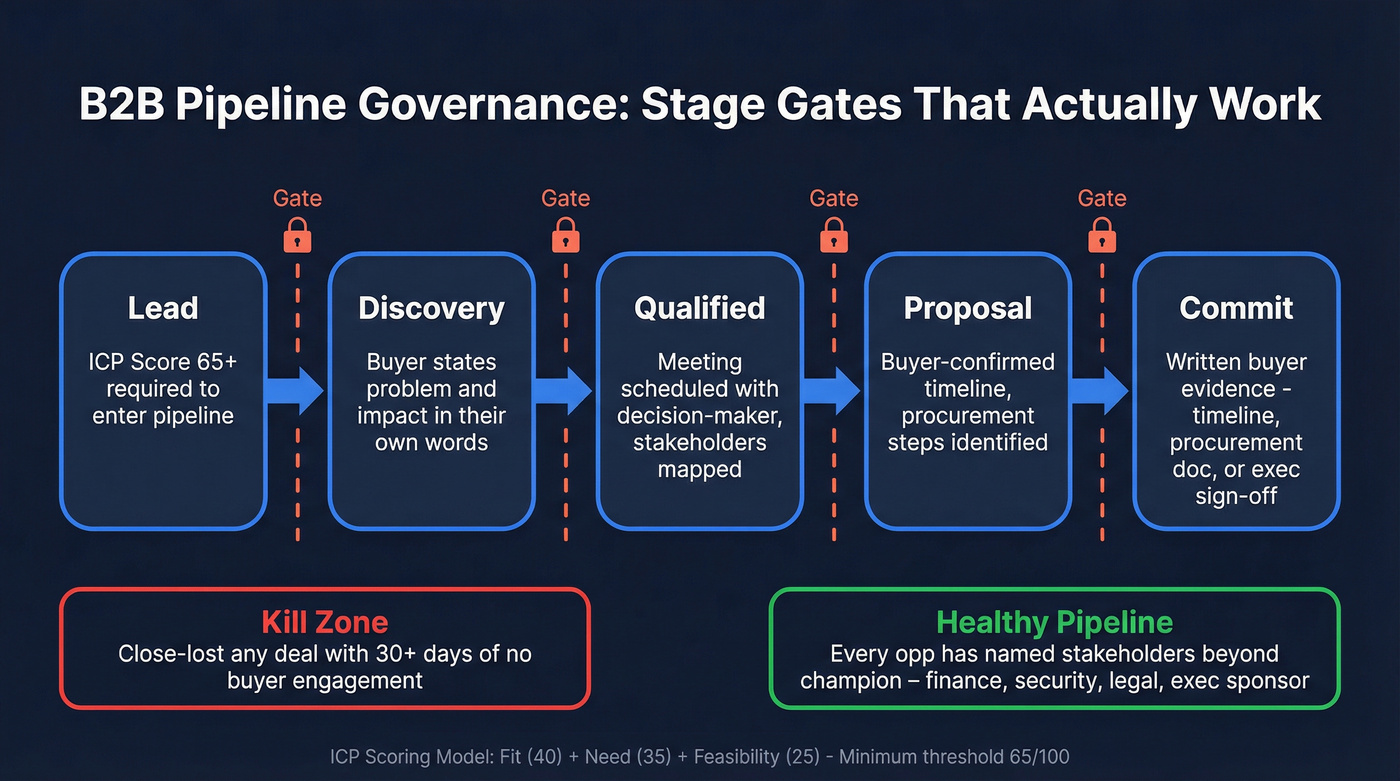
Set pipeline entry rules, not just stage rules. Before an opportunity even exists, require an ICP score. Use a simple model: Fit (40), Need (35), Feasibility (25). Set a minimum threshold - 65/100 is a clean starting line. If a deal can't clear that bar, it stays a lead, not an opp.
Use stage exit criteria reps can't skip. Every stage transition needs a binary gate. Discovery to Qualified requires (a) the buyer states the business problem and impact in their own words, and (b) a meeting is scheduled with a decision-maker. No "I'll update it later." If it's not true, it doesn't move.
Run a weekly deal-quality inspection and kill deals. Pick 3-10 deals per rep. Check whether the close date matches reality, confirm a buyer-confirmed next step exists, and close-lost anything with 30+ days of no buyer engagement. A sales leader on r/sales described their pipeline as "realistically inflated by about 60%" - wrong values, outdated dates, ghost opportunities everywhere. That's what no governance looks like.
Manage for multi-stakeholder reality. Most meaningful B2B deals die in the buying committee, not in the demo. If your opp doesn't have named stakeholders beyond your champion - finance, security, legal, exec sponsor - it's not "late-stage." It's fragile.

Pick a qualification framework (BANT for shorter cycles, MEDDIC for complex ones) and enforce it. The goal isn't to become a "playbook company" where process replaces thinking. It's to stop letting fantasy deals squat in your forecast.
Forecasting That Finance Can Trust
Only 45% of sales leaders are confident in their forecast accuracy. That's unacceptable - because finance will plan as if your number is real.
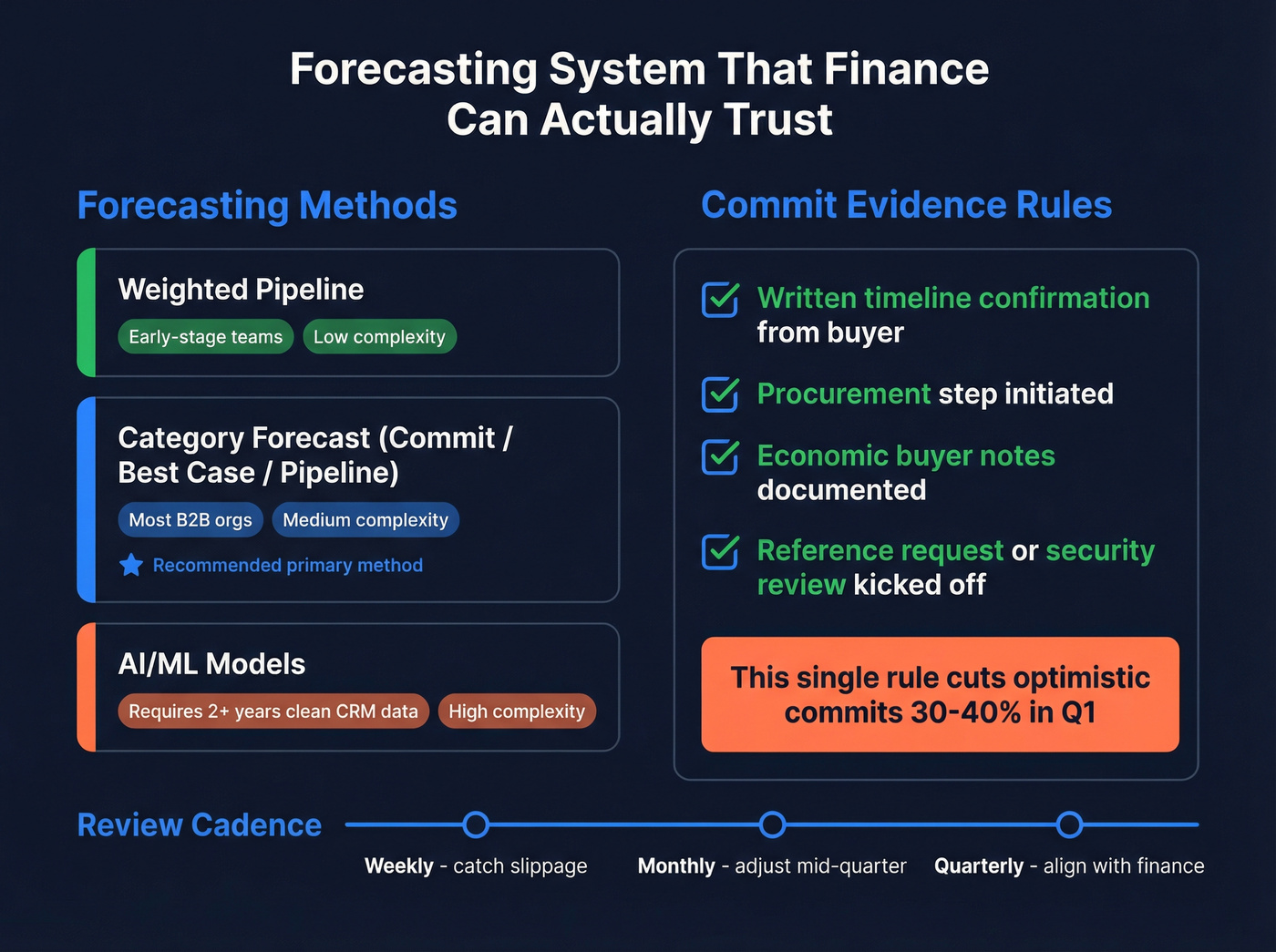
Use a simple stack:
| Method | Best For | Complexity |
|---|---|---|
| Weighted pipeline | Early-stage teams | Low |
| Category (commit/best/pipe) | Most B2B orgs | Medium |
| AI/ML models | Orgs with 2+ years CRM data | High |
Our recommendation: run category forecasting as the primary method and keep weighted pipeline as a sanity check. AI/ML is great after you've earned it with clean history.
Cadence that actually works. Weekly manager reviews catch slippage early. Monthly reviews adjust the plan mid-quarter. Quarterly rollups align with finance and force scenario planning. Don't mash these into one mega-meeting.
Commit evidence is non-negotiable. For every deal in commit, require one piece of buyer-side evidence: a written timeline confirmation, a procurement step, or economic buyer notes. This single rule cuts optimistic commits 30-40% in the first quarter - we've seen it happen across multiple teams we've worked with.
Track buyer-side execution signals. The best leading indicators aren't rep activity - they're buyer actions. Reference requests. A shared internal timeline. Procurement document requests. Security review kickoff. When those signals disappear, your "commit" is just hope with a close date.
KPIs and Benchmarks That Matter
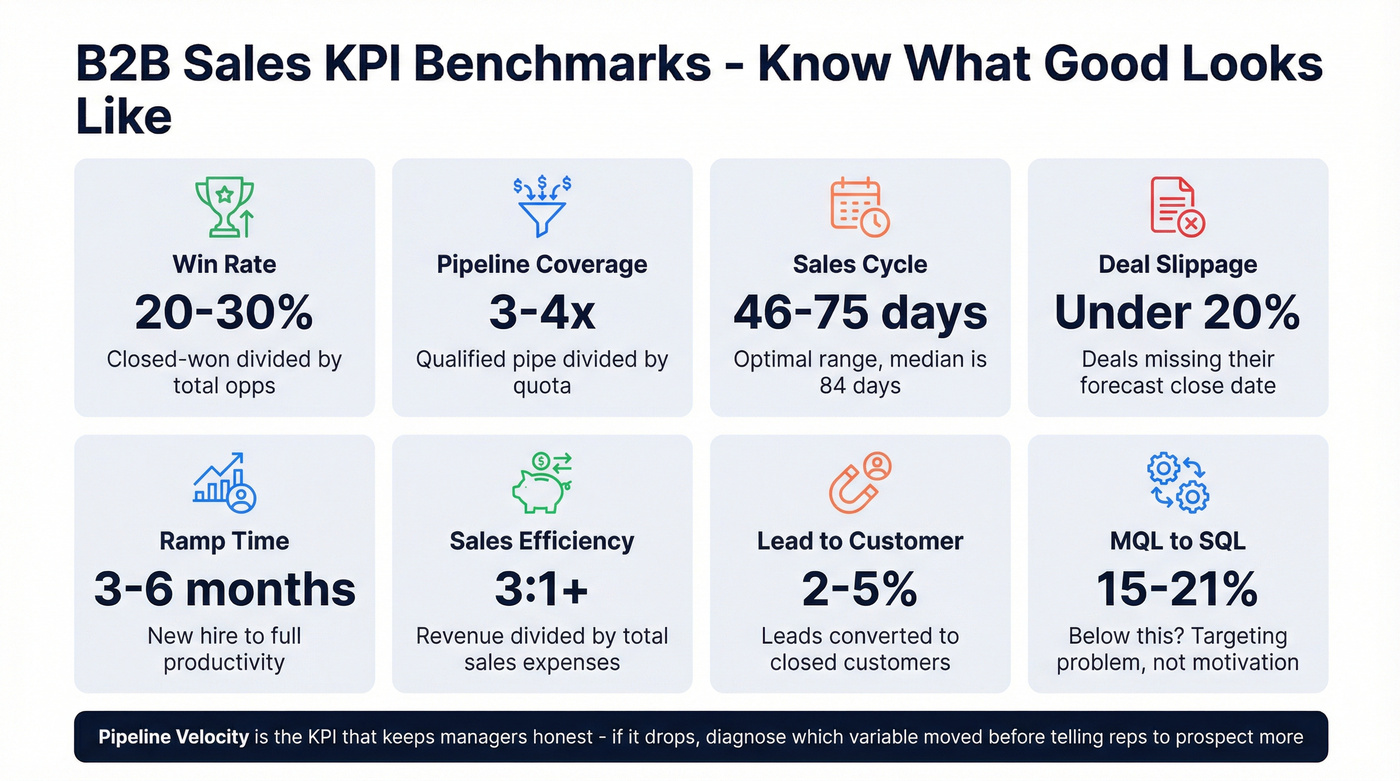
Start with win rate. It tells you more about deal quality, rep skill, and pipeline health than any dashboard full of activity metrics.
| KPI | Formula | Benchmark |
|---|---|---|
| Win Rate | Closed-won / Total opps | 20-30% |
| Qualified Pipeline Coverage | Qualified pipe / Quota | 3-4x |
| Pipeline Velocity | (Opps x Deal Value x Win%) / Cycle Days | Flag if down 2+ months |
| Median Sales Cycle | Days: opp creation to close | ~84 days (46-75 optimal) |
| Deal Slippage | Deals missing forecast close | <20% |
| Ramp Time | New hire to full productivity | 3-6 months |
| Sales Efficiency | Revenue / Sales expenses | 3:1+ |
| Lead-to-Customer | Leads to closed customers | 2-5% |
Pipeline velocity is the KPI that keeps managers honest. If it drops, diagnose the variable that moved - deal size, win rate, cycle time, or opp volume - instead of yelling "prospect more."
One more benchmark worth knowing: MQL-to-SQL conversion typically lands around 15-21%. If you're below that, you don't have a motivation problem. You have a targeting and qualification problem.

You just read that MQL-to-SQL conversion should hit 15-21%. If you're below that, the problem isn't motivation - it's targeting. Prospeo's 30+ search filters (buyer intent, technographics, headcount growth, funding) let you build pipeline that actually clears your ICP threshold. 300M+ profiles. 98% email accuracy. Data refreshed every 7 days, not 6 weeks.
Stop letting bad data inflate your pipeline with ghost opportunities.
Coaching Cadence That Reps Don't Hate
Most reps hate 1:1s because managers turn them into interrogations. Fix that, and performance follows.
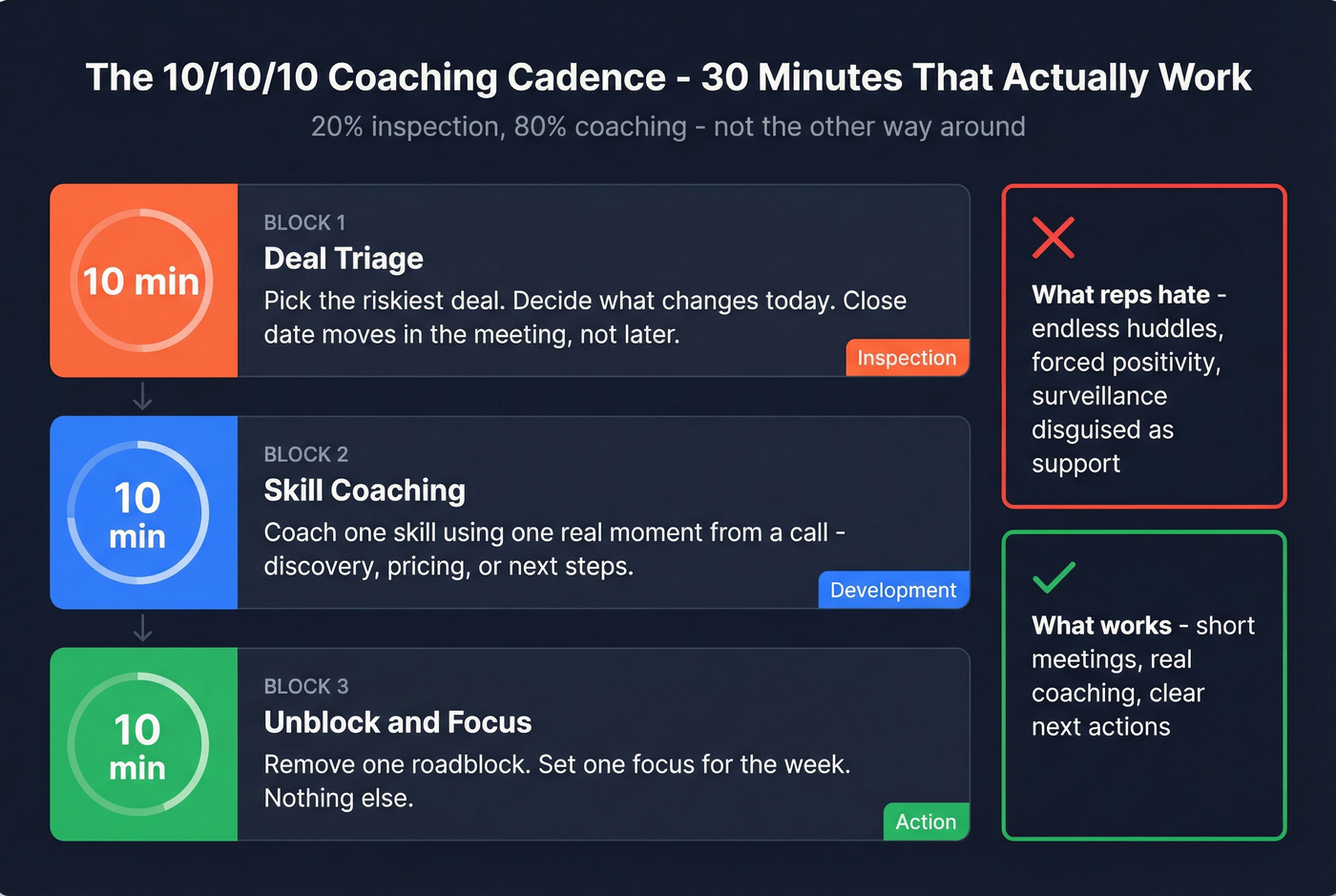
Spend 20% of the time on inspection and 80% on coaching. Here's a clean weekly rhythm we call the 10/10/10:
- First 10 minutes: Pick the riskiest deal and decide what changes today. Close date moves in the meeting, not "later."
- Middle 10: Coach one skill using one real moment from a call - discovery, pricing, next steps.
- Final 10: Remove one roadblock and set one focus for the week.
This directly addresses the r/sales frustration with "enablement theater" - endless huddles, forced positivity, and surveillance disguised as support. Short meetings. Real coaching. Clear next actions. The framework works whether your team is in-office or fully remote across time zones, because the structure keeps accountability tight regardless of location.
Structure for Remote and Hybrid Teams
Territories usually work best as a hybrid of vertical and customer tier. The mistake is treating the plan as permanent - review territories quarterly, because markets shift, accounts churn, and headcount changes.
As remote selling becomes the default, territory design matters even more. Geographic overlap disappears, but account-ownership conflicts don't. Distributed teams need clear rules of engagement baked into the CRM, not just a shared spreadsheet, to prevent duplicate outreach and wasted effort.
Comp should stay boring: base plus commission plus quota plus OTE plus accelerators. Design for roughly 60-70% attainment across the team. If everyone's hitting, quotas are too low. If nobody's hitting, quotas are fiction. Add anti-gaming guardrails like clawbacks on churned deals and minimum hold periods.
Data Quality: The Silent Pipeline Killer
Here's a scenario we see constantly: an AE sends 200 emails from a fresh list. Thirty-eight bounce. That's a 19% bounce rate - enough to damage deliverability for the entire team's outbound domain.
Bad contact data wastes rep time, inflates pipeline with unreachable "buyers," and turns forecasting into a confidence game nobody wins. Effective b2b sales management means treating data hygiene as infrastructure, not an afterthought. Let's be honest - if your reps are spending hours prospecting contacts that bounce, you're paying them to damage your sender reputation.
Prospeo addresses this at the source with 98% email accuracy and a 7-day data refresh cycle, compared to the industry average of about six weeks. It also supports CRM and CSV enrichment with 50+ data points per contact and a 92% API match rate. Teams like Snyk cut bounce rates from 35-40% to under 5% after switching, and their AE-sourced pipeline jumped 180%. There's a free tier that includes 75 verified emails per month and 100 Chrome extension credits - enough to test whether your current data is actually as clean as you think.
If you're seeing bounces climb, start with your email deliverability fundamentals and tighten your sender reputation controls before scaling volume.
The article ended mid-sentence for a reason - bad contact data is the silent killer behind blown forecasts, damaged domains, and reps missing quota. Prospeo's 5-step verification and proprietary email infrastructure keep bounce rates under 2%. Teams using Prospeo book 26% more meetings than ZoomInfo users, at $0.01 per email instead of $1.
Replace the data that's poisoning your forecast - starting at zero cost.
2026 Trends Reshaping Sales Leadership
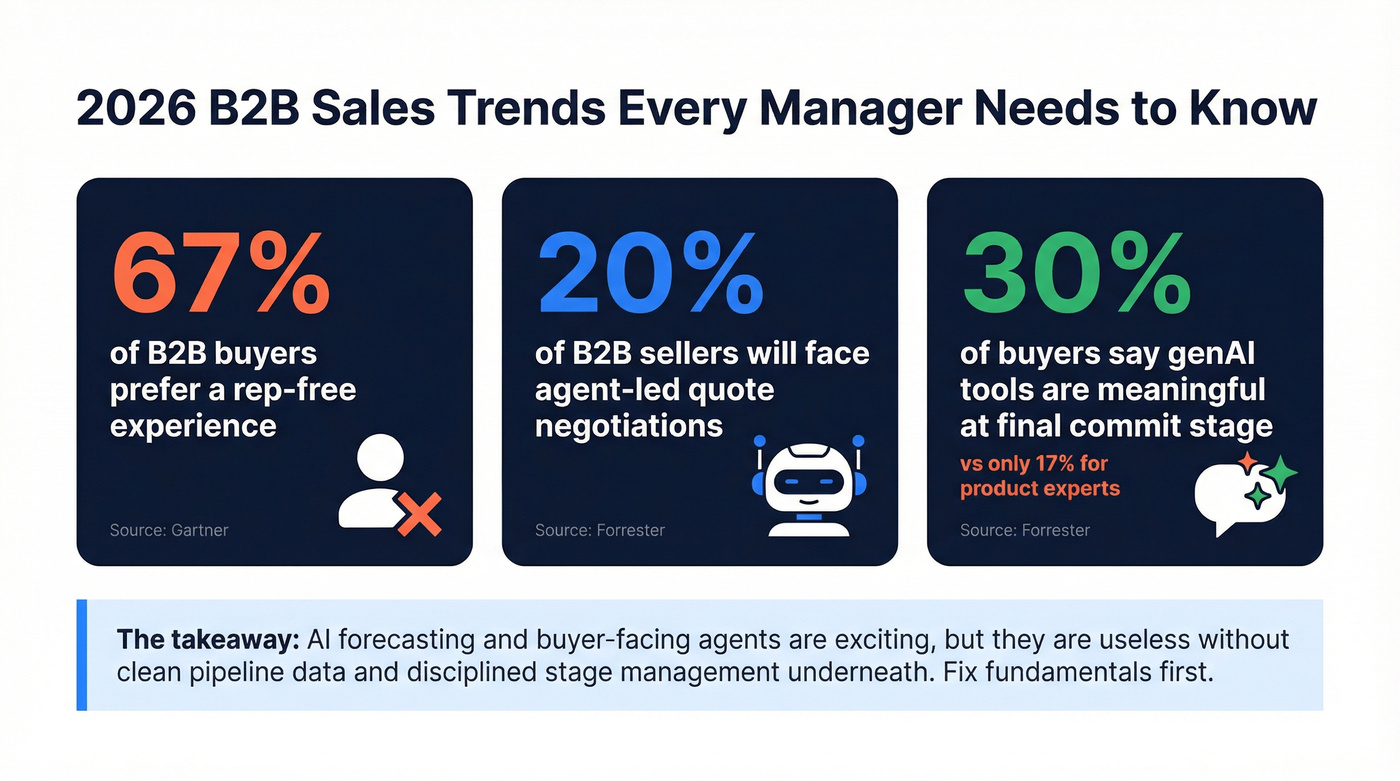
The buyer is changing faster than most sales orgs can adapt. Gartner found 67% of B2B buyers prefer a rep-free experience, and AI is now part of the purchase motion. Forrester expects 20% of B2B sellers to face agent-led quote negotiations - your reps will negotiate with software, not a person.
The shift toward remote-first models accelerates this. When reps aren't in the same building as their managers or their buyers, the operating system described above - pipeline governance, commit evidence, coaching cadence - becomes non-optional.
One stat that should change how you run enablement: Forrester found 30% of buyers viewed genAI tools as a meaningful interaction at the final commit stage, compared with 17% for product experts. Your "best deck" matters less than your ability to support buyers with fast, precise answers and proof right when they're trying to justify the decision internally. The Harvard Business Review's research on B2B buying behavior reinforces this shift - buyers increasingly self-educate before ever talking to a rep.
Skip the trend-chasing if your fundamentals aren't solid. AI-powered forecasting and buyer-facing agents are exciting, but they're useless without clean pipeline data and disciplined stage management underneath.
FAQ
What's the difference between sales management and sales operations?
Sales management runs people and performance: coaching, pipeline governance, and deal strategy. Sales ops and RevOps run systems - CRM, tooling, data, and reporting. They overlap on forecasting and CRM rules, but they're not the same job.
How many direct reports should a sales manager have?
Six to ten is the sweet spot. Beyond ten, coaching quality collapses and you end up firefighting instead of developing reps. If you're carrying 12+ reps, add another frontline manager or accept that performance will drift.
What's the fastest way to improve forecast accuracy?
Enforce commit evidence for every commit deal, then clean your contact data so dead leads don't inflate pipeline. Teams that combine strict commit criteria with verified contact data typically see forecast accuracy improve within a single quarter.
Does this playbook work for fully remote teams?
Yes - every system here was designed to function asynchronously. Pipeline governance, stage gates, and commit evidence are CRM-native, so they work identically whether your team is co-located or fully distributed. The 10/10/10 coaching cadence runs over video just as well as in person.