

The B2B Sales Performance Paradox (And How to Fix It)
A VP of Sales walks into a board meeting with a slide showing 18% revenue growth. Three slides later, the CRO reveals only 3 out of 10 reps hit quota. Both numbers are accurate - and that contradiction is the defining challenge in B2B sales performance right now.
79% of sales teams grew revenue over the past twelve months, yet up to 70% of reps missed quota in 2024. Only 28% hit quota in 2023, down from 44% the year before. Revenue growth is masking a structural performance crisis, and most teams are measuring the wrong things to fix it.
2026 Benchmarks Worth Tracking
The median B2B conversion rate is 2.9%, with most industries landing between 2.0% and 5.0%. Legal services run hot at 7.4%; SaaS ranges from 1.1% to 7.0% depending on deal size.
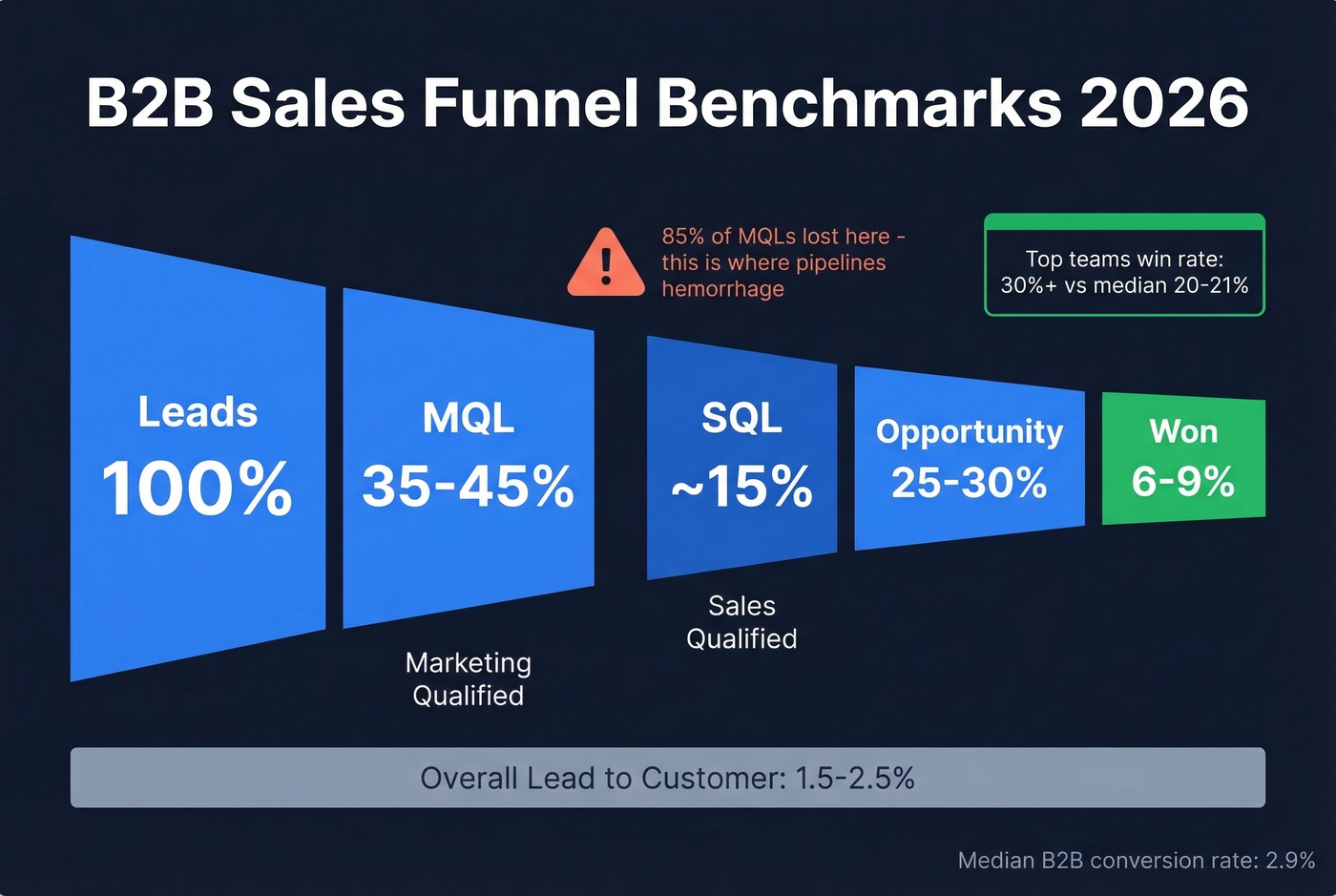
Here's the stage-by-stage breakdown:
| Funnel Stage | Conversion Rate |
|---|---|
| Lead to MQL | 35-45% |
| MQL to SQL | ~15% |
| SQL to Opportunity | 25-30% |
| Opportunity to Won | 6-9% |
| Overall Lead to Customer | 1.5-2.5% |
That MQL-to-SQL drop is where most pipelines hemorrhage. If you're losing 85% of your MQLs before they become qualified opportunities, the problem isn't closing - it's qualification. Average B2B win rates hover at 20-21%, with top teams hitting 30%+. Below 15%? Stop optimizing your pitch deck and start examining how deals enter your pipeline.
Sales cycles have stretched 38% longer than 2021, and length correlates directly with deal size:
| ACV Range | Avg. Cycle (Days) |
|---|---|
| Under $5K | 25-40 |
| $5K-$50K | 55-75 |
| $50K-$250K | 120-170 |
| Over $250K | 220-270 |
Industry matters too:
| Industry | Avg. Cycle (Days) |
|---|---|
| Software / SaaS | 90 |
| Financial Services | 98 |
| Healthcare | 125 |
| Manufacturing | 130 |
| Consulting / Professional Services | 103 |
If your forecasting model hasn't adjusted for these shifts, your pipeline coverage math is wrong. Healthy coverage runs 3-5x depending on win rate and segment, and enterprise teams often need closer to 5x.
Here's the thing: most teams obsess over top-of-funnel volume when the real gains sit in the MQL-to-SQL handoff and multi-threading existing opportunities. Generating more leads into a broken qualification process just creates more waste.
Why Performance Is Declining
Your reps aren't underperforming. Your infrastructure is.
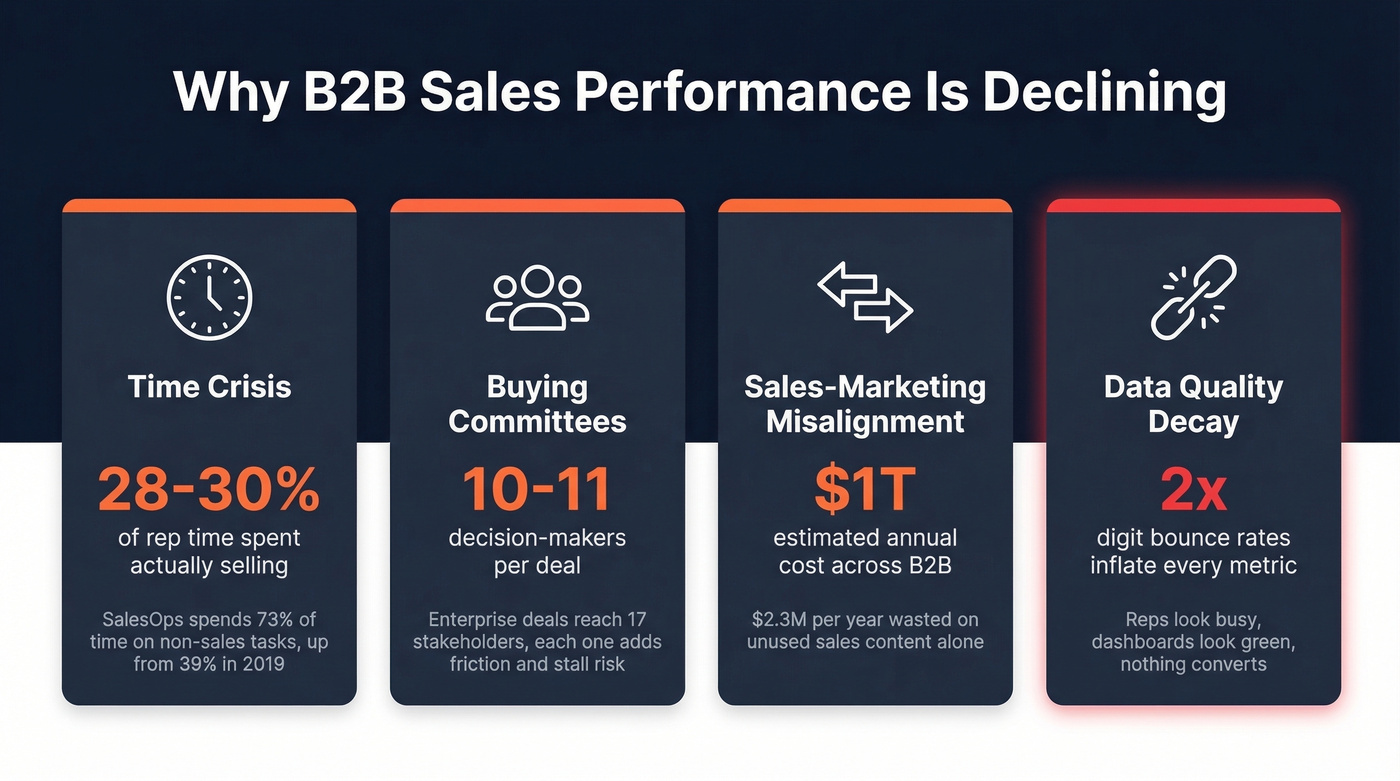
Time allocation crisis. Reps spend 28-30% of their time actually selling. The rest goes to CRM updates, internal meetings, and admin work that doesn't move deals forward. SalesOps teams now dedicate 73% of their time to non-sales functions - up from 39% in 2019. The people supposed to make sellers productive are drowning in non-selling work themselves.
Buying committee expansion. The average B2B deal now involves 10-11 decision-makers, with enterprise deals reaching 17 stakeholders. Every additional person adds friction, extends timelines, and increases stall risk. That's not a trend you can outwork with more calls.
Sales-marketing misalignment. Misalignment between sales and marketing costs an estimated $1T annually across B2B, with $2.3M/year wasted on unused sales content alone. When marketing qualifies leads differently than sales expects, the MQL-to-SQL gap widens. Tightening your lead scoring model is often the fastest way to close that gap.
Data quality decay. The silent killer. When bounce rates hit double digits, every activity metric is inflated. Reps look busy. Dashboards look green. Nothing converts. Practitioners on r/b2bmarketing echo this: buyers are harder to reach, trust is lower, and deals require more proof. Bad data makes all of that worse.

You just read that data quality decay is the silent killer of B2B sales performance. Reps burning cycles on bounced emails and disconnected numbers inflates every activity metric while converting nothing. Prospeo's 98% email accuracy and 7-day refresh cycle cut bounce rates from 35%+ to under 4% - ask Meritt, whose pipeline tripled to $300K/week after switching.
Stop feeding phantom pipeline. Start reaching real buyers.
Four Tactics That Lift Win Rates
Multi-Threading
This is the single highest-leverage tactic most teams ignore, and it frustrates us how often it gets overlooked in favor of flashier plays. An analysis of 1.8 million opportunities found that closed-won deals have roughly 2x the buyer contacts compared to lost deals. For deals over $50K, multi-threading boosts win rates by 130%.
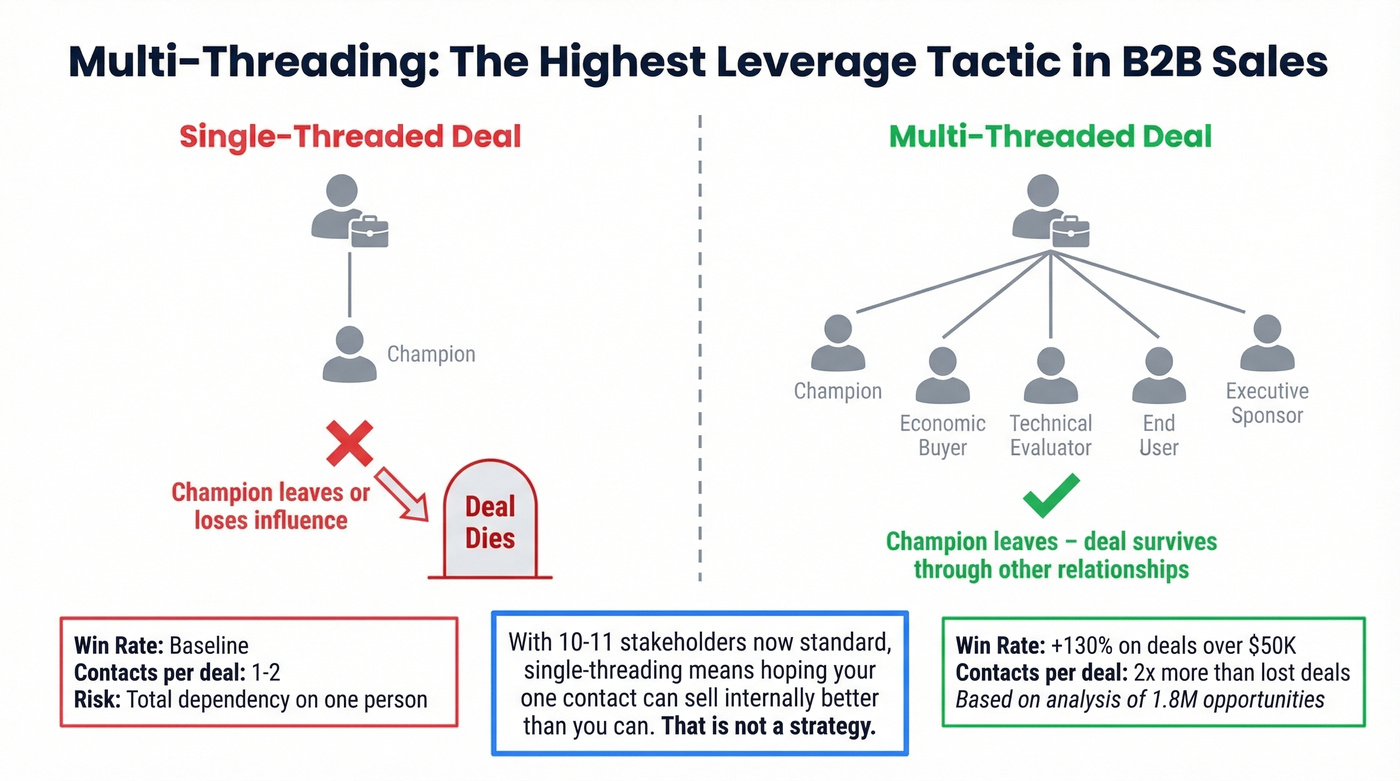
Think about it: if your champion leaves or loses internal influence, a single-threaded deal dies instantly. With 10-11 stakeholders now standard, single-threading means you're hoping your one contact can sell internally better than you can. That's not a strategy - it's a prayer.
A high-earning IC on r/sales makes the same point from a different angle: relationship-first selling, mining their network for referrals, and asking clients for advice rather than pitching. Multi-threading isn't just a pipeline tactic; it's how the best reps build durable revenue.
If you want a more structured approach, account-based selling makes multi-threading easier to operationalize.
Sales Enablement
Organizations with a sales enablement strategy achieve a 49% higher win rate on forecasted deals. Yet only 42% of best-in-class companies use playbooks, compared to 14% of laggards. Playbooks aren't about dumbing things down. They codify what your best reps do so the middle 60% can replicate it.
If you're building the function, the sales enablement strategy should map directly to the metrics you report.
Social Selling
Often overlooked, but the data is hard to argue with. Reps strong at social selling create 45% more opportunities and are 78% more likely to outsell peers who don't use social channels. Multi-threading often starts here - engaging multiple stakeholders through professional profiles before a formal sales conversation begins.
To keep it consistent across reps, standardize your sales communication and outreach touchpoints.
AI Adoption
Only 8% of sellers report not using AI in 2026. Sellers who effectively partner with AI tools are 3.7x more likely to hit quota, 64% save 1-5 hours per week on manual tasks, and 86% of sales teams see positive ROI within the first year. We've seen teams cut cycle length by roughly 25% just by automating research and lead prioritization - the kind of work that eats into that precious 28% of actual selling time.
If you're rolling this out, start with generative AI sales tools that reduce admin without breaking your process.
Data Quality as a Revenue Lever
Let's be honest about something most performance articles skip: none of these tactics work if your outbound data is rotten.
Don't underestimate retention and expansion revenue either - McKinsey found that reducing churn has 2x the revenue impact of new-logo acquisition. But when your reps are emailing dead addresses and calling disconnected numbers, you're burning cycles on phantom pipeline.
In our experience, this is where data quality tools earn their keep. Prospeo delivers 98% email accuracy with a 7-day refresh cycle versus the 6-week industry average. The proof shows up fast: Meritt went from a 35% bounce rate to under 4% after switching, and their pipeline tripled from $100K to $300K per week. Snyk saw similar results - 50 AEs cut bounce rates from 35-40% to under 5%, driving AE-sourced pipeline up 180%.
If you're diagnosing deliverability, start with email bounce rate benchmarks and fixes before you change messaging.
Skip this if your bounce rates are already under 5% and your connect rates are healthy. But if you're running double-digit bounces? Fix that before you touch anything else.
A 90-Day Improvement Plan
Stop adding metrics. Start acting on three: win rate, pipeline coverage, and quota attainment.
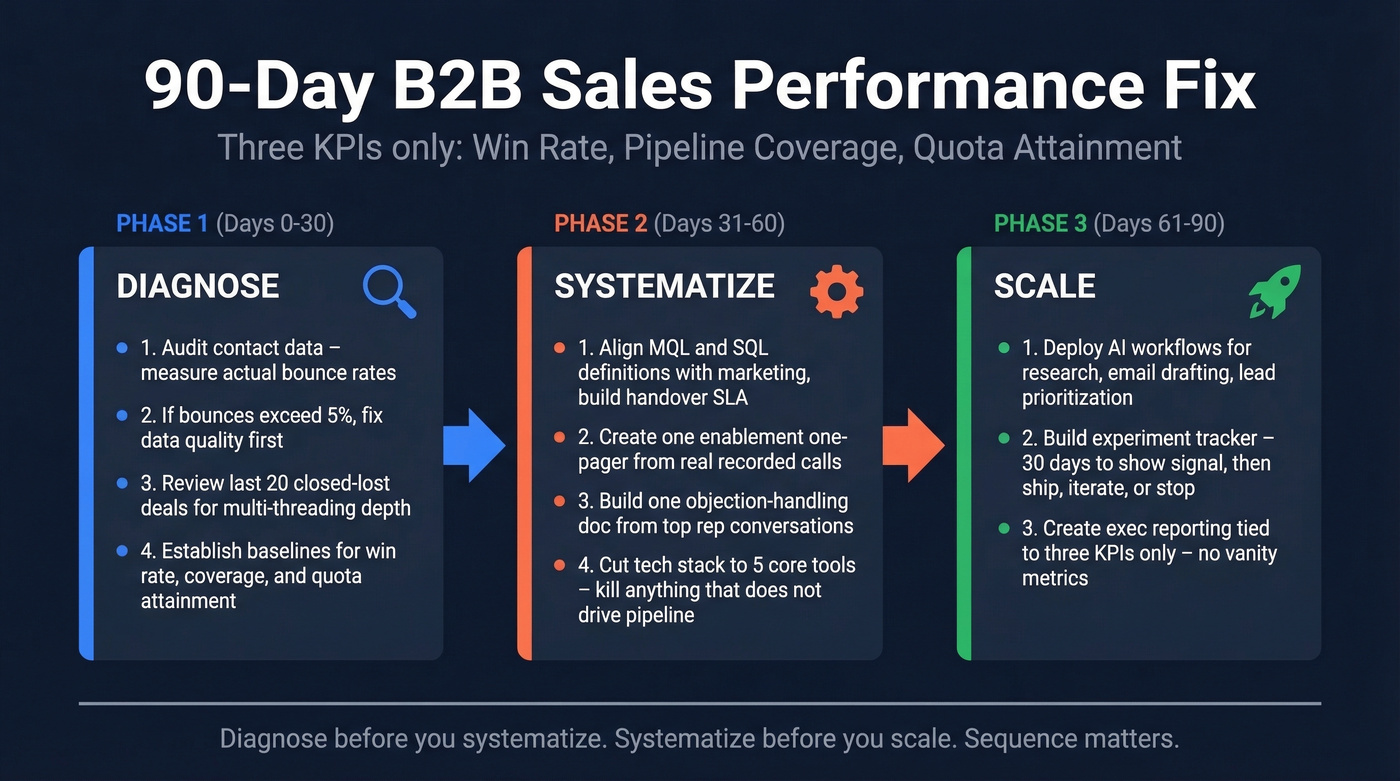
Days 0-30: Diagnose
Audit contact data quality first - measure actual bounce rates, and if more than 5% bounce, that's your first fix. Then measure multi-threading depth on your last 20 closed-lost deals. You'll probably find most were single-threaded. Establish baselines for your three core KPIs. A spreadsheet is fine.
Days 31-60: Systematize
Lock in MQL/SQL definitions with marketing and build a handover SLA with response-time commitments. Create one enablement one-pager and one objection-handling doc based on your top reps' actual conversations - not hypothetical best practices, real recorded calls. Cut your tech stack to 5 core tools. If a tool doesn't directly contribute to pipeline generation or deal progression, kill it.
If you need a template to operationalize this cadence, adapt a 30-60-90 day plan to your team’s KPIs.
Days 61-90: Scale
Deploy AI-augmented workflows for research, email drafting, and lead prioritization. Build an experiment tracker where every initiative gets 30 days to show signal, then ship, iterate, or stop. Create exec reporting that ties activity to the three KPIs. No vanity metrics.
Most teams try to do all of this simultaneously and accomplish none of it. Diagnose before you systematize. Systematize before you scale. The 90-day cadence works because it forces your B2B sales performance conversations to center on outcomes rather than activity volume.
Multi-threading 10-11 stakeholders per deal requires verified contact data for every buyer in the committee. Prospeo gives you 300M+ profiles, 125M+ verified mobiles, and 30+ filters - including buyer intent and job changes - so your reps spend that precious 28% of selling time actually selling, not chasing dead leads.
Cover the entire buying committee with data that connects.
FAQ
What is B2B sales performance?
It's the measurable effectiveness of a sales organization at converting pipeline into revenue - tracked through win rate, quota attainment, sales cycle length, and stage-by-stage conversion rates. In 2026, the median win rate sits at 20-21% and fewer than 30% of reps hit quota.
What's a good B2B win rate in 2026?
The median is 20-21%, and top-performing teams consistently hit 30%+. If your win rate is below 15%, tighten qualification criteria and multi-thread deals before optimizing anything downstream. Deal entry quality matters more than closing technique.
How does data quality affect sales results?
Bad contact data inflates activity metrics while tanking conversion. Teams with double-digit bounce rates waste rep time and damage sender reputation, compounding losses across every campaign. Clean data is the fastest path to better outcomes - teams that fix bounce rates typically see pipeline improvements within weeks, not quarters.
What's the biggest driver of quota attainment?
Multi-threading is the single highest-leverage tactic. Closed-won deals average 2x the buyer contacts of lost deals, and multi-threaded opportunities over $50K see win rates jump 130%. Combine that with sales enablement playbooks and you give your middle-performing reps a realistic path to quota.