

B2B Salesman: Pay, Skills, Daily Reality, and Career Path
You're three months into your BDR role. You've made 2,000 calls this month, booked 6 meetings, and your manager wants 12. The job description said "strategic sales professional." The reality is a headset, a dialer, and a spreadsheet tracking your daily activity. That gap between the job posting and the actual work is where most people either quit or figure out how to thrive.
A B2B salesman sells products or services to other companies rather than individual consumers. Unlike B2C, where you're convincing one person to buy a pair of shoes, B2B means navigating buying committees, multi-month deal cycles, and procurement departments that exist to slow you down. The money's better. The complexity is higher. It's one of the few careers where a 28-year-old with no MBA can out-earn their lawyer friends - going from $50K to $300K+ in under a decade.
Here's what this job actually looks like in 2026: the pay, the grind, the skills, and whether it's right for you.
The Quick Version
What's the pay? The average US base salary for B2B sales sits at $91K/year_Sales/Salary) across 2,393 respondents. But that number hides massive range. Entry-level SDRs earn $50-70K OTE. Enterprise AEs pull $270K median OTE, with top companies paying $500K+.
What's the daily grind? Reps spend 28-30% of their time actually selling. The rest is CRM updates, internal meetings, admin, and pipeline reviews. At entry level, expect 100-130 calls per day. At the enterprise level, you're multi-threading across 25 stakeholders over 6.5-month cycles.
What skills matter most? A 1,004-person study by RAIN Group found three things separate top performers: advanced consultative selling (88% more likely to excel), staying focused on their agenda (73% more likely), and the discipline to change habits when something isn't working (1.7x more likely).
What Does a B2B Salesman Actually Do?
There's a thread on r/sales where someone asks what the day-to-day is really like as an SDR, explicitly calling out that job descriptions are embellished. They're right. Let's skip the embellishment.
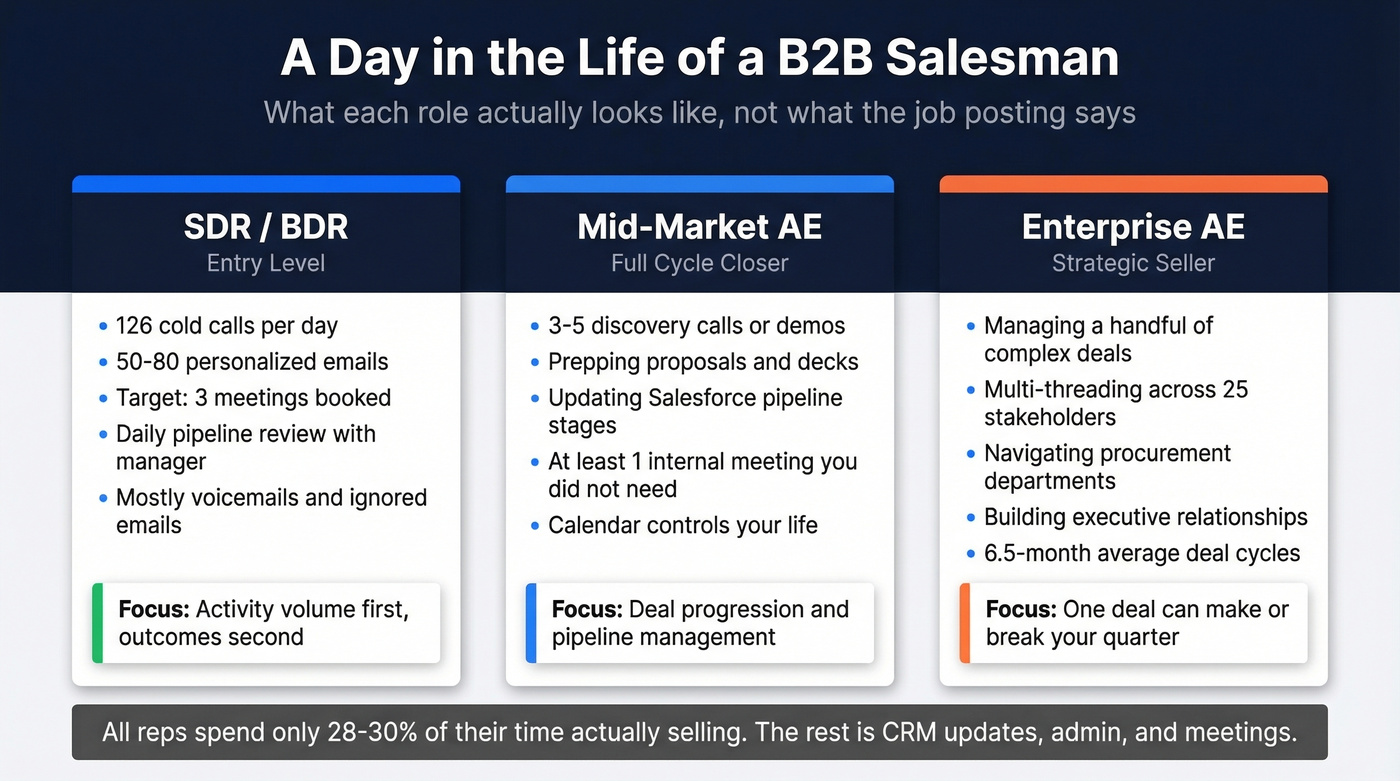
The core responsibilities haven't changed in decades: prospecting, qualifying, pitching, negotiating, closing, and managing accounts after the deal. What's changed is how little time you spend on the parts that actually generate revenue. The average seller uses 10 tools daily, and 66% feel overwhelmed by their tech stack.
A day as an SDR looks like this: 126 calls, a target of 3 appointments booked, 50-80 personalized emails, and a pipeline review with your manager. You're measured on activity volume first, outcomes second. The calls are mostly voicemails. The emails are mostly ignored. The meetings that do land feel like small victories - because they are.
A day as a mid-market AE is different. You're running 3-5 discovery calls or demos, prepping proposals, updating pipeline stages in Salesforce, and sitting in at least one internal meeting you didn't need. Your calendar controls your life.
A day as an enterprise AE barely resembles the SDR role. You're managing a handful of complex deals simultaneously, each involving multi-threading across 25 stakeholders, navigating procurement, and building executive-level relationships over 6.5-month cycles. One deal can make your quarter. One lost deal can break it.
Social selling has also become non-negotiable. LinkedIn generates roughly 80% of B2B social leads, and reps who are strong at social selling create 45% more opportunities and are 78% more likely to outsell peers who ignore it. If you're not building a presence where your buyers research, you're invisible during the most critical phase of their decision.
Look - if you need constant variety and creative freedom, the SDR grind will wear you down fast. If you thrive on structure and can find motivation in incremental progress, the career path opens up quickly.
B2B Sales Roles and Career Path
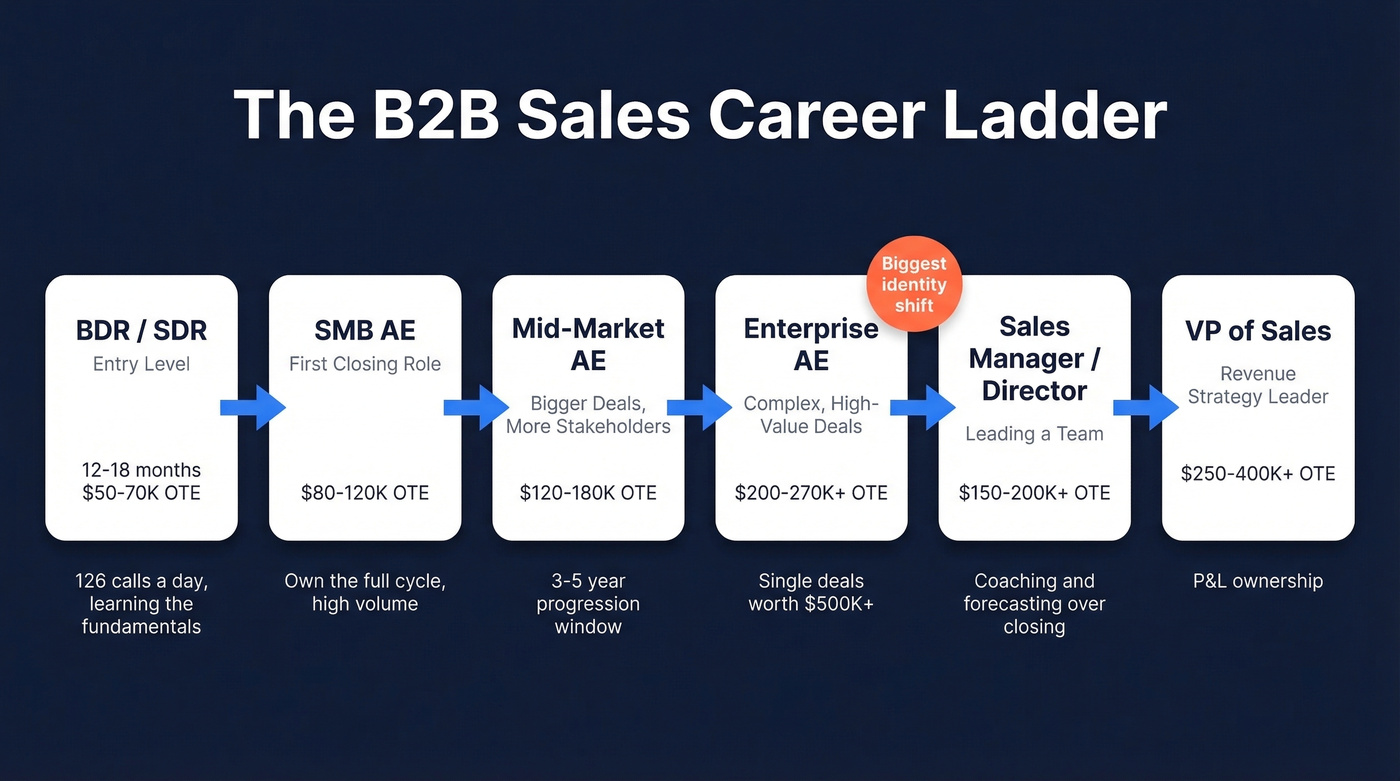
The B2B sales career ladder is one of the most clearly defined in any profession. Each rung has different expectations, different comp, and a fundamentally different job. The global sales job market grew from 54,748 to 72,215 commercial roles between 2024 and 2025 - a 31.9% year-over-year increase - and Forrester estimates B2B sales will hit about $3 trillion by 2027, so the demand is real.
One distinction worth noting: B2B sales isn't just SaaS. It spans manufacturing, wholesale distribution, professional services, and everything in between. A manufacturer's rep selling industrial equipment to factories is a B2B sales representative just as much as a SaaS AE selling cloud software. The skills overlap heavily; the deal structures and buyer personas differ.
Entry Level - BDR/SDR
This is where almost everyone starts. You're doing outbound prospecting - cold calls, cold emails, social touches - to generate qualified meetings for Account Executives. Expect to stay 12-18 months before promotion. Activity targets are aggressive: that 126 calls/day example from a UK BDR role isn't unusual. The job is repetitive by design. The point is to learn the fundamentals of sales conversations, objection handling, and pipeline discipline before you're trusted with revenue.
Account Executive (SMB to Enterprise)
The AE role is where you start owning the full sales cycle - from first meeting to signed contract. SMB AEs handle high volumes of smaller deals with shorter cycles. Mid-market AEs work fewer, larger deals with more stakeholders.
Senior AEs bridge the gap between mid-market and enterprise, typically managing a mix of larger mid-market and smaller enterprise accounts while developing the multi-threading skills needed at the top level. Enterprise AEs manage a handful of massive opportunities where a single deal might be worth $500K+ in annual contract value. The progression from SMB to enterprise typically takes 3-5 years and requires a completely different skill set at each level. Inside sales AEs work remotely via phone and video. Outside/field sales AEs travel to meet prospects in person - still common in enterprise and manufacturing.
Sales Leadership - Manager to VP
The jump from individual contributor to sales manager is the biggest identity shift in the career. You stop carrying a personal quota (mostly) and start being measured on your team's performance. Sales Managers and Directors earn $121K-$200K+ total comp. VP-level roles push past $300K.
The skills that made you a great AE - closing instinct, competitive drive - don't automatically make you a great leader. Coaching, forecasting accuracy, hiring, and working closely with sales enablement and RevOps become your new core competencies.
What B2B Salespeople Earn
You've seen the posts claiming everyone in SaaS sales makes $250K. You've also seen the thread where someone admits to making $60K total in 2025 and calls the $250K claims "top 1% or enterprise reps." Both are true - for different people at different stages.
The PayScale benchmark_Sales/Salary) puts the average US base salary for B2B sales at $91K across 2,393 respondents. But base is only part of the picture. OTE - on-target earnings, meaning base plus commission at 100% quota attainment - is what matters.
Compensation by Role Level
| Role | Base Range | OTE Range | Typical Ramp |
|---|---|---|---|
| BDR/SDR | $40-55K | $50-70K | 2-3 months |
| SMB AE | $55-75K | $80-120K | 3-4 months |
| Mid-Market AE | $75-110K | $120-180K | 4-6 months |
| Enterprise AE | $120-160K | $200-270K+ | 6-12 months |
| Sales Manager | $100-140K | $150-200K | N/A |
| Director/VP | $150-200K+ | $250-400K+ | N/A |
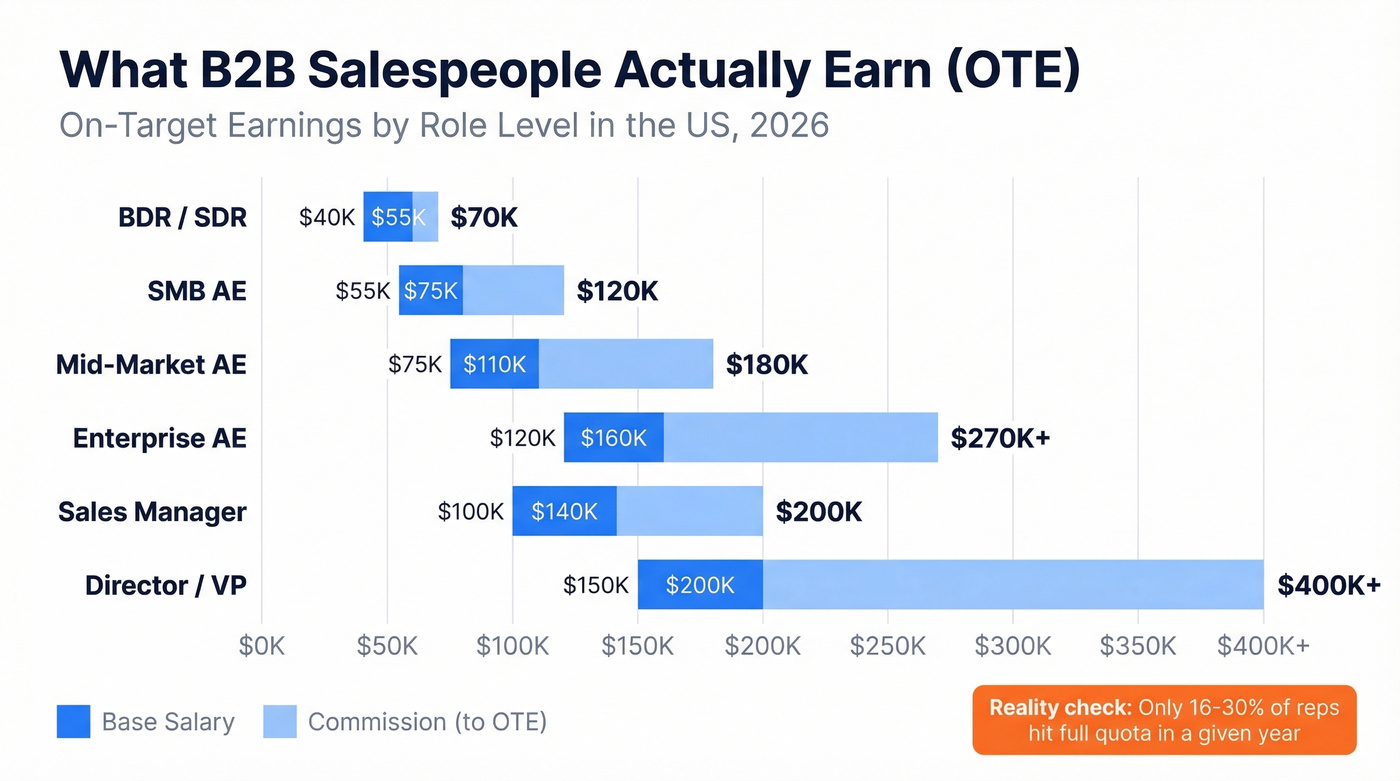
Enterprise AE comp gets wild at the top. RepVue data shows a median OTE of $270K for enterprise AEs, with some companies paying over $500K in median OTE.
For context outside the US: Canadian enterprise SaaS AEs see CAD $120K-$180K OTE. UK Sales Managers average PS48K with a range of PS36K-PS120K. Australian Sales Directors pull AUD $200K-$300K+ total comp.
The Quota Reality
Here's where the LinkedIn fantasy meets spreadsheet reality. Only 16-30% of reps hit quota in a given year, depending on the study. The average B2B win rate runs 20-21%. Pipeline coverage sweet spot is 3.1-4x your target, with enterprise teams often needing 5x+.
What this means for your actual take-home: if you're an AE with $180K OTE and you hit 80% of quota, you're earning $140-150K. That's still excellent money. But the gap between OTE and actual earnings is something every candidate should understand before accepting an offer.
The reps posting $250K W-2s are real - they're the ones who hit 120%+ of a well-structured plan at a company with a product that sells.
Skills That Separate Top Performers
One experienced rep put it simply: B2B sales boils down to three things - persistence, good discovery questions, and a relaxed demeanor. The data largely backs this up, with some important additions.
The Three Fundamentals
Discovery questions. The ability to ask questions that uncover real business pain - not surface-level "what keeps you up at night" softballs, but specific, informed questions that make the buyer think. Top performers are 88% more likely to excel at advanced consultative selling, meaning they inspire buyers to reach out for ideas and advice rather than just responding to inbound requests.
Ruthless qualification. Most deals that die in your pipeline should've been disqualified weeks earlier. MEDDPICC, BANT, whatever framework you use - the discipline is the same. Identify need, budget, stakeholders, and timeline early. Kill deals that don't qualify. Your pipeline shrinks, but your win rate climbs.
Follow-up discipline. Most deals need 5+ follow-ups to close, and 44% of reps quit after one. That gap is where deals are won and lost. The reps who build systematic follow-up cadences - not annoying "just checking in" emails, but value-adding touches - consistently outperform. (If you want a starting point, steal a few follow-up cadences.)
What the Research Says
The RAIN Group study of 1,004 sellers and sales managers quantified the gap between top performers and everyone else. The multipliers are striking:
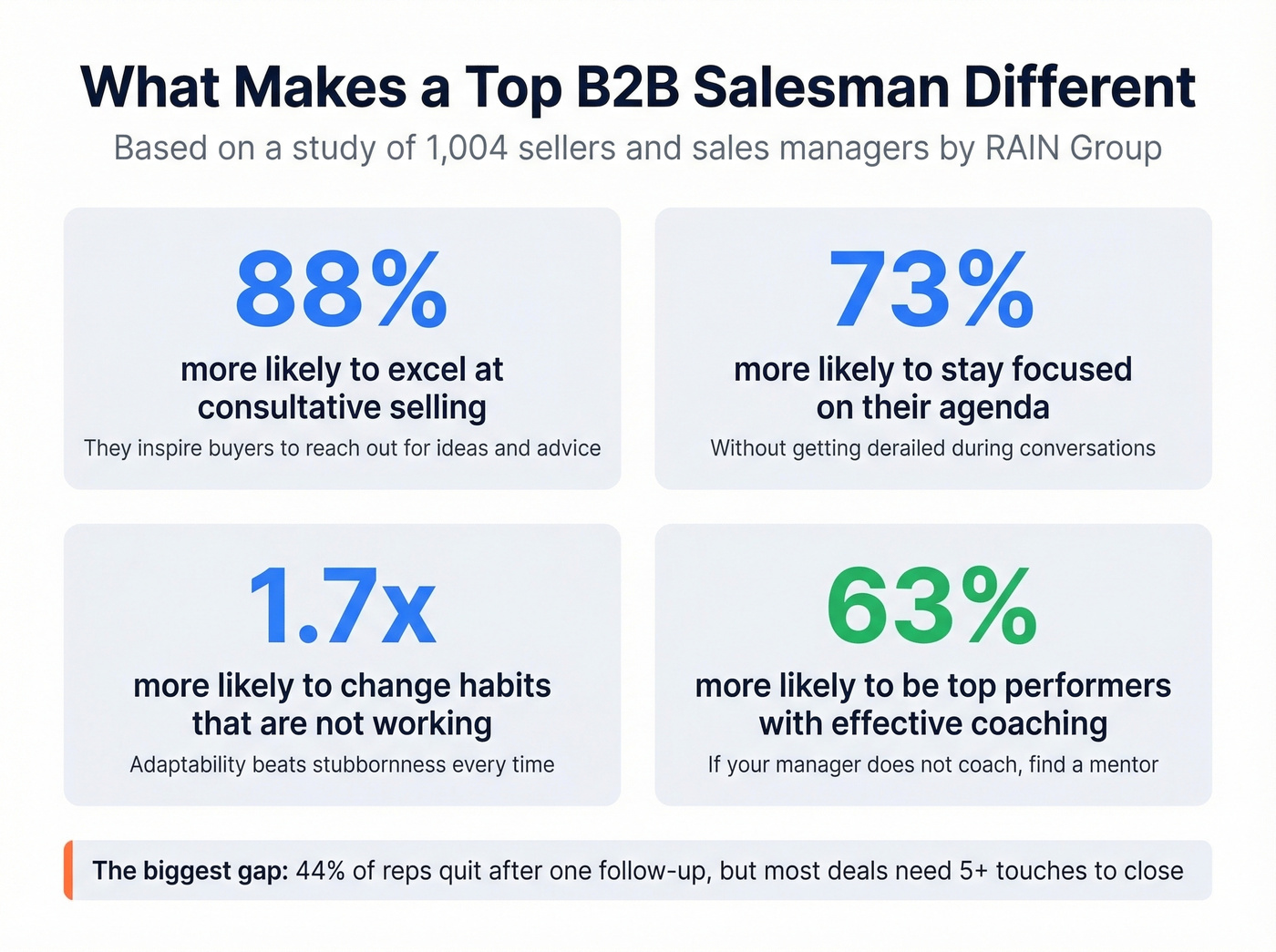
- 88% more likely to excel at consultative selling
- 73% more likely to stay focused on their agenda without getting derailed
- 1.7x more likely to change habits when current approaches aren't working
- 1.7x more likely to grow existing accounts through cross-sell and upsell
The coaching finding is equally important: sellers with effective manager coaching and ongoing training are 63% more likely to be top performers. If your manager doesn't coach, you're fighting with one hand tied behind your back. Seek out coaching from a mentor or a peer, because raw talent without feedback plateaus fast.

SDRs make 126 calls a day, but bad contact data means most never connect. Prospeo gives B2B salespeople 300M+ verified profiles with 98% email accuracy and 125M+ mobile numbers with a 30% pickup rate - so every dial and send counts.
Stop burning hours on bounced emails and dead numbers.
Sales Methodologies Worth Knowing
Every few years, a new methodology gets hot. Right now, the big three are Challenger, SPIN, and MEDDPICC.
The Challenger Sale came from CEB's research across 6,000+ sales reps. The core idea: top performers teach buyers something new about their business, tailor their message to the stakeholder, and take control of the conversation. Xerox reported a 17% increase in sales and $65M in contract value after implementing it. It works best when the status quo is your biggest competitor - when buyers don't realize they have a problem worth solving.
SPIN Selling is the OG research-backed methodology. Neil Rackham analyzed 35,000 sales calls over 12 years across 20+ countries. The framework - Situation, Problem, Implication, Need-payoff - gives you a question sequence that moves buyers from "I'm fine" to "I need to fix this now." It's particularly effective in complex, long-cycle consultative sales where the buyer needs to build internal consensus.
MEDDPICC covers Metrics, Economic Buyer, Decision Criteria, Decision Process, Paper Process, Identify Pain, Champion, and Competition. It's the enterprise qualification framework. If you're selling six- or seven-figure deals, you'll encounter it. If you're interviewing at enterprise companies, expect to be tested on it during the hiring process.
The practitioner consensus? All sales methodologies boil down to the same fundamentals - need, budget, stakeholders, timeline. That's not wrong. Learn the fundamentals first. Then pick a methodology that fits your market and deal complexity. The framework matters less than the discipline of actually using one consistently.
How B2B Buyers Actually Buy
Most sales advice focuses on what sellers should do. Understanding how buyers behave changes everything about your approach.
92% of B2B buyers start their evaluation with at least one vendor already in mind. The winning vendor is on the buyer's Day One shortlist 95% of the time. And buyers don't reach out to sales until they're 61% through their buying journey.
Let that sink in. By the time a prospect takes your call, they've already done most of their research, have a preferred vendor, and are using your conversation to validate a decision they've nearly made. The average buying cycle runs 10.1 months. 80% of buyer interactions happen digitally. The average B2B deal involves 13 decision-makers, and enterprise deals can involve 25+.
Here's the stat that should change how you prioritize your time: 35-50% of deals go to the vendor that reaches out first. Speed to lead isn't a cliche - it's a competitive advantage backed by data.
Most B2B salespeople spend too much time perfecting their pitch and not enough time being found early. Your job isn't cold persuasion. It's being present in the buyer's research phase - through thought leadership, warm introductions, and strategic outreach - long before a formal evaluation begins. The AE who loses a 4-month deal to the incumbent they never knew about didn't have a skills failure. They had a positioning failure.
Essential Tools for the Job
The sales tech market is projected to hit $104.5 billion by 2030. The average rep uses 6-10 tools daily. You don't need all of them, but you need the right ones in five categories.
CRM
Salesforce remains the gold standard - it's where your pipeline lives, your forecasts generate, and your manager judges your performance. Pricing varies by edition and add-ons, scaling from entry tiers to enterprise tiers. HubSpot is the all-in-one alternative: free CRM with Sales Hub paid tiers starting around $20/user/month. If you're at a startup, you'll start on HubSpot. If you're at a company with 50+ reps, you're almost certainly on Salesforce.

Data Enrichment and Email Verification
Before you can prospect, you need accurate contact data. Bad emails and dead phone numbers waste hours and destroy your domain reputation. We've tested a lot of tools in this category, and data freshness is the single biggest differentiator - stale data means you're calling people who left the company two months ago. (If you're comparing vendors, start with these data enrichment services.)

Prospeo covers 300M+ professional profiles with 98% email accuracy and 125M+ verified mobile numbers that hit a 30% pickup rate. The data refreshes every 7 days, compared to the 6-week industry average. The free tier gives you 75 emails/month, and paid plans work out to roughly $0.01 per lead.
Sales Engagement
Outreach and Salesloft manage your multi-channel sequences - automated email cadences, call tasks, social touches, and A/B testing. They're typically ~$100+/user/month. They're the execution layer that turns your prospect list into actual conversations. If you're building your stack, start with a shortlist of SDR tools.
Conversation Intelligence and Forecasting
Gong records and analyzes your sales calls, surfacing patterns in what top performers say differently. Clari handles pipeline forecasting with AI-driven predictions that are more accurate than your manager's gut feeling. These tools matter more as you move into AE and leadership roles (especially if you're evaluating sales forecasting solutions).
AI in B2B Sales
This deserves its own callout because AI has fundamentally changed the daily workflow. 81% of sales teams now use AI in some capacity, and teams that adopt AI tools are significantly more likely to see revenue growth - 83% compared to 66% for teams that don't. In practice, AI handles email personalization at scale, call summarization, lead scoring, and pipeline forecasting.
We've seen the biggest impact in two areas: AI-generated call summaries that eliminate 30 minutes of post-meeting CRM updates, and AI-powered lead scoring that helps reps focus on the 20% of their pipeline most likely to close. If your company hasn't adopted AI tools yet, push for them. The productivity gap between AI-enabled and non-AI teams is widening every quarter.
Mistakes That Kill B2B Deals
The median B2B conversion rate is 2.9%. Most leads don't convert - that's the math. But plenty of deals that should close don't, because of avoidable mistakes.
Talking too much instead of listening. The best discovery calls are the ones where the buyer does most of the talking. Most reps invert that ratio. Shut up and let the buyer tell you what they need.
Failing to qualify leads. Every hour you spend on an unqualified deal is an hour you're not spending on one that could close. Ask the hard questions early: budget, timeline, decision-maker access. If the answers are vague, move on. (If you want a deeper framework, use MEDDIC sales qualification.)
Speaking to the wrong stakeholders. You can run a perfect demo for a champion who has zero buying authority. Always map the decision-making committee early - especially in enterprise deals with 13+ decision-makers.
Skipping objection prep. If you're surprised by an objection, you didn't prepare. The top 5-7 objections in your market are predictable. Script your responses and practice them until they sound natural.
Quitting after one follow-up. 44% of reps give up after a single follow-up attempt. Most deals need 5+. Build systematic follow-up cadences with genuine value at each touch.
Ignoring existing customers. Existing customers have a 60-70% purchase probability versus 5-20% for new prospects. Expansion revenue is the easiest revenue. Don't neglect it.
Using bad contact data. Every bounced email chips away at your domain reputation. Every dead phone number wastes time. Multiply that across hundreds of contacts and you've lost days of productive selling. One of our customers, Meritt, cut their bounce rate from 35% to under 4% after switching data providers - and the downstream effect on meetings booked was dramatic.
Enterprise AEs multi-thread across 25 stakeholders per deal. Prospeo's 30+ search filters - buyer intent, job changes, department headcount - let you map entire buying committees in minutes, not days. At $0.01 per email, it costs less than your morning coffee.
Build your pipeline like a $300K AE without the $30K data budget.
Is B2B Sales Right for You?
The "what's the catch" question comes up constantly on r/sales, and it deserves a straight answer.
The upside is real. Uncapped earning potential after ramp. No specific degree required - many top performers come from hospitality, the military, and teaching. Transferable skills that work in any industry. Career progression speed that outpaces most white-collar paths. A mid-market AE making $150K at 28 with no student debt isn't unusual in SaaS.
The downside is also real. Quota anxiety is constant when only 16-30% of reps hit target in a given year. The entry-level grind - 100+ calls a day, constant rejection - is genuinely draining. Miss quota for two consecutive quarters and you're on a PIP. The emotional toll of rejection, lost deals, and clawbacks is something nobody talks about in the interview.
Who thrives: competitive people who are genuinely curious about business problems, comfortable with ambiguity, and energized by human interaction. People who can hear "no" 50 times and still pick up the phone for call 51. (If you want to build that muscle, start with a system for resilience in sales.)
Who doesn't: anyone who needs predictable income, avoids confrontation, or takes rejection personally. Skip this career if the idea of your compensation fluctuating 30-40% quarter to quarter makes you anxious. It's not the career for stability. It's the career for upside.
The best test? Get an SDR role for 12 months. You'll know within 6 months whether you love it or hate it. And if you hate it, the skills you've built - communication, resilience, business acumen - transfer to marketing, customer success, product management, and a dozen other paths. Being a B2B salesman isn't for everyone, but for the right person, it's one of the fastest paths to a six-figure career without a graduate degree.
FAQ
Do I need a degree to become a B2B salesman?
No. Most companies hiring SDRs and BDRs prioritize coachability, drive, and communication skills over credentials. Many top-performing AEs and sales leaders come from hospitality, military, and teaching backgrounds. A relevant degree helps at some enterprise companies, but it's rarely a dealbreaker.
How long does it take to ramp up in B2B sales?
BDR ramp is typically 2-3 months to full activity targets. AE ramp runs 4-6 months to carrying a full quota. Enterprise AE ramp can take 6-12 months given longer sales cycles. Ramp time depends heavily on deal complexity and how well the company supports onboarding.
What industries pay the most for B2B sales roles?
SaaS and enterprise technology consistently offer the highest OTEs - cybersecurity, cloud infrastructure, and AI/ML platform sales top the list in 2026. Enterprise AEs in these segments regularly clear $270K+ OTE. Financial services and medical device sales also pay well but often require specialized certifications.
What tools should a new B2B sales rep learn first?
Master your CRM first, whether that's Salesforce or HubSpot. Then get comfortable with a data enrichment tool for finding verified emails and direct dials, and a sequencing platform like Outreach or Salesloft. Those three cover 80% of your daily workflow. Add conversation intelligence once you're in an AE role running your own demos.
Can B2B sales be done remotely?
Yes - inside sales roles are predominantly remote since 2020. Most prospecting, demos, and pipeline management happen virtually. Enterprise and field sales roles still involve travel for on-site meetings, but even those have shifted toward hybrid models where 60-70% of the work is remote.