

BDR Support: What It Actually Means and How to Get It Right
"BDR support" pulls triple duty as a term. It means enabling a sales BDR team with people, process, and tools. It means outsourcing your BDR function to an agency. And in IT, it means backup and disaster recovery. Three audiences, zero overlap.
If you're building or scaling a sales development team, the next three sections cover the frameworks, tools, and outsourcing models that matter. If you need the IT breakdown, jump to the backup section near the end.
What Does "BDR" Mean in Sales?
A BDR (business development representative) generates new business opportunities and feeds pipeline to account executives. The core duties are prospecting, lead qualification, nurturing, and booking meetings.
In practice, the role stretches further. Competitive research, cross-department coordination, strategy experimentation, and data analysis all land on the BDR's plate depending on the org. The consensus on r/sales is that BDRs handle outbound while SDRs qualify inbound leads, but titles blur heavily across companies. Here's the bigger problem: nearly one-third of BDRs leave within a year. That makes supporting them less about tools and more about retention infrastructure.
Resources for BDR Teams: People, Process, Platform
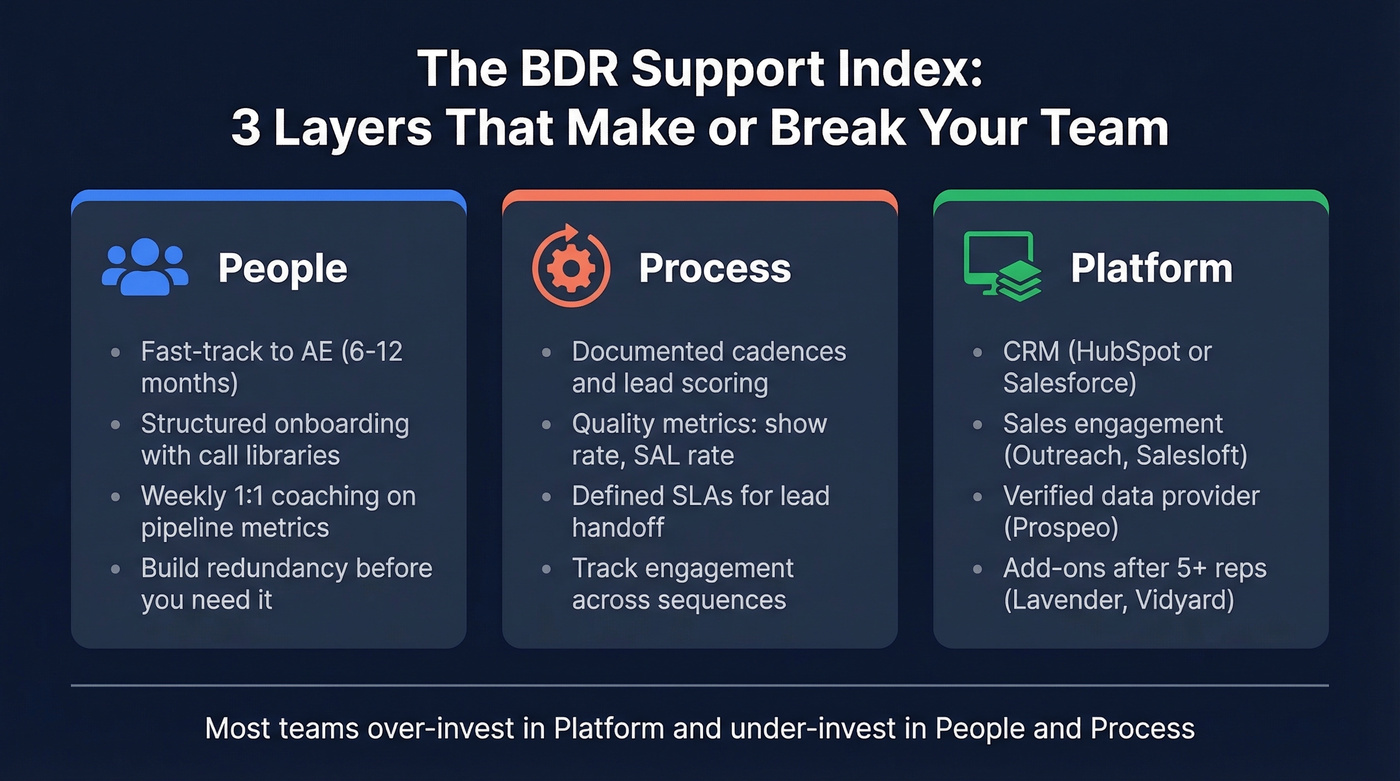
A BDR program isn't a headcount line item. It's a system with three layers, and most teams underinvest in at least one. Think of this section as a BDR support index - a reference you can return to whenever you're auditing gaps.
People
You need trained reps aligned to your ICP, not warm bodies making dials. That one-third churn stat hits hardest on small teams. Lose one BDR from a two-person squad and half your outbound capacity vanishes overnight.
Retention checklist:
- Clear 6-12 month fast-track to AE - the single best lever, and without it, your best reps leave for companies that offer one
- Structured onboarding with call recordings, objection libraries, and ICP documentation
- Weekly 1:1 coaching tied to pipeline metrics, not just activity counts
- Build redundancy early, even if it feels expensive
Process
Documented cadences, lead scoring rules, and handoff protocols to AEs aren't optional. They separate a BDR team from a group of people cold-calling off a spreadsheet.
Process essentials:
- Response frameworks for common objections and personas
- Quality-over-volume metrics: show rate, sales acceptance rate, pipeline created
- Defined SLAs for lead handoff timing and AE follow-up
- Track opens, clicks, and replies across sequences, then use that engagement history to warm follow-up touches instead of treating every touchpoint as cold
If your BDRs are booking meetings that AEs no-show or disqualify, the process is broken regardless of dial volume.
Platform
The BDR tech stack breaks into categories. Sales engagement platforms like Outreach or Salesloft typically run $100+/user/month. CRM is table stakes - HubSpot offers a free CRM with paid Sales Hub tiers, and Salesforce is the default for larger orgs. Lavender (paid plans around $30/month) helps with email personalization. Vidyard offers a free tier with paid plans starting around $20/month and adds video prospecting that cuts through inbox noise.
None of it matters if your contact data is garbage.
In our experience, the single biggest ROI improvement comes from fixing data quality before optimizing sequences. We've watched BDRs waste hours chasing dead emails and disconnected numbers, and no amount of clever copywriting fixes a 15% bounce rate. One team we worked with cut their bounce rate from 35% to under 4% just by switching data providers - their reply rates doubled within two weeks without changing a single word of copy.
Prospeo solves this layer. It delivers 98% email accuracy across 300M+ professional profiles, with 143M+ verified emails and 125M+ verified mobile numbers, on a 7-day data refresh cycle compared to the six-week industry average. Use 30+ filters - buyer intent, technographics, job change signals, headcount growth, department headcount, funding, and revenue - to build lists that match your exact ICP instead of blasting generic segments. The free tier gives you 75 verified emails per month plus 100 Chrome extension credits to test before committing.

Let's be honest: most teams over-buy tools and under-invest in data. Start with three - CRM, sales engagement platform, verified data provider. Everything else is a nice-to-have until you scale past five reps.

Bad data is the silent killer of BDR productivity. Teams using Prospeo cut bounce rates from 35% to under 4% and tripled connect rates - without changing a word of copy. 300M+ profiles, 98% email accuracy, 7-day refresh cycle.
Fix your BDR data layer before you optimize anything else.
Outsourced BDR Support Models
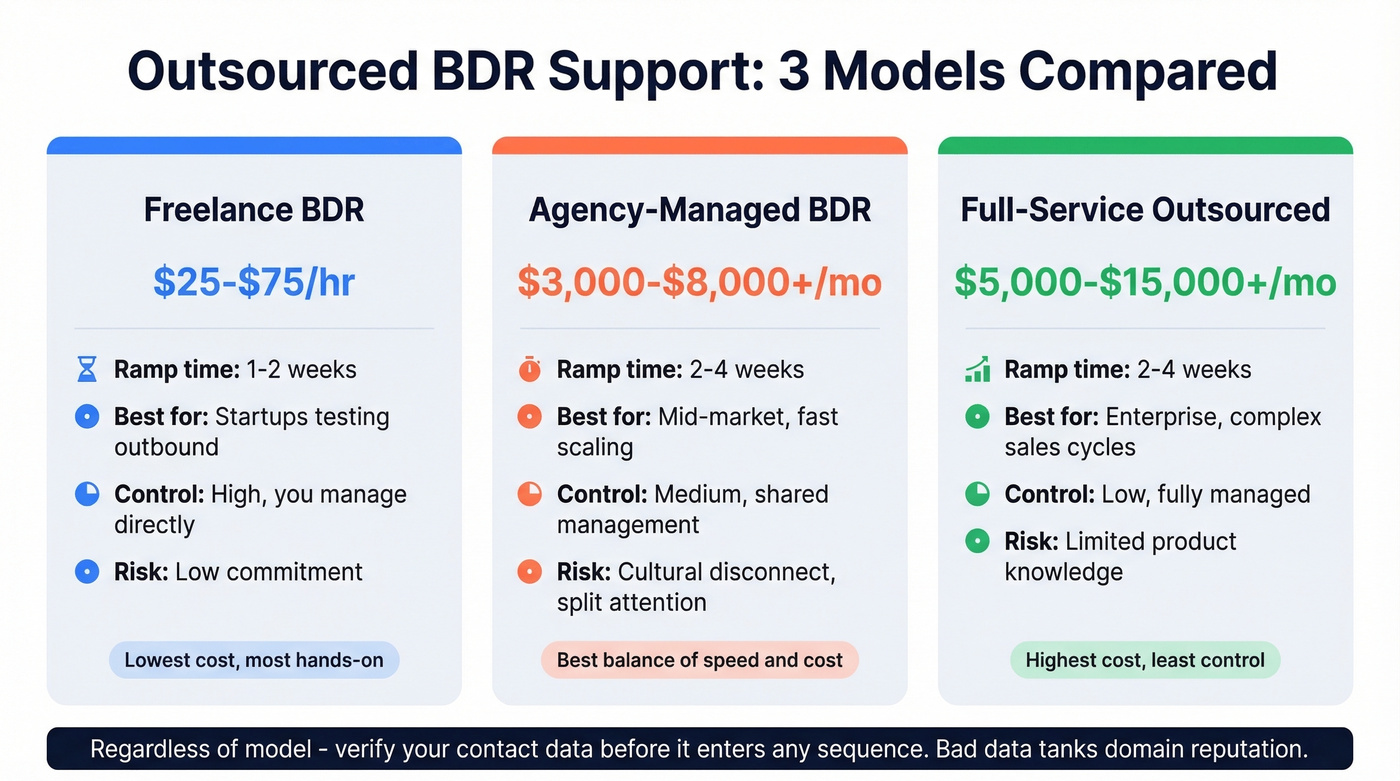
Not every company should build in-house. Outsourcing makes sense when your deal sizes exceed $15k/year, your sales cycle runs 3+ months, and you've got a defined ICP.
Skip this route if you're still figuring out product-market fit. An outsourced BDR team will burn cash without learning anything useful.
| Model | Typical Cost | Best For |
|---|---|---|
| Agency-managed BDR | $3,000-$8,000+/mo | Mid-market teams needing fast ramp |
| Freelance BDR | $25-$75/hr | Startups testing outbound |
| Full-service outsourced | $5,000-$15,000+/mo all-in | Enterprise, complex cycles |
Onboarding typically takes 1-4 weeks, faster than hiring internally. The tradeoffs are real though: limited product knowledge, cultural disconnect, and divided attention across clients. We've seen outsourced teams hit quota on meeting volume while delivering leads that AEs reject at twice the normal rate. We've also watched in-house teams with half the headcount outperform outsourced squads simply because they understood the product deeply enough to qualify on the first call.
Whether you build or outsource, verify your data before it enters any sequence. At roughly $0.01 per verified email, catching bad addresses before they tank your domain reputation is the cheapest insurance in your stack.
Whether you build in-house or outsource, every BDR sequence starts with contact data. At $0.01 per verified email, Prospeo protects your domain reputation and gives your reps direct dials from 125M+ verified mobiles with a 30% pickup rate.
Stop burning BDR hours on disconnected numbers and dead emails.
BDR in IT: Backup & Disaster Recovery
In IT, BDR stands for backup and disaster recovery. Backup means copying and storing data; disaster recovery means restoring systems and operations after a disruption. Different world from sales, but the acronym collision is real, so let's cover it briefly.
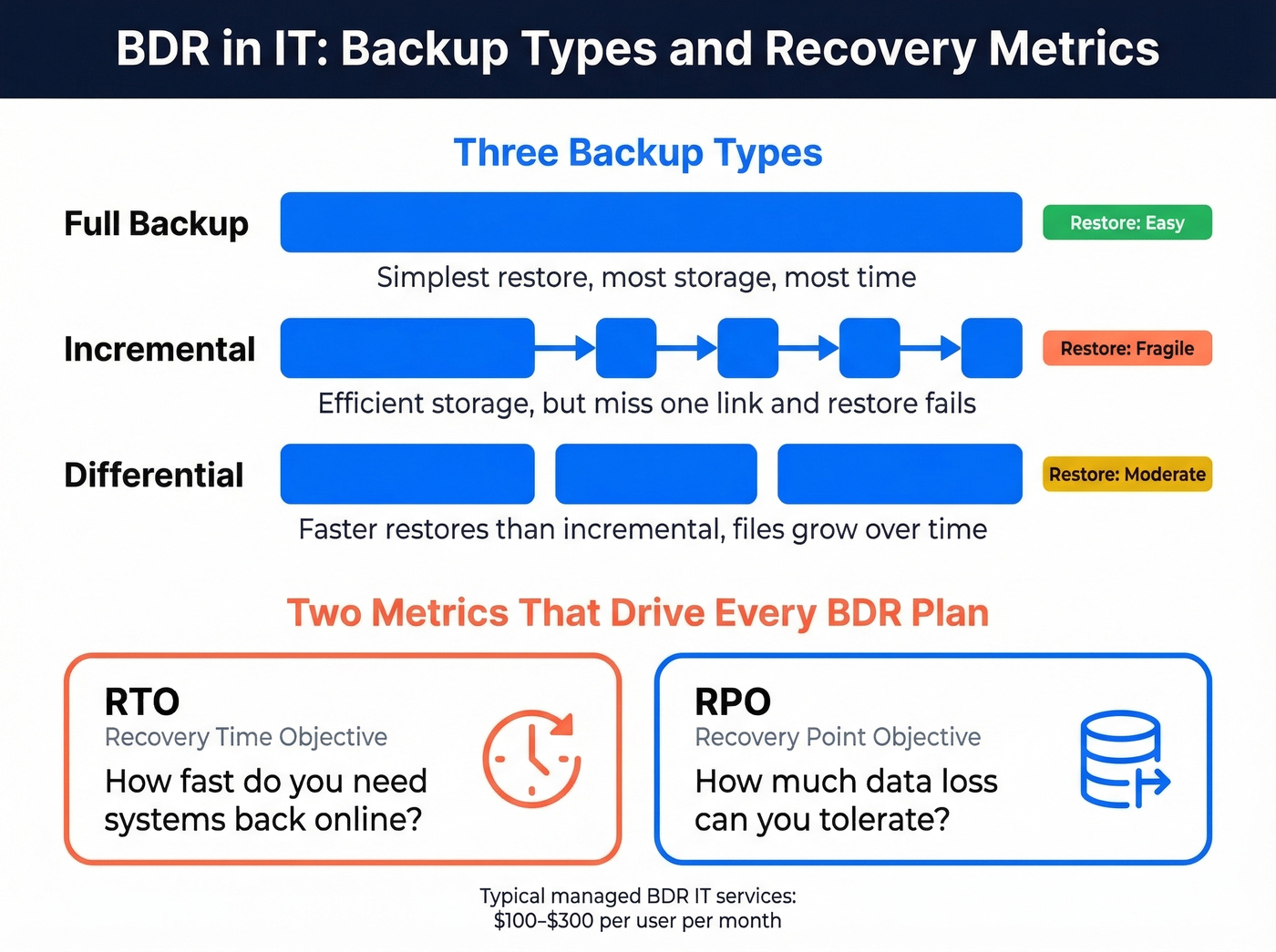
Three backup types matter. Full backups are simplest to restore but consume the most time and storage. Incremental backups are efficient but require the full backup plus every incremental since to restore - miss one link in the chain and you're stuck. Differential backups split the difference: faster restores than incremental, but files grow larger between full backups.
Two metrics drive every BDR plan: RTO (recovery time objective - how fast you need systems back) and RPO (recovery point objective - how much data loss is acceptable). Hybrid storage combining on-prem and cloud is the current best practice for balancing speed and resilience.
Ransomware made immutable storage and air-gapped backups baseline requirements, not enterprise luxuries. Managed IT services that include BDR typically run $100-$300/user/month, with most SMBs landing at $150-$200. Watch for hidden cloud costs: egress and API fees can inflate bills by 60-80%.
FAQ
What's the difference between a BDR and an SDR?
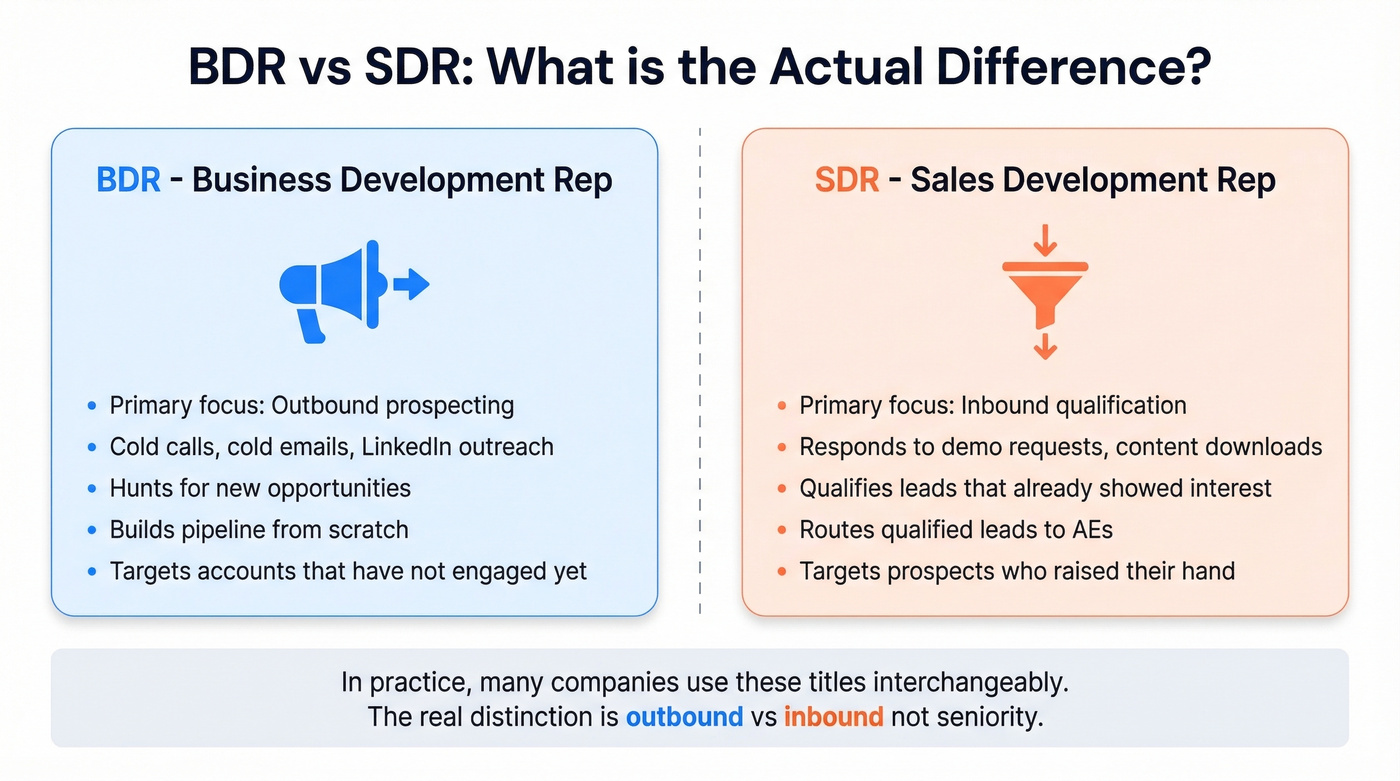
BDRs typically handle outbound prospecting - cold calls, cold emails - while SDRs qualify inbound leads. Many companies use the titles interchangeably. The key distinction is outbound vs. inbound focus, not seniority, though BDRs are sometimes positioned below SDRs when both roles exist in the same org.
How much does outsourced BDR support cost?
Agency-managed teams run $3,000-$8,000+ per month per rep, while full-service outsourced sales companies charge $5,000-$15,000/month all-in including management and performance incentives. Freelance BDRs charge $25-$75/hour, making them the cheapest way to test outbound before committing to a contract.
What tools do BDR teams need most?
At minimum: a CRM (HubSpot or Salesforce), a sales engagement platform (Outreach or Salesloft), and a verified data provider for accurate emails and direct dials. Prospeo's free tier covers the data layer for small teams starting out, while tools like Lavender and Vidyard add value once you scale past five reps. Use the support index above to audit which layer - people, process, or platform - needs the most attention.