

BDR vs SDR: What the Data Actually Says
Ask ten sales leaders whether SDR means inbound or outbound, and you'll get at least three different answers. Six published guides define SDR as inbound and BDR as outbound. Two define it the exact opposite way. The BDR vs SDR debate generates endless content, but only ~25% of companies actually split inbound and outbound into separate roles. Everyone else calls the job whatever they want and moves on.
Let's skip the semantics and focus on what actually matters: the benchmarks, the money, and the tech stack that makes either role productive.
The Short Version
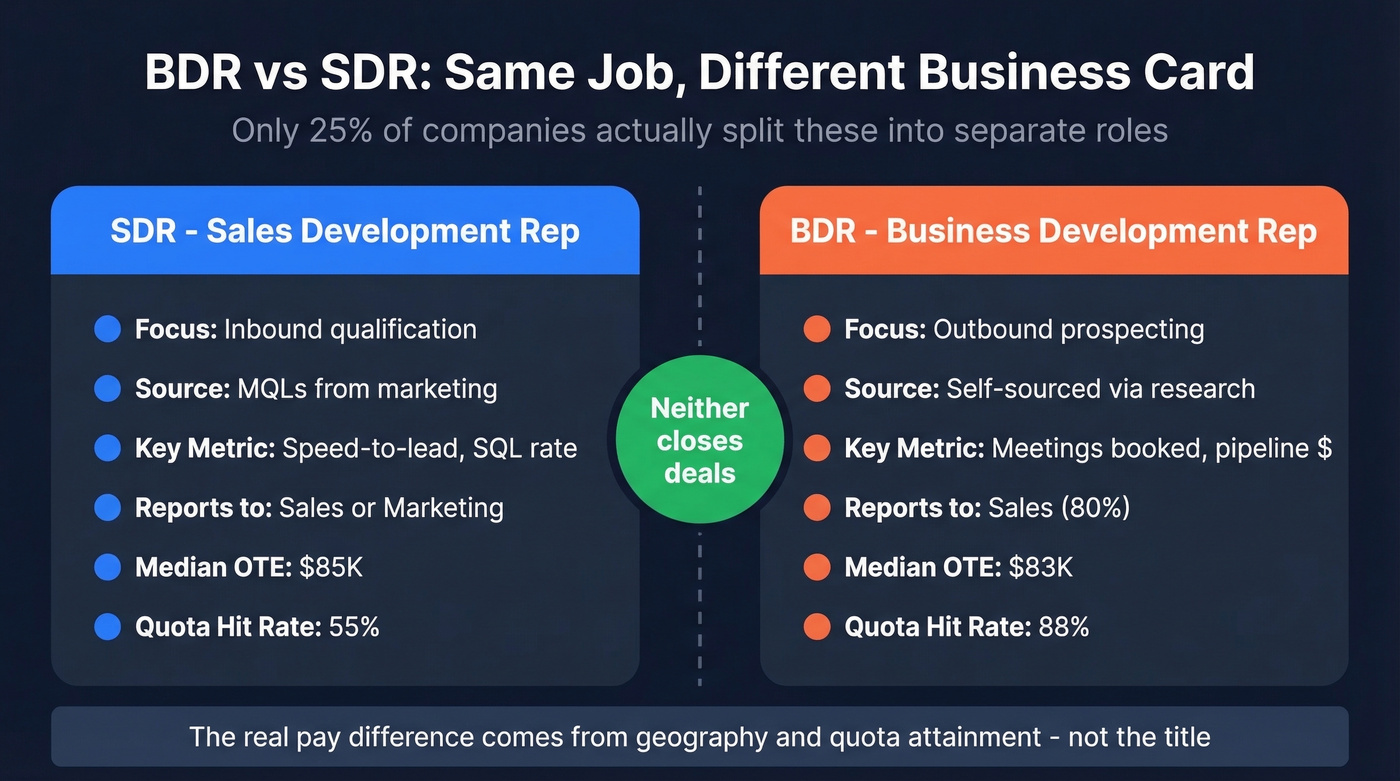
At most companies, SDR and BDR are the same job. Only a quarter of firms split inbound and outbound into separate roles. Median OTE for either title lands between $83K and $85K, with top performers clearing $130K+. The real pay difference comes down to geography and quota attainment, not the title on your business card.
Here's the thing most guides won't tell you: the #1 lever for hitting quota isn't your script or cadence. It's data quality. If 30%+ of your emails bounce, fix your data layer before touching anything else.
The Real Definitions
The standard framing goes like this: SDRs handle inbound leads from marketing, qualifying MQLs and routing them to AEs. BDRs do outbound - cold calls, cold emails, building pipeline from scratch.
Except it isn't that clean. Definitions flip depending on the company. Some orgs call their outbound reps SDRs. Others use BDR as the senior title. The consensus on r/sales and r/salesdevelopment is that the distinction barely matters - and we'd agree.
For most B2B SaaS companies under $50M ARR, SDR and BDR are effectively the same role with different business cards. The meaning varies so widely across the industry that job descriptions for both titles are often interchangeable. Average tenure in either seat is about 1.5 years, with 3+ months of ramp before a rep is fully productive. That's a tight window to generate ROI, which is why the title debate matters far less than the systems around the role.
| Dimension | SDR (typical) | BDR (typical) |
|---|---|---|
| Primary focus | Inbound qualification | Outbound prospecting |
| Lead source | MQLs from marketing | Self-sourced via research |
| Goal | Qualify and hand to AE | Create pipeline and hand to AE |
| Reports to | Sales (sometimes Marketing) | Sales (~80%) |
| Key metric | Speed-to-lead, SQL rate | Meetings booked, pipeline $ |
| Closes deals? | No | No |
The 80% figure for BDR reporting to Sales comes from the 6sense 2026 BDR benchmark report, the most thorough dataset available on the topic.
When to Split vs. Combine
Separate inbound and outbound titles start to make sense once you have 10+ salespeople and enough inbound volume to keep a dedicated qualifier busy full-time - roughly 300+ inbound leads per month. Below that threshold, a single hybrid motion usually works better because it prevents slow inbound follow-up and keeps outbound from getting deprioritized. Whether you label that hybrid role BDR or SDR is cosmetic.
The diagnostic is simple. If your reps' activity is high but conversion is low, fix the playbook. If conversion is fine but pipeline is thin, add headcount.
What a Day Actually Looks Like
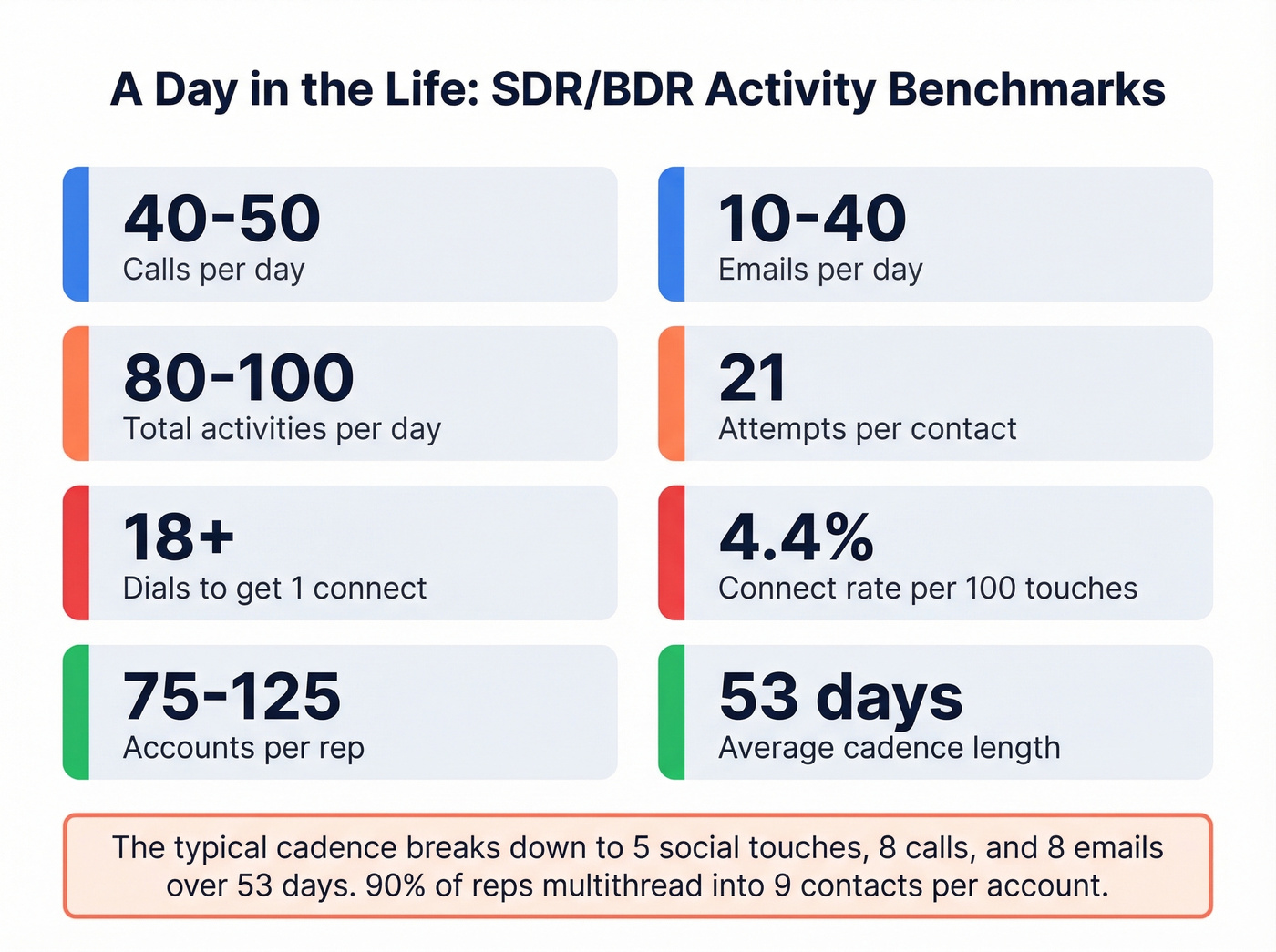
The activity volume expected from either role is relentless:
| Activity | Benchmark |
|---|---|
| Calls per day | 40-50 |
| Emails per day | 10-40 |
| Total activities/day | 80-100 |
| Attempts per contact | ~21 over 53-day cadence |
| Dials to connect | 18+ |
| Connects per 100 touches | 4.4 |
| Accounts per rep | 75-125 |
Most of these benchmarks come from Bridge Group, Tenbound, Gartner, and TOPO research compiled across hundreds of SDR orgs. The cadence benchmark - roughly 21 attempts per contact over 53 days - comes from 6sense's 2026 report. Reps are making 18+ dials to get a single connect. That's a lot of wasted effort if your contact data is stale.
Those 21 attempts break down to about 5 social touches, 8 calls, and 8 emails, and reps give up after 53 days. Ninety percent multithread into accounts, engaging an average of 9 individuals per deal. That's a lot of contacts to keep accurate. And 74% of teams hand off as an Opportunity rather than a Lead or Account, meaning the rep's job isn't done until the deal is real enough to enter the pipeline.
Benchmarks That Matter
Here's the reverse funnel math every sales development leader should have pinned to their wall:
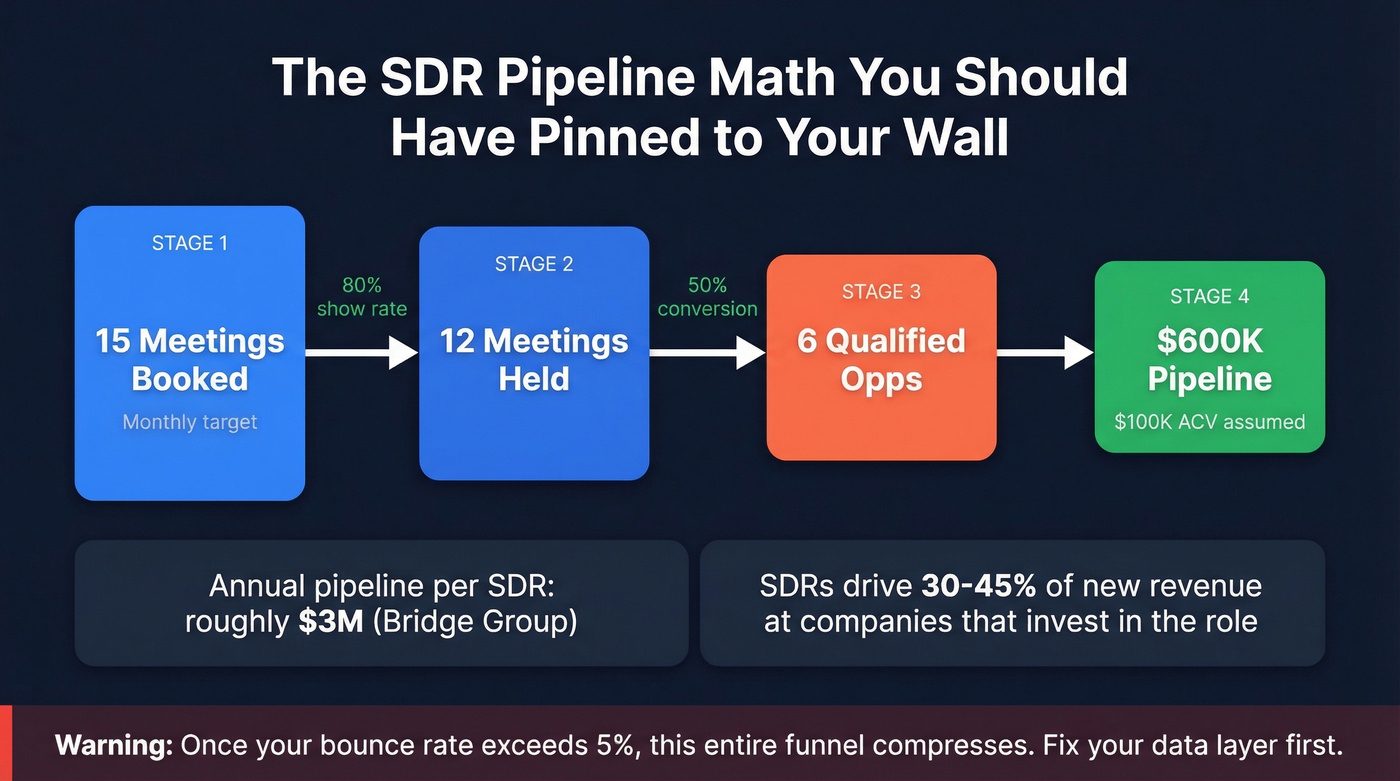
Pipeline math: 15 meetings booked -> 12 held (80% show rate) -> 6 qualified opps (50% conversion) -> $600K pipeline/month at $100K ACV.
That aligns with Crunchbase's SDR benchmark data, which pegs roughly 1 in 2 held meetings converting to a next step. Bridge Group's separate benchmark puts annual pipeline per SDR at ~$3M. The gap reflects different ACV assumptions and conversion definitions, but both numbers confirm the same thing: a productive rep is worth multiples of their OTE. Those numbers assume clean data and working contact info. The moment your bounce rate creeps above 5%, the whole funnel compresses.
Inbound vs. outbound conversion rates diverge sharply. Low-intent inbound leads like content downloads convert to meetings at just 5-10%. High-intent leads - demo requests, pricing page visits - convert at 75-80%. That gap explains why inbound SDRs need volume while outbound BDRs need precision.
SDRs are responsible for 30-45% of new revenue at companies that invest in the role. The team structure benchmark most orgs target is 1 SDR per 2.6 AEs. Quota attainment tells an interesting story too: SDRs hit quota about 55% of the time, while BDRs average closer to 88%. That gap reflects how quota is set rather than role difficulty - outbound quotas tend to be calibrated more conservatively because the motion is harder to predict.

You just read it: 30%+ bounce rates kill the entire SDR/BDR funnel before it starts. Prospeo's 98% email accuracy and 7-day data refresh mean your reps spend those 80-100 daily activities reaching real buyers - not dead inboxes. At $0.01 per email, cleaning up your data layer costs less than one hour of a rep's time.
Stop wasting 21 touches on contacts that don't exist.
Compensation in 2026
The pay difference between a sales development representative and a business development representative is a rounding error. Median SDR OTE sits at $85K. Median BDR OTE: $83K. The variable that actually moves compensation is where you live and whether you hit quota.
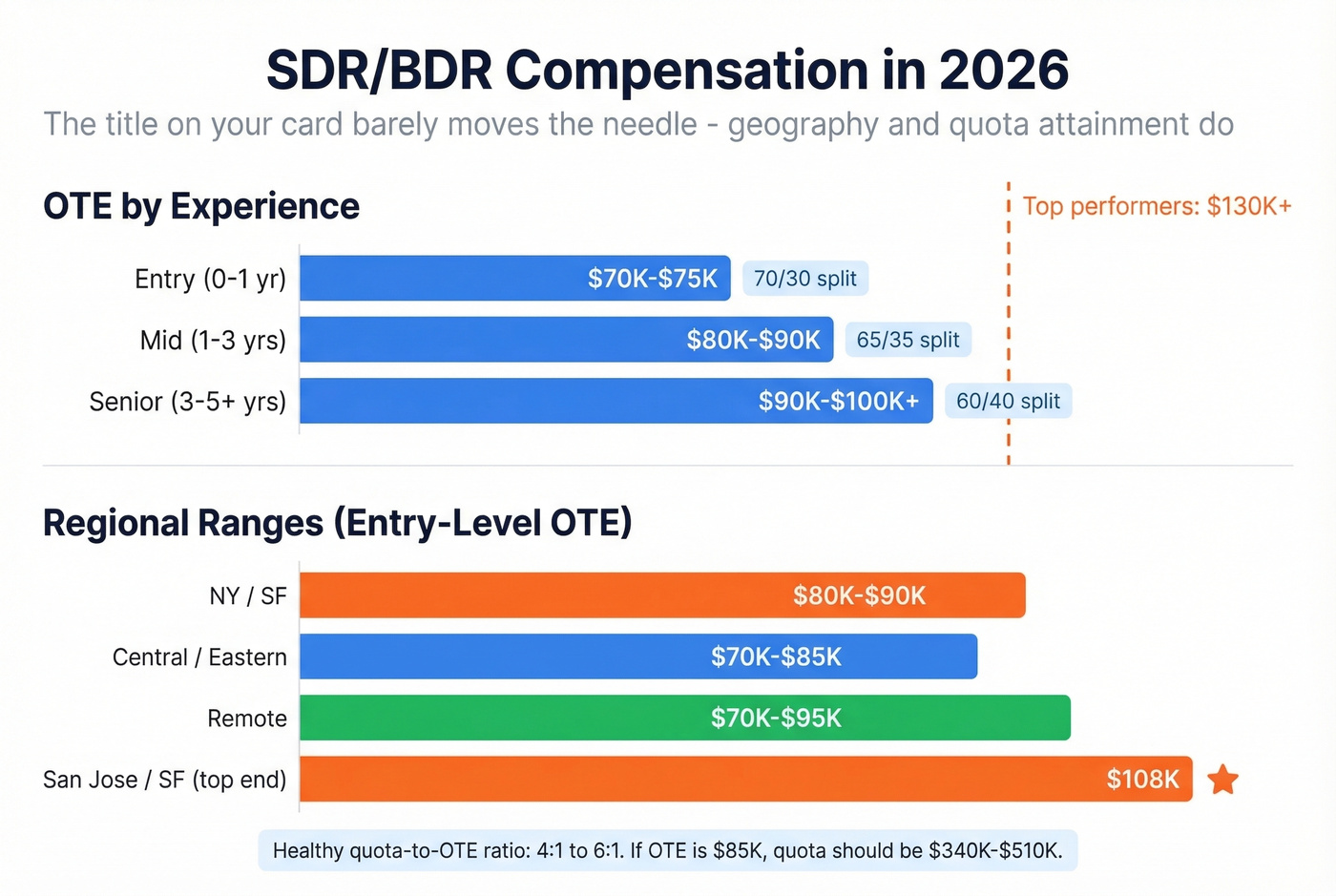
SDR salaries rose 5-10% through 2025, per Betts Recruiting's comp data. Top performers in either role clear $130K+.
OTE by Experience
| Experience | OTE Range | Base/Variable Split |
|---|---|---|
| Entry (0-1 yr) | $70K-$75K | 70/30 |
| Mid (1-3 yrs) | $80K-$90K | 65/35 |
| Senior (3-5+ yrs) | $90K-$100K+ | 60/40 |
Regional Ranges (Entry-Level)
| Region | Base | OTE |
|---|---|---|
| NY / SF | $50K-$70K | $80K-$90K |
| Central / Eastern | $55K-$70K | $70K-$85K |
| Remote | $50K-$70K | $70K-$95K |
City-level data shows even wider swings. San Jose and San Francisco top out around $108K, NYC averages ~$78K, Washington DC hits ~$96K, while Chicago averages $55K. A healthy OTE quota-to-OTE ratio runs 4:1 to 6:1 - meaning if your OTE is $85K, your annual quota should be $340K-$510K in pipeline or revenue, depending on how the company measures.
The SDR/BDR Tech Stack
McKinsey's data shows B2B companies with advanced sales tech grow revenue 2-3x faster. The gap between a rep using a notepad and a rep using a proper stack is enormous. But the stack only works if the foundation is solid, and the foundation is data.
| Category | Purpose | Examples |
|---|---|---|
| Data & Enrichment | Verified contacts, firmographics | Prospeo, Apollo, ZoomInfo |
| Sequencing | Multi-step outreach automation | Outreach, Salesloft |
| Calling | Power/parallel dialing | Aircall, Orum |
| Intent Data | In-market buyer signals | 6sense, Bombora |
| Lead Routing | Speed-to-lead for inbound | Chili Piper |
The data layer determines whether everything downstream actually works. We've seen this firsthand: teams running 35%+ bounce rates don't have a messaging problem - they have a data problem. Prospeo's 98% email accuracy and 7-day refresh cycle keep contacts current while most competitors refresh every 4-6 weeks. With 300M+ professional profiles and 125M+ verified mobile numbers, reps spend less time hunting for contact info and more time selling.

The proof shows up in real numbers. Snyk's 50-person AE team was running 35-40% bounce rates before switching their data provider - that dropped to under 5%, and AE-sourced pipeline jumped 180%. When your reps are making 50 calls a day, the difference between 30% and 5% bounce isn't marginal. It's the difference between hitting quota and updating your resume.
If you're rebuilding your stack, start with the SDR tools and the data enrichment layer, then work outward into sequencing and calling.
Whether you call them SDRs or BDRs, quota attainment depends on reaching the right people. Prospeo gives your reps 300M+ verified profiles, 125M+ direct dials with a 30% pickup rate, and 30+ filters to build precise outbound lists - no annual contracts, no sales calls required.
Give every rep enterprise-grade data at $0.01 per lead.
Career Path: What Comes Next
The SDR/BDR role was never meant to be permanent. Standard time-in-role before promotion is 12-18 months, with high performers moving in 10-12. The benchmark most managers use: hit 90%+ quota for two straight quarters.
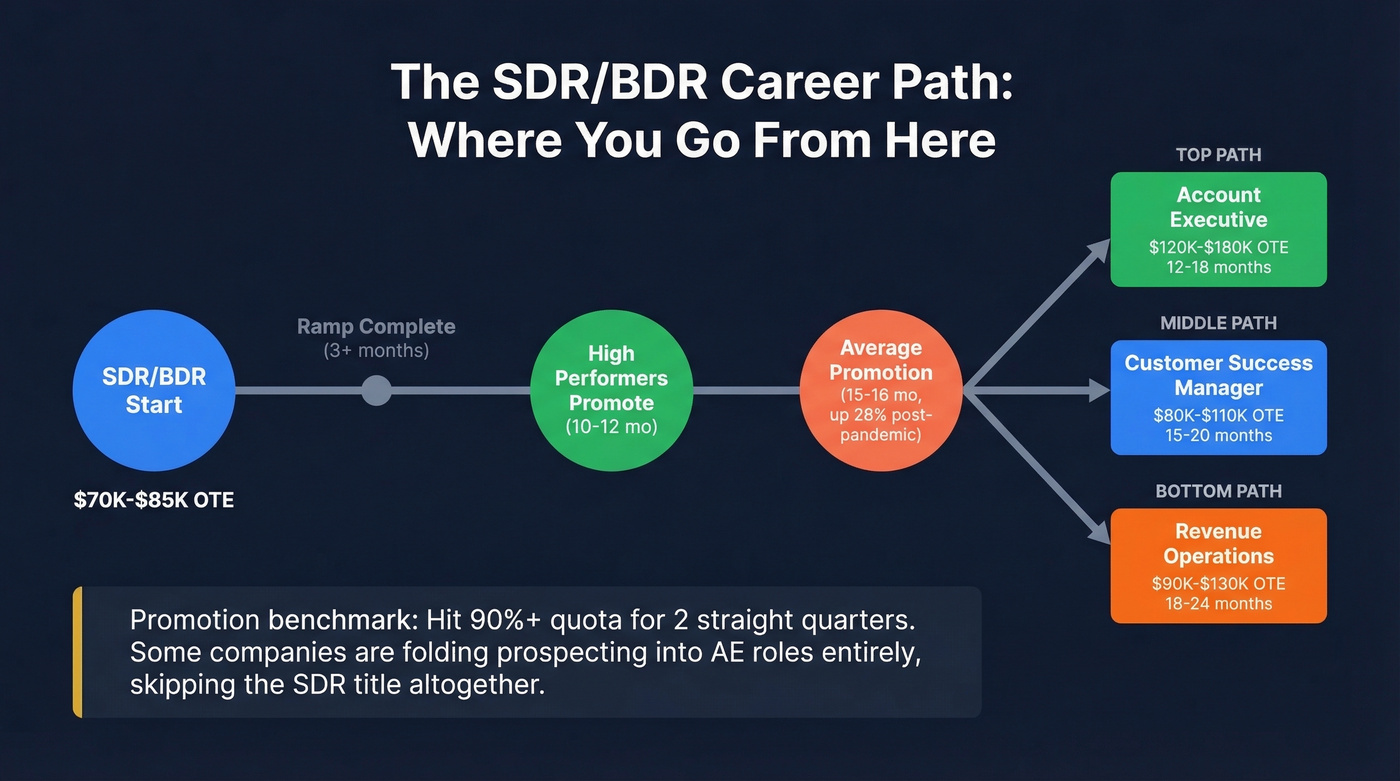
That timeline has stretched post-pandemic. Promotion timelines increased 28%, pushing the average to 15-16 months. The market is tighter, and companies are slower to promote.
| Next Role | Timeline | OTE Range |
|---|---|---|
| Account Executive | 12-18 months | $120K-$180K |
| Customer Success Mgr | 15-20 months | $80K-$110K |
| Revenue Operations | 18-24 months | $90K-$130K |
If you're aiming for AE, it helps to understand the B2B sales funnel and how teams measure pipeline health beyond meetings booked.
One trend worth watching: some companies are folding prospecting into AE roles entirely, eliminating the classic entry-level seat. That doesn't mean the skills are less valuable - it means the career path might skip the title and go straight to a hybrid role.
The AI Factor in 2026
60% of BDRs already use AI tools, but only 13% see AI as a threat to their job. The operational data from SaaStr's internal AI SDR rollout tells a more nuanced story:
| Metric | Human SDR | AI SDR |
|---|---|---|
| Immediate technical answers | 15% | 87% |
| Calls needing follow-up | 73% | 22% |
| Time to technical qualification | 8.3 days | 2.1 days |
| Technical buyer satisfaction | 6.2/10 | 8.4/10 |
Those numbers look devastating for human reps - until you see what happens without supervision. AI SDRs require daily QA. They hallucinate product details, miss buying signals that require empathy, and can't navigate a political org chart. We've talked to teams that deployed AI SDRs and pulled them back within weeks because nobody was reviewing the output.
Here's the stat that should calm the panic: 79% of orgs grew or maintained their BDR team size in 2025, and 58% actively expanded. Companies aren't replacing reps with AI. They're giving reps AI tools.
Our take: if your average deal size is under $10K, you probably don't need a human SDR at all - AI can handle first-touch qualification at that price point. Skip the hire and invest in tooling instead. Above $25K ACV, human reps remain irreplaceable for the multi-threaded, politically complex deals that actually build pipeline. The reps who learn to work alongside AI will out-earn those who ignore it by a wide margin.
FAQ
Do SDRs or BDRs make more money?
Compensation is nearly identical. Median SDR OTE is $85K; median BDR OTE is $83K. The real variable is geography and quota attainment, not the title. Top performers in either role clear $130K+, and the base/variable split shifts from 70/30 at entry level to 60/40 for senior reps.
Should my company split inbound and outbound roles?
Not unless you're past $50M ARR with 10+ salespeople and 300+ monthly inbound leads. Only 25% of companies strictly separate the two motions. Most teams benefit from hybrid reps with clear AE handoff processes and a five-minute-or-less SLA on inbound demo requests.
What's the fastest way to improve connect rates?
Fix your data first. If your bounce rate exceeds 5%, reps waste hours on dead contacts. Clean numbers beat more dials every time - Snyk cut bounces from 35% to under 5% and saw AE-sourced pipeline jump 180% after switching to verified data with a weekly refresh cycle.
Does the title on my resume matter?
Hiring managers care about quota attainment, pipeline generated, and tools used - not whether your title said BDR or SDR. What matters is the numbers you can point to and the outcomes you drove.