

7 Benefits of RevOps (With the Numbers to Prove It)
Why RevOps, Why Now
Your VP of Sales and VP of Marketing just presented two different pipeline numbers to the board. The CEO doesn't know which one to believe. That moment - where leadership loses trust in its own data - is exactly why the benefits of RevOps are measured in revenue, not just alignment.
The operating model isn't new, but the urgency is. Gartner projected that 75% of high-growth B2B companies would operate with a formal revenue operations model by 2026. In Forrester's study of 927 respondents, 57% planned to invest in a RevOps function within 12 months - a trend that's only accelerated since. The RevOps software market is projected to grow from $3.45B to $10.25B by 2033.
Most content on this topic lists "alignment" as benefit #1 and stops there. Alignment is the mechanism. The outcome is measurably more revenue, shorter cycles, and forecasts your CFO actually trusts.
What RevOps Actually Is
RevOps isn't a department. It's an operating model. If you hired a "RevOps person" and asked them to admin your CRM, you don't have RevOps. It spans Marketing Ops, Sales Ops, CS Ops, and increasingly Finance. Gartner found Sales Ops teams now spend 68% of their time on non-sales functions - up from 39% in 2019. That scope creep is exactly why revenue operations matters as a distinct model.
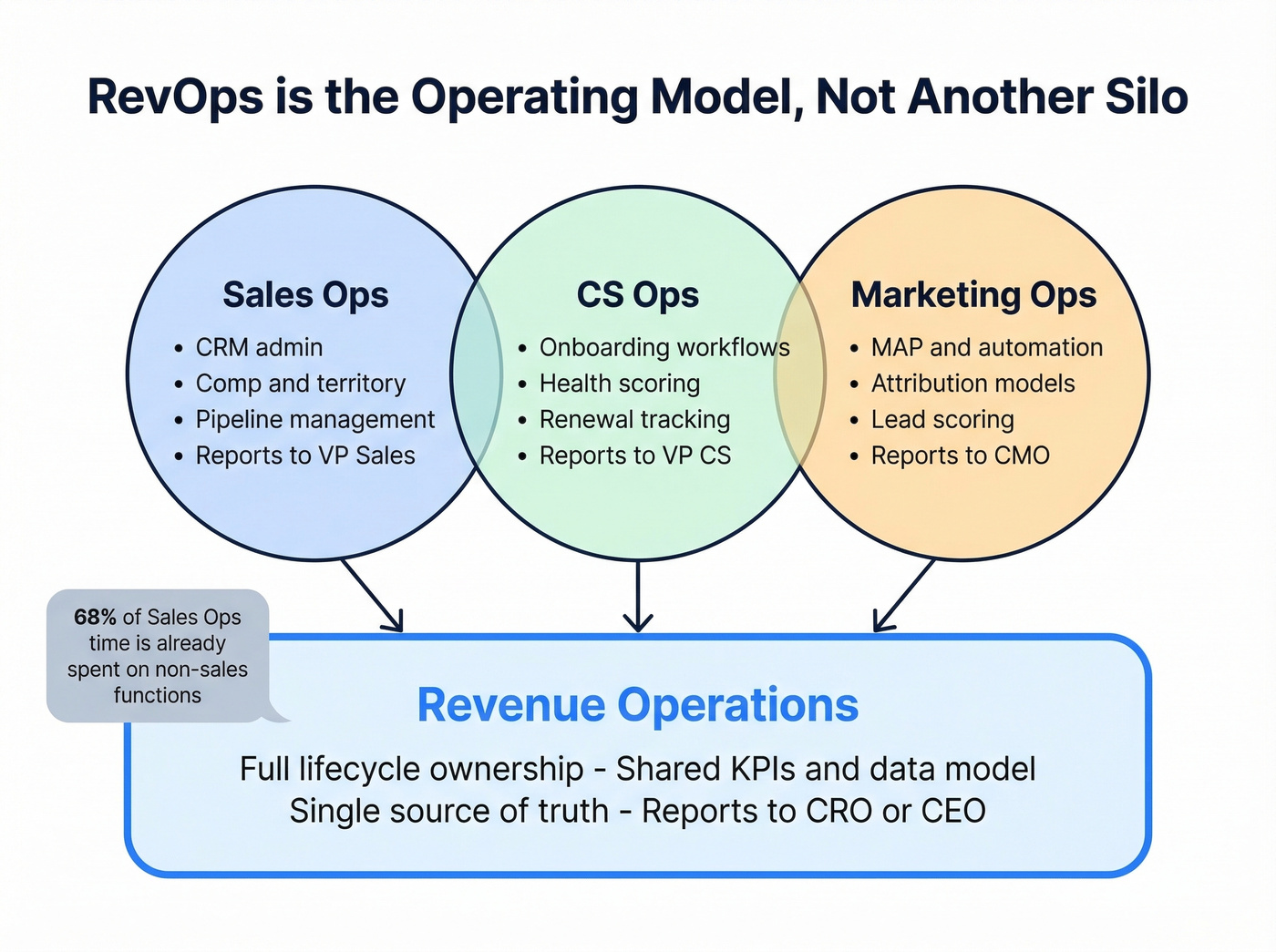
| Sales Ops | Marketing Ops | RevOps | |
|---|---|---|---|
| Scope | Sales execution | Demand gen infra | Full lifecycle |
| Owns | CRM, comp, territory | MAP, attribution | Shared KPIs, data |
| Reports to | VP Sales | CMO | CRO / CEO |
7 Quantified Revenue Operations Benefits
1. Cross-Team Alignment That Shows Up in the P&L
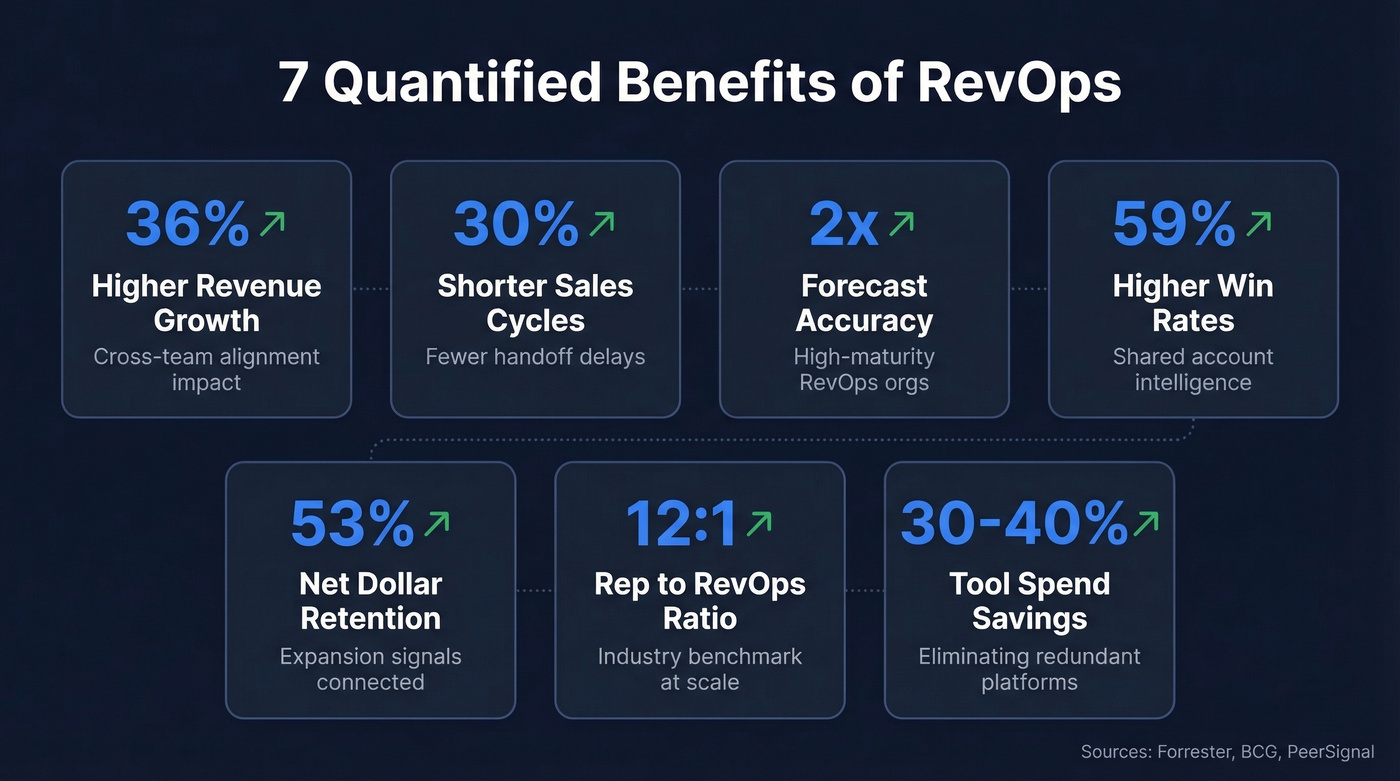
Companies with RevOps report 36% higher revenue growth and up to 28% more profitability. But the real benefit nobody talks about is what it prevents: conflicting pipeline numbers, finger-pointing between teams, and decisions made on data that's six weeks stale. This isn't about getting people in a room together. It's about removing the friction between existing revenue motions so deals actually flow instead of stalling at every handoff.
2. Shorter Sales Cycles
RevOps can shorten the sales cycle by up to 30%. That's not just a velocity win - it means more deals per rep per quarter without adding headcount. Fewer handoff delays and shared account intelligence are the advantages that compound fastest at scale, especially for companies running complex multi-touch sales processes where a deal touches marketing, an SDR, an AE, and a solutions engineer before close.
If you're trying to tighten handoffs and speed up pipeline, it also helps to standardize sales activities across teams.
3. Better Forecasting
High-maturity RevOps orgs are 2x more likely to achieve accurate planning. Finance is now joining RevOps to align billing, revenue recognition, and pipeline forecasting - eliminating the gap between booked and recognized revenue. We've watched companies go from "the forecast is a guess" to "the forecast is a commitment" in under a year once they got this right.
If forecasting is a priority, compare sales forecasting solutions and the broader landscape of best sales forecasting tools.
4. Higher Win Rates
A 59% improvement in win rates, based on widely cited RevOps benchmarks. When marketing, sales, and CS share the same account intelligence and handoff processes, deals stop dying in the cracks between teams. That's the difference between a warm handoff with context and a cold one where the AE asks the prospect to "tell me about your business" for the third time.
Win-rate lifts tend to compound when teams adopt more consistent sales process optimization.
5. Stronger Customer Retention
53% increase in net-dollar retention. RevOps connects expansion signals from CS back to the sales pipeline, so upsell and renewal aren't afterthoughts. They're built into the operating rhythm.
Retention work gets easier when you track churn drivers systematically - see churn analysis for a practical framework.
6. Scalable Operations and Cost Savings
The industry benchmark is 12:1 sales reps to RevOps personnel, based on PeerSignal's analysis of 2,500 B2B SaaS companies. At $50M ARR, that's 4-5 RevOps staff. Without the operating model, you're just adding ops headcount reactively every time something breaks. The savings are structural: one unified team replacing three siloed ops functions means less duplicated tooling, fewer conflicting workflows, and lower total headcount. We've seen companies cut their ops tool spend by 30-40% just by eliminating redundant platforms that different teams bought independently.
7. Data-Driven Decisions (When the Data Is Actually Clean)
Here's the thing: three dashboards that sort-of agree, a spreadsheet the VP of Sales updates on Fridays, and nobody trusts any of it. Sound familiar? The single biggest maturity criterion is a single source of truth - one system of record that everyone trusts. Without it, every other benefit on this list erodes.
A big part of getting there is fixing enrichment and verification - start with lead enrichment and a shortlist of data enrichment services.

Every RevOps benefit on this list depends on clean data. Prospeo enriches your CRM with 50+ data points per contact, 98% email accuracy, and a 7-day refresh cycle - so your single source of truth actually stays true. Snyk saw AE-sourced pipeline jump 180% after deploying it across 50 reps.
Don't build RevOps on a foundation of decayed CRM data.
Why RevOps Fails
Most RevOps initiatives don't fail because of bad strategy. They fail on execution. Here are the five failure modes we see repeatedly:
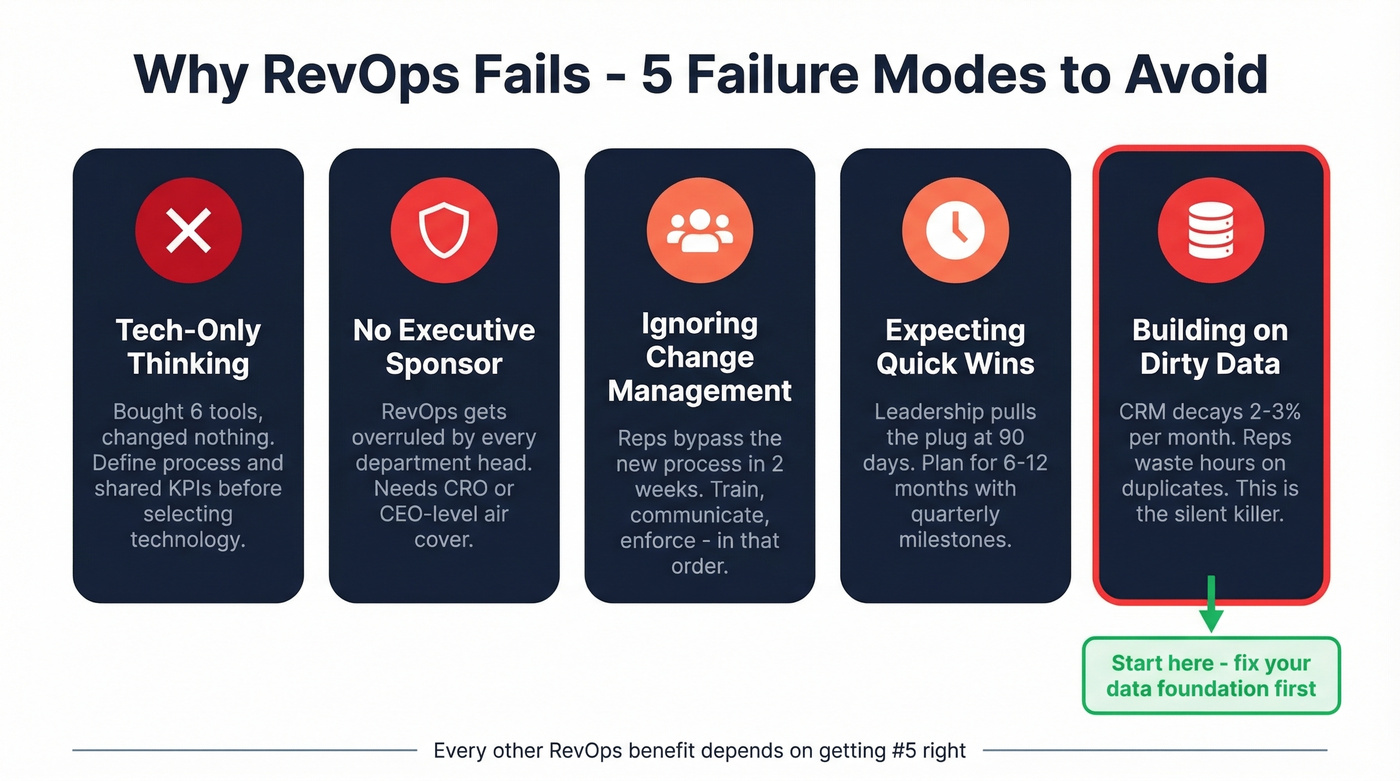
- Treating RevOps as tech-only. You bought six tools and nothing changed. Define process and shared KPIs before selecting technology.
- No executive sponsor. RevOps gets overruled by every department head. It needs CRO or CEO-level air cover, period.
- Ignoring change management. Reps bypass the new process within two weeks. Train, communicate, and enforce - in that order.
- Expecting short-term wins. Leadership pulls the plug at 90 days. Set expectations for a 6-12 month transformation with quarterly milestones.
- Building on dirty data. Your CRM decays 2-3% per month; reps spend hours on duplicates instead of selling. Invest in enrichment infrastructure before anything else.
That last one is the silent killer. Every other benefit on this list depends on it being right.
The Data Problem Nobody Talks About
Every RevOps article says "data-driven decisions." Nobody discusses what happens when your CRM is full of duplicates, dead emails, and contacts who changed jobs eight months ago. Leadership makes decisions on stale data. Reps lose trust in the system. The whole operating model erodes from the inside.
This is where the enrichment layer matters. Prospeo keeps your CRM current with 98% email accuracy, a 7-day refresh cycle versus the 6-week industry average, and 50+ data points per contact. It integrates natively with Salesforce and HubSpot, so enrichment runs automatically - not as a quarterly cleanup project. When Snyk deployed it across 50 AEs, their bounce rate dropped from 35-40% to under 5%, and AE-sourced pipeline jumped 180%.
If you're seeing deliverability issues, measure and fix your email bounce rate before scaling outbound.
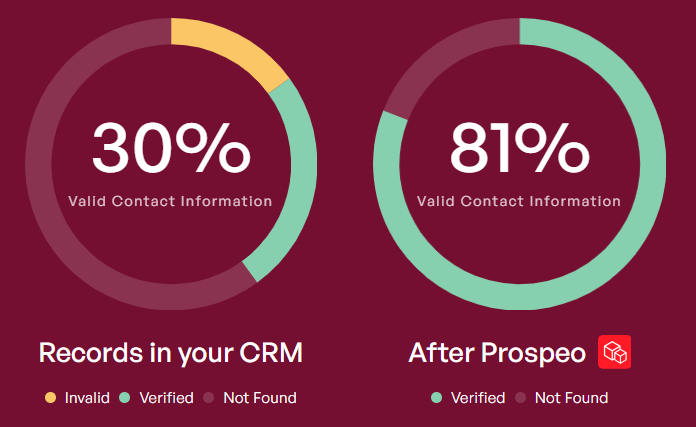
RevOps shortens sales cycles when reps trust the data. With 143M+ verified emails, native Salesforce and HubSpot integrations, and enrichment at ~$0.01/email, Prospeo eliminates the bounce rates and stale contacts that quietly erode every operational improvement you make.
Clean data is the silent multiplier behind every RevOps win.
Where You Stand - RevOps Maturity
Forrester's maturity distribution breaks down to 27% low, 48% medium, and 25% high. High-maturity orgs are 2x more likely to realize the benefits listed above. Most companies are stuck in the middle. And if you're considering AI in revenue operations, the consensus on r/RevOps is sobering: a survey of 300+ revenue leaders found fewer than 10% are seeing ROI from AI tools. Fix your data foundation first.
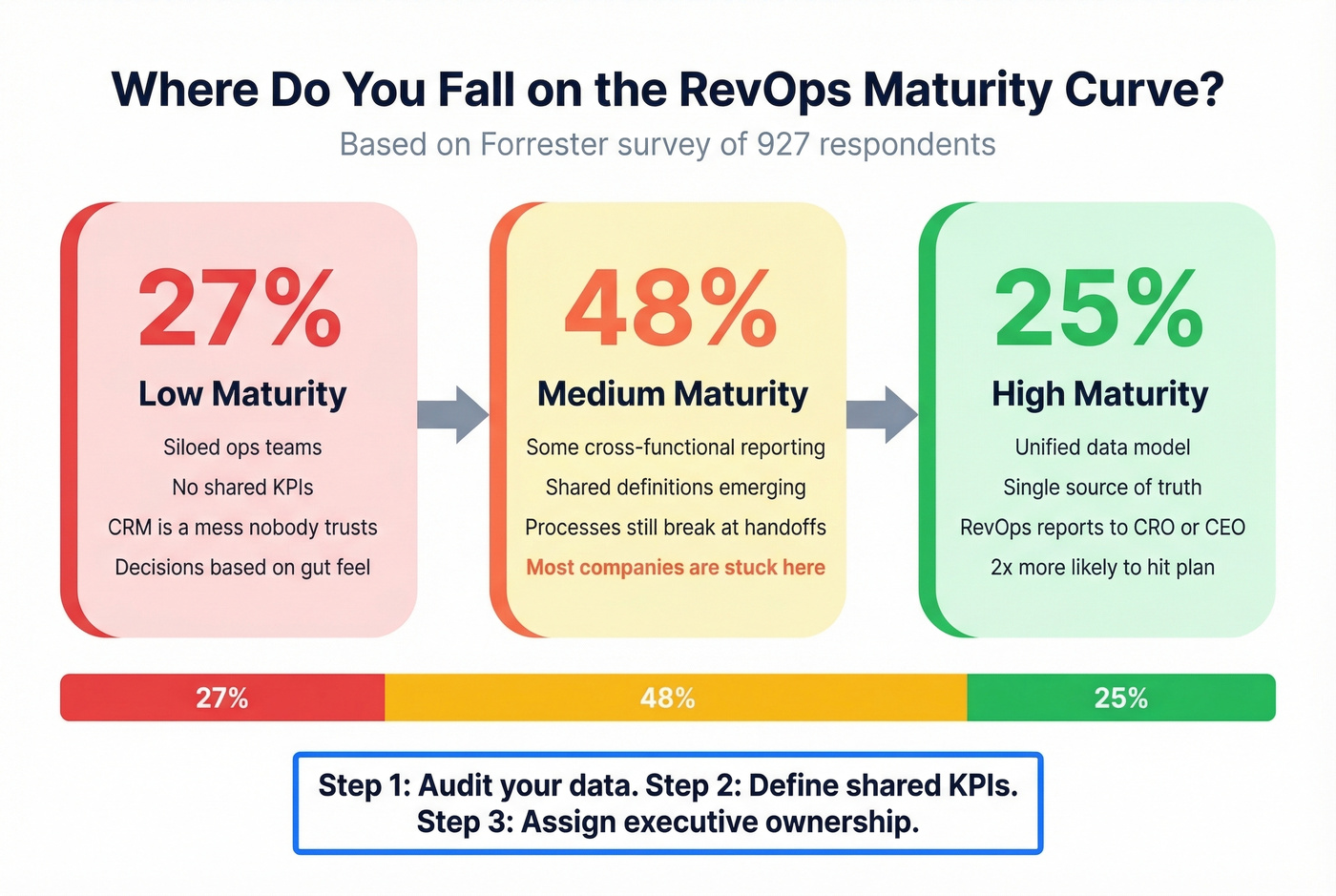
Here's where you likely fall:
| Maturity | What it looks like |
|---|---|
| Low | Siloed ops teams, no shared KPIs, CRM is a mess nobody trusts |
| Medium | Some cross-functional reporting, shared definitions emerging, but processes still break at handoffs |
| High | Unified data model, single source of truth, RevOps reports to CRO/CEO with authority to enforce |
Skip the maturity assessment if you already know your CRM data is bad. Start there. In our experience, the data audit is where 80% of RevOps projects should begin. If you're building from scratch, this is the sequence:
- Audit your data. How stale is your CRM? What's your bounce rate? How many duplicates exist?
- Define shared KPIs. Sales, marketing, and CS need to agree on what "pipeline" and "qualified" mean.
- Assign executive ownership. Someone with authority needs to own this cross-functionally - not a committee, a person.
The first sign RevOps is working? The Monday pipeline review stops being a debate and starts being a decision meeting.
FAQ
What's the difference between RevOps and Sales Ops?
RevOps covers the full customer lifecycle and aligns all revenue teams under shared KPIs, while Sales Ops focuses narrowly on sales execution - CRM admin, pipeline management, and comp design. Sales Ops alone can't solve cross-functional misalignment between marketing, sales, and customer success.
How long does it take to see RevOps ROI?
Most organizations see measurable improvements in forecasting accuracy and pipeline velocity within 6-12 months. Expecting results in 90 days is a top reason initiatives get abandoned - set quarterly milestones instead.
How does RevOps improve revenue growth?
RevOps eliminates handoff gaps and data silos that slow deals down. By unifying marketing, sales, and CS under shared metrics, companies achieve shorter cycles, higher win rates, and stronger retention - all compounding over time.
What tools does a RevOps team need?
At minimum: a CRM like Salesforce or HubSpot, a data enrichment platform to keep records current with verified contacts, and a revenue intelligence tool for pipeline visibility. Layer in intent data and workflow automation as you mature.