

How to Build the Best B2B Sales Funnel in 2026
You've got 500 opportunities in the pipeline and a 4% close rate. Your CEO thinks it's a volume problem. Your VP of Sales thinks it's a closing problem. They're both wrong - it's a funnel architecture problem.
Every guide on building the best B2B sales funnel walks you through Awareness, Consideration, Decision, then stops, as if naming the stages is the same as engineering a system that converts. 67% of B2B buyers now prefer a rep-free experience. Your funnel needs to reflect how people actually buy, not how a textbook says they should.
The Quick Version
- Define 4-5 stages max with strict qualification criteria at each gate.
- Benchmark every stage against industry conversion rates (table below).
- Fix the data layer first - your funnel math is fiction if 35% of emails bounce.
What's Actually Changed in 2026
A B2B sales funnel measures how prospects convert between stages, from first touch to closed deal. A pipeline tracks individual deals and their dollar value through those stages. You need both, but the funnel tells you where the system is leaking.
The journey is non-linear, multi-stakeholder, and self-directed. 73% of buyers actively avoid suppliers who send irrelevant outreach, 69% report inconsistencies between what a company's website says and what the sales rep tells them, and 45% of buyers used AI during a recent purchase. If your funnel still assumes a linear path from awareness to close, you're designing for a buyer that doesn't exist anymore.
The "Skinny Funnel" Principle
Before we get into stages and benchmarks, here's the idea that should reshape how you think about all of it: stop optimizing your funnel. Start shrinking it.
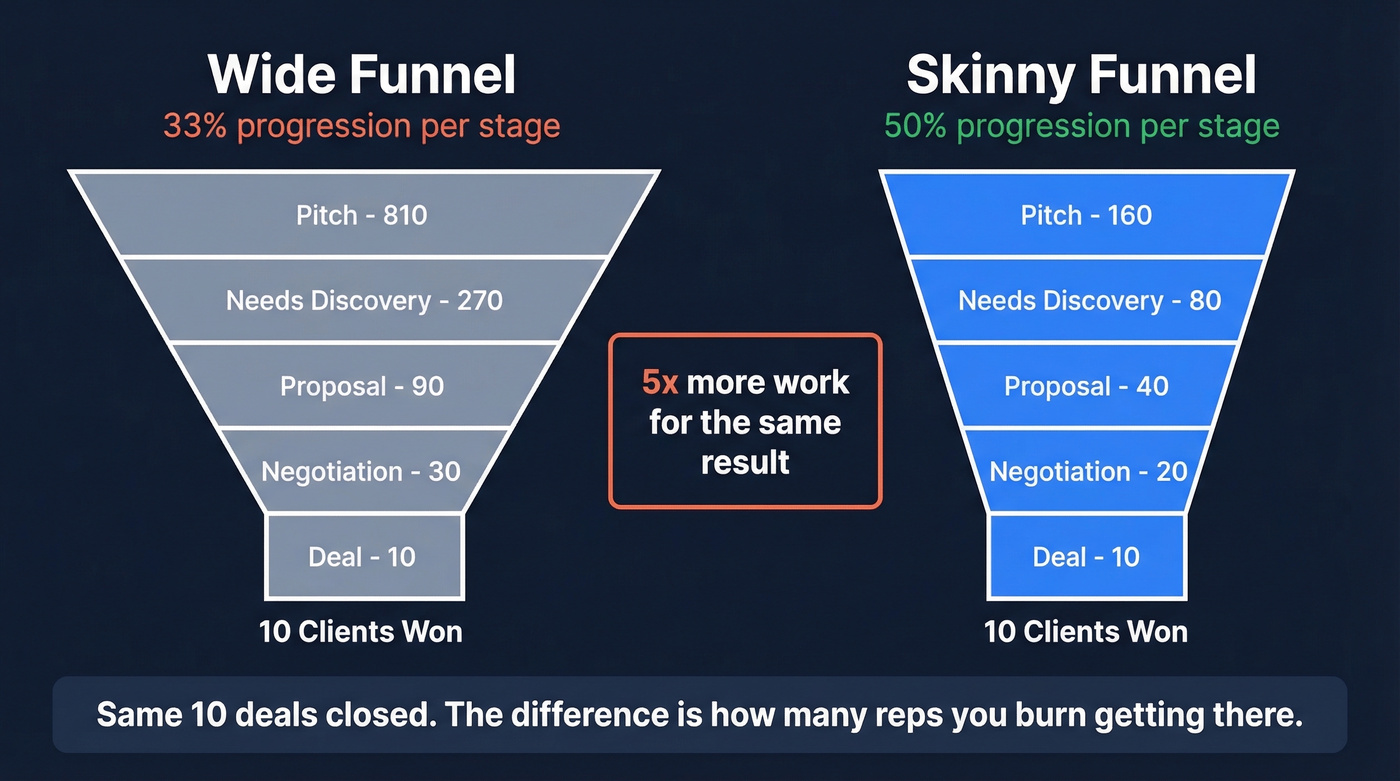
The math is brutal. To win 10 clients with 50% progression at each stage, you need 160 pitches. Drop that progression to 33% and you need 810 - that's 5x the workload for the same result. A practitioner on r/GrowthHacking broke it down using five stages (pitch, needs discovery, proposal, negotiation, deal) and the takeaway was simple: disqualify leads as early as possible to protect the scarcest resource you have, which is salesperson time. We've tested both approaches across dozens of campaigns, and the skinny funnel wins every time. Wide funnels look impressive in dashboards. Skinny funnels close deals.
Here's the thing: if your average deal size sits below $15K, you don't need more leads. You need fewer, better ones and a shorter cycle. Most teams would double revenue by cutting their top-of-funnel in half and tripling qualification rigor.
How to Build a B2B Funnel in 5 Stages
Only 3% of your market is actively buying at any given time. The rest are unaware, researching, or stuck in a buying committee of 6-10 decision-makers. Here's what each stage requires.
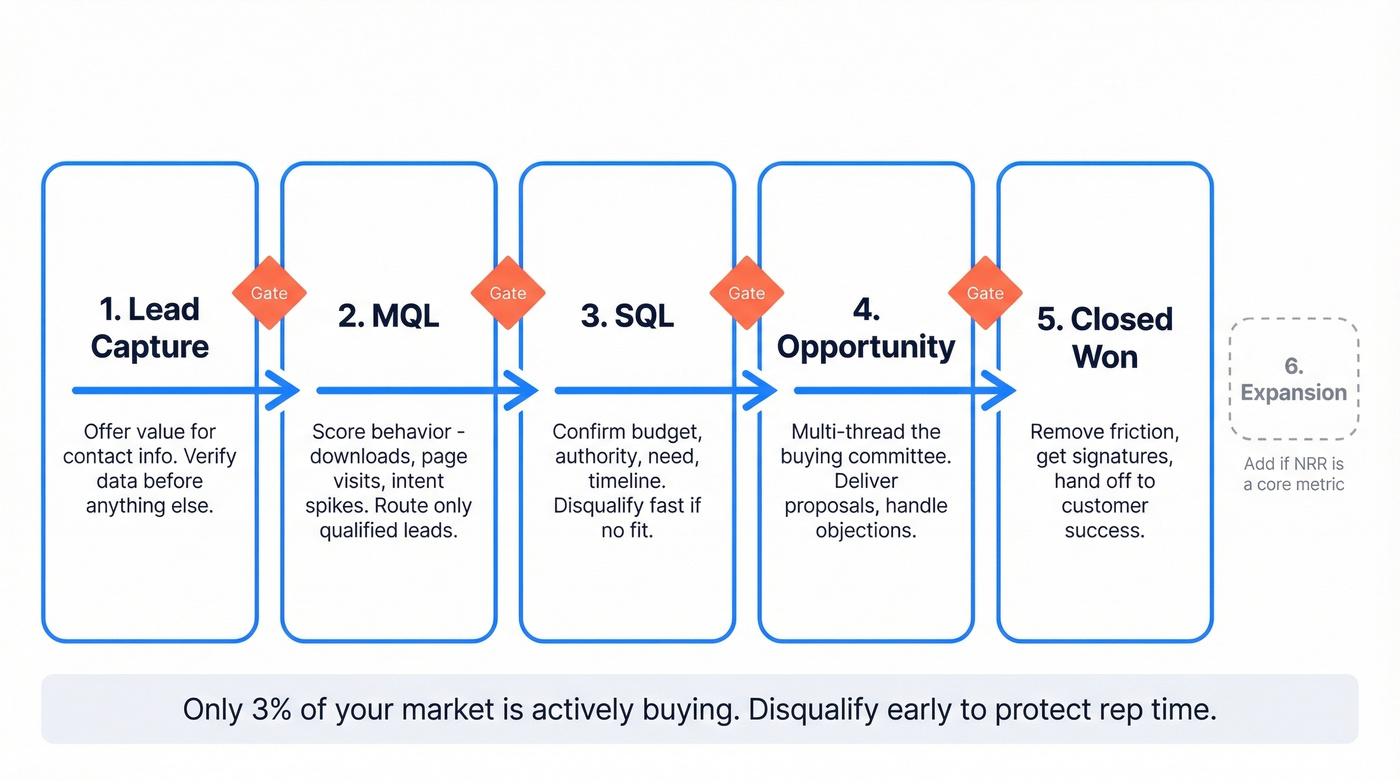
Lead Capture - The buyer is curious but uncommitted. Offer value in exchange for contact info: content, tools, free trials. Your top-of-funnel data needs to be verified before anything downstream matters. A 35% bounce rate silently kills funnel math before it starts, and we've seen teams waste months optimizing mid-funnel conversion rates that were built on garbage data.
MQL - The buyer is engaged with your content or showing intent signals. Score behavior like downloads, page visits, and intent spikes, then route to sales only when criteria are met. 61% of B2B marketers send everything to sales; only 27% of those leads are actually qualified. That gap is where rep burnout lives.
SQL - The buyer is evaluating solutions, possibly comparing vendors. Run discovery, confirm budget, authority, need, and timeline, then disqualify fast if the fit isn't there. Speed matters here. Every day between "hand raised" and "rep connected" drops your conversion rate. If you need a tighter framework, use qualification to standardize what “sales-ready” means.
Opportunity - The buyer is building internal consensus. Multi-thread the buying committee, deliver proposals, handle objections. Deals stall here if you're only talking to one champion.
Closed Won - Negotiate terms, remove friction, get signatures, hand off cleanly to customer success. Some teams add a sixth stage - Expansion - to track upsells and referrals. If your business depends on net revenue retention, include it.

You just saw the math: drop stage progression from 50% to 33% and you need 5x the leads. But here's what most guides skip - none of that math matters if your contact data is bad. Prospeo delivers 98% email accuracy with a 7-day refresh cycle, so every conversion rate you measure is real. Snyk cut bounce rates from 35-40% to under 5% and grew AE-sourced pipeline 180%.
Stop optimizing a funnel built on garbage data. Fix the foundation first.
Stage-by-Stage Conversion Benchmarks
Here's what stage-by-stage conversion actually looks like across industries:
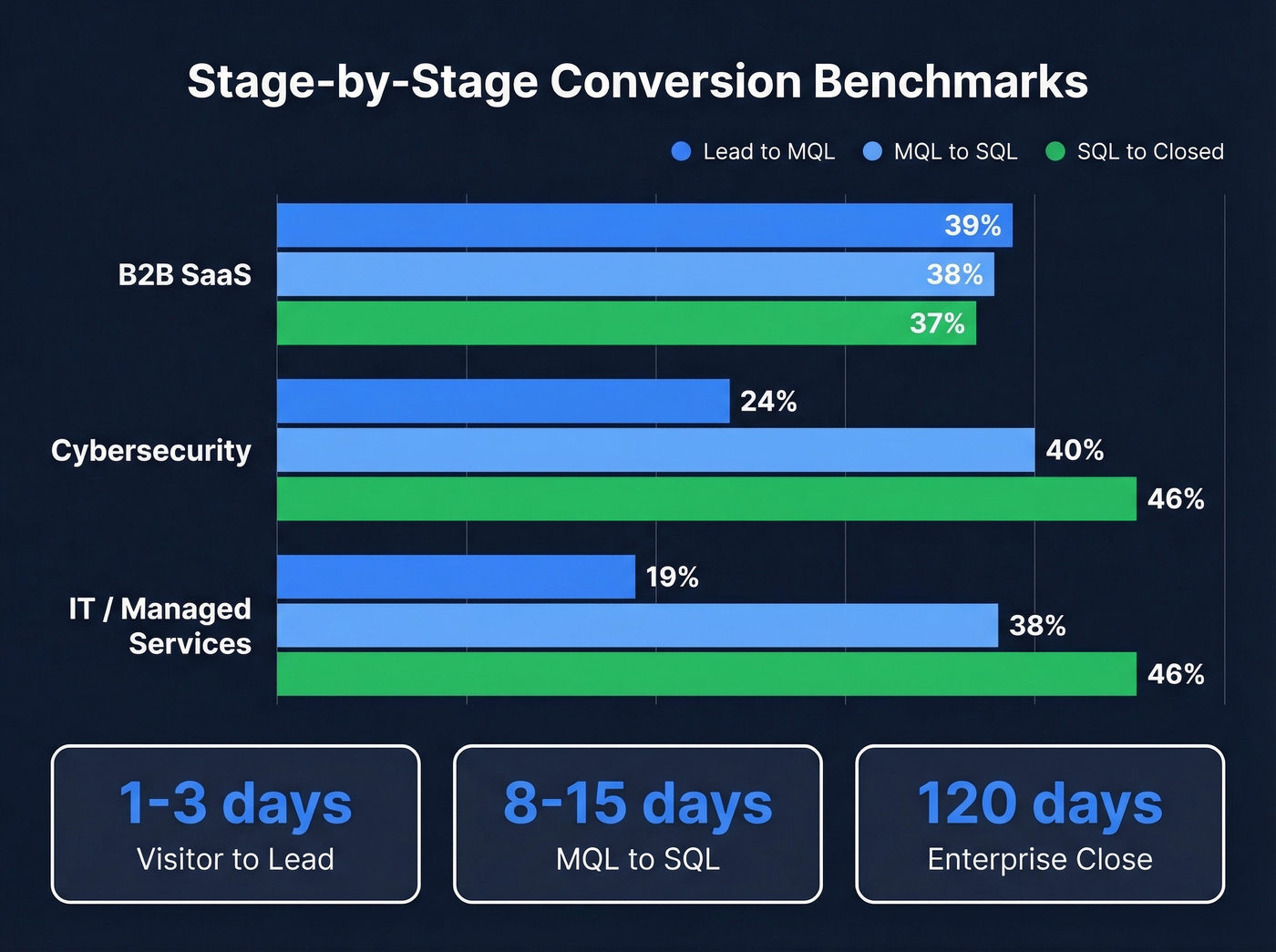
| Industry | Lead to MQL | MQL to SQL | SQL to Closed |
|---|---|---|---|
| B2B SaaS | 39% | 38% | 37% |
| Cybersecurity | 24% | 40% | 46% |
| IT / Managed Services | 19% | 38% | 46% |
Time matters too. Visitor-to-lead conversion typically happens in 1-3 days. MQL-to-SQL takes 8-15 days. Enterprise opportunity-to-close? Budget 120 days. SMB cycles run 30-45 days.
On channels, Google Ads converts visitors to leads at 3-5%, while LinkedIn runs 1.8-3.2%. If your numbers fall significantly below these ranges, the problem is structural, not tactical - revisit your funnel metrics and qualification criteria before you touch your ad spend.
5 Mistakes That Kill B2B Funnels
Too many stages. Keep it to 3-5. Every additional stage creates a handoff, and every handoff leaks pipeline. We've seen teams with 8-stage funnels where nobody could agree on what stage a deal was actually in, which made every forecast useless.
No retargeting. Only 2-3% buy on first visit, and 97% of B2B website visitors are anonymous. If you aren't running retargeting and email nurture, you're abandoning nearly all of your traffic.
Wide funnel vanity metrics. 10,000 unqualified leads isn't pipeline - it's noise that burns rep time. The consensus on r/b2bmarketing is blunt: if your SDRs spend more time sorting leads than calling them, your funnel is broken at the top. Fix it with better sales prospecting techniques and stricter list criteria.
Bad contact data compounding through every stage. High bounce rates corrupt every conversion metric downstream and tank domain reputation. One customer, Snyk, saw bounce rates drop from 35-40% to under 5% after switching to Prospeo - and AE-sourced pipeline jumped 180%. If you’re diagnosing this, start with email bounce rate and then work backward to your list sources.
Inconsistent messaging. When 69% of buyers see discrepancies between your website and your reps, trust evaporates before the SQL stage begins. Let's be honest: most companies don't even audit this. They should.
Tools by Funnel Stage
| Stage | Category | Tool | Starting Price |
|---|---|---|---|
| Prospecting | Data platform | Prospeo | Free tier; ~$0.01/email |
| Prospecting | All-in-one | Apollo | From ~$49/mo |
| Prospecting | Enterprise data | ZoomInfo | Custom; ~$1/lead |
| CRM | SMB | HubSpot | Free CRM; paid from ~$20/seat/mo |
| CRM | Enterprise | Salesforce | From $25/mo/user |
| CRM | Mid-market | Pipedrive | From $24/mo/user |
| Engagement | Cold email | Lemlist | From $69/mo |
| Engagement | Volume outbound | Instantly | From $37/mo |
| Engagement | Enterprise sequences | Outreach | ~$100-150/user/mo |
| Intelligence | Conversation | Gong | ~$100-150/user/mo |
| Intelligence | Intent data | Bombora | ~$25K+/yr enterprise |
Skip ZoomInfo if you're a team under 50 reps - the contract minimums and annual lock-in don't make sense at that scale. For teams that need verified emails and direct dials without enterprise pricing, Prospeo's 300M+ profiles with 98% email accuracy and a 7-day data refresh cycle are hard to beat, especially since it integrates natively with Salesforce, HubSpot, Instantly, Lemlist, and Clay.
Measuring Funnel Performance
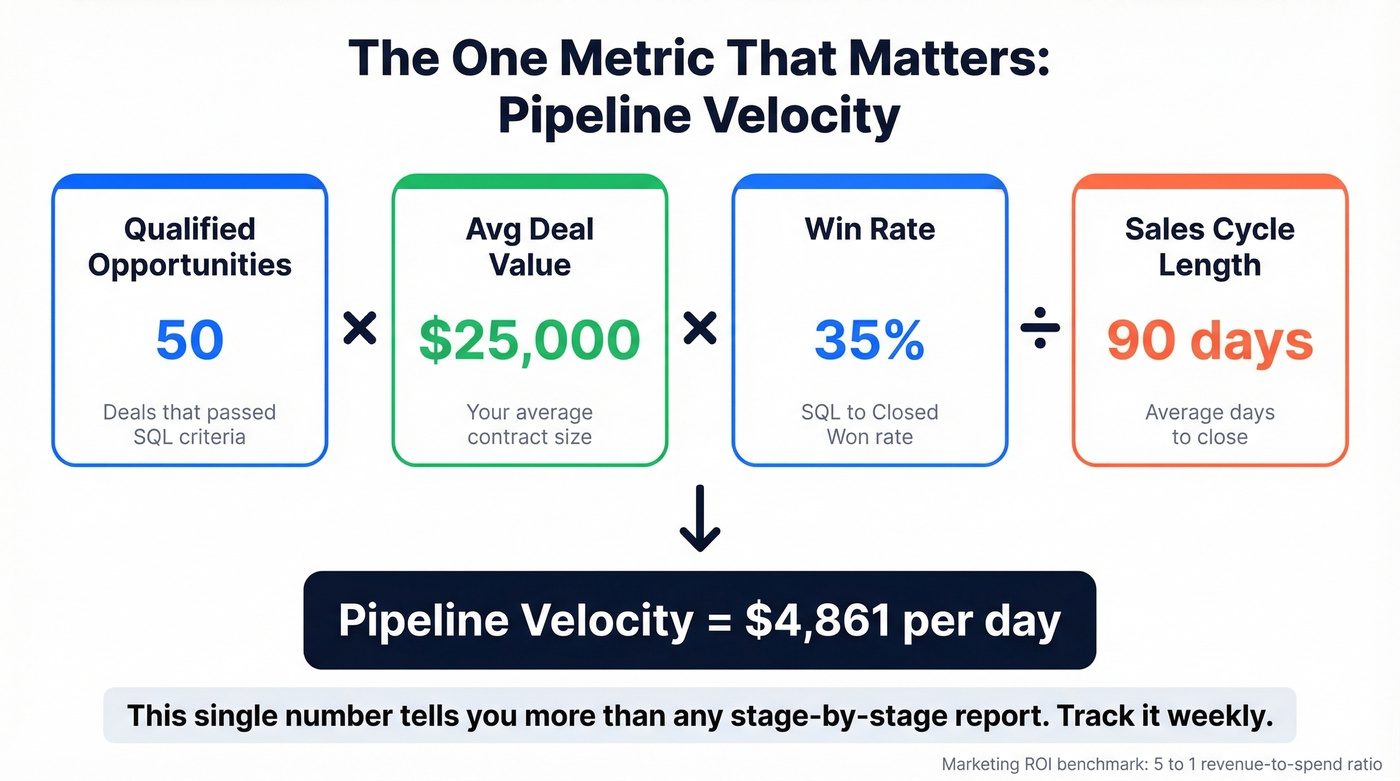
The formula that matters most is pipeline velocity: qualified opportunities multiplied by average deal value multiplied by win rate, divided by sales cycle length. That single number tells you more than any stage-by-stage report. If you want a deeper breakdown, use these sales operations metrics to spot where velocity is actually being lost.
For marketing ROI, the standard formula is (Revenue - Marketing Investment) / Marketing Investment x 100. The commonly cited benchmark is a 5:1 revenue-to-spend ratio. Here's what we've seen trip teams up: they track sourced revenue instead of influenced revenue. A prospect who read three blog posts, attended a webinar, and then booked a demo through a cold email didn't come from one channel. Track the full picture or your attribution will lie to you.
The skinny funnel wins when every lead entering it is real. Prospeo's 300M+ verified profiles with 30+ filters - buyer intent, technographics, headcount growth, funding - let you disqualify before the first email, not after the third follow-up. At ~$0.01 per email, shrinking your funnel costs less than a wide one full of dead ends.
Fewer leads, better data, more closed deals. That's the skinny funnel in practice.
FAQ
What's the difference between a sales funnel and a pipeline?
A funnel measures conversion rates between stages - it diagnoses systemic problems. A pipeline tracks individual deals and their dollar value through those stages. You need both: the funnel shows where the system leaks, the pipeline manages specific revenue.
How many stages should a B2B sales funnel have?
Four to five. More creates handoff confusion and unreliable reporting. Lead, MQL, SQL, Opportunity, Closed Won covers most B2B motions. Add an Expansion stage only if net revenue retention is a core metric for your business.
How do you fill the top of a funnel with quality leads?
Start with a tight ICP, then build targeted lists using verified data. Layer in buyer intent signals and technographic filters to narrow before you scale. Pair that with content and retargeting to capture the 97% who don't convert on first touch.
What's a good SQL-to-close rate for B2B?
For B2B SaaS, 37% is the median benchmark. Cybersecurity and managed services teams often hit 46%. If you're below 25%, revisit your SQL qualification criteria - you're likely passing unqualified deals to closers, which wastes everyone's time and demoralizes the team.