

Best Cold Email Templates - Plus the System That Makes Them Work
A RevOps lead we work with sent 200 cold emails last month, pulled straight from a top-ranked blog post. Reply rate: 1.4%. The template wasn't bad. It was just the same template every other SDR in the prospect's inbox was using. Template fatigue is real, and it's accelerating - practitioners on r/sales estimate prospects decide read-or-delete in ~2.7 seconds. Your email needs to earn those seconds, not borrow them from someone else's framework.
Cold email can deliver roughly $36 for every $1 spent. But the gap between teams that get results and teams that burn their domains has never been wider. The templates below are structures - starting points you fill with actual research about actual humans. The difference between a 2% reply rate and an 8% reply rate isn't the template. It's the system around it: data quality, deliverability, personalization depth, and follow-up cadence.
What to Fix Before You Write a Single Word
Three rules matter more than any template:
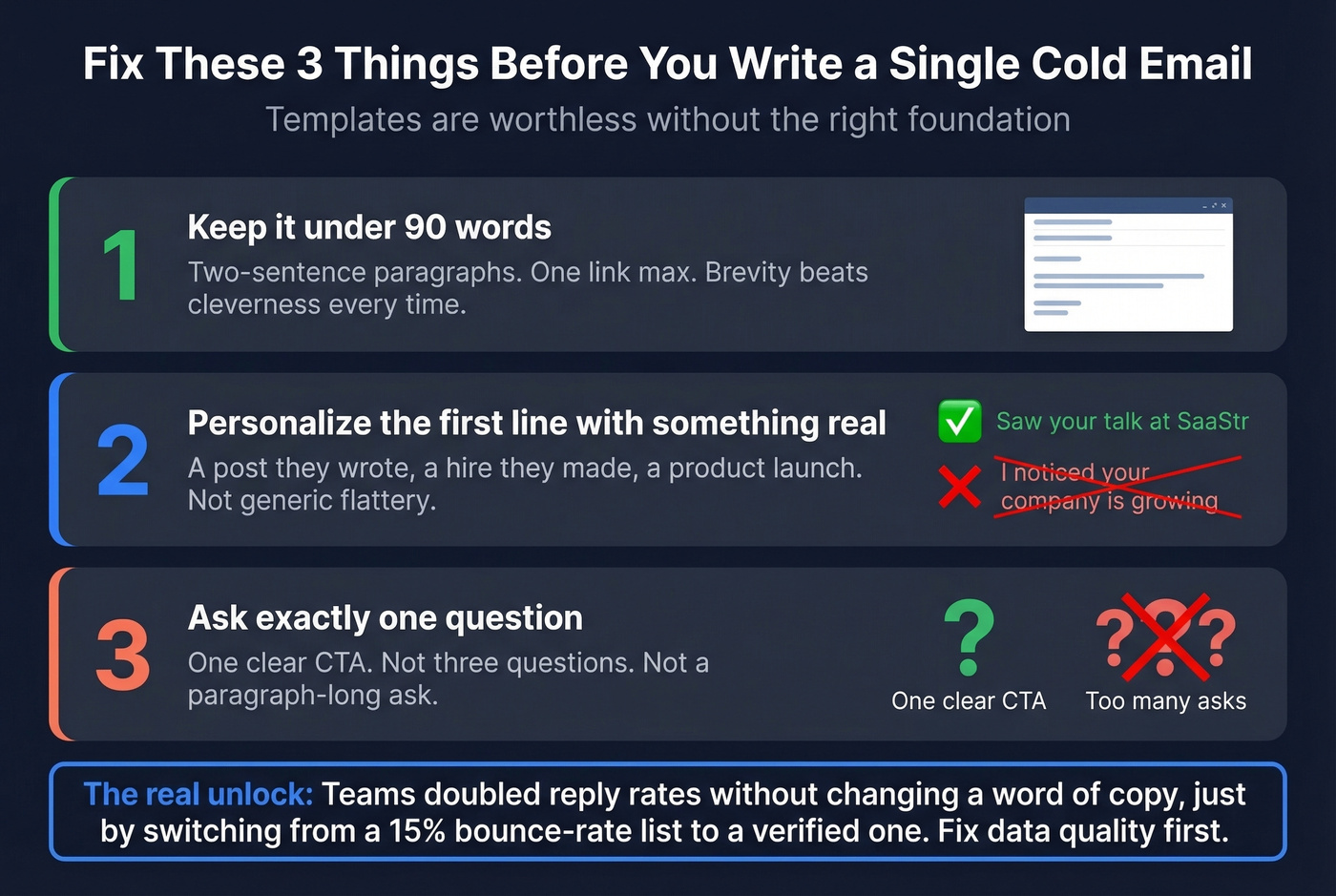
- Keep it under 90 words. Two-sentence paragraphs. One link max.
- Personalize the first line with something specific - a post they wrote, a hire they made, a product launch. Not "I noticed your company is growing."
- Ask one question. One. Not three. Not a paragraph-long CTA.
None of this matters if your emails bounce or land in spam. Fix your data quality and deliverability infrastructure first.
Here's the thing: most teams don't need better templates. They need cleaner data and a warmed-up domain. We've seen teams double their reply rate without changing a single word of copy - just by switching from a 15% bounce-rate list to a verified one. The most polished email in the world can't outperform a broken sending infrastructure.
Cold Email Benchmarks (2026 Data)
A Belkins analysis of 16.5 million cold emails covers one of the biggest public benchmark datasets available. The numbers are sobering.
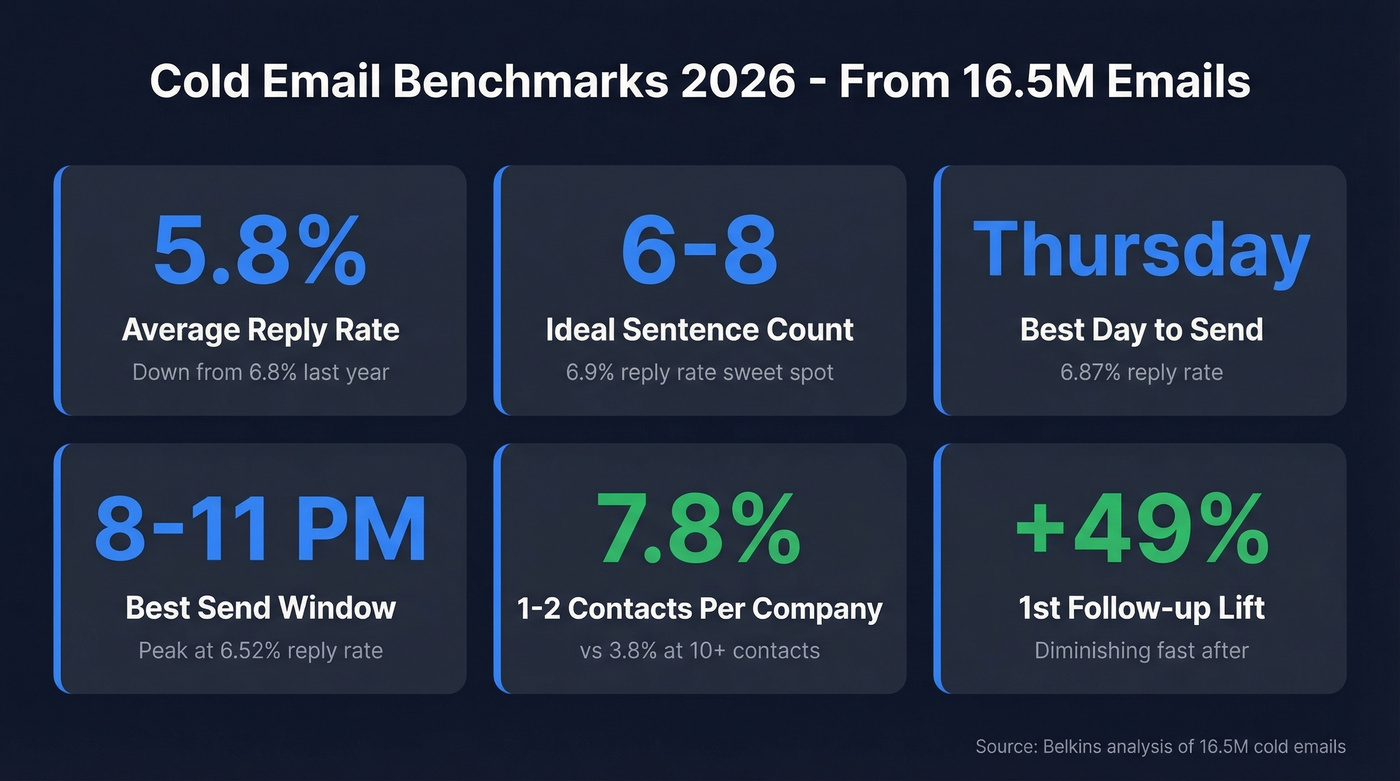
| Metric | Data | Notes |
|---|---|---|
| Avg reply rate | 5.8% | Down from 6.8% the prior year |
| Best email length | 6-8 sentences | 6.9% reply rate |
| Best day | Thursday | 6.87% reply rate |
| Best send window | 8-11 PM | Peak at 6.52% |
| 1-2 contacts/company | 7.8% reply | vs 3.8% at 10+ |
| 1st follow-up lift | Up to 49% | Diminishing fast after |
Thursday evenings beat Monday mornings by a wide margin. Emailing fewer contacts per company produces higher reply rates - spray-and-pray is measurably worse. And turning off open-tracking pixels improved response rates by roughly 3% in internal testing, likely because pixel-loaded emails trigger spam filters more often. That single change - removing a tracking pixel - outperformed most subject-line optimizations we tested.
Not all replies are positive. Expect 20-40% to be genuinely interested, depending on your offer and ICP fit. The rest are polite declines, auto-replies, and "remove me" requests.
For context, a small-volume test on Reddit showed 30 deeply personalized emails generating 3 replies - a 10% reply rate. Volume matters less than relevance.
Subject Lines That Get Opened
The average professional receives 126 emails per day. Your subject line is competing with 125 others.
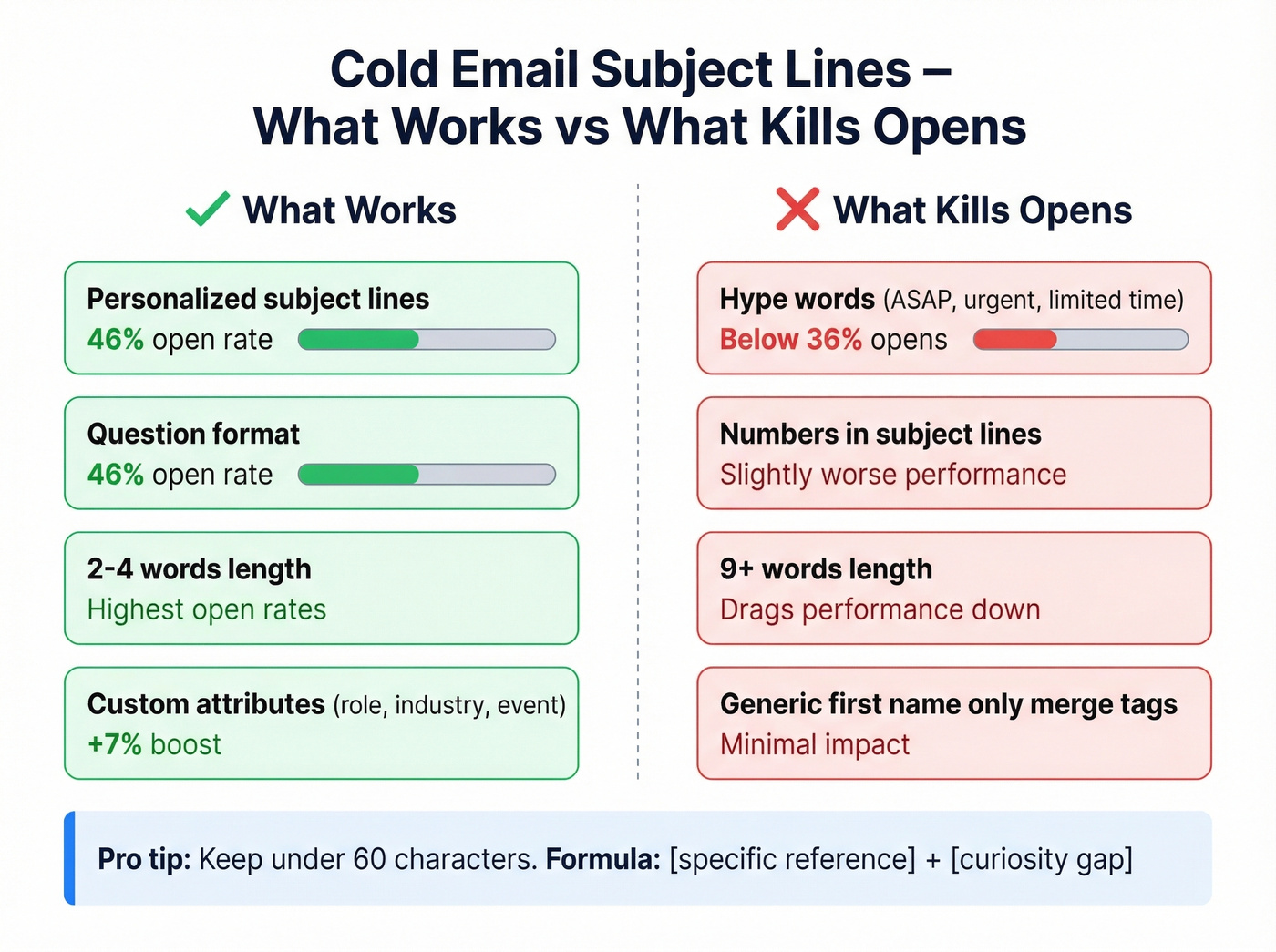
The Belkins dataset, combined with a 5.5 million-email subject-line analysis, makes the rules clear. Personalized subject lines hit a 46% open rate versus 35% without - about a 31% boost. Question-style subject lines matched that 46% mark. The length sweet spot is tight: 2-4 words produced the highest opens, while anything past 9 words dragged performance down.
Hype terms kill opens. Words like "ASAP," "urgent," or "limited time" pulled open rates below 36%. Numbers in subject lines performed slightly worse too. The consensus on r/sales mirrors this - prospects have developed antibodies to urgency language.
Hunter's analysis of 20,000+ subject lines found that including at least one custom attribute - job role, industry, a conference they attended - boosted opens by 7%+. That's the real personalization lever. Not just inserting {{first_name}}, but referencing something specific to their world. Hunter also found that 95-word emails outperformed 170-word emails by 5.81% in click-through rate, further evidence that brevity wins across every metric.
Pronoun heuristic: Aim for a 1-to-2 ratio of "I/my" versus "you/your." If your email talks about yourself more than the prospect, rewrite it.
Keep subject lines under 60 characters to avoid inbox truncation. A good formula: [specific reference] + [curiosity gap]. If you want more options, pull from a swipe file of subject lines and adapt them to your ICP.
Templates That Actually Get Replies
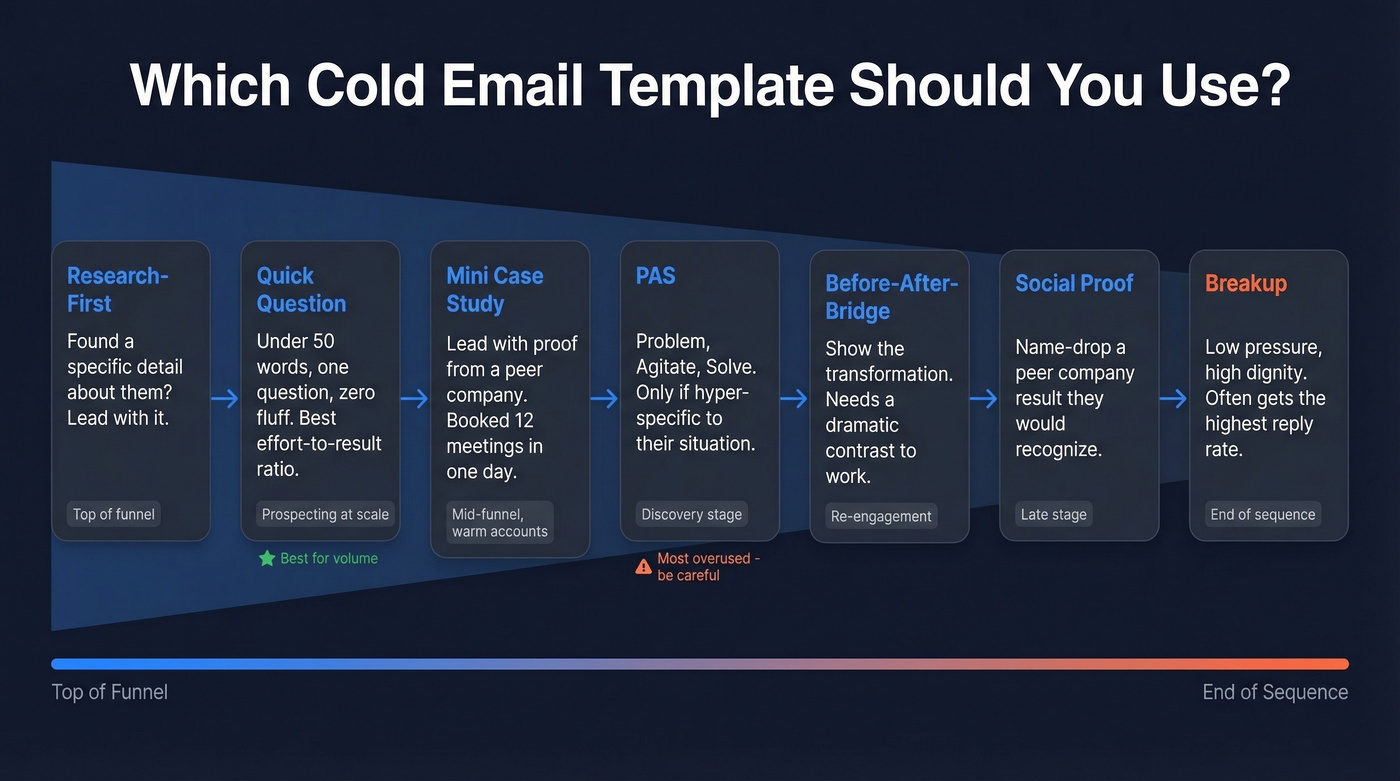
Every template below includes a named framework, guidance on when to use it, and the sales stage it fits best. Treat these as starting skeletons - the personalization is on you.
The Research-First Email
Framework: Intro -> Observation -> Bridge -> Vision -> Offer
Filled-in example:
Hi Sarah,
Caught your comment on the MarketingProfs thread about attribution being "the metric everyone reports and nobody trusts" - couldn't agree more.
Most B2B marketing teams in the $10-50M range are still stitching together attribution from 3+ tools. What if your pipeline reporting was as sharp as your campaign creative?
We helped a similar SaaS marketing team cut reporting time by 60% and surface $400K in hidden pipeline within 90 days. Worth a 15-minute call?
When to use: When you've found something genuinely specific - a comment, a podcast appearance, a recent hire. This framework from r/b2bmarketing works because the observation proves you did homework. Skip it if you can't find a real, specific detail. Best for: Top-of-funnel prospecting.
The Quick Question
This is the workhorse template - under 50 words, one question, zero fluff. It respects the under-90-word rule most faithfully and scales better than any other format because the personalization burden is lighter. If you're running high-volume outbound on deals under $10K, start here. Among all the formats in this guide, this one has the strongest effort-to-result ratio.
Hi {{first_name}},
You handle {{responsibility}} at {{company}} - curious how you're solving {{specific problem}} right now?
We've helped similar teams cut {{metric}} by {{result}}. Worth a quick chat?
Best for: Prospecting at scale.
The Mini Case Study
This is the template that earns trust fastest, because you're leading with proof instead of promises. One practitioner on r/sales reported this format booked 12 meetings in a single day - nearly double their standard template's performance. The key is a proof point from a company the prospect would recognize as a peer.
Filled-in example:
Hi James,
Datadog is scaling the enterprise sales team - congrats on the 12 new AE hires this quarter.
We just helped Grafana reduce their lead-to-meeting time from 9 days to 3. Their SDR team went from 15 qualified meetings per month to 38 in under 60 days.
Would it make sense to show you how?
Placeholder version:
Hi {{first_name}},
{{Company}} is scaling {{department}} - congrats on the recent hires.
We just helped {{similar company}} reduce their {{pain point}} by {{specific number}}. Their team went from {{before state}} to {{after state}} in {{timeframe}}.
Would it make sense to show you how?
Best for: Mid-funnel, warm accounts.
The PAS (Problem-Agitate-Solve)
Skip this template unless you can write a problem statement hyper-specific to the prospect's situation. PAS is the most overused framework in cold email, and generic versions of it are the fastest way to get deleted. The only way it works in 2026 is if the prospect reads the first line and thinks "how do they know that?"
Hi {{first_name}},
Most {{role}}s at {{company stage}} companies tell us the same thing: {{problem statement}}.
It gets worse when {{agitation - what happens if they don't fix it}}.
We built {{product/service}} specifically for this. {{One-sentence proof point.}} Open to hearing more?
Best for: Discovery stage, complex pain points.
The Before-After-Bridge
Hi {{first_name}},
Before: {{Their current painful reality - be specific.}}
After: {{What their world looks like with the problem solved.}}
Bridge: That's exactly what we did for {{similar company}} - {{one-line result}}.
Worth 15 minutes to see if we can do the same for {{company}}?
Works especially well for tools that save time or reduce manual work. The transformation story needs to be stark - if the before/after contrast isn't dramatic, use a different template. Best for: Re-engagement or second touch.
The Social Proof Email
Hi Priya,
Snyk was dealing with AE-sourced pipeline drying up - reps were spending 4-6 hours a week on manual prospecting with 35% bounce rates. After switching their data stack, they cut bounces to under 5% and grew AE-sourced pipeline by 180%.
They're a 500-person security company like CrowdStrike, so the playbook translates directly. Want me to share what they did?
Best for: Late-stage prospecting, competitive displacement.
The Breakup Email
Hi {{first_name}},
I've reached out a couple times - no worries if the timing isn't right.
If {{problem}} becomes a priority down the road, I'm here. Deleting you from my sequence either way. Cheers.
Final touch in a sequence. Low pressure, high dignity. Breakup emails often generate the highest reply rates in a sequence because they remove all obligation. Best for: End of sequence.

You read it above: teams double reply rates just by switching to verified data. Prospeo delivers 98% email accuracy with a 7-day refresh cycle - so your best cold email templates actually reach real inboxes instead of bouncing.
Stop perfecting templates that bounce. Fix the data first.
Follow-Up Sequence That Maximizes Replies
The first follow-up lifts reply rates by up to 49%. Roughly 60% of replies come after the second follow-up. But diminishing returns hit fast - the third email produces ~20% fewer responses than the second, and by the fifth, response rates drop 55%.
If you want more plug-and-play options, borrow a few follow-up templates and adapt them to your offer.
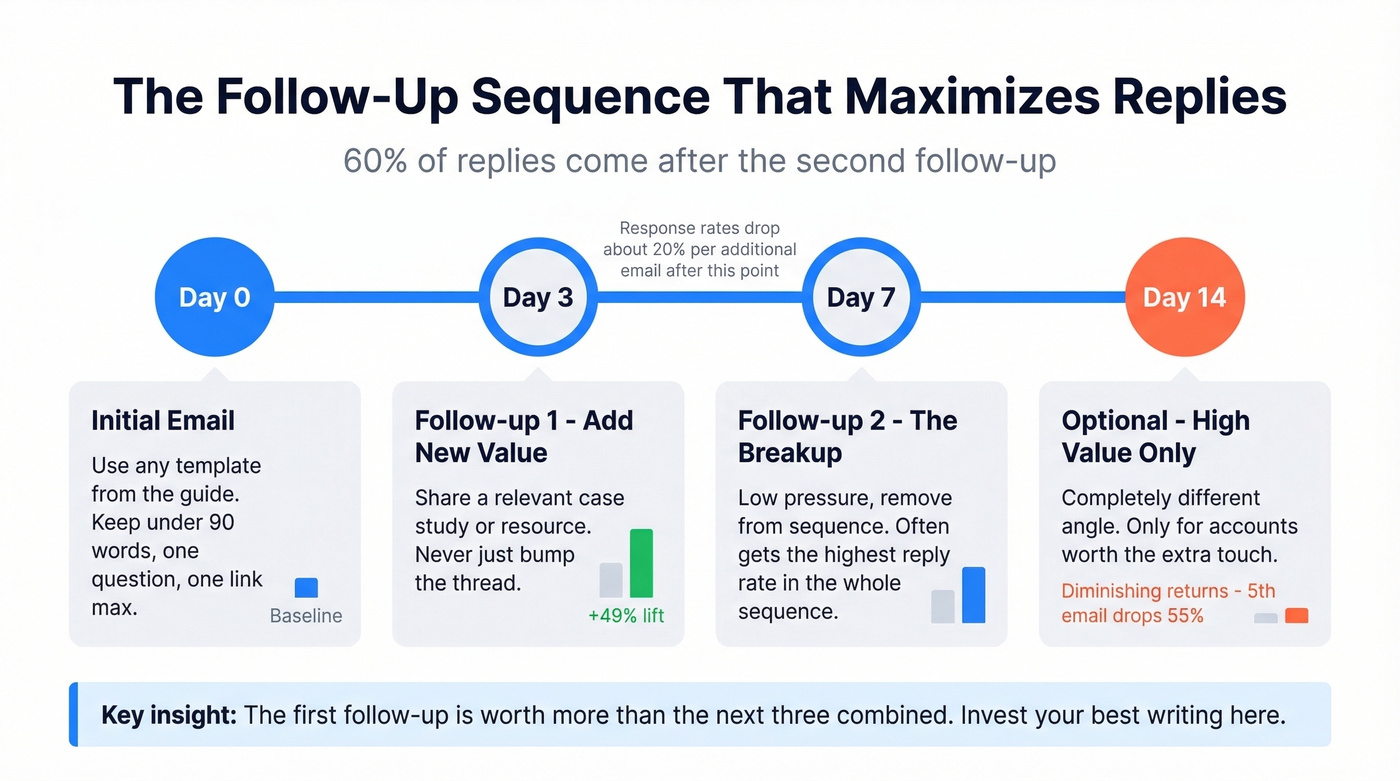
Here's the sequence we recommend:
Day 0 - Initial email. Use any template above.
Day 3 - Follow-up #1: Add new value. Don't just "bump" the thread.
Hi {{first_name}},
Quick follow-up - thought this might be useful. {{Similar company}} published a case study on how they solved {{problem}} - {{one-line result}}.
Here's the link: {{link}}. Happy to walk you through how it'd apply to {{company}} if you're interested.
Day 7 - Follow-up #2: The breakup email. Use the Breakup template above.
Day 14 - Optional, high-value accounts only. A completely different channel touch - a relevant article share, a brief video message - can re-open the conversation. For most accounts, three email touches is the ceiling. Spend the energy finding better-fit prospects instead.
Testing Your Templates
Don't A/B test with gut feel. Run a 20/80 split: send the new variant to 20% of your list, measure for 48 hours, then deploy the winner to the remaining 80%. Test one variable at a time - subject line, opening line, or CTA. Never all three at once. That's how you build compounding improvements instead of chasing noise.
Your Templates Are Useless in Spam
Gmail enforced bulk-sender authentication requirements in February 2024. Outlook followed with high-volume sender enforcement in May 2025. If you haven't set up SPF, DKIM, and DMARC, your emails aren't reaching inboxes. Period.
Technical checklist:
- SPF: One record, 10 or fewer DNS lookups (more triggers a PermError)
- DKIM: 2048-bit keys, published at
selector._domainkey - DMARC: Start at
p=nonewith reporting, then move to quarantine/reject
If you need a deeper walkthrough, start with a clean SPF setup and then validate DKIM end-to-end.
Warm-up ramp for new mailboxes:
| Week | Daily volume | Notes |
|---|---|---|
| Week 1 | 30-50 | Plain text only, no trackers |
| Week 2 | 50-80 | Monitor bounce rate |
| Week 3 | 80-120 | Only if metrics are green |
| Week 4 | 120-150 | Max sustainable volume |
Keep bounce rates under 3% and spam complaints under 0.1% per mailbox. If you exceed either threshold, pause and fix before sending another email.
Monitor with Gmail Postmaster Tools and Microsoft SNDS. Send from named humans, not "sales@company.com." And skip open-tracking pixels on day one - they're the fastest way to trigger spam filters on a fresh domain.
The Hidden Variable: Data Quality
Let's be honest about where most cold email advice falls short. Templates and subject lines get all the attention, but data quality is the foundation everything else sits on.
Picture this: you launch a 500-email sequence Monday morning. By noon, 47 bounces. That's a 9.4% bounce rate - three times the safe threshold. Your domain reputation just took a hit that'll take weeks to recover from. I've watched teams spend weeks perfecting copy only to torch their sender reputation on day one because they skipped verification.
Stack Optimize built from $0 to $1M ARR running cold email campaigns with 94%+ deliverability, bounce rates under 3%, and zero domain flags across all clients. The difference? They verified every email before it went out. No collection of top outreach templates will save a campaign built on bad data.
Prospeo runs a 5-step verification process with catch-all handling, spam-trap removal, and honeypot filtering - 98% email accuracy on 143M+ verified addresses. Data refreshes every 7 days, compared to the 6-week industry average. You can verify 75 emails per month free, no contracts or sales calls required. For outbound teams, pairing it with your sequencer (native integrations with Smartlead, Instantly, and Lemlist) means your carefully crafted templates actually reach real inboxes.
If you're comparing options, start with a shortlist of data enrichment services and a dedicated email reputation monitoring stack.
Sending 200 cold emails means nothing if 30 bounce and 50 hit spam. Prospeo's 5-step verification and proprietary email infrastructure keep bounce rates under 4% - exactly the foundation the benchmarks above demand.
Every template in this guide works better with verified contacts at $0.01 each.
Cold Email Compliance Essentials
Cold email is legal in every major market - with rules.
| Jurisdiction | Consent needed? | Max penalty | Key requirement |
|---|---|---|---|
| US (CAN-SPAM) | No prior consent | Up to $53,088/email | Opt-out honored in 10 business days |
| EU (GDPR) | Legitimate interest | EUR 20M or 4% revenue | Document your LIA |
| Canada (CASL) | Consent-first | Up to $10M per violation | 24-month implied window |
| UK (PECR) | Varies by recipient type | GBP 500,000 | Reg 22 rules apply |
Real talk: the biggest compliance risk isn't the legal framework - it's lazy shortcuts. Never use deceptive "Re:" subject lines or fake invoice-style bait. Include your physical address. Add a one-click unsubscribe. Honor opt-outs within 10 business days and keep records for 3 years (CASL requires this explicitly).
For GDPR, legitimate interest is your lawful basis for B2B cold email. Document a Legitimate Interest Assessment covering purpose, necessity, and balancing tests. It takes 30 minutes and protects you from fines that can reach 4% of global revenue.
FAQ
What reply rate should I expect from cold email?
Based on 16.5 million emails analyzed, the average reply rate is 5.8%. Top performers hit 8-10% with deep personalization and clean data. If you're below 3%, the issue is almost certainly deliverability or data quality, not your template.
How long should a cold email be?
Six to eight sentences, under 200 words. This length produces a 6.9% reply rate - the highest in the dataset. Every sentence must earn its place. Use two-sentence paragraphs for scannability.
How many follow-ups should I send?
Three total touches - initial email plus two follow-ups. The first follow-up lifts reply rates by up to 49%, and roughly 60% of all replies come after the second message. Beyond three, response rates drop sharply. Spend that energy finding better-fit prospects.
How do I stop cold emails from landing in spam?
Authenticate your domain (SPF, DKIM, DMARC), warm up new mailboxes over 4 weeks, keep bounce rates under 3%, and verify your contact list before sending. Prospeo catches invalid addresses before they damage your sender reputation - the free tier covers 75 verifications per month.
Is cold email legal in 2026?
Yes, in every major market. The US (CAN-SPAM) requires no prior consent for B2B outreach - just a working opt-out, your physical address, and honest subject lines. The EU allows it under GDPR's legitimate interest basis. Canada (CASL) is strictest but permits a 24-month implied consent window for existing business relationships.