

Best Day to Cold Call in 2026 (300M Calls Analyzed)
Fifty dials, three connects, zero meetings. The timing was textbook - Tuesday morning, 10am sharp. But the problem wasn't when the reps were calling. Half the numbers rang to voicemail boxes that hadn't been set up, and the other half belonged to people who'd left the company six months ago.
Every cold calling article obsesses over the best day to cold call. Almost none talk about the variable that actually determines whether your dials connect: data quality. Remote work has scrambled how predictable "office hours" feel, and a lot of the best timing data sits inside proprietary dialers - which makes the benchmarks that do get published more valuable than ever. We've seen teams triple their connect rates by fixing their data, not their schedule.
Let's fix both.
Quick Answer: Best Days and Times
Call Tuesday or Wednesday, between 10-11am or 4-5pm in the prospect's local time. Those two days account for 44% of all demos booked across 1.4M+ outbound calls to new business accounts, per ZoomInfo's analysis. Avoid Friday afternoons and the lunch hour. If you can only protect two calling blocks per week, make them Tuesday 10-11am and Wednesday 4-5pm.
But timing is roughly 20% of the equation. Data quality determines whether those dials actually ring a human.
How Each Weekday Performs
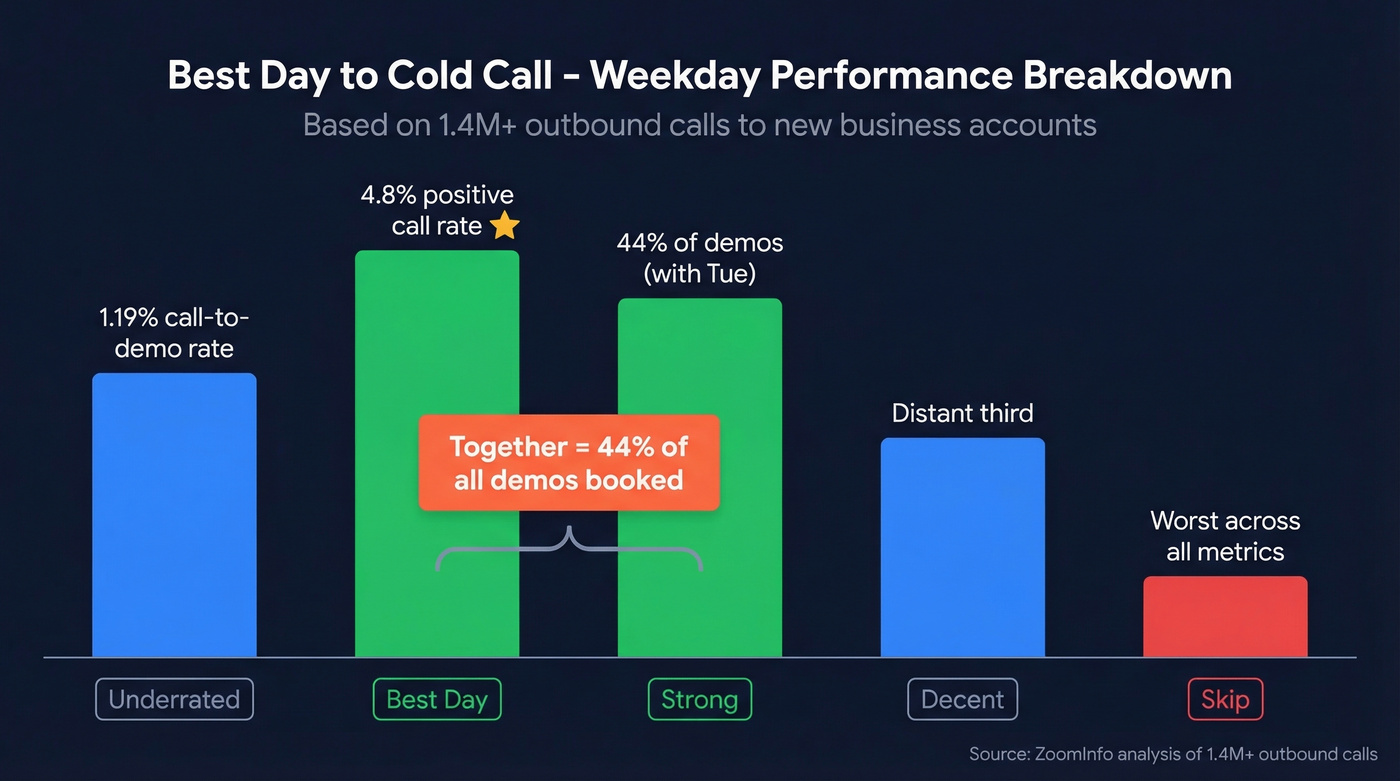
Tuesday is the top-rated day for cold calling. Here's how the week breaks down:
| Day | Verdict | Key Data | Notes |
|---|---|---|---|
| Tuesday | Best | 4.8% positive call rate (tied with Monday) | Highest demo volume share |
| Wednesday | Strong | Tue + Wed = 44% of demos | Even stronger in EMEA |
| Thursday | Decent | Distant third | Still a productive calling day |
| Monday | Underrated | 1.19% call-to-demo rate | Call volume ~15% lower than Tuesday |
| Friday | Skip | Worst across all metrics | Lowest volume, connects, demos, and positive call rate |
Tuesday and Wednesday together generate 44% of all demos - nearly half the week's output crammed into two days. Thursday trails as a distant third but remains worth staffing.
Here's the thing: Monday is underrated. It has the highest call-to-demo efficiency at 1.19% and ties Tuesday for the best positive call rate at 4.8%. Monday call volume runs about 15% lower than Tuesday, which partly explains why it feels "quieter" to prospects - less competition for their attention. The trick is avoiding early Monday morning when everyone's clearing weekend email. Late Monday morning works well. We've watched teams waste entire Friday calling blocks before reallocating those hours to Tuesday, and the lift is immediate.
Friday is the worst day for cold calling. Every metric craters. If you're staffing Friday calling blocks, stop.
One SDR on r/sales tracked 37,000+ calls and landed on the same peak windows the larger datasets show - 8am and late afternoon - reinforcing that these patterns hold at the individual rep level, not just in aggregate studies.
For EMEA prospects, Wednesday outperforms its global ranking. Connect rates, positive call rates, and call-to-demo conversion all tick up on Wednesdays for European buyers. If you're running a transatlantic team, weight your EMEA lists toward mid-week.
Best Times of Day to Dial
Two windows consistently outperform everything else: 10-11am and 4-5pm in the prospect's local time. This is the convergence point across multiple datasets - Gong's analysis of 100,000 connected B2B sales calls, CallHippo's 2019 dataset, and SalesHive's 2026 benchmarks all point to the same blocks.
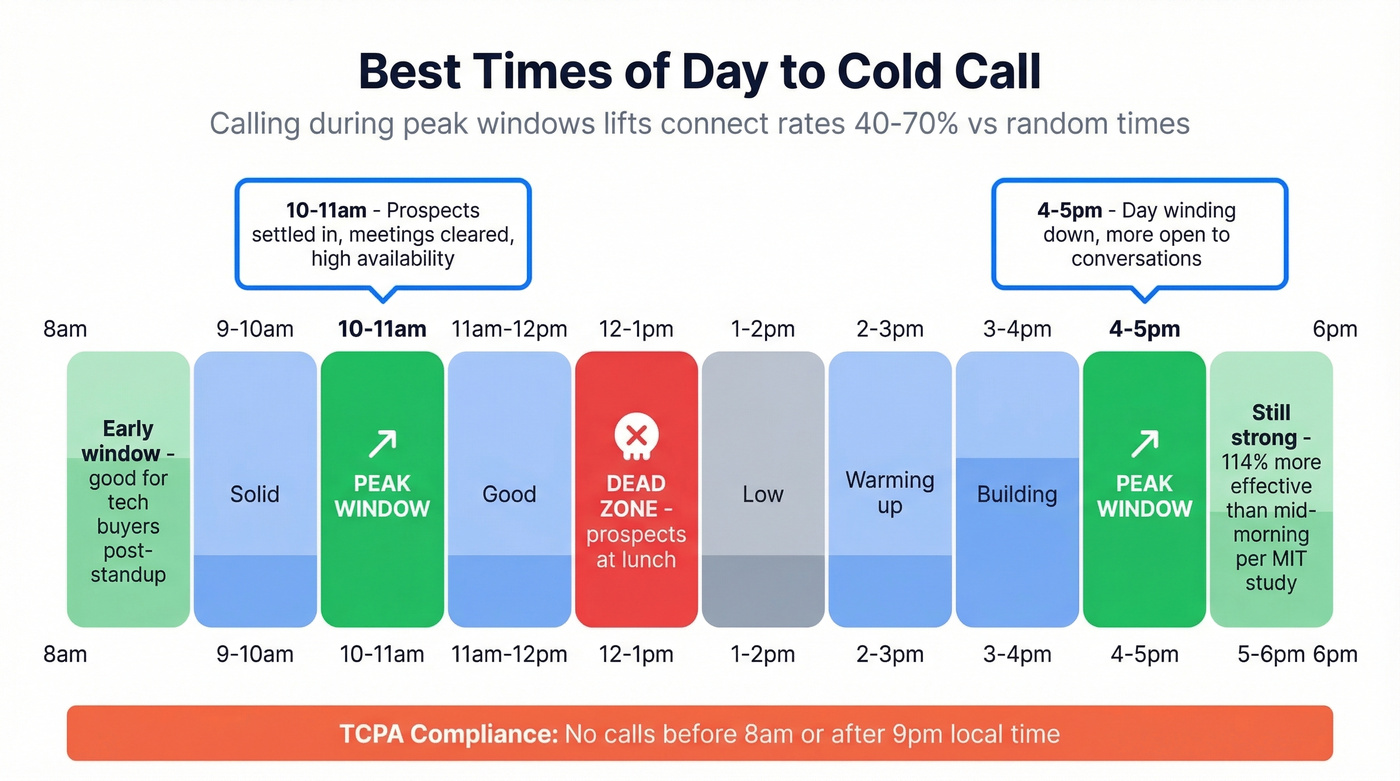
Some guides call these the "shoulder" windows - the gaps before and after the meeting-heavy core of the day. The data supports the concept. SalesHive's numbers show that calling during the 8-9am or 4-5pm windows lifts connect rates 40-70% compared to dialing at random times. That's not marginal. That's the difference between three conversations per day and five.
The classic MIT/InsideSales study from 2007-2008 found late afternoon (4-6pm) was 114% more effective than mid-morning, and modern datasets still confirm late afternoon as a top window.
The worst time? Lunch. The 12-1pm block is a dead zone - prospects are away from their desks, screens locked, your dials going straight to voicemail. If you're dialing during lunch, you're burning dials for nothing. Protect two blocks - late morning and late afternoon - and batch everything else around them.
One compliance note: the TCPA prohibits calling residences before 8:00 a.m. or after 9:00 p.m. local time, and violations have led to multimillion-dollar settlements. Stay inside compliant windows.
2026 Cold Calling Benchmarks
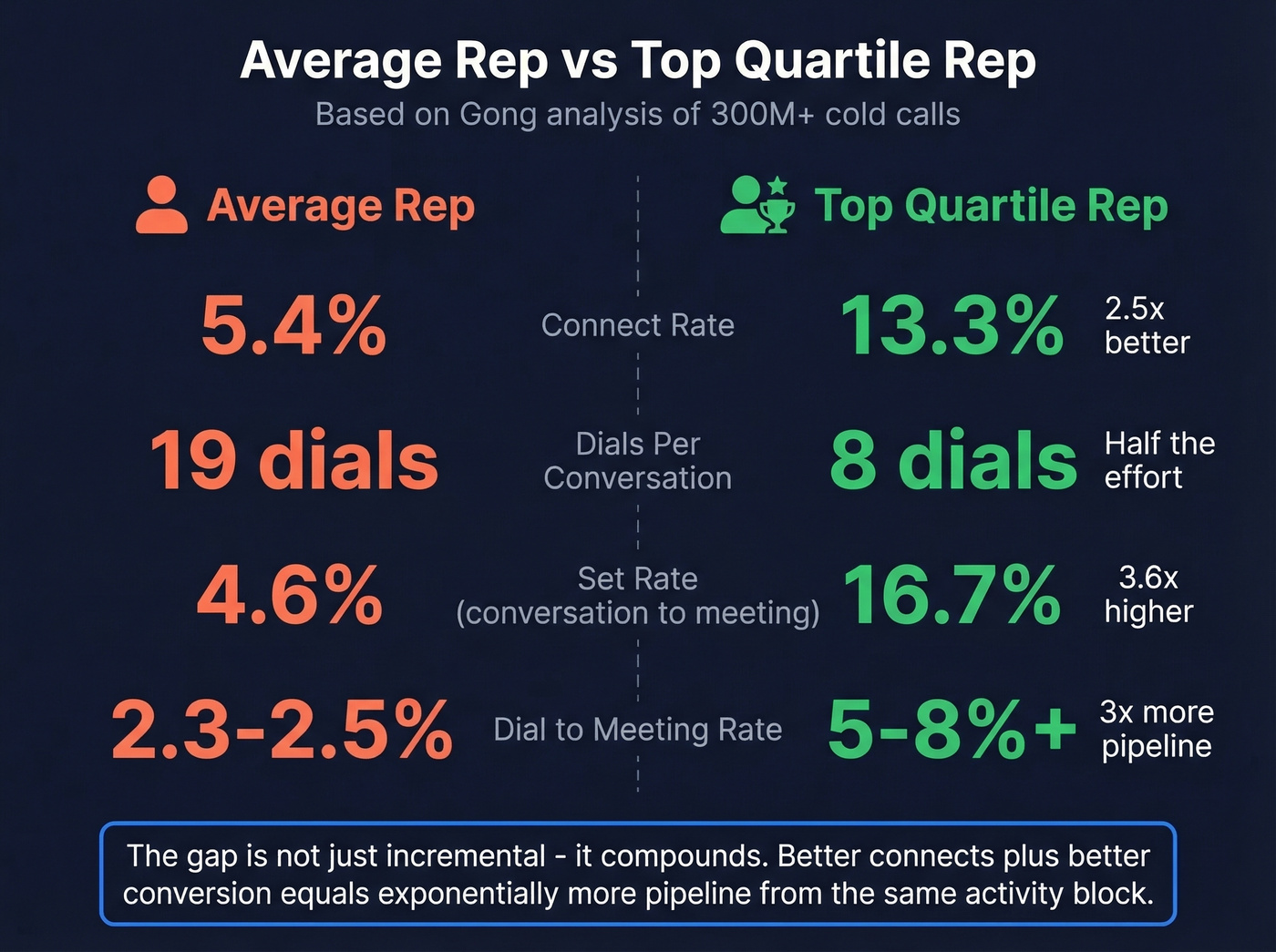
Before you optimize timing, you need to know what "good" looks like. Gong's analysis of 300M+ cold calls paints a stark picture of the gap between average and top-performing reps:
| Metric | Average Rep | Top Quartile |
|---|---|---|
| Connect rate | 5.4% | 13.3% |
| Dials per conversation | 19 | 8 |
| Set rate (conversation to meeting) | 4.6% | 16.7% |
| Dial-to-meeting rate | ~2.3-2.5% | 5-8%+ |

Top-quartile reps need half the dials to start a conversation and book 3x+ more meetings from those conversations. The compounding effect is massive - a rep who's better at both connecting and converting doesn't just perform incrementally better, they produce exponentially more pipeline from the same activity block.
Most SDR teams average 40-50 dials per day, generating 4-6 quality conversations. At a 2.3-2.5% dial-to-meeting rate, that's roughly one meeting per day. It takes 8+ attempts to reach a prospect, so persistence matters as much as timing.
One stat that doesn't get enough attention: cold calling nearly doubles email reply rates. Gong found that prospects who received a cold call replied to emails at 3.44% vs 1.81% for those who didn't - even when the call itself didn't connect. The voicemail alone primes the email.
If you want to systematize the rest of your outbound motion, start with a repeatable set of sales activities and a tighter set of sales prospecting techniques that match your ICP.

Your reps don't have a timing problem - they have a data problem. Half of cold call failures come from dialing numbers that belong to people who left months ago. Prospeo's 125M+ verified mobile numbers refresh every 7 days, not every 6 weeks. Teams using Prospeo see 30% pickup rates vs. the 12.5% industry average.
Stop wasting your Tuesday 10am window on dead numbers.
Optimal Windows by Industry
Generic "Wednesday at 10am" advice has a shelf life. Your industry and buyer persona shift the optimal windows significantly.
Tech / SaaS: Call right after standup. Most engineering and product teams wrap their morning sync by 8:45-9:15am. That post-standup window catches decision-makers before they disappear into deep work blocks. The standard 10-11am window works for sales and marketing buyers, but technical buyers are often heads-down by then.
Real estate is the opposite of a 9-to-5 play. Agents and brokers are showing properties during business hours, so the sweet spot is 4-6:30pm - the commute window when they're between appointments and actually answering their phones. (If you sell into that segment, keep a set of real estate phone scripts ready.)
Financial services: Avoid Monday mornings entirely - advisors and analysts are processing weekend market moves. Post-market-close works well, after 4pm ET. One financial advisor on r/CFP reported a 14% appointment rate on answered calls working a highly targeted list. That's exceptional, but it reinforces the point: targeting quality matters as much as timing.
B2B vs B2C: B2C prospects may accept evening calls; B2B prospects generally won't. Respect the boundary. There's also a "first five days of the month" effect - prospects are planning and budgeting, making them slightly more receptive to meeting requests.
Build a Time-Zone-Aware Schedule
If you're calling prospects across multiple time zones - and most teams are - a flat calling block doesn't work.
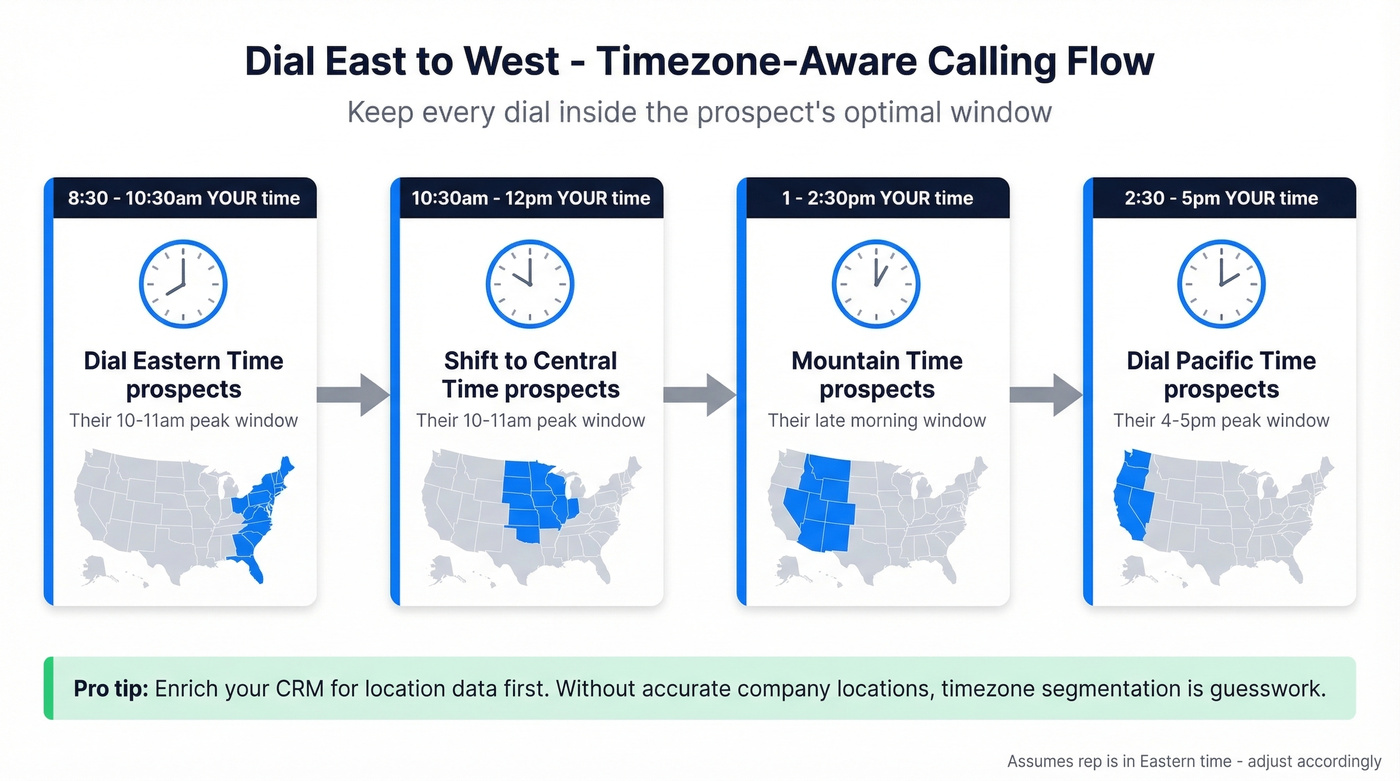
Segment lists by timezone before each block. Pull your CRM list and sort by prospect location. Don't mix East Coast and West Coast contacts in the same hour.
Dial east to west. Start with Eastern time prospects in your morning block, then shift to Central and Mountain, finishing with Pacific in your afternoon block. This keeps every dial inside the prospect's optimal window.
Enrich for location data. If your CRM records are missing company location, run them through an enrichment tool first. Prospeo's enrichment returns 50+ data points per contact including company headquarters, making timezone segmentation automatic rather than manual. (If you're comparing vendors, see our breakdown of data enrichment services.)
Automate local-hour scheduling. Use your CRM or sales engagement platform to schedule follow-up calls in the prospect's local business hours, not yours. A 2pm call in your timezone might be a 5pm call in theirs - that's the difference between a connect and a voicemail.
Why Data Quality Matters More Than Timing
Look, here's my honest take: the best day to make cold calls is whichever day your data is fresh. Calling at the perfect time with a wrong number is a wasted window - and that happens far more often than most teams admit.
The industry average for data refresh is six weeks. That means the phone number your rep dials on Tuesday at 10am might belong to someone who changed jobs last month. Every stale number burns one of your 40-50 daily dials and pushes your connect rate further below that 5.4% average.
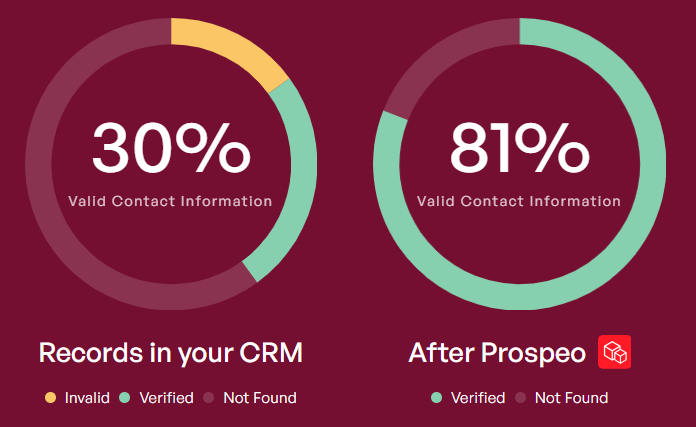
In our experience, data quality accounts for far more of the variance in connect rates than any timing optimization. A rep with verified mobiles calling at 2pm on a Thursday will outperform a rep with stale data calling at the "optimal" 10am Tuesday - every single time. Prospeo maintains 125M+ verified mobile numbers on a 7-day refresh cycle, roughly 6x faster than the industry norm, with a 30% pickup rate across all regions. Data quality is the 80% of the equation that timing articles ignore.
If you're building a repeatable outbound engine, it helps to think in terms of a full cold calling system (data, dialer, scripts, QA) rather than just calendar blocks.
Top-quartile reps need only 8 dials per conversation - half the average. The difference isn't just skill, it's data. When every number is verified and refreshed weekly, your best calling blocks actually convert. At $0.01 per lead, fixing your data costs less than one wasted hour of dialing disconnected lines.
Turn your 40 daily dials into 8+ real conversations.
Your Weekly Cold Calling Schedule
Here's a template combining the day-of-week data, two peak time windows, and realistic activity targets. At 40-50 dials per day across your calling blocks, this should generate 4-6 quality conversations daily.
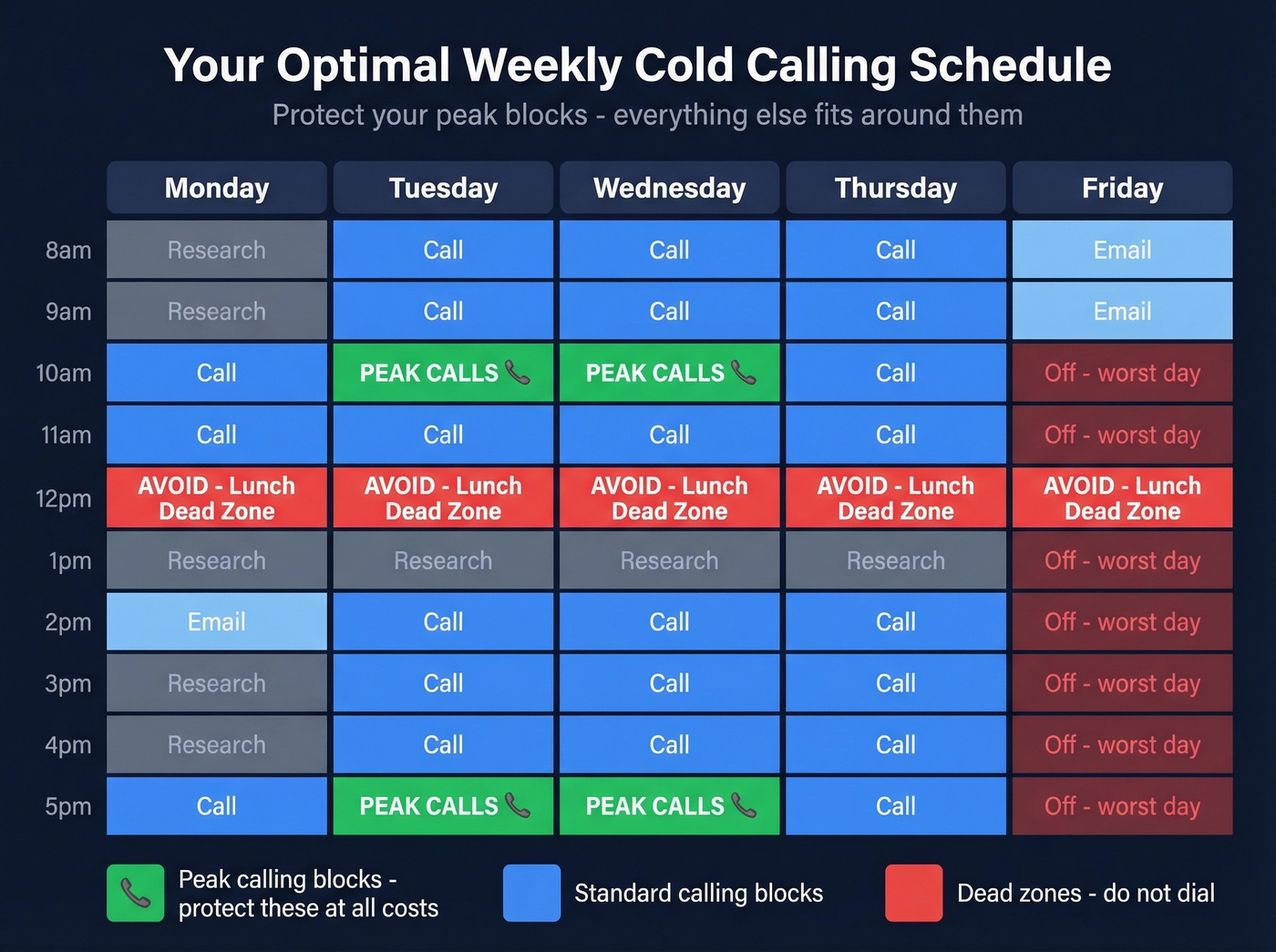
| Time | Monday | Tuesday | Wednesday | Thursday |
|---|---|---|---|---|
| 8-9 | Research | Call | Call | Call |
| 9-10 | Research | Call | Call | Call |
| 10-11 | Call | Call | Call | Call |
| 11-12 | Call | Call | Call | Call |
| 12-1 | Avoid | Avoid | Avoid | Avoid |
| 1-2 | Research | Research | Research | |
| 2-3 | Call | Call | Call | |
| 3-4 | Research | Call | Call | Call |
| 4-5 | Call | Call | Call | Call |
Friday: Email follow-ups in the morning, then wrap for the week. Don't waste your best dials on the worst day.
Bold blocks are your two protected power hours - guard them. Monday mornings are for research and list prep so your Tuesday dials are sharp. Friday mornings handle email follow-ups from the week's conversations. Skip this structure and you'll default to random dialing, which the data says costs you 40-70% of your potential connects.
To convert the conversations you do get, keep a tight set of sales follow-up templates and a consistent sales meeting follow-up email process.
FAQ
Is Monday a good day to cold call?
Monday has the highest call-to-demo efficiency at 1.19% and ties Tuesday for the best positive call rate at 4.8%, making it a surprisingly productive calling day. Avoid early morning when prospects are clearing inboxes, but late morning through afternoon works well. It won't match Tuesday's raw volume, but the conversion efficiency makes it worth staffing.
What's the single best day for cold calling?
Tuesday. Every major dataset points to it, with Wednesday as a close second - together they account for 44% of all demos booked. If your team can only prioritize two days, those are the ones to protect.
How many cold calls should I make per day?
Most SDR teams average 40-50 dials per day, generating 4-6 quality conversations and roughly one meeting at a 2.3-2.5% dial-to-meeting rate. Top teams operating at 5-8%+ book two to three meetings daily from the same dial volume - the gap comes down almost entirely to data quality and conversation skill, not raw activity.
Does data quality affect cold call connect rates?
Fresh, verified mobile numbers are the single biggest lever for improving connect rates - more impactful than any timing optimization. The industry-standard six-week refresh cycle means numbers go stale fast, especially in high-turnover roles. Teams that switch to weekly-refreshed data sources routinely see connect rates jump 2-3x during those Tuesday and Wednesday power hours.