

Best Discovery Questions for Sales in 2026: A Stage-by-Stage System That Closes Deals
A RevOps lead ran a discovery call audit last quarter. The team asked 22 questions per call, hit every MEDDIC checkbox, and still lost deals at proposal. The problem wasn't the questions - it was the sequence, the depth, and the fact that half the calls targeted the wrong person entirely.
The best discovery questions in sales don't follow a script. Data from thousands of recorded sales calls shows 11-14 targeted questions per call correlate with the highest close rates. More than that and you're interrogating, not discovering. One Reddit poster put it bluntly - AI-generated discovery questions make you sound like a robot. And with 96% of consumers researching tools before they ever talk to sales, you can't afford to waste the conversation on basics.
Three Questions That Matter Most
If you only remember three questions from this entire article:
- "Why now?" - reveals urgency and internal pressure
- "Who else is involved?" - maps the buying committee early
- "What happens if you don't solve this?" - quantifies the cost of inaction
For framework selection: BANT works for deals under $10K, SPICED fits many SaaS motions, and MEDDIC earns its complexity on $50K+ enterprise deals. These questions are built for B2B sales - B2C discovery follows different patterns entirely.
Discovery Call Benchmarks
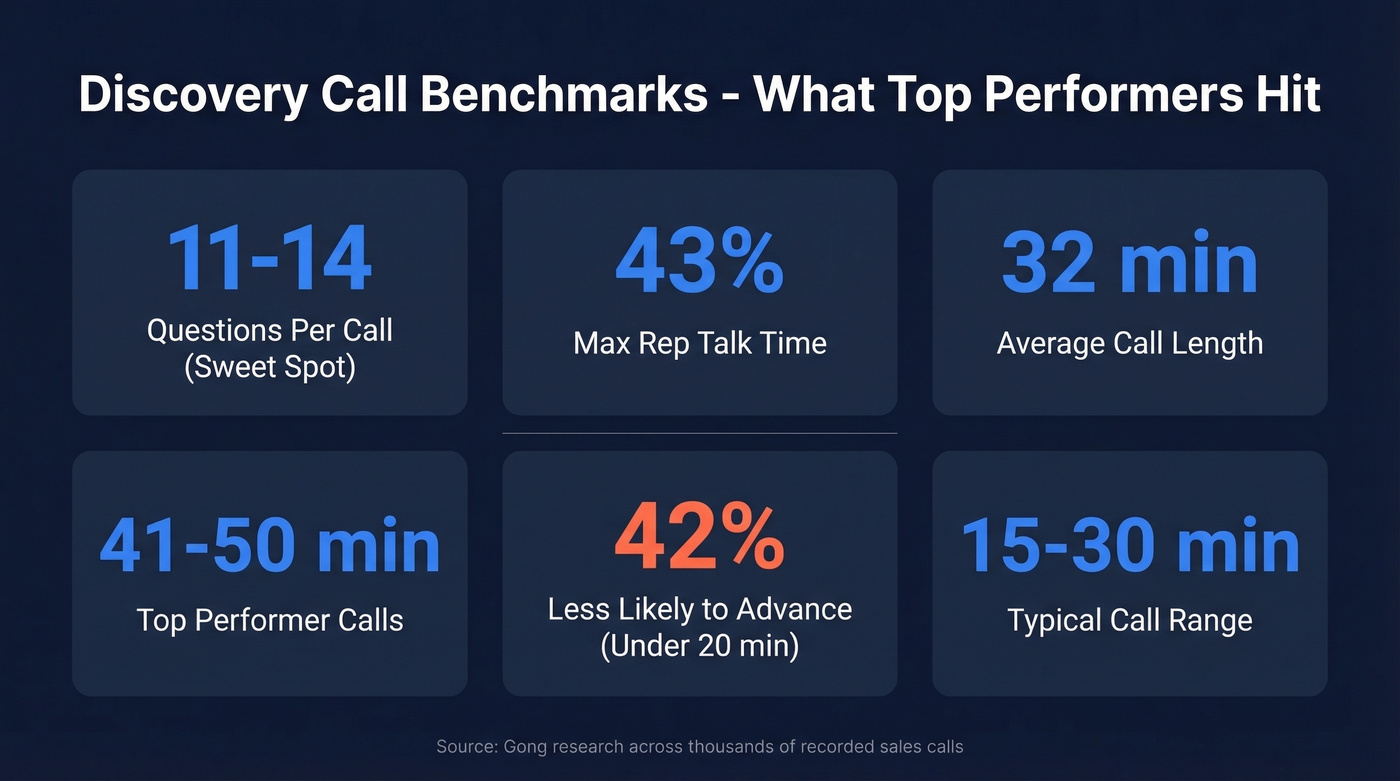
These benchmarks are drawn from Gong's published guidance on discovery questions and widely cited call analysis across large datasets. Treat them as guardrails, not gospel.
| Metric | Benchmark |
|---|---|
| Questions per call | 11-14 |
| Rep talk time | 43% |
| Avg call length | 32 min |
| Top performer calls | 41-50 min |
| Calls under 20 min | 42% less likely to advance |
| Typical range | 15-30 min |
If you're talking more than 43% of the call, you're pitching, not discovering. Longer buyer responses correlate directly with higher close rates - the more your prospect talks, the better your odds.
Pre-Call Research Checklist
Your prospect has already done their homework. 90% of their research is done before they pick up the phone. Every Googleable question you ask costs you credibility. We've seen reps burn the first five minutes asking things a quick look at the company's careers page would've answered.
Before every discovery call, confirm these:
- Company context - recent funding, headcount changes, tech stack, open job postings that signal priorities
- Prospect's role and tenure - a new VP has different urgency than someone three years in-seat
- Stakeholder map - modern B2B deals involve 6-10+ stakeholders, so know who else might be in the room
- Verified contact data - confirm you have a working email and direct dial before the call, not after (see email verification)
- Competitive landscape - check job postings and tech stack for clues about alternatives they're evaluating
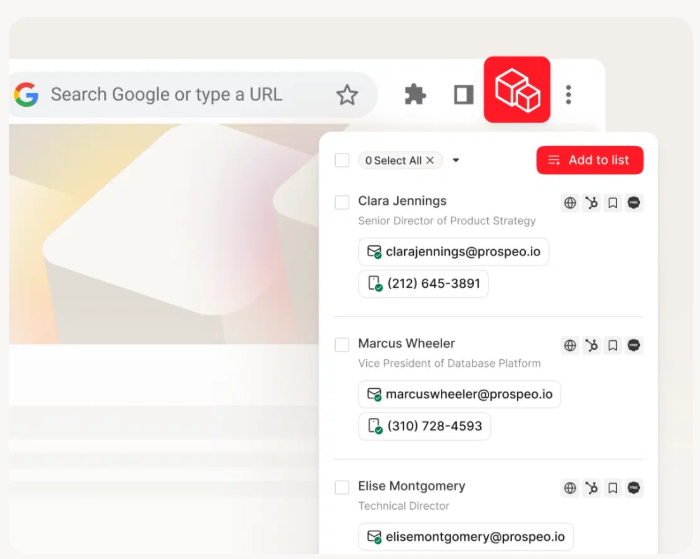

Your pre-call checklist says confirm contact data before every discovery call. Prospeo gives you 98% accurate emails and 125M+ verified mobile numbers - so you spend those 32 minutes talking to the actual decision-maker, not chasing bounced emails afterward.
Stop running perfect discovery on the wrong prospect.
Sales Discovery Questions by Stage
A flat list of 30 questions isn't useful. What matters is asking the right question at the right moment. Here are the best discovery call questions organized by the stage of conversation where they hit hardest.
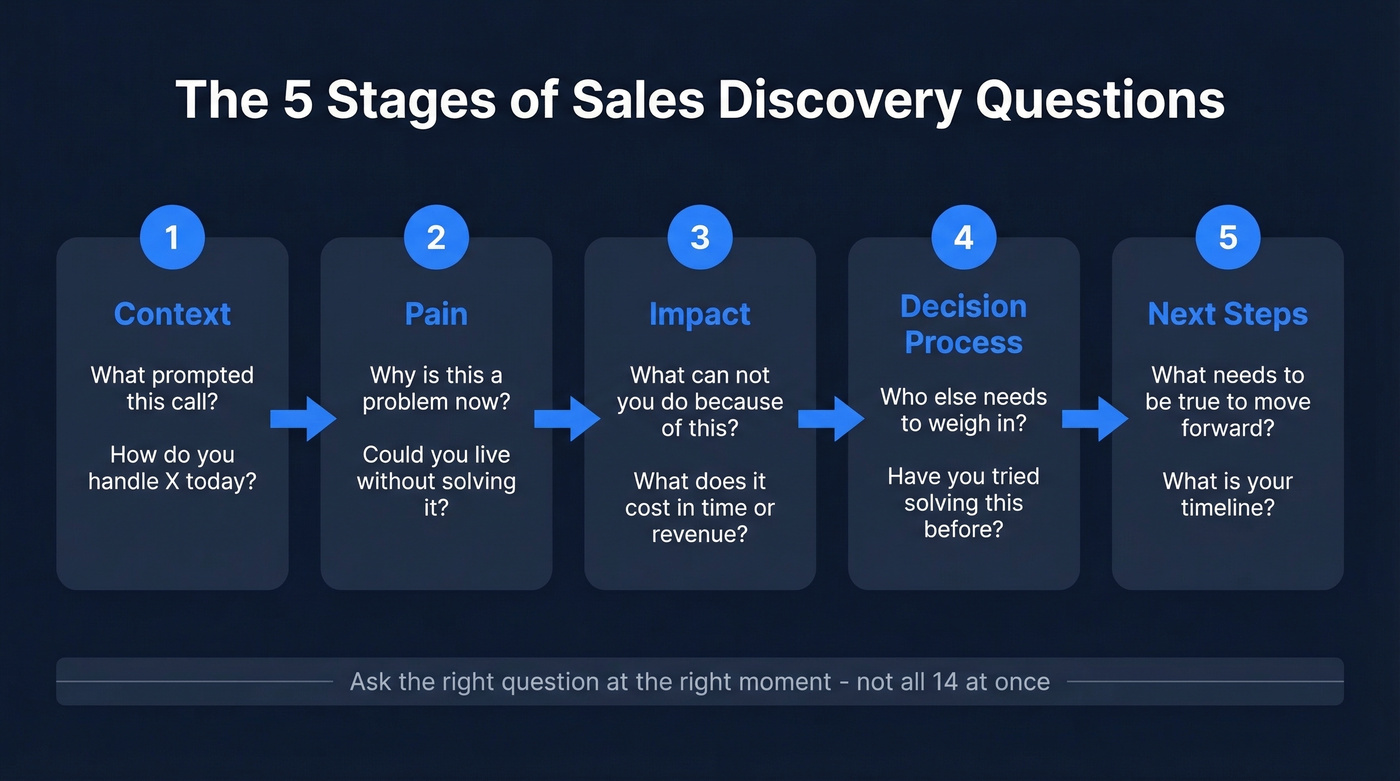
Context
- "What prompted you to take this call?" - Tells you whether they're actively shopping or just exploring. The answer shapes your entire approach.
- "Walk me through how you're handling [X] today." - Gets them narrating their current process. Long answers here are gold.
Pain
- "Why is this a problem now?" - If they can't articulate urgency, the deal will stall.
- "Can you give me an example of how this causes issues?" - Forces specificity. Vague pain means a vague deal.
- "If you didn't solve this, could you live with it?" - Most reps skip this one. If the answer is "yeah, probably," you don't have a deal - you have a nice-to-have.
Here's the thing: one underrated tactic before asking tough questions like that last one is to preface it with "Can I ask you a difficult question?" It reduces defensiveness and signals you're about to go deeper. In our experience, this single move changes the entire tone of the conversation.
Impact
- "What could you be doing that you can't do today because of this?" - Frames the problem as lost opportunity, not just current pain.
- "What does this cost you in time, revenue, or headcount?" - Get a number. Even a rough one. You'll need it when the CFO asks why this matters.
Decision Process
- "Who else feels this pain?" - Identifies allies you can multi-thread to.
- "Who else needs to weigh in on this decision?" - Uncovers hidden stakeholders before they become surprise blockers at the finish line.
- "Have you tried to solve this before - what happened?" - Reveals past failures, internal politics, and what "good enough" looks like to them.
- "Do you have a sense of what solving this is worth to the business?" - This is how you ask about budget without saying "what's your budget?" In mid-market deals, asking directly often makes prospects defensive. Frame it around value instead.
Next Steps
- "What would need to be true for you to move forward?" - Exposes objections before they fester.
- "What's your timeline for making a change?" - No timeline means no deal. Better to know now.
Which Framework Fits?
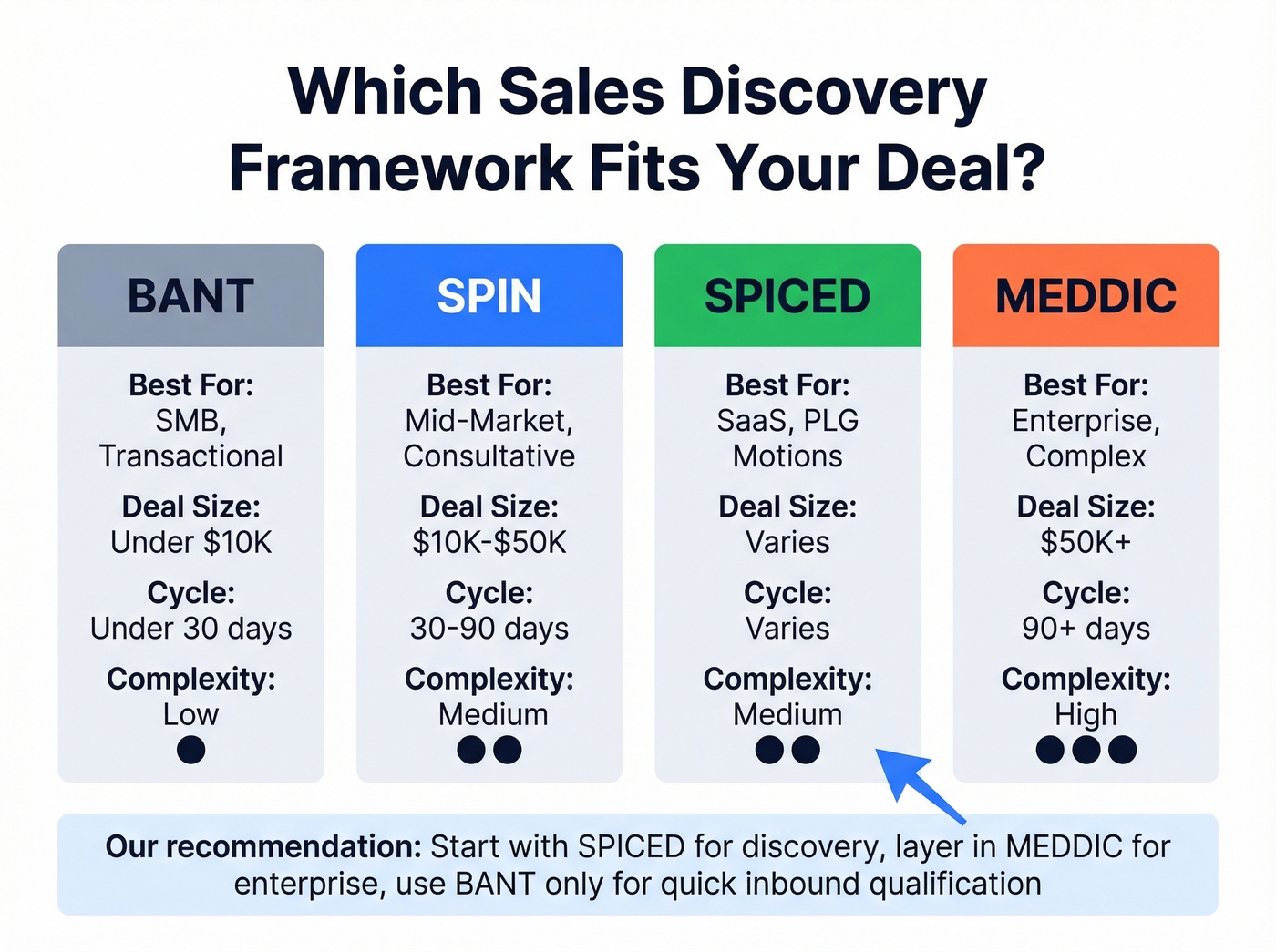
Frameworks aren't religions. They're scaffolding. Pick one that matches your deal complexity.
| Framework | Best For | Deal Size | Cycle | Complexity |
|---|---|---|---|---|
| BANT | SMB / transactional | Under $10K | Under 30 days | Low |
| SPIN | Mid-market / consultative | $10K-$50K | 30-90 days | Medium |
| SPICED | SaaS / PLG | Varies | Varies | Medium |
| MEDDIC | Enterprise / complex | $50K+ | 90+ days | High |
SPIN's research base spans 35,000 sales calls, which gives it real credibility for consultative selling. But it was designed for a world where buyers didn't show up pre-educated. SPICED handles the modern SaaS motion better because it starts with the prospect's situation rather than your qualification checklist. NEAT covers similar ground, but SPICED gives you more room to explore context before jumping to qualification.
The hybrid approach makes the most practical sense: start with SPICED for discovery, layer in MEDDIC for enterprise deals, and reserve BANT for quick inbound qualification where speed matters more than depth.
Let's be honest - if your average deal is under $15K, you probably don't need MEDDIC. It's a powerful framework, but the overhead kills velocity on smaller deals. SPICED gets you 80% of the insight in half the time. Skip MEDDIC until your deal size justifies the extra rigor.
Discovery Mistakes That Kill Deals
| Mistake | Deal Impact | Fix |
|---|---|---|
| Talking more than 43% of the call | Prospect disengages; you miss critical context | Ask a question, then shut up. Let silence work. |
| Running 15+ questions regardless of seniority | C-suite feels interrogated; call ends early | Fewer, sharper questions for executives; 11-14 for most calls |
| Hearing a trigger word and jumping to solution mode | You pitch a feature, not a business case | Finish understanding the full picture before you prescribe |
| Asking questions you could've Googled | Credibility drops instantly | Do 10 minutes of pre-call research. No exceptions. |
| Qualifying too fast | Deal looks "qualified" but dies at proposal | Spend 70% of discovery understanding the problem, not checking boxes |
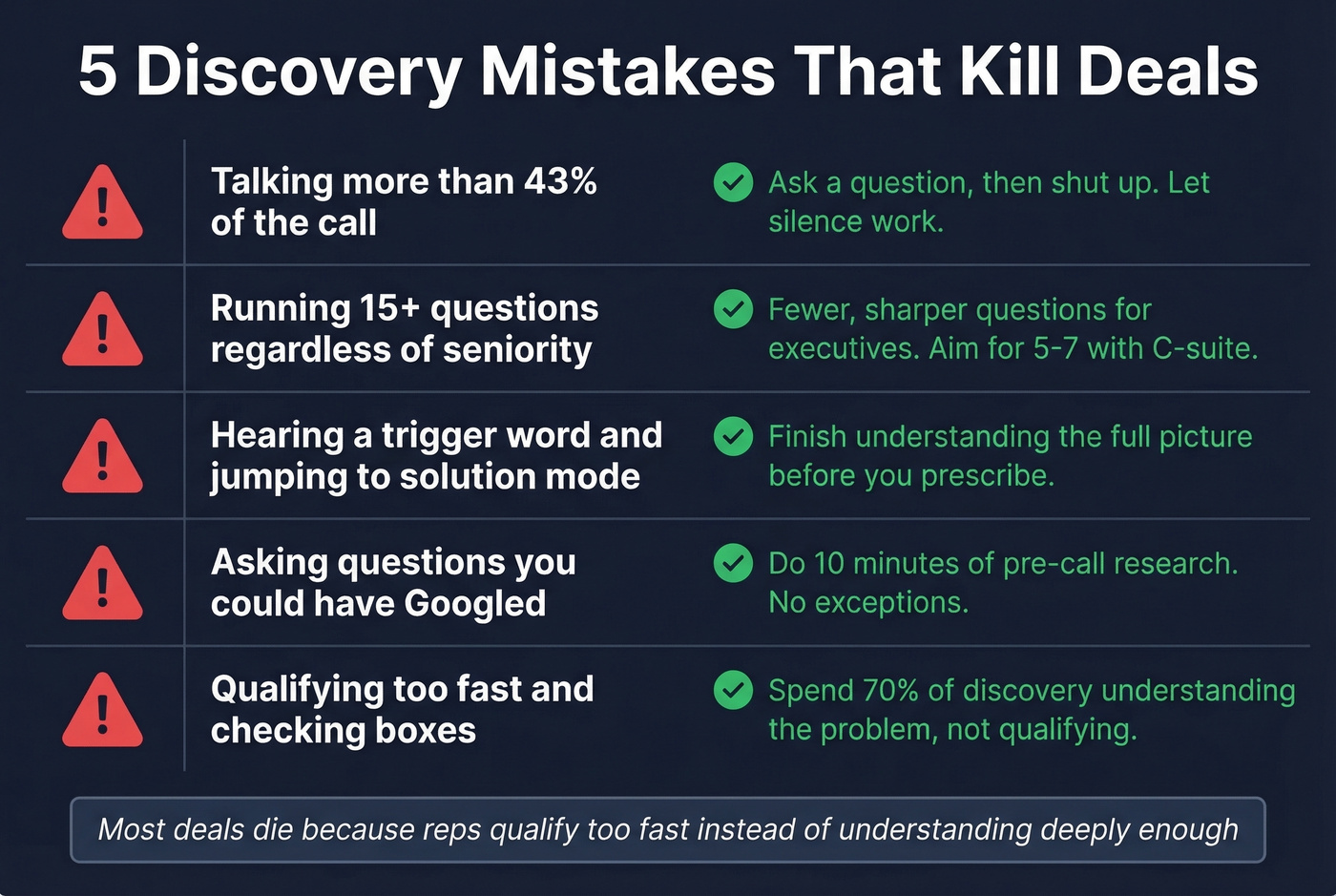
The r/sales community is blunt about this - most deals die because reps qualify too fast instead of understanding deeply enough. Compiling great questions is only half the battle. Knowing when to stay quiet and listen is the other half.
What to Do After Discovery
Discovery doesn't end when you hang up. The next 30 minutes determine whether the deal moves or stalls.
Log structured notes in your CRM - pain points, quoted language, stakeholder names, timeline, and next steps. Discrete fields your team can act on, not a paragraph of prose nobody reads. This matters beyond the immediate deal too: 72% of company revenue comes from existing customers, and the context you capture now feeds expansion conversations later. If your team struggles with consistency here, use a simple 30-60-90 day plan to standardize the habit.
Send a recap email within 2 hours summarizing what you heard in their language, not yours, and confirming the next step (use these sales follow-up templates).
You mapped 6-10 stakeholders on the buying committee. Now you need direct dials and verified emails for every one of them. Prospeo's Chrome extension lets you pull contact data from any company page in one click - 40K+ sales reps already use it to multi-thread before the first call.
Multi-thread every deal with contacts you can actually reach.
FAQ
How many questions should I prepare for a discovery call?
Data from thousands of recorded calls shows 11-14 targeted questions correlate with the highest close rates. More than 15 starts feeling like an interrogation. For C-suite calls, aim for 5-7 sharper, higher-level questions instead.
What's the difference between discovery and qualification?
Qualification determines if a prospect fits your ICP - budget, authority, timeline. Discovery goes deeper: uncovering pain, mapping stakeholders, and quantifying the cost of inaction. Think of qualification as the filter and discovery as the conversation that builds the business case.
How long should a discovery call last?
Top performers run 41-50 minute calls, but the typical range is 15-30 minutes. Calls under 20 minutes are 42% less likely to advance. A thorough 35-minute discovery call beats two shallow 15-minute ones every time.
How do I find verified contact info for stakeholders uncovered during discovery?
Use a B2B data platform with real-time verification. Prospeo covers 300M+ professional profiles with 98% email accuracy and 125M+ verified mobile numbers, so when discovery reveals new decision-makers, you can multi-thread within minutes instead of waiting days for introductions.