

The 9 Best Email APIs for Developers in 2026
Stop comparing eleven email APIs. You need one sending API and one verification layer.
Most guides ranking the best email APIs sort tools by feature count and ignore the two things that actually matter: what you'll pay at 100K emails per month, and whether those emails land in the inbox. The independent deliverability data is ugly - inbox rates tested across major providers show every single one declining year-over-year. Mailgun dropped from 53.8% to 26.05%. That's not a rounding error. That's half your transactional emails disappearing, and none of this accounts for what happens when you're sending to unverified addresses in the first place.
We evaluated each API's documentation, SDK quality, and pricing transparency, then cross-referenced the most recent independent deliverability benchmarks from GlockApps.
Our Picks (TL;DR)
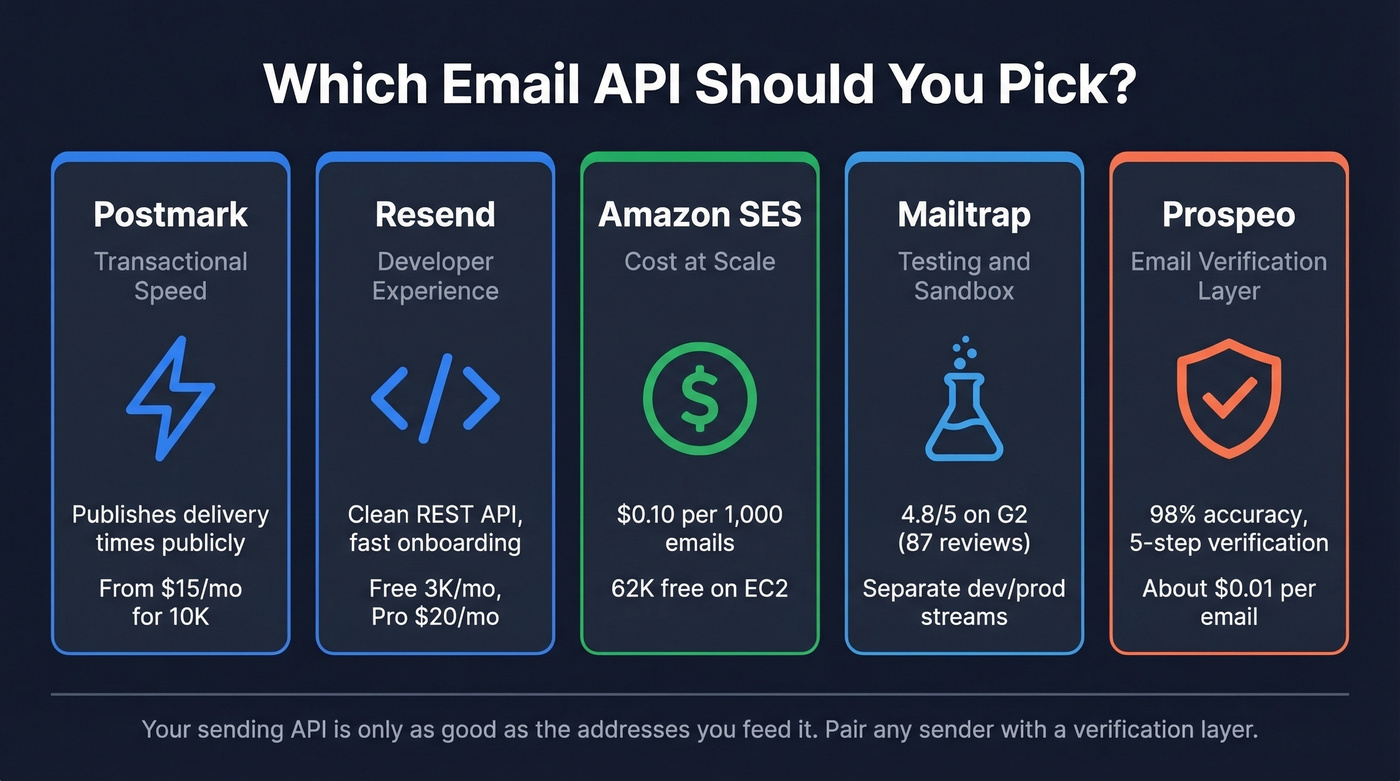
- Best for transactional speed: Postmark - purpose-built for transactional email, publishes delivery times publicly
- Best modern developer experience: Resend - clean API, great DX, but watch the billing
- Best for cost at scale: Amazon SES - $0.10 per 1,000 emails, nothing cheaper exists
- Best for testing and sandbox: Mailtrap - 4.8/5 on G2, separate streams for dev and production
- Best for email verification before sending: Prospeo - 98% accuracy, 5-step verification, ~$0.01/email
What Makes an Email API "Best"
Not all email APIs solve the same problem. Here's what actually separates the good ones from the marketing noise:
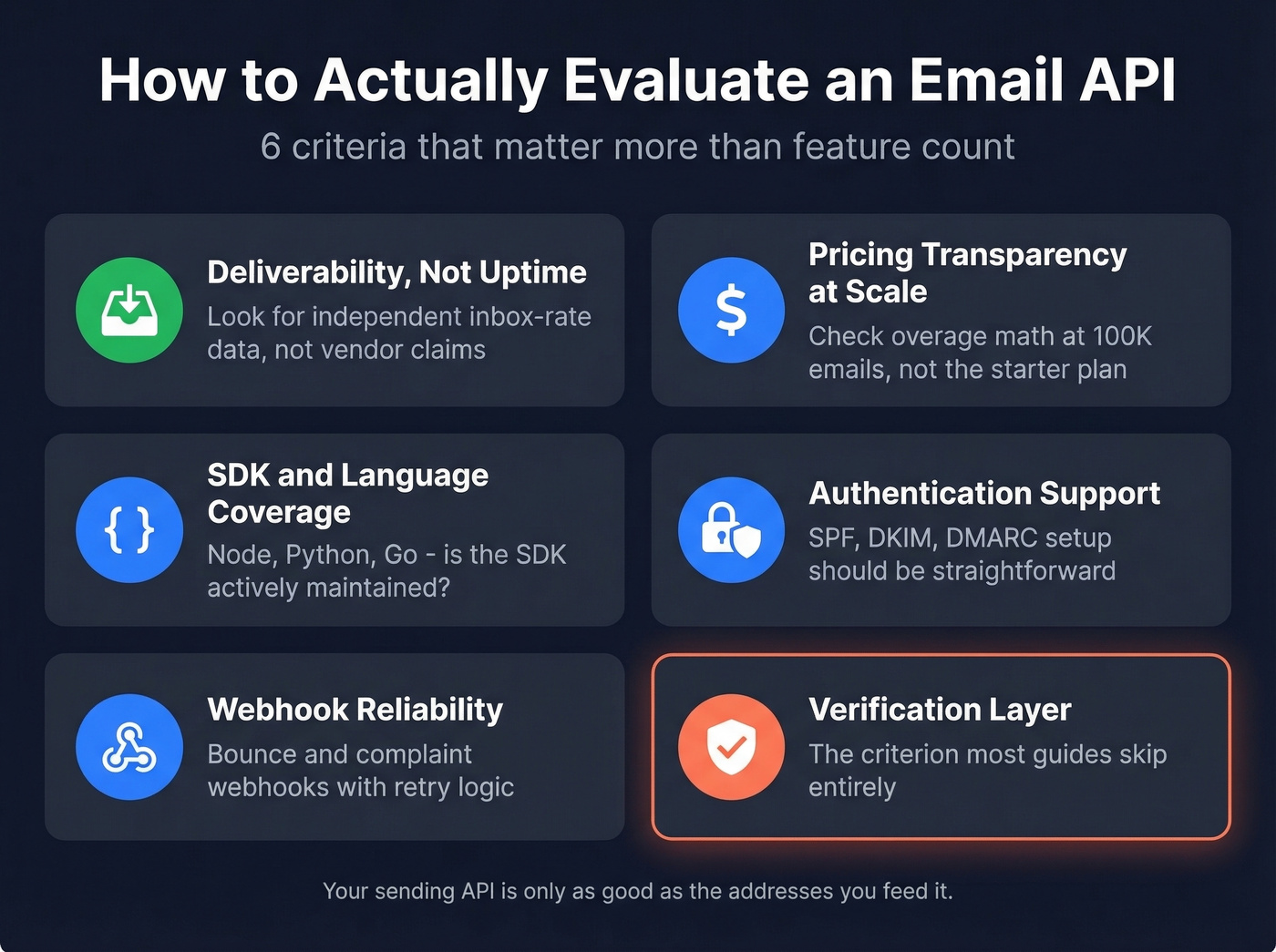
Deliverability, not uptime. Every provider promises 99.9% uptime. That means nothing if 40% of your emails land in spam. Look for independent inbox-rate data, not vendor claims. If you need a deeper framework, start with an email deliverability checklist.
Pricing transparency at scale. The $15/month plan looks great until you hit 100K emails and discover overage math that requires a finance degree. We've been burned by this.
SDK and language coverage. If your stack is Node/Python/Go, check that the SDK is actively maintained - not a community wrapper last updated in 2023.
Authentication support. SPF, DKIM, DMARC setup should be straightforward. Microsoft now requires DMARC with at least p=none for bulk senders. If you’re troubleshooting alignment, see DMARC alignment and SPF.
Webhook reliability. Bounce, complaint, and delivery webhooks need to fire consistently with retry logic. Email tracking API support for opens, clicks, and delivery events should be accessible via webhooks or a dedicated endpoint - not buried in a dashboard. (Related: tracking domain setup.)
Verification as a layer. Your sending API is only as good as the addresses you feed it. Bounces destroy sender reputation. This is the criterion most guides skip entirely. If you’re diagnosing issues, use an email bounce rate benchmark and fix list hygiene first.
The 9 Best Email APIs in 2026
Postmark
Best for: Transactional email where speed and deliverability are non-negotiable.
Postmark is the only email API provider that publishes delivery times publicly. They don't allow marketing email at all - which is actually the point. By keeping marketing senders off their infrastructure, they maintain cleaner IP reputation for everyone on the platform. Dedicated IPs are available as an add-on at higher volumes, and bounce analytics with automatic suppression lists come standard.
The pricing is straightforward: $15/month for 10K emails, $245 for 300K, $695 for 1M. That's more expensive than SES or SendGrid at volume, but you're paying for a transactional-first product with fewer moving parts.
Skip Postmark if you need marketing email on the same platform, or if you're sending 50K+ emails/month on a tight budget. It's premium-priced for a reason.
Resend
Best for: Modern developer experience with a clean, well-documented API.
Resend is what happens when developers build an email API for developers. The REST API is elegant, onboarding is fast, and DKIM, SPF, and DMARC are supported cleanly. Free tier gives you 3,000 emails/month with a 100/day cap, one custom domain, and one webhook endpoint. The Pro plan runs $20/month for 50K emails with 10 custom domains and 10 webhook endpoints. Dedicated IPs cost $30/month on the Scale plan for customers exceeding 500 emails/day. All tiers get 30-day data retention.
Here's the thing, though. A Reddit user reported a 42% bill increase on just 15% more volume, with no usage alert and no clear dashboard breakdown of overage math. Support took five days to respond and said the charge was "accurate" without detailed explanation. For a tool that markets itself on simplicity, the overage calculations aren't obvious. Worth monitoring closely if you're near tier boundaries.
Amazon SES
Best for: Raw cost at scale when you have the engineering resources to build around it.
Nothing beats SES on price. $0.10 per 1,000 emails. That's $1 for 10K, $10 for 100K, $100 for a million. If you're running on EC2, you get 62,000 free emails/month. For a startup sending transactional email from an AWS-hosted app, the marginal cost is essentially zero.
The tradeoff is real. SES gives you no deliverability insights out of the box, SES-only plans don't include support, and there's more manual work for event tracking and monitoring. You're building your own bounce handling, complaint processing, and analytics layer. You start with conservative sending limits and can request increases as you build reputation. Webhook equivalents come through SNS notifications for bounces, complaints, and deliveries - requiring separate SNS topic setup. Sandbox mode restricts sending to verified addresses only until you request production access.
We've seen teams spend 40-80 engineering hours getting SES to production-grade - hours that cost more than a year of Postmark. Use SES if you have a dedicated backend team optimizing for cost per email above all else. Skip it if you're a small team that needs to ship email in a weekend.
Mailtrap
Best for: Email testing, sandbox environments, and teams that need separate dev/production streams.
Mailtrap's sandbox is excellent for development workflows. You can inspect emails in a fake inbox, check spam scores before sending, and keep test emails from ever reaching real users. The production sending API handles separate streams for bulk and transactional email, keeping things clean.
G2 users give it 4.8/5 across 87 reviews, with consistent praise for ease of use and customer support. In our testing, Mailtrap's sandbox-to-production workflow was the smoothest of any ESP on this list - the customizable throttling and test-first design philosophy make it a natural fit for teams with proper CI/CD pipelines. Pricing starts at $15/month for 10K emails. Free tier is 1,000 emails/month, fine for testing but not production.
SendGrid
SendGrid is the incumbent. It's everywhere, it integrates with everything, and it's the email API most developers have used at least once. The Essentials plan starts at $19.95/month for 50K emails, which looks competitive until you realize the useful features - dedicated IP, advanced analytics, subuser management - are gated behind higher tiers. The Pro tier runs around $249/month at higher volumes. Free tier caps at 100 emails/day, barely enough for local development.
The bigger concern is deliverability. Independent testing shows SendGrid's average inbox rate dropped from 45.30% to 35.31% year-over-year. That's a meaningful decline for a platform this established. If you're already on SendGrid and it's working, there's no urgent reason to migrate. But if you're choosing fresh, the value proposition has weakened.
Mailgun
Mailgun targets developers with solid documentation and a clean REST API. It supports sending via API and SMTP, automatically classifies bounce events, spam complaints, and unsubscribes into suppression lists, and provides an email tracking API for opens, clicks, and delivery events - useful if you need granular engagement data without a third-party analytics layer.
Paid plans start at $15/month, with up to 100 emails/day free. The Foundation tier runs $35/month for 10K emails, scaling up at higher volumes.
Let's be honest about the deliverability numbers: they're alarming. Independent benchmarks measured Mailgun's inbox rate dropping from 53.8% to 26.05% - a 27.75-point collapse in one year. That's the steepest decline of any major provider tested. If you're evaluating Mailgun today, deliverability should be your first question in the sales conversation, not your last.
Brevo
Free tier at 300 emails/day, paid plans from ~$15/month for 20K. Brevo's strength is combining marketing and transactional email on one platform with built-in templates and a drag-and-drop editor. If you need both and don't want to manage two vendors, it's a reasonable choice - but its inbox rate (30.40% down to 24.93%) is the lowest on this list.
MailerSend
The cheapest paid entry at ~$7/month for 5K emails, with 100 email verifications included. MailerSend is built for small teams and early-stage products that need a simple, affordable sending API without enterprise complexity. Solid option for MVPs and side projects.
Other ESPs worth evaluating: Mailjet for EU compliance focus, SMTP2GO for simple SMTP relay, and SparkPost for enterprise-level analytics. If you’re building outbound sequences, also compare options in our cold email API guide.

Every sending API on this list suffers the same problem: bounces from bad addresses destroy your sender reputation. Prospeo's 5-step verification catches invalid emails, spam traps, and honeypots before they ever hit your sending infrastructure - at 98% accuracy and ~$0.01/email.
Add the verification layer most developers skip entirely.
Pricing at Scale
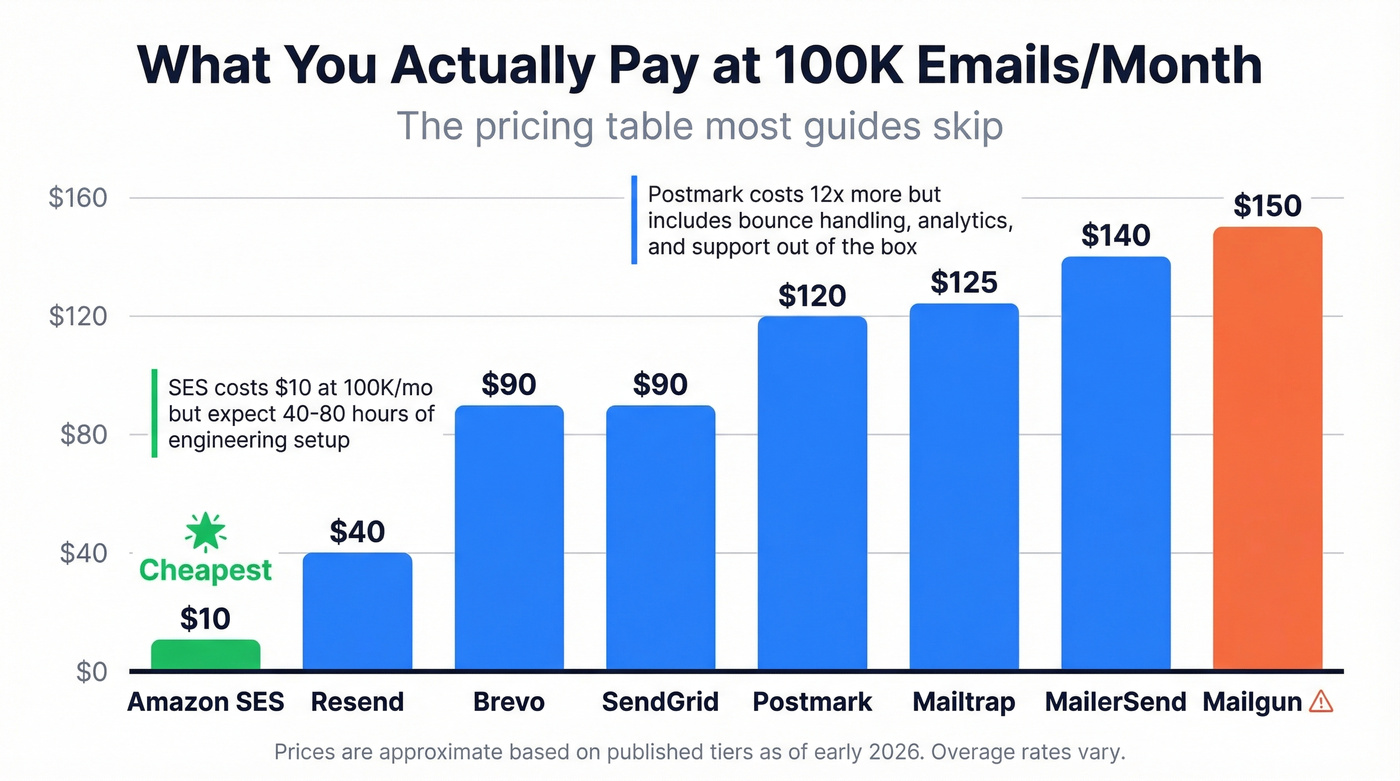
Here's what you'll actually pay as volume grows - the table most guides don't include.
| Provider | 10K/mo | 50K/mo | 100K/mo |
|---|---|---|---|
| Amazon SES | $1 | $5 | $10 |
| MailerSend | ~$14 | ~$70 | ~$140 |
| Brevo | ~$15 | ~$45 | ~$90 |
| Mailtrap | $15 | ~$65 | ~$125 |
| Postmark | $15 | ~$75 | ~$120 |
| SendGrid | ~$20 | $19.95 | ~$90 |
| Resend | ~$20 | $20 | ~$40 |
| Mailgun | ~$35 | ~$75 | ~$150 |
Free tiers: SES gives 62K/mo on EC2. Resend offers 3K/mo (100/day). Mailtrap: 1K/mo. SendGrid: 100/day. Mailgun: 100/day. Brevo: 300/day. MailerSend: 500/mo. Postmark: 100/mo.
At 1M emails/month, SES costs $100 and Postmark costs $695. That gap narrows fast when you factor in the engineering time to build what Postmark gives you out of the box.
If your average deal size is under $5K, you probably don't need anything beyond SES plus a verification layer. The deliverability difference between a $100/month SES setup with clean data and a $695/month Postmark plan is smaller than most vendors want you to believe - as long as your list hygiene is airtight. (If you’re cleaning lists at scale, see spam trap removal.)
Deliverability Reality Check
Every email API markets "99% deliverability." The independent data tells a different story.
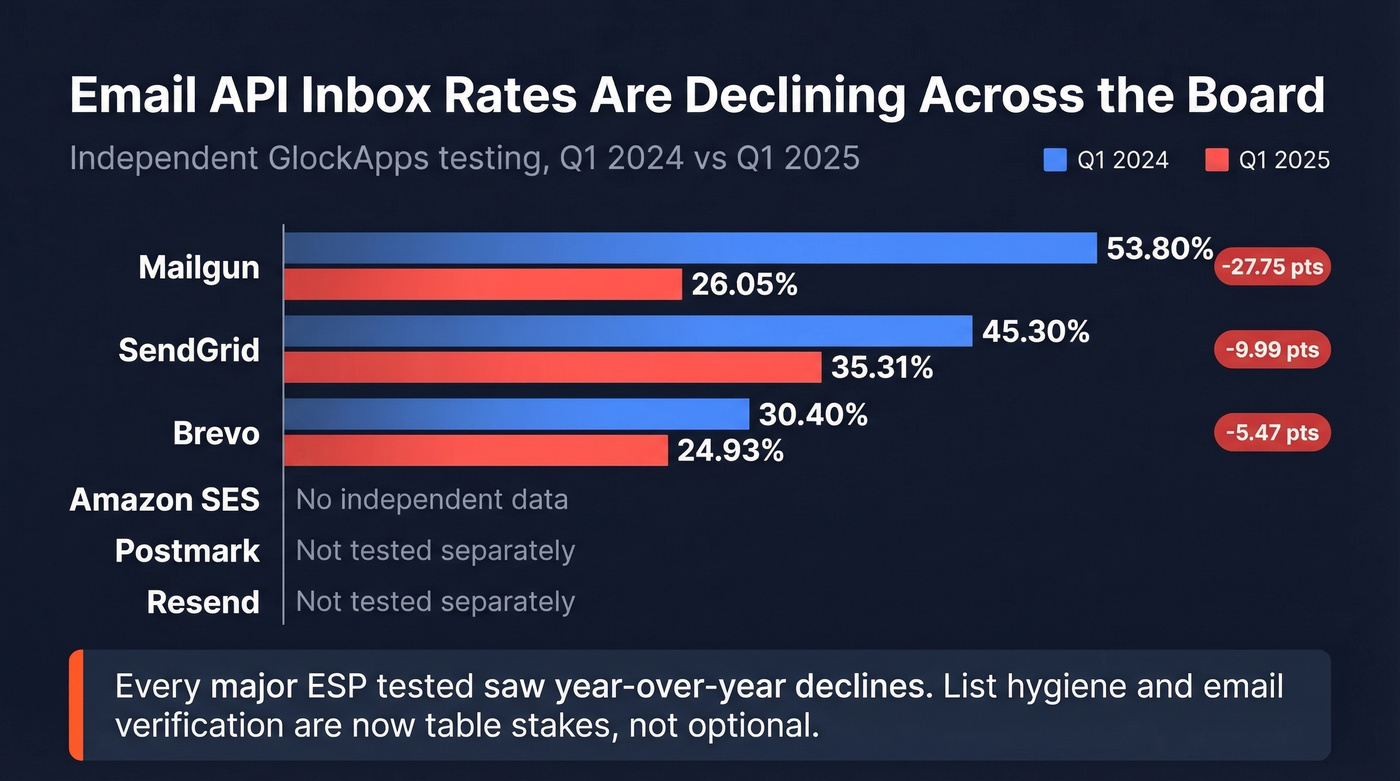
GlockApps tested inbox placement rates across major providers. From Q1 2024 to Q1 2025, every major ESP saw declines:
| Provider | Before | After | Drop |
|---|---|---|---|
| Mailgun | 53.8% | 26.05% | -27.75 pts |
| Amazon SES | 54.9% | 40.3% | -14.6 pts |
| SendGrid | 45.3% | 35.31% | -9.99 pts |
| Brevo | 30.4% | 24.93% | -5.47 pts |
Part of this is Microsoft tightening enforcement. Bulk senders must now publish DMARC with at least p=none for Microsoft domains, with full DMARC alignment required. Office 365 inbox rates dropped from 77.43% to 50.70% across the board.
These numbers get worse when you're sending to unverified addresses. Bounces tank your sender reputation, which tanks your inbox rate - creating a downward spiral that no sending API can fix on its own. Authentication and list hygiene matter more than which API you choose. If you’re actively working on reputation recovery, follow an improve sender reputation playbook.

The Verification Layer Nobody Mentions
Picture this: you've spent two weeks integrating Postmark, configured DKIM and DMARC perfectly, warmed your dedicated IP - and your first production batch bounces at 12%. Your sender reputation drops. Three days later, your password reset emails are landing in spam. Users are filing support tickets. Your CTO is asking what happened.
What happened is you sent to bad addresses. Your sending API didn't stop you.
This is where Prospeo's email verification API fits into the stack. Before emails hit your sending API, it runs a 5-step process: syntax validation, domain verification, mailbox confirmation, catch-all detection, and spam-trap/honeypot removal. The 7-day data refresh cycle means you aren't working with stale verification results. At 98% accuracy across 143M+ verified emails, it catches the addresses that would otherwise destroy your deliverability. If you’re comparing verifiers, start with Bouncer alternatives.
The API integration is straightforward - send an address, get back a valid/invalid/catch-all classification with risk scoring. At ~$0.01 per verification, the math is simple: a few hundred dollars in verification prevents thousands in lost deliverability and engineering time debugging reputation issues.
You just read that Mailgun's inbox rate dropped to 26%. No sending API can fix deliverability when you're blasting unverified addresses. Prospeo verifies 143M+ emails with catch-all handling, spam-trap removal, and a 7-day data refresh cycle - so your transactional and outbound emails actually land.
Stop optimizing your sending API while ignoring the data going in.
How to Choose by Use Case
Startup MVP shipping fast: Resend. Clean DX, quick setup, $20/month gets you to 50K emails. You'll be live in an afternoon.
SaaS transactional at scale: Postmark. Pay more per email, worry less about deliverability. The no-marketing-email policy is a feature, not a limitation.
High-volume marketing + transactional: SendGrid or Brevo. Both handle dual workloads, though deliverability trends are concerning - monitor closely.
Agency or multi-tenant platform: Mailtrap. Separate streams, sandbox testing, and the flexibility to manage multiple client environments cleanly.
Budget-first, engineering-rich: Amazon SES. Nothing cheaper exists. Just budget the engineering hours honestly.
Whichever sending API you pick, verify your list first. Clean data in means clean delivery out.
FAQ
What is an email API?
A programmatic interface that lets your application send, receive, and track emails without managing mail servers directly. Most support both REST endpoints and SMTP relay, with webhooks for delivery events like bounces, opens, and complaints.
REST API or SMTP - which should I use?
REST for modern applications - you get better error handling, structured webhooks, and richer metadata. SMTP makes sense if you're migrating legacy systems or need plug-and-play compatibility with existing mail clients and infrastructure.
Are free email API tiers enough for production?
Rarely. Most free tiers cap at 100-300 emails per day, which covers development and testing but not a live product. Even the cheapest paid options like SES ($0.10/1K) and MailerSend (~$7/month) cost under $15/month for meaningful volume.
Do I need email verification with a sending API?
Yes. Sending to unverified addresses causes bounces, which damage sender reputation and deliverability. Prospeo verifies emails at 98% accuracy for ~$0.01 each - cheap insurance against reputation damage that takes weeks to recover from.
Which email API has the best deliverability?
No provider guarantees inbox placement. Independent GlockApps data shows inbox rates declining across all major ESPs. Authentication setup (SPF, DKIM, DMARC) and list hygiene consistently matter more than which sending API you choose.