

The Best Email Extractor Tools in 2026, Backed by Real Test Data
Most email extractor tools lie about accuracy. Not maliciously - they define "verified" loosely enough that you don't notice until your first sequence bounces 20%+ and your domain reputation tanks. Cold email practitioners on Reddit report exactly this: emails marked "verified" that hard-bounce at alarming rates.
ZeroBounce's 2026 analysis confirms the underlying problem - at least 23% of an email list degrades every year. Broader B2B data-decay research puts it even more starkly: 70.8% of business contacts change roles within 12 months. So finding the best email extractor tool isn't about who returns the most results. It's about who returns emails that actually land.
Our Top Picks
| Tool | Best For | Free Tier | Starting Price |
|---|---|---|---|
| Prospeo | Accuracy-first prospecting | 75 emails/mo | ~$0.01/email |
| Hunter.io | Domain search & simplicity | 50 credits/mo | $34/mo (annual) |
| Apollo.io | Volume on a budget | Yes (generous) | $49/mo per user |
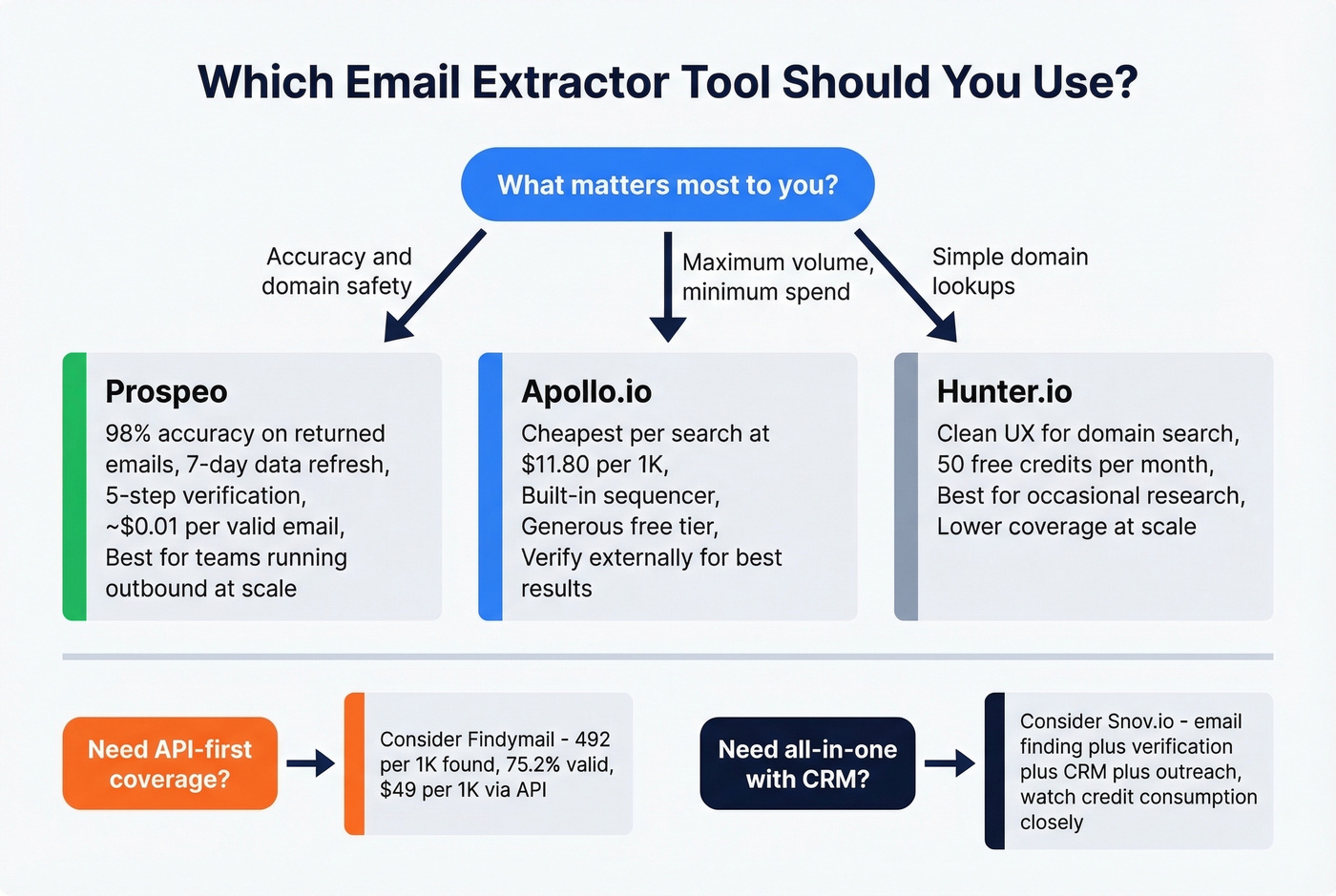
Prospeo if you can't afford bounces. Hunter if you want dead-simple domain lookups. Apollo if you need sheer volume and you're willing to verify externally.
What Independent Tests Actually Show
Every "best email extractor" ranking you'll find is published by a vendor. Let's be honest about that. So we dug into the tests that at least tried to be rigorous.
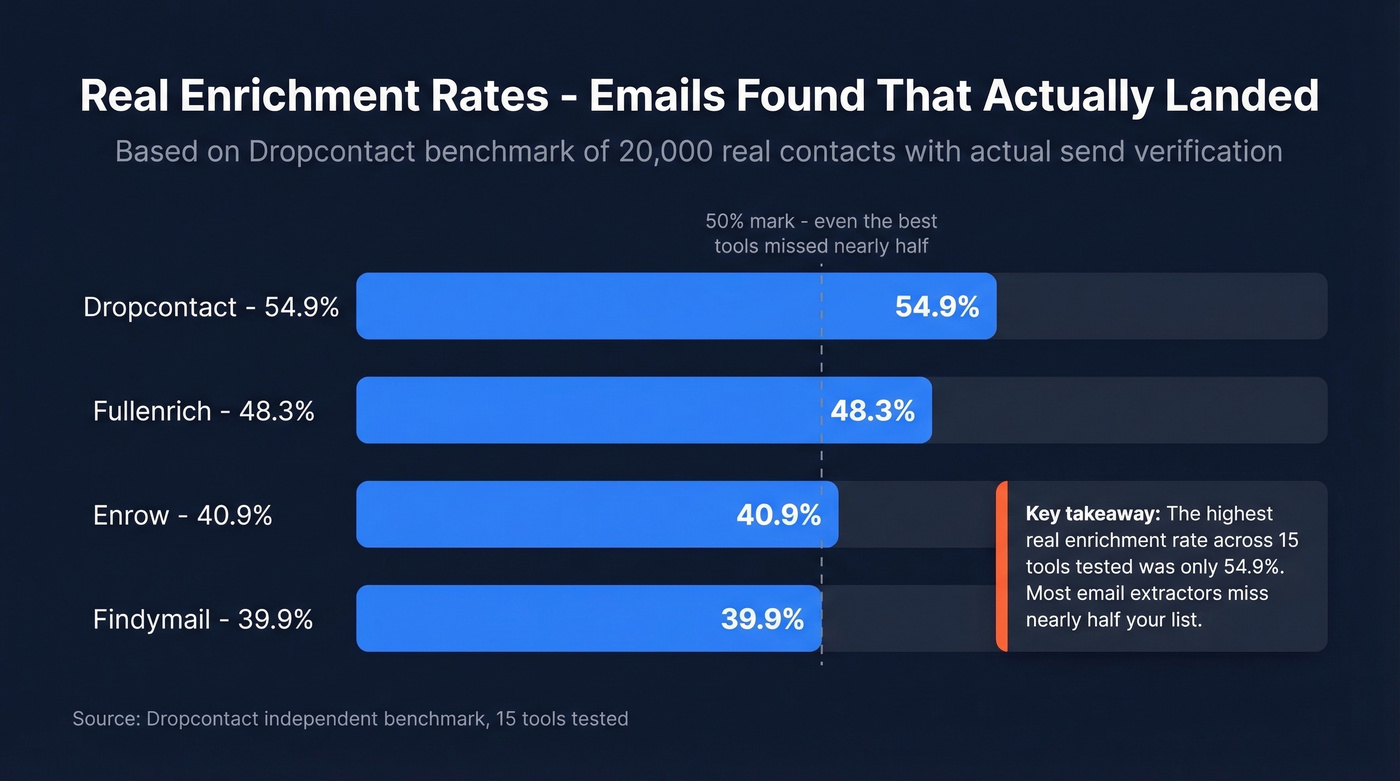
A Dropcontact benchmark tested 15 email finders against 20,000 real contacts - then actually sent emails to every address found. Their "real enrichment rate" (found emails minus bounces minus wrong domains) topped out at 54.9% for Dropcontact, followed by Fullenrich at 48.3%, Enrow at 40.9%, and Findymail at 39.9%. Even the best tools missed nearly half the list.

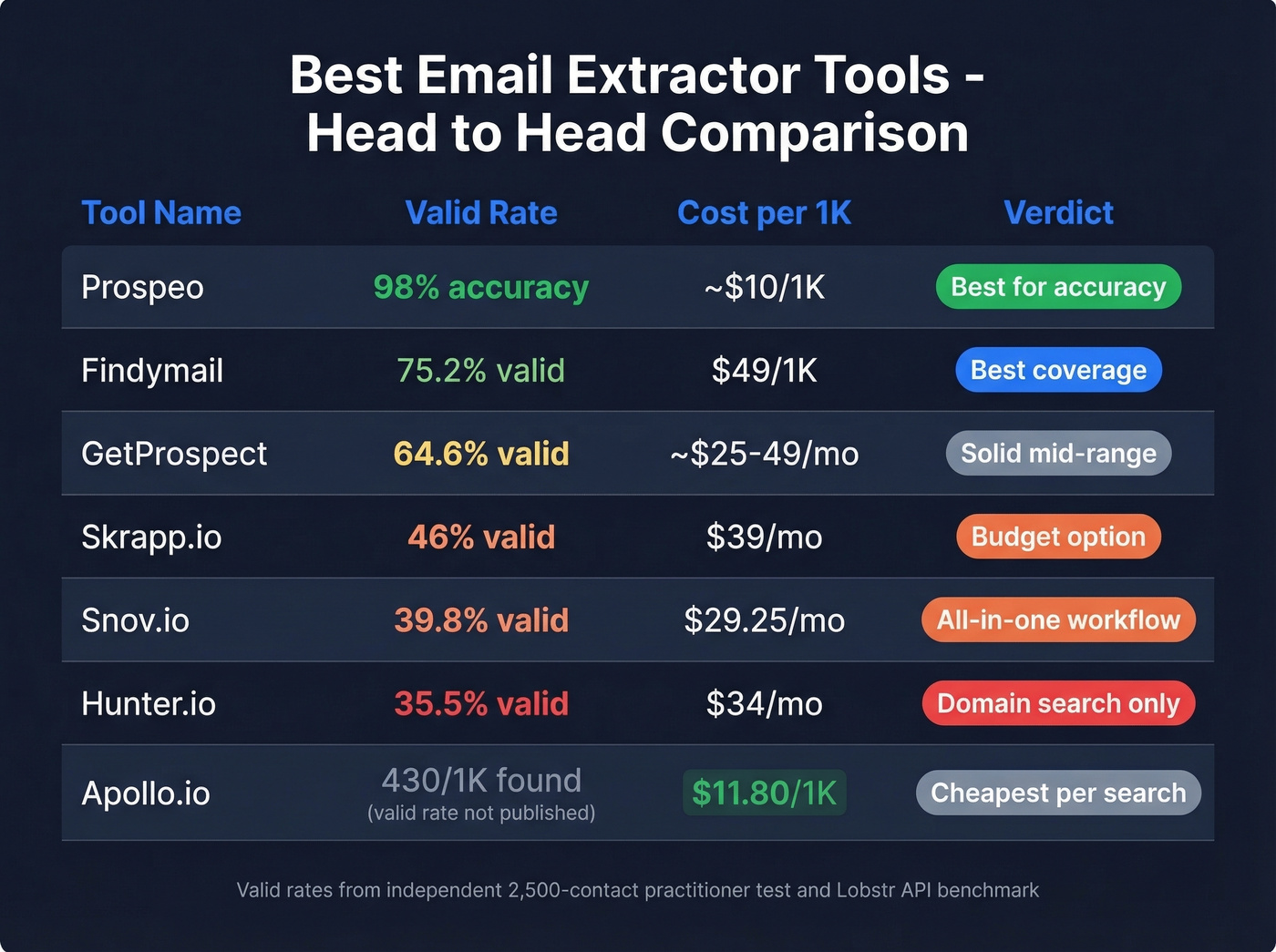
A separate Lobstr API bake-off tested 1,000 leads and measured cost, speed, and coverage. Apollo found 430 emails per 1,000 leads at just $11.80/1k - the cheapest option by far. Hunter found only 281 at $50/1k. Findymail led on coverage with 492 found at $49/1k.
One practitioner ran the same 2,500 contacts through 8 tools. Tomba hit 76.9% valid, Findymail 75.2%, GetProspect 64.6% - and Hunter, despite its brand recognition, landed at just 35.5%. RocketReach was singled out in a separate thread as "most accurate so far." The takeaway: popularity doesn't predict performance.
Email Extractor Tools Ranked
Full Comparison
| Tool | Accuracy Signal | Data Freshness | Free Tier | Starting Price | Best For |
|---|---|---|---|---|---|
| Hunter.io | 35.5% valid (2,500-contact test) | Not public | 50 credits/mo | $34/mo | Domain search |
| Apollo.io | 430/1k found (Lobstr test) | Not public | Generous | $49/mo per user | Budget volume |
| Snov.io | 39.8% valid (2,500-contact test) | Not public | 50 credits/mo | $29.25/mo | All-in-one workflow |
| GetProspect | 64.6% valid (2,500-contact test) | Not public | 50 credits at sign-up | ~$25-$49/mo | Mid-range reliability |
| ContactOut | Not independently tested | Not public | 5 emails/day | $49/mo | Recruiter prospecting |
| Findymail | 492/1k found; 75.2% valid | Not public | No | $49/1k (API) | API-first coverage |
| Skrapp.io | 46% valid (2,500-contact test) | Not public | 50 credits/mo | $39/mo | Light prospecting |
Prospeo
In the 2,500-contact practitioner test, Prospeo returned valid emails for 35.6% of contacts - a lower find rate than some competitors. But the emails it returned held a 98% accuracy rate. That distinction matters more than most people realize: a tool that finds 77% of emails but half bounce costs you more in domain reputation damage than one that finds 36% where nearly all land.
If you're comparing finders, it's also worth scanning Best Email Search Tools and Best Email ID Finder Tools to see how accuracy signals differ across categories.
Prospeo's 5-step verification pipeline handles catch-all domains, spam traps, and honeypots across a database of 300M+ professional profiles with 143M+ verified emails and 125M+ verified mobile numbers. The 7-day data refresh cycle is the real differentiator - most providers refresh on an industry-average 6-week cycle, which means you're working with stale data by default. One customer, Meritt, went from 35% bounces on their previous tool to under 4% after switching, and their pipeline tripled from $100K to $300K per week.
The Chrome extension (40,000+ users) works across company websites and professional profiles, and native integrations push contacts straight into Salesforce, HubSpot, Instantly, Lemlist, and Clay.
If bounces are your main pain, pair extraction with a dedicated verifier or deliverability stack (see Best Email Reputation Tools and Email Deliverability Guide).
Use this if: you're running outbound at scale and can't afford domain reputation damage from bad data. At ~$0.01 per email with a free tier of 75 emails/month, the cost-per-valid-email math is hard to beat.
Skip this if: you need a full outreach sequencer built in - pair it with Instantly or Lemlist for that.
Hunter.io
Hunter built its reputation on domain search - type in a company domain, get every associated email pattern and address. The UX is genuinely clean, and the 50 free monthly credits make it easy to test. Paid plans start at $34/mo (annual) for 2,000 credits/month, scaling to $209/mo (annual) for 25,000 credits/month.
If you're shopping around, compare it against other options in our Hunter alternatives breakdown.
One detail worth knowing: verification costs 0.5 credits, so 2,000 credits doesn't mean 2,000 verified emails.

The numbers tell a mixed story. In the 2,500-contact practitioner test, Hunter landed at 35.5% valid. The Lobstr bake-off showed only 281 emails found per 1,000 leads at $50/1k - the lowest coverage of the major tools tested.
Use this if: you do domain-level research and want a simple, well-integrated tool for occasional lookups. It's the safe default.
Skip this if: you need high-volume extraction with strong valid rates. Hunter's a scalpel, not a chainsaw.
Apollo.io
Apollo is the budget king. A generous free tier, Basic plans from $49/mo per user, and the Lobstr test showed it finding 430 emails per 1,000 leads at just $11.80/1k - the cheapest cost-per-search in the field. The built-in sequencer means you can prospect and outreach from one platform.
If you're evaluating it specifically for data quality vs cost, see Coresignal vs Apollo.io.
The trade-off is data freshness. The Lobstr comparison flags Apollo for "outdated data," and credits don't roll over between billing cycles. We've seen teams burn through verification credits mid-subscription, then face a choice between paying more or sending unverified emails. One user on Reddit reported exactly this - exhausting Apollo credits and shopping for cheaper alternatives like Datagma.
Use this if: you're a startup or SMB that needs maximum coverage for minimum spend and you're willing to verify externally.
Skip this if: data freshness matters more than volume. Apollo's refresh cycle isn't published, and the "outdated data" flag shows up too often to ignore.
Snov.io
Snov.io bundles email finding, verification, CRM, and outreach automation into one platform. Starter plans run $29.25/mo (annual) for 1,000 credits. They restructured plans in mid-2025, renaming tiers and bumping recipient limits - Pro S now includes 25,000 recipients instead of 10,000, and Starter is solo-only with no team features.
The credit model is where it gets tricky. Credits get spent on prospect search, email search, and email verification - and each action costs 1 credit. Users consistently complain about credits evaporating faster than expected. The 2,500-contact test showed Snov.io at 39.8% valid. The LinkedIn automation add-on at $69/mo per slot adds up quickly.
GetProspect
GetProspect quietly posted one of the strongest showings in the 2,500-contact practitioner test: 64.6% valid emails - nearly double Hunter's result. You get 50 free credits at sign-up, and paid plans typically land around $25-$49/mo for 1,000 credits. Not flashy, but the mid-range reliability and straightforward positioning make it a legitimate contender for teams that don't need a full platform.
If you're deciding between these two, start with GetProspect vs Apollo.io.
ContactOut
ContactOut focuses on extracting emails and phone numbers from professional profiles - especially popular with recruiters. The free tier gives you 5 emails/day. The Email plan runs $49/mo (annual) for unlimited emails and 300 exports/month. Email + Phone jumps to $99/mo (annual) with 600 exports/month. The 700M+ profile database is impressive, but the 1-user-per-company limit on lower tiers is frustrating for team rollouts.
Findymail
Strong benchmark performer: 492 emails found per 1,000 leads in the Lobstr test (highest coverage) and 75.2% valid in the practitioner test. At $49/1k via API, it's priced mid-range for API workflows. Worth testing if you integrate via API and prioritize coverage over per-email cost.
If you're comparing API-first tools, Findymail vs RocketReach is a useful reference point.
Skrapp.io
Budget-friendly entry point: free tier with 50 credits/month, paid from $39/mo for 1,000 credits. The practitioner test showed 46% valid - middle of the pack. Fine for light prospecting, but you'll outgrow it fast at scale.
If you're using it mainly for browser-based extraction, also check Best Email Scraper Chrome Extensions.

The tests above show most email extractors top out around 50-75% valid. Prospeo's 98% accuracy rate means the emails you find actually land - backed by 5-step verification, catch-all handling, and a 7-day data refresh that keeps your list clean while competitors serve 6-week-old data.
Stop paying for emails that bounce. Start with 75 free extractions.
Cost Per Valid Email Is the Only Metric That Matters
Here's the thing - raw search cost is misleading. We calculated cost-per-valid-email using published benchmark data, and the gaps are striking.
If you want to go deeper on bounce math and what “good” looks like, see Email Bounce Rate.
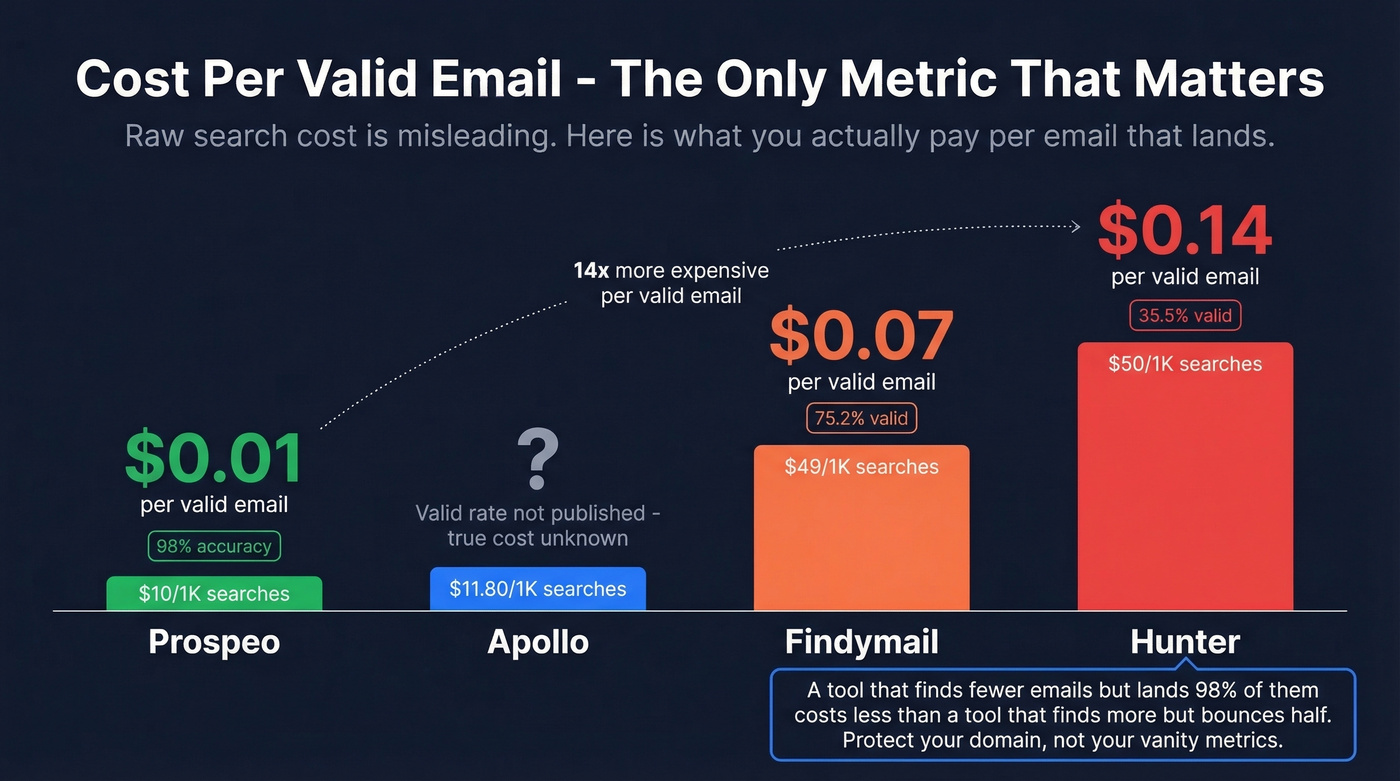
| Tool | Cost per 1K Searches | Valid Rate | Est. Cost/Valid Email |
|---|---|---|---|
| Prospeo | ~$10 | 98% | ~$0.01 |
| Apollo | $11.80 | Not published | - |
| Findymail | $49 | 75.2% | ~$0.07 |
| Hunter | $50 | 35.5% | ~$0.14 |
Prospeo's 98% reflects accuracy of verified emails returned. The 75.2% and 35.5% figures come from the 2,500-contact practitioner test.
Apollo wins on raw cost-per-search, but you still need to factor in your own verification and bounce outcomes to get a true cost-per-valid-email.
Our take: if your average deal size is under five figures, you probably don't need ZoomInfo-level data. A tool with 98% accuracy on returned emails paired with a good sequencer will outperform an expensive all-in-one platform where half the emails bounce. The best email extractor tool is the one that protects your domain reputation, not the one with the biggest database.
Meritt switched email extractors and went from 35% bounces to under 4% - tripling their pipeline to $300K/week. At ~$0.01 per verified email across 143M+ addresses, the cost-per-valid-email math beats every tool on this list.
Find fewer emails. Land every one. Protect your domain reputation.
How to Choose the Right Tool
Four criteria matter more than feature lists.
Real-time verification. Does the tool verify at the point of finding, or hand you an unverified email and call it "found"? Real-time verification is non-negotiable for outbound at scale - anything less and you're gambling with your sender reputation on every batch.
Credit model transparency. Some tools charge you even when nothing's found, while pay-per-valid models mean you only spend on usable results. Read the fine print on what counts as a credit spend.
Data refresh cycle. This is where most tools quietly fail you. A 6-week refresh cycle means the contact who changed jobs three weeks ago still shows up as valid in your export.
Native integrations. The tool needs to push directly into your CRM and sequencer. Manual CSV exports are a workflow killer, and every manual step introduces errors and delays.
Compliance Essentials
Extracting emails doesn't exempt you from the law. Under GDPR, you need legitimate interest tied to the recipient's professional role - personalize, be transparent, and offer a clear opt-out. CAN-SPAM penalties run $51,744-$53,088 per violation, so include a physical address, honest subject lines, and honor opt-outs within 30 days. The CCPA adds additional requirements for California residents. Always use reputable data sources, clean lists regularly, and include an unsubscribe link.
For deliverability-safe sending practices, see Best Way to Send Bulk Email Without Getting Blacklisted.
FAQ
What's the difference between an email extractor and an email finder?
An extractor scrapes emails from web pages, often pulling generic addresses like info@ or support@. A modern email finder searches professional databases and verifies results in real time. For B2B prospecting, you want a finder with built-in verification - the difference between getting a pile of addresses and getting contacts you can actually reach.
How many emails should I expect to bounce?
With a quality tool that verifies at the point of discovery, expect under 5% bounces. Without real-time verification, practitioners report 20%+ bounce rates even on "verified" emails. That gap is the difference between a healthy sender domain and one that's flagged.
Is cold email extraction legal?
Yes, with guardrails. GDPR requires legitimate interest and an opt-out mechanism. CAN-SPAM requires a physical address and honest subject lines, with penalties up to $53,088 per violation. Use reputable data sources and honor unsubscribe requests promptly.
What's a good free email extractor for small teams?
Prospeo offers 75 free verified emails per month with full verification - the strongest free tier for accuracy. Hunter gives 50 credits/month for domain lookups. Apollo's free plan provides generous search volume but without published accuracy guarantees. For teams running real campaigns, the free tier that delivers the most usable contacts wins over the one that delivers the most contacts, period.