

The Best Email Verification Services - And Why Most Lie About Accuracy
You're paying for "99% accurate" email verification, and your last campaign still bounced 8%. The tool worked fine on syntax checks. Real-world business emails are a different story, and most vendors don't want you to know the difference.
[Roughly 1 in 6 emails] never reach the inbox, with global inbox placement sitting around 84%. At least [25% of email databases decay] every year. That list you verified in January? It's already rotting by summer.
When [bounce rates climb above 5%], ISPs start throttling your domain - not just that campaign, but everything you send. Email marketing still returns [$36-$40 for every $1 spent], but only if your emails actually land. A bounced email doesn't just waste a credit. It poisons your sender reputation and makes every subsequent send less effective.
So which verification services actually protect you? We tested the major players on real B2B lists and tracked deliverability outcomes. Here's what performed - and what's just noise.
Our Top Picks
| Use Case | Pick | Why |
|---|---|---|
| Find AND verify emails | Prospeo | 98% accuracy, 5-step verification, 7-day data refresh |
| Best standalone list cleaner | Bouncer | $8/1K credits, credits never expire, G2 "Easiest to Use" |
| Best deliverability suite | ZeroBounce | Verification + inbox placement + abuse detection |
| Best automated list hygiene | NeverBounce | ESP integrations, $49/mo for 10K, set-and-forget |
| Best budget option | DeBounce | ~$2/1K - one of the cheapest per-credit options |
| Best for developers | Kickbox | Strong API-first workflow |
Not every tool below has a free plan, but they all give you free credits or a free test so you can validate results before committing. Prospeo gives you 75 free emails per month. Bouncer starts you with 100 credits. ZeroBounce offers 100 free monthly with a business domain. NeverBounce lets you verify your first list free, no credit card required.
What "99% Accuracy" Actually Means
Almost every verification vendor advertises 95-99% accuracy. These numbers are technically true and practically useless.
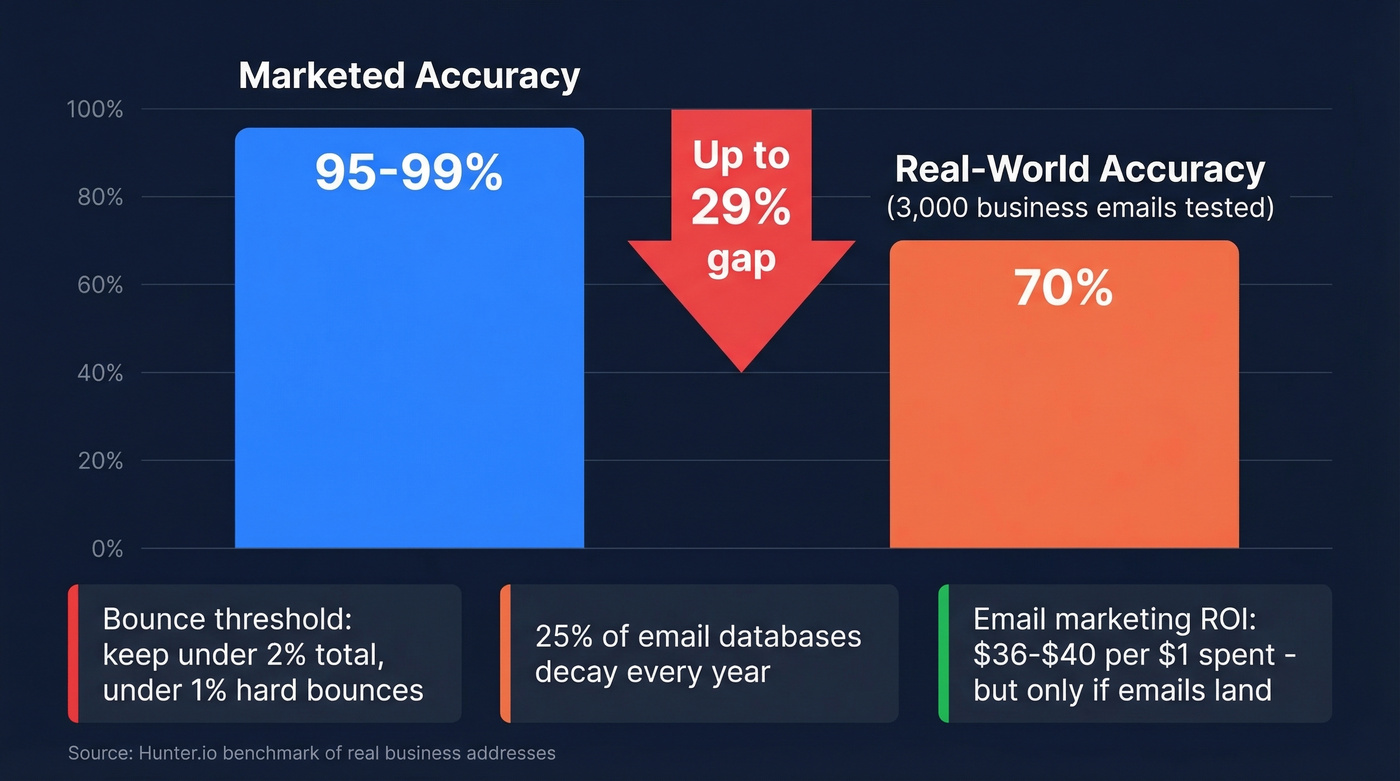
Most accuracy claims are measured against the tool's own test set, which skews heavily toward easy-to-verify domains - Gmail, Outlook, corporate domains with standard MX configurations. A benchmark against 3,000 real business email addresses found the top overall score was 70.00% accuracy. That's a massive gap from the 99% on the marketing page, and it applies even to top-ranked tools that dominate G2 rankings.

The inflation comes from syntax checks. Catching john@@company..com as invalid is trivial - every tool does it. The hard part is confirming whether john.smith@company.com actually exists as a live mailbox, especially on catch-all domains that accept everything during SMTP handshake. Industry best practice says to [keep total bounces below 2%] and hard bounces under 1%. If your "99% accurate" tool lets 5%+ bounce through, the marketing number is meaningless.
Don't trust self-reported accuracy. Test every tool against your own list - your industry, your ICP, your domain mix.
Pricing Comparison
Verification pricing varies wildly once you normalize for volume. We split this into two tables for clarity.
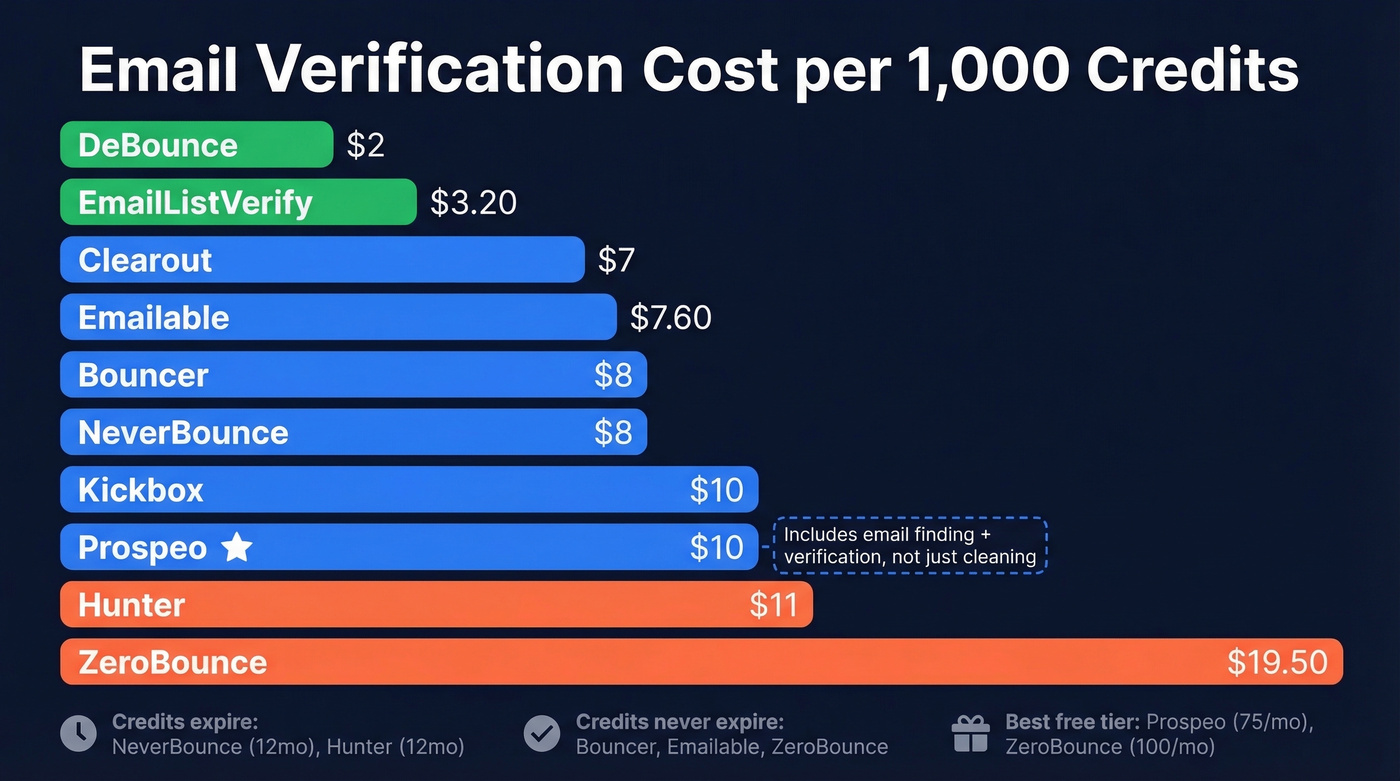
Pricing by Volume
| Tool | Cost/1K | Cost/10K | Free Credits | Min Purchase |
|---|---|---|---|---|
| DeBounce | ~$2 | ~$20 | 100 | None |
| EmailListVerify | ~$3.20 | ~$24 | 100 | None |
| Clearout | ~$7 | ~$70 | 100 | None |
| Emailable | ~$7.60 | ~$76 | 250 | 5K credits |
| Bouncer | $8 | $60 | 100 | None |
| NeverBounce | $8 | $80 | Free first list | None |
| Kickbox | ~$10 | ~$100 | 100 | 500 credits |
| Prospeo* | $10 | $100 | 75/mo | None |
| Hunter | $11 | $110 | 50/mo | None |
| ZeroBounce | $19.50 | $129 | 100/mo | 2K credits |
*Prospeo's cost includes email finding + verification - not just list cleaning. You're paying $0.01 for a sourced and verified contact, not just a cleaned one.
Policies & Catch-All Handling
| Tool | Credits Expire? | Catch-All Handling | Notes |
|---|---|---|---|
| DeBounce | No | Not specified | Cheapest per-credit |
| EmailListVerify | No | Not specified | Fast: 100K/hour |
| Clearout | No | AI verdict | Accept/reject prediction |
| Emailable | Never | Flags only | 15% subscription discount |
| Bouncer | Never | Returns unknown | No charge for unknowns |
| NeverBounce | 12 months | Returns unknown | $49/mo plan available |
| Kickbox | No | Returns unknown | API-first workflow |
| Prospeo | No | Dedicated handling | 5-step pipeline with spam-trap removal |
| Hunter | 12 months | Returns unknown | Publishes own benchmarks |
| ZeroBounce | Never | Abuse detection | Full deliverability suite |
The biggest hidden variable isn't the per-credit price - it's credit expiration. NeverBounce credits expire after 12 months. Bouncer and Emailable credits never expire. If you verify in bursts rather than steady monthly volumes, expiration policies can quietly waste hundreds of dollars.

Most verification tools claim 99% accuracy but let 5-8% of emails bounce. Prospeo's 5-step pipeline - catch-all handling, spam-trap removal, honeypot filtering - delivers 98% real-world accuracy at $0.01/email.
Stop paying to clean bad data. Start with emails that are already verified.
The 10 Best Email Verification Services Reviewed
1. Prospeo - Best Find-and-Verify
Use this if you're building prospect lists from scratch and want verified emails without stitching together a finder and a separate verifier.
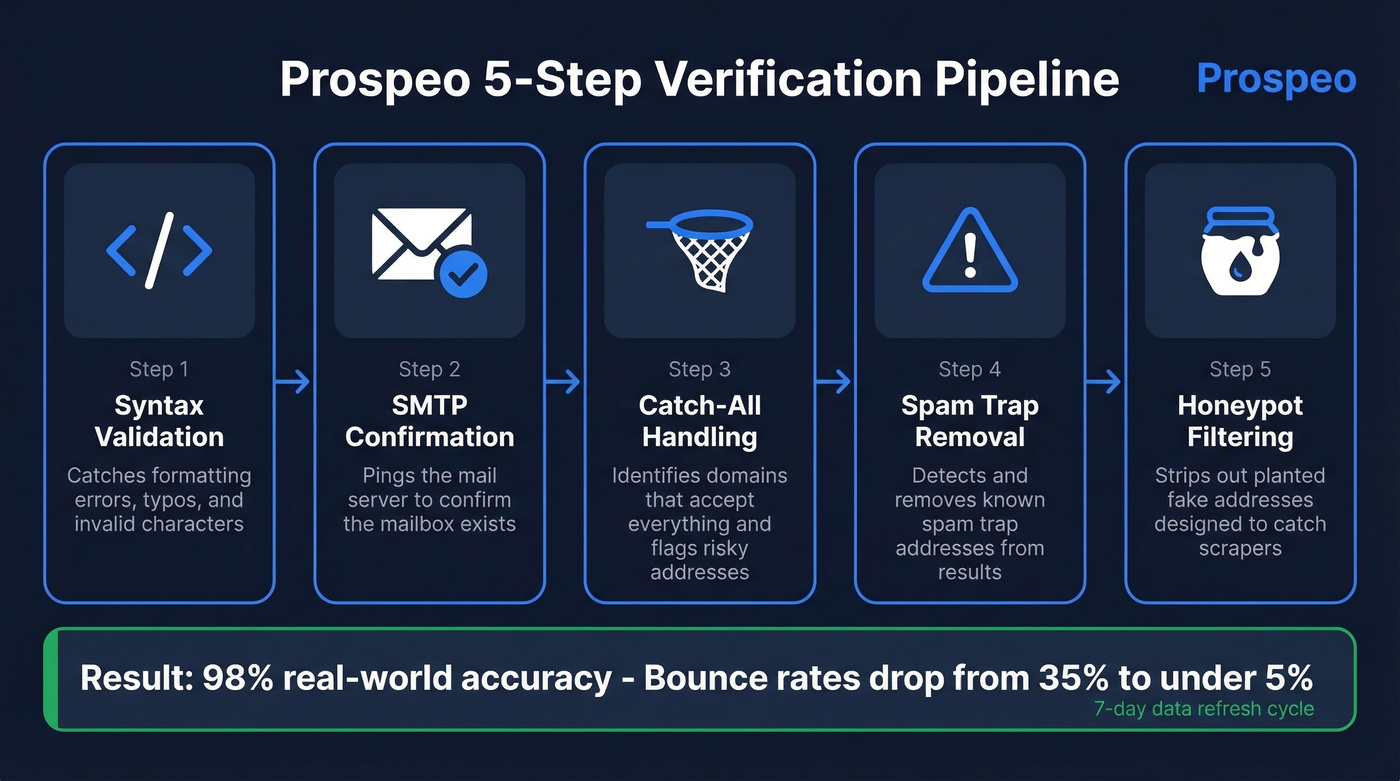
Prospeo runs a 5-step verification pipeline - catch-all handling, spam-trap removal, honeypot filtering, SMTP confirmation, and syntax validation - automatically on every email it finds across 300M+ professional profiles. The 7-day data refresh cycle means contacts don't go stale between when you find them and when you email them, which is a real problem when the industry average refresh sits at six weeks.
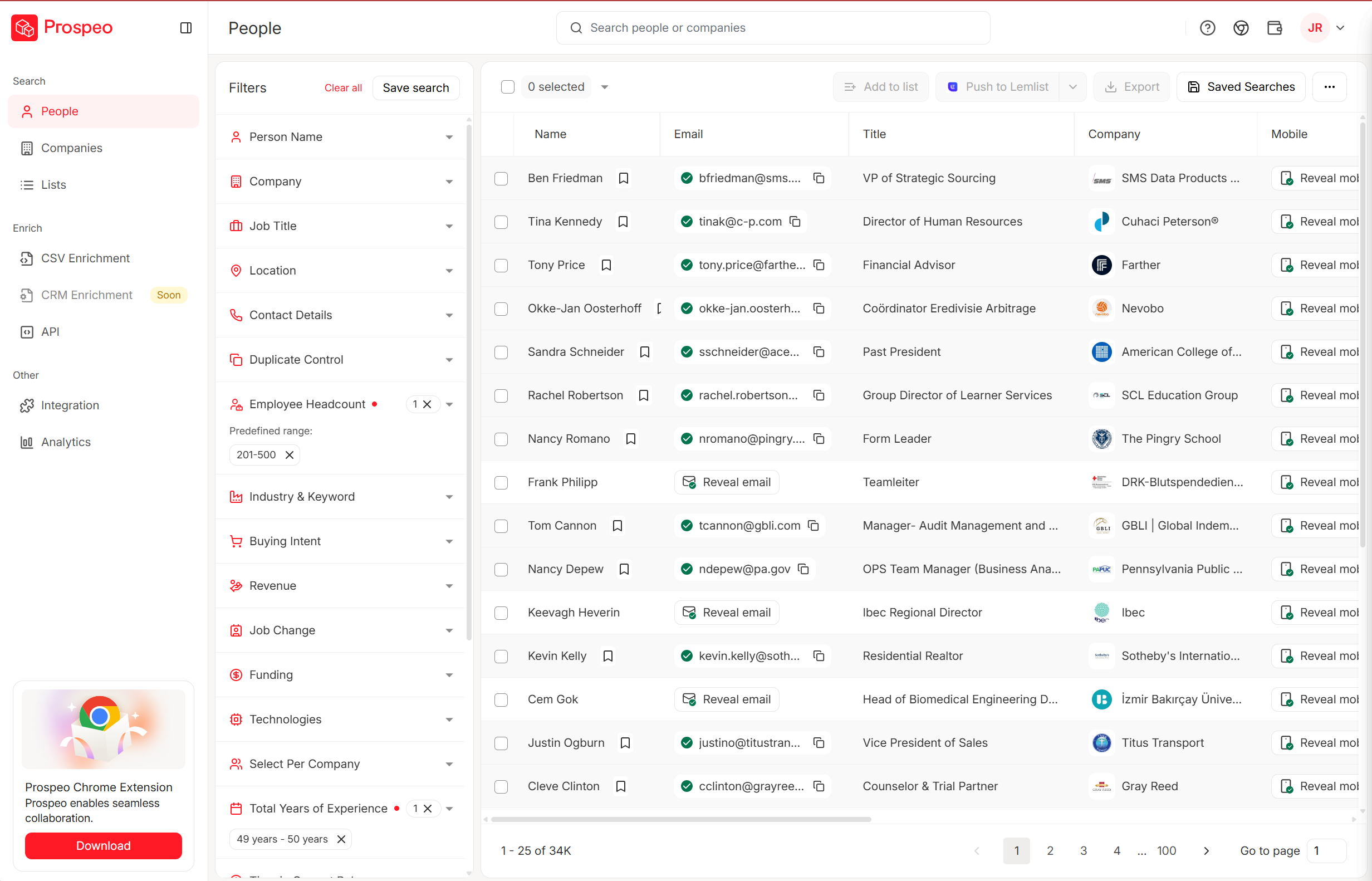
The results speak for themselves. Snyk's 50-person AE team went from 35-40% bounce rates to under 5% after switching. Meritt tripled pipeline from $100K to $300K/week and cut bounce rate from 35% to under 4%.
Integrations cover the full outbound stack: HubSpot, Salesforce, Instantly, Lemlist, Clay, Zapier, and more. Free tier gives you 75 emails plus 100 Chrome extension credits per month. Paid plans start around $39/mo with no annual contracts.
Skip this if you already have a clean list and just need bulk re-verification - a dedicated list cleaner like Bouncer will be cheaper per credit.
2. Bouncer - Best Budget List Cleaner
G2 named Bouncer "Easiest to Use" in the email verification category, and that tracks with our experience. Upload a CSV, get results, done.
Pricing starts at $8 for 1,000 credits and drops to $2/1K at the million-credit tier. Credits never expire - buy in bulk when you have budget, use them whenever. They don't charge for duplicates or unknown results, which is a nice touch that other tools should copy.
No learning curve, no configuration headaches. It does one thing and does it well. But it's only one thing - no email finding, no enrichment, no prospecting.
If you're comparing similar tools, see our breakdown of Bouncer alternatives.
3. ZeroBounce - Best Deliverability Suite
ZeroBounce is for teams that want verification, inbox placement testing, abuse detection, and email scoring in a single platform. ZeroBounce ONE runs $99/mo ($79/mo annual) and includes 10,000 verification credits plus Finder searches and deliverability tools. It's the closest thing to a full deliverability command center.
| Strength | Weakness |
|---|---|
| All-in-one deliverability platform | Expensive at low volumes ($19.50/1K at the 2K minimum) |
| Abuse & spam-trap detection | 2,000 credit minimum purchase |
| Credits never expire | Complex pricing tiers |
| Unknown results not charged | Overkill for basic list cleaning |
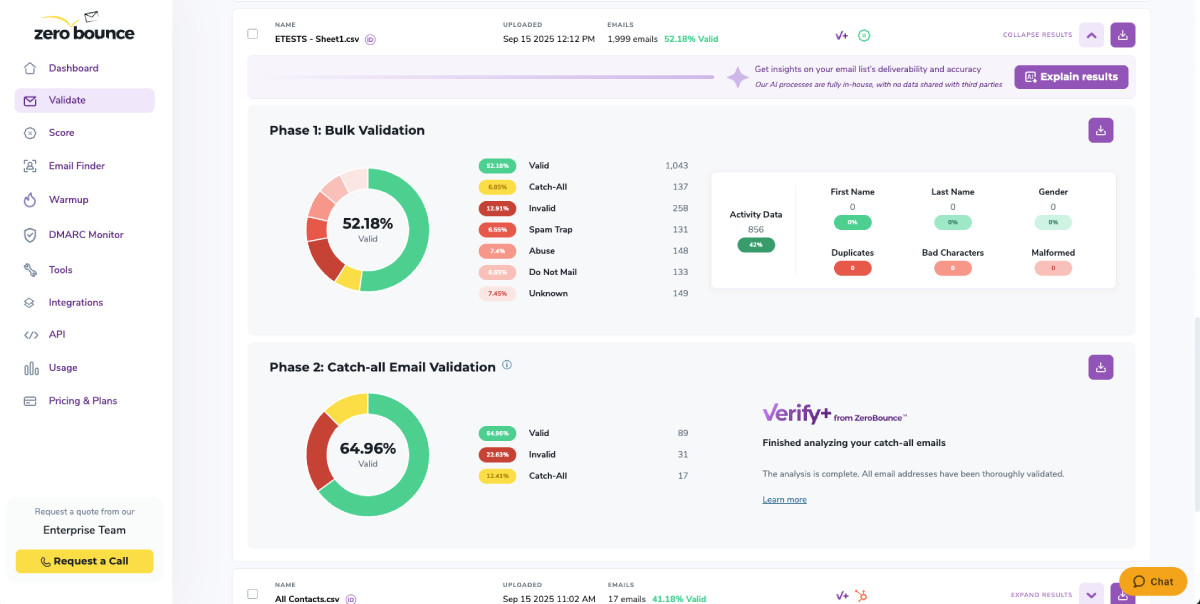
At scale (100K+), the per-credit cost drops to about $0.0065, which is competitive. But if you're a small team doing basic list cleaning, Bouncer or DeBounce will save you real money.
4. NeverBounce - Best Automated Hygiene
Use this if you want verification that runs automatically inside your ESP or marketing platform. NeverBounce's strength is its integration layer - connect it to your email platform and it cleans lists on autopilot. The Growth plan at $49/mo covers up to 10,000 verifications, and pay-as-you-go runs $8/1K.
One important callout: NeverBounce credits expire after 12 months. If you're a seasonal sender or verify in irregular bursts, this matters. Bouncer and Emailable don't have this limitation.
Skip this if you verify manually in batches. The automation premium isn't worth it unless you're actually using the ESP integrations.
5. Clearout - Best Real-Time API Verification
Clearout shines at the point of capture. Its widget and API verify emails on web forms, signup flows, and landing pages before bad data enters your system. The AI-powered accept/reject verdict goes beyond standard "unknown" flags on catch-all domains - it predicts whether the address is likely valid, which is a meaningful step up from tools that just shrug and return "catch-all."
Plans start at $18/mo for 3,000 credits, with pay-as-you-go from $0.007/credit. 100 free credits to test. Skip this if your workflow is batch-based - without the real-time angle, you're paying a premium for a standard verifier.
6. Emailable - Best "Set and Forget" Credits
[Emailable credits never expire], and the 15% subscription discount makes recurring verification affordable. The minimum purchase is 5,000 credits (~$38), which includes inbox reports at 100 credits per report. You get 250 free credits to start.
For teams that buy verification credits in advance and use them over months, this is a solid pick. But if you need fewer than 5,000 verifications, DeBounce or Bouncer offer lower entry points.
7. Kickbox - Best for Developer Teams
Your engineering team owns the verification workflow? Kickbox is API-friendly and built for teams that want verification embedded directly into forms, product flows, and internal systems. Starts at $5 for 500 credits, with 100 free to test.
Skip this if you're a marketer who wants a simple upload-and-verify interface. Kickbox is built for developer workflows, and the UI reflects that.
8. EmailListVerify
Budget-friendly bulk verification at ~$3.20/1K, with 100 free verifications and plans from $16/mo for 5K. Processing speed hits 100K emails/hour. Solid for high-volume list cleaning where you need fast, cheap verification without advanced features.
9. DeBounce
One of the cheapest options on this list at ~$2/1K. DeBounce is popular in the cold email community for good reason - it's fast and affordable. Fewer advanced features than Bouncer or ZeroBounce, but when price-per-verification is your primary filter, it's hard to beat.
10. Hunter
Hunter offers 50 free credits per month (each verification costs 0.5 credits, so that's 100 verifications). Paid plans start at $49/mo. Hunter also publishes a large verifier benchmark using 3,000 real business email addresses; the top overall score in that benchmark is 70.00% accuracy - a useful reality check on how "accuracy" behaves on real B2B data.
If you're evaluating similar platforms, compare Hunter alternatives.
Snyk cut bounce rates from 35% to under 5%. Meritt tripled pipeline to $300K/week. The difference? A 7-day data refresh cycle and verification that catches what other tools miss.
Test Prospeo against your own list - no credit card, no contract.
The Catch-All Problem
Catch-all domains are the single biggest blind spot in email verification.
A catch-all server accepts every incoming email regardless of whether the specific mailbox exists. Send to completely.fake.person@catchall-company.com and the server returns SMTP 250 - "accepted." But that email might bounce internally, get silently dropped, or land in a dead inbox.
Legacy verification tools return "catch-all/unknown" for up to 30% of a typical B2B list. That's a huge chunk of your prospects sitting in limbo - too risky to email blindly, too valuable to discard. Even the best verifier on the market can't fully resolve catch-all addresses through SMTP alone.
Here's the workflow that actually works:
- Quarantine by default. Don't send to catch-all addresses in your main sequences.
- Test in micro-batches. Send 20-50 catch-all addresses per domain and monitor bounces closely.
- Cap catch-all share per sequence. Keep catch-all addresses under 10-15% of any single send.
- Fail closed. If bounce or complaint indicators worsen, pull all catch-all addresses immediately.
Even with the best tool, catch-all domains require operational discipline. No verifier can fully solve them.
If you're trying to diagnose bounces and fix root causes, start with our email deliverability guide and the deeper dive on email bounce rate.
The Waterfall Approach
Here's our hot take: if your deal sizes exceed $5K, you can't afford to rely on a single verification source. In one practitioner test shared on Reddit, single-source enrichment tools landed around 60-70% valid emails, while a cascade approach pushed results to ~90%. The consensus on r/sales threads is pretty clear - stacking providers beats relying on one.
Let's break down a concrete waterfall that works:
Layer 1: Source and verify with a prospecting tool that has built-in verification. You're starting with clean data rather than cleaning dirty data after the fact.
Layer 2: Run remaining unknowns and catch-all addresses through Bouncer. At $8/1K with no credit expiration, it's a strong second pass.
Layer 3: Anything still unresolved gets quarantined. Don't send to it. The cost of a bounced email to your domain reputation far exceeds the cost of a missed prospect.
This three-layer approach typically gets teams to 90%+ verified contacts at a blended cost well under $0.02 per email. That's cheap insurance for your sender reputation.
If you're building lists upstream, pair verification with data enrichment services and proven sales prospecting techniques.
FAQ
How does email verification work?
Verification follows four steps: syntax check (valid format?), MX record lookup (domain accepts email?), SMTP handshake (server responds?), and mailbox confirmation (address exists?). Catch-all domains break step four because they accept everything regardless of whether the mailbox is real. Test any tool against your own list before committing credits.
What's a catch-all domain?
A catch-all domain accepts all incoming mail regardless of whether the specific mailbox exists - the SMTP server returns "accepted" for every address. This affects up to 30% of B2B lists and is the primary reason "99% accuracy" claims fall apart in practice. Tools with dedicated catch-all handling offer better resolution than those that just return "unknown."
How often should I verify my list?
Quarterly at minimum, given 25% annual database decay. High-volume senders should verify monthly or use tools with automated re-verification. A 7-day data refresh cycle eliminates the "verify, wait, verify again" problem - look for tools that keep data current automatically.
Is free email verification accurate enough?
Free tiers of 50-250 credits are perfect for testing a tool's accuracy against your specific list before committing money. But standalone free tools with no paid tier often skip SMTP verification entirely, relying only on syntax and MX checks. That's not real verification - it's a spell checker for email addresses.
Should I use one verifier or multiple?
Multiple. In practitioner tests, single-source tools land around 60-70% valid emails while stacking two or three providers pushes accuracy to ~90%. Start with a prospecting tool that includes built-in verification, then run remaining unknowns through a dedicated bulk cleaner like Bouncer. The blended cost stays under $0.02 per email.