

The Best Marketing Strategies for B2B - Ranked by What They Actually Cost
Every "best marketing strategies for B2B" article gives you the same list: content marketing, ABM, social selling. None of them tell you what each strategy actually costs per lead, which ones work at your company size, or where to start if you've got a $5K/month budget and a team of three.
Closing a complex B2B deal now takes 222+ touchpoints on average, per a HockeyStack analysis of 1.5M+ contacts across 50+ B2B SaaS companies. And 86% of enterprise buyers have already shortlisted vendors before they start "researching." The question isn't which strategies exist - it's which ones earn you a spot on that shortlist without torching your budget.
Here's the thing: most B2B teams overspend on events and underspend on the channels that actually compound. We've pulled real CPL data so you can see exactly where your dollars go furthest.
Where to Start Based on Company Size
Under 50 employees (CPL target: ~$146): Start with SEO/content, cold email with verified data, and referral marketing. Add one paid channel only after organic pipeline is flowing.
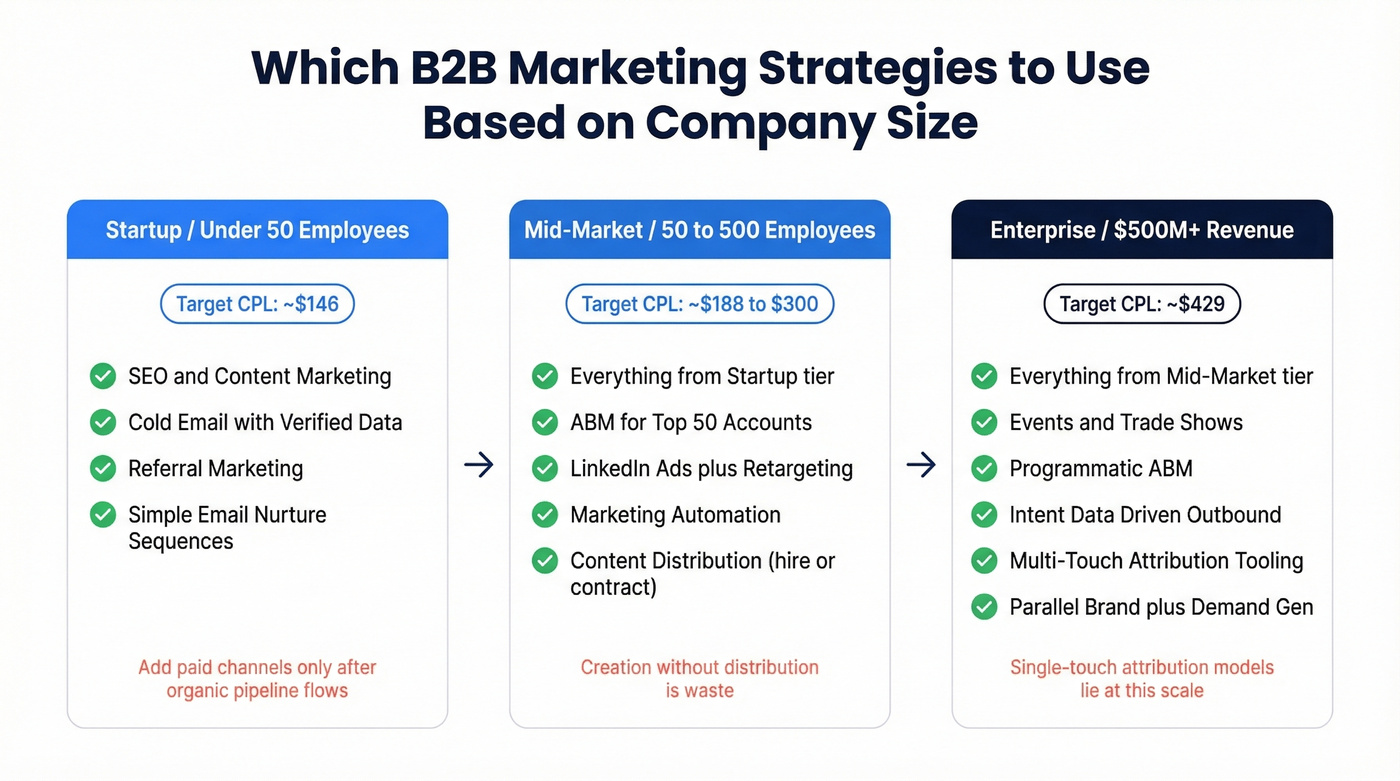
50-500 employees (CPL target: ~$188-$300): Layer in ABM for your top 50 accounts and paid social through LinkedIn plus retargeting. Invest in marketing automation to nurture the leads you're already generating. Hire or contract for content distribution - creation without distribution is waste.
Enterprise (>$500M revenue) (CPL target: ~$429): Add events, programmatic ABM, and intent-data-driven outbound. Budget for multi-touch attribution tooling because single-touch models lie at this scale. Coordinate brand and demand gen as parallel tracks, not competing priorities.
CPL Benchmarks by Channel
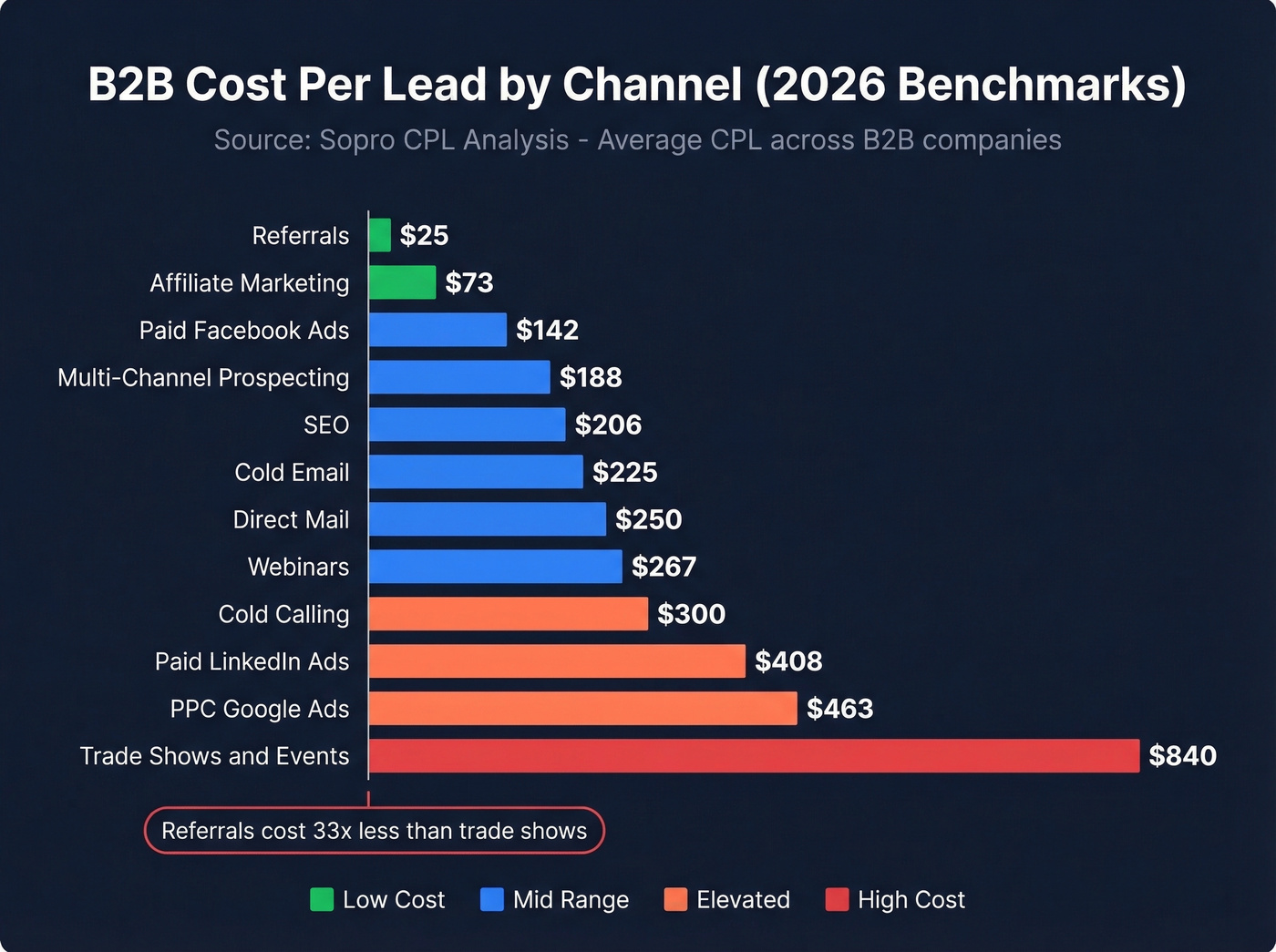
Here's what nobody else publishes: the actual cost per lead by channel. These benchmarks come from Sopro's CPL analysis - the most granular public dataset available.
| Channel | Avg CPL |
|---|---|
| Referrals | $25 |
| Affiliate marketing | $73 |
| Paid Facebook ads | $142 |
| Multi-channel prospecting | $188 |
| SEO | $206 |
| Cold email | $225 |
| Direct mail | $250 |
| Webinars | $267 |
| Cold calling | $300 |
| Paid LinkedIn ads | $408 |
| PPC (Google Ads) | $463 |
| Trade shows / events | $840 |
The spread is staggering. Referrals cost 33x less than trade shows. Yet most mid-market companies pour their biggest line item into events because "that's what we've always done."
On budget, the Gartner benchmark puts average B2B marketing spend at 8.4% of revenue - versus 5.7% for B2C. That typically splits 42% programs, 35% personnel, 23% technology. Gartner also found marketers use only 33% of their martech stack's capability. You're paying for tools you don't use, running channels you can't measure, and wondering why pipeline is flat. The average qualified-lead conversion rate across 14 industries is just 2.9%, which means for every 100 contacts you touch, fewer than 3 become real opportunities. Every dollar matters.
Strategies That Actually Drive Pipeline
Content Marketing + SEO + GEO
SEO pulls a $206 CPL - middle of the pack - but it compounds. The leads you generate from a ranking page in month 12 cost far less per incremental lead than the ones in month 1. That's the magic of organic.
The newer layer is GEO (Generative Engine Optimization): structuring content so AI assistants like ChatGPT and Perplexity surface your brand in answers. It's early, but teams ignoring it will lose visibility as 67% of buyers prefer self-service over talking to a rep. Your content is your first salesperson. Make sure it shows up where buyers actually look.
Referral Marketing
At $25 per lead, referrals are the cheapest pipeline source by a mile. So why doesn't every company have a formal program? Because referrals feel unscalable. They're not - they're under-systematized.
Here's a four-step system we've seen work repeatedly:
- Ask within 30 days. Every closed-won customer gets asked for two introductions while the win is still fresh.
- Track in your CRM. Create a "referral" source field. If you can't report on it, you can't grow it.
- Reward it. Gift cards, account credits, public recognition - pick what fits your buyer.
- Set a target. 15-20% of pipeline from referrals is realistic for teams that actually execute.
Skip this if you don't have at least 10 happy customers yet. You need a base of advocates before a referral program produces anything meaningful.
Email Nurturing
Without nurture sequences, 80% of new leads never convert. Marketing generates volume, sales complains about quality, and most of your spend evaporates.
With automated nurture, companies generate 50% more sales-ready leads at 33% lower cost. Nurtured leads make 47% larger purchases. Automated nurture emails generate 320% more revenue than manual campaigns. Even a simple 5-email drip segmented by persona outperforms a monthly newsletter blast. If you're dumping leads straight to sales without a nurture sequence, you're burning most of your marketing spend.
Multi-Channel Outbound
Combining email, phone, and social outreach boosts results by 287% versus email alone. Cold email open rates average 27.7%, with a 3.43% reply rate.
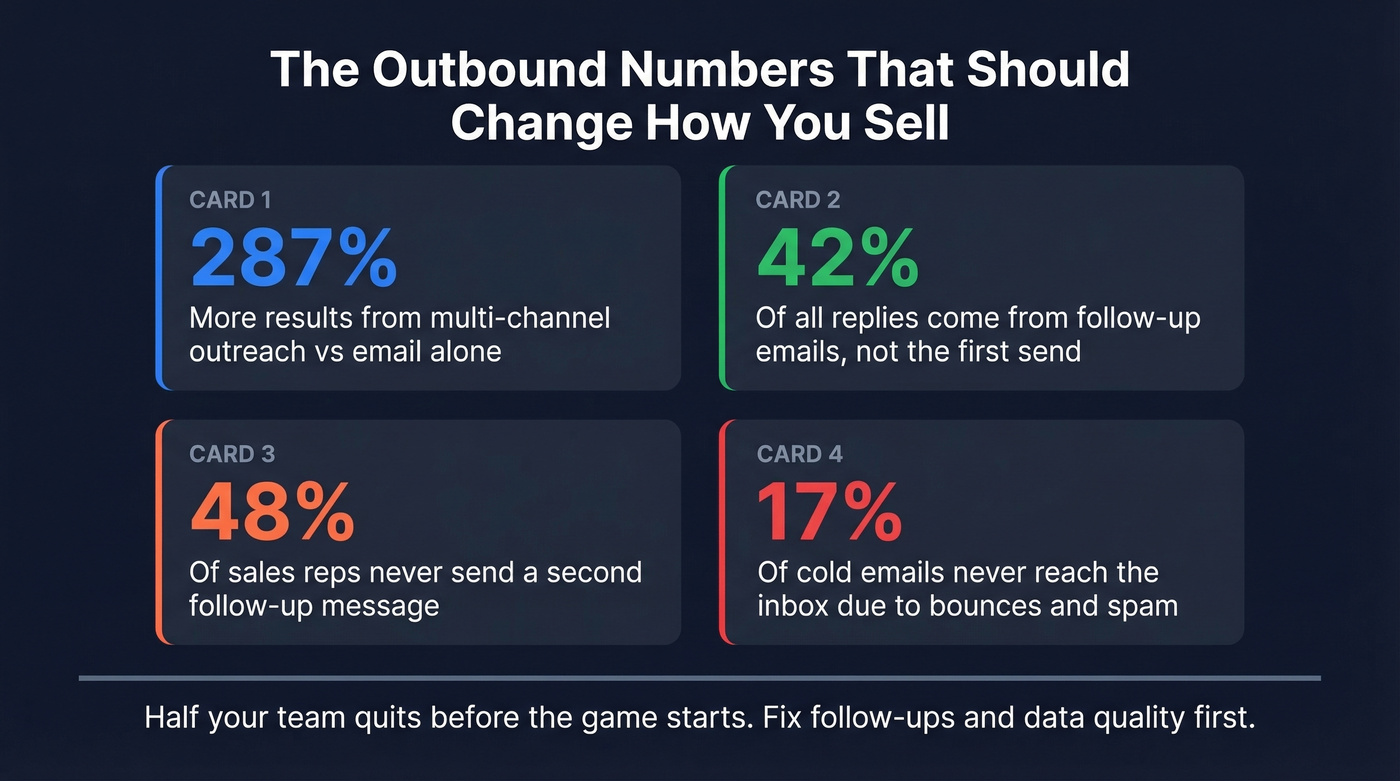
Here's what kills me: 42% of all replies come from follow-ups, yet 48% of reps never send a second message. Half your team is quitting before the game starts.
Your outbound results live and die on data quality. When 17% of emails never reach the inbox due to bounces and spam filtering, no sequence design saves you. We'll get to the data quality section below - it's the invisible prerequisite for everything on this list.
Account-Based Marketing
ABM concentrates resources on accounts that actually matter. The podcast ABM tactic is underrated - Storemaven used their "Mobile Growth & Pancakes" show to invite VPs and C-level targets as guests, turning cold prospects into warm relationships. Direct mail in ABM campaigns returns up to 20x ROI and makes campaigns 27% more likely to deliver top sales performance.
The tradeoff is real, though. ABM is resource-intensive. You need clean account data, sales-marketing alignment, and patience. If your average deal size is under $25K, the economics rarely work. It's a precision weapon - don't use it for spray-and-pray.
Social Media
YouTube + TikTok + Reddit - younger decision-makers research here before they ever hit your website. If you're only on LinkedIn, you're missing half the conversation. The consensus on r/sales is that Reddit threads and community posts influence buying decisions far more than most marketers realize.
Respond within 24 hours. 73% of people expect it, and ignoring DMs for 72 hours actively damages trust. Employee advocacy consistently outperforms brand posts on engagement - arm your team with talking points and get out of the way.
Demand Gen + Brand Building
Remember that 86% shortlist stat? Buyers decide who's on the list before they start evaluating. That's demand gen's job - making sure your brand is already in the room when the buying committee convenes. Buyers are nearly 70% through the purchasing process before they engage a seller, so if your entire strategy is lead capture forms and SDR outreach, you're only reaching people who've already made up their minds.
Brand investment feels unmeasurable, but it's the reason some companies get inbound while others grind for every meeting.
Hot take: If your average deal is under $10K, you probably don't need most of the strategies on this list. Nail SEO, referrals, and cold email. That's it. The companies drowning in complexity are usually the ones that added channels before proving ROI on the basics.
Paid Advertising
Use this if your ACV justifies the CPL. PPC runs $463 per lead, LinkedIn Ads $408, Facebook Ads $142. Retargeting is typically the highest-ROI paid tactic because you're reaching people who already know you.
Skip this if you're an early-stage team with deals under five figures. At $408 per LinkedIn lead, you typically need mid-five-figure deal sizes for the math to work. Start with organic and outbound, then layer in paid once you know your ICP converts.
Webinars + Virtual Events
Webinars pull a $267 CPL - roughly a third of trade shows. And while 45% of B2B marketers cite in-person events as their top lead source, webinars capture similar engagement without the typical five-figure booth and travel costs. The key is making them genuinely useful, not a 45-minute product demo disguised as education. Invite a customer to co-present, share data nobody else has, then record it and repurpose into 10 pieces of content.
Data Quality + List Hygiene
This is the strategy nobody talks about because it's not glamorous. But it's the foundation everything else sits on.
When 17% of cold emails never reach the inbox and Gmail's spam complaint threshold is 0.1%, a dirty list doesn't just waste money - it destroys your domain reputation and takes every outbound channel down with it. Even the best-designed B2B campaigns fail when the underlying data is broken.
We've seen this play out firsthand. Meritt, an outbound agency, was running a 35% bounce rate before switching to verified data. After cleaning up their lists, bounces dropped under 4% and pipeline tripled from $100K to $300K per week.
Prospeo handles this at the infrastructure level - 300M+ professional profiles with 98% email accuracy and a 7-day data refresh cycle versus the 6-week industry average. That freshness gap matters when you're emailing people who changed jobs last month. The free tier gives you 75 verified emails and 100 Chrome extension credits per month to test, and it integrates natively with Smartlead, Instantly, Lemlist, and other sequencers.

You just saw it: 17% of emails never reach the inbox, and 42% of replies come from follow-ups your reps never send. Fix the data layer first. Prospeo delivers 98% email accuracy with a 7-day refresh cycle - so every dollar you spend on multi-channel outbound actually reaches a real person.
At $0.01 per verified email, bad data is no longer an excuse.
Mistakes That Kill Your Pipeline
Five patterns that destroy marketing ROI over and over:
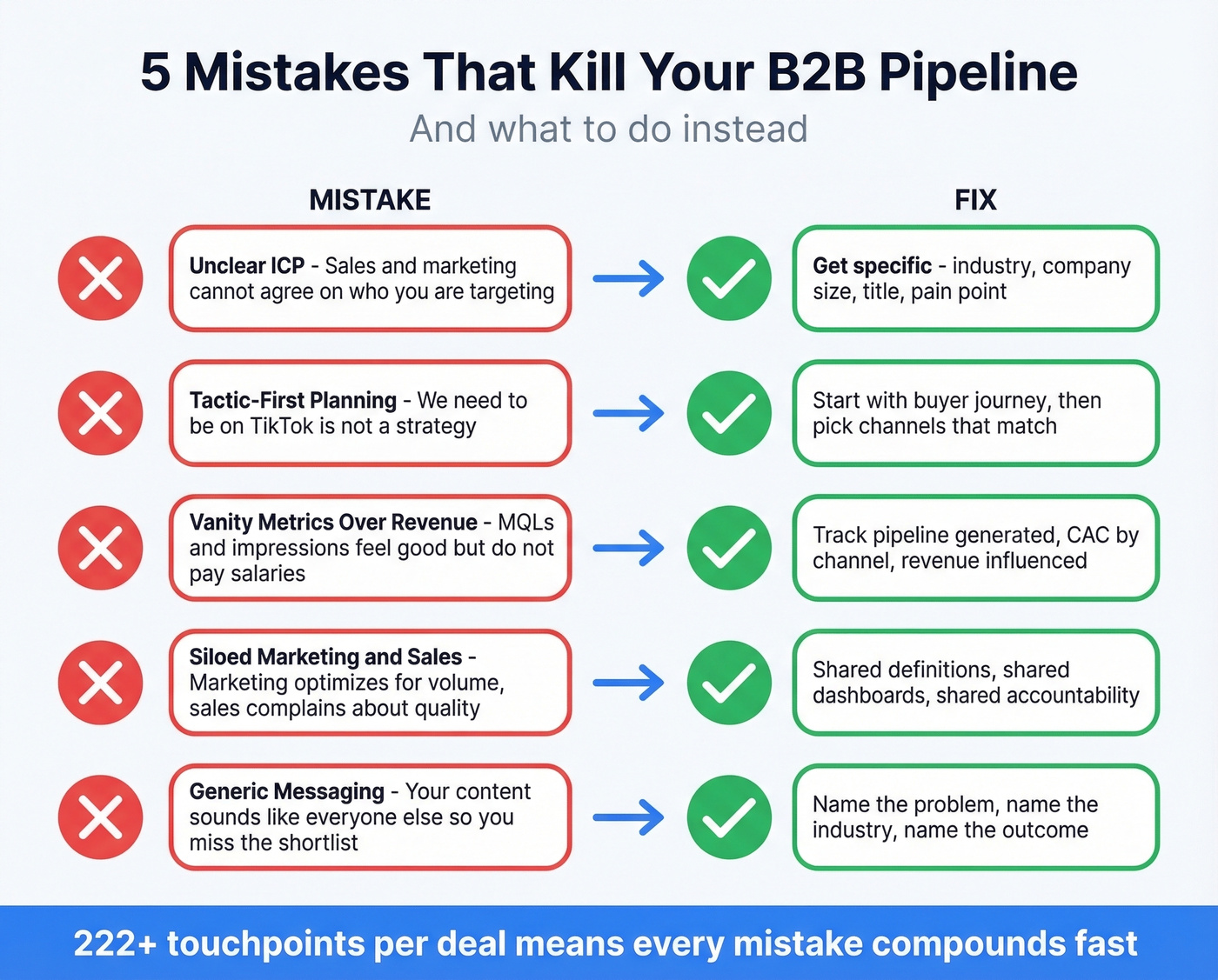
Unclear ICP. If sales and marketing can't agree on who you're targeting, every channel underperforms. Get specific - industry, company size, title, pain point. Vague personas produce vague results. Use an Ideal Customer Profile template to force clarity.
Tactic-first planning. "We need to be on TikTok" isn't a strategy. Start with your buyer's journey, then pick channels that match where they spend time. The 222+ touchpoints reality means you need deliberate sequencing, not random acts of marketing.
Vanity metrics over revenue metrics. MQLs, impressions, and follower counts feel good in a dashboard. They don't pay salaries. Track pipeline generated, CAC by channel, and revenue influenced.
Siloed marketing and sales. When marketing optimizes for lead volume and sales complains about lead quality, nobody wins. Shared definitions, shared dashboards, shared accountability. Non-negotiable.
Generic messaging. Buyers are 70% through their process before they talk to you. If your content sounds like everyone else's, you won't make the shortlist. Specificity wins - name the problem, name the industry, name the outcome.
How to Prioritize by Company Size
| Under 50 employees | 50-500 employees | Enterprise | |
|---|---|---|---|
| Top strategies | SEO, cold email, referrals | + ABM, paid social, automation | + events, programmatic, intent |
| Expected CPL | ~$146 | ~$188-$300 | ~$429 |
| Q1 priority | 2 SEO pages/wk + referrals | ABM list (50 accounts) + nurture | Multi-touch attribution + brand |
| Budget range | 8-12% of revenue | 8-10% of revenue | 6-8% of revenue |
Smaller companies spend a higher percentage because they're investing in growth. Enterprise companies spend more in absolute dollars but less as a percentage because brand momentum carries some of the load. The rule for every tier: don't spread across more than 3-4 channels until you've proven ROI on each one.
Measuring What Matters
Three metrics actually predict revenue growth: pipeline velocity (how fast deals move), CAC by channel (what you're really paying per customer, not per lead), and revenue influenced (which touchpoints contributed to closed deals).
With 222+ touchpoints per deal, giving credit to the last click or the first touch is fiction. Multi-touch attribution isn't perfect either, but it's closer to reality. If you're making budget decisions based on "which channel generated the most MQLs," you're optimizing for the wrong thing. Track what creates revenue, not what creates activity. The best B2B marketing strategies are the ones you can tie directly to closed revenue - not the ones that look best in a slide deck. If you need a baseline, start with sales pipeline benchmarks and a simple pipeline health dashboard.
ABM and intent-driven outbound only work when your account data is clean. Prospeo tracks 15,000 buyer intent topics via Bombora, layers in technographics and headcount growth signals, and returns 50+ data points per contact at a 92% match rate. That's the precision ABM demands - without the ZoomInfo price tag.
Build your target account lists with intent data that's refreshed weekly.
FAQ
What's the most cost-effective B2B marketing channel?
Referral marketing at $25 CPL is the cheapest B2B channel by a wide margin, followed by affiliate marketing at $73 and paid Facebook ads at $142. Multi-channel outbound comes in at $188 and SEO at $206. If you haven't systematized referrals yet, start there - it's the most underused pipeline source in B2B.
How much should a B2B company spend on marketing?
The Gartner benchmark is 8.4% of revenue for B2B companies, compared to 5.7% for B2C. That typically splits 42% programs, 35% personnel, and 23% technology. Before adding budget, audit what you're already paying for - most companies activate only a third of their martech stack.
How do I improve cold email deliverability?
Start with verified data - 17% of cold emails never reach the inbox due to bounces and spam filtering. Use a tool with 98%+ accuracy and weekly data refreshes to verify every address before sending. Keep spam complaints under Gmail's 0.1% threshold, warm up new domains gradually, and always send follow-ups. 42% of replies come from them.
What are the top B2B channels ranked by cost per lead?
Ranked by CPL: referrals ($25), affiliate marketing ($73), paid Facebook ads ($142), multi-channel prospecting ($188), SEO ($206), cold email ($225), direct mail ($250), webinars ($267), cold calling ($300), and paid LinkedIn ads ($408). The right mix depends on your deal size and team capacity - prove ROI on basics before layering expensive channels.