

Best Predictive Dialer in 2026: Honest Picks by Team Size
A RevOps lead we know ran a dialer bake-off last quarter. The team had 12 SDRs. They spent three weeks evaluating predictive dialers, got quotes, ran demos - then realized predictive dialing doesn't even work with 12 reps. The algorithm needs 50+ agents to predict anything useful. They'd been shopping for the wrong tool the entire time.
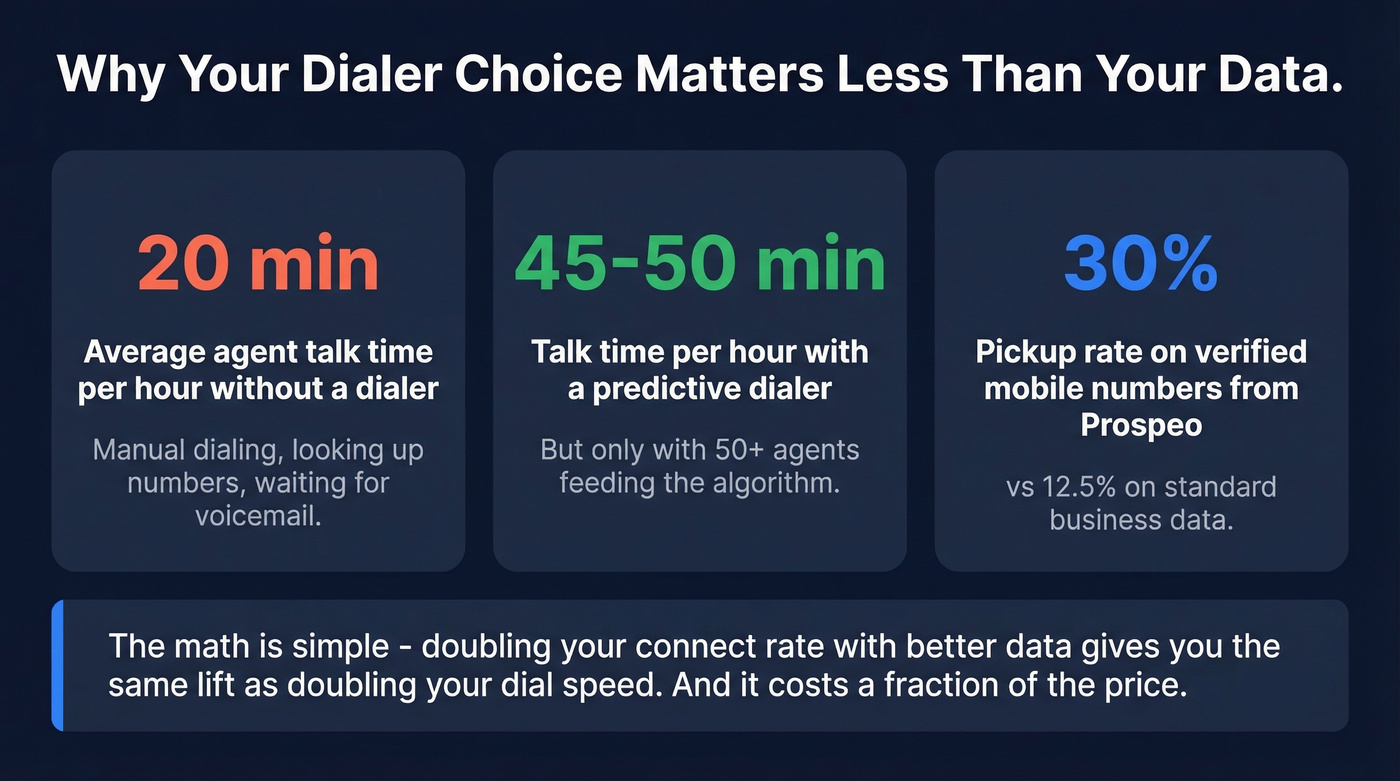
That's the dirty secret of every "best predictive dialer" list: most teams reading them don't actually need one. They need a power dialer, a parallel dialer, or - more often than anything - better phone numbers. A predictive dialer can push agent talk time from ~20 minutes per hour to 45-50 minutes, but only if you've got the team size and call volume to feed the algorithm.
Our Top Picks
| Category | Pick | Why |
|---|---|---|
| Best for call centers (50+ agents) | Convoso | True predictive pacing, compliance tools, quote-based pricing (~$90/user/mo estimated) |
| Best budget predictive | DialedIn | $25-$79/user/mo, real predictive algorithm at the lowest price on the market |
| Best for SDR teams (parallel) | Orum | Strong value vs. Nooks, 781 reviews at 4.6/5 |
| Best data layer for any dialer | Prospeo | 125M+ verified mobiles, 30% pickup rate - your dialer is only as good as your list |
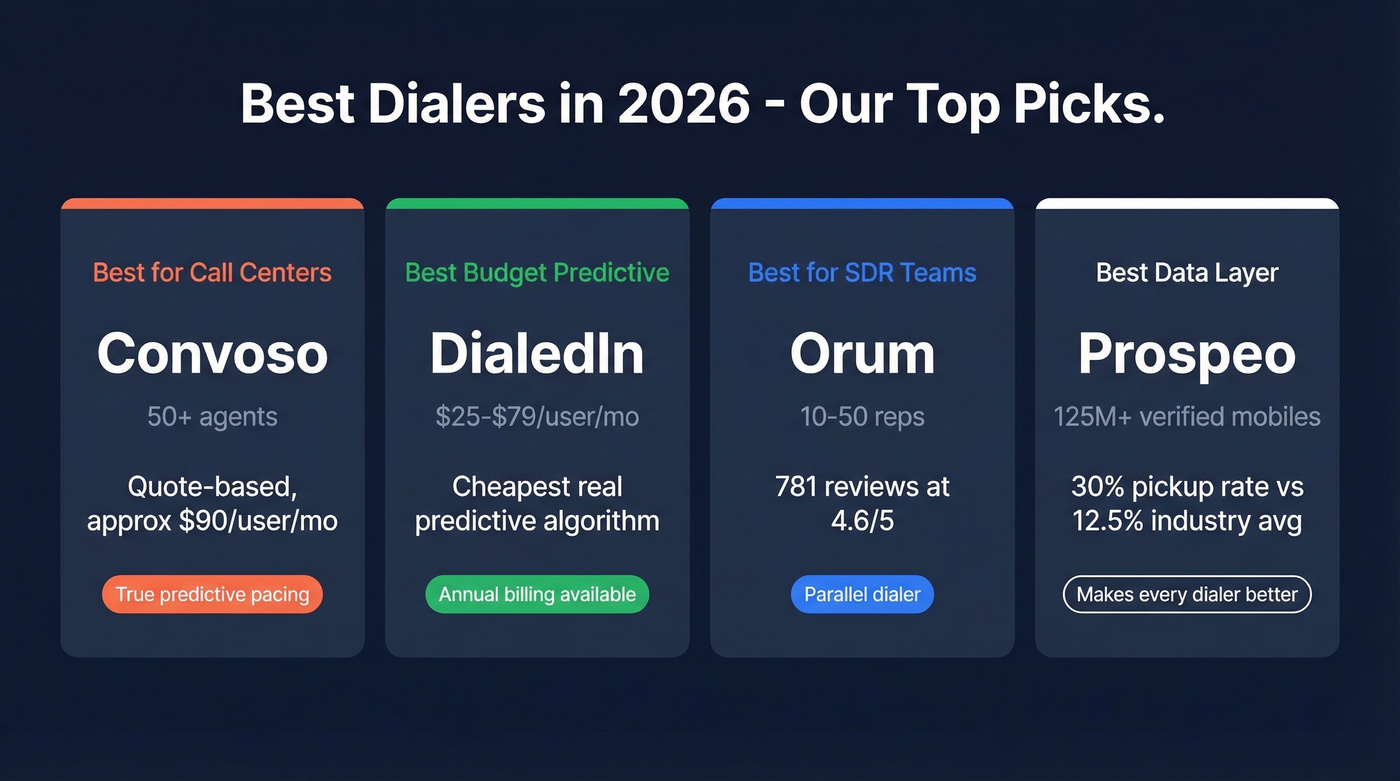
Convoso is the pick if you're running a real call center. DialedIn wins on price without sacrificing the core algorithm. Orum is what most B2B SDR teams actually want when they think they want "predictive." And the fourth pick isn't a dialer at all - it's the data layer that makes every dialer on this list perform better.
Do You Actually Need a Predictive Dialer?
Probably not. Predictive dialers use algorithms that forecast when an agent will become available and dial ahead of that moment. For the math to work, you need consistent call lengths across a large pool of agents. Regal's guidance puts the minimum at 50-100 agents. Below that threshold, the algorithm doesn't have enough data points to predict anything - it's just auto-dialing with extra steps.
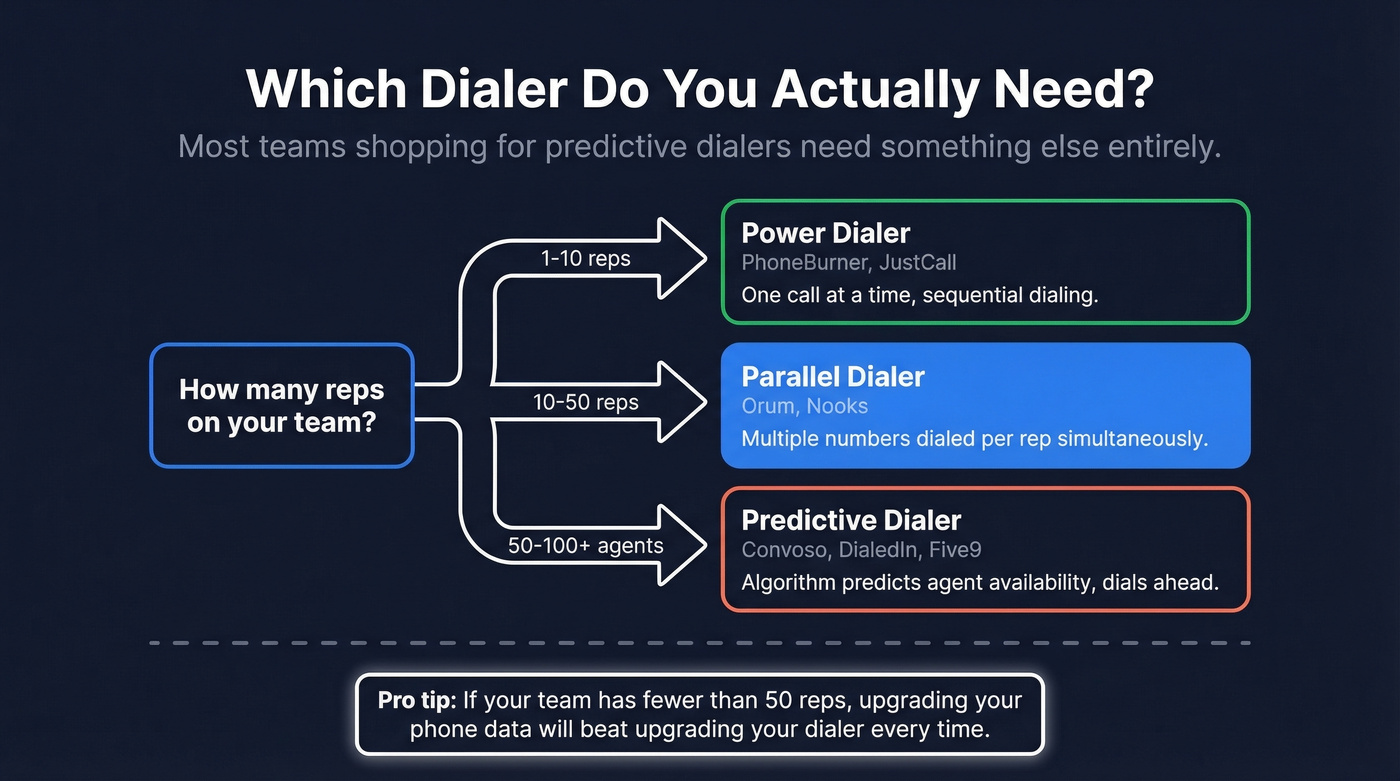
Most B2B sales teams have 5-30 reps. That's parallel dialer territory.
Dialer Type Quick-Match
| Dialer Type | Team Size | How It Works | Best For |
|---|---|---|---|
| Power | 1-10 reps | Dials one number per agent, sequentially | Solo reps, small teams |
| Parallel | 10-50 reps | Dials multiple numbers per agent simultaneously | SDR teams, outbound BDRs |
| Predictive | 50-100+ agents | Algorithm predicts agent availability, dials ahead | High-volume call centers |
| Progressive | 20-50+ agents | Dials a preconfigured ratio per agent with AMD | Compliance-sensitive centers |
Under 10 reps? Get a power dialer - PhoneBurner or JustCall will do. Between 10 and 50 reps? A parallel dialer like Orum gives you the volume lift without the compliance headaches of predictive. Only at 50+ agents with consistent, high-volume campaigns does a true predictive dialer start earning its keep.
Progressive dialers sit between power and predictive. They dial a preconfigured ratio - say, two calls per available agent - and use answering machine detection to filter. They're a solid middle ground for compliance-sensitive teams that still want automation. Most of the tools below offer progressive mode alongside predictive.
Here's the thing: if your deal sizes are under five figures and your team has fewer than 50 reps, you'll get more ROI from investing in verified phone data than from upgrading your dialer. The bottleneck is almost never the dialing software. It's the list.
Top Predictive Dialers and Alternatives
True Predictive Dialers
These tools run actual predictive pacing algorithms designed for large agent pools.
Convoso - Best for High-Volume Call Centers
Use this if you're running 50+ agents on outbound campaigns and need granular compliance controls. Convoso's predictive algorithm adjusts pacing in real time, and the compliance toolkit - AMD, local caller ID management, DNC scrubbing - is built for teams that can't afford TCPA violations. Contract options range from month-to-month to two-year terms, with discounts for longer commitments.
Skip this if you're under 40 seats. Trials are typically positioned for 40+ seats, and telephony usage charges apply on top of the base platform cost. Pricing isn't publicly listed, but it's commonly estimated to start around ~$90/user/mo on a custom quote. For a 50-agent team, expect an effective cost of $100-$200/user/mo once you factor in minutes and add-ons. Expensive, but the ROI math works when you're making thousands of dials per day.
Pricing: Quote-based, estimated ~$90/user/mo starting.
DialedIn - Cheapest Real Predictive Dialer
Here's what matters about DialedIn: it's the only tool on this list where you can get a genuine predictive pacing algorithm for $25/user/mo on an annual plan. Four tiers run from $25 to $79/user/mo annually, or $35 to $99/user/mo on monthly billing. Every tier includes the core algorithm, AMD, and campaign management.
The tradeoff is scope. DialedIn is focused on dialing, not on being a full CCaaS suite with email, SMS, and chat. If you need omnichannel or deep workforce management, look at Five9 or Genesys. But for pure outbound calling at scale, DialedIn's focus keeps the price low and the product sharp.
Pricing: $25-$79/user/mo (annual) or $35-$99/user/mo (monthly).
Five9 - Enterprise Standard (With a Catch)
Five9 is the full CCaaS platform - workforce management, quality monitoring, omnichannel routing, AI-powered agent assist, and conversation intelligence all under one roof. If you're an enterprise contact center that needs predictive dialing as one capability among many, Five9 delivers.
The catch is the contract. Five9 is commonly sold on 36-month terms. For a 30-seat team at $119-$159/user/mo, that's roughly a $128,520-$171,720 commitment over 36 months before you've made a single call - and before any usage, add-ons, or services. It's reliable but rigid. If you're not sure you'll need this for three years, look elsewhere.
Pricing: $119-$159/user/mo, commonly sold on 36-month terms.
Readymode - Mid-Market Workhorse
The headline number is $199/license/mo - expensive per seat. But Readymode includes unlimited outbound minutes with $0 setup fees. That all-inclusive model means no surprise telephony bills at month-end.
Reviewers (4.6/5 from 155 reviews) consistently praise the predictive dialer but flag slow loading during peak hours and limited customization options. If you need rock-solid performance during high-traffic periods, test thoroughly before committing.
Pricing: $199/license/mo, $0 setup.
CallTools - Highest User Rating
CallTools holds a 4.9/5 from 72 reviews - the highest rating in the predictive dialer category. Reviewers highlight customer support and smooth onboarding, with average implementation running about one month. The platform offers 39 integrations including Salesforce, HubSpot, and Zoho.
The downside is cost. Reviewers flag high pricing, and you'll need a custom quote. Expect $100-$200/user/mo based on market positioning. There's also a learning curve that takes a few weeks to overcome.
Pricing: Custom quote, ~$100-$200/user/mo estimated.
Parallel Dialers (The Modern Alternative)
For most B2B SDR teams, parallel dialing delivers the volume lift of predictive without the 50+ agent requirement. These tools dial multiple numbers simultaneously per rep and connect the first live answer.
Orum - Best Parallel Dialer for SDR Teams
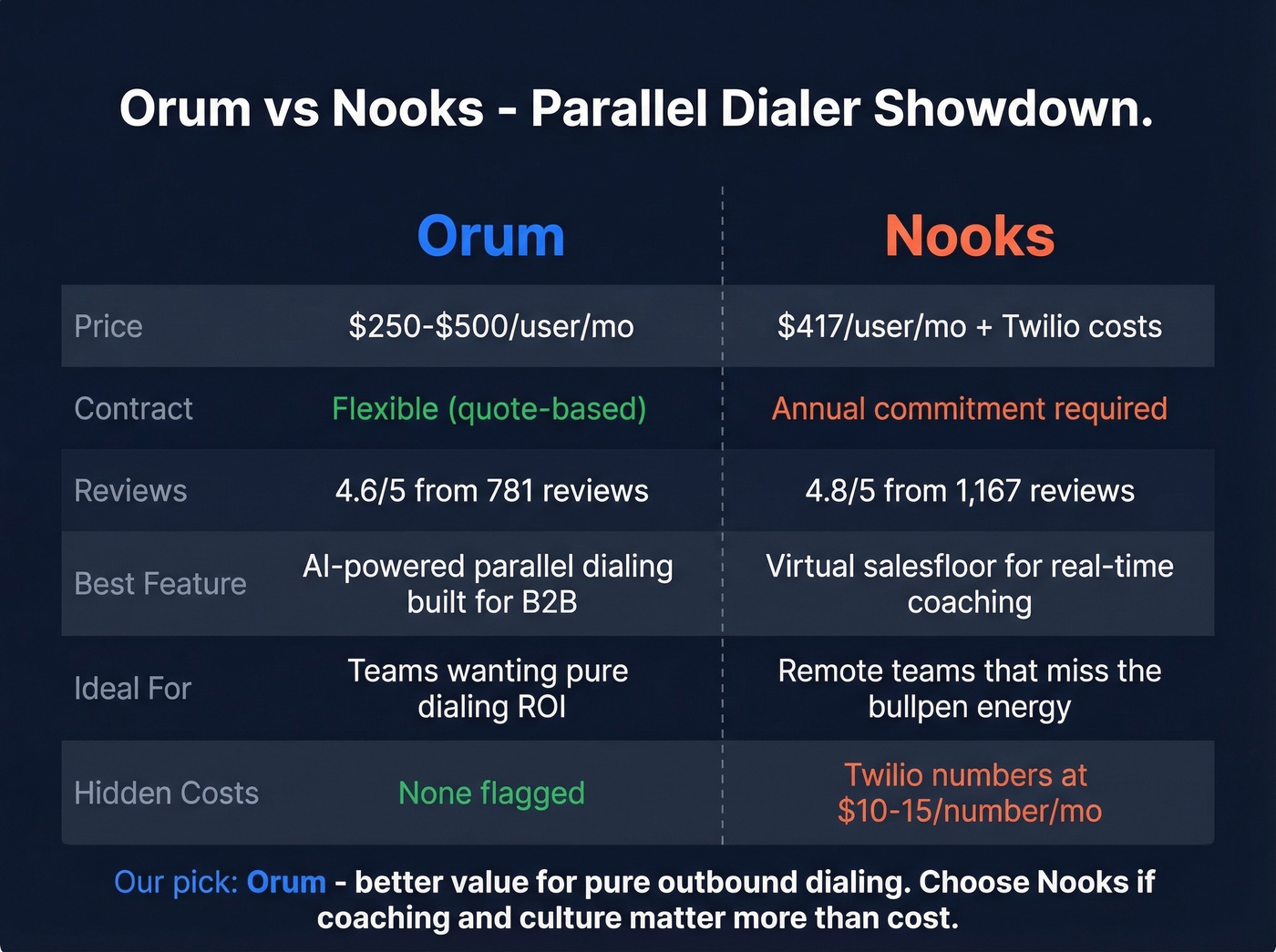
We've seen more B2B teams land on Orum than any other parallel dialer in the last year, and the numbers back it up. With 781 reviews at 4.6/5, it's one of the most proven options on the market. Orum's AI-powered parallel dialer is purpose-built for B2B outbound, and it works well for teams of 10-50 reps who want more conversations per hour without the compliance risk of predictive pacing.

Skip this if your budget is tight. Orum runs sales-led pricing in the $250-$500/user/mo range - premium territory. But compared to Nooks at ~$417/user/mo plus Twilio costs and an annual lock-in, Orum offers better flexibility. The learning curve is real (reviewers mention it), but most teams are productive within two weeks.
Pricing: ~$250-$500/user/mo (sales-led, quote required). 4.6/5 from 781 reviews.
Nooks - Popular but Pricey
Nooks' real differentiator isn't the dialer - it's the virtual salesfloor where managers coach reps in real time and reps feed off each other's energy. Genuinely valuable for remote SDR teams that miss the buzz of a physical bullpen. At ~$5,000/user/year plus Twilio numbers at $10-15/number/mo, it's the most expensive parallel dialer on the market. Annual commitment required. For pure dialing ROI, Orum gives you more for less.
Pricing: ~$5,000/user/year + Twilio costs, annual commitment. 4.8/5 from 1,167 reviews.
Power Dialers (For Smaller Teams)
If you've got fewer than 10 reps, this is your category.
PhoneBurner - Best Power Dialer
Half the "best predictive dialer" lists on the internet incorrectly include PhoneBurner. It's not predictive. It's a power dialer - one number at a time per rep, sequentially. It's just good at what it does. For teams under 10 reps, you don't need predictive or parallel features anyway.
Pricing: $140-$215/user/mo depending on tier and billing cycle. Transparent pricing - refreshing in this category.
JustCall
JustCall starts at ~$29/user/mo and targets SMBs that need a basic power dialer with CRM integrations. For solo reps or teams of 2-5, it gets the job done at a fraction of PhoneBurner's price.
Enterprise CCaaS Suites
Full contact center platforms that include predictive dialing as one feature among dozens. You'd buy these for the platform, not the dialer.
RingCentral RingCX runs $65-$145/agent/mo across three tiers. Solid CCaaS choice if you're already in the RingCentral ecosystem, but you're paying for a lot more than dialing.
Genesys Cloud CX spans $75-$240/user/mo across four tiers. Enterprise-grade workforce management, omnichannel routing, and AI-driven conversation intelligence with predictive dialing baked in. Overkill for pure outbound teams.
NICE CXone offers five plans from $110-$249/agent/mo. The AI features - agent assist, real-time coaching, automated summaries - are gated behind the $209+ tier. Below that, you're paying enterprise prices for a standard dialer.
Voiso starts at $49/user/mo and positions itself as the budget-friendly option for mid-market teams. Worth a look if Convoso and DialedIn don't fit, though it lacks the review depth of either.

Every dialer on this list dials numbers. None of them verify them. Prospeo gives you 125M+ verified mobile numbers with a 30% pickup rate - 3x higher than ZoomInfo's 12.5%. Feed your dialer clean data and watch connect rates climb.
Stop paying for a dialer to call dead numbers.
Pricing Compared
Every tool on this list with real pricing - no "contact sales" gaps where we could find real numbers.
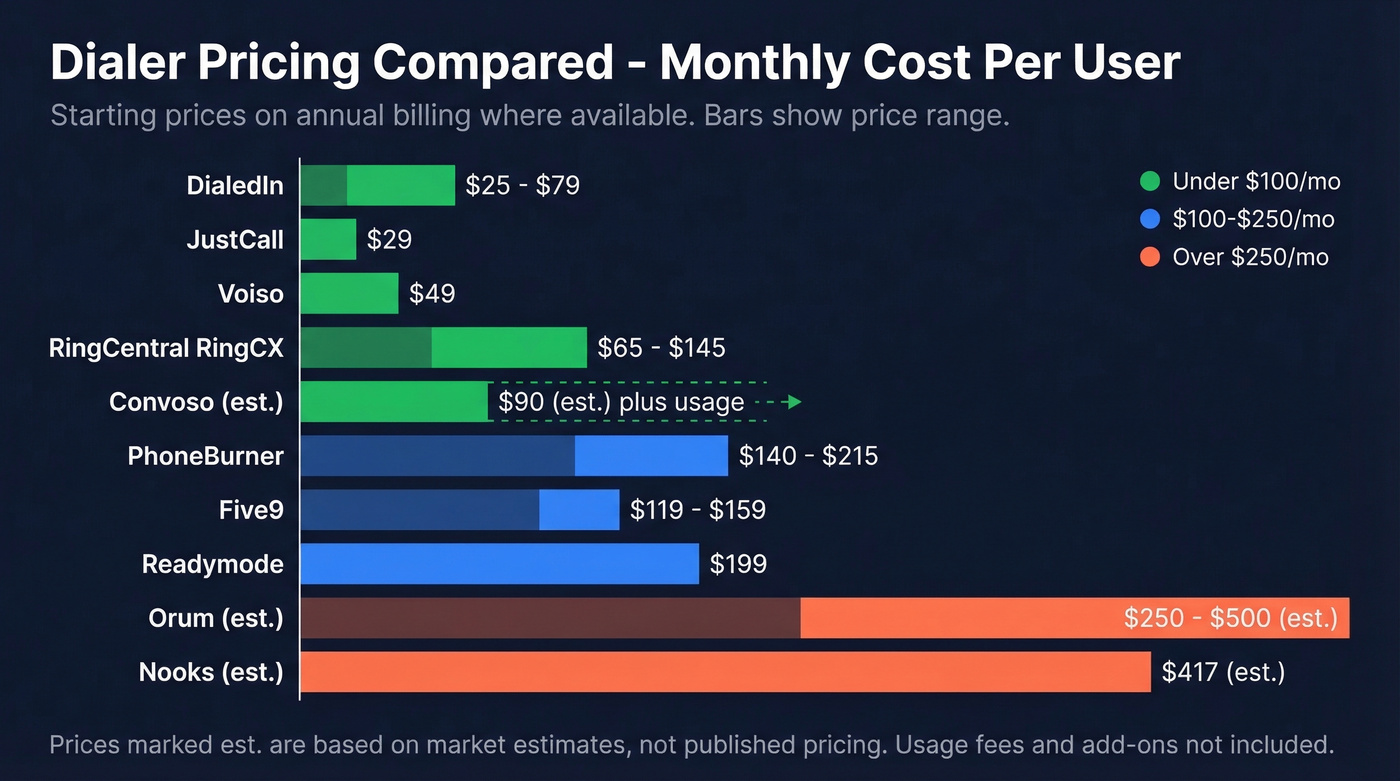
| Tool | Type | Starting Price | Contract | Notable |
|---|---|---|---|---|
| DialedIn | Predictive | $25/user/mo (annual) | Monthly or annual | Cheapest true predictive |
| Voiso | Predictive | $49/user/mo | Flexible | Budget option |
| Convoso | Predictive | ~$90/user/mo (estimated) | Month-to-month to 2yr | 40+ seat trial positioning |
| Five9 | Predictive/CCaaS | $119/user/mo | Commonly 36-month | Enterprise lock-in |
| Readymode | Predictive | $199/license/mo | Flexible | Unlimited minutes, $0 setup |
| CallTools | Predictive | ~$100-$200/user/mo | Custom | Quote required |
| RingCentral RingCX | CCaaS | $65/agent/mo | Flexible | 3 tiers |
| NICE CXone | CCaaS | $110/agent/mo | Flexible | AI gated to $209+ |
| Genesys Cloud CX | CCaaS | $75/user/mo | Flexible | 4 tiers |
| PhoneBurner | Power | $140/user/mo (annual) | Flexible | Not predictive |
| JustCall | Power | ~$29/user/mo | Flexible | SMB-focused |
| Orum | Parallel | ~$250-$500/user/mo | Sales-led | Quote required |
| Nooks | Parallel | ~$417/user/mo | Annual | + Twilio costs |
The sticker price is never the full story. A detailed breakdown from Acefone covers the hidden line items worth asking about: per-minute usage charges, seat minimums that force you to buy more licenses than you need, integrations gated behind higher tiers, compliance and recording storage fees, and onboarding costs that don't show up until the contract is signed.
Why Data Quality Beats Dialer Upgrades
The most expensive mistake in outbound calling: buying a $150/user/mo dialer and feeding it a list where 25% of the numbers are dead. You're paying your dialer vendor to call ghosts. Your agents sit through ring-after-ring of disconnected numbers, your caller IDs burn through reputation faster, and your cost-per-conversation skyrockets.
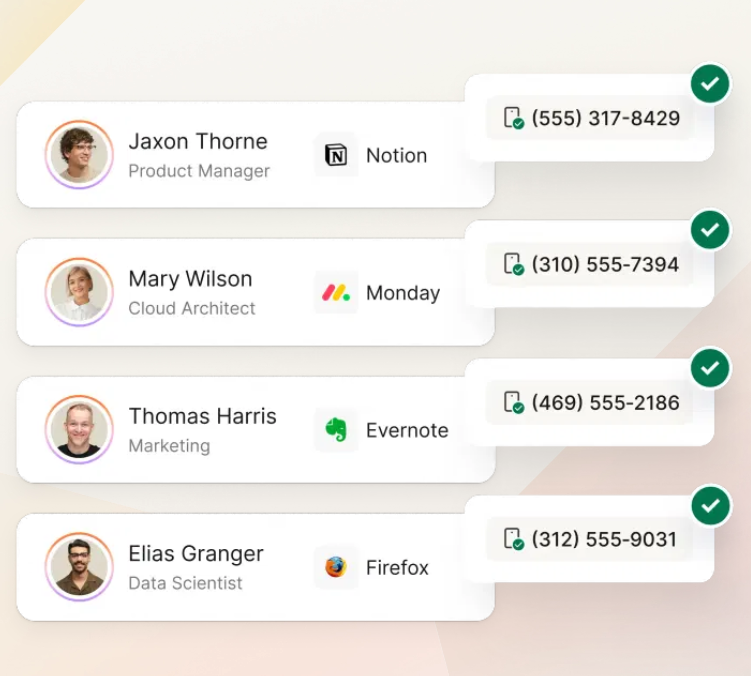
The highest-ROI investment in any outbound stack isn't a fancier dialer - it's clean data.
Meritt, an outbound agency, saw their bounce rate drop from 35% to under 4% and their connect rate triple to 20-25% after switching their data layer to Prospeo's mobile finder. That 125M+ verified mobile database runs on a 7-day refresh cycle versus the 6-week industry average, which means fewer dead numbers reaching your dialer in the first place. Even the best predictive dialer on this list produces garbage results if your numbers aren't real. Pair any dialer above with verified mobiles and you'll see more conversations per hour than upgrading your dialer tier ever would.
If you're rebuilding your outbound stack end-to-end, pair dialing with sales prospecting techniques and a tighter cold calling system so volume turns into pipeline.
TCPA Compliance Basics
If you're running a predictive dialer in the US, TCPA compliance isn't optional - it's existential. Statutory damages run $500-$1,500 per violation, and class actions can aggregate thousands of violations into eight-figure settlements.
The core rules every dialer operator needs to know:
- The 3% abandonment rule: Since 2003, the FCC has required that no more than 3% of answered calls in a campaign be abandoned. A live agent must be available for 97% of answered calls within two seconds. This is the rule that makes predictive dialing risky - aggressive pacing creates dead air and abandoned calls.
- Prior express written consent: Required before making telemarketing calls using an automatic dialer, prerecorded voice, or ringless voicemail. No exceptions.
- STIR/SHAKEN compliance: Carriers actively filter calls that don't pass caller ID authentication. If your dialer doesn't support STIR/SHAKEN attestation, your calls may never ring.
- State-level complexity: California, Florida, and several other states have their own telemarketing laws that layer on top of federal TCPA requirements. Compliance isn't a single checkbox - it's an ongoing operational discipline.
None of this is legal advice. But if your dialer vendor can't explain how their platform handles the 3% rule and consent management, that's a red flag.
How to Evaluate Your Shortlist
Before you sign a contract, run every vendor through these criteria. We've seen teams skip this step and regret it within 90 days, so let's break it down:
- AMD accuracy: False positives mean agents get connected to voicemail. False negatives mean abandoned calls that count against your 3% limit.
- Pacing algorithm controls: Can you adjust aggressiveness and set maximum abandon rates? The best dialers let you tune the algorithm, not just turn it on.
- AI features: Does the platform offer agent assist, real-time coaching, or conversation intelligence? Five9, NICE CXone (at $209+), and Genesys all include AI capabilities. For high-volume centers, AI-driven call summaries and sentiment analysis save hours of manual QA.
- CRM integrations: Salesforce and HubSpot are table stakes. Check whether the integration is native or requires Zapier - native integrations are faster and more reliable.
- Carrier quality and local presence: Does the vendor provide local caller IDs in your target markets? Local presence dialing can materially lift connect rates.
- Spam labeling management: Can the platform rotate numbers automatically and monitor for spam flags across carriers?
- BYOC support: Can you bring your own carrier or VoIP provider, or are you locked into the vendor's telephony? BYOC gives you more control over call quality and costs.
- Reporting granularity: Can you see connect rates, talk time, and abandonment rates per campaign, per agent, per time slot? Aggregate-only reporting is useless for optimization.
- Contract flexibility: Month-to-month vs. annual vs. multi-year. Five9's 36-month lock-in is the cautionary tale here.
- Minimum seat requirements: Convoso's 40-seat trial positioning is an example. Make sure the vendor's minimums match your team size.
- Onboarding timeline: CallTools averages about one month for implementation. Ask every vendor for a realistic timeline - not the sales deck version.
If you're also tightening the rest of your outbound motion, align dialing KPIs with sales operations metrics and broader lead generation metrics so you can see what's actually moving pipeline.
That RevOps team spent three weeks evaluating dialers. The real bottleneck was their list. Prospeo's verified mobiles refresh every 7 days - not the 6-week industry average - so your reps dial numbers that actually ring. At $0.10 per mobile, it costs less than one wasted minute of talk time.
Upgrade your data layer before you upgrade your dialer.
FAQ
What's a realistic cold outbound connect rate?
Expect 5-10% on cold lists and 8-15% with clean, verified data and local presence dialing. The biggest lever isn't your dialer - it's list quality. In our experience, teams feeding verified mobile numbers into any dialer consistently outperform teams running premium dialers on unverified lists.
Predictive vs. parallel dialer - what's the difference?
Predictive dialers use algorithms to forecast agent availability and dial ahead, requiring 50-100+ agents to function properly. Parallel dialers ring multiple numbers simultaneously per rep and connect the first live answer, working well for 10-50 person SDR teams. Parallel boosts conversations per day; predictive maximizes agent utilization at scale.
Can a small team use a predictive dialer?
Not effectively. The algorithm needs 50-100 agents with consistent call lengths to generate accurate predictions. Below that threshold, it can't model availability patterns - leading to excessive abandoned calls and TCPA compliance risk. Teams under 50 should use power dialers (1-10 reps) or parallel dialers (10-50 reps).
What's a good free tool for building dialer lists?
Prospeo offers a free tier with 75 verified emails and 100 Chrome extension credits per month - no contract required. For teams testing outbound before committing to a paid data provider, it's enough to validate list quality before scaling. Hunter (25 free searches/mo) is another option, though it lacks mobile number coverage.
Cloud or on-premise dialer?
Cloud. On-premise dialers are legacy infrastructure with higher maintenance costs, slower feature updates, and limited remote access. Every modern predictive dialer worth considering is cloud-based, and there's no compelling reason to go on-premise in 2026.