

Best Time of Day to Send Cold Emails - Based on Reply Data, Not Opens
You've probably been told "Tuesday at 10 AM" like it's a law of physics. So you schedule your sends, watch a pretty open rate climb, and still get a depressing reply rate. That's because most timing advice is built on opens - a metric that Apple Mail proxy servers have been faking since 2022. Nearly half the "opens" in your dashboard aren't humans. They're machines.
Let's talk about what the reply data actually says.
The Short Answer
- Best send window: 7-11 AM in the recipient's local timezone
- Best day: Thursday (6.87% reply rate across 16.5M emails)
- Best evening window: 8-11 PM (6.52% reply rate - decision-makers clearing inboxes after dinner)
- The metric that matters: replies, not opens
Best Time of Day by Reply Rate
The Belkins dataset - 16.5 million cold emails across 93 business domains - found that evenings between 8-11 PM produced the highest reply rate at 6.52%. That's counterintuitive. Most guides tell you to send mid-morning, and for years that was the default. But by evening, decision fatigue from a full day of meetings can actually work in your favor. Prospects default to quick, decisive actions like hitting reply instead of flagging your email for "later" (which really means "never").
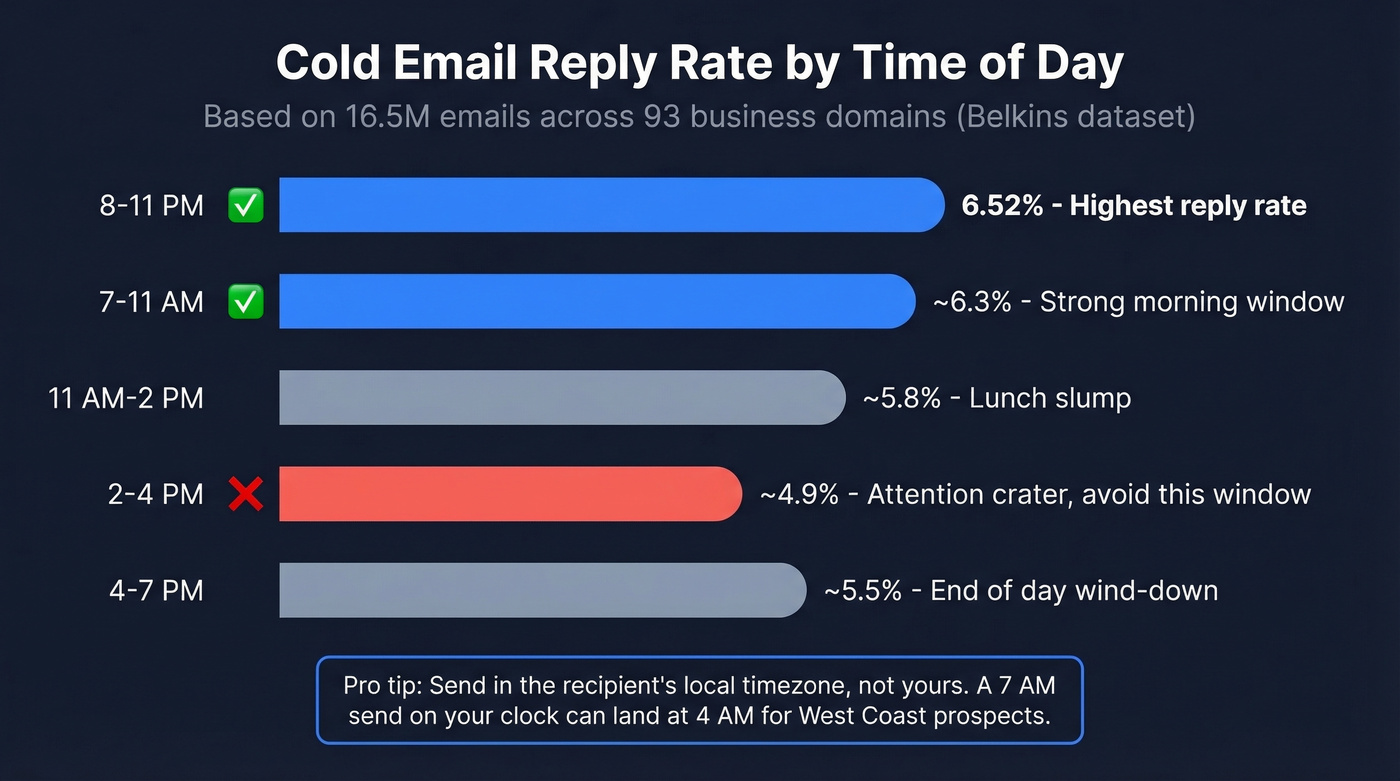
Mornings still work well. The 7-11 AM window is consistently strong in the Belkins data. Siege Media's analysis of 85,000+ personalized emails found 6-9 AM PST produced the best overall performance - though their sample skewed toward journalists and bloggers, not enterprise buyers.
One r/AskTechnology poster reported best replies around 10:30 AM on Tuesdays and Thursdays. In practice, the "perfect hour" matters less than two things: sending in the recipient's local timezone and avoiding mid-afternoon (2-4 PM) when attention craters.
Quick timing cheat sheet
| Recipient type | Safer window | Worth testing | Avoid |
|---|---|---|---|
| Busy operators (rev ops, finance, IT) | 7-9 AM | 8-11 PM | 2-4 PM |
| Execs / founders | 8-11 AM | 8-10 PM | 12-2 PM |
| Agencies / services | 9-11 AM | 7-9 PM | 4-6 PM |
Best Day to Send Cold Emails
Thursday wins. Here's how the days rank from the 16.5M-email dataset:
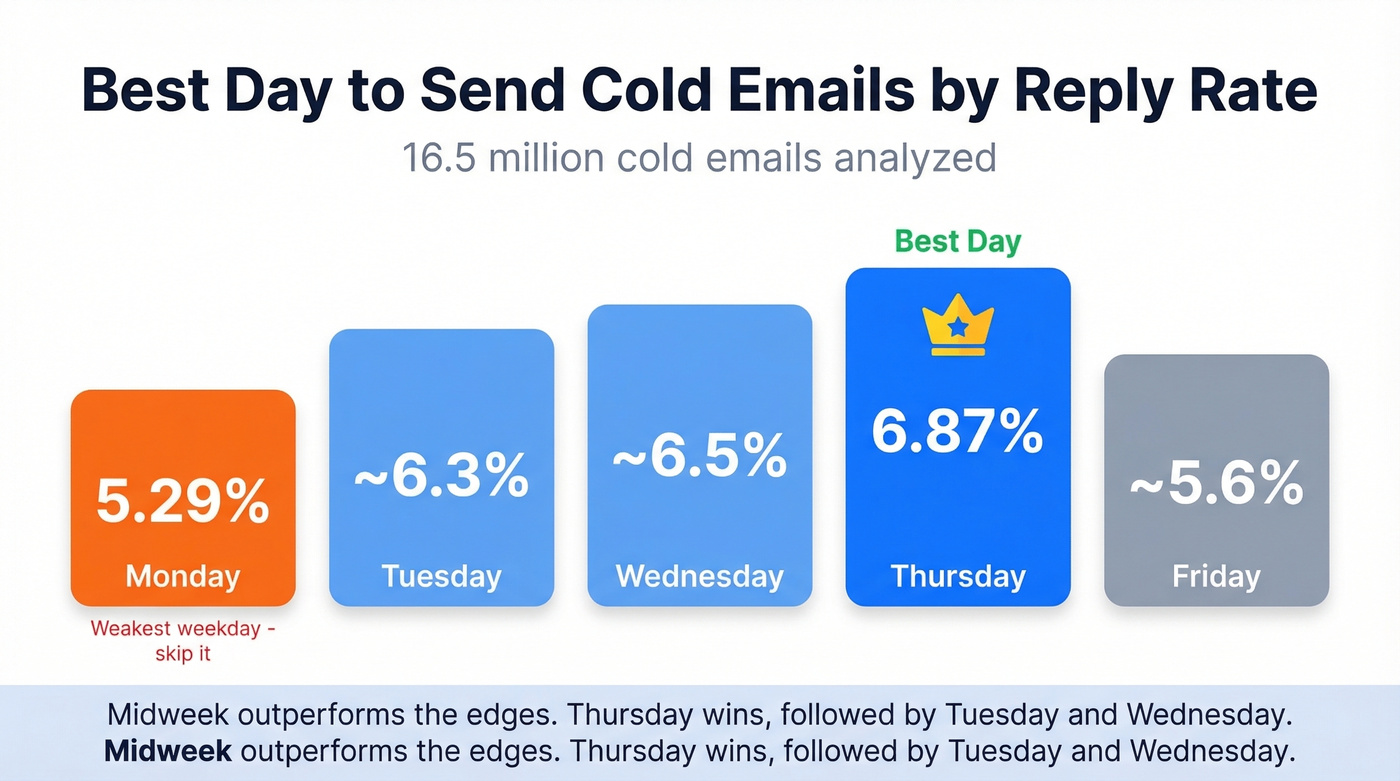
Thursday (6.87%) > Wednesday > Tuesday > Friday > Monday (5.29%)
The pattern is clear: midweek outperforms the edges.
Academic research backs this up. A study by Wolff & Goritz (2022) across five experiments found response rates are highest early in the workweek and fall to a Friday low, with the effect stronger among employed professionals. Siege Media's dataset actually favored Monday, but again - their audience was content creators, not B2B buyers. For sales outreach, Thursday is your best bet, followed by Tuesday and Wednesday.
Don't let anyone tell you Monday is the move. It's the weakest weekday in the cold-email data.

You can nail the Thursday 7-11 AM window and still get zero replies if half your emails bounce. Teams using Prospeo cut bounce rates from 35% to under 4% - and watched reply rates climb before changing a single word of copy. 98% verified accuracy, refreshed every 7 days.
Fix your bounce rate before you touch your send schedule.
Why Open-Rate Timing Advice Is Broken
Apple Mail Privacy Protection preloads tracking pixels through proxy servers, generating fake opens with distorted timestamps, spoofed geolocations, and masked device data. Apple accounted for roughly 49% of email opens in early 2025 based on Litmus data, and that share has only grown. Nearly half the "opens" in your dashboard are machines, not humans.
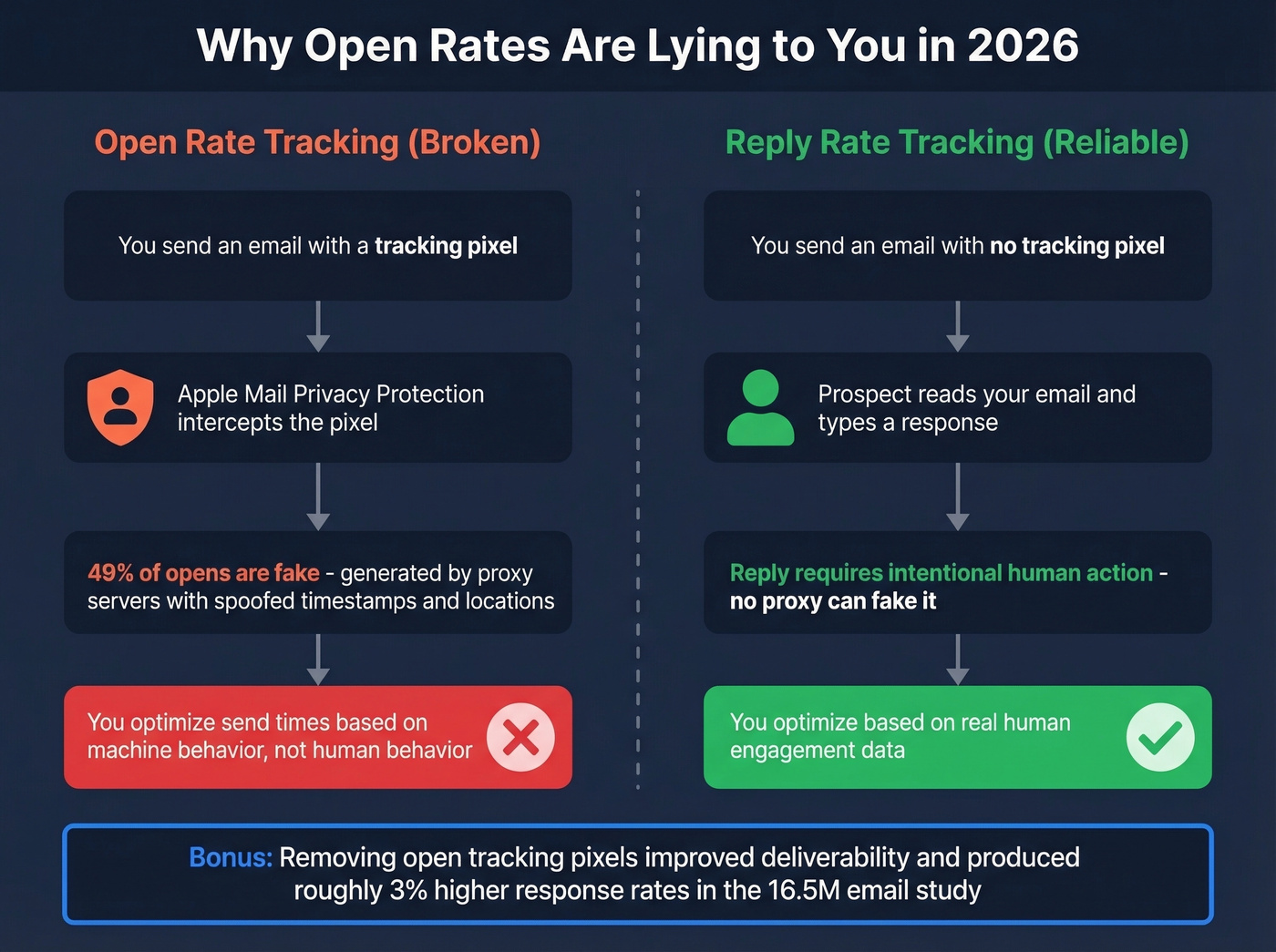
This isn't a minor distortion. MailerLite's benchmarks across 3.6 million campaigns from 181,000 approved accounts explicitly note that MPP inflates open rates. The 16.5M-email dataset's authors stopped tracking opens mid-year. Here's the kicker: in their experiment, turning off open tracking pixels improved deliverability and produced roughly 3% higher response rates.
If you're optimizing send times based on open rates in 2026, you're optimizing for Apple's proxy servers, not your prospects. Track replies and clicks - those require intentional human action.
What Matters More Than Perfect Timing
Here's the thing: if your bounce rate is above 5%, timing optimization is a complete waste of your energy. You can hit the perfect send window and still get zero replies if your list is garbage. Litmus found 70% of emails show at least one spam-related issue - timing won't save you from authentication failures or stale data.

Deliverability interacts with timing in ways most guides ignore:
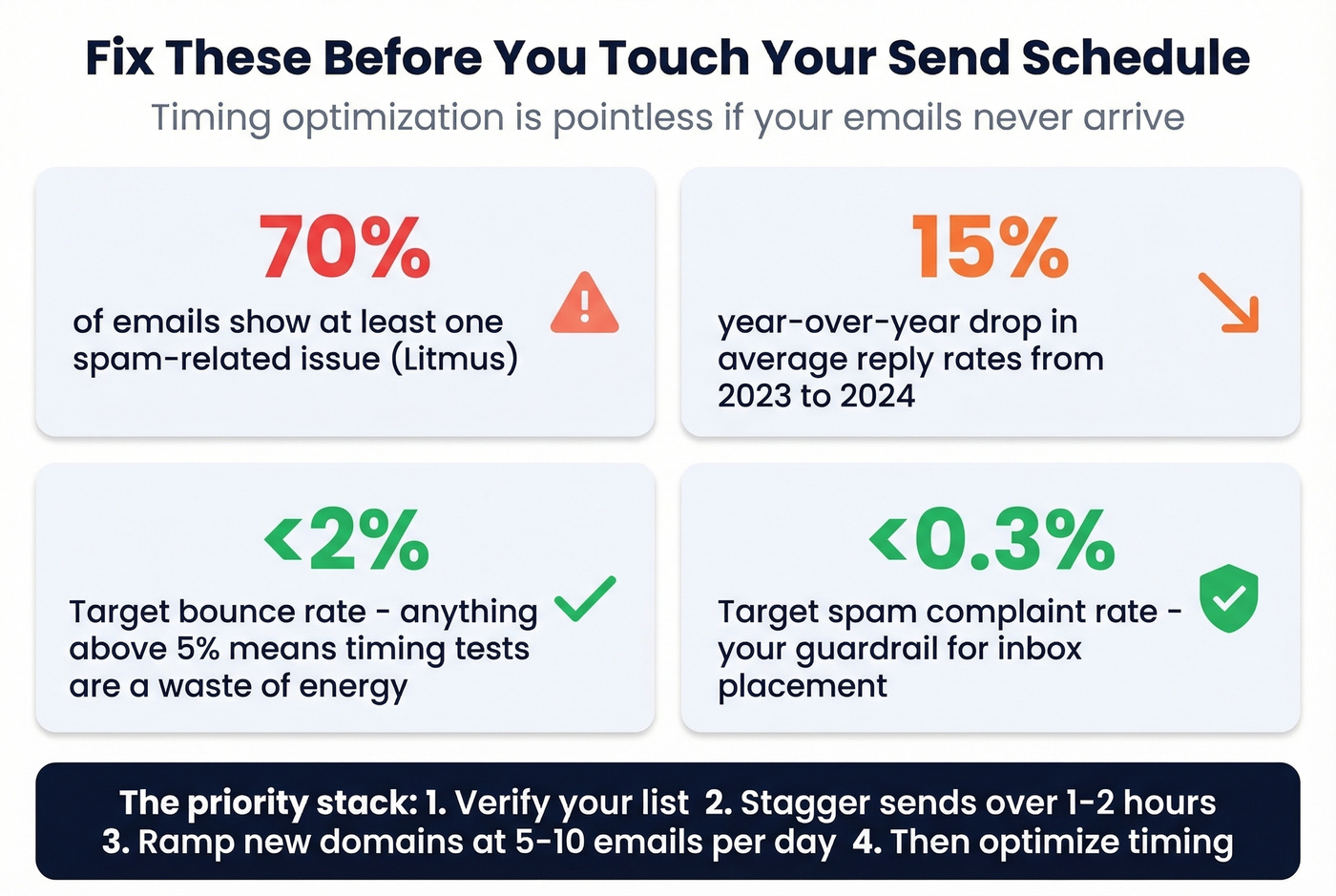
- Batching triggers throttling. Blasting a huge chunk at the same minute causes rate limiting and filtering. Stagger sends across a 1-2 hour window.
- Guardrails that actually matter: Keep spam complaints under 0.3% and bounces under 2%.
- New domain ramp: Start at 5-10 emails/day and ramp over 4-6 weeks.
The macro trend is ugly. Average reply rates dropped 15% year-over-year - from 6.8% in 2023 to 5.8% in 2024. We've seen teams triple reply rates just by fixing bounce rates before touching their schedule. One agency we spoke with went from a 35% bounce rate to under 4% after switching to real-time verification through Prospeo, and their reply rates jumped before they changed a single word of copy. Verify your list before you obsess over the clock. And while you're at it: emails under 200 words hit 6.9% reply rates in the same dataset. Keep it short.
How to Test Your Own Send Times
Don't blast half your list at one time and call it an A/B test. That can trigger throttling - Barracuda-style filtering, for example - which contaminates both cohorts. In our experience, two weeks of structured testing beats any published benchmark. Here's how to run it right:
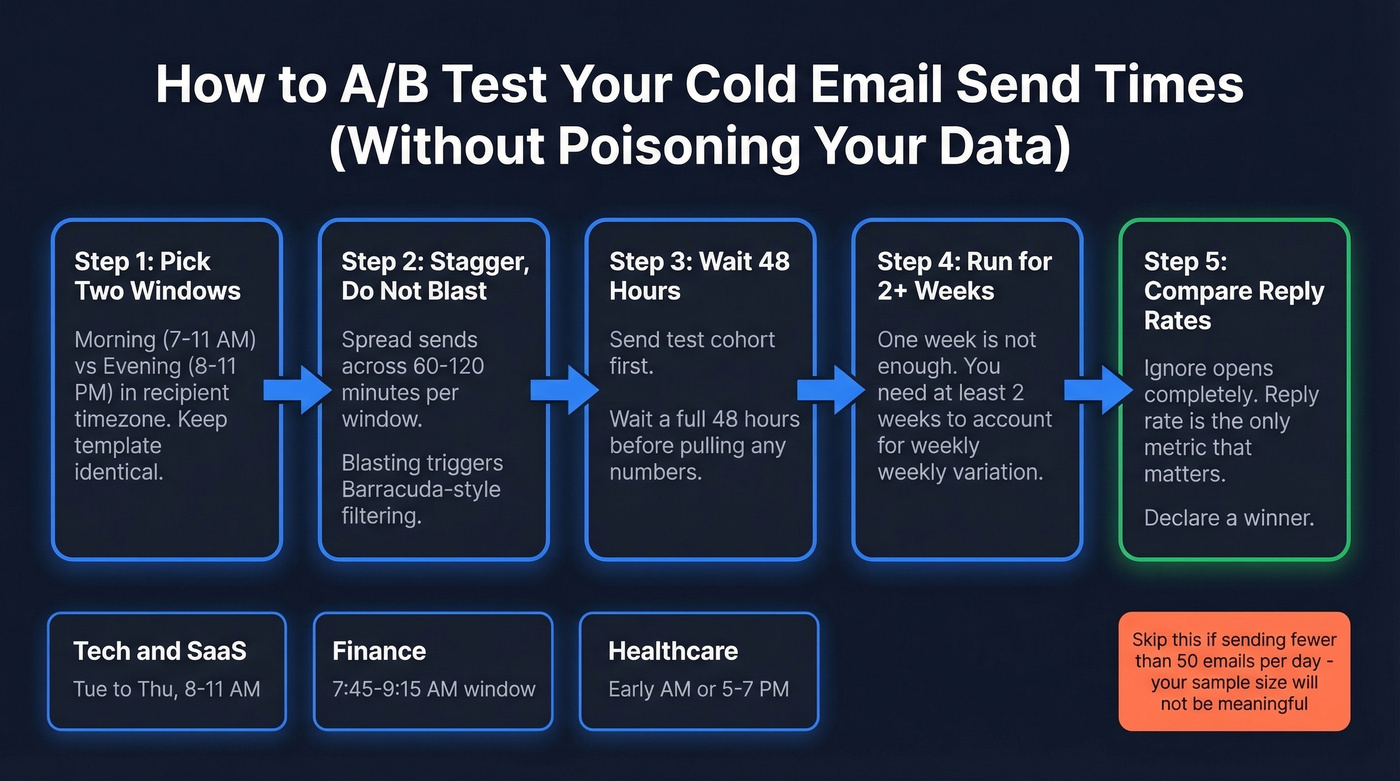
- Send the test cohort first, wait 48 hours before analyzing
- Run tests for at least 2 weeks to account for weekly variation
- Use reply rate as the success metric, not opens
- Keep your control template identical - only change the send time
Starting hypotheses by vertical:
- Tech/SaaS: Tuesday-Thursday, 8-11 AM
- Finance & consulting: 7:45-9:15 AM window
- Healthcare: Early AM or 5-7 PM (outside patient hours)
Most sequencing tools - Instantly, Smartlead, Lemlist - support timezone-aware delivery. Set it once and forget it. Skip this step if you're sending fewer than 50 emails a day; your sample size won't produce statistically meaningful results anyway, and you're better off spending that time improving your copy. If you’re building a full outreach cadence, a B2B cold email sequence will usually beat one-off sends.
Running send-time tests with bad data poisons both cohorts. Prospeo's 5-step verification and 7-day refresh cycle ensure every email in your A/B test actually reaches a real inbox - at ~$0.01 per verified address. No contracts, no sales calls.
Clean data in, real replies out. Start free with 75 verified emails.
FAQ
Does timezone matter for cold email send times?
Yes. A "7 AM send" on your clock can land at 4 AM for West Coast prospects and get buried by the time they check email. Schedule based on the recipient's local time, not yours. Deliver between 7-11 AM local time, and test 8-11 PM for exec-heavy lists.
Should I send cold emails on weekends?
Not for B2B. Weekday performance is consistently stronger, and weekend sends tend to sit unread until Monday morning, where they get crushed by backlog. Use Tuesday-Thursday as your baseline. If you want a single "default," pick Thursday - 6.87% replies in the 16.5M-email dataset.
Can evening sends actually work?
They can. The 8-11 PM window produced a 6.52% reply rate across 16.5 million emails, beating most daytime windows. The practical play is to reserve evenings for senior decision-makers and high-intent segments, then stagger delivery over 60-120 minutes to avoid spam-filter spikes.
Summary
If you want a clean default in 2026, the best time of day to send cold emails is 7-11 AM in the recipient's local timezone, with Thursday as the best day. But don't miss the bigger lever: list quality and deliverability. Fix bounces, stagger sends, and test two windows - morning plus evening - before you declare a "winner." The teams getting the best reply rates right now aren't the ones who found the magic hour. They're the ones who made sure their emails actually arrived. If you want to go deeper on deliverability, start with an email deliverability guide, then tighten your email bounce rate and email velocity to stay under provider thresholds. For better messaging, use proven cold email follow-up templates, test your prospecting email subject lines, and keep your copy sharp with an email copywriting checklist.