

The Best Time to Send an Email on Tuesday - And Why 10 AM Isn't It
Every email marketing guide says the same thing: send on Tuesday at 10 AM. So that's exactly what everyone does, and it's exactly why your Tuesday morning emails are drowning in a flooded inbox. Seventeen percent of all weekly email volume lands on Tuesday. The best time to send an email on Tuesday isn't 10 AM - at least, not anymore. You're not optimizing. You're competing with every other marketer who read the same blog post.
The Short Answer
- For opens: Send Tuesday between 9 and 11 AM local time, but schedule at odd minutes (like 10:07 or 10:21) to dodge the on-the-hour traffic jam.
- For clicks and conversions: Test 8 PM Tuesday evening. Multiple large datasets show click-through rates peak well after business hours.
- Before any of this matters: Verify your list. Sending at the perfect time to invalid addresses doesn't generate pipeline - it wrecks your sender reputation.
Why "Tuesday at 10 AM" Stopped Working
The r/Entrepreneur crowd figured this out years ago: when every marketer follows the same "best time" advice, the advice cancels itself out. Inbox congestion at 10 AM on Tuesday is real. Your carefully crafted subject line sits sandwiched between a SaaS renewal reminder, a competitor's newsletter, and a pile of app notifications.
The data still shows mid-morning as a high-open-rate window, but that's an average across millions of campaigns. It doesn't account for the fact that your specific audience's inbox is most crowded at that exact moment.
Tuesday Send Times by Window
| Time Window | Best For | Key Data Point | Who Should Use It |
|---|---|---|---|
| 8-11 AM | Opens | Opens typically peak in the morning | B2B, newsletters |
| 1-4 PM | Balanced engagement | Brevo shows opens peaking ~3 PM and CTR peaking ~4 PM | B2C, ecommerce |
| 8-9 PM | Clicks/conversions | Omnisend found 8 PM hit a 59% open rate | Action-oriented emails |
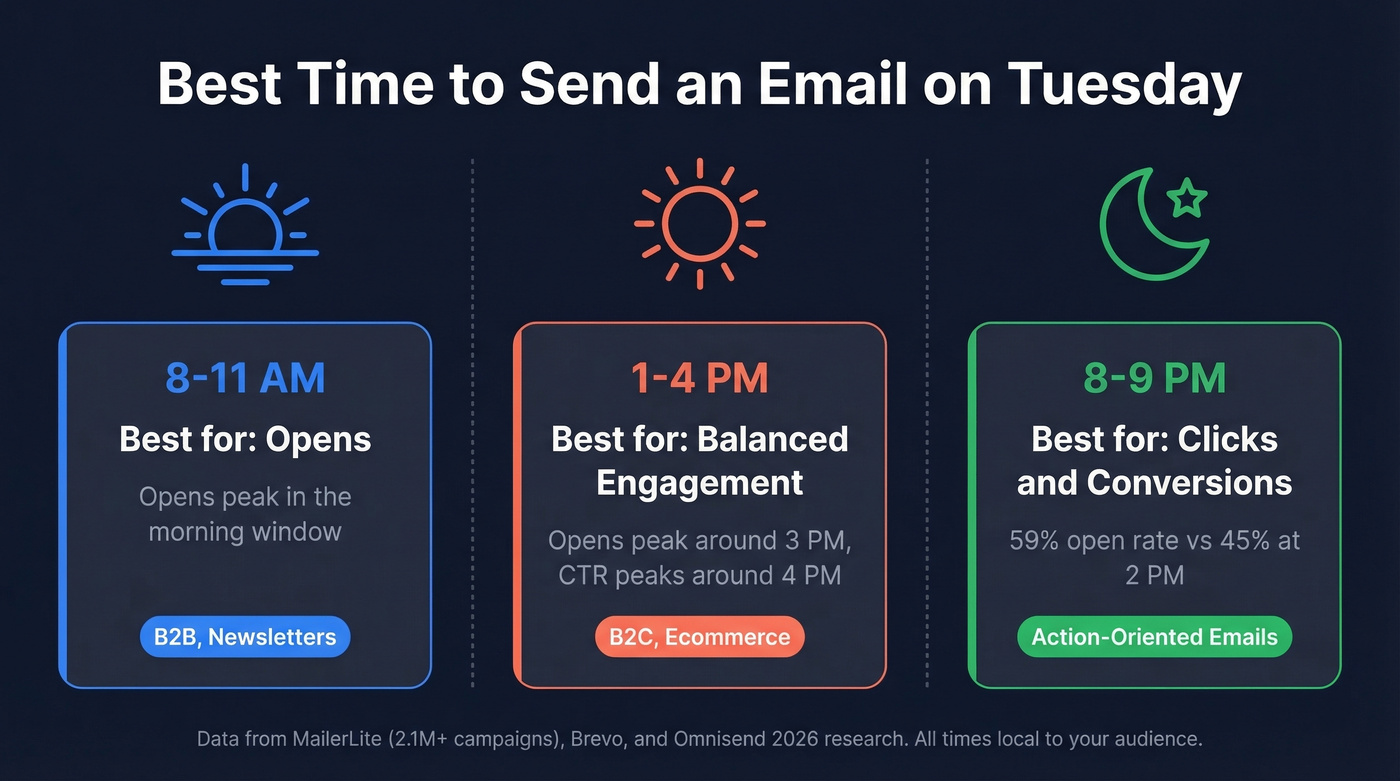
These aren't guesses. They're drawn from MailerLite's analysis of 2.1M+ campaigns, Brevo's cross-industry data, and Omnisend's 2026 research. All times are local to your audience - the primary datasets cover the US, UK, Australia, and Canada, so if your list skews to other regions, test accordingly.
Hour by Hour on Tuesday
Morning (8-11 AM)
MailerLite's large-scale analysis shows that open rates peak between 8 AM and 11 AM local time across most weekdays. Sender.net backs this up, recommending Tuesday sends in the 9-11 AM range. This is the window where people are triaging their inbox - scanning subject lines, deciding what deserves a click (and whether your subject lines earn attention).
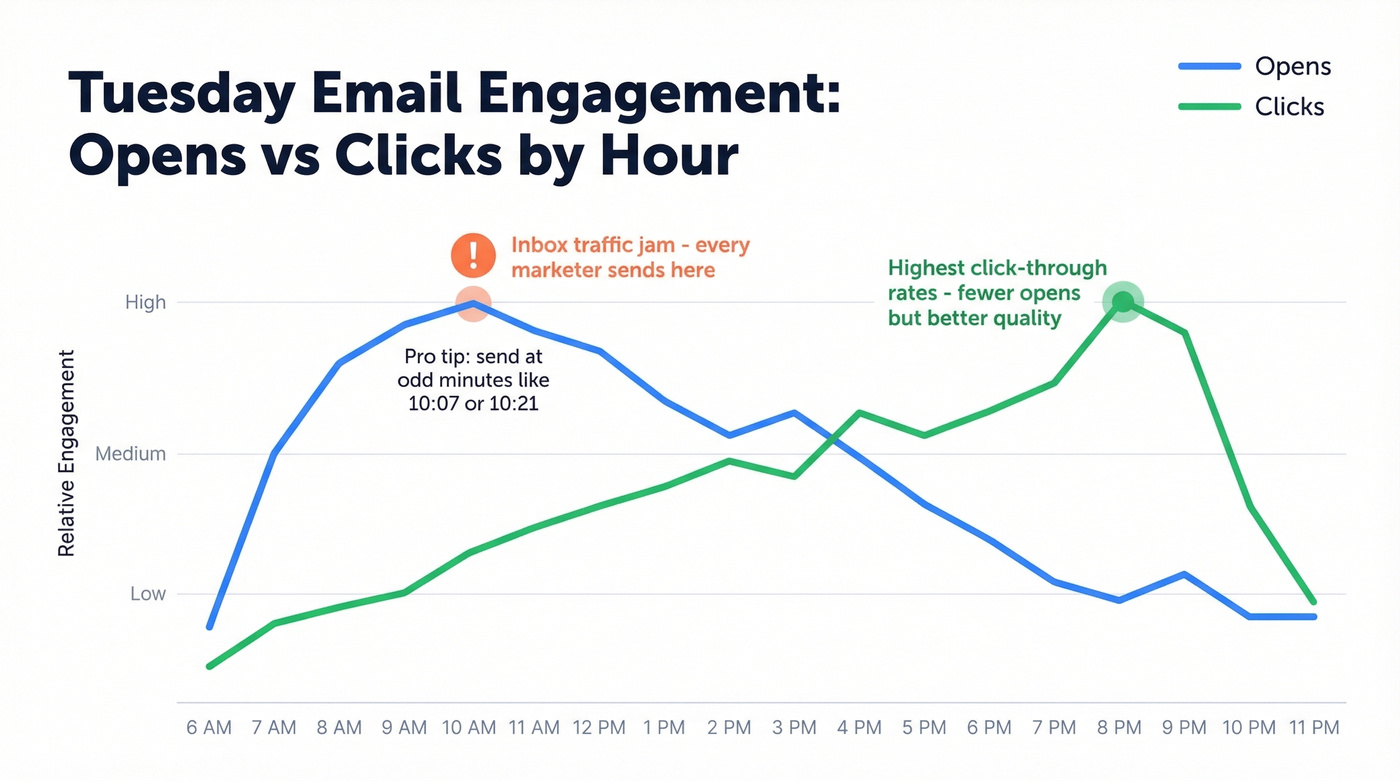
Here's the thing: don't send at exactly 10:00 AM. Twilio SendGrid recommends scheduling at odd minutes - :07, :21, :36 - to avoid ISP traffic jams. When thousands of senders all trigger at :00, email servers throttle delivery. Sending at 10:07 means your email isn't stuck behind a queue of identical-timestamp messages.
Afternoon (1-4 PM)
Brevo's data shows a secondary engagement peak in the afternoon. Opens climb again around 3 PM, and click-through rates peak closer to 4 PM.
This window works well for ecommerce and B2C brands. People are past their morning email triage, they've had lunch, and they're more willing to click through to a product page or read a longer piece of content. If your goal is balanced engagement - decent opens plus meaningful clicks - the afternoon is underrated.
Evening (8-9 PM)
This is where the data gets interesting. MailerLite finds that click rates peak between 8 and 9 PM across most weekdays. Moosend's analysis of 10 billion emails found the same pattern. And Omnisend's 2026 research found 8 PM sends reaching a 59% open rate versus 45% for 2 PM sends.
We've seen this hold in practice: evening sends generate fewer opens but higher-quality engagement. The people opening your email at 8 PM aren't triaging. They're reading. And they're clicking.
Our take: If your email's primary goal is driving a specific action - a demo booking, a purchase, a signup - test 8 PM Tuesday before you test anything else. Morning sends are the safe choice. Evening sends are the smart one.

You just learned that Tuesday evening sends drive higher click-through rates - but none of that matters if 15% of your list bounces. Prospeo's 5-step email verification delivers 98% accuracy, so every perfectly timed Tuesday email actually reaches a real inbox.
Fix your data before you fix your send time.
B2B vs B2C: Different Tuesdays
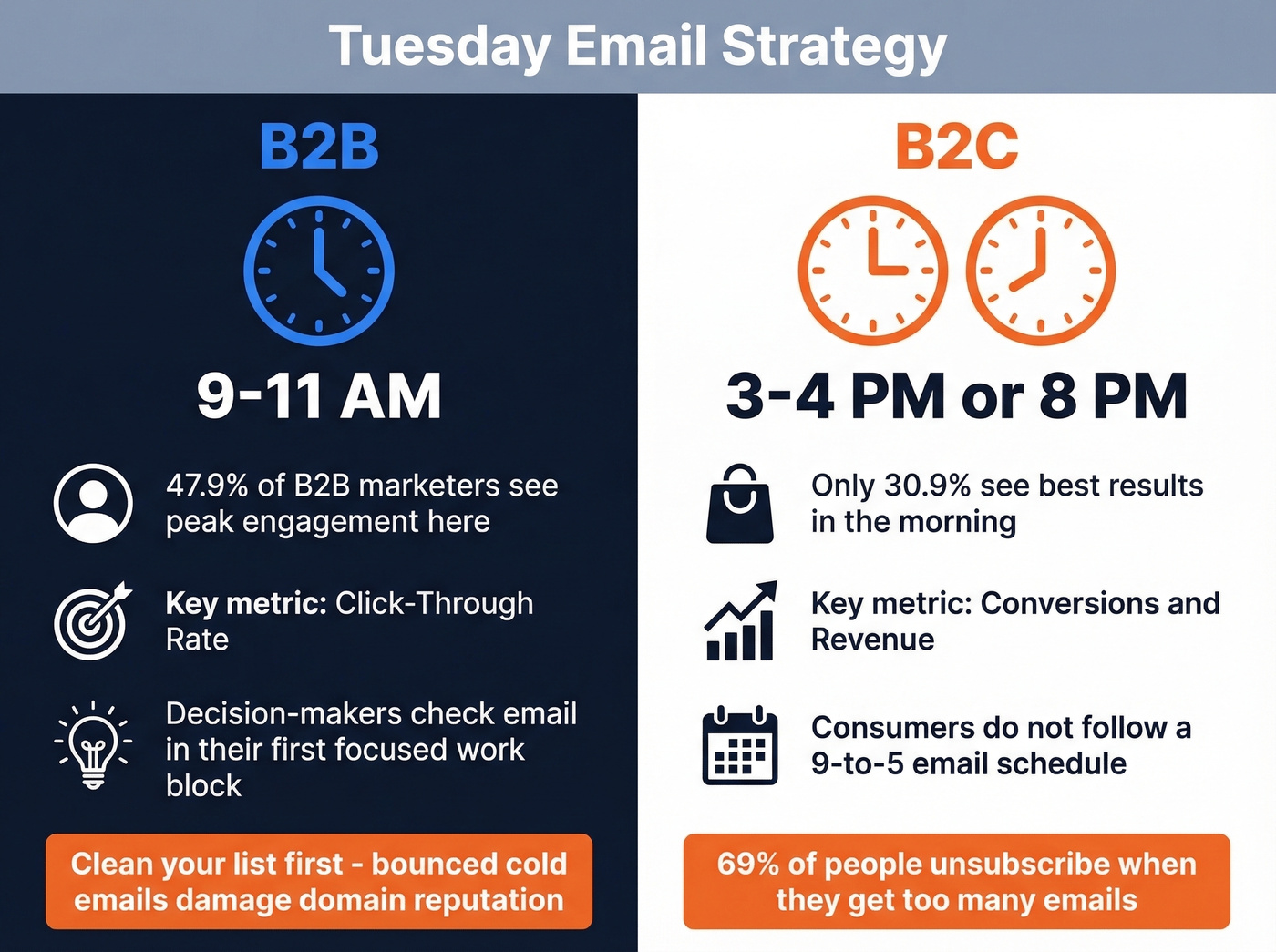
| Factor | B2B | B2C |
|---|---|---|
| Peak window | 9-11 AM | 3-4 PM or 8 PM |
| Why | Decision-makers in inbox mode | Consumers engage after work |
| Metric to watch | Click-through rate | Conversions/revenue |
B2B: 9-11 AM, No Question
HubSpot's survey data is clear: 47.9% of B2B marketers report peak engagement between 9 AM and 12 PM. This makes sense when you consider that B2B buying groups often involve 6-10 decision-makers, all checking email during business hours. Your Tuesday morning email catches them during their first focused work block, before meetings eat the afternoon.
For cold outbound specifically, the 9-11 AM window is even more critical. Decision-makers are more receptive to new information early in the day. But clean data matters more than timing - a bounced cold email does double damage: you lose the prospect and hurt your domain reputation. We've watched teams obsess over send-time optimization while blasting lists with 15%+ bounce rates. Fix the data first (start with your email bounce rate).
B2C: Spread Your Bets
Only 30.9% of B2C marketers see their best engagement in the morning window - engagement is much more spread across the day. Brevo's ecommerce patterns support testing the 3-4 PM afternoon slot and the 8 PM evening window. Consumers don't operate on a 9-to-5 email schedule, so your Tuesday send strategy shouldn't either.
And don't overdo frequency: 69% of people have unsubscribed from a mailing list because they got too many emails. Nailing the right time matters more than sending more often.
Opens vs Clicks: Pick Your Metric
Most send-time articles skip this: opens and clicks peak at different times. Morning wins for opens. Evening wins for clicks. You can't optimize for both simultaneously.
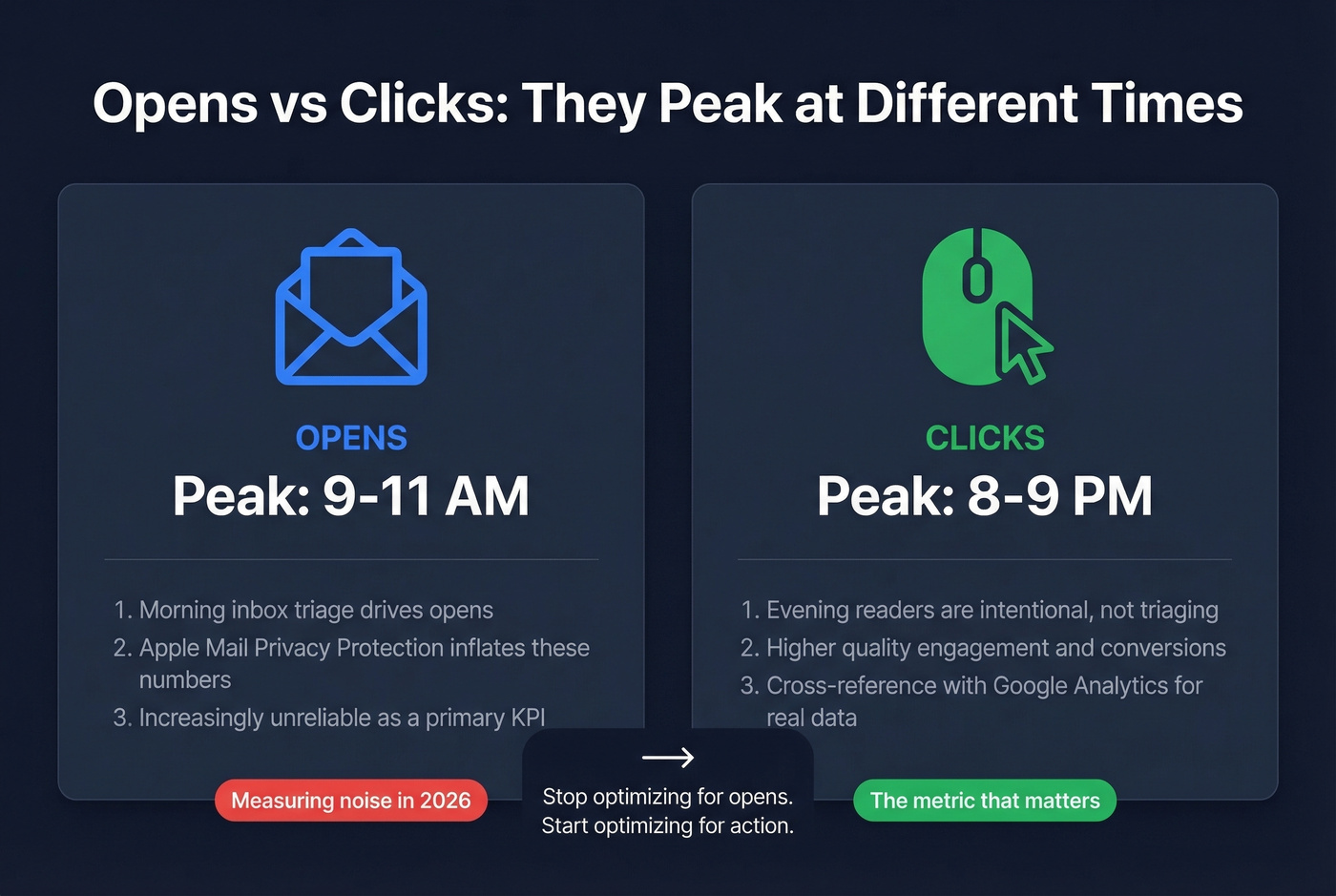
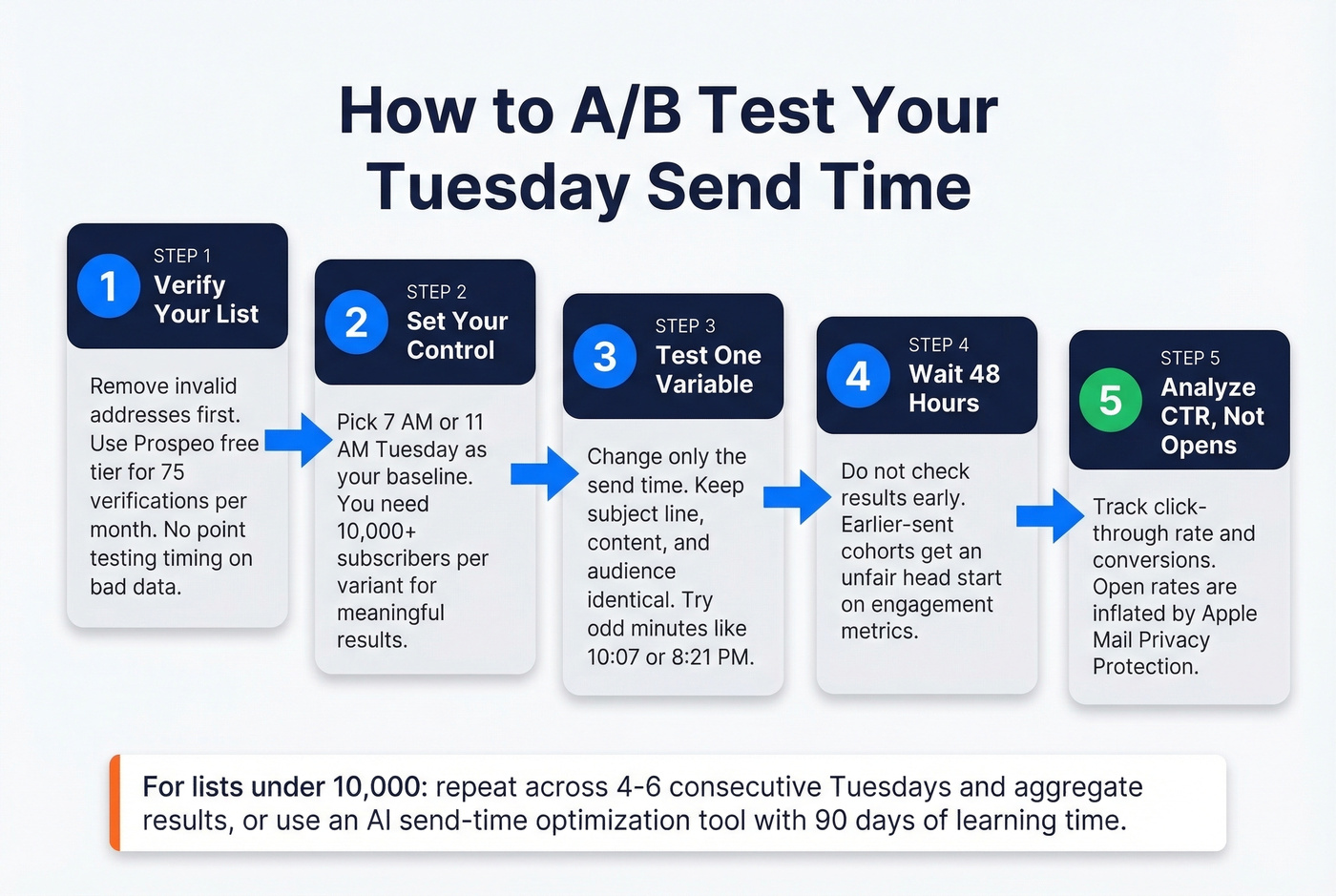
In 2026, optimizing for opens is increasingly unreliable anyway. Apple Mail Privacy Protection pre-fetches images, inflating open rates across the board. Customer.io and Sender.net both recommend tracking CTR and conversions as primary KPIs. Cross-reference with Google Analytics to see which send times drive actual site engagement, not just opens (and make sure you’re using the right click rate formula).
If you're still reporting "open rate" as your primary email KPI, you're measuring noise.
How to Test Your Tuesday Send Time
Set Up the Test
Litmus recommends a minimum of 10,000 subscribers per variant for meaningful A/B results. Use Tuesday at 7 AM or 11 AM as your control, then test one alternative slot per cycle. The key discipline: test one variable at a time. Don't change your subject line and your send time in the same test - you won't know which variable moved the needle (same logic as email preview text A/B testing).
Avoid Common Biases
Seventh Sense's testing methodology highlights a subtle trap: if you're comparing send-time optimization against a standard blast, send the STO cohort first and the blast last. This reduces throttling bias and priming effects. Wait at least 48 hours after the last email is delivered before analyzing results, otherwise the earlier-sent cohort gets an unfair head start on engagement metrics.
Even Twilio SendGrid couldn't find a statistically significant best open time during Memorial Day weekend - proof that context matters more than universal rules.
Should You Use Send-Time Optimization?
AI-powered send-time optimization tools can increase open rates by 23% over static timing. Give any STO system at least 90 days before split testing it - the models need historical data to learn your audience's patterns.
For lists under 10,000, STO is especially valuable because it compensates for the sample sizes that make manual A/B testing unreliable.
Fix Your Data Before Timing
None of this timing advice matters if your emails bounce. High bounce rates damage your sender reputation, which means ISPs start throttling or junking your messages regardless of when you send them. We've seen teams triple their effective open rates just by cleaning their list - no send-time changes at all (especially when they follow a real email deliverability guide).
Prospeo's email verification catches invalid addresses, spam traps, and honeypots before they tank your deliverability. With 98% email accuracy and a 7-day data refresh cycle, your Tuesday sends actually reach real inboxes. The free tier gives you 75 email verifications per month - enough to clean a test segment before your next campaign.
Cold outbound at 9-11 AM Tuesday only works when you're reaching real decision-makers at valid addresses. Prospeo refreshes 300M+ contacts every 7 days - not every 6 weeks - so your Tuesday morning sends hit active inboxes, not dead ends.
Stop optimizing send times on a stale list.
FAQ
Is Tuesday really the best day to send email?
Tuesday is the consensus pick - 27% of marketers in HubSpot's survey name it the best day. But the best day for your audience requires testing. Friday actually leads on open rates in MailerLite's dataset, so run your own A/B tests across multiple weekdays before committing.
What if my list is under 10,000 subscribers?
Run the same Tuesday time test across 4-6 consecutive weeks and aggregate results. Smaller lists need more repetitions for statistical significance. A send-time optimization tool that learns individual recipient behavior can compensate for low volume - skip this if you're only sending monthly newsletters, though, since there won't be enough data points to learn from.
Does Tuesday timing matter for cold email?
Yes. B2B cold emails follow the same 9-11 AM pattern, but deliverability matters even more than timing. Verify emails before you send, keep bounce rates low, and pair verified contacts with odd-minute scheduling for the best results.
What's a free way to verify emails before a Tuesday campaign?
Prospeo's free tier includes 75 email verifications per month with the same 98% accuracy as paid plans. Upload your segment, remove invalid addresses, and send with confidence - no credit card required at prospeo.io.