

Bottom-Up Sales Methodology: The 2026 Playbook
Your SDR team keeps cold-calling VPs who won't take the meeting. Meanwhile, three engineers at that same account already tried your free tier last month and loved it. That's the gap the bottom-up sales methodology exists to close - and it's the reason PLG companies are eating market share from enterprise incumbents who only know how to sell top-down.
Most guides on this topic are actually about forecasting spreadsheets. That's a different concept entirely. This is a selling playbook.
What You Need (Quick Version)
- Bottom-up sales = sell to end users first, build internal champions, expand the deal upward. It's a selling motion, not a forecasting exercise.
- Works best when ACV is under $5K and self-serve onboarding is feasible.
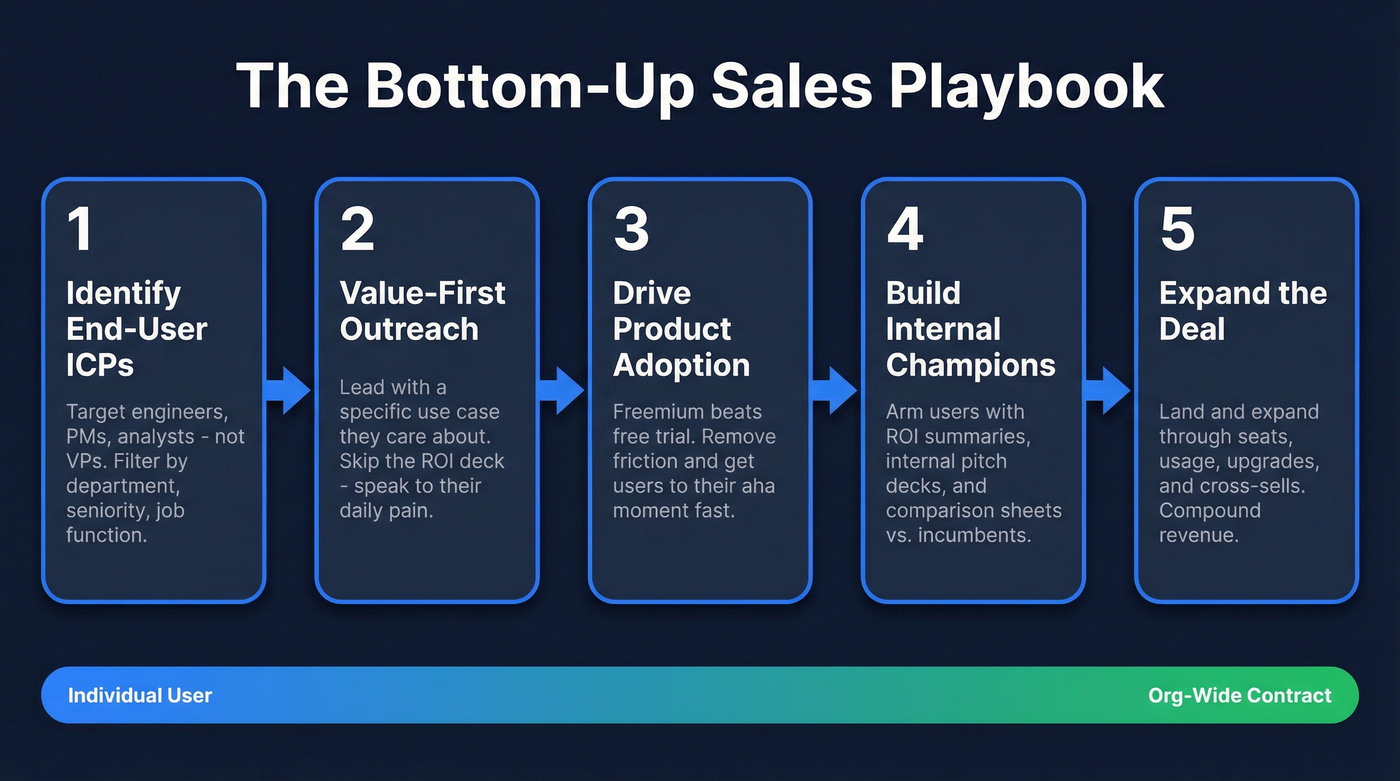
- The playbook: find end users, lead with value, drive adoption, arm champions, expand.
- You'll need verified contact data for individual contributors, a free or low-friction entry point, and champion enablement assets.
What Is Bottom-Up Selling?
Bottom-up selling targets junior users and individual contributors first - product managers, engineers, analysts, team leads - and lets the product speak for itself. As those users adopt and get value, they become internal advocates who spread the product through their org and influence managers and executives to buy. The deal expands upward, not downward.
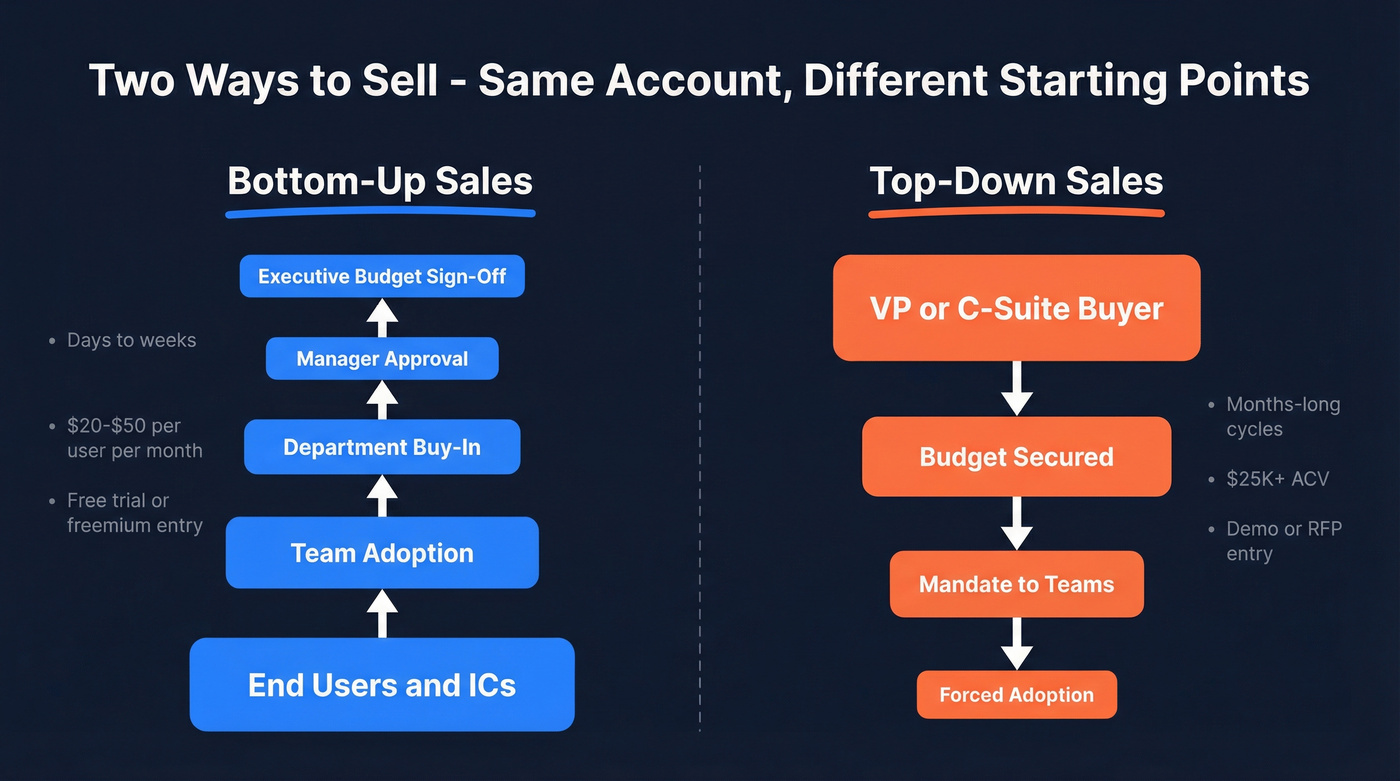
This is the opposite of the top-down approach, where you target a VP or C-suite buyer, secure budget, and push adoption down through the org. Both work. They solve different problems. And don't confuse this with bottom-up forecasting, which is a revenue projection method that aggregates pipeline and performance inputs - completely unrelated to how you sell.
| Bottom-Up Sales | Top-Down Sales | |
|---|---|---|
| First target | End users, ICs | VPs, C-suite |
| Common pricing shape | $20-$50/user/mo | $25K+ ACV |
| Cycle length | Days to weeks | Months |
| Entry mechanism | Free trial, freemium | Demo, RFP |
| Risk profile | Higher churn, smaller deals | Longer cycles, more friction |
Why Executives Prefer Ground-Level Truth
Here's a tension most sales orgs never talk about. A Varicent analysis of Cascade Research survey data found that 64% of sales managers prefer top-down planning, as do 60% of directors and 55% of VPs. But 60% of C-suite executives prefer bottom-up.
Our read on why that matters: the people living in the day-to-day pipeline often want clarity and direction from above, while execs want ground-level truth they can actually trust. That same survey broke respondents into satisfaction clusters, and the most satisfied cluster - a small and mid-sized business group representing 26% of businesses - overwhelmingly used bottom-up approaches. Eighty-six percent of that cluster, to be exact.
The lesson isn't subtle. A bottom-up sales methodology builds a foundation of real usage data and internal champions that top-down mandates can't replicate.

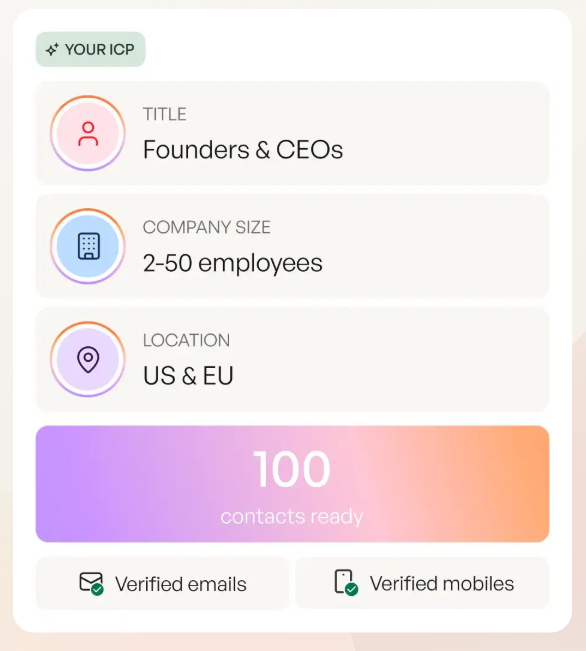
Bottom-up selling lives or dies on reaching the right individual contributors - not VPs. Prospeo's 30+ search filters let you target by department, seniority, technographics, and job function to build IC lists at scale. With 98% email accuracy and a 7-day data refresh cycle, you're reaching real people at verified addresses - not bouncing off stale data that torches your domain.
Build your first end-user list in minutes, not hours.
The 5-Step Bottom-Up Playbook
1. Identify End-User ICPs
Your ideal customer profile for bottom-up selling isn't the VP of Engineering. It's the person who'll use your product daily and feel the pain it solves.
| Persona | Pain point | Why they matter |
|---|---|---|
| Senior engineer | Manual infra tasks | High influence, low sales resistance |
| Product manager | Scattered workflows | Cross-functional visibility |
| Data analyst | Slow reporting | Quantifies ROI naturally |
Build lists of these individual contributors at target accounts, filtered by department, seniority, and job function. Most sales databases are built for executive prospecting, so you'll need a tool with granular title and department filters to actually find ICs.
2. Value-First Outreach
End users don't care about your ROI deck. They care about time saved, ease of use, and whether your product solves the thing that's annoying them today.
Lead with a specific use case, not a business case. "We help data analysts cut report build time by 60%" beats "We drive operational efficiency across your analytics org" every single time. The first sentence speaks to a person; the second speaks to a procurement committee that hasn't been formed yet.
For building end-user lists, we've found that Prospeo's 30+ search filters - department headcount, technographics, job-change signals - make it straightforward to zero in on the right individual contributors at target accounts. Its 98% email accuracy matters more here than in executive outreach, because IC email addresses are harder to find and more likely to be stale in other databases.
3. Drive Product Adoption
According to OpenView's PLG benchmarks, 75% of PLG companies choose free trial or freemium as their entry point. The overall free-to-paid conversion rate averages about 9%, which sounds low until you realize these users self-selected and require zero sales touch to convert.
Freemium beats free trial for bottom-up. Trial deadlines create urgency for the wrong buyer - the manager evaluating tools, not the IC who needs to live in yours for two weeks before they're hooked. Your job at this stage isn't to sell. It's to remove friction and get users to their "aha" moment faster.
4. Build Internal Champions
Once an end user loves your product, they become your internal sales rep. But they need ammunition:
- One-page ROI summary with their actual usage data
- Internal pitch deck they can forward to their manager
- Security and procurement FAQ that preempts IT objections
- Comparison sheet vs. the incumbent tool
Here's the thing about champions: if yours leaves the company, you can lose the account. But that person becomes an entry point at their new company. We've watched this pattern create entire expansion networks across an industry - one champion at Stripe becomes your way into three fintech startups within eighteen months.
5. Expand the Deal
Land-and-expand is where bottom-up generates real revenue. There are four expansion types worth building into your pricing, and the best companies design for all of them simultaneously:
Account growth means more seats. Slack's classic path: free user to team to org-wide. Usage growth charges more as consumption scales - Chili Piper runs per-user pricing plus tiered platform fees. Upgrade growth upsells to higher tiers, like HubSpot's free to Professional to Enterprise ladder. Cross-sell growth sells adjacent products, the way Lattice offers multiple HR products as separate subscriptions.
Egnyte built a 15,000-customer business on this model, with annualized gross churn under 6%. You're not just closing deals - you're compounding them.
Metrics That Prove It's Working
| Metric | Benchmark |
|---|---|
| Free-to-paid conversion | ~9% avg; 10% median at $1K-$5K ACV |
| PQL conversion | ~25% avg; up to 39% at $5K-$10K ACV |
| NRR lift (PLG) | 15-20% higher |
| Activation rate | 17% median; 33% best-in-class |
| PLG adoption | 58% of B2B SaaS; 61% of Cloud 100 |
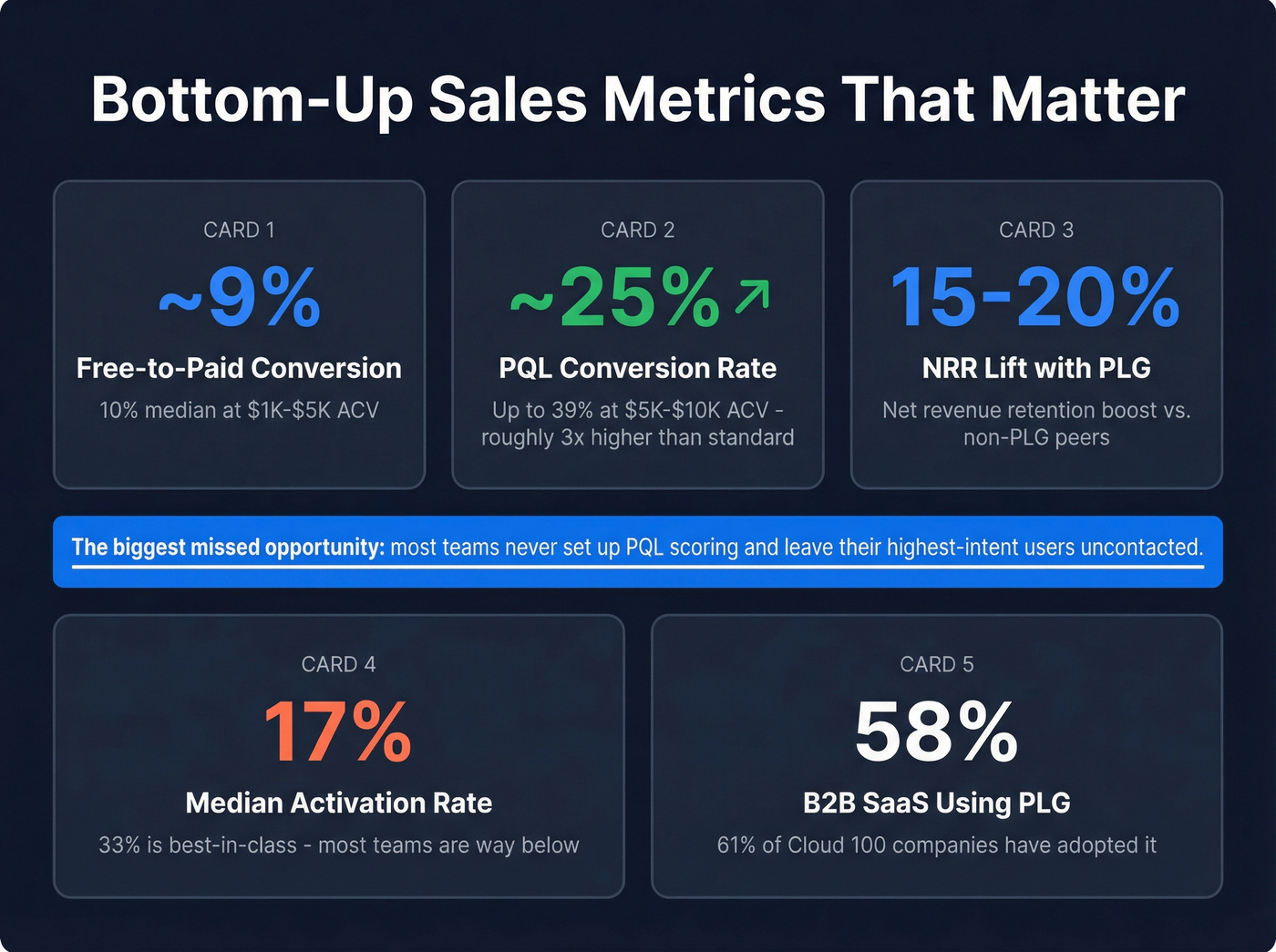
The PQL number should grab your attention. When companies define and track product-qualified leads, conversion runs roughly 3x higher than standard free-to-paid. In our experience, most teams never bother setting up lead scoring - which means they're leaving their highest-intent users completely uncontacted.
That's the single biggest missed opportunity in bottom-up selling.
When to Layer in Top-Down Selling
You don't switch from bottom-up to top-down - you layer. Most companies start with a bottom-up sales methodology out of necessity and add enterprise selling once they have case studies and brand credibility. We've watched companies try to skip the bottom-up phase and go straight to enterprise. It rarely works without existing brand trust.
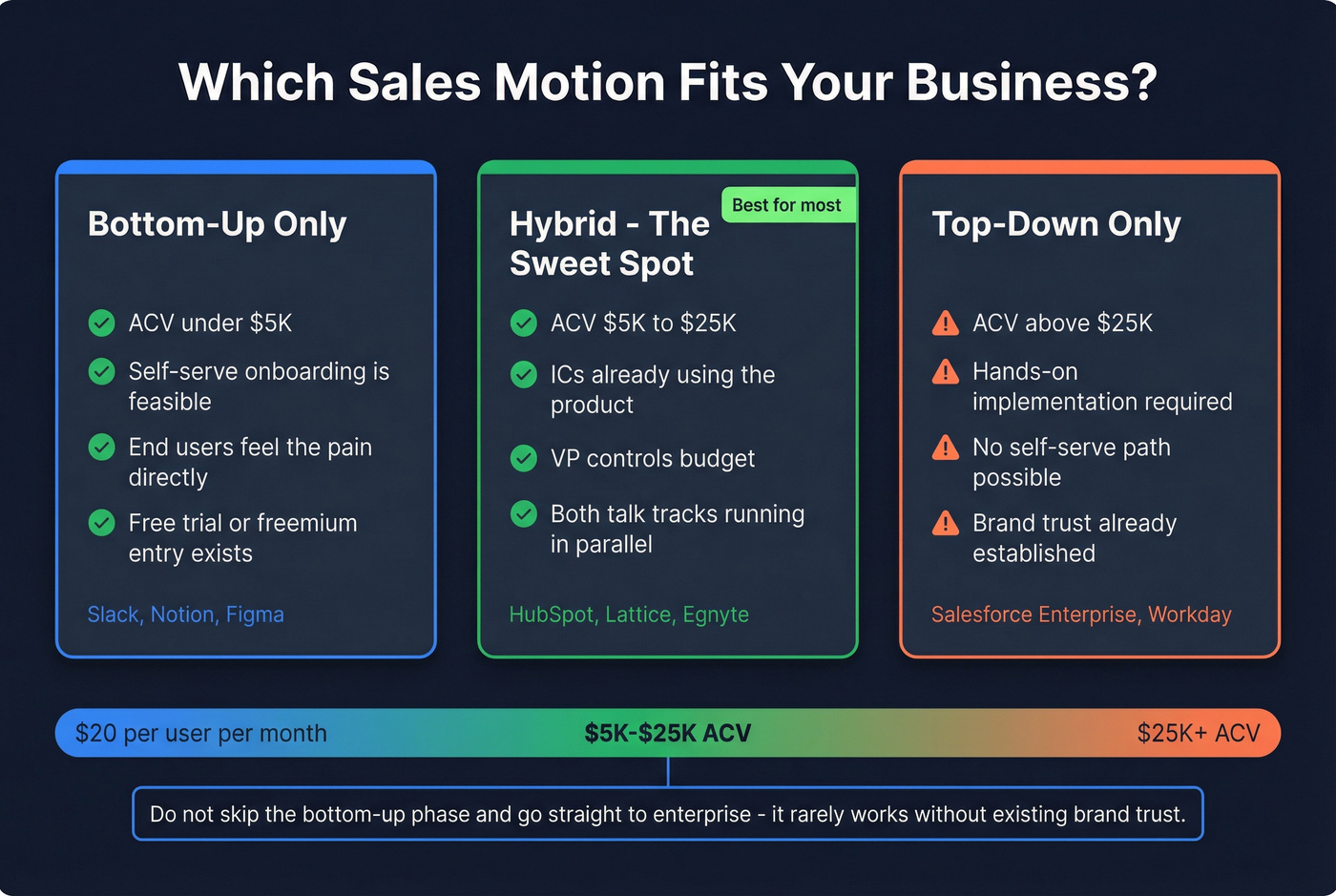
The hybrid approach is where the real advantage sits. A well-timed touch at both ends of the buying committee - the IC who's already using the product and the VP who controls budget - can increase deal speed by 40%, according to Trumpet's analysis of hybrid sales motions. Companies using hybrid forecasting models are 37% more likely to hit revenue targets.
If your ACV is above $25K and your product requires hands-on implementation, skip bottom-up entirely. You'll waste six months trying to create self-serve adoption for a product that fundamentally needs a sales-assisted motion. Start top-down and layer in product-led signals later.
Let's be honest about the messaging shift, too. C-suite cares about ROI, risk mitigation, and strategic alignment. End users care about ease of use and time saved. You need different talk tracks for different levels, running in parallel. As deals grow and you need to map the full buying committee, enrichment tools that return 50+ data points per contact - like Prospeo's API at a 92% match rate - let you build complete account maps from ICs up through the C-suite without stitching together three different databases.
Your champion just left the account? That's not a lost deal - it's a new entry point. Prospeo tracks job-change signals across 300M+ profiles so you can follow champions to their next company and restart the bottom-up motion before a competitor does. At $0.01 per verified email, scaling this play costs less than a single lost meeting.
Turn every champion job change into your next expansion deal.
FAQ
What's the difference between bottom-up sales and bottom-up forecasting?
Bottom-up forecasting aggregates pipeline data to predict revenue. Bottom-up sales is a selling motion where you target end users first and expand deals upward through internal champions. They share a name but solve completely different problems.
What's the ideal ACV range for this approach?
Products priced $20-$50/user/month ($240-$600/year) are the sweet spot. Below roughly $600/year, paid acquisition math breaks and content marketing plus self-serve become your primary growth levers. Above $25K ACV, start top-down instead.
Can you run bottom-up without a PLG product?
Yes. You need a low-friction entry point - a free trial, a live demo, or a well-scoped proof of concept. The motion is about who you sell to first, not whether you have a self-serve product.
How do you find individual contributor contacts at scale?
Most sales databases prioritize executive contacts. You need a platform with granular job title, department, and seniority filters across a large enough profile database to actually surface ICs - the people who'll use your product daily, not the people who'll sign the contract six months from now.
When should you add a top-down motion?
Layer it in once you have 3-5 strong case studies and recognizable logos. Start with bottom-up selling to prove value, then add enterprise outbound once you have the brand credibility to get VPs on the phone.