

Best Bulk Email Providers: Real Costs at Scale in 2026
SendGrid killed its free plan in May 2025. If the last "best bulk email providers" article you read still recommends it as a free starting point, that article is wrong - and it's probably wrong about other things too. Roughly one in six emails never reaches the inbox, and the gap between what providers advertise and what they actually cost at 50k, 100k, or 1M emails per month is enormous.
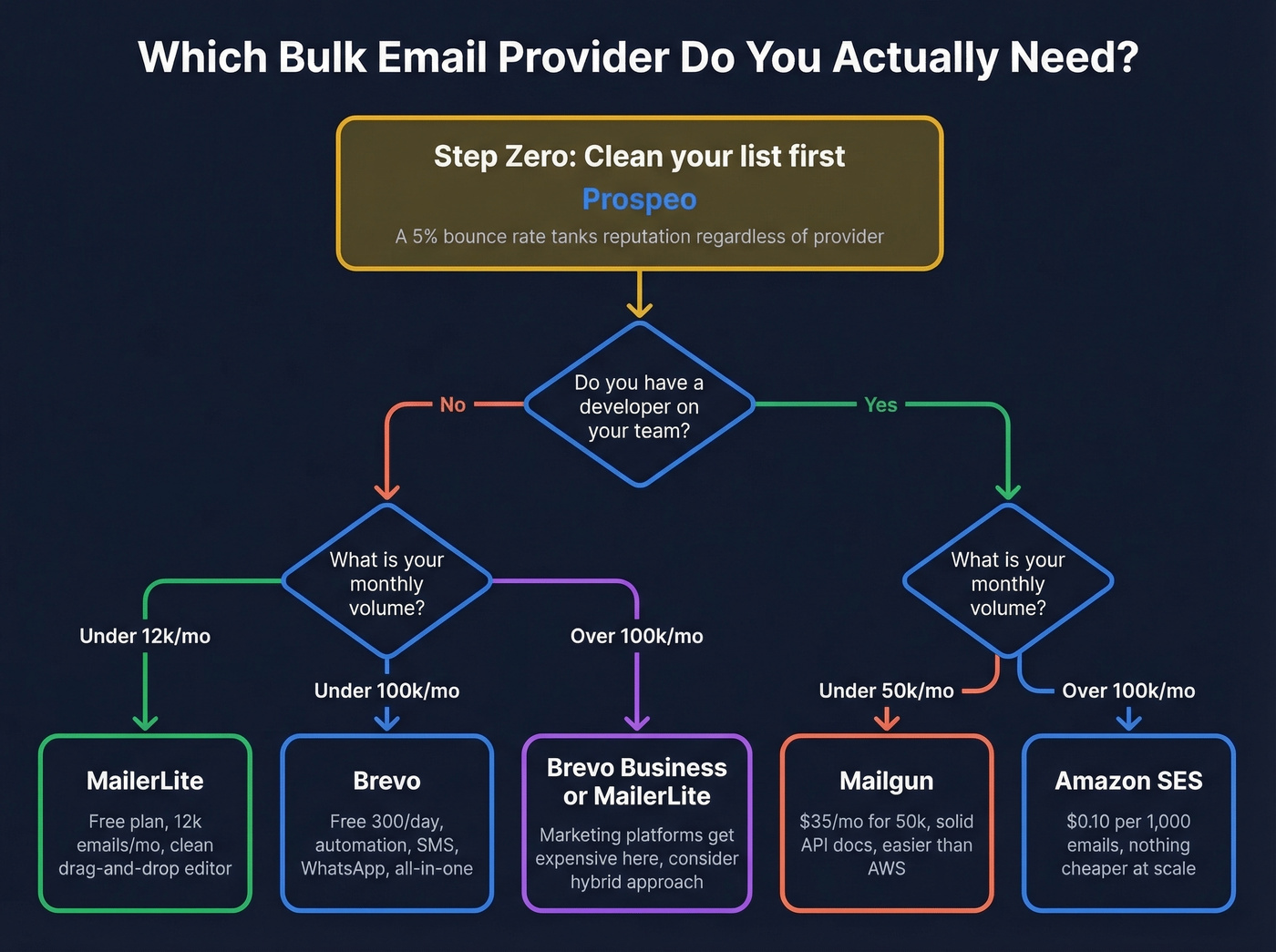
Here's what most guides also miss: your deliverability problem usually isn't your ESP. It's your data. A 5% bounce rate tanks sender reputation faster than any misconfigured SPF record, and no sending platform can fix a list full of dead addresses. That's why verification belongs in this conversation alongside sending infrastructure.
Our Picks (TL;DR)
| Use Case | Tool | Why | Starting Price |
|---|---|---|---|
| List verification & data accuracy | Prospeo | 98% email accuracy, 5-step verification, ~$0.01/email | Free (75 emails/mo) |
| High-volume infrastructure | Amazon SES | $0.10 per 1,000 emails , unbeatable at volume | Free tier: 3,000/mo (first 12 months) |
| All-in-one marketing | Brevo | Free 300 emails/day, automation + transactional | Free / from $9/mo |
| Best free starting point | MailerLite | 12k emails/mo free, clean UI | Free / $10/mo |
Marketing Platforms vs. Infrastructure Providers
Stop comparing Brevo to Amazon SES. One builds your newsletter; the other is a sending engine. These are fundamentally different products, and most "best bulk email" guides mash them together without acknowledging the distinction.
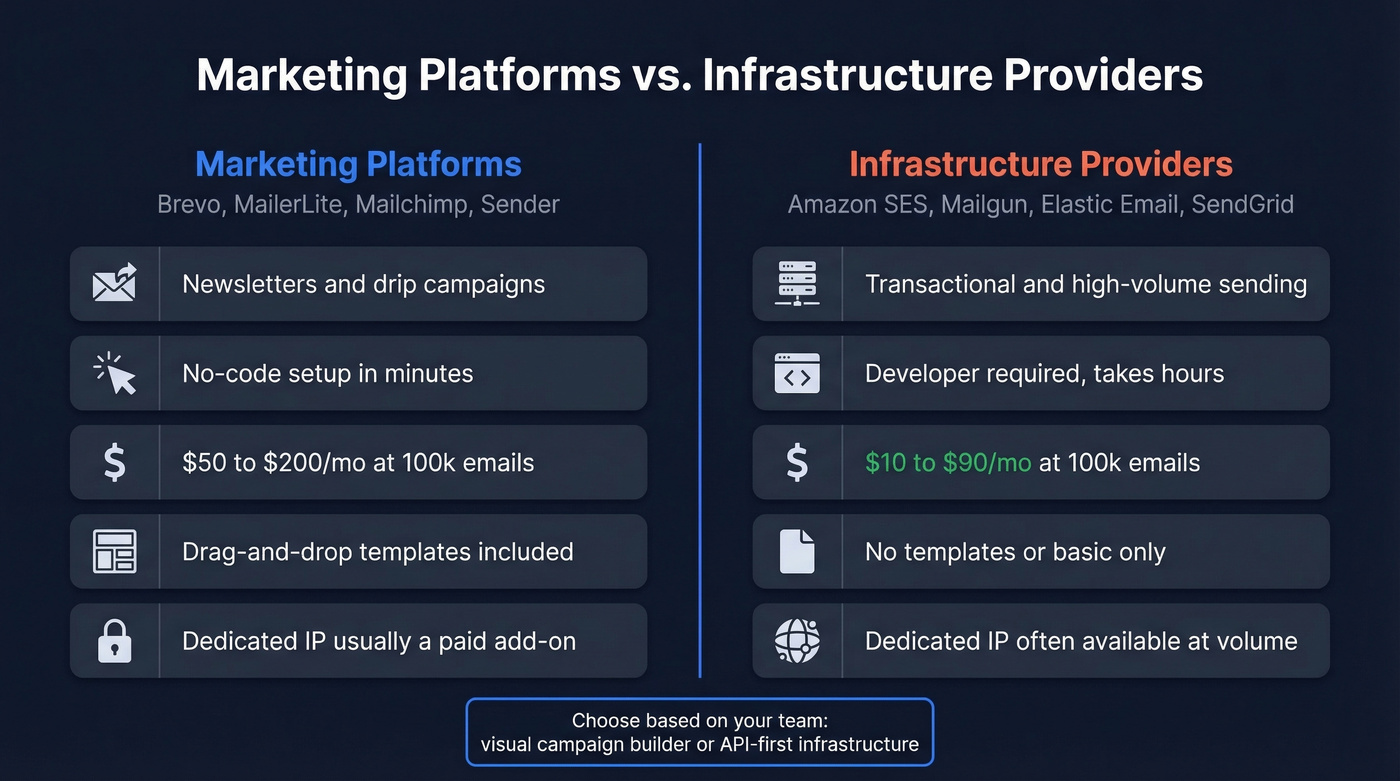
Marketing platforms - Brevo, MailerLite, Mailchimp, Sender - give you drag-and-drop editors, subscriber management, automation workflows, and analytics dashboards. You're paying for convenience and features. Infrastructure providers - Amazon SES, Mailgun, Elastic Email, SendGrid - give you SMTP relay and API access. You're paying for raw sending power and expecting your developers to handle the rest.
| Marketing Platforms | Infrastructure Providers | |
|---|---|---|
| Best for | Newsletters, drip campaigns | Transactional, high-volume |
| Setup | No-code, minutes | Developer required, hours |
| Cost at 100k emails | $50-$200/mo | $10-$90/mo |
| Includes templates | Yes | No (or basic) |
| Dedicated IP | Usually paid add-on | Often available at volume |
Some providers offer separate sending streams for transactional vs. marketing email - distinct from dedicated IPs - which prevents marketing reputation from dragging down transactional delivery. Worth asking about if you send both types.
The right choice depends on whether you have a developer on staff and whether you need a visual campaign builder. Marketing newsletters go on a marketing platform. Transactional emails or product infrastructure go API-first.
Best Bulk Email Providers Compared
Prospeo - Verify Before You Send
Best for: Cleaning and building your list before it touches any ESP. Skip if: You need a sending platform - Prospeo handles the data layer, not the delivery.
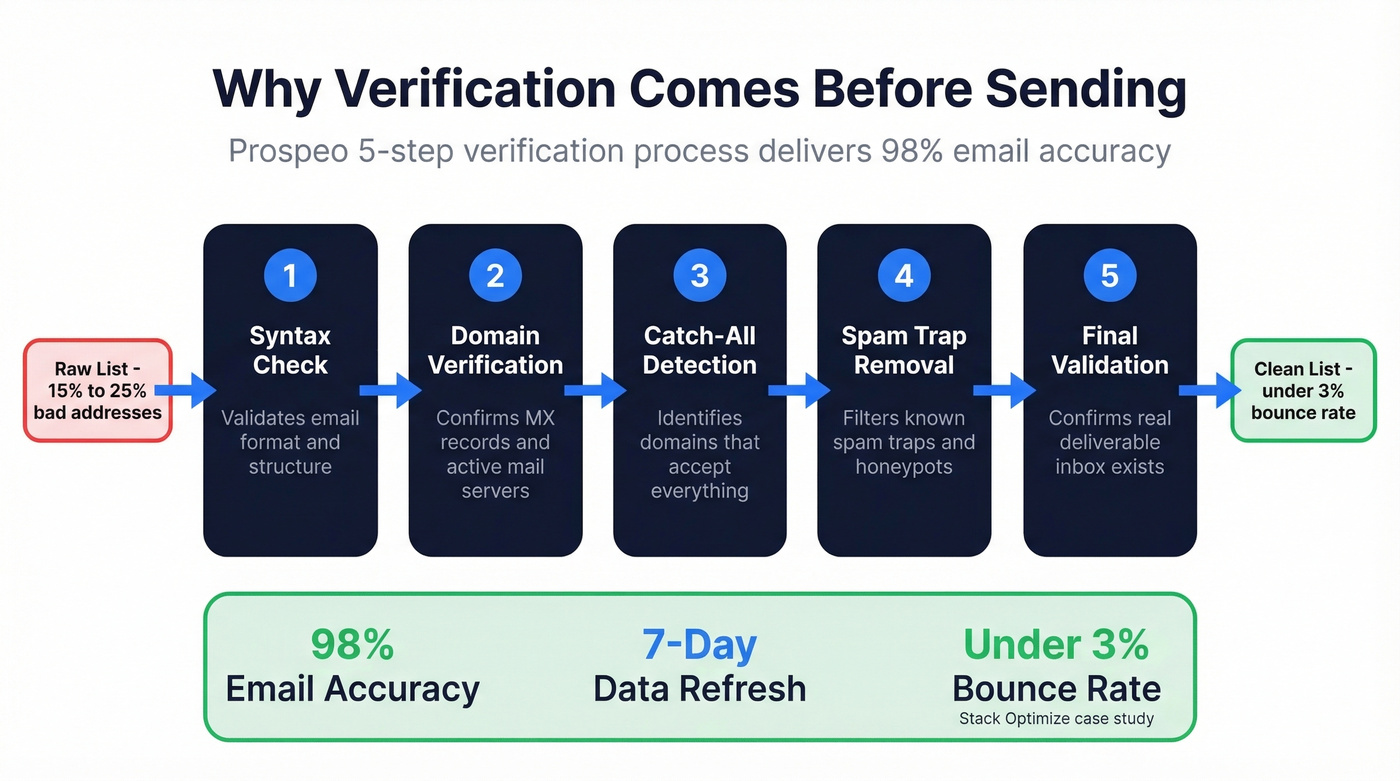
Prospeo sits upstream of every provider on this list. Its 300M+ professional profiles and 143M+ verified emails make it a B2B database and verification tool in one. The 5-step verification process - catch-all handling, spam-trap removal, honeypot filtering - delivers 98% email accuracy, which directly translates to lower bounce rates and healthier sender reputation.
Data refreshes every 7 days, compared to the 6-week industry average. That matters when you're sending at high volume and stale addresses accumulate fast. The free tier gives you 75 emails and 100 Chrome extension credits per month. Paid plans run ~$0.01 per email with no contracts.
Native integrations push verified contacts straight into HubSpot, Salesforce, Smartlead, Instantly, and Lemlist - so your list is clean before it hits your sequence management. Stack Optimize used Prospeo to build from $0 to $1M ARR while maintaining 94%+ deliverability and under 3% bounce rate across all clients.
Amazon SES - Cheapest at Volume
Best for: Teams sending 100k+ emails/month with a developer who can handle setup. Skip if: You want a visual editor, automation builder, or anything resembling a marketing UI.
Nothing touches Amazon SES on price. At $0.10 per 1,000 emails, sending 1M emails costs roughly $100. The free tier covers 3,000 message charges per month for your first 12 months.
Where costs add up: standard dedicated IPs run $24.95/month, while managed dedicated IPs cost $15/month per account plus $0.08 per 1,000 emails (dropping with volume). The Virtual Deliverability Manager add-on costs $0.07 per 1,000 emails for your first 10M, with tiered pricing that drops to $0.02 above 100M. Email validation runs $0.01 per address through the SES console or API.
If you have a developer on staff and send 100k+ per month, nothing else comes close on cost. The tradeoff is real, though - there's no campaign builder, no drag-and-drop editor, no subscriber management. SES is plumbing. Very good, very cheap plumbing.
Brevo - Best All-in-One
Best for: Marketing teams that want email, SMS, WhatsApp, and automation in a single platform without enterprise pricing. Skip if: You're sending 500k+ emails/month and need infrastructure-level cost efficiency.
Brevo's free plan is genuinely generous - 300 emails per day with up to 100k stored contacts. That's 9,000 emails per month at zero cost, enough for early-stage newsletters and drip campaigns. Starter runs $9/month for 5,000 emails, and Business jumps to $18/month with marketing automation, A/B testing, and advanced stats. Transactional email is priced separately starting at $15/month for 20,000 emails.
The platform handles segmentation, automation workflows, SMS campaigns, and WhatsApp messaging from one dashboard. For teams that don't want to stitch together three different tools, Brevo consolidates the stack nicely. At high volume, you're paying a premium for convenience - but if your volume sits under 100k/month and you value a clean UI over raw cost efficiency, Brevo is the obvious pick.

Mailgun - Mid-Range Infrastructure
Best for: Developer teams that want infrastructure-grade sending without the AWS learning curve. Skip if: You need a marketing UI or you're only sending a few thousand emails per month.
Mailgun's free tier caps at 100 emails per day - fine for testing, useless for production. Basic runs $15/month for 10,000 emails with $1.80/1,000 overage. The real value starts at Foundation - $35/month for 50k emails - or Scale at $90/month for 100k. Overage pricing on the Scale plan drops to $0.50 per 1,000 at 1M emails and $0.40 per 1,000 at 2.5M. Dedicated IP pools and 5,000 email validations are included on Scale.
Think of Mailgun as the middle ground between SES's raw cheapness and a more guided developer experience. The API documentation is solid, and you don't need an AWS certification to get started.
MailerLite - Best Free Plan
Best for: Small businesses and creators who want a polished marketing platform at zero cost. Skip if: You're sending B2B outbound at high volume or need API-level infrastructure.
MailerLite's free plan includes 12,000 emails per month. The drag-and-drop editor is clean, landing pages are included, and paid plans start at just $10/month for 500 contacts with unlimited sends. We've seen small teams run their entire email marketing operation on MailerLite's free plan for months before needing to upgrade. It's the right starting point if you're building a list from scratch and don't want to commit budget yet.
Elastic Email - Budget API
Best for: Cost-conscious teams sending 50k-1M emails/month via API. Skip if: You need a real free plan - Elastic Email's free tier is testing-only, limited to your own verified addresses.
At $19/month for 50,000 emails, Elastic Email undercuts most infrastructure competitors. Private IPs run $50/month. The self-serve ceiling is 1M emails per month; above that, you'll need to contact their support team. It's a no-frills API option that works well for teams who've outgrown free tiers but don't need SES-level volume.
SendGrid - The Asterisk
Here's the thing: SendGrid's free plan - the one that made it the default recommendation in every bulk email guide - was retired on May 28, 2025. After the 60-day transition, sending was paused for free-plan accounts unless they upgraded. If you had more than 100 contacts stored on the free Marketing Campaigns plan, those contacts were deleted during the transition.
SendGrid still has a solid API, but the value proposition has shifted. Paid plans start around $20-$30/month, with higher-volume tiers landing around $90+/month. If you're evaluating fresh, cheaper options exist everywhere.
Mailchimp - The Name You Know
Mailchimp has a small free tier, but it isn't built for serious volume. Paid plans start around $13-$20/month and climb quickly as your list size and feature needs grow. You're often paying for brand recognition and ecosystem familiarity more than raw value.
Postmark - Transactional Specialist
Postmark is purpose-built for transactional email - password resets, order confirmations, account notifications. Free tier covers 100 emails, paid starts at $15/month for 10k, dedicated IP at $50. Don't use it for marketing blasts; that's not what it's for, and Postmark will tell you the same thing.
Sender - Budget Marketing
Sender offers 2,500 subscribers and 15,000 emails per month on its free plan, with paid plans from $7/month. It's a solid option for small businesses on a tight budget who need basic automation and templates without the Mailchimp price tag.

A 5% bounce rate destroys sender reputation faster than any ESP misconfiguration. Prospeo's 5-step verification - catch-all handling, spam-trap removal, honeypot filtering - delivers 98% email accuracy at ~$0.01/email. Stack Optimize maintained under 3% bounce rates across every client while scaling to $1M ARR.
Clean your list before it touches your bulk email provider.
What Mass Email Sending Actually Costs at Scale
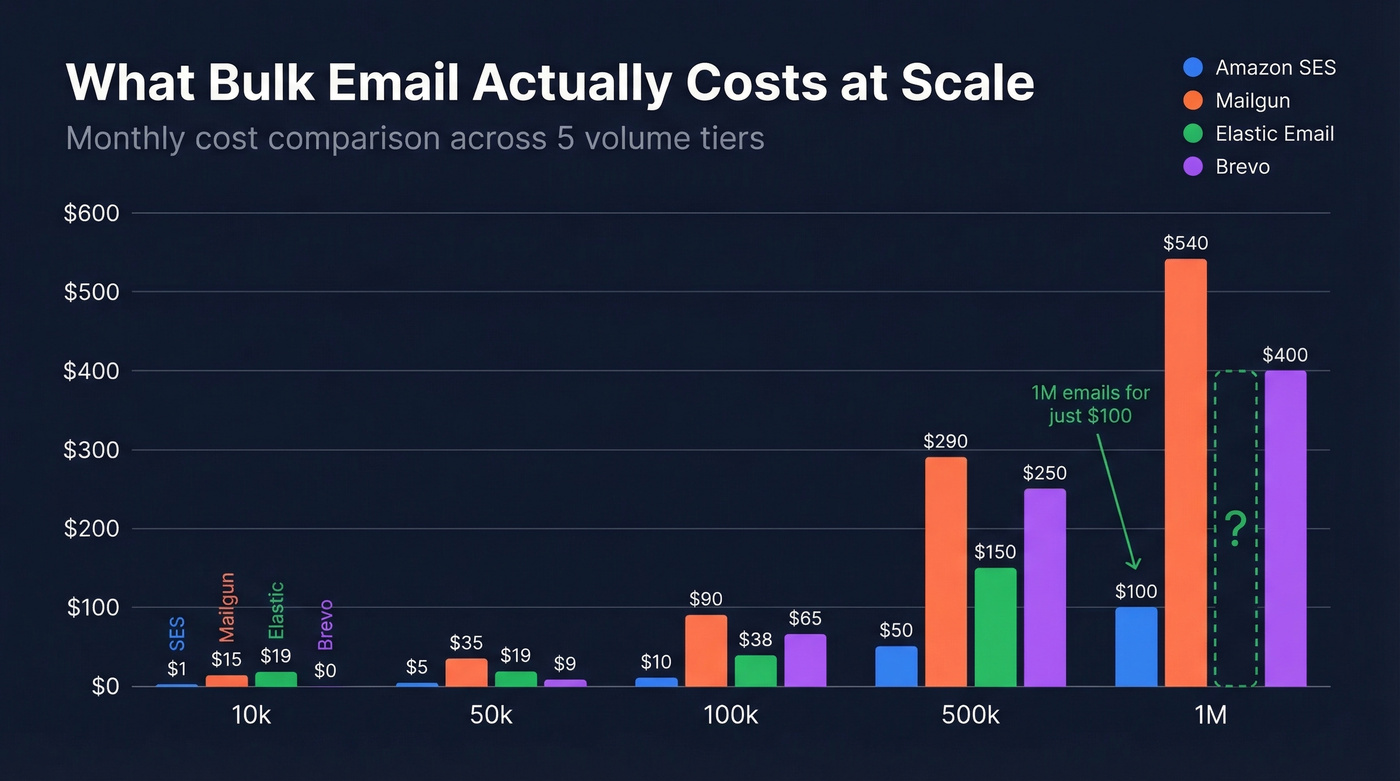
Every provider advertises "$9/month" or "$15/month." Here's what the numbers actually look like when volume grows.
Infrastructure Providers
| Monthly Volume | Amazon SES | Mailgun | Elastic Email | SendGrid (paid) |
|---|---|---|---|---|
| 10k | $1 | $15 (Basic) | $19 | ~$20-$30 |
| 50k | $5 | $35 (Foundation) | $19 | ~$20-$30 |
| 100k | $10 | $90 (Scale) | ~$38 | ~$90+ |
| 500k | $50 | $290 | ~$150 | ~$250+ |
| 1M | $100 | $540 | Contact support | ~$400+ |
Marketing Platforms
| Monthly Volume | Brevo | MailerLite | Mailchimp | Sender |
|---|---|---|---|---|
| 10k | Free | Free | ~$100 | Free |
| 50k | $9+ | $10+ | ~$350 | ~$30 |
| 100k | ~$65 | ~$75 | ~$500 | ~$85 |
| 500k | ~$250 | ~$300 | ~$1,000+ | ~$300 |
| 1M | ~$400 | ~$500 | Contact sales | Contact sales |
Dedicated IP add-ons (not included above): Amazon SES $24.95/mo, Mailgun Scale includes dedicated IP pools, Elastic Email $50/mo, SendGrid and Brevo charge separately.
The divergence is massive. Sending 1M emails through Amazon SES costs $100. Doing the same through a marketing platform runs $400-$500+. That's a 4-5x premium for the drag-and-drop editor and automation features. We've run these numbers across dozens of client setups, and the gap only widens above 500k/month.
Let's be honest about when that premium is worth it: if your average deal size sits below $15k and you're sending fewer than 50k emails per month, you probably don't need infrastructure-level pricing. The $50-$100/month premium for a marketing platform buys you hours of developer time you'd otherwise spend configuring SES. But above 100k/month, the math flips hard - and you should be on infrastructure.
The cheapest sending infrastructure in the world won't save you if 8% of your list bounces, though. A $50/month SES bill becomes a domain reputation problem when bad addresses trigger spam filters. The math only works if your list is clean first.
Deliverability Reality Check
A bulk email tool doesn't guarantee inbox placement. Deliverability depends on domains, authentication, and content - not the platform logo. Here's what the 2025 inbox placement data shows:
| Mailbox Provider | Inbox Rate | Spam Rate | Missing |
|---|---|---|---|
| Gmail | 87.2% | 6.8% | 6.0% |
| Yahoo/AOL | 86.0% | 4.8% | 9.2% |
| Apple Mail | 76.3% | 14.3% | 9.4% |
| Microsoft | 75.6% | 14.6% | 9.8% |
Microsoft is the hardest inbox to land in - nearly 1 in 4 emails get flagged or disappear entirely. If your prospect list skews toward corporate Outlook addresses, deliverability matters even more than usual.
The compliance landscape has tightened significantly. Since February 2024, senders pushing 5,000+ daily emails to Google and Yahoo need an active DMARC policy. Microsoft followed with similar requirements in early 2025. In 2026, non-compliant messages get rejected at the SMTP level - not just filtered to spam, but bounced outright. Understanding your email service provider's sending limits - both ISP-imposed and platform-imposed - is critical to staying compliant and avoiding throttling.
Your authentication checklist:
- SPF record configured per sending domain
- DKIM signing enabled and aligned
- DMARC policy published - at minimum p=none, ideally p=quarantine or p=reject
- One-click unsubscribe header in every marketing email
- Spam complaints well under 0.3%
Five Mistakes That Kill Deliverability
1. Sending without validating your list. Validate every address before sending. A 3% bounce rate is manageable; 10% triggers ISP throttling and can burn your domain. In our experience, this single step prevents more deliverability disasters than any other.
2. Volume spikes without warm-up. Going from 500 emails/day to 50,000 overnight is the fastest way to land in spam. Warm up new IPs and domains over 2-3 weeks, gradually increasing volume.
3. Using purchased or scraped lists. Bought lists are full of dead addresses, spam traps, and people who never opted in. The engagement rates are terrible, and the legal exposure under GDPR and CAN-SPAM is real.
4. Tracking opens and clicks in cold email. Counterintuitive, but the consensus on r/coldemail is consistent: tracking pixels hurt deliverability by adding flagged domains to your emails. Keep cold outbound text-based. (If you want the technical why, see email tracking pixels.)
5. Ignoring DMARC/SPF/DKIM setup. In 2026, this isn't optional - it's table stakes. Non-compliant emails get rejected at the SMTP level. Set it up before you send a single email.
How to Choose the Right Provider
The decision tree is simpler than most guides make it.
By volume: Under 10k emails per month? Start with a free plan on MailerLite or Brevo. Between 10k and 100k? Mid-tier infrastructure like Mailgun or a paid marketing platform. Above 100k? Amazon SES is the cost leader, full stop.
By technical skill: No developers on your team? Marketing platforms only - Brevo, MailerLite, Sender. Got a developer who can configure SMTP and manage API calls? Infrastructure providers will save you 3-5x as volume grows.
By use case: Marketing newsletters and drip campaigns belong on Brevo or MailerLite. Transactional email like receipts and notifications belongs on Postmark or SES. For cold outbound, you'll want an infrastructure provider plus verification, with the practitioner math in mind: roughly 3 inboxes per domain, 30 emails per inbox per day, 90 emails per domain per day. Scale by adding domains, not by blasting volume through one. (For a deeper playbook, see best way to send bulk email without getting blacklisted.)
Every bulk email provider on this list performs better with clean data. Prospeo refreshes 300M+ profiles every 7 days - not the 6-week industry average - so stale addresses don't pile up between sends. Native integrations push verified contacts straight into HubSpot, Salesforce, Instantly, and Lemlist.
Stop paying your ESP to bounce emails off dead addresses.
FAQ
What's the difference between bulk and transactional email?
Bulk email goes to many recipients at once - newsletters, promotions, product updates - while transactional email is triggered by a user action like a password reset or order confirmation. Most providers handle both, but specialists like Postmark focus exclusively on transactional delivery with higher inbox placement guarantees.
Shared IP vs. dedicated IP - which do I need?
Shared IPs work fine under ~50k emails per month. Above that, a dedicated IP gives you full control over sender reputation so other senders can't drag your deliverability down. Expect to pay $25-$50/month and plan for a 2-3 week warm-up period.
How many emails can I send from Gmail for free?
Gmail caps personal accounts at 500 emails per day and Google Workspace at 2,000 per day. For anything beyond that - or anything requiring proper authentication, tracking, and list management - you need a dedicated sending platform.
Do I need to verify my list before sending?
Yes. Unverified lists cause high bounce rates, spam complaints, and permanent sender reputation damage. List cleaning at ~$0.01 per verification is the cheapest insurance against a burned domain. Aim for under 3% bounce rate on every send.
Is it legal to send bulk email?
Yes, provided you comply with CAN-SPAM (US), GDPR (EU), and CASL (Canada). Requirements include clear sender identity, a physical mailing address, one-click unsubscribe, and - for senders pushing 5,000+ daily emails - an active DMARC policy. In 2026, non-compliance means SMTP-level rejection, not just fines.