

The Best Bulk Email Senders for Every Use Case in 2026
You're sending 200 emails from Gmail, hitting the daily cap by lunch, and watching half your "delivered" messages land in spam. Consumer email wasn't built for this. Whether you're running marketing campaigns, cold outreach, or transactional notifications, you need a bulk email sender with proper infrastructure - and the wrong pick will cost you deliverability, money, or both.
Gmail caps free accounts at 500 sends per day. Google Workspace bumps that to 2,000, but new accounts often get throttled to 100-200. Even if you hack around these limits with SMTP relays, you're still sending from infrastructure that wasn't designed for volume. A dedicated sending platform gives you proper authentication, reputation management, and the analytics to know what's actually working.
Here's the thing: most guides lump marketing ESPs, cold email tools, and developer SMTP relays into one list and call it a day. That's lazy, and it leads to bad decisions.
Our Picks at a Glance
| Use Case | Pick | Why |
|---|---|---|
| Best overall (marketing) | Brevo | Priced by emails, not contacts. Free 300/day. |
| Best value at scale | MailerLite | ~$73/mo at 10K contacts. No send limits on paid. |
| Best for cold outreach | Instantly | Built-in warmup, inbox rotation, ~$30/mo. |
| Best for developers | Amazon SES | $0.10/1,000 emails. Nothing cheaper. |
| Best for list verification | Prospeo | 98% email accuracy. ~$0.01/email. Verify before you send. |
That last row matters more than most people think. The best sending infrastructure in the world can't save you from a dirty list.
Marketing vs. Cold Email vs. SMTP Relay
This is the distinction that 90% of "best mass email sender" articles get wrong. These three categories solve fundamentally different problems, and mixing them up is how teams end up with compliance violations or tanked deliverability.
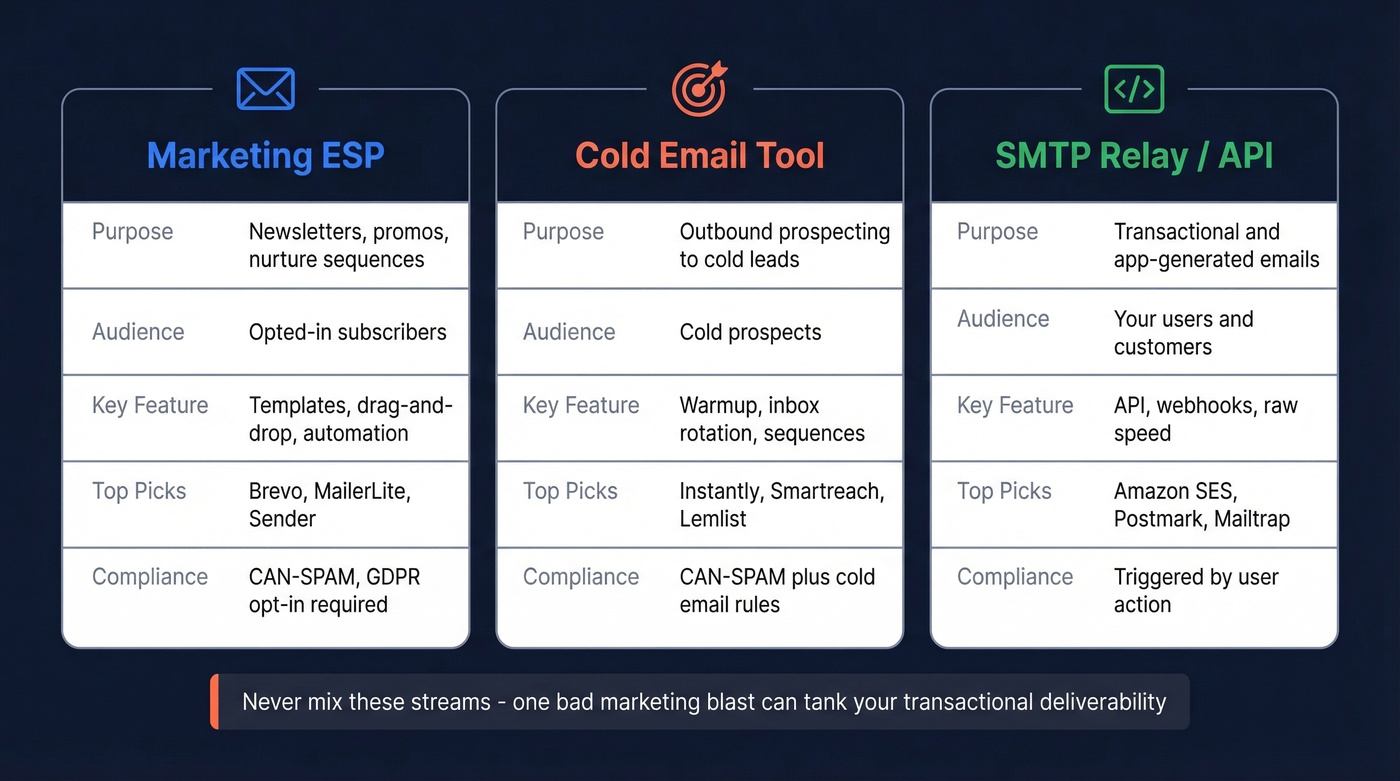
| Marketing ESP | Cold Email Tool | SMTP Relay / API | |
|---|---|---|---|
| Purpose | Newsletters, promos, nurture | Outbound prospecting | Transactional, app-generated |
| Audience | Opted-in subscribers | Cold prospects | Users/customers |
| Key feature | Templates, automation | Warmup, inbox rotation | API, webhooks, speed |
| Examples | Brevo, MailerLite | Instantly, Smartreach | Amazon SES, Postmark |
| Compliance | CAN-SPAM, GDPR opt-in | CAN-SPAM + cold email rules | Triggered by user action |
The critical concept here is separate sending streams. Your transactional emails - password resets, order confirmations - should never share infrastructure with marketing blasts. One bad campaign tanks your transactional deliverability, and suddenly customers can't log in. Postmark enforces this separation by design. Others let you configure it, but you have to know to ask.
If you're running cold outreach through a marketing ESP, stop. Marketing ESPs will shut your account down for sending to non-opted-in lists. Cold email tools exist for a reason, and choosing the right service for cold outreach is the difference between booked meetings and a blacklisted domain. If you're building sequences, start with a proven B2B cold email sequence structure.
Best Marketing ESPs
Brevo - Best for Growing Lists
Use this if you have a large contact list but moderate send volume. Brevo charges by emails sent, not contacts stored - the opposite of Mailchimp and most competitors. For a company with 50,000 contacts sending a weekly newsletter, that's a massive cost difference. Free tier gives you 300 emails per day. Paid plans start at $9/mo for 5,000 emails, with transactional email available separately from $15/mo for 20,000 emails.
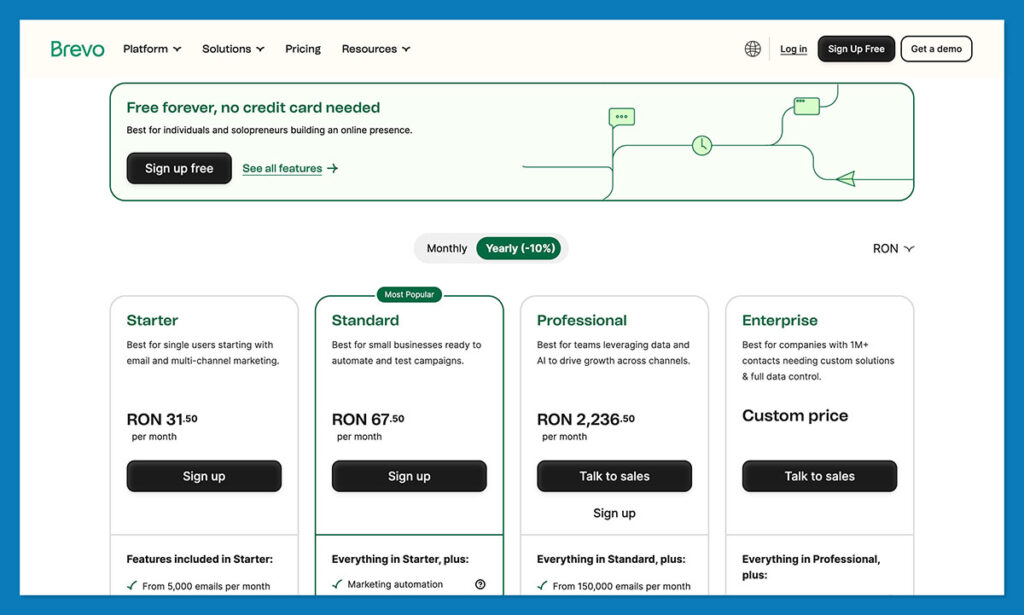
Skip this if you need advanced automation workflows or deep e-commerce integrations. Brevo's automation is competent but not ActiveCampaign-level. Removing Brevo branding from emails costs an extra $12/mo, which feels nickel-and-dime-ish on an otherwise clean pricing model.
MailerLite
Use this if you want the best dollar-per-contact value at scale. MailerLite's free tier includes 12,000 emails per month. Paid plans start at $10/mo for 500 contacts and scale to ~$73/mo at 10,000 contacts - roughly 35% cheaper than Mailchimp at the same tier. No send limits on paid plans.
Skip this if you need CRM-level contact management or complex branching automation. MailerLite keeps things simple, which works great until you need conditional logic or advanced segmentation. For straightforward newsletter and marketing campaigns, though, it's consistently the best value we've found at scale.
If you're pairing an ESP with a database, make sure you have a clean lead generation workflow so you don't import junk.
Sender
The most generous free plan in the marketing ESP space: 15,000 emails per month to 2,500 subscribers, no credit card required. Paid plans start at $7/mo for 12,000 emails. The drag-and-drop editor is clean and deliverability is solid for the price.
Feature depth drops off compared to Brevo or MailerLite once you need segmentation or multi-step automations. Fine for straightforward campaigns, but you'll outgrow it.
Moosend
Unlimited sends on every paid plan, starting at $9/mo for 500 contacts. If you send high-frequency campaigns like daily deals or content digests, the per-email economics are excellent. The automation builder punches above its weight. The tradeoff: no free plan (just a 30-day trial), a smaller template library, and reporting that feels a generation behind MailerLite or Brevo.
Best Cold Outreach Tools
Instantly - Best for Cold Email
Use this if cold email is your primary outbound channel and you need built-in warmup, inbox rotation, and campaign management in one tool. Instantly starts at ~$30/mo and is purpose-built for cold outreach. The warmup network and automatic inbox rotation are table stakes for anyone sending cold at volume. If you're optimizing volume safely, use an email velocity framework.
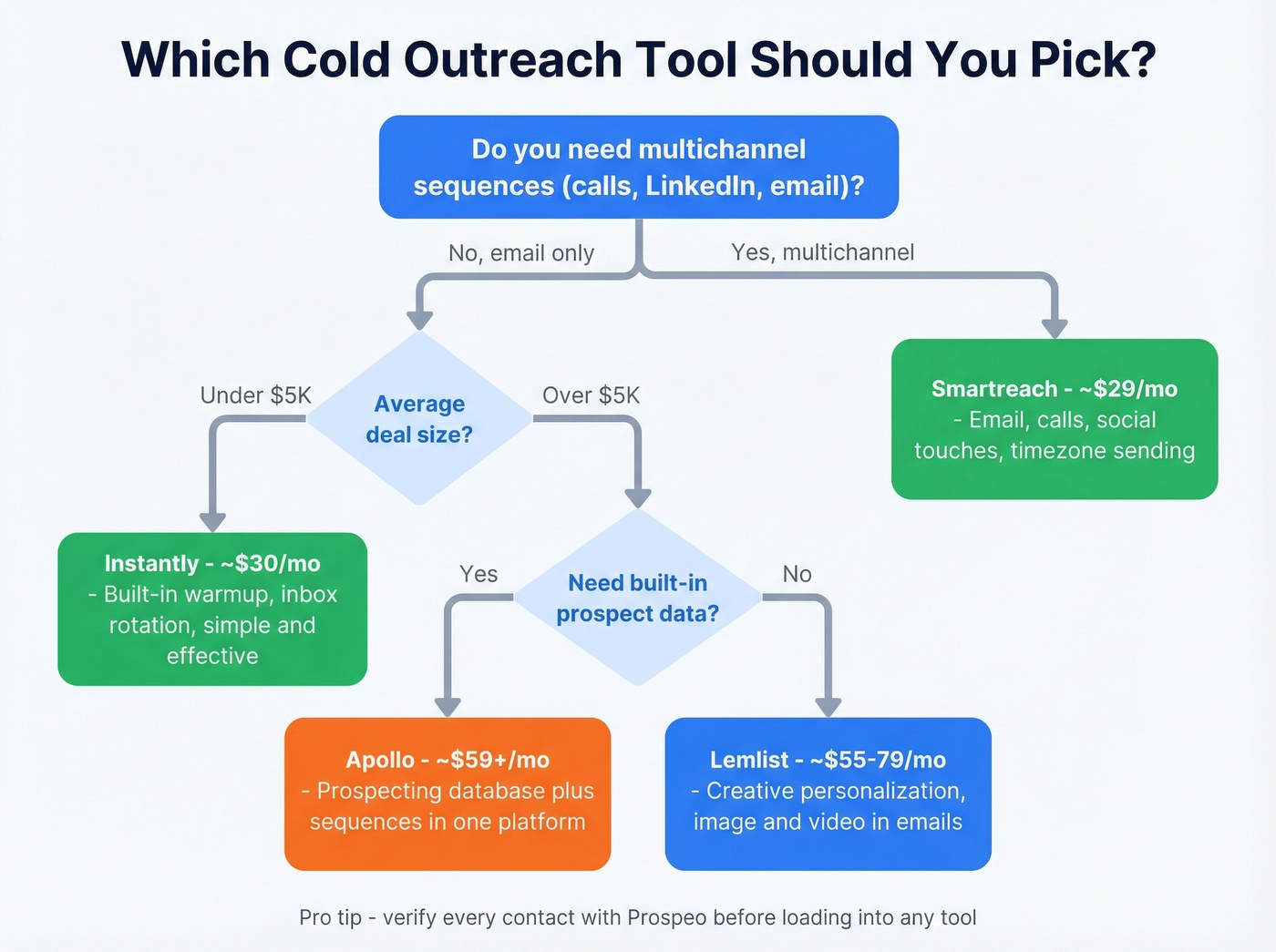
Skip this if you need multichannel sequences or deep CRM integration out of the box. Instantly is email-first, and the CRM features on lower tiers are basic. The shared infrastructure risk at lower tiers is real - if another user on your shared IP burns the reputation, your deliverability suffers.
Smartreach
True multichannel sequences - email, calls, and social touches in one drip. Time-zone sending is built in, which matters when you're prospecting across regions. Entry pricing around ~$29/mo is competitive. The deliverability stack with warmup, blacklist monitoring, and inbox rotation is solid. The best multichannel features are gated behind higher-tier plans, though, and the UI has a steeper learning curve than Instantly.
Let's be honest: if your average deal size is under $5K, you probably don't need multichannel sequences. A well-written cold email to a verified contact outperforms a mediocre five-touch sequence every time. Save the complexity for enterprise deals.
Also worth a look: Lemlist (~$55-79/mo) for creative personalization and Apollo (~$59+/mo) for teams that want prospecting data and sequences in one platform. For subject testing, keep a swipe file of cold email subject line examples.
Developer / Transactional / SMTP
Amazon SES - Cheapest at Scale
At $0.10/1,000 emails, nothing comes close on price. A million emails costs $100. SES handles transactional, marketing, and bulk - all through API or SMTP relay. You need a developer on the team, though. There's no drag-and-drop editor, no pre-built templates, no visual campaign builder. SES is infrastructure, not a product. You'll build or buy everything on top of it.
Below 100,000 emails per month, a shared IP from a managed provider is simpler and delivers comparably. Above that, SES with a dedicated IP is hard to beat.
Postmark
The highest inbox placement in Mailtrap's seed testing - 83.3% inbox rate on shared IPs. Postmark is transactional-first by design, with enforced separation between transactional and broadcast streams. Free tier gives you 300 emails per day with a 500 contact limit. Paid plans start at $9/mo for 5,000 emails. Not built for marketing campaigns or cold email, but for transactional deliverability, it's the best in class.
Elastic Email
Budget infrastructure for teams that don't need SES's complexity. $19/mo gets you 50,000 emails through their API. Dedicated IP available as a $50/mo add-on. The free tier is essentially useless - you can only send to yourself - and support is limited on lower plans. Functional but bare-bones.
Mailtrap
A newer entrant worth watching. Free tier includes 4,000 emails per month, and paid plans start at $15/mo for 10,000 emails. Inbox placement tested at 78.8% - ahead of Mailgun and SendGrid. Strong developer experience with email testing and debugging tools baked in. If you're troubleshooting placement, an email spam checker can help isolate content vs. auth issues.

The fastest way to tank your bulk email sender is loading it with unverified contacts. Prospeo's 5-step verification catches spam traps, honeypots, and catch-all domains before they torch your reputation - 98% accuracy at ~$0.01 per email.
Clean your list before your sender reputation pays the price.
Others Worth Knowing
SendGrid has a limited free tier (100 emails/day), and paid transactional plans start at $19.95/mo. Inbox placement hit just 61% in seed tests - the worst of the major providers tested. This isn't the SendGrid people remember from five years ago.
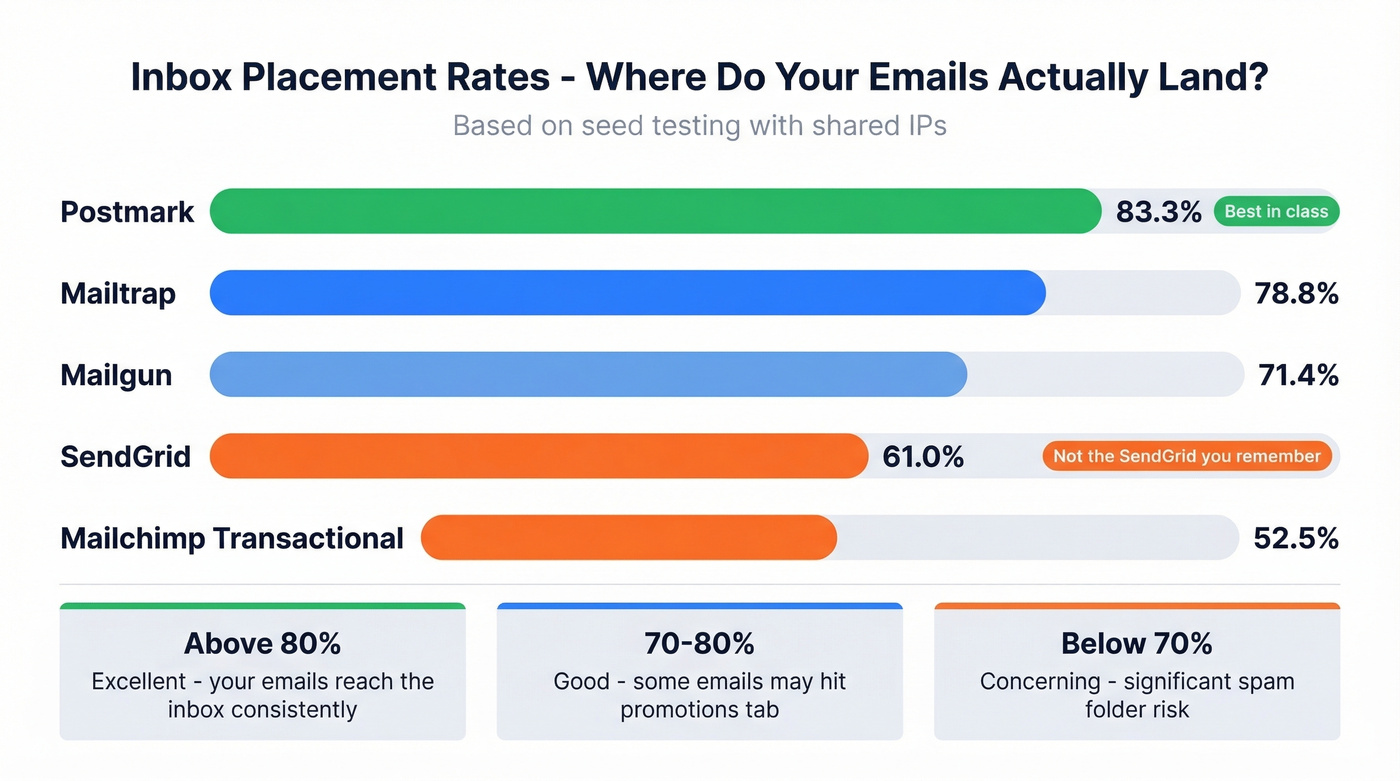
Mailgun offers solid API documentation and developer experience from $15/mo. Inbox placement tested at 71.4% - middle of the pack. A reasonable SES alternative if you want better docs and don't need rock-bottom pricing.
ActiveCampaign has the deepest automation builder in the ESP space, from $15/mo at 1,000 contacts. It scales aggressively though - ~$149/mo at 10,000 contacts. Worth the premium for complex branching workflows and lead scoring. For simple sends, you're overpaying.
Constant Contact starts at ~$30/mo for 500-1,000 contacts with a send limit of 10x your contact count. Beginner-friendly with good templates, but per-contact pricing gets expensive fast and the feature set plateaus.
SMTP.com runs from $25/mo for 50,000 emails with dedicated IP included on most plans. A solid pick for high-volume senders who want a managed solution without building on SES.
Pricing Compared
Pricing models vary wildly, and the model matters as much as the number. Brevo charges by email volume. Mailchimp charges by contacts - including unsubscribed ones you forgot to archive, a billing trap that can inflate your costs 10-20%. Mailchimp also killed its free plan, so the days of testing it risk-free are over. HubSpot's marketing tier requires a $3,000+ onboarding fee before you send a single email.
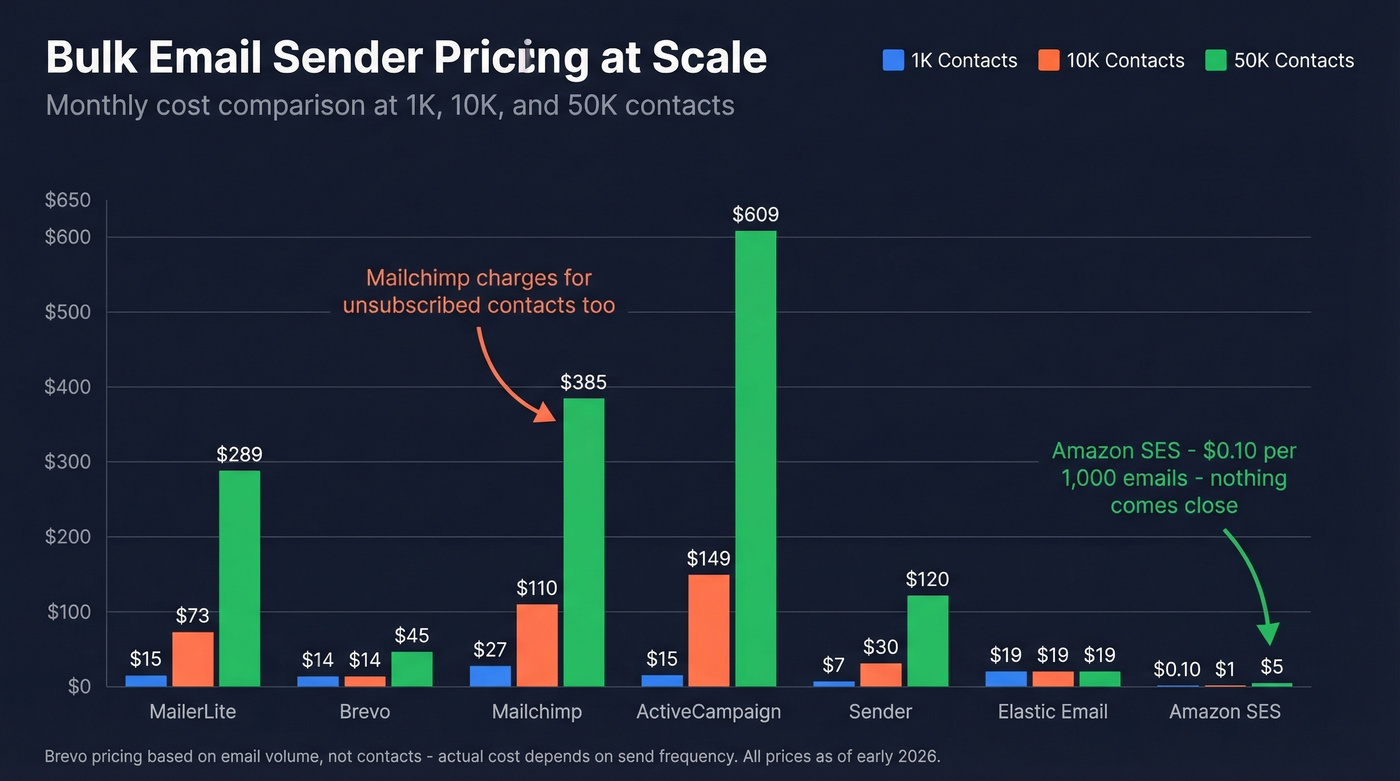
| Tool | Free Tier | 1K Contacts | 10K Contacts | 50K Contacts | Model |
|---|---|---|---|---|---|
| MailerLite | 12K/mo | $15/mo | $73/mo | $289/mo | Per contact |
| Brevo | 300/day | ~$14/mo | ~$14/mo* | ~$45/mo* | Per email |
| Mailchimp | None | ~$27/mo | ~$110/mo | ~$385/mo | Per contact |
| ActiveCampaign | None | $15/mo | $149/mo | $609/mo | Per contact |
| Sender | 15K emails/mo | $7/mo | ~$30/mo | ~$120/mo | Per contact |
| Elastic Email | Send to self only | ~$19/mo | ~$19/mo | ~$19/mo | Per email |
| Amazon SES | N/A | $0.10 | $1.00 | $5.00 | Per email |
*Brevo pricing based on email volume, not contacts - costs depend on send frequency. Paid plans start at $9/mo for 5,000 emails.
If you have a big list but send infrequently, Brevo saves you money. Frequent sends to a moderate list? MailerLite is the sweet spot. And if you're a developer comfortable with APIs, nothing touches Amazon SES on raw cost.
Deliverability - What the Tests Show
Deliverability is the metric that actually matters, and most bulk emailing services don't publish real numbers. Every undelivered email costs roughly $0.11 in wasted resources - multiply that across a 100K send and the math gets ugly fast. Mailtrap ran a seed test across major transactional providers using free tiers, shared IPs, and identical templates:
| Provider | Inbox | Tabs | Spam | Missing |
|---|---|---|---|---|
| Postmark | 83.3% | 1.0% | 14.3% | 0.9% |
| Mailtrap | 78.8% | 4.8% | 14.4% | 2.0% |
| Amazon SES | 77.1% | 1.9% | 20.0% | 1.0% |
| Mailgun | 71.4% | 3.8% | 23.8% | 1.0% |
| SendGrid | 61.0% | 1.0% | 17.1% | 20.9% |
Two things jump out. Postmark's transactional-first architecture pays off - enforcing stream separation keeps their shared IPs clean. And SendGrid's 20.9% "missing" rate is alarming. One in five emails just vanished.
The dedicated IP question comes up constantly on r/emailmarketing and the consensus is pretty clear: below 100,000 emails per month, shared IPs from a reputable provider are fine. Above that, a dedicated IP lets you control your own reputation. But a dedicated IP with low volume actually hurts - there's not enough sending history to build trust with mailbox providers.
One macro trend worth watching: DMARC adoption surged 75% between 2023 and 2025, jumping from 27.2% to 47.7% among the top 1.8 million domains. Despite that surge, 84% of B2B sending domains still have no DMARC protection at all. Authentication isn't optional anymore. If you want to go deeper, start with DMARC alignment and a practical SPF record example.
Verify Your List Before You Send
Even the best sending platform can't fix a bad list. If 5% of your emails bounce, your sender reputation takes a hit that affects every future campaign. Spam complaint thresholds are even tighter - Gmail and Yahoo enforce a 0.3% maximum, and the recommendation is to stay under 0.1%. One bad send can put you in a hole that takes weeks to climb out of.
Prospeo handles this upstream step with a 5-step verification process that catches invalid addresses, spam traps, and honeypots before they ever hit your sending infrastructure - delivering 98% email accuracy with catch-all domain handling that most verification tools skip entirely. Upload a CSV or connect via API, and every address gets verified on a 7-day data refresh cycle compared to the 6-week industry average. Native integrations with Instantly, Lemlist, and Smartlead mean verified contacts flow directly into your sequences with no stale data. If you're comparing verifiers, see our picks for Bouncer alternatives.
Stack Optimize built their agency to $1M ARR running client campaigns through pre-verified lists - client deliverability stayed above 94%, bounces under 3%, zero domain flags across all clients. At ~$0.01 per email verified, with a free tier of 75 emails plus 100 Chrome extension credits per month, there's no reason to skip this step.
Cold outreach tools like Instantly and Smartreach only work when the data going in is accurate. Prospeo gives you 143M+ verified emails refreshed every 7 days - not the stale, bouncing contacts that get your domain blacklisted and your sending account shut down.
Stop feeding bad data into good sending infrastructure.
2026 Compliance Checklist
Gmail and Yahoo's bulk sender requirements rolled out in 2024 and have only gotten stricter. Microsoft joined the enforcement party in May 2025, and Apple's guidelines closely align. If you're sending more than 5,000 messages per day to personal inboxes, you're classified as a bulk sender and these rules apply.
The non-negotiable baseline:
- SPF + DKIM + DMARC authentication on every sending domain (minimum DMARC policy: p=none)
- One-click unsubscribe via RFC 8058 headers (List-Unsubscribe + List-Unsubscribe-Post)
- Spam complaint rate below 0.3% - ideally under 0.1%
- Valid forward and reverse DNS (PTR) records for sending IPs
- Honor unsubscribes within 2 days
- DKIM keys at 2048-bit with RSA-SHA256, rotated every 6 months
A Mailgun survey found that 63% of senders were familiar with these requirements, but only 49.5% actually made changes. That means roughly half the market is still non-compliant - which is both a risk and an opportunity. If your authentication is tight and your competitors' isn't, you'll land in the inbox while they hit spam. For a step-by-step, use this guide on how to verify DKIM is working.
Mistakes That Kill Deliverability
Don't send from a brand-new domain without warming it up first. No reputation equals spam folder. Don't send to old, unverified lists - a list that hasn't been cleaned in 6 months is a liability. Don't use misleading subject lines like "Re: our conversation" when there was no conversation; it tanks trust and triggers complaints. And don't blast your entire list with the same generic message. Segmentation isn't optional.
Do use double opt-in for marketing lists. Monitor spam complaints, bounce rates, and engagement metrics after every send. Segment by engagement - subscribers who haven't opened in 90 days should get a re-engagement campaign or be removed. No sending software can compensate for poor list hygiene.
For benchmarks, Mailchimp's data across billions of emails shows averages of 35.63% open rate, 2.62% click rate, and 0.22% unsubscribe rate. If your numbers are significantly below these, you have a deliverability or content problem - or both. One caveat: Apple's Mail Privacy Protection inflates open rates, so treat that metric as directional rather than precise.
FAQ
Can I send bulk email from Gmail?
Not at scale. Gmail caps free accounts at 500 emails per day and Workspace at 2,000. Tools like GMass use SMTP relay workarounds, but you risk account suspension and reputation damage. For anything beyond a few hundred recipients, use a dedicated bulk email sender with proper authentication.
What's a good bounce rate for mass email?
Under 2% is healthy. Above 5% signals a list quality problem that'll damage your sender reputation. Pre-verifying with a tool like Prospeo - which includes catch-all handling and spam-trap removal - keeps bounces under 3% even for agencies running high-volume client campaigns.
Do I need a dedicated IP?
Only if you're sending more than 100,000 emails per month. Below that threshold, shared IP pools from reputable providers deliver comparable results. A dedicated IP with low volume actually hurts - there isn't enough sending history to build the reputation that mailbox providers look for.
What's the cheapest way to send bulk email?
Amazon SES at $0.10 per 1,000 emails - but you need a developer to configure it. For non-technical users, Sender's free tier (15,000 emails per month) or Brevo's free plan (300 emails per day) are the cheapest options that include a visual editor and campaign management.
How do I choose the right bulk email service?
Start with your use case. Marketing newsletters need an ESP with templates and automation. Cold outreach needs warmup and inbox rotation. Transactional emails need API-first infrastructure with high deliverability. Then match your volume to the pricing model - per-email pricing favors large lists with infrequent sends, while per-contact pricing works better for frequent senders with smaller lists.