

How to Conduct Buyer Persona Research That Doesn't Become Shelfware
Most buyer personas are fiction dressed up as research. Someone on the marketing team spends two weeks building a beautiful slide deck with stock photos, clever names, and demographic details nobody asked for. The CMO presents it at the board meeting. Then it sits in a shared drive, untouched, while the SDR team keeps blasting the same generic outreach to everyone on the list.
The shelfware problem isn't about effort - it's about method. Let's talk about how to do buyer persona research that actually changes the way your team sells and markets.
Three Things That Separate Useful Personas From Decorative Ones
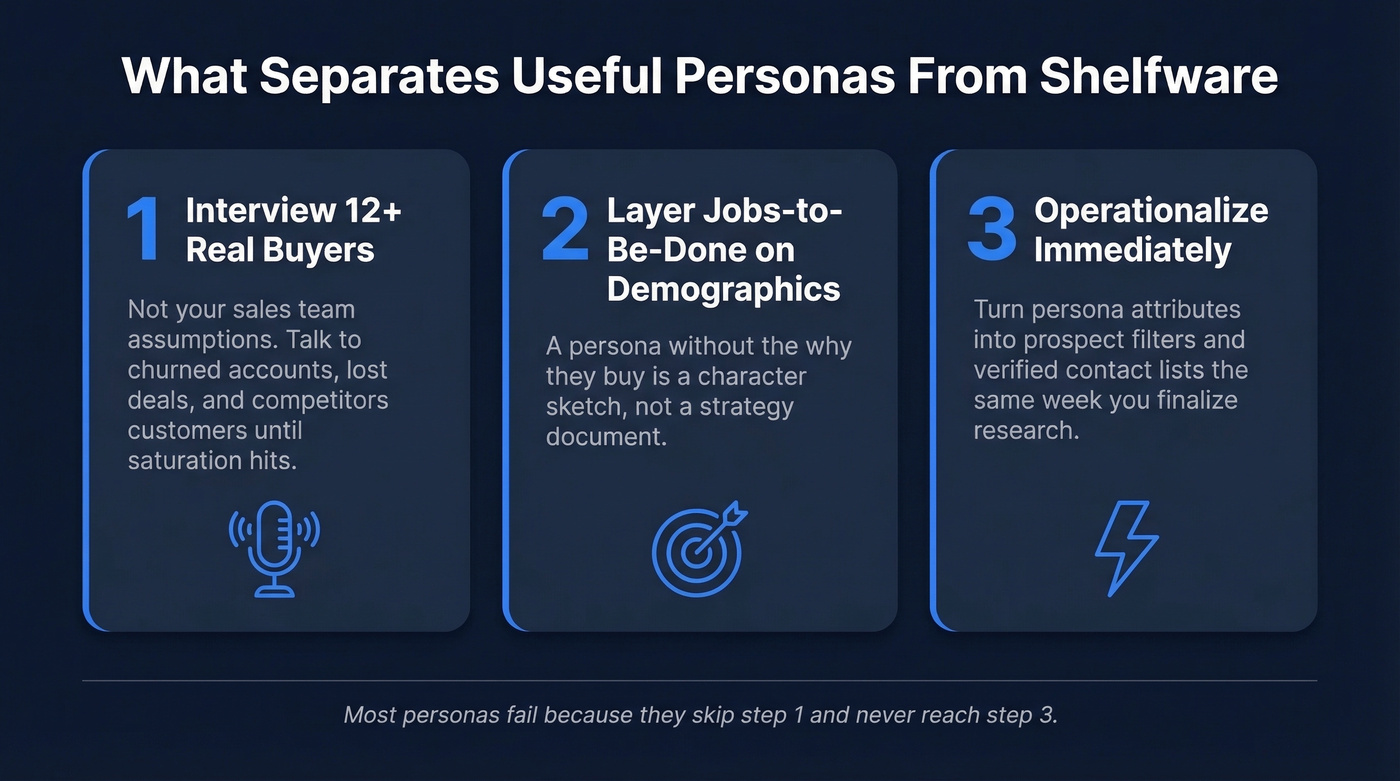
- Interview around 12 real buyers per persona (not your sales team's assumptions) - that's where saturation tends to show up.
- Layer Jobs-to-Be-Done on top of demographics - a persona without "why they buy" is a character sketch, not a strategy document.
- Operationalize immediately - turn persona attributes into prospect filters and verified contact lists the same week you finalize the research.
What Is Buyer Persona Research?
Buyer persona research is the process of building a data-backed profile of a real buyer archetype - someone who actually purchases (or influences the purchase of) your product. It covers their goals, challenges, decision criteria, and buying behavior, grounded in interviews and analytics rather than guesswork.
A common confusion: target audience analysis and persona development use similar inputs (analytics, interviews, social listening), but they produce different outputs. A target audience defines a group - "mid-market SaaS companies with 200-500 employees." A buyer persona defines the individual human inside that group who signs the contract or kills the deal.
Then there's the negative persona - the profile of someone you explicitly don't want as a customer. The startup founder who'll churn in 60 days. The enterprise prospect who needs 14 months of procurement review for a $5k deal. Defining who you're not selling to is just as valuable as defining who you are.
Why Most Personas Fail
The persona template is the least important part. The research behind it is everything.
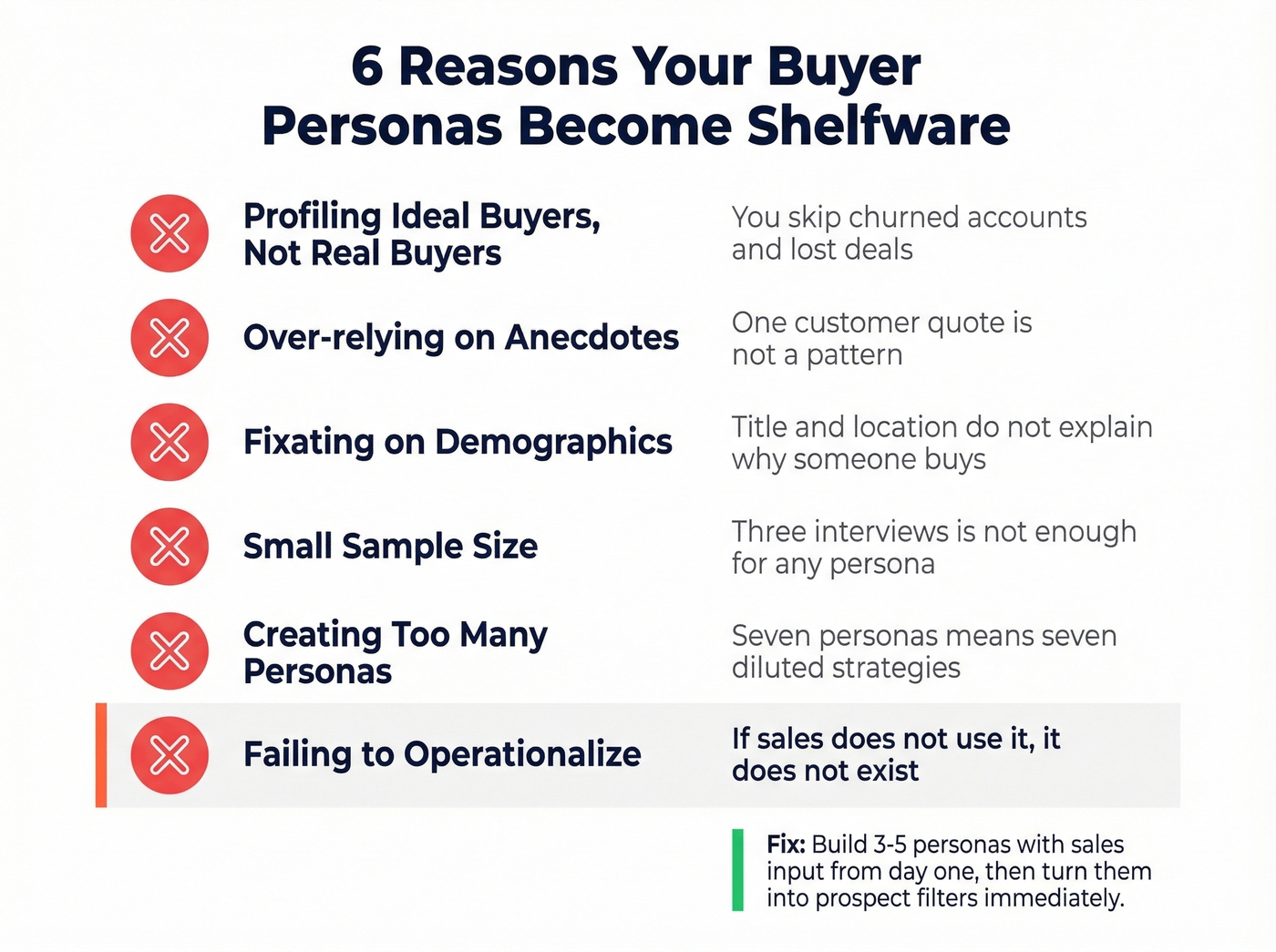
Profiling ideal buyers, not real buyers. Your best customer isn't your only customer. Interview the messy middle - people who almost churned, deals you lost, prospects who chose a competitor. That's where the real patterns live.
Over-relying on anecdotes. "Our biggest customer said X" isn't research. It's a single data point. Back every pattern with multiple interviews and quantitative signals, or you're just confirming your own bias.
Fixating on demographics. Age, title, and location don't explain why someone buys. Motivations, pain points, and decision triggers do. A VP of Operations in Austin and one in London might buy for identical reasons - or completely different ones.
Using a small sample size. Three interviews isn't enough. If you've got a small customer base, make up for quantity with quality - longer, deeper conversations that probe motivations and context.
Creating too many personas. Seven personas means seven diluted messaging strategies. Most companies need three to five. More than that and your marketing team can't act on any of them effectively.
Failing to operationalize. This is the big one. A persona that doesn't change your outreach, content, or targeting is a creative writing exercise. If your sales team doesn't recognize the personas you've built, the personas are wrong - or at least incomplete. Their value is measured by the actions they drive, not the slides they fill.
How to Conduct the Research
Define Your Research Goals
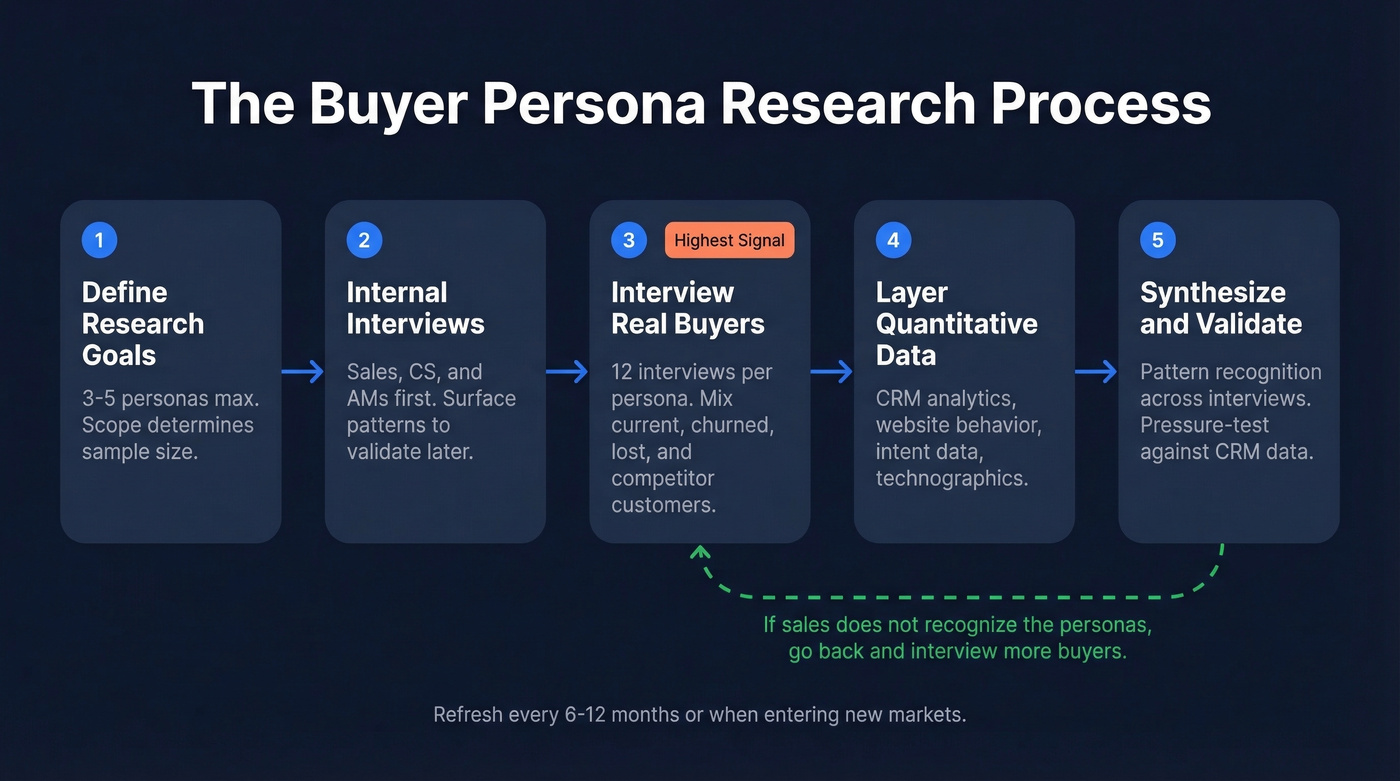
Start by scoping the project. How many personas do you actually need? For most B2B companies, three to five covers the core buying committee without diluting your focus. Your scope determines your sample size - a narrow persona needs fewer interviews than a broad one spanning multiple verticals. Set clear goals before you schedule a single call.
Start With Internal Interviews
Before you talk to a single customer, interview your own team. Sales reps, account managers, and customer success leads talk to buyers every day. They know the objections, the triggers, the questions that come up in every demo.
In our experience, the personas that actually get used are the ones built with sales team input from day one. Starting internal surfaces patterns you can validate externally and builds the buy-in that makes the sales team actually reference the finished personas in their outreach.
Interview Real Buyers
This is the highest-signal step, and the one most teams skip. Aim for 3-8 unique interviews per persona as a minimum, each running 15-30 minutes. Recruit a mix: current customers, churned accounts, lost deals, and - if you can get them - competitors' customers. That 360-degree view prevents survivorship bias.
How many interviews total? Griffin and Hauser's model found that 20-30 interviews can uncover 90-95% of customer needs. Guest, Bunce, and Johnson observed saturation - the point where new interviews stop producing new themes - around interview 12. For most B2B persona projects, around 12 interviews per persona is a practical target that balances rigor with the reality that your team has other things to do. A single 30-minute conversation with the right person reveals more than weeks of spreadsheet analysis. Don't skip the calls.
Layer in Quantitative Data
Interviews give you the "why." Quantitative data gives you the "how many" and "how often." Pull CRM analytics to see which titles convert fastest, which industries churn least, and where deals stall. Layer in website behavior data, survey responses from tools like SurveyMonkey or Typeform, and audience intelligence platforms like SparkToro to see what your buyers actually read and follow. Intent data and technographic signals add a modern dimension - they tell you what buyers are actively researching before they ever fill out a form.
Synthesize and Validate
Pattern recognition is the core skill here. Look across your interviews for recurring themes in pain points, decision criteria, and buying triggers. Group similar patterns into distinct personas, then pressure-test them against your quantitative data. If a persona doesn't show up in your CRM analytics, it's aspirational rather than real.
Make your personas visual and shareable. A one-page card with a short video clip from an actual buyer interview beats a 30-slide deck every time - people remember faces and voices, not bullet points. Plan to refresh personas every 6-12 months, or whenever you enter a new market or launch a new product line.
Here's the thing: if your sales team doesn't recognize the personas you've built, go back and interview more buyers. The personas are wrong.
20 Buyer Persona Interview Questions
The right questions turn a polite conversation into actionable intelligence. In one case, changing an asset headline based on interview feedback lifted conversions by 40%. That's the kind of insight a well-structured interview produces.
Background & Role
- What does your day-to-day actually look like?
- How is your performance measured?
- What tools do you use most?
- Who do you report to, and who reports to you?
Goals & KPIs
- What are you trying to accomplish this quarter?
- What does success look like for your team?
- What metric would get you promoted?
- What's the biggest gap between where you are and where you need to be?
Challenges & Pain Points
- What's the most frustrating part of your current process?
- What have you tried that didn't work?
- Where do you waste the most time?
- What keeps coming up in your team meetings as an unresolved problem?
Buying Process & Decision Criteria
- How did you first hear about solutions like ours?
- Who else was involved in the decision?
- What almost stopped the deal?
- What would make you switch from your current solution?
Information Sources
- Where do you go to learn about new tools or approaches?
- Which analysts, publications, or communities do you trust?
- How do you evaluate vendors?
- What content format do you actually consume - podcasts, newsletters, reports?

You just defined your buyer personas. Now operationalize them. Prospeo's 30+ search filters - including buyer intent, technographics, job changes, and department headcount - let you turn persona attributes into targeted prospect lists with 98% verified emails. No more shelfware.
Go from persona slide deck to verified contact list in minutes.
Jobs-to-Be-Done: The Missing Layer
Most personas describe the "who" - title, company size, industry, reporting structure. Jobs-to-Be-Done describes the "why" - the context, triggers, and desired outcomes that drive a purchase decision.
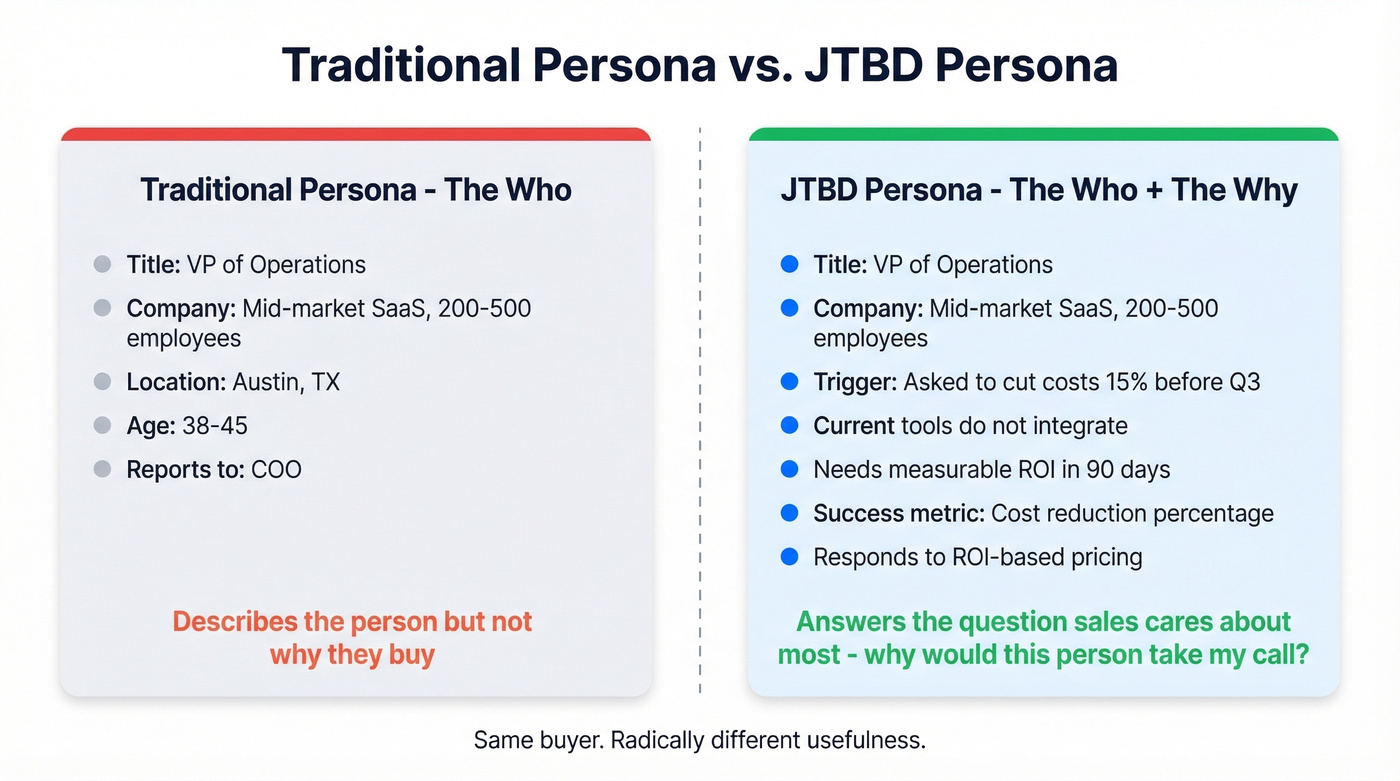
They're complementary, not competing. A persona tells you that your buyer is a VP of Operations at a mid-market SaaS company. JTBD tells you she's buying your platform because she's been asked to cut operational costs by 15% before Q3, her current tools don't integrate, and she needs to show measurable ROI within 90 days to keep her budget.
The JTBD framework focuses on what customers "hire" a product to do - the progress they're trying to make in a specific circumstance. When you layer this onto a traditional persona, you get a "JTBD persona" - a profile that captures both the demographic reality and the behavioral trigger. That's the document your sales team will actually use, because it answers the question they care about most: why would this person take my call?
And here's an angle almost nobody covers: persona research also informs pricing. When you understand the buyer's willingness to pay and the value metrics they care about - cost savings, time recovered, revenue generated - you can design pricing pages that convert instead of confuse. A VP who measures success in "cost reduction percentage" responds to ROI-based pricing. An IC who measures success in "hours saved per week" responds to per-seat simplicity. Same product, different framing, driven entirely by the research.
Using AI for Persona Development
Traditional persona research has four structural problems: survivorship bias (you only interview existing customers), staleness (personas created once and never updated), abstraction (broad labels that don't guide action), and a research-to-action gap (personas disconnected from CRM and outreach). AI addresses all four.
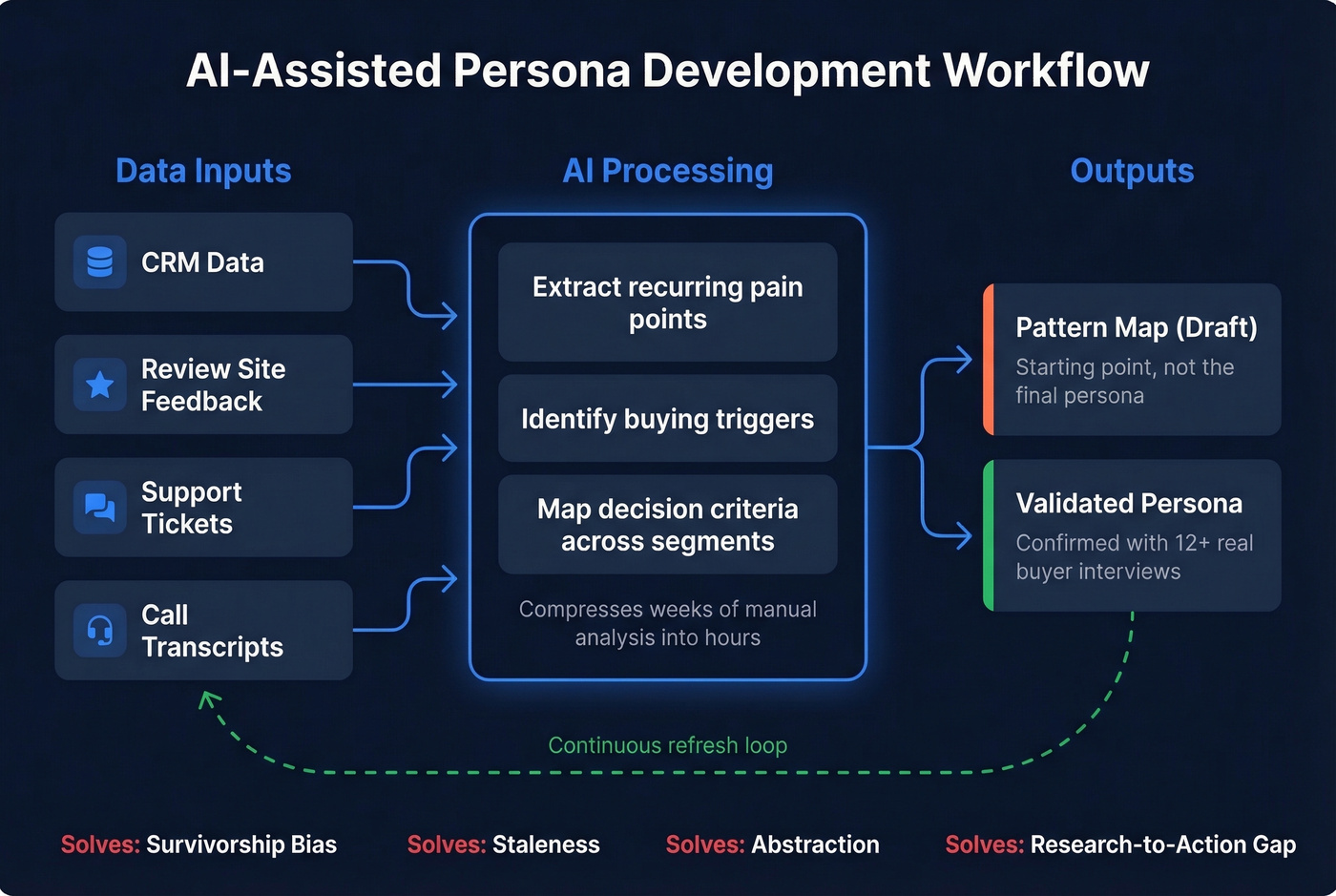
The practical workflow: feed your CRM data, review-site feedback, support tickets, and call transcripts into an LLM like Claude or ChatGPT. Ask it to extract recurring pain points, buying triggers, and decision criteria across your customer base. The output isn't a finished persona - it's a pattern map that compresses weeks of manual analysis into hours. Tools like M1 Project can generate a draft persona in 3-5 minutes, useful as a starting point but not a substitute for the interview-backed synthesis described above.
The real power is in cadence. Instead of a one-time research project, run a weekly refresh on new CRM data and a quarterly deep dive comparing current patterns against your existing personas. As HBR noted, market research is one of the managerial functions most disrupted by generative AI - and persona development is a prime use case. We've tested AI-generated personas against interview-backed ones, and the AI drafts are a solid starting point but miss the emotional triggers that close deals. The interviews still matter. The AI just makes them scale.
A practical rule of thumb: if your average deal size is under $8k, you probably don't need a 30-page persona document. A one-paragraph JTBD statement, five interview quotes, and a prospect filter in your CRM will outperform any slide deck. Save the elaborate personas for enterprise deals where the buying committee has six people and a 9-month sales cycle.
Buyer Persona Example
Here's a filled-in B2B decision-maker persona based on the framework above:
| Field | Details |
|---|---|
| Name | Operations Olivia |
| Role | VP of Operations |
| Company | Mid-market SaaS, 300-700 employees |
| Priorities | Standardize processes, reduce inefficiencies, improve KPI visibility |
| KPIs | Cost reduction %, efficiency gains, on-time delivery, team productivity |
| Core Risks | Workflow disruption during rollout, adoption resistance, tools that don't deliver ROI |
| Decision Criteria | Measurable ROI within 90 days, integrations with existing stack, vendor reputation and support quality |
| JTBD Layer | "I need to cut operational costs by 15% before Q3 without disrupting current workflows" |
| Info Sources | Operations-focused Slack communities, Gartner reports, peer referrals, vendor case studies |
| Buying Triggers | Board mandate to reduce costs, failed implementation of a previous tool, team scaling beyond current processes |
The negative persona: don't forget to define who you're excluding. For this example, that's a solo founder at a 10-person startup - they don't have the operational complexity to need your platform, they'll churn in 60 days, and the support cost will exceed the contract value. Documenting this saves your SDR team hours of wasted outreach.
From Persona to Prospect List
Look, every buyer persona guide on the internet stops at "now you have a persona." That's like writing a recipe and stopping before you turn on the oven.
Your SDR team is sending the same generic outreach to CTOs and individual contributors - persona research fixes that, but only if you operationalize it the same week you finalize the work. Take the attributes from your persona - job title, industry, company size, tech stack, growth signals, buying triggers - and translate them directly into prospect search filters.
Prospeo's database lets you do this with 30+ filters, including buyer intent powered by Bombora's 15,000 topics, technographic signals, headcount growth, and job change alerts. Search across 300M+ profiles, export verified emails at 98% accuracy on a 7-day refresh cycle, and push contacts straight into Salesforce, HubSpot, or your sequencing tool. The free tier gives you 75 emails per month to test the workflow before you commit a dollar.

The gap between "we have personas" and "we're booking meetings with the right people" is a day of work, not a quarter-long project.
Great persona research means nothing if you can't reach the people it describes. Prospeo gives you 300M+ profiles, 143M+ verified emails, and intent data across 15,000 topics - so you can find exactly the buyers your research identified, already in-market for what you sell.
Stop researching buyers you can't contact. Start at $0.01 per email.
Best Tools for Persona Research
| Tool | Category | Best For | Starting Price |
|---|---|---|---|
| Prospeo | B2B Data & Prospecting | Turning personas into verified prospect lists | Free tier (75 emails/mo) |
| SurveyMonkey | Surveys | Large-scale quantitative validation | ~$25+/mo |
| Typeform | Surveys | High-completion surveys | ~$25+/mo |
| SparkToro | Audience Intelligence | Discovering what buyers follow | Free tier available |
| HubSpot Make My Persona | Persona Generator | Quick persona formatting | Free |
| M1 Project | AI Persona Generator | AI-drafted personas in minutes | ~$29+/mo |
| Clearbit | Data Enrichment | Firmographic enrichment | ~$99+/mo |
Prospeo bridges the gap between research and execution - once you've defined persona attributes, its search filters (intent data, technographics, headcount growth, funding) let you build a matching prospect list in minutes with 98% email accuracy and a 7-day data refresh cycle. Skip this if you're only doing qualitative research and don't need to build outbound lists.
SurveyMonkey is used by 98% of the Fortune 500 and handles large-scale quantitative validation well. Typeform averages a 57% completion rate, which matters when you're asking buyers to spend 10 minutes on a survey. SparkToro's free tier lets you see what any audience reads, listens to, and follows - paid plans start around $50+/mo for deeper analysis. HubSpot's Make My Persona tool is free and useful for formatting, though it won't do the research for you. Clearbit handles firmographic and technographic enrichment starting around $99+/mo for smaller teams. The consensus on r/sales tends to be that no single tool replaces the interviews - these platforms just make the surrounding data work faster.
FAQ
How often should you update buyer personas?
Refresh every 6-12 months at minimum, or immediately when entering a new market, launching a new product, or seeing a shift in win/loss patterns. Stale personas lead to misaligned messaging and wasted outreach spend.
How many personas does a company need?
Most B2B companies need three to five personas to cover the core buying committee. More than five dilutes messaging and makes operationalization nearly impossible - your sales team can't memorize seven different talk tracks.
What's the difference between a buyer persona and an ICP?
An ICP defines the ideal company - industry, revenue, headcount, tech stack. A buyer persona defines the individual human within that company who makes or influences the purchase decision. You need both: the ICP narrows your target account list, the persona shapes your messaging.
Can you build personas without customer interviews?
You can start with CRM data, analytics, and AI-assisted analysis, but interviews remain the highest-signal input. Even five solid conversations surface emotional triggers and decision criteria that no amount of spreadsheet analysis reveals.
How do you turn personas into a prospect list?
Map persona attributes - job title, industry, company size, tech stack, growth signals - to search filters in a B2B data platform. Tools like Prospeo let you match persona criteria to 300M+ profiles and export verified contacts directly into your CRM, closing the gap between research and outreach in a single session.