

Pricing for SaaS: The Guide With Actual Numbers
The average SaaS startup spends about six hours - total, ever - on pricing strategy. Six hours on the single lever that, when improved by just 1%, drives an 11% increase in profit. At a $15M ARR company, sloppy pricing architecture leaks roughly $2.4M per year in unrealized revenue. That's not a rounding error. That's a Series B worth of capital evaporating through discounting habits, underpriced tiers, and expansion revenue you never capture.
If you're expecting a tidy taxonomy of models, you're in the wrong place. This guide has the models, but it also has the dollar figures, the failure case studies, and the research playbook to back them up.
The Short Version
If you're short on time:
- The right model for most SaaS companies: tiered (Good/Better/Best) with a usage-based expansion lever. This isn't controversial - it's what the data supports.
- Your entry plan anchor: $29/user/month. That's the median across 100+ SaaS companies. Start there and adjust based on willingness-to-pay research, not gut feel.
- You're almost certainly undercharging. One founder doubled their price from $19 to $39 and watched conversions go up. Premium signaling is real. Run a Van Westendorp survey this month - it takes a week and can reshape your entire revenue trajectory.
Seven SaaS Pricing Models That Dominate
Most companies end up using a hybrid of two or three of these. Here's what each looks like in practice.
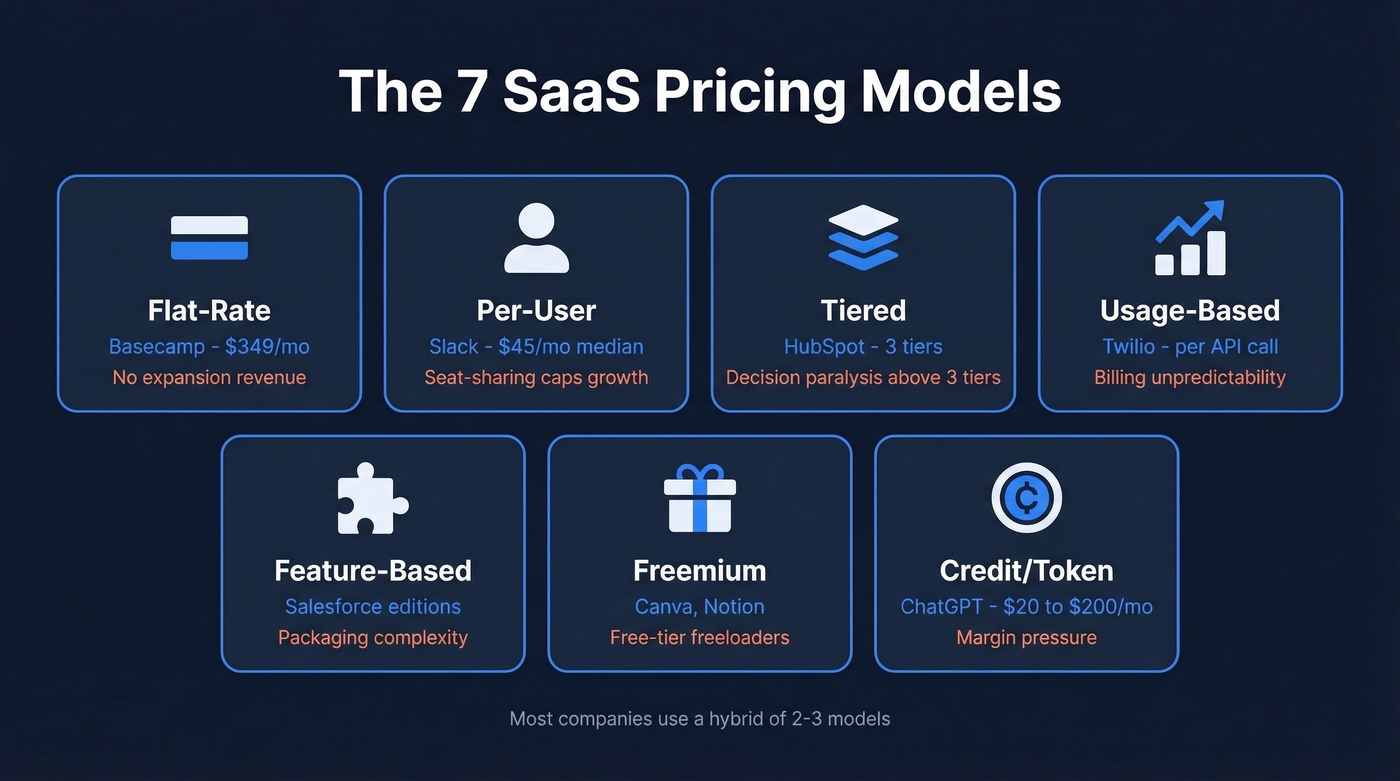
Flat-Rate Pricing
One product, one price, everyone pays the same. Basecamp charges $349/month for unlimited users. It's beautifully simple and eliminates pricing friction entirely. The tradeoff: you leave money on the table with power users and have no natural expansion revenue.
Per-User Pricing
Why does 57% of SaaS default to per-user pricing? Because it's the easiest model for buyers to budget. Slack is the canonical example - revenue scales predictably with adoption, and the median per-user price sits at $45/month. The risk: customers start sharing logins or resist adding seats, capping your growth.
Tiered Pricing
The workhorse. HubSpot runs Starter/Professional/Enterprise tiers, each unlocking more features and capacity. The industry average is 3.2 public tiers plus an enterprise/custom option. One founder on r/SaaS reported that adding a fourth and fifth tier caused conversions to drop roughly 30% from decision paralysis. Stick to three.
Usage-Based Pricing
85% of SaaS companies have adopted some form of usage-based pricing, and 78% of those adopted it within the last five years. Twilio charges per API call. Typeform charges per response. It aligns cost with value beautifully - but customers hate invoice surprises, and your finance team hates forecasting revenue that fluctuates monthly.
Feature-Based Pricing
Salesforce pioneered this - different editions unlock different feature sets. It works when your product has clearly differentiated capabilities that map to different buyer personas. A Reddit thread flagged that switching from per-user to per-project pricing led to bigger teams signing up, which makes intuitive sense: growing teams don't get penalized for adding headcount.
Freemium
Skip this if your product doesn't spread organically. 38% of SaaS companies offer a free tier, but it only works when each free user potentially brings in paid users - think Canva and Notion. If your product lacks viral or network effects, a 14-day free trial with a clear upgrade trigger converts better than an indefinite free plan that trains users to never pay.
Credit & Token-Based Pricing
The AI era's pricing model. ChatGPT charges Plus at $20/month, Pro at $200/month. Claude runs Pro at $17/month and Max at $100-$200/month. On the API side, Anthropic's Sonnet 4.5 costs $3 per million input tokens and $15 per million output tokens. Credits and tokens let vendors meter AI consumption without pure usage-based billing's unpredictability.
| Model | Best For | Example | Key Risk |
|---|---|---|---|
| Flat-rate | Simple products | Basecamp | No expansion revenue |
| Per-user | Predictable scaling | Slack | Seat-sharing, growth caps |
| Tiered | Multi-segment | HubSpot | Decision paralysis (>3 tiers) |
| Usage-based | API/consumption | Twilio | Billing unpredictability |
| Feature-based | Complex platforms | Salesforce | Packaging complexity |
| Freemium | Viral products | Canva | Free-tier freeloaders |
| Credit/token | AI products | ChatGPT | Margin pressure |
Strategies That Actually Work
Models are the structure. Strategy is the philosophy. There are four strategies worth discussing, and one is clearly superior.
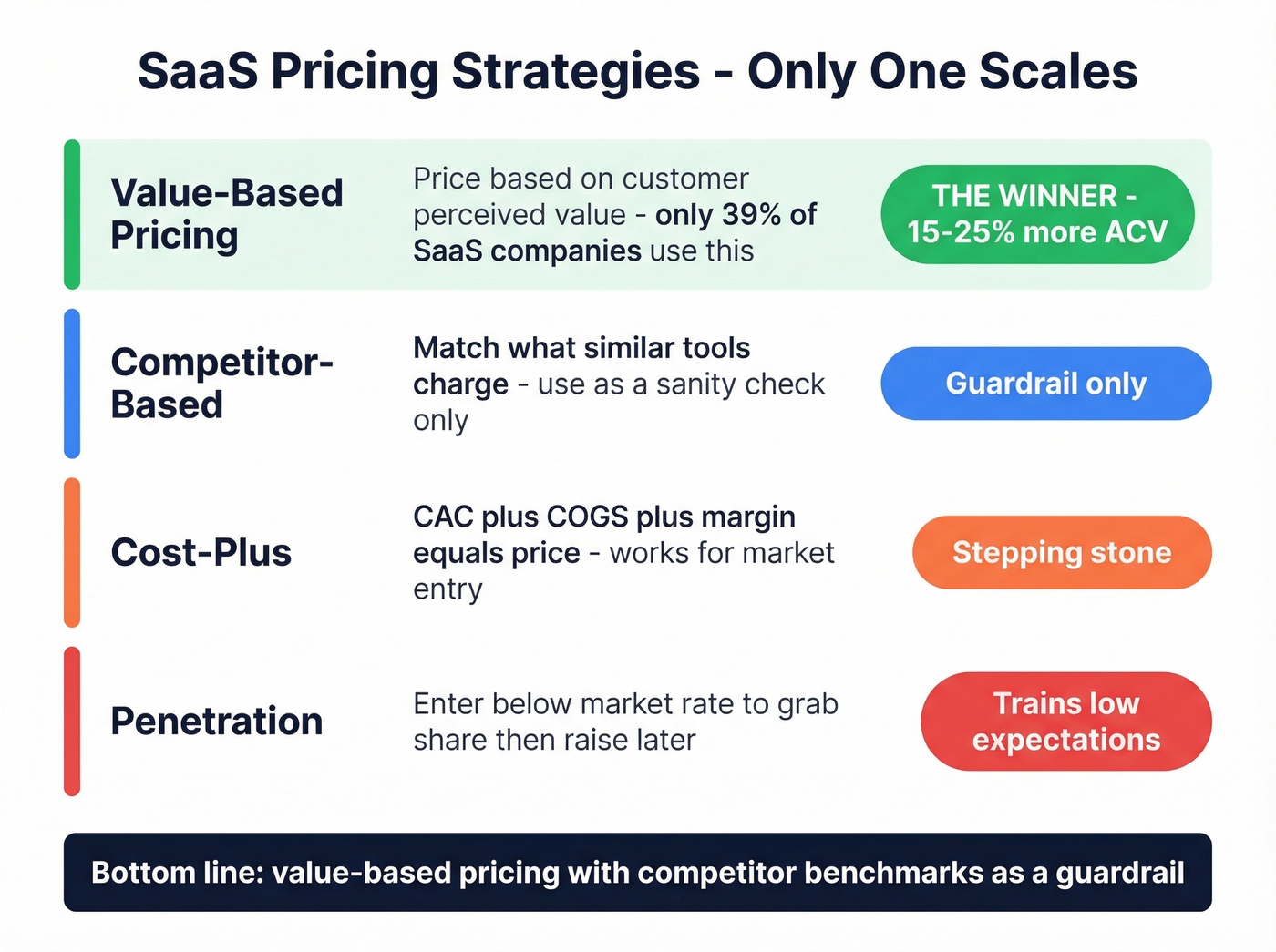
Value-based pricing is the only strategy that scales. You price based on the customer's perceived value of your product, not your costs or your competitor's price tag. Only 39% of SaaS companies use value-based pricing as their primary approach. That number should be 100%. Every other strategy is either a stepping stone or a crutch.
The data backs this up: companies that shift from per-seat to value-based pricing capture 15-25% more ACV on enterprise deals. If your ACV is above $50K, this switch alone could be worth hundreds of thousands in annual revenue.
Competitor-based pricing means you look at what similar tools charge and price accordingly. Use this as a sanity check, never as your primary strategy. If you're pricing based on what your competitor charges, you're letting someone else's cost structure and value proposition dictate your revenue. Check competitive benchmarks on PricingSaaS, then move on.
Cost-plus pricing uses the formula: CAC + COGS + margin = price. It's how Netflix entered the market in 1999 - four DVD rentals for $15.95 while Blockbuster charged $4.99 for a single 3-day rental. Cost-plus works for market entry. It doesn't work for optimization.
Penetration pricing means entering below market rate to grab share, then raising prices once you've built a user base. Use this if you're entering a crowded market with a comparable product and need adoption velocity. Skip it if you have genuine differentiation - you'll just train customers to expect low prices.
Let's be honest: most mature SaaS companies should be running value-based pricing with competitor benchmarks as a guardrail. Everything else is leaving money on the table.
2026 Benchmarks and Real Numbers
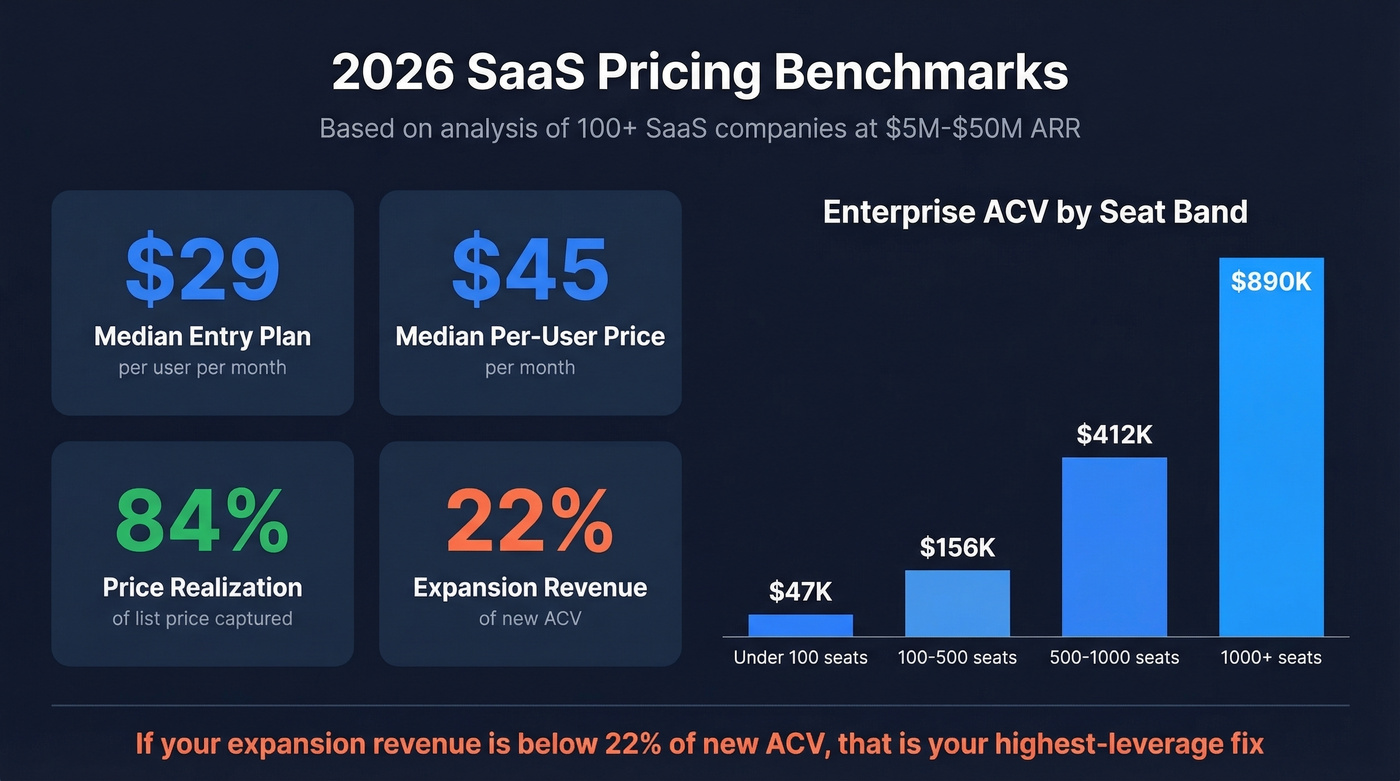
These numbers come from Monetizely's analysis of 100+ SaaS companies and TechGrowth Insights' 2026 benchmark analysis for $5M-$50M B2B SaaS.
| Metric | Median | Top Quartile | Bottom Quartile |
|---|---|---|---|
| Entry plan price | $29/user/mo | $49/user/mo | $15/user/mo |
| Per-user price | $45/mo | $79/mo | $19/mo |
| Price realization | 84% of list | 93% | 72% |
| Deals discounted | 64% | 38% | 82% |
| Expansion rev % | 22% of new ACV | 41% | 8% |
| YoY price increase | 8-12% | - | 0% |
| Annual increase adoption | 34% | - | - |
The enterprise ACV numbers are where it gets interesting:
| Seat Band | Median ACV |
|---|---|
| <100 seats | $47K |
| 100-500 seats | $156K |
| 500-1,000 seats | $412K |
| 1,000+ seats | $890K |
Enterprise discount depth averages ~23% off list for 3-year commitments, and platform fees appear in 67% of enterprise contracts.
One benchmark most companies miss: companies that monetize their strongest differentiator as a separate add-on - typically priced at $50-$200/user/month - generate 18-25% incremental revenue on enterprise deals. At ~$15M scale, that's $300K-$600K in annual revenue you're leaving on the table by bundling everything into a single tier.
The diagnostic that matters most: if your win-rate lift from discounting is under 5 percentage points, you're giving away margin for nothing. Expansion dollars cost $0.15-$0.25 to capture versus $1.00 for new logo dollars. If your expansion revenue is below 22% of new ACV, that's your highest-leverage fix.

Value-based pricing only works when you reach the right buyers. Prospeo gives you 300M+ profiles with 30+ filters - including buyer intent, technographics, and funding data - so you test pricing with prospects who actually match your ICP.
Stop guessing who'll pay. Start reaching 143M+ verified emails at 98% accuracy.
How AI Is Reshaping SaaS Pricing
A Cursor user woke up to a $7,225 yearly subscription invoice. A single developer had burned through 500 requests in one day. Cursor's CEO issued a public apology and offered refunds for affected users.
That's what happens when usage-based pricing meets unpredictable AI consumption.
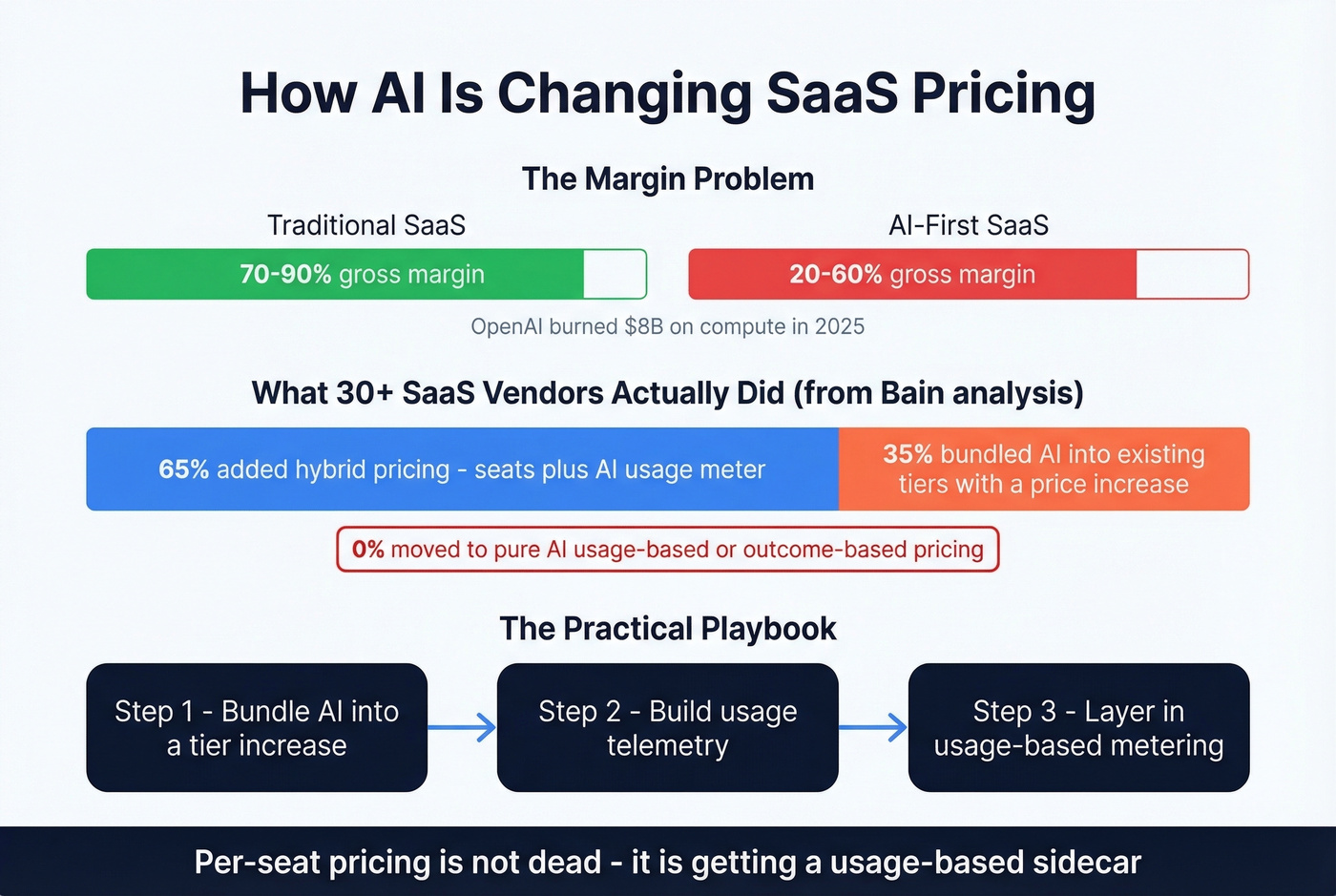
The economics are fundamentally different from traditional SaaS. AI-first gross margins run 20-60%, compared to traditional SaaS at 70-90%. OpenAI pulled in $13B+ in revenue but burned $8B on compute in 2025, projecting $14B in cumulative losses by end of 2026. These aren't sustainable unit economics, and they're forcing creative pricing structures across the industry.
Bain's analysis of 30+ SaaS vendors adding generative AI capabilities found a clear pattern: ~65% introduced hybrid pricing (seats plus an AI usage meter), ~35% bundled AI into existing per-seat tiers with a price increase, and exactly zero moved to pure AI usage-based or outcome-based pricing. Per-seat pricing isn't dead - it's getting a usage-based sidecar.
For a concrete example: a YC founder recently floated charging $30K/year plus implementation for a human-in-the-loop AI workflow that saves roughly a third of a $70K/year analyst's time. The math works on a value basis - the customer saves ~$23K/year - but the sticker shock of $30K for "AI" is real. This is the tension every AI-first company is navigating right now.
The execution barriers are real, too. Most companies lack the telemetry infrastructure for granular usage tracking, billing systems can't handle hybrid models cleanly, and enterprise procurement teams still think in seats. If you're adding AI features, start with a bundled tier increase and layer in usage-based metering once you have the data infrastructure.
Our take: If your average deal size is under $10K, you probably don't need a usage-based AI meter at all. Just bundle it, raise your price 15-20%, and move on. The engineering cost of building metering infrastructure will eat more margin than the usage-based revenue will generate at that scale.
How to Research Your Pricing
Stop guessing. Here's the playbook.
Step 1: Run a Van Westendorp Price Sensitivity Survey. Ask four questions to your target customers:
- At what price would this product be so expensive you wouldn't consider it?
- At what price would you start to think it's expensive, but you'd still consider it?
- At what price would you think it's a bargain?
- At what price would you think it's so cheap you'd question the quality?
The intersections of these curves give you four critical price points: Point of Marginal Cheapness, Point of Marginal Expensiveness, Optimal Price Point, and Indifference Price Point. Your acceptable price range falls between the first two.
Step 2: Get 100+ responses per customer segment. This is the minimum for statistical significance. If you're targeting SMB and mid-market separately, that's 200+ total responses. Companies that do willingness-to-pay research outperform peers by 10-15% on revenue growth.
Building a clean, verified contact list for survey outreach is where most teams stall. Prospeo's 30+ search filters let you target exact ICP segments by company size, department, seniority, and industry - and 98% email accuracy means your survey invitations actually land in inboxes instead of bouncing. If you need a repeatable workflow, start with lead generation workflow basics and then layer in lead enrichment to keep segments clean.
Step 3: Validate with a fake-door test. Put your proposed pricing on a landing page with a "Buy Now" button that leads to a "launching soon" email capture. Buffer famously used this approach. Measure click-through as an intent proxy before committing to a price point.
Step 4: Run a segmented A/B test. Test two price points over ~30 days, comparing conversion rate against ARPU. The price that maximizes revenue per visitor - not just conversion rate - wins. For deeper analysis, consider conjoint analysis to estimate feature-level utility and optimize your packaging alongside pricing.
Mistakes That Cost Real Revenue
Too many tiers. Three options is the sweet spot - it gives buyers a clear Good/Better/Best framework without triggering choice paralysis. If you need more granularity, put it behind a "Contact Sales" enterprise tier.
Undercharging. A SaaS founder on r/SaaS shared that doubling their price from $19 to $39 actually increased conversions. Higher prices signal quality. If your product solves a real problem, charging too little makes prospects suspicious, not grateful. We've seen this pattern repeatedly - the fear of raising prices is almost always worse than the reality.
Habitual discounting. 64% of deals get discounted, and 40-60% of that discount volume is habitual - reps giving discounts because they always give discounts, not because the deal requires it. At 84% median price realization, the average $15M SaaS company is leaking $2.4M annually through pricing architecture failures alone. That's infuriating when you think about how much effort goes into generating pipeline, only to give it back at the close.
Botched price increases. "CloudMetrics" (a composite case from Monetizely's research) pushed a 40% price increase with only 30 days' notice. The fallout was brutal: support tickets spiked 340% on day one, monthly churn jumped from 2.1% to 8.7% within two weeks, 23% of customers churned within 60 days (representing $890K in ARR), 31% of remaining customers downgraded, and win rates dropped 15% as prospects heard about the backlash. Total first-year revenue impact exceeded $1.4M - against a projected gain of $600K. The math didn't just not work. It went catastrophically negative.
How to Raise Prices Right
The CloudMetrics disaster wasn't caused by raising prices. It was caused by raising prices badly.
Podpage raised prices and saw a 28.5% increase in ARR with zero customers lost. Klipfolio shifted from user-based to resource-based pricing, A/B tested for over two months, and found higher average starting subscription values with no significant conversion-rate difference - plus more users per account and increased expansion revenue. The broader data backs this up: 98% of SaaS companies that make pricing changes see positive results. One founder raised prices 25% and lost only ~3% of users.
Here's what works:
- Grandfather existing customers. They keep their current rate; new pricing applies to new sign-ups. One company pushed a 40% increase while grandfathering existing accounts - those grandfathered customers became their biggest referral source.
- Give enterprise accounts 90-120 days' notice. CloudMetrics gave 30 days. That's insulting for a company that needs budget approval cycles.
- Offer price locks for annual commitments. "Lock in your current rate for 12 months by switching to annual billing" turns a potential churn trigger into a cash flow win. The standard incentive is 2-3 months free for annual plans.
- A/B test before you commit. Klipfolio's two-month test gave them confidence the change wouldn't hurt conversion. Don't guess - measure.
- Make annual increases a default operating rhythm. Only 34% of companies apply annual increases, but the ones that do typically apply 5-8% at renewal and realize 12-18% higher ACV over three years with no meaningful churn impact.
If you want to pressure-test the rollout, treat it like a pipeline change: define funnel metrics, monitor churn analysis, and align the team on sales process optimization.
Nailed your SaaS pricing tiers? Now fill the pipeline. Teams using Prospeo book 26% more meetings than ZoomInfo users - at $0.01/email instead of $1. That's the kind of unit economics that makes your pricing strategy actually compound.
Your pricing page converts. Make sure the right decision-makers land on it.
Key Metrics to Track
You can't optimize pricing without measuring its downstream effects. Here are the metrics that matter, with benchmarks.
| Metric | What It Tells You | Benchmark |
|---|---|---|
| MRR/ARR | Revenue baseline | - |
| Churn rate | Pricing tolerance | 1% enterprise / 2-2.5% SMB |
| LTV/CAC ratio | Unit economics | 3:1 minimum |
| Expansion MRR | Upsell health | 22% of new ACV (median) |
| NRR | Revenue retention | 100%+ (115% = top quartile) |
| ARPU | Per-account value | $45/user/mo (median) |
| Price realization | Discount discipline | 84% of list (median) |
The NRR number deserves special attention. The difference between 104% and 115% NRR at $15M ARR equals roughly $1.65M in incremental annual revenue - the difference between a company that's growing efficiently and one that's constantly backfilling churn with expensive new logos.
Price realization at 84% means your average customer pays 84 cents on every dollar of list price. If you're below that median, your discounting culture is the first thing to fix - before you touch your pricing page, your packaging, or your model. If you need a tighter operating cadence, borrow from pipeline health and sales operations metrics to keep pricing changes measurable.
FAQ
What's the best pricing model for a new SaaS product?
Tiered pricing with three public plans plus an enterprise option works best for most new products. Anchor your entry plan around $29/user/month and adjust based on Van Westendorp research. Layer in usage-based expansion once you have enough customers to measure consumption patterns.
How often should I change my SaaS pricing?
At least annually. Only 34% of SaaS companies apply annual increases, but those that do typically realize 12-18% higher ACV over three years with no meaningful churn impact. If you haven't revisited pricing in over a year, you're leaving revenue on the table.
Should I offer a free plan or free trial?
Freemium works if your product has viral or network effects - think Canva or Notion. If it doesn't spread organically, a 14-day free trial with a clear upgrade trigger converts better. Tools like Prospeo, for example, offer a free tier (75 emails/month) that's generous enough to prove value without creating freeloaders.
How do I find the right price point?
Run a Van Westendorp survey with 100+ respondents per segment, then validate with a fake-door test on your pricing page. Companies that conduct willingness-to-pay research outperform peers by 10-15% on revenue growth - the week of effort pays for itself many times over.
Is usage-based pricing better than per-seat?
Not on its own. 85% of SaaS companies have adopted some usage-based element, but most pair it with seats as a hybrid. The winning pattern is per-seat as the base with usage-based metering for consumption-heavy features like AI or API calls.