

How to Define Your B2B Target Audience - And Actually Reach It
73% of B2B buyers actively avoid suppliers who send irrelevant outreach. Nearly three out of four potential buyers filter you out before you get a shot - not because your product is wrong, but because your targeting is. Here's the thing: the problem with B2B target audience work isn't that teams skip the strategy. It's that they build a beautiful ICP document, then blast emails to a list full of bounced addresses and wrong titles.
The Quick Version
- Score your ICP on a 100-point rubric - firmographics, technographics, and intent signals. Not a vague description doc.
- Build 3-5 buyer personas with sales input. Interview customers. Listen to calls. Name the personas.
- Use a verified contact database to actually reach the people who match. Prospeo's 30+ search filters map directly to ICP criteria, and 98% email accuracy means you're not torching your domain on bad data.
Why B2B Targeting Is a Revenue Problem
Most B2B teams treat audience definition as a marketing exercise - a slide deck, a persona PDF, maybe a workshop. Then it sits in a shared drive while reps prospect however they want.
86% of B2B purchases stall during the buying process, and 61% of buyers prefer a rep-free experience entirely. If your outreach isn't precisely targeted at the right accounts and the right people within those accounts, you're actively pushing buyers away. A common critique on r/b2bmarketing is blunt: many ICPs turn into "fairytale personas" built by marketers who never talk to customers. That tracks with what we've seen too.
Target Audience vs. Target Market vs. ICP
These terms get used interchangeably, and that's where targeting falls apart.
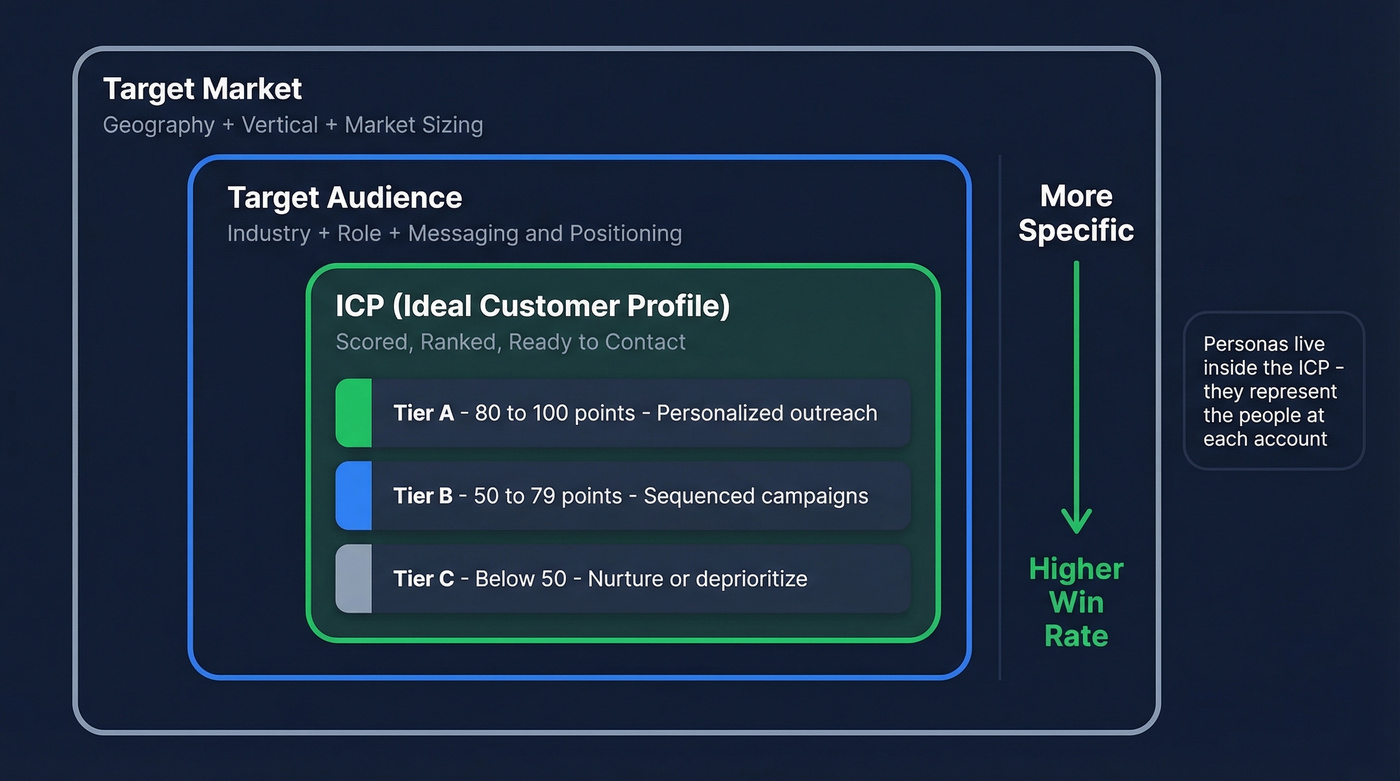
| Target Audience | Target Market | ICP | |
|---|---|---|---|
| Level | Broad segment | Addressable market | Specific account profile |
| Granularity | Industry + role | Geography + vertical | Scored multi-signal fit |
| Use case | Messaging & positioning | Market sizing & GTM | Prioritization & outreach |
Your ICP is account-level - scored, ranked, and ready to contact. Personas are individual-level within those accounts. Understanding how these layers relate is the foundation of persona targeting that B2B teams can actually operationalize.
If you need a clean way to size the market before you narrow to an ICP, start with your addressable market (TAM/SAM/SOM).

Your ICP scoring rubric maps directly to Prospeo's 30+ search filters - industry, headcount, tech stack, funding, intent signals. Filter 300M+ profiles down to Tier A accounts and get 98% accurate emails for every contact on the buying committee.
Stop scoring accounts you can't actually reach.
How to Identify Your B2B Target Audience
Start With the Problem You Solve
Don't start with features. Start with the pain. Who has the problem you fix, and what does it cost them to leave it unsolved? The companies experiencing that pain are your starting universe.
Analyze Your Best Customers
Pull 50-100 closed-won deals from the last 12 months. In our experience, 70-80% of wins share 3-5 common traits: industry, headcount range, tech stack, growth stage, or a specific trigger event. Those shared traits become your scoring criteria. One team we worked with discovered that 80% of their best accounts had raised Series B funding in the prior 18 months - a signal they'd never thought to filter on.
If you're struggling to turn those traits into a repeatable process, borrow a few sales prospecting techniques that force consistency across reps.
Score Your ICP (100-Point Rubric)
Most guides stop at "define your ICP" and leave you with a description. That's not enough. You need a scoring system, because teams that score rigorously see Tier A win rates 1.5-2x higher than Tier B, with 15-20% shorter sales cycles.
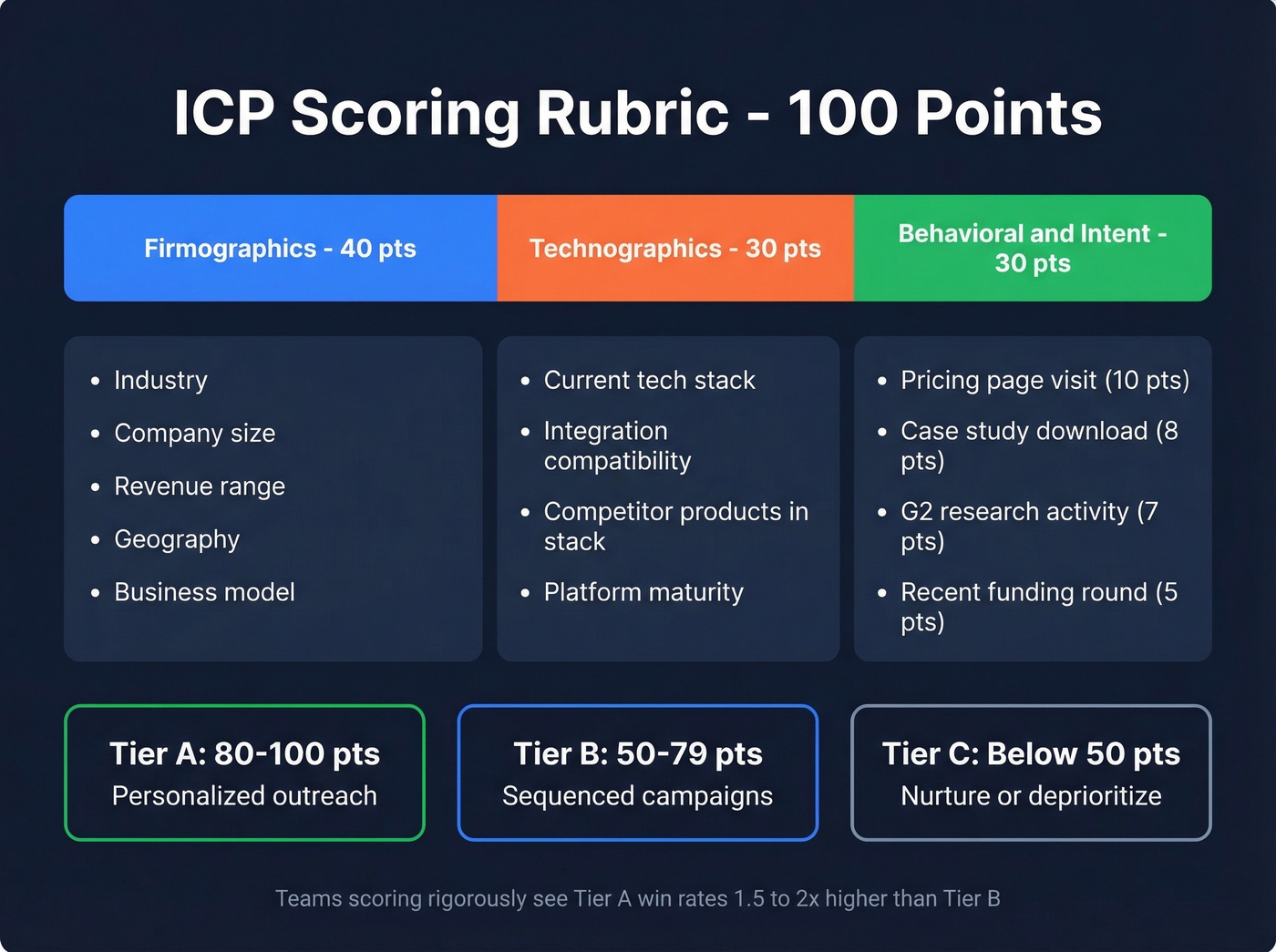
Firmographics (40 points): Industry, company size, revenue, geography, business model. These are your table stakes - the filters that eliminate 80% of the market before you spend a minute on research.
Technographics (30 points): What's in their stack? If you integrate with HubSpot and they run Salesforce, that's a different conversation. A competitor's product in their stack is a signal too.
Behavioral and intent signals (30 points): Pricing page visit = 10 points. Case study download = 8 points. G2 research activity = 7 points. Recent funding round = 5 points. When evaluating intent data, prioritize signal fidelity over volume - ask vendors about decay curves and false positive rates, not just topic counts. And use intent signals not only to score known accounts but to surface new segments showing buying behavior you hadn't targeted.
Tier your accounts: Tier A (80-100) gets personalized outreach. Tier B (50-79) gets sequenced campaigns. Tier C (below 50) gets nurture content or gets deprioritized entirely.
If you want a plug-and-play doc for this, use an Ideal Customer Profile Template and adapt the weights to your funnel.
Map the Buying Committee
[The average B2B purchase involves 13 people spanning two or more departments, and 95% of buyers now anticipate using GenAI in their evaluation process. Your targeting data needs to be precise enough to compete with AI-assisted buyers who are doing deeper research than ever.
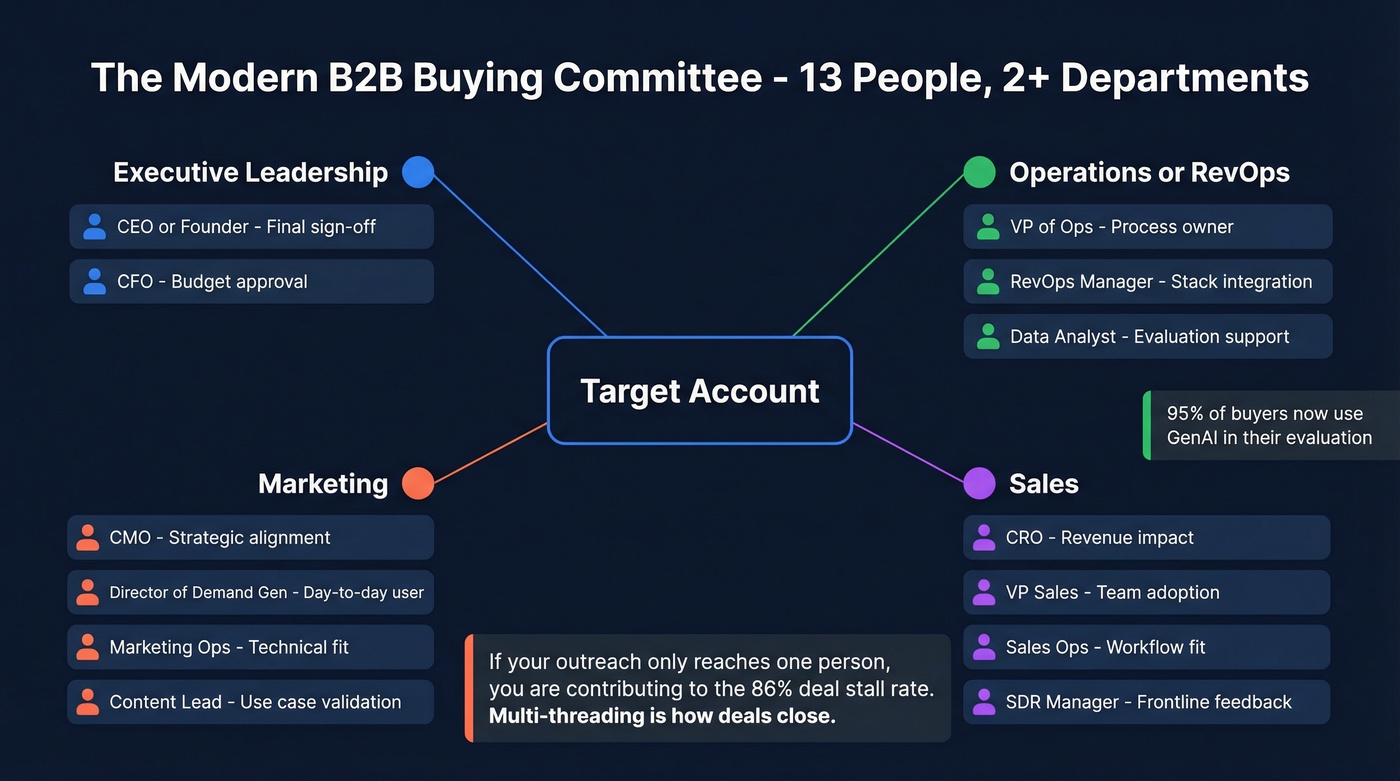
If your outreach only reaches one person at an account, you're contributing to that 86% stall rate. Multi-threading across the full buying committee isn't optional anymore - it's how deals close.
To operationalize multi-threading, many teams pair this with account-based selling best practices so outreach stays coordinated across roles.
Build Personas Sales Will Actually Use
You don't need ten. Three good ones will do. Build them from interviews with real customers and recorded sales calls - not demographic profiles invented in a conference room. "Director Dana" sticks in a sales team's head better than "Persona Segment 2B." The best B2B buyer personas capture decision-making authority, day-to-day pain points, and the internal politics that stall deals.
Persona Mistakes That Waste Budget
Applying B2C thinking to B2B. Firmographics and buying committees drive B2B purchases, not demographics like age and hobbies. Skip the "enjoys hiking on weekends" filler.
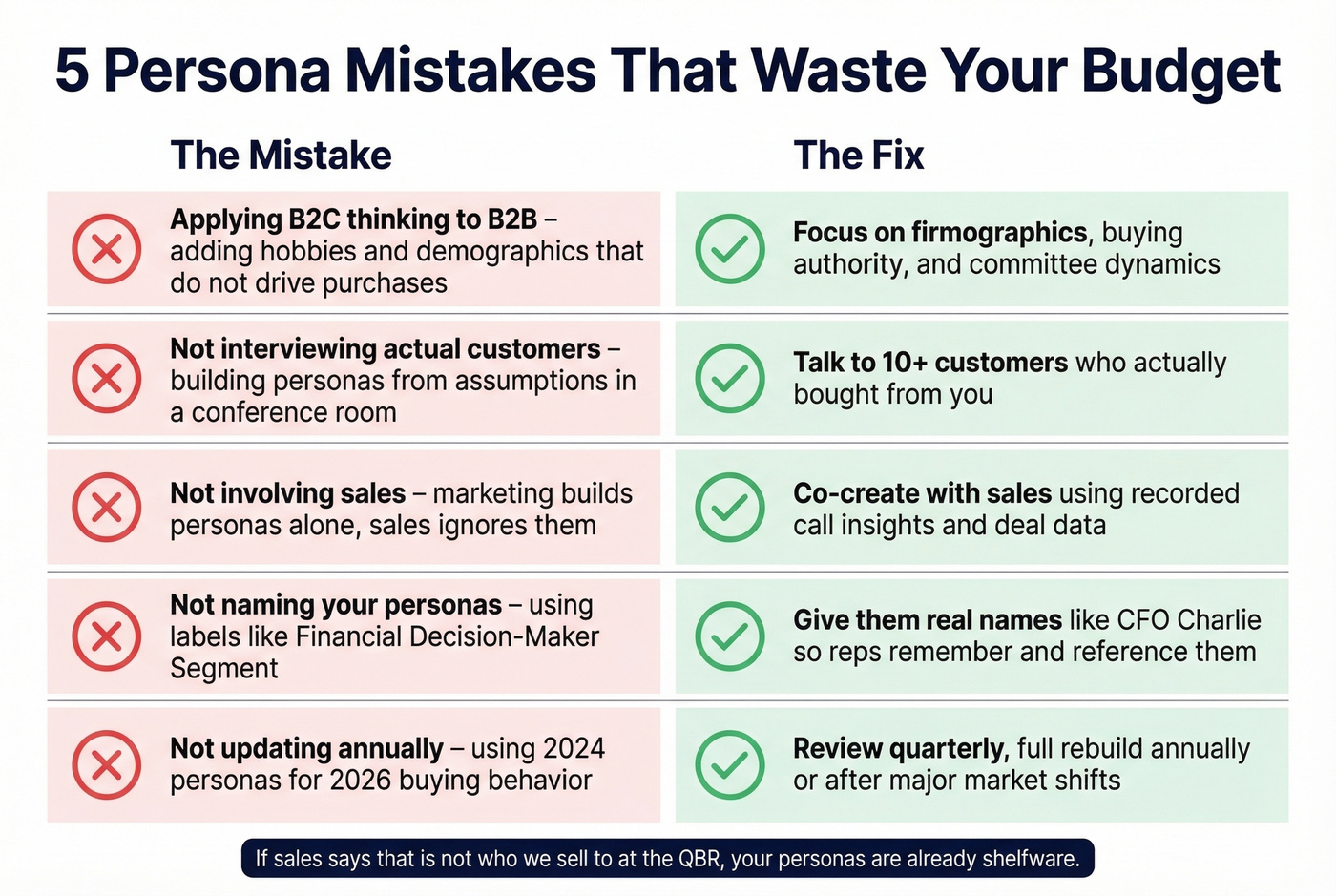
Not interviewing actual customers. If your personas aren't built on conversations with people who've bought from you, they're fiction. Full stop.
Not involving sales. We've seen this dozens of times: marketing builds personas, presents them at a QBR, and sales says "that's not who we sell to." Instant shelfware.
Not naming your personas. "CFO Charlie" gets referenced in pipeline reviews. "Financial Decision-Maker Segment" doesn't.
Not updating annually. Personas from 2024 don't reflect 2026 buying behavior. B2B audiences shift as industries consolidate, budgets tighten, and new roles emerge. If you haven't revisited your personas in over a year, they're probably steering your team toward accounts that no longer fit.
Reaching Your B2B Target Audience
This is where most targeting work dies.
You've scored your ICP, built personas, and know exactly who you want to reach. Then you pull a list from a stale database, a big chunk of the emails bounce, and your domain reputation tanks. We've watched this happen to teams that did everything else right - and it's genuinely frustrating, because the hard strategic work was already done.
If you're seeing bounces climb, fix the root cause with an email deliverability guide and track your email bounce rate like a core revenue metric.
Let's be honest: if your average deal size is under $10k, you probably don't need a $50k intent data platform. You need accurate contact data for the accounts you've already identified. Many intent data platforms start around $25k/year, and enterprise platforms often run $50k+. Prospeo starts free - 75 verified emails per month, 143M+ verified emails in the database, 98% accuracy, and a 7-day data refresh cycle versus the six-week industry average.
If you're evaluating vendors, compare options in our roundup of data enrichment services or go deeper on sales prospecting databases.

Multi-threading a 13-person buying committee means nothing if half your emails bounce. Prospeo's 5-step verification and 7-day data refresh keep contact data current - so your targeting strategy actually converts to pipeline, not domain damage.
Reach the full buying committee with data that's never more than a week old.
Benchmarks that signal good targeting: Average B2B website conversion sits around 1.8%, but targeted traffic pushes that to 3-5%. Companies running ABM programs are 60% more likely to hit revenue goals. If your conversion rates are below these numbers, your targeting - not your content - is the bottleneck.
FAQ
What's the difference between a B2B target audience and an ICP?
Your target audience is the broad segment you market to - defined by industry, company size, and role. Your ICP is a scored, account-level profile identifying which specific companies are the best fit. Think of it as a prioritized subset you can action immediately rather than a general direction.
How many buyer personas should a B2B company have?
Three to five. More than five usually means you haven't prioritized. Each persona should map to a distinct role in the buying committee so your messaging covers the full decision-making group without redundancy.
How often should you update your B2B audience targeting?
Review quarterly by comparing win rates across ICP tiers. Do a full rebuild annually, or whenever your product positioning or market shifts significantly.
What's the fastest way to find contacts for your B2B target audience?
Use a verified database with ICP-aligned filters instead of scraping or guessing email formats. Look for platforms that cover firmographic, technographic, and intent filters in a single search - with high email accuracy and frequent data refreshes so you're not burning your sender reputation on stale records.