

Buying Group Data: What It Is, Why It Matters, and How to Use It
Your SDR just booked a meeting with a VP of Engineering. The deal looks promising - until it stalls because nobody engaged the CFO, the procurement lead, or the security architect who quietly vetoed the shortlist. That's the buying group data problem, and it kills more pipeline than bad data or weak messaging combined.
What You Need (Quick Version)
Buying group data maps every stakeholder involved in a B2B purchase - not just the one person who filled out your form. The average deal now involves 13 internal stakeholders and 9 external participants.
What Is Buying Group Data?
Three terms get thrown around interchangeably, and they shouldn't be. Lead data is one person - a name, email, maybe a title. Account data is one company - firmographics, technographics, revenue. Buying group data is the specific cluster of people at that company who are actively involved in this purchase decision.
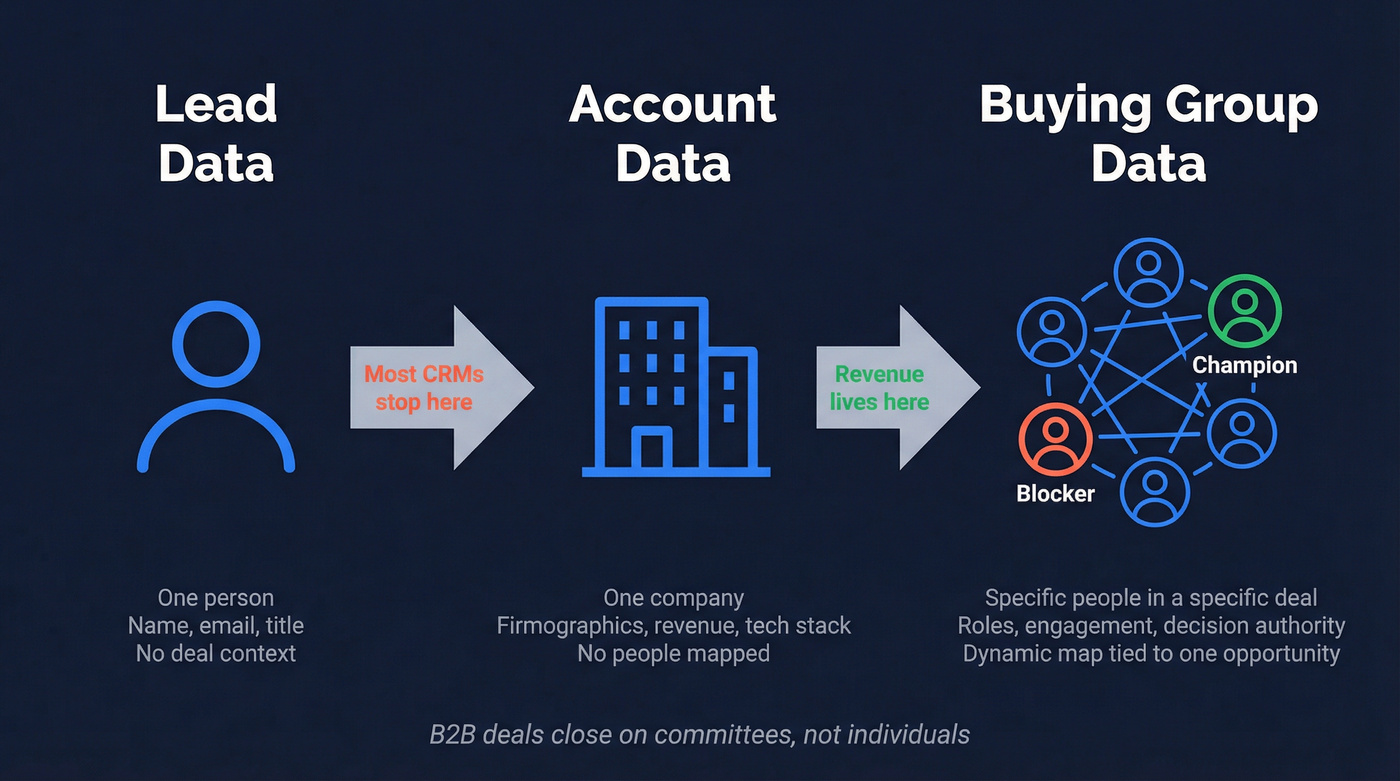
That distinction matters because B2B deals don't close on a single thread. The person who downloads your whitepaper isn't the person who signs the contract. This intelligence connects those dots: it tells you who's researching, who's evaluating, who holds budget authority, and who can kill the deal from the security or procurement side.
Most CRMs aren't built for this. They track leads and accounts. Buying group data sits in between - a dynamic map of roles, engagement signals, and decision authority tied to a specific opportunity. Without it, you're selling to individuals and hoping the deal committee sorts itself out.
Why Buying Groups Matter in 2026
The complexity of B2B buying has escalated dramatically. Forrester's 2026 research puts the average purchase at 13 internal stakeholders plus 9 external participants, and purchases that include AI features can double the number of stakeholders involved as security, data governance, and AI ethics reviewers pile onto the committee.
Buyers have shifted from FOMO to FOMU - fear of messing up. 49% say financial pressure shortened their buying cycles, and 81% are unhappy with at least one part of their experience with go-to vendors. GenAI is making this worse in unexpected ways: while 36% of buyers feel more confident using AI for research, 20% feel less confident because AI-generated information is unreliable. The buying committee is expanding and confused at the same time.
Here's the stat that should keep every GTM leader up at night: 94% of buying groups rank their preferred vendors before first contact, and they purchase from that preliminary favorite 77% of the time. If you're not engaging the full committee early - while they're still forming opinions - you're showing up to a race that's already been run.
Selling to one champion and hoping they'll evangelize internally is a strategy from 2018. If your average deal size is above $25K and you're not mapping buying groups, you're leaving deals on the table that no amount of better messaging will recover.
Buying Group Size & Composition
Regional benchmarks from 6sense's research show meaningful variation:
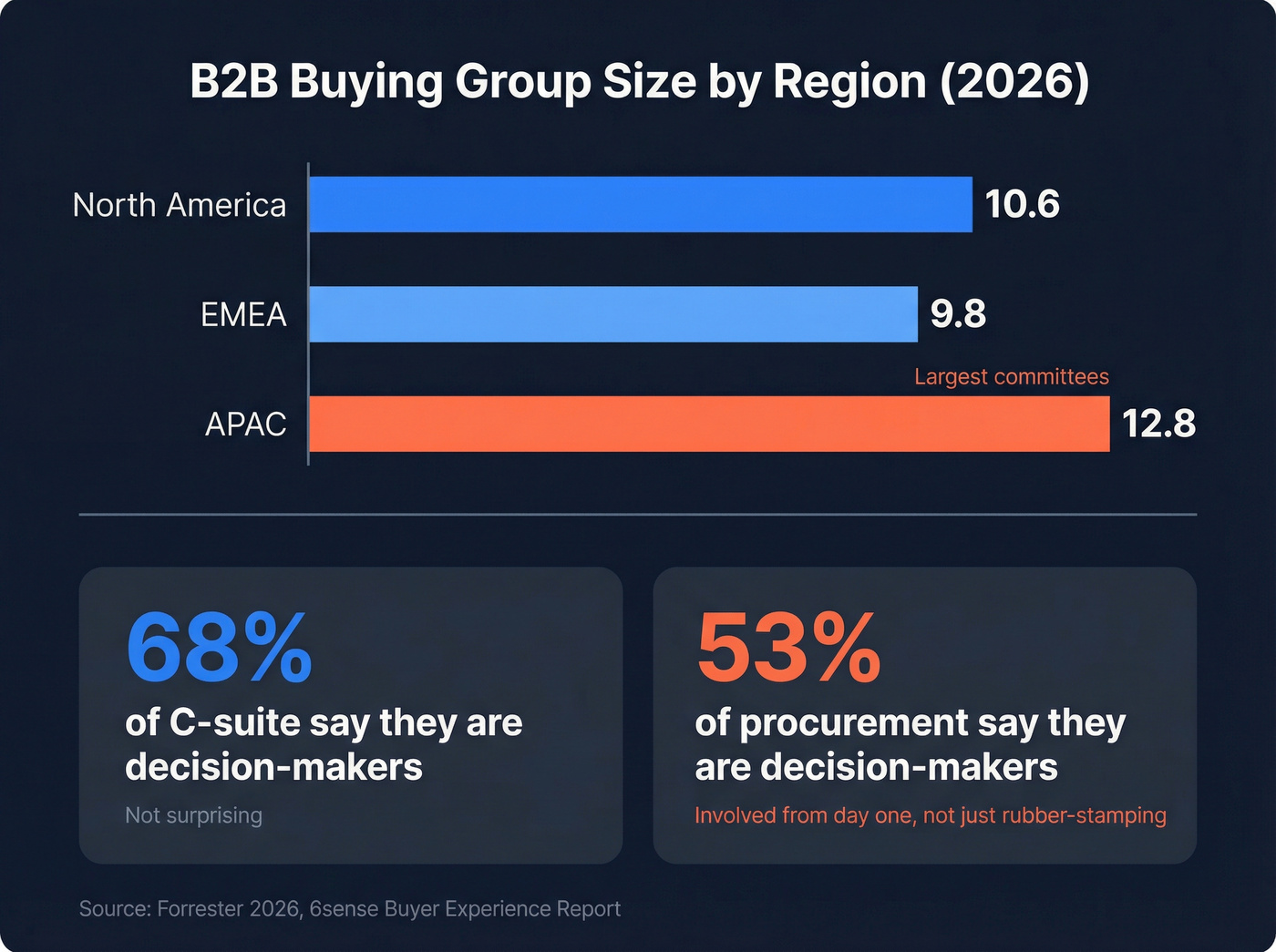
| Region | Avg. Group Size |
|---|---|
| North America | 10.6 |
| EMEA | 9.8 |
| APAC | 12.8 |
Who's actually making decisions? C-suite executives identify as decision-makers 68% of the time, which isn't surprising. What is surprising: procurement identifies as decision-makers 53% of the time, and they're involved from the earliest stages - not just rubber-stamping at the end.
Forrester now frames these as "buying networks" rather than buying groups, because influence extends beyond the org chart to external consultants, peer advocates, and AI tools that buyers use for preliminary research. The practical implication: you need to map influence, not just titles.
Buying cycles have compressed too. 6sense's 2026 Buyer Experience Report shows cycles dropped from 11.3 months to 10.1 months, with first contact shifting from 69% of the journey to 61%. Shorter cycles with more stakeholders means less time to identify and engage each member. The window is shrinking fast.

You just identified 13 stakeholders in a deal. Now you need verified contact data for every one of them. Prospeo gives you 98% accurate emails and 125M+ verified mobile numbers - filtered by job title, department, seniority, and buyer intent across 15,000 topics.
Stop selling to one champion. Reach the entire buying committee.
Types of Stakeholder Intelligence
Not all buying group data is created equal. Four categories matter, and conflating them is how teams end up paying for the wrong tools.
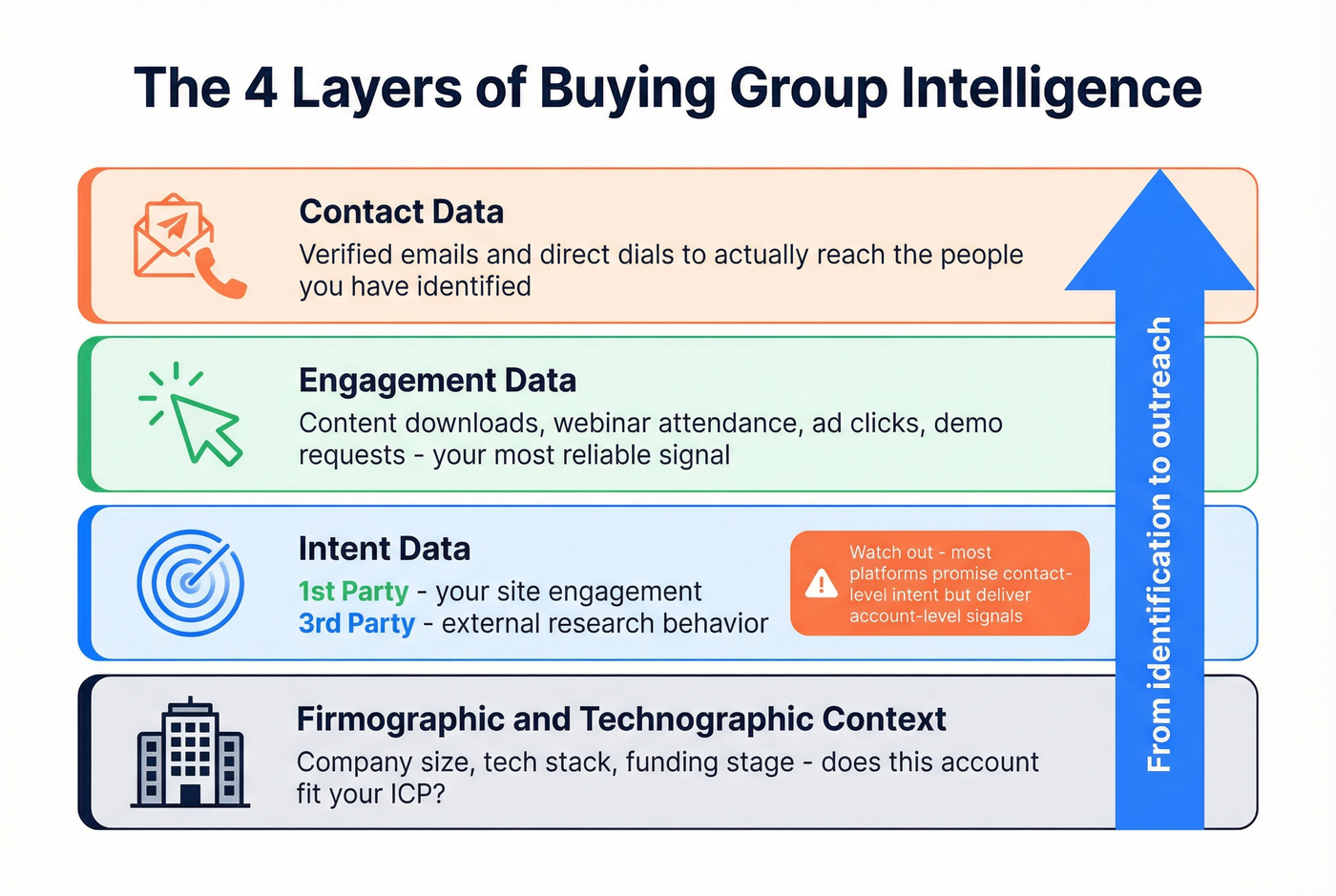
Intent data comes in two flavors: first-party (your website and content engagement) and third-party (research behavior across external sites). Most teams pay for account-level intent and call it buying group intelligence. It's not. Account-level intent tells you someone at Acme Corp is researching your category. Contact-level intent tells you which specific person clicked, downloaded, or engaged. That distinction - clearly articulated by Influ2 - is the difference between knowing an account is in-market and knowing which committee members are active.
Let's be honest: RevOps practitioners consistently complain that platforms promise contact-level intent but deliver account-level signals. Make sure you know which you're getting before signing a contract.
Contact data bridges identification and outreach. You've identified that five people at an account are involved in a purchase decision - now you need verified emails and direct dials to actually reach them. (If you're building a stack, compare sales prospecting platforms and validate with an email checker tool.)
Engagement data tracks what your buying group members do: content downloads, webinar attendance, ad clicks, demo requests. This is your first-party signal source, and it's the most reliable indicator of committee formation.
Firmographic and technographic context rounds out the picture - company size, tech stack, funding stage, and growth signals that tell you whether this account fits your ICP in the first place. If you need a deeper framework, start with firmographic and technographic data.
How to Collect It
Here's a practical framework: third-party intent finds accounts, first-party intent builds buying groups. Third-party signals from providers like Bombora, which tracks behavior across 5,000+ B2B websites and 12,000+ topics, tell you which accounts are researching your category. But they rarely tell you which people are involved.
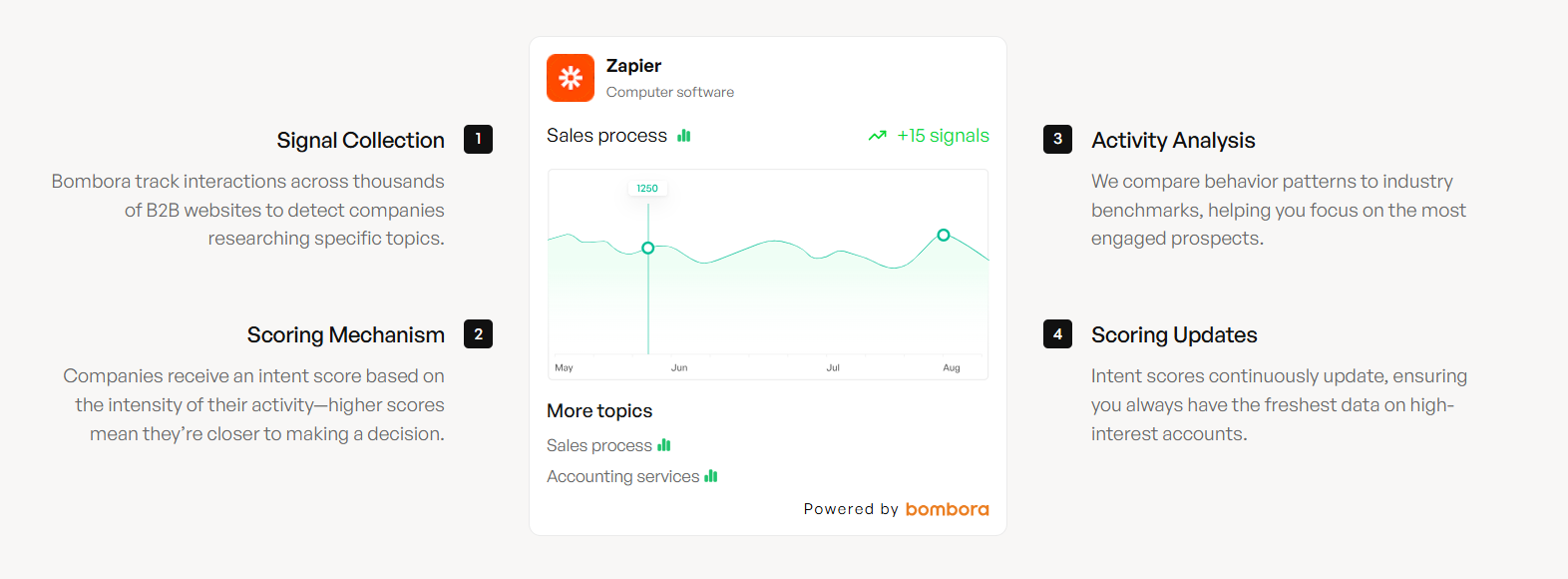
First-party signals fill that gap. When multiple stakeholders from the same org visit your pricing page, integrations docs, and a webinar recording within the same week, that's a buying committee forming in real time. Different content themes map to different roles - the person reading your security whitepaper isn't the same person checking your API docs. These engagement patterns help you detect groups as they form, not after they've already made a decision.
Treat anonymous first-party intent as signal, not noise. Repeat sessions, pricing page clusters, and integration page visits from the same IP range are early indicators. Progressive identification works better than hard form fills here - a lightly gated ROI calculator captures contact info without the friction that deters modern buyers, and 60%+ of buyers now engage in some form of trial before committing. To make this measurable, align on intent signals and how to measure intent data.
How to Operationalize It
Collecting buying group data is the easy part. Making it drive revenue requires CRM discipline. We've seen teams waste months evaluating enterprise platforms when a CRM workflow plus verified contacts would've gotten them 80% of the way there.
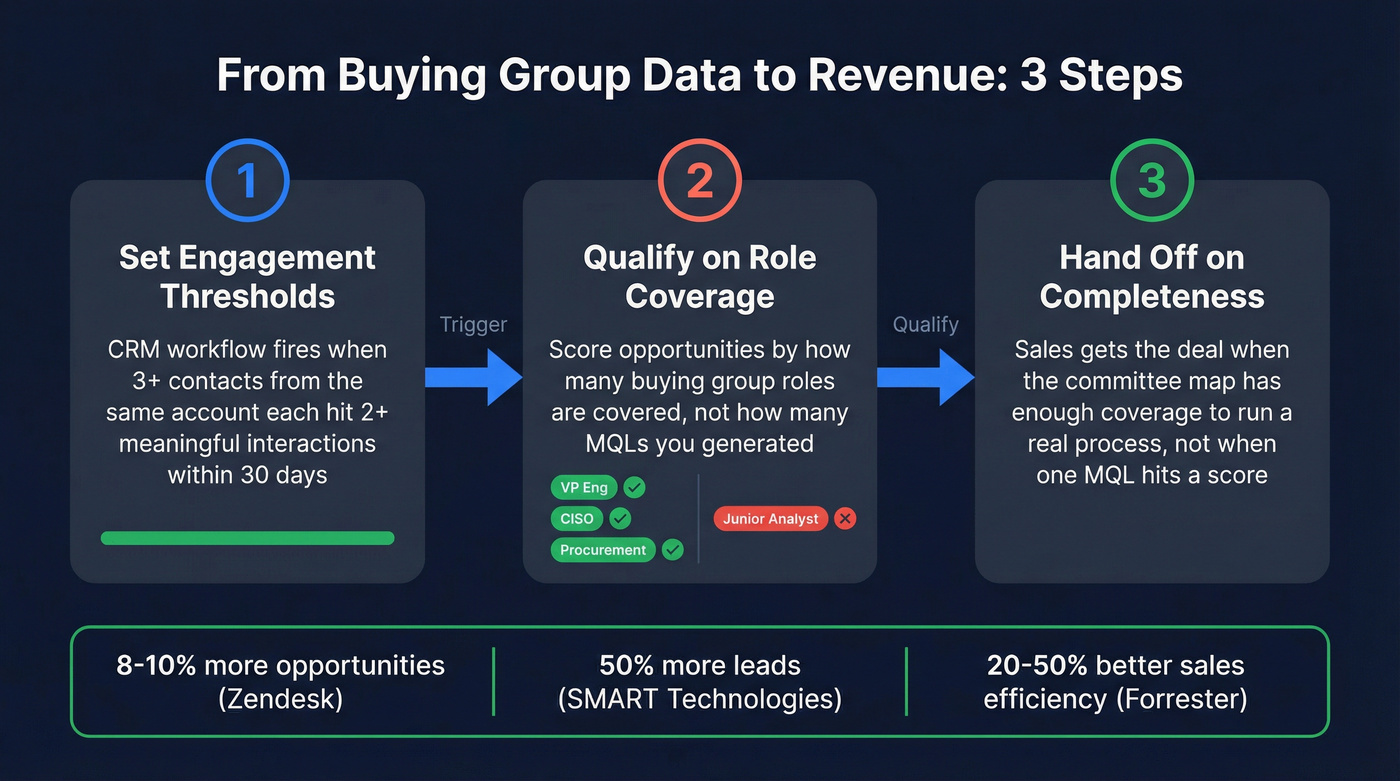
Set engagement thresholds. Build CRM workflow triggers that fire when multiple contacts from the same account cross an engagement threshold - say, three stakeholders each with two or more meaningful interactions within 30 days. This is easiest to maintain with strong CRM hygiene.
Qualify on role coverage, not lead scores. An opportunity with the VP of Engineering, the CISO, and a procurement lead engaged is fundamentally different from one where only a junior analyst downloaded a PDF. Score opportunities based on how many buying group roles are covered, not how many MQLs you've generated. If you want a scoring blueprint, use ABM lead scoring.
Hand off based on completeness. Sales should receive opportunities when the committee map has enough coverage to run a real deal process - not when a single MQL hits a threshold. This is where account qualification keeps teams honest.
The results are real. Zendesk reported an 8-10% increase in opportunity creation after implementing a buying group-focused approach. SMART Technologies saw a 50% increase in lead volume, 35% higher lead acceptance rates, and 48% year-over-year growth using a similar model. Forrester's "Return on Integration" outcomes for high-performing brands include 10-20% more opportunities from existing customers and 20-50% improvements in sales efficiency when they operationalize this intelligence.
Tools for Buying Group Data
| Tool | Focus | Best For | ~Annual Cost |
|---|---|---|---|
| Prospeo | Contact data + verification + intent | Verified outreach at scale | ~$0.01/email |
| Demandbase | Full ABM platform | Enterprise ABM | $40K-$100K+ |
| 6sense | ABM + buyer intel | Predictive analytics | $50K-$120K+ |
| Bombora | Intent data | Signal sourcing | $25K-$60K |
| Intentsify | Persona-level intent | Granular targeting | $30K-$80K |
| LeanData | Routing & ops | Lead-to-account matching | $30K-$80K |
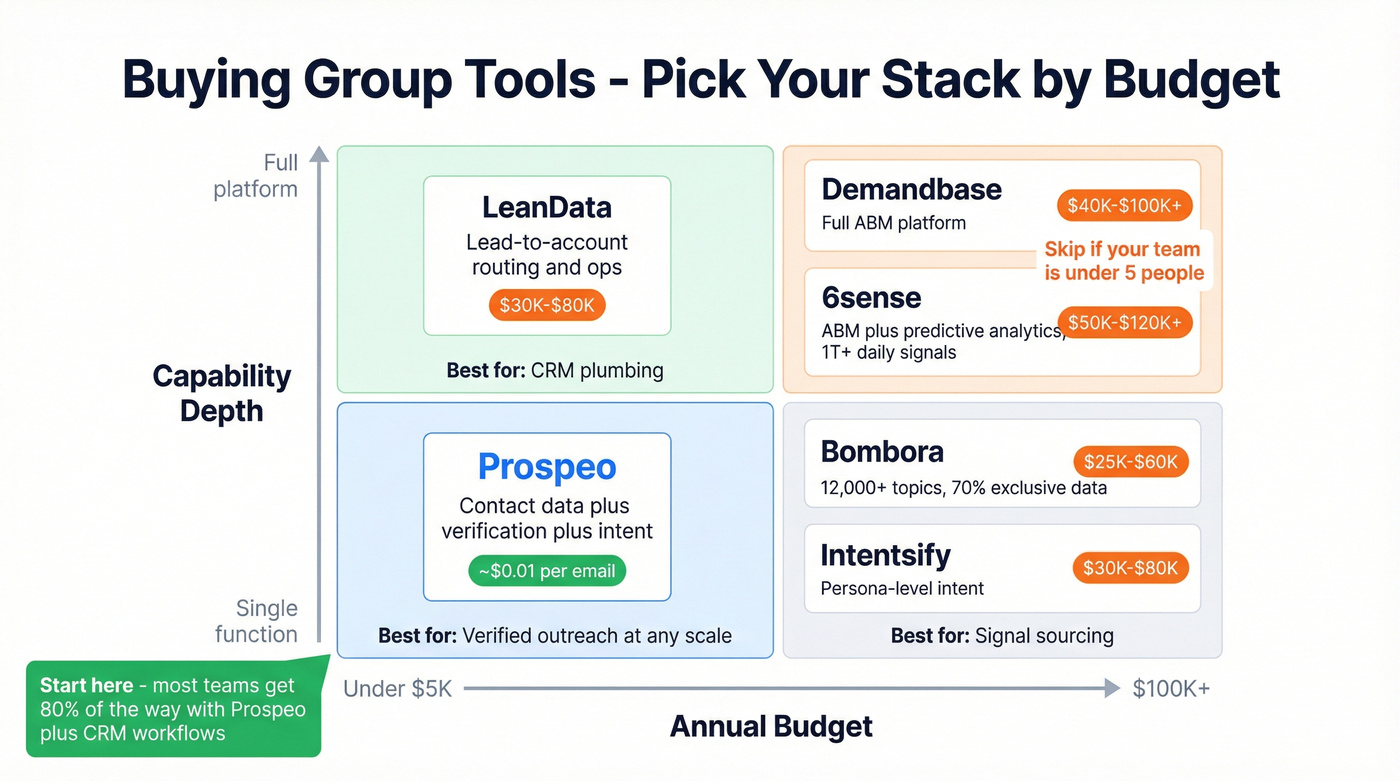
Demandbase and 6sense are the heavyweights. They automate buying group identification, score accounts, and orchestrate multi-channel plays. If you're running enterprise ABM with a dedicated ops team and six-figure budget, they're the right tools. 6sense processes over a trillion signals daily and their buyer identification benchmarks are the industry standard. Skip these if you're a team of five with a $20K annual tools budget - you'll spend more time configuring than selling.

Bombora sits underneath many of these platforms as the intent data source - 12,000+ topics, 70% exclusive data. Intentsify differentiates by offering persona-level intent rather than just account-level signals, which gets closer to actual buying group identification.
Reaching the Buying Team Without a $50K Platform
You don't need an enterprise platform to run a buying group motion. The strategy works at any budget with three building blocks.
First, use first-party intent signals to spot committee formation - multiple stakeholders from the same account engaging with your content is your trigger. Second, use a contact data tool to find verified emails and direct dials for each stakeholder you've identified. Third, build CRM workflows to track role coverage per opportunity and trigger sales handoffs when enough of the buying group is engaged. If you want the playbook behind this, start with account-based prospecting and signal-based outbound.
Look, every buying group vendor hides pricing and forces you through a sales process. The irony isn't lost on anyone in the r/sales community. Start with a self-serve tool's free tier, test it on your top five accounts, and prove the model before committing to a six-figure contract.

Buying cycles dropped to 10.1 months and 94% of groups pick their vendor before first contact. You can't afford stale data. Prospeo refreshes every 7 days - not 6 weeks - so you reach committee members while they're still forming opinions, not after they've already decided.
Engage buying groups before the race is already run.
FAQ
How many people are in a typical B2B buying group?
Forrester's 2026 research puts it at 13 internal stakeholders and 9 external participants on average. Regional variation matters: 10.6 in North America, 9.8 in EMEA, and 12.8 in APAC. AI-related purchases can double these numbers.
What's the difference between buying group data and intent data?
Intent data tells you an account is researching a topic; buying group data combines intent with contact-level information, engagement patterns, and role mapping to identify the specific people involved. Intent alone shows where to look - committee-level intelligence tells you who to talk to and what role they play.
Can I build buying group intelligence without an enterprise platform?
Yes. Combine first-party intent signals with a verified contact tool to identify and reach committee members. Enterprise platforms automate this, but CRM workflows plus accurate contact data get you 80% of the value. Start by mapping roles on your top five accounts and work outward from there.
How does buying group research differ from standard account research?
Standard account research focuses on firmographics - revenue, industry, tech stack. Buying group research identifies individual stakeholders in a specific purchase, maps their roles and influence, and tracks engagement over time. The goal is understanding the decision-making structure, not just the company profile.