

"By Way of Introduction" Email - Professional Opener or Recruiter Cliche?
You're staring at a blank compose window. New job, day one, and you need to email 30 people you've never met. Your cursor blinks after "Hi everyone," and your brain offers up: By way of introduction, I'm... Something about it feels off. You're not alone - the phrase shows up constantly in recruiter outreach, and on Reddit people describe it as something that "sounds so wrong." Here's when a by way of introduction email works, when it doesn't, and what to say instead.
The Short Answer
"By way of introduction" is grammatically correct but sounds stiff and recruiter-y to most people outside law and government. Skip it in 90% of situations. Use a direct self-identification opener or a context-first line instead. The rest of this article gives you the alternatives, the templates, and the one step most people forget before hitting send.
What the Phrase Actually Means
The phrase is standard formal English, equivalent to "as an introduction" or "for the purpose of introducing." You'll sometimes see the variant "by the way of introduction" in older correspondence, though "by way of" is the more common and accepted form today. It's rooted in the same construction as "by way of explanation" or "by way of apology." Grammatically, there's nothing wrong with it.
The problem isn't grammar - it's tone. In law, diplomacy, and government correspondence, it reads as appropriately formal. In tech, startups, and most modern business contexts, it's old-fashioned and overly formal. It registers as impersonal, stiff, and lacking warmth. The gap between correct and effective is where most people trip up.
Should You Use It?
The best introduction email doesn't "introduce" at all - it gives the reader a reason to care. But if you're deciding whether this specific phrase fits your situation, here's a quick framework.
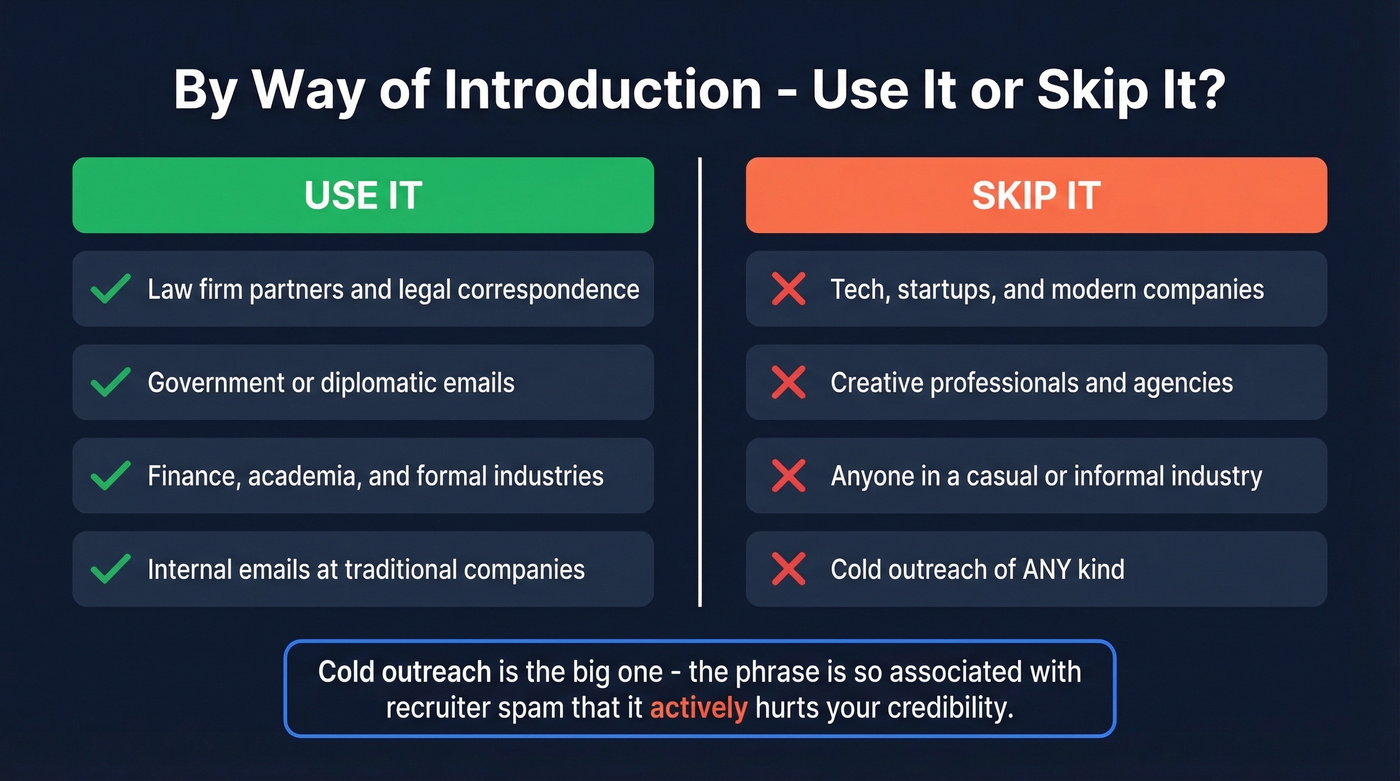
| Use it when... | Skip it when... |
|---|---|
| Emailing law firm partners | Emailing tech/startup contacts |
| Government or diplomatic contexts | Creative professionals |
| Formal industries (finance, academia) | Anyone in a casual industry |
| Internal correspondence at traditional firms | Cold outreach of any kind |
That last row matters most. The phrase's heavy association with recruiter and sales spam means using it in cold outreach actively hurts your credibility. If someone's seen it in 15 recruiter messages this month, yours won't feel personal - it'll feel templated. Swapping in "by means of introduction" doesn't fix the underlying problem either; one formal phrase for another still reads the same way.
If you're doing any kind of cold outreach, the opener matters less than relevance and deliverability.

A perfect introduction email means nothing if it bounces. Prospeo gives you 98% verified email accuracy across 300M+ professional profiles - so your carefully crafted opener actually reaches the inbox. At $0.01 per email, bad data stops being the reason your outreach fails.
Stop perfecting emails that never arrive. Verify the address first.
Better Alternatives by Formality
You don't need 35 ways to say the same thing. You need three or four that match your tone.
| Phrase | Formality | Best For |
|---|---|---|
| Allow me to introduce myself | High | Legal, executive, diplomatic |
| I'd like to introduce [Name] | High | Third-party intros, formal |
| A quick introduction | Medium | New team, new client |
| I'm reaching out because... | Medium | Cold outreach, networking |
| [Mutual contact] suggested I reach out | Medium | Warm referrals |
| Just a quick hello | Low | Internal, casual industries |
| Wanted to connect about [topic] | Low | Peer-level networking |
| Hi - I'm [Name], [role] at [Company] | Low | Almost any context |
The last one is underrated. A direct self-identification line - no preamble, no throat-clearing - works in nearly every professional scenario. In our experience, it outperforms every other opener on this list because it respects the reader's time and gets to the point.
If you want more examples beyond openers, use these company introduction email examples as a starting point.
How to Write One That Gets Replies
Structure matters more than any single phrase. Here's the framework that consistently performs: Subject line -> Opening line -> Who you are (one sentence) -> Why you're emailing -> Specific ask -> Sign-off.
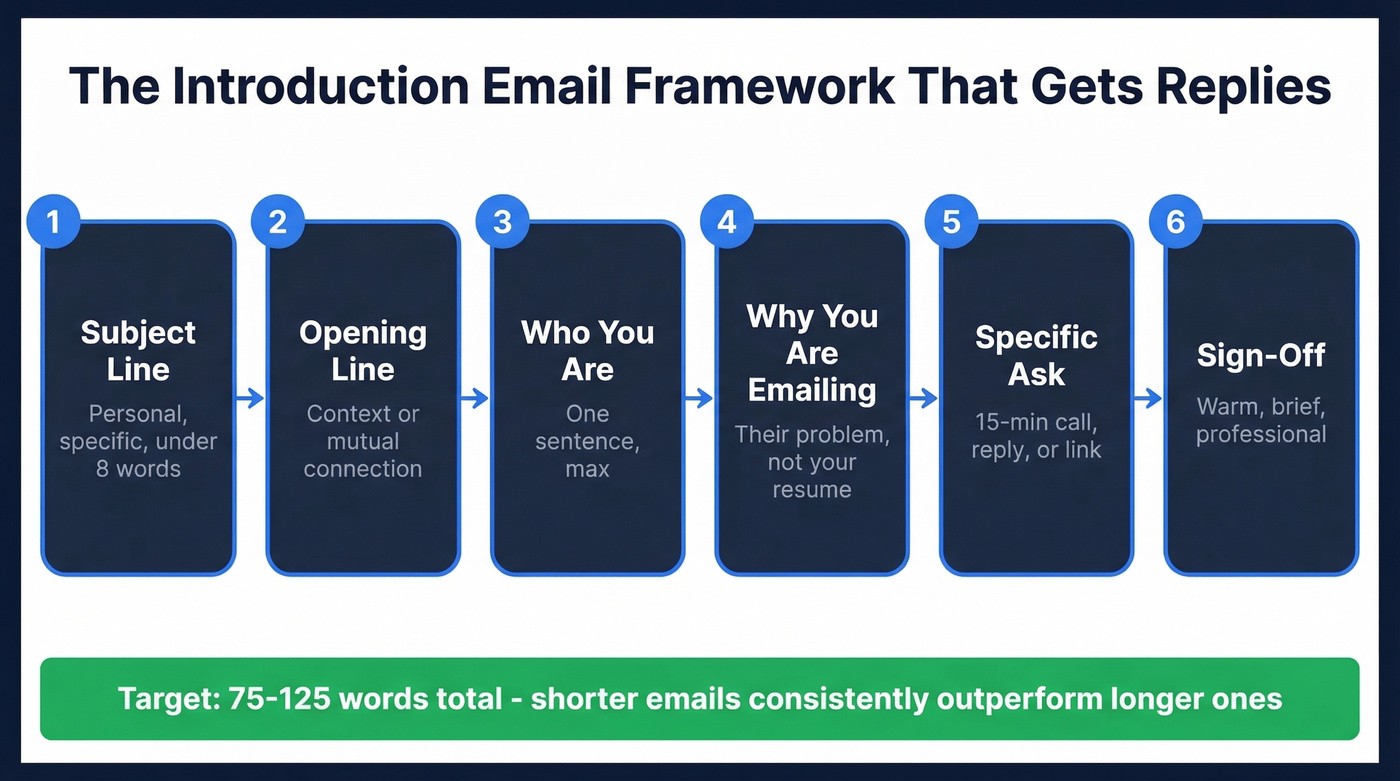
Let's break down the pieces that affect reply rates.
Subject Line Is Everything
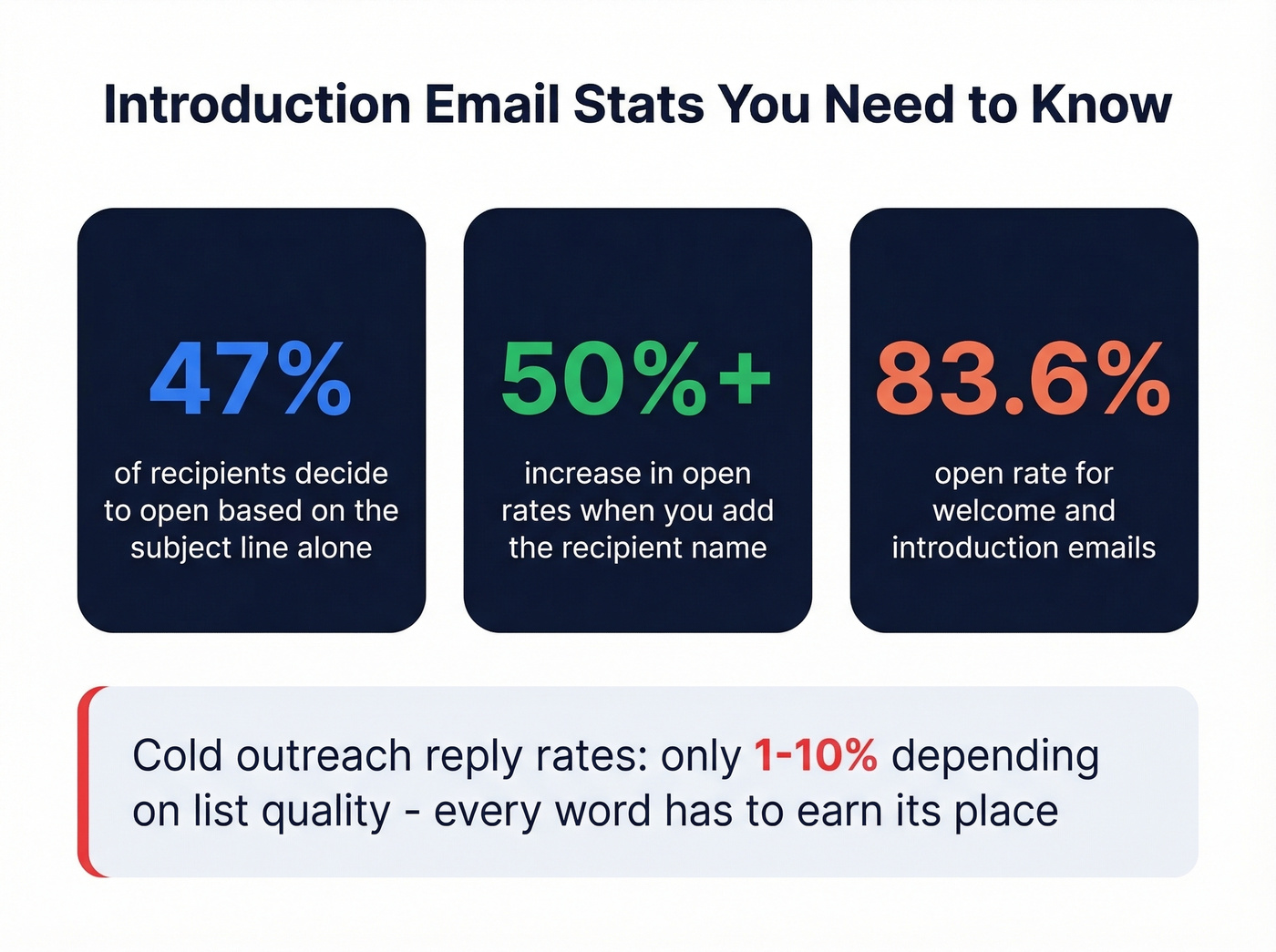
47% of recipients decide to open based on the subject line alone. Adding the recipient's name can increase open rates by at least 50%. Keep it short and lead with relevance, not cleverness. "Introduction" by itself is too vague - "[Name], quick intro from [Your Company]" is better.
If you need inspiration, pull from these email subject line examples and adapt them to your context.
Length Matters More Than You Think
Aim for 75-125 words total. Introduction emails that run longer get skimmed or ignored. Your goal isn't to tell your life story - it's to earn a reply.
Welcome emails hit 83.63% open rates according to GetResponse's benchmarks, while the average across all industries sits around 42% per MailerLite's 2025 data. You've got attention. Don't waste it with a wall of text. Cold outreach reply rates land between 1-10% depending on list quality, so every word has to earn its place.
If you're building a sequence, pair the intro with proven sales follow-up templates so you don't lose momentum after the first send.
Here's the thing: if your introduction email is longer than 125 words, you're not introducing yourself - you're monologuing. Cut it in half and watch your reply rate climb.
Introduction Email Templates
New Team Introduction
Subject: Hi from [Your Name] - just joined [Team]
Hi everyone - I'm [Name], the new [Role] on [Team]. Before this, I spent [X years] at [Company] doing [one-line summary]. I'm excited to dig in and looking forward to working with all of you. Feel free to grab time on my calendar if you want to connect.
Short, warm, and gives colleagues just enough context without overwhelming them.
Cold Outreach to a Prospect
Subject: [Name], quick question about [specific challenge]
Hi [Name] - I'm [Your Name], [Role] at [Company]. We help [type of company] solve [specific problem], and I noticed [relevant observation about their business]. Would a 15-minute call next week make sense to see if there's a fit?
This leads with the recipient's problem, not your credentials. The specific observation proves you did your homework. Notice there's no "by way of this email I would like to introduce" - the directness is the introduction.
If you're sending this at scale, make sure your B2B cold email sequence is built to earn replies, not just opens.
Warm Referral Follow-Up
Subject: [Mutual Contact] suggested we connect
Hi [Name] - [Mutual Contact] mentioned you're working on [topic] and thought we should talk. I lead [function] at [Company], and we've helped similar teams with [specific outcome]. Would you be open to a quick call this week?
The "CC'd Previously" Scenario
More common than people expect: the awkward moment when you've been silently CC'd on threads with someone for weeks.
Subject: Putting a name to the CC line
Hi [Name] - we've been CC'd on a few threads together, but I wanted to introduce myself directly. I'm [Name], [Role] at [Company], and I'll be your main point of contact for [project/account] going forward. Happy to jump on a quick call to align, or feel free to loop me in directly on anything you need.
Post-Event Introduction
Subject: Good meeting you at [Event]
Hi [Name] - we spoke briefly at [Event] about [topic]. I'm [Name], [Role] at [Company]. I'd love to continue that conversation - are you free for 20 minutes next week?
Short, specific, and anchored to a real interaction. No need to re-explain who you are - the event does that work for you.
Introducing Two People (Double Opt-In)
The double opt-in approach is the only respectful way to introduce two people. Confirm there's a real reason for the intro, get permission from both parties, and normalize opting out. Single opt-in intros create social pressure nobody asked for - the consensus on r/sales is pretty clear on this one.
Subject: Intro - [Name A] <> [Name B]
[Name A] and [Name B] - I asked you both beforehand, so connecting you here. [Name A] is [role/context]. [Name B] is [role/context]. I think you'd benefit from a conversation about [specific reason]. Totally fine if the timing doesn't work - no pressure either way.
Mistakes That Kill Introduction Emails
Being vague about why you're emailing. "Just wanted to reach out" tells the reader nothing. Every introduction email needs a clear reason in the first two sentences.
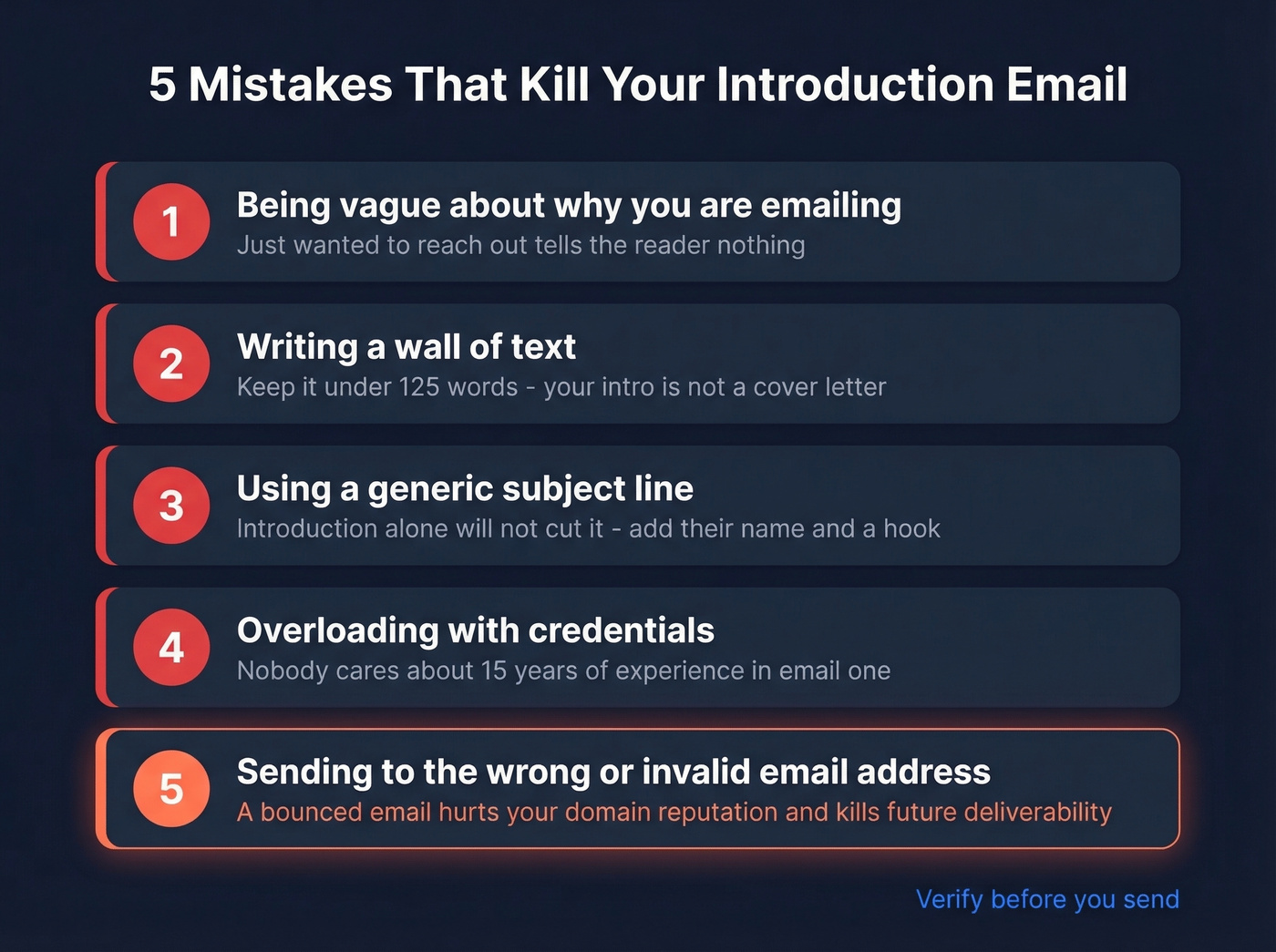
Writing a wall of text. Keep it under 125 words. Your introduction email isn't a cover letter. Lead with relevance, not your resume. We've tested this across outbound campaigns - shorter emails consistently outperform longer ones.
Using a generic subject line. "Introduction" or "Quick hello" won't cut it. Include the recipient's name and a specific hook.
Overloading with credentials. Nobody cares about your 15 years of experience in the first email. They care about what's in it for them. One sentence of background, max.
Sending to the wrong or invalid email address. This is the mistake nobody talks about, and it's the most damaging. A bounced email doesn't just fail to reach someone - it hurts your domain reputation and makes future emails more likely to land in spam. Before you send any introduction email, especially a cold one, verify the address. Prospeo's Email Finder checks addresses in real time with 98% accuracy, so your carefully crafted intro actually reaches a human instead of bouncing into the void.
If you're seeing bounces, start with email bounce rate basics, then work through a full email deliverability guide to fix the root cause.

Cold outreach reply rates depend on list quality more than any opening line. Prospeo's 30+ search filters let you find the exact decision-makers worth introducing yourself to - with verified emails refreshed every 7 days, not 6 weeks.
Write fewer introduction emails. Send them to the right people.
FAQ
Is "by way of introduction" grammatically correct?
Yes, it's standard formal English - perfectly grammatical. The variant "by the way of introduction" is also accepted, though most style guides prefer dropping the extra "the." But grammatically correct doesn't mean effective. In most professional contexts outside law and government, simpler openers like "I'm reaching out because..." get more replies.
What's the best subject line for a self-introduction email?
Include the recipient's name and a specific reason for the email. "[Name], quick intro from [Your Company]" outperforms vague lines like "Introduction" because it's personal and signals what's inside. Personalized subject lines lift open rates by at least 50%.
How long should an introduction email be?
75-125 words. Anything longer gets skimmed or ignored. Lead with why you're emailing and what's relevant to the reader, not your background. The introduction emails that actually get replies are almost always under 100 words.
How do I verify an email address before sending?
Use a real-time verification tool before hitting send. Bounced emails damage your sender reputation and push future messages toward spam. Prospeo's free tier covers 75 email verifications per month - enough to validate any introduction list without paying a cent.
What's a double opt-in introduction?
It's an email introduction where you get permission from both parties before connecting them. You confirm there's a real reason for the intro, ask each person separately, and make it easy to say no. It's the only respectful way to connect two people - single opt-in intros create awkward social pressure nobody asked for.