


Bytemine Pricing Explained: What You Actually Pay Per Contact
You're staring at Bytemine's homepage and the number looks clean: $50/month for 1,000 credits. That's roughly $0.05 per credit - cheap by any standard. But credit-based pricing is only simple until you start burning through credits faster than expected, and suddenly that tidy number on the pricing page doesn't match your invoice. Let's break down Bytemine pricing, credit mechanics, and how costs stack up against the rest of the market.
Quick clarification: Bytemine.io is an algorithmic trading platform based in London. Bytemine.ai is the B2B contact data tool. This article covers Bytemine.ai.
Quick verdict: Bytemine starts at $50/month for 1,000 credits with unlimited users and a free plan. The vendor frames costs at roughly $0.05 down to $0.02 per record at higher volumes. The catch? Credit burn mechanics aren't transparent, and independent benchmarks don't exist yet - as of mid-2026, there's no G2 profile and no relevant Reddit threads we could find. Test the free plan before committing.
Plans and Credit Tiers
Bytemine runs a credit-based model. The entry point is $50/month for 1,000 credits, with per-record costs dropping to roughly $0.02 at higher volumes. Annual billing comes in around $480/year.
Unlimited user seats on paid plans is a genuine advantage over per-seat tools like Apollo or Lusha, where costs multiply with headcount. Bytemine also claims coverage of 80M US mobile numbers and 160M emails. The free plan requires no credit card, and contact profiles include 50+ data attributes - mobile numbers, work and personal emails, social links, job titles, company details, industry, revenue, location, and technologies used. The platform integrates with Clay, Apollo, and HighLevel, and it's also listed on Datarade for teams that want to evaluate a dataset through a marketplace workflow.
Use this if: You need bulk contact data with rich attributes and your team has more than 2-3 users who'd each need seats elsewhere.
How Credits Actually Burn
Here's where things get murky. The site doesn't break down how credits are consumed per action, and that matters a lot:
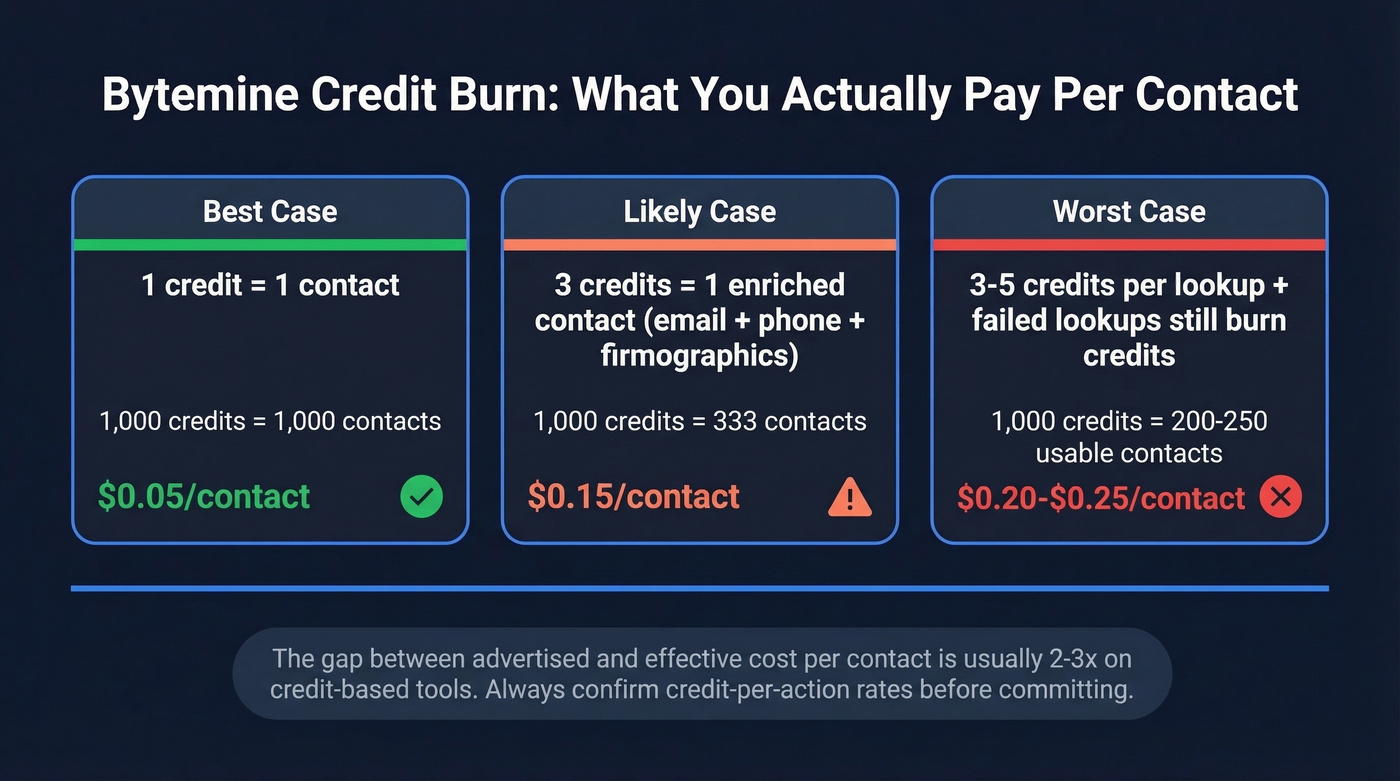
- Does 1 credit = 1 email reveal, or does a full enrichment (email + phone + firmographics) cost 3-5 credits?
- Do unused credits roll over or expire each billing cycle?
- Do failed lookups - where no data is returned - still consume credits?
- What happens when you hit your limit mid-month?
We've tested enough credit-based tools to know the gap between advertised and effective cost-per-contact is usually 2-3x. Here's the math: if full enrichment costs 3 credits per contact, your 1,000-credit plan yields about 333 enriched contacts, pushing your effective cost from $0.05/credit to roughly $0.15 per enriched contact. Always confirm the credit-per-action rate before committing.
If you're trying to forecast spend, treat credits like a usage budget and track them the same way you track deliverability and list health. (If you’re managing multiple AI tools too, you might even be thinking: "Manage your AI credits with Google One" - but Bytemine credits are separate from that ecosystem.)

Credit burn mechanics shouldn't be a guessing game. Prospeo charges ~$0.01 per verified email - you only pay when a valid address is returned. No multi-credit enrichments, no mystery deductions. 98% accuracy means your sender reputation stays intact.
Stop guessing what your credits actually cost. Know exactly what you pay.
Bytemine vs Competitors on Cost
B2B contact data typically ranges from $0.10 to $1.50+ per contact, and hidden fees can inflate your total bill by 30-50%.
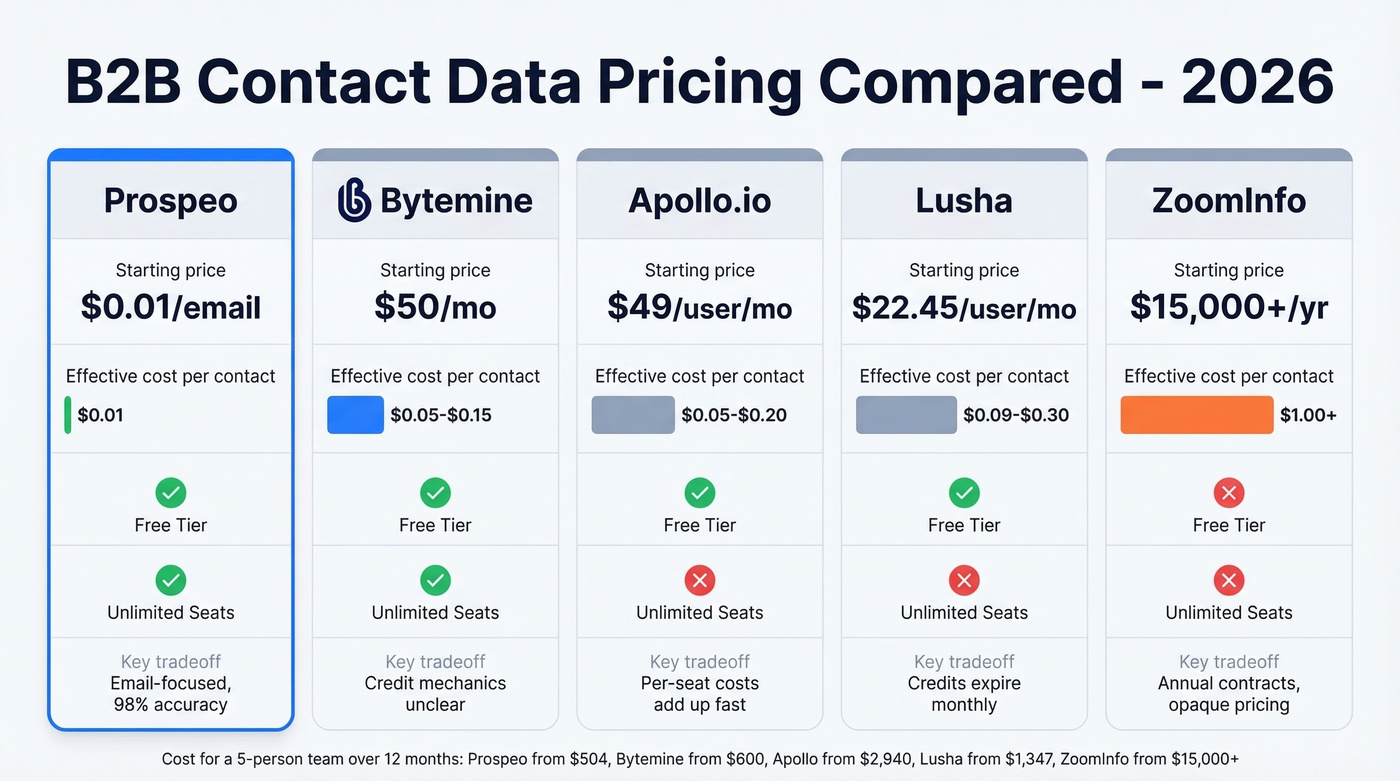
| Tool | Starting Price | Eff. $/Contact | Free Tier | Key Tradeoff |
|---|---|---|---|---|
| Prospeo | ~$0.01/email | ~$0.01 | 75 emails + 100 ext. credits/mo | Email-focused, not full database |
| Bytemine | $50/mo (1K credits) | ~$0.05-$0.02 (vendor claim) | Yes | Credit mechanics unclear |
| Apollo.io | $49/user/mo (annual) | ~$0.05-$0.20 | Yes (limited) | Per-seat pricing adds up |
| Lusha | $22.45/user/mo (annual) | ~$0.09-$0.30 | 70 credits/mo | Credits expire, per-seat |
| ZoomInfo | ~$15,000/yr | ~$1+ | No | Annual contracts, opaque |
| People Data Labs | API-based | ~$0.35/record | 100 lookups/mo | No dashboard, dev-only |
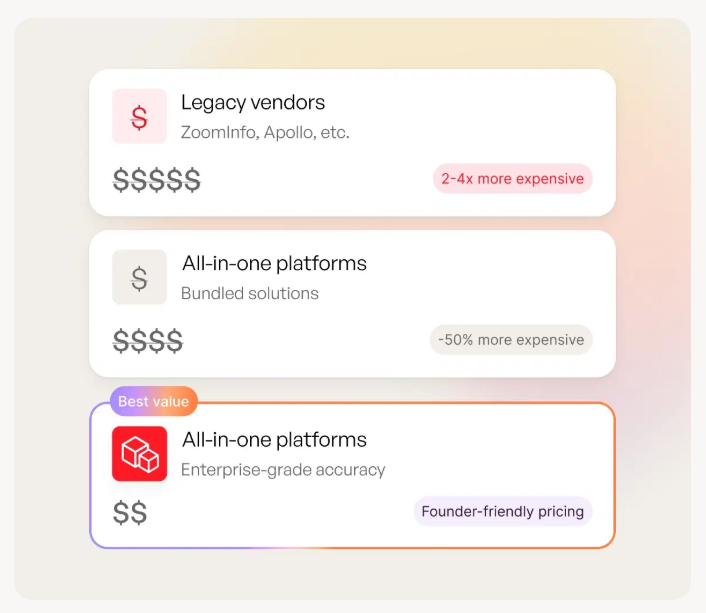
How much does team size cost you elsewhere? Apollo's $49/user/month Basic plan means a 5-rep team pays $245/month before add-ons. Bytemine's unlimited seats are a clear win for larger teams. ZoomInfo is a different universe entirely - Advanced plans often run $25,000-$28,000/year, and renewals climb 10-20%. Lusha starts cheaper per seat at $22.45/month but caps you at 3,000 credits/year on Pro, and they expire. People Data Labs is the developer play: API-first, built for building data products, painful if you need a search bar and workflow UI.
If your main goal is outbound, the real comparison is cost-per-usable contact after verification and bounce control. That’s why it helps to understand email bounce rate benchmarks and how to protect sender reputation before you scale volume.
Is It Worth the Cost?
Bytemine makes sense in two scenarios. First: your CFO is cutting costs and you need to replace a $15,000+ ZoomInfo contract with something functional at a tenth of the price. Bytemine's $600/year for 12,000 credits is a defensible line item. Second: you're building Clay waterfall enrichment workflows and need another data source in the stack.
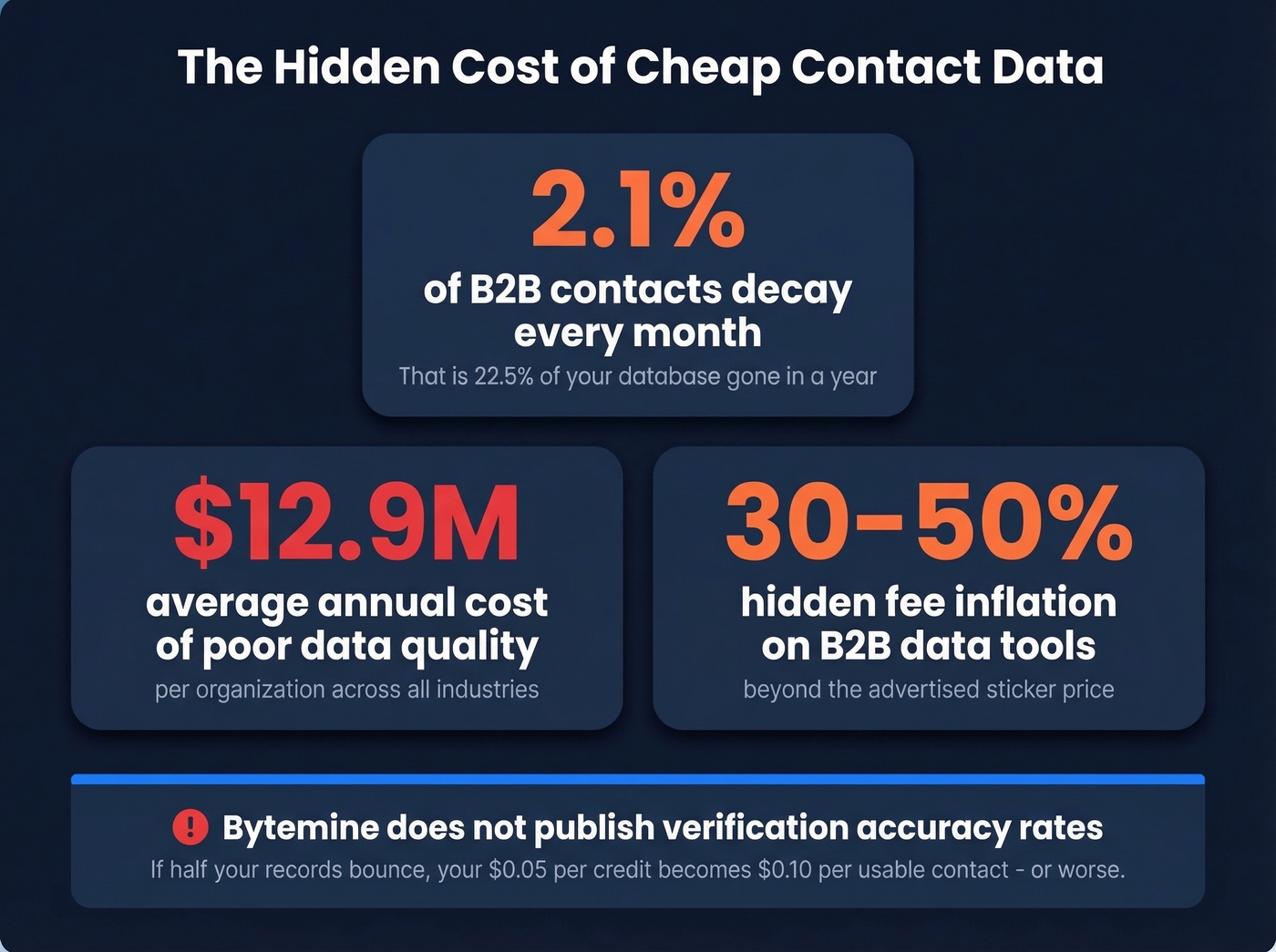
But the cheapest data isn't cheapest if half the records bounce. B2B contact databases decay roughly 2.1% per month - that's 22.5% annually. Poor data quality costs organizations an average of $12.9M per year. Bytemine doesn't publish verification accuracy rates, and we've seen too many credit-based tools where the effective cost doubles once you account for bad records.
Here's the thing: most teams shopping Bytemine don't actually need a full-database tool. If 80% of your workflow is finding verified emails for outbound sequences, you're overpaying for 50+ data fields you'll never use. Buy the tool that matches the job, not the one with the longest feature list. Skip Bytemine if your primary need is verified email addresses at scale - a dedicated email verification or email finder will serve you better and cost less.
If you’re doing enrichment at scale, it’s also worth mapping where Bytemine fits in your broader lead enrichment process and whether you should use a dedicated provider from a shortlist of data enrichment services.
Bytemine doesn't publish verification accuracy. Prospeo does: 98% email accuracy, 5-step verification, and a 7-day data refresh cycle vs the 6-week industry average. At $0.01/email, a $50 budget gets you 5,000 verified contacts - not 333.
Get 5x more verified contacts for the same budget. No contracts required.
FAQ
Does Bytemine Have a Free Plan?
Yes. Bytemine.ai offers a free plan with no credit card required. Use it to test credit burn rates and data quality before committing to the $50/month paid tier. Pay close attention to whether failed lookups consume credits - that's the detail most free trials reveal.
How Does Bytemine Compare to ZoomInfo on Price?
Dramatically cheaper. Bytemine runs $50/month vs ZoomInfo's roughly $15,000/year starting point with annual contracts that often climb 10-20% at renewal. The tradeoff is database depth, intent data, and feature breadth - ZoomInfo is a full GTM platform, not just a contact database.
What's the Cheapest Verified Email Tool in 2026?
Prospeo offers verified emails at roughly $0.01 each with 98% accuracy and a free tier of 75 emails per month. Bytemine is also budget-friendly on paper at $50/month for 1,000 credits, but it doesn't publish email verification rates. When bounce rates directly impact sender reputation, the verification guarantee matters more than the per-contact price.