

C-Level Titles: The Complete Guide for 2026
A Deloitte analysis of [46,000 C-suite job postings](https://www.deloitte.com/us/en/programs/center-for-board-effectiveness/articles/board-oversight-of-expanding-c-suite-roles.html) between 2018 and 2023 found something most org charts won't tell you: C-level titles are expanding fast, but not evenly. Some exist at nearly every large company. Others are vanity labels slapped on director-level roles at 12-person startups. And a few - like Chief AI Officer - barely existed three years ago but are now showing up at JPMorgan Chase and Walmart.
Most guides just list titles and move on. We've put real numbers on which roles actually exist across the S&P 500, which are growing or shrinking, and how to cut through the title inflation muddying the whole picture.
The Quick Version
Six titles exist at virtually every large company: CEO, CFO, CLO, CHRO, CTO/CIO, and - less universally than people assume - COO. The fastest-growing emerging role is the Chief AI Officer, with 26% global adoption and climbing. The most endangered traditional title is the CMO, down 8% year-over-year in the Fortune 500. If you're here to actually find and contact C-level executives, skip to How to Reach C-Level Executives.
What "C-Level" Actually Means
"C-level" refers to the highest-ranking executives in an organization - the ones whose titles start with "Chief." These officers typically report directly to the CEO or the board of directors and carry fiduciary responsibility for the company's performance. That fiduciary piece is what separates a C-level executive from a VP or SVP: a Chief Financial Officer has a legal obligation to shareholders that a Vice President of Finance doesn't.
Below the C-suite, you'll find V-level executives (VP, SVP, EVP), D-level leaders (Directors), and B-level managers. The gap between a VP and a Chief Officer isn't just seniority - it's legal accountability.
The term emerged in the late 20th century as companies formalized executive hierarchies beyond just "president" and "treasurer." Today it's shorthand for the senior leadership team, though the exact composition varies significantly. A "CTO" at a five-person startup who's also writing code and fixing the Wi-Fi isn't the same as a CTO at Microsoft. Context matters more than the title itself - something we'll come back to when we talk about title inflation.
Core C-Suite Roles
These roles form the backbone of most large organizations. You'll find them at nearly every S&P 500 company, though their prevalence and tenure vary more than you'd expect.
Chief Executive Officer (CEO)
The top of the chain. S&P 500 data from Spencer Stuart counts 503 CEOs - more than 500 because some companies run co-CEO structures. Average tenure sits at 7.6 years, the longest of any C-suite role, which makes sense: CEO transitions are expensive and disruptive. Every other C-level executive ultimately reports to the CEO, or to the board in the case of the CEO themselves.
Chief Financial Officer (CFO)
The CFO is the second most universal title after CEO, present at essentially every S&P 500 company. They own financial planning, reporting, risk management, and investor relations. In many organizations, the CFO has quietly become the CEO's most important strategic partner - especially at companies where capital allocation decisions drive growth more than product innovation does.
Chief Operating Officer (COO)
Here's where conventional wisdom gets it wrong. People assume every company has a COO. They don't.
The same S&P 500 analysis found only 284 COOs - barely more than half of companies. The COO role is often temporary, created when a CEO needs an operational counterpart during a growth phase or transition, then eliminated when the need passes. Average tenure is just 3.3 years, the shortest of any core C-suite role. If you're mapping an org chart and can't find a COO, that's normal.
CTO and CIO
These two roles overlap enough to group together, though they serve different functions. The CTO typically owns product technology and innovation - what the company builds. The CIO owns internal IT infrastructure - what the company runs on. Large enterprises often have both; smaller companies give one person both mandates.
CISOs are increasingly being elevated to executive-level titles as well, sometimes reporting directly to the CEO rather than the CIO. That shift is driven by the board-level visibility of cybersecurity risk.
Chief Marketing Officer (CMO)
Roughly two-thirds of S&P 500 companies have a CMO or equivalent, but this role is under pressure. Fortune 500 data shows CMO prevalence dropped 8% year-over-year - the steepest decline of any traditional C-suite title.
Companies aren't eliminating marketing. They're restructuring it. Some fold marketing under a Chief Revenue Officer or Chief Growth Officer. Others split the role into brand and demand gen functions. Average tenure is 4.1 years, and the trend line isn't encouraging for anyone with "CMO" on their business card.
Chief Human Resources Officer (CHRO)
The CHRO - sometimes titled Chief People Officer - manages talent strategy, compensation, culture, and organizational design. This role gained significant influence after 2020 as workforce dynamics like remote work, retention challenges, and DEI initiatives moved from HR concerns to board-level priorities. Its strategic importance continues to grow even as the specific title evolves.
How Common Is Each Title?
Let's put real numbers on this. The S&P 500 snapshot provides the clearest picture of which chief officer titles actually exist at scale versus which ones are niche or aspirational.
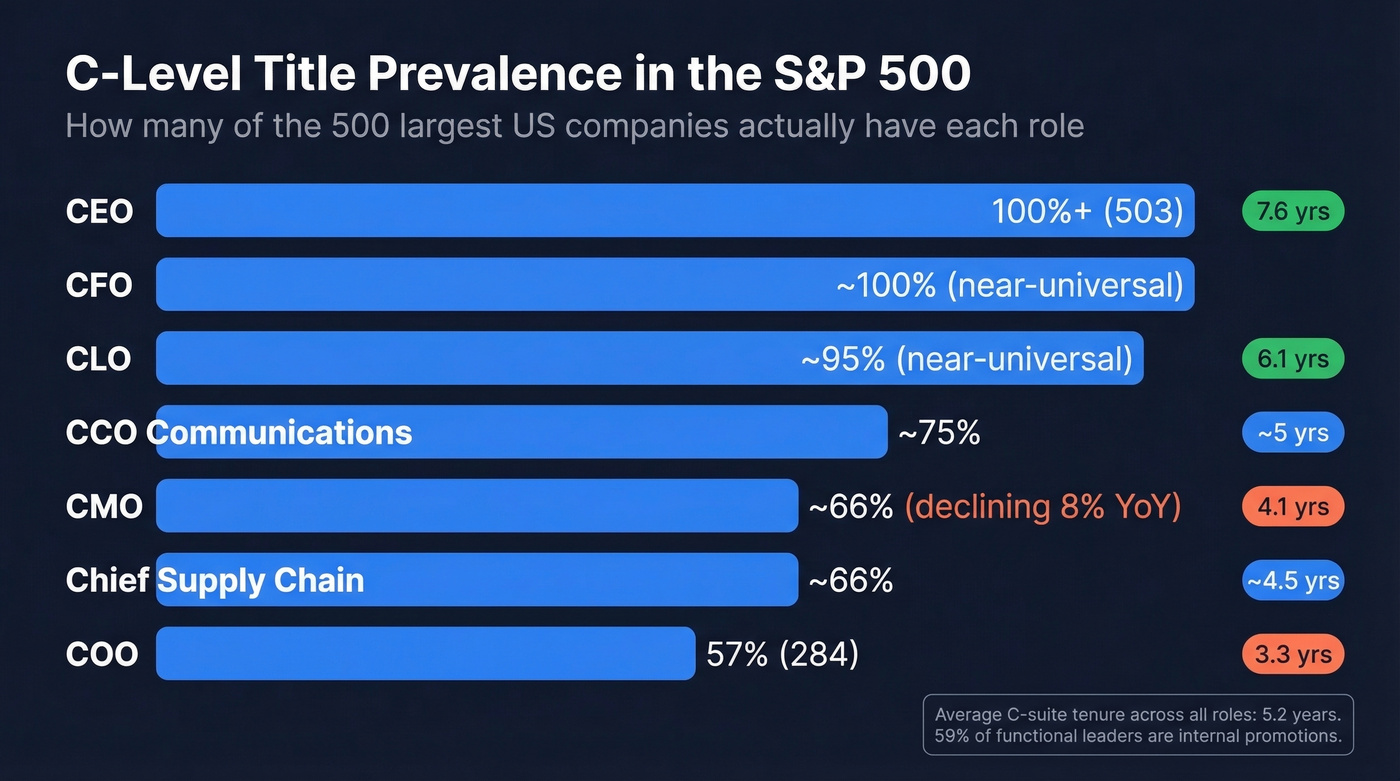
| Title | S&P 500 Prevalence | Avg. Tenure |
|---|---|---|
| CEO | 503 (100%+) | 7.6 years |
| CFO | ~500 (near-universal) | - |
| CLO / General Counsel | Near-universal | 6.1 years |
| CCO (Communications) | ~75% | ~5 years |
| CMO | ~66% | 4.1 years |
| Chief Supply Chain | ~66% | ~4.5 years |
| COO | 284 (~57%) | 3.3 years |
A few things jump out. 59% of C-suite functional leaders are internal appointments, meaning the majority of these roles are filled by promoting from within rather than external hiring. Average tenure across all sitting S&P 500 C-suite leaders is 5.2 years.
There are really only 6-8 titles that exist at virtually every large company. The other 40+ executive designations you'll encounter are niche, emerging, or - let's be honest - sometimes vanity.
Every C-Level Title, Categorized
Beyond the core six, the C-suite gets crowded. Here's a reference covering the titles you're most likely to encounter, organized by function.
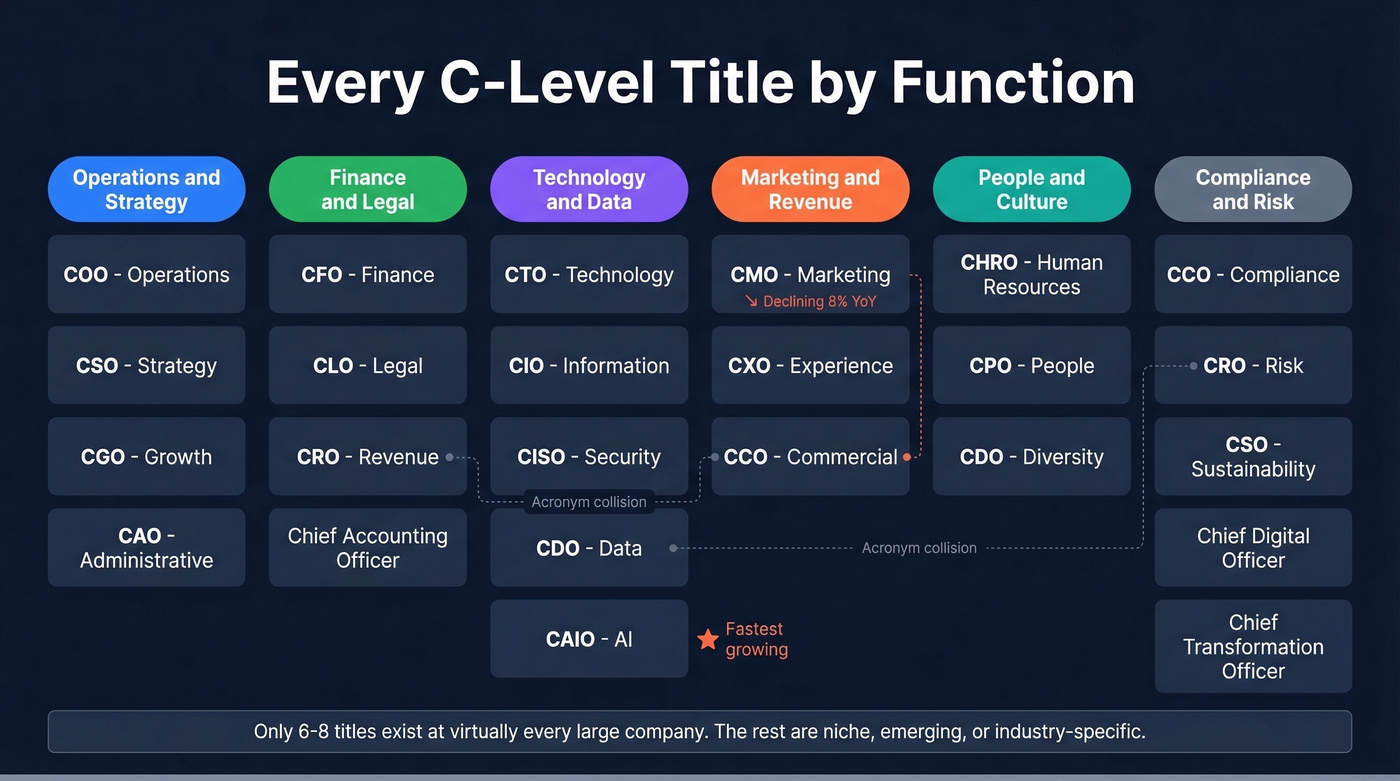
Operations & Strategy
- COO - Chief Operating Officer. Oversees day-to-day operations and execution.
- CSO - Chief Strategy Officer. Owns corporate strategy, M&A evaluation, and long-term planning.
- CGO - Chief Growth Officer. Bridges sales, marketing, and product to drive revenue growth. Often replaces or absorbs the CMO role.
- CAO - Chief Administrative Officer. Manages internal operations like facilities, procurement, and administrative functions.
Finance & Legal
- CFO - Chief Financial Officer. Financial planning, reporting, and capital allocation.
- CLO - Chief Legal Officer or General Counsel. Legal strategy, compliance, and risk. Near-universal in the S&P 500 with an average tenure of 6.1 years - one of the most stable C-suite roles.
- CRO - Chief Revenue Officer. Owns the full revenue engine: sales, and often marketing and customer success. One of the most prominent C-level sales titles, the CRO has grown rapidly as companies consolidate go-to-market functions under a single leader.
- Chief Accounting Officer - Distinct from CFO; focuses on accounting standards, audits, and regulatory filings.
Technology & Data
- CTO - Chief Technology Officer. Product technology and engineering.
- CIO - Chief Information Officer. Internal IT systems and infrastructure.
- CISO - Chief Information Security Officer. Cybersecurity strategy and risk.
- CDO - Chief Data Officer. Data governance, analytics strategy, and data infrastructure.
- CAIO - Chief AI Officer. AI strategy, implementation, and governance. The newest major addition.
Marketing & Revenue
- CMO - Chief Marketing Officer. Brand, demand generation, and market positioning.
- CXO - Chief Experience Officer. Customer experience across all touchpoints.
- CCO - Chief Commercial Officer. Commercial strategy and go-to-market execution. Note: CCO also means Chief Customer Officer, Chief Compliance Officer, or Chief Communications Officer depending on context.
People & Culture
The people function has fragmented into multiple executive titles, which can confuse anyone mapping an org chart. The CHRO remains the dominant title, but Chief People Officer signals a more culture-focused mandate. Chief Diversity Officer owns DEI strategy and programs. CPO collides with Chief Product Officer and Chief Procurement Officer in different industries - always check the department before assuming.
Compliance, Risk & Emerging Roles
The compliance and risk space adds its own acronym collisions. CCO doubles as Chief Compliance Officer in regulated industries like pharma and banking. CRO means Chief Risk Officer in financial services but Chief Revenue Officer everywhere else. Newer titles like Chief Sustainability Officer, Chief Digital Officer, Chief Transformation Officer, and Chief Purpose Officer continue to appear - though many of these are temporary mandates or rebrandings of existing functions rather than permanent additions to the org chart.

Knowing C-level titles is step one. Reaching those executives is where pipeline gets built. Prospeo's database covers 300M+ professionals with 30+ filters - search by title, seniority, company size, and buyer intent to find the exact C-suite contacts you need. 98% email accuracy means your outreach actually lands.
Stop mapping org charts manually. Search by C-level title and get verified contact data in seconds.
Acronym Disambiguation
C-suite acronyms collide constantly. Here's a quick reference for the worst offenders.
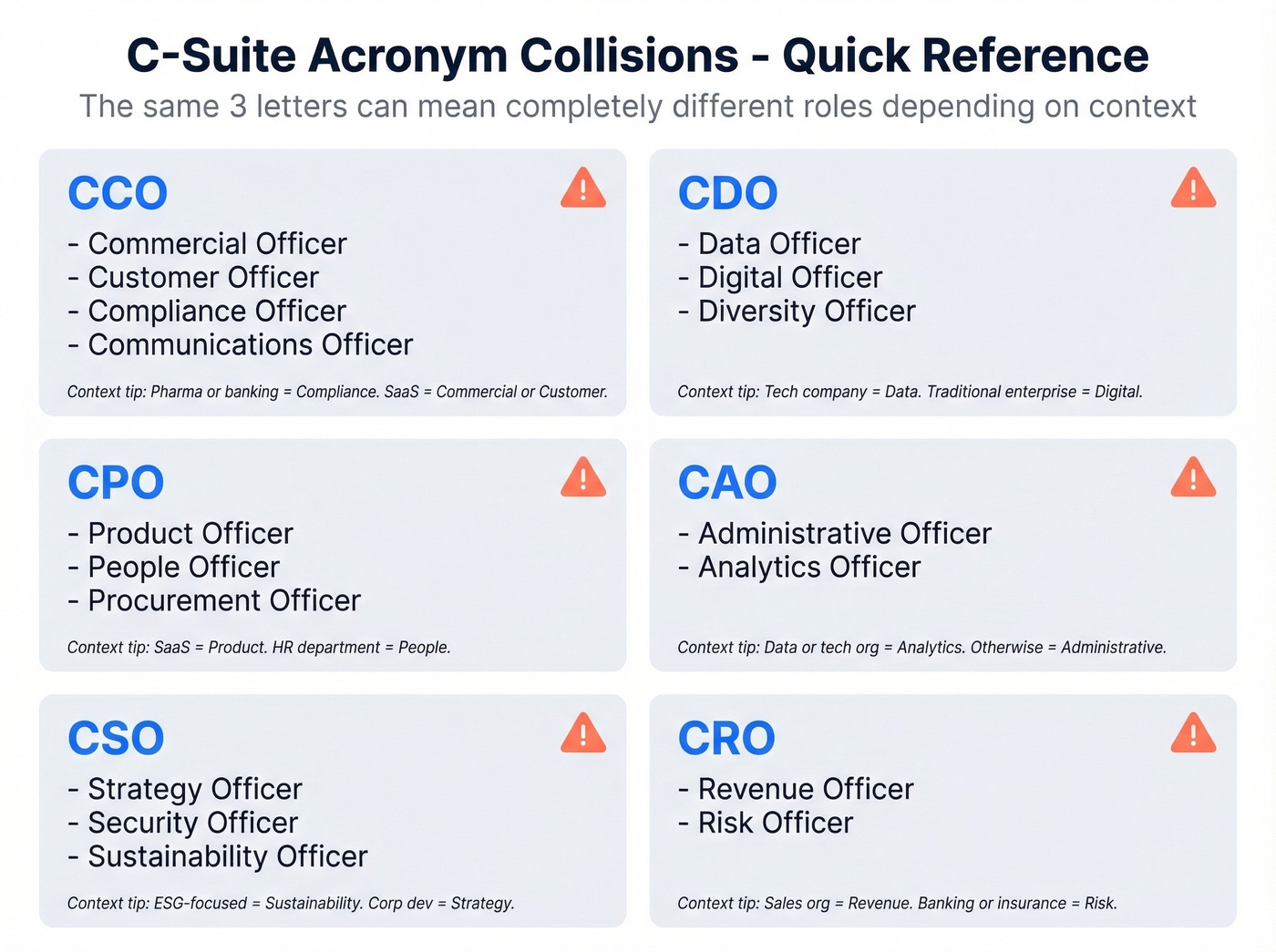
| Acronym | Possible Titles | Context Clue |
|---|---|---|
| CCO | Commercial / Customer / Compliance / Communications | Industry + department |
| CDO | Data / Digital / Diversity | Tech company = Data; traditional = Digital |
| CPO | Product / People / Procurement | SaaS = Product; HR context = People |
| CAO | Administrative / Analytics | Analytics if in tech/data org |
| CSO | Strategy / Security / Sustainability | Check if ESG-focused or corporate dev |
| CRO | Revenue / Risk | Sales org = Revenue; banking = Risk |
When you encounter an ambiguous acronym, look at the company's industry and the executive's department. A CCO at a pharmaceutical company is almost certainly Chief Compliance Officer. A CCO at a SaaS company is probably Chief Commercial Officer or Chief Customer Officer.
Emerging C-Suite Roles in 2026
Chief AI Officer (CAIO)
This is the most important new C-level role of the decade. Not close. 26% of organizations globally now have a CAIO, up from 11% just two years ago. Nearly 48% of the FTSE 100 have appointed one, with 65% of those appointments made in the past two years. JPMorgan Chase, Walmart, Siemens, GE HealthCare, SAP, and Pfizer all have CAIOs in place.
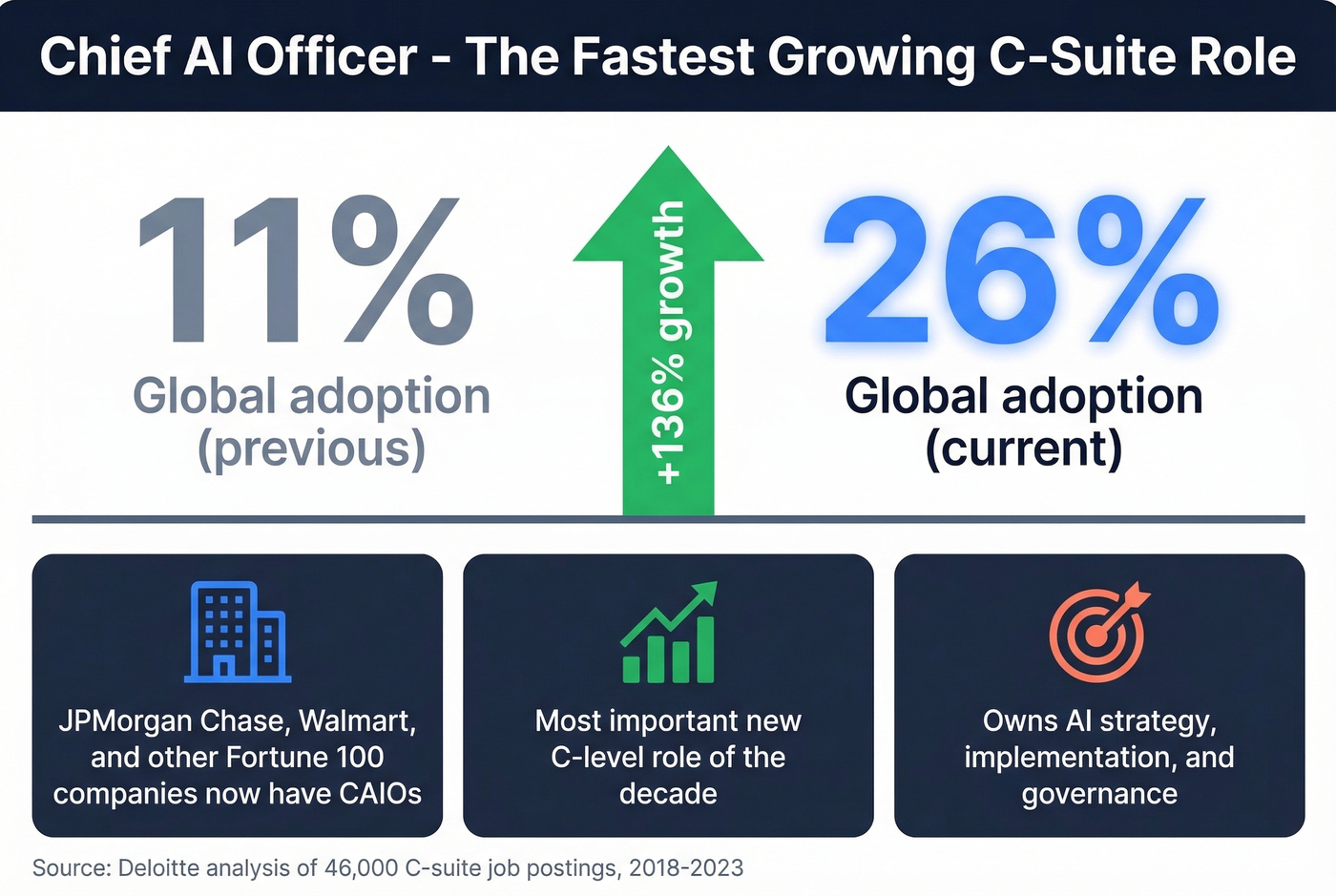
The role itself is evolving fast. Early CAIOs were essentially "go figure out AI" mandates - exploratory, loosely defined. In 2026, the role has shifted toward operational execution: embedding AI into production workflows, establishing guardrails for responsible use, defining ROI metrics, and coordinating models, data, and platforms across the organization. More than half of CAIOs report directly to the CEO or board.
Compensation reflects the demand. Base salaries run $250K-$400K+, with top earners clearing $645K+. There's no single org model - some companies keep a distinct CAIO, others absorb the responsibilities into existing CTO or CIO roles as AI becomes normalized. But the standalone CAIO is growing faster than any other emerging C-suite title right now.
Other Roles to Watch
Chief Sustainability Officer is growing, up 2% to 294 in the Fortune 500. ESG reporting requirements are driving adoption more than voluntary commitment. Chief Experience Officer is gaining traction as companies realize customer experience cuts across marketing, product, and support - none of which own it cleanly. Chief Digital Officer remains common but will likely be absorbed into CIO or CTO roles as "digital transformation" stops being a separate initiative and becomes just how companies operate.
Which Roles Are Growing and Shrinking
The C-suite isn't just expanding - it's reshuffling. S&P 500 and Fortune 500 data show clear winners and losers.
| Role | YoY Change | Direction |
|---|---|---|
| CMO / equivalent | -8% | Shrinking |
| Supply chain leaders | -7% (to 422) | Shrinking |
| CCO (Communications) | -6% | Shrinking |
| CSO (Sustainability) | +2% (to 294) | Growing |
| D&I leaders | +9% (to 321) | Growing |
| CAIO | Rapid growth | Growing fast |
Average tenure across Fortune 500 C-suite leaders rose from 4.5 to 4.9 years, suggesting less churn overall even as the composition shifts. The pattern is clear: roles tied to regulatory pressure, AI, and ESG are growing. Roles tied to traditional marketing and communications are being consolidated or restructured.
The CMO decline doesn't mean marketing is less important - it means the CMO title specifically is losing ground to CRO, CGO, and other structures that bundle marketing with revenue accountability. Here's our take: if your company's deal sizes stay under $25K, you probably don't need a CMO at all. A strong CRO who owns the full funnel will outperform a CMO and a VP of Sales pulling in different directions every time.
Title Inflation
Here's the uncomfortable truth about executive titles: 92% of workers believe companies use inflated titles to create the illusion of career growth while withholding actual raises. Two-thirds say they've noticed impressive-sounding titles without better pay happening more often than in past years. And 15% have accepted a lower salary in exchange for a fancier title.
From the employer side, 54% of organizations now use titles to attract talent - a 35-point jump from 2018. The math is simple: titles are free, raises aren't.
This creates a real problem for anyone trying to prospect into the C-suite. A "Chief Growth Officer" at a 12-person startup isn't the same as a CGO at Salesforce. One is a strategic executive with a $50M budget and a board seat. The other is a solo marketer who picked their own title.
We've seen teams waste entire quarters prospecting "C-level" contacts who turned out to be founders of two-person companies. The consensus on r/sales is the same - title verification isn't optional anymore. It's pipeline hygiene. Skip this step and you'll burn through sequences sending personalized emails to people who can't sign a purchase order.
How to Reach C-Level Executives
Knowing the titles is step one. Actually reaching these people is the hard part.
C-level executives are insulated by gatekeepers, flooded with outreach, and increasingly skeptical of cold contact. Generic emails to info@ addresses don't work. Neither does guessing email formats and hoping for the best. In our experience, the single biggest bottleneck in C-suite outreach isn't messaging - it's data quality. You can write the perfect email, but if it bounces or lands in a gatekeeper's inbox, it doesn't matter.
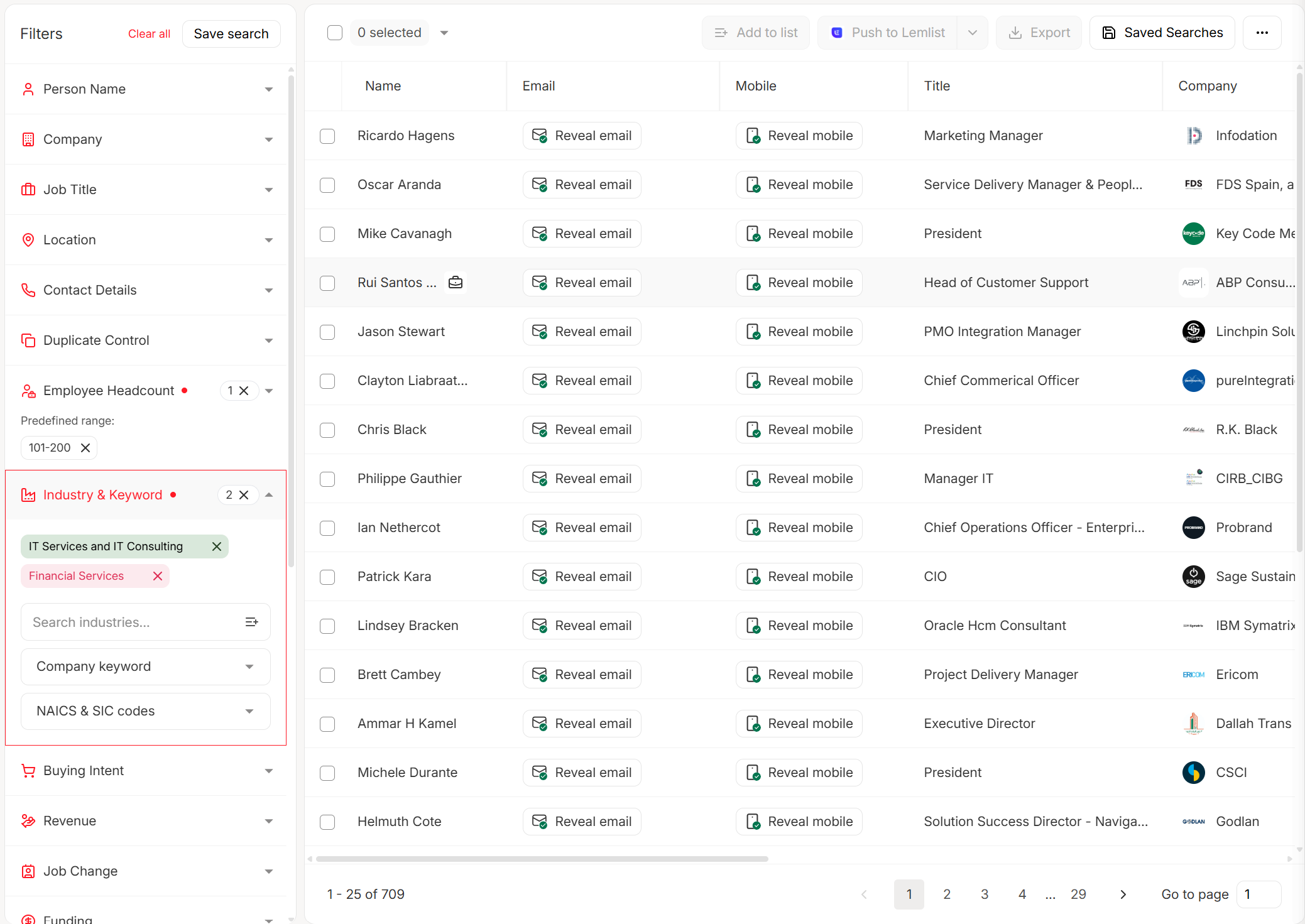
What works is verified direct contact data, filtered by the exact title, company size, and industry you're targeting. Prospeo's database covers 300M+ professional profiles with 98% email accuracy and 125M+ verified mobile numbers, refreshed every 7 days so you're reaching current executives rather than people who left the role six months ago. Filter by 30+ criteria - including buyer intent across 15,000 topics - to find C-level executives who are actively in-market.
If you're building lists at scale, start with org chart work, then move into a repeatable prospecting workflow that keeps targeting consistent across reps.
If you need a broader stack comparison, see our breakdown of B2B prospecting tools and sales prospecting platforms for 2026.
For outreach, pair clean data with a tight cold email campaign and a few proven intro email samples so you’re not reinventing copy every time.
Only 284 of the S&P 500 even have a COO - so targeting the wrong title wastes your outreach. Prospeo lets you filter by exact job title, department headcount, and company signals so you reach the real decision-maker, not a vanity title. 125M+ verified mobile numbers and 143M+ verified emails, refreshed every 7 days.
Cut through title inflation and connect with the executives who actually hold budget authority.
FAQ
What is the highest C-level title?
CEO is the highest-ranking C-level title. The CEO reports to the board of directors, and all other C-suite executives report to the CEO or COO where one exists. In some companies, an Executive Chairman outranks the CEO, but that's a board-level role rather than a traditional C-suite position.
Is VP considered a C-level title?
No. Vice Presidents - including SVPs and EVPs - sit below the C-suite and typically report to a chief officer. The key distinction is fiduciary responsibility: C-level executives carry legal obligations to the board and shareholders that VPs generally don't, even when they manage large teams.
How many C-suite roles does a typical company have?
Startups typically have 1-3 chief officers. Mid-market companies run 5-8. S&P 500 enterprises average roughly 8-10 named C-suite roles, though the exact count varies by industry. Beyond those core positions, the other 40+ C-level titles you'll encounter are niche, emerging, or inflated.
What are common C-level sales titles?
The most common are Chief Revenue Officer and Chief Commercial Officer. The CRO typically owns the entire revenue engine - sales, and often marketing and customer success - while the CCO focuses on commercial strategy and go-to-market execution. Chief Sales Officer exists but is less prevalent in the S&P 500 than CRO.
What's the fastest way to find C-level contact information?
Use a B2B data platform that filters by exact title, company size, and industry. Prospeo covers 300M+ profiles with 98% email accuracy and refreshes every 7 days, so you're reaching current executives rather than people who left months ago. The free tier includes 75 verified emails per month - enough to test before committing.