

How to Build a Cold Email Campaign That Gets Replies in 2026
An SDR at a Series B company we worked with burned a domain in 72 hours. They loaded 2,000 contacts from a stale list, hit send, and watched 400 emails bounce. By Thursday, their primary domain was flagged - every email, including replies to warm prospects, landed in spam. The cold email campaign wasn't killed by bad copy. It was killed by bad data.
That's the thesis of this guide: data quality drives deliverability, deliverability drives inbox placement, and inbox placement drives replies. Most cold email guides start with subject lines. We're starting where campaigns actually fail.
What You Need (Quick Version)
- List quality determines everything. Verify every email before sending - 98%+ accuracy or don't bother. One bad list can tank a domain for weeks. (If you need bounce thresholds and fixes, see bounce rate.)
- Infrastructure before copywriting. SPF, DKIM, and DMARC setup with proper alignment, then warmup. Skip this and your perfectly crafted email hits spam. (For a deeper walkthrough, use this email deliverability guide.)
- Fewer, better emails win. Belkins' 2023-2024 benchmark shows reply rates dropped 15% year-over-year. Top performers send under 80 words to 1-2 contacts per company, not blast 10 people at the same org.
What Cold Outreach Actually Means
A cold email campaign is a structured sequence of unsolicited but targeted emails sent to prospects who haven't opted in. It's not spam when it's relevant, identifies the sender, and includes a clear opt-out mechanism.
The distinction matters because it determines how you build, send, and measure.
| Cold Email | Spam | Email Marketing | |
|---|---|---|---|
| Audience | Targeted ICP | Untargeted bulk | Opted-in subscribers |
| Consent | Opt-out model | No consent | Opt-in model |
| Volume | Around 50-500/day | Thousands+ | Thousands+ |
| Goal | Start a conversation | Clicks/scams | Nurture/convert |
Based on 4 billion+ emails sent through GMass, the average cold email reply rate sits between 1% and 5%. That's the baseline.
Benchmarks and Reply Rates in 2026
Two datasets give us the clearest picture of where cold email performance actually stands.
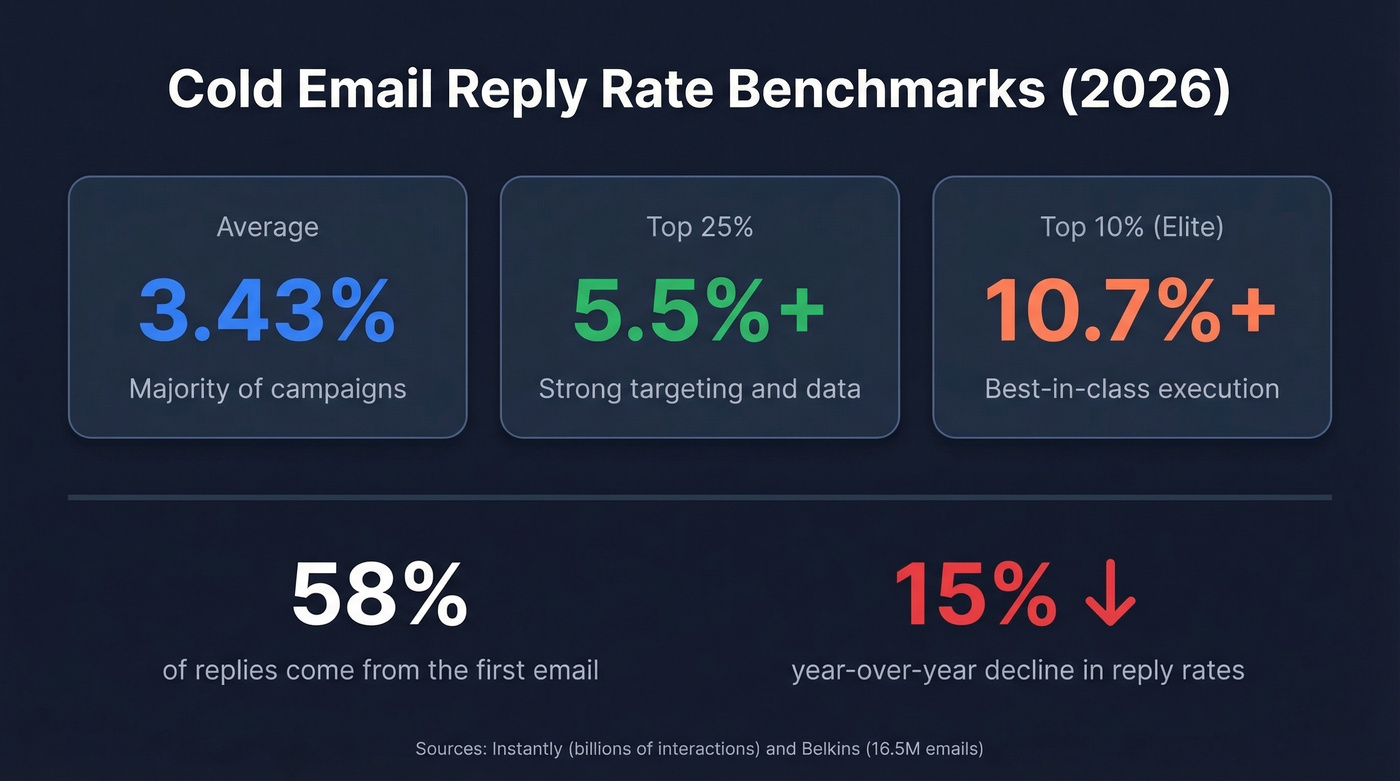
Instantly's benchmark report, drawn from billions of interactions across thousands of workspaces, puts the average reply rate at 3.43%. Top quartile campaigns hit 5.5%+. Elite performers - the top 10% - exceed 10.7%.
Belkins analyzed 16.5 million cold emails sent in 2024. Their numbers skew higher at 5.8% average reply rate, but the trend line is what matters: that's down from 6.8% in 2023, a 15% year-over-year decline. Open rates swung from 46% to 31-32% within the same period before Belkins abandoned open tracking entirely - further evidence that open rates are a vanity metric.
Both datasets agree on one thing: 58% of replies come from the first email. Follow-ups contribute the remaining 42%, but with rapidly diminishing returns. If your first email doesn't land in the inbox and resonate, no amount of follow-up saves the campaign.
Here's the thing most vendors won't tell you: a 3.43% average means the majority of campaigns are underperforming, and the gap between average and elite isn't copy - it's list quality, infrastructure, and targeting discipline. If your deal size justifies cold outreach, invest in data first. If you're closing deals under $5K, you probably can't afford the bounces from cheap data.

The article is clear: one bad list tanks a domain for weeks. Prospeo's 5-step verification with catch-all handling, spam-trap removal, and honeypot filtering delivers 98% email accuracy on 300M+ profiles - refreshed every 7 days, not 6 weeks.
Stop gambling with your domain. Start with data that's actually verified.
The 7-Step Framework
Step 1 - Build a Verified Prospect List
Your campaign lives or dies on list quality. Full stop.
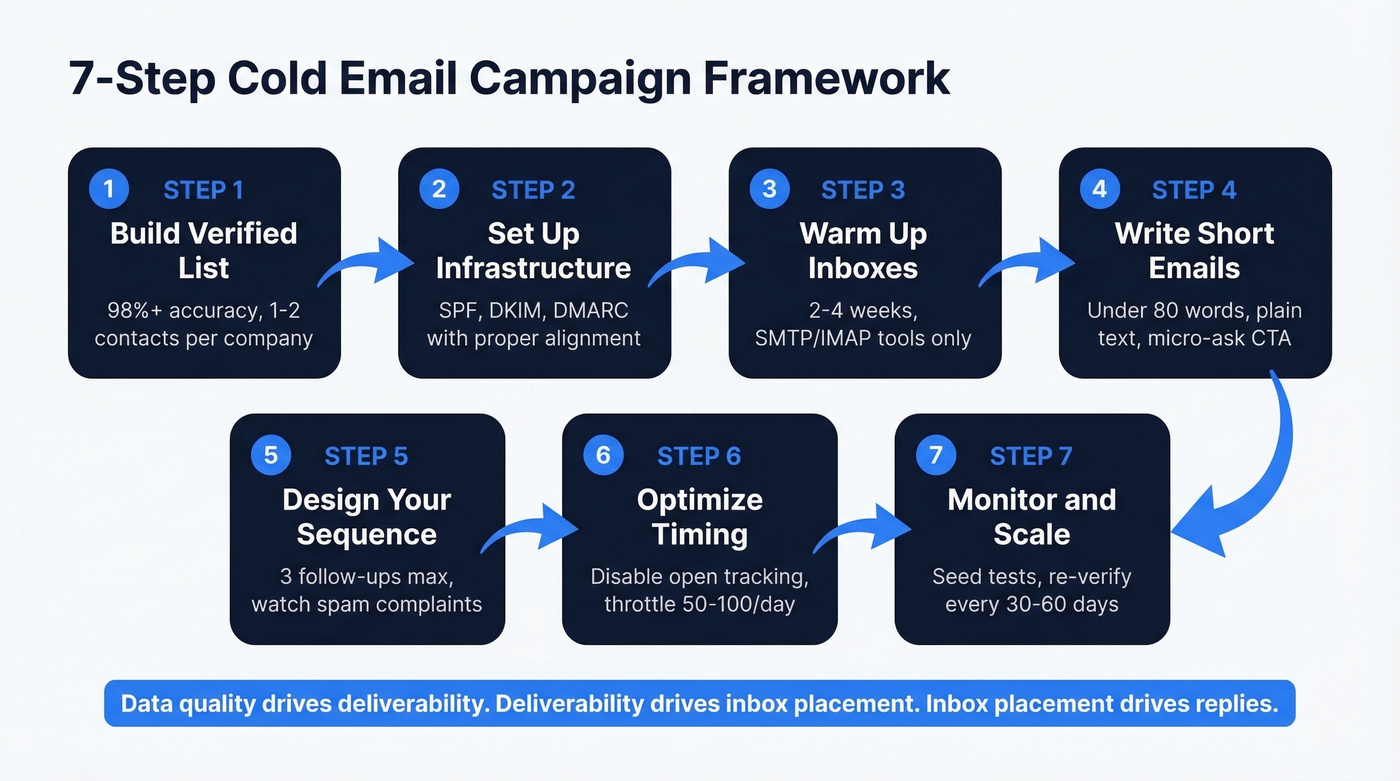
Targeting 1-2 contacts per company produces a 7.8% reply rate. Targeting 10+ contacts at the same company drops that to 3.8%. Spray-and-pray doesn't just underperform - it actively damages your sender reputation by generating bounces and spam complaints across a wider surface area.
Start by defining your ICP tightly: industry, headcount, title, geography, and at least one intent or behavioral signal like hiring activity, tech stack changes, or recent funding. Then build your list using 30+ filters to narrow by these criteria, and run every address through a dedicated verification step before loading contacts into your sequencer. A 5-step verification process that handles catch-all domains, removes spam traps, and filters honeypots is the minimum standard - anything less and you're gambling with your domain. (If you want a structured way to define and score your ICP, use an ideal customer profile template.)

Don't skip verification. Even if you're pulling contacts from a "verified" database, re-verify before sending. (If you're comparing vendors, start with email list providers.)
Step 2 - Set Up Sending Infrastructure
Authentication is the foundation. Without it, inbox providers have no reason to trust your emails.
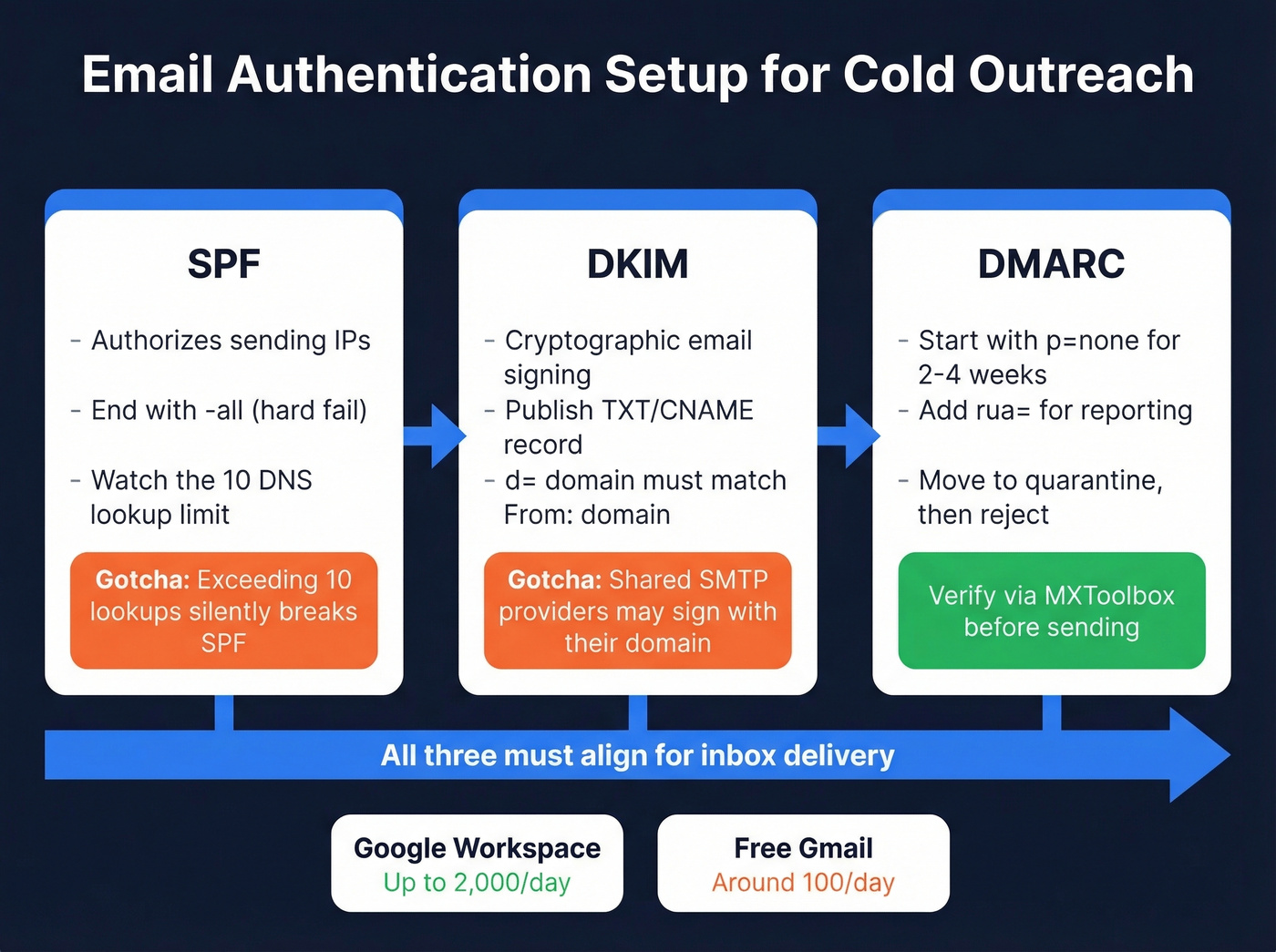
SPF tells receiving servers which IPs can send on behalf of your domain. Create a TXT record that includes your email provider and your sending platform, and end with -all to hard-fail unauthorized senders. The critical gotcha: SPF has a 10 DNS lookup limit. Exceed it and SPF silently fails - no error, no warning, just broken authentication. If you're using multiple sending tools, you'll need an SPF flattening service. (More examples: SPF record example.)
DKIM cryptographically signs your emails. Generate the key in your provider, publish the TXT/CNAME record, and enable signing. The alignment requirement trips people up: the DKIM signing domain (d=) must match your From: domain. Shared SMTP providers sometimes sign with their own domain, which breaks DMARC alignment entirely. (If you want a quick checklist, see how to verify DKIM is working.)
DMARC ties it together. Start with p=none and a reporting address (rua=) so you can monitor for two to four weeks. Then move to quarantine, then reject. Verify everything via MXToolbox before sending a single outreach email. (If you keep getting alignment issues, read DMARC alignment.)
Google Workspace and Microsoft 365 are the most common providers for cold outreach. Free Gmail accounts are limited to around 100 emails/day, while paid Google Workspace accounts allow up to around 2,000/day. Avoid cheap shared hosting - the IP reputation is usually already damaged.
Step 3 - Warm Up New Inboxes
Google cracked down on warmup tools using Gmail APIs in late 2022 and early 2023. GMass shut down its warmup service entirely. Tools using SMTP/IMAP protocols still work - Google targeted the method of access, not the concept of reputation-building.
Budget two to four weeks for warmup on any new domain or inbox. The process involves automated opens, replies, and "mark as important" actions that build sender reputation gradually.
Warmup has real limits, though. Cheap warmup networks running small, recycled inbox pools get detected. Providers recognize the patterns and discount the engagement signals. And warmup is a band-aid - if your list is 30% invalid, no amount of warmup saves your domain. If your bounce rate exceeds 3%, stop sending and re-verify your list before continuing. (To set safe caps, use email velocity.)
Step 4 - Write Emails That Get Replies
Both major benchmark studies converge on the same conclusion: shorter wins.
Campaigns under 80 words perform best. The sweet spot is 6-8 sentences, under 200 words, with a 6.9% reply rate. Plain-text formatting outperforms HTML templates with logos and banners every time - one hyperlink maximum, no images, no signatures with 15 social icons. (If you want a deeper writing framework, see email copywriting.)
Your CTA should be a micro-ask, not a commitment. "Worth a 15-minute call?" works. "Book a 45-minute demo to see our full platform capabilities" doesn't. (More examples: email call to action.)
The PAS framework compresses well into cold email. Here's a real example in under 30 words:
"Most SDRs spend 4 hours building lists that bounce 20%." (Problem) "Every bounce pushes your next email closer to spam." (Agitate) "We cut that to under 3% for [similar company]." (Solve)
Stop optimizing your subject lines. Start auditing your list. A perfect subject line sent to an invalid email address accomplishes nothing. Keep subjects short, specific, and free of clickbait - then spend your optimization energy on targeting and data quality. (If you need a swipe file, use cold email subject line examples.)
Step 5 - Design Your Sequence
Three follow-ups is the ceiling, not the floor.
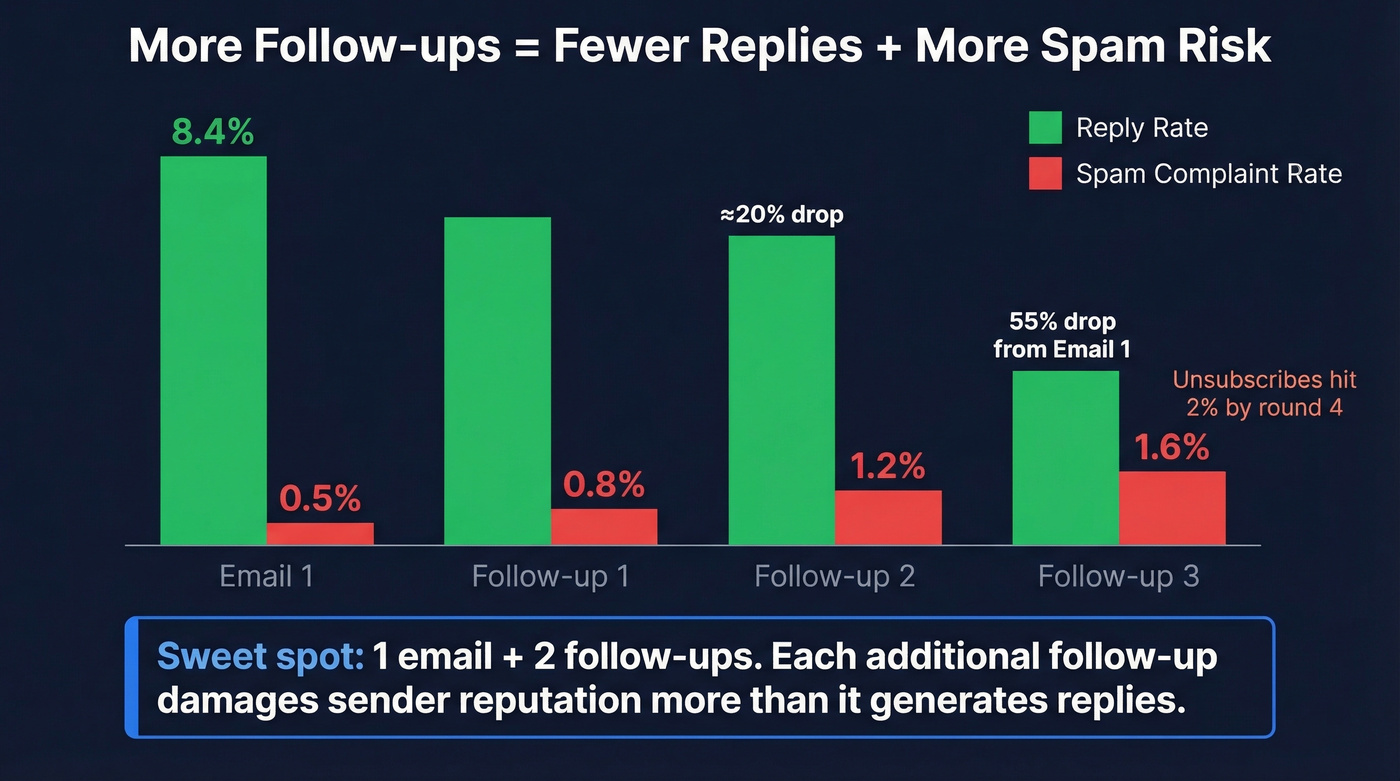
The data on sequence length tells a nuanced story. Some platforms suggest 4-7 touchpoints spaced 3-4 days apart. But the risk data paints a different picture: campaigns with just one email got the highest reply rate at 8.4%, and adding a third email can drop reply rates up to 20%. By the fourth follow-up, response rates fall 55% compared to earlier emails.
The risk escalation matters most. Spam complaints jump from 0.5% on the first email to 1.6% by the fourth. Unsubscribes hit 2% by round four. Each follow-up doesn't just produce fewer replies - it actively damages your sender reputation.
If your first email is well-targeted and well-written, two follow-ups are usually enough. (If you want ready-to-send copy, see cold email follow-up templates.)
Step 6 - Optimize Timing and Sending
The two major datasets disagree on the best day, which tells you timing matters less than you think.
Tuesday and Wednesday show up as peak days in one dataset. Another found Thursday produces the highest reply rate at 6.87%, compared to Monday's 5.29%. For time of day, evenings between 8-11 PM generate the highest reply rates at 6.52% - likely because fewer competing emails land during those hours. (More data: best time to send cold emails.)
One underrated finding: turning off open-tracking pixels produced a 3% higher response rate in a controlled experiment. Tracking pixels add weight to emails and can trigger spam filters. We disabled them months ago and haven't looked back.
Throttle your sending to 50-100 emails per inbox per day maximum. Spread sends across the day rather than blasting 100 emails at 9 AM.
Step 7 - Monitor and Scale
Sending is the beginning, not the end.
Set up seed list monitoring - send test emails to accounts on Gmail, Outlook, and Yahoo to check inbox vs. spam placement before and during campaigns. Google Postmaster Tools gives you domain reputation data directly from Google. Check it weekly. A/B test one variable per week: subject line, opening line, CTA, or send time. Don't test everything simultaneously or you'll learn nothing.
When scaling, use sender rotation and inbox rotation across multiple domains. Keep per-account sending limits conservative. A domain that sends 500 emails a day from one inbox will get flagged faster than five inboxes sending 100 each. Stack Optimize, an outbound agency, built from $0 to $1M ARR by maintaining 94%+ client deliverability, sub-3% bounce rates, and zero domain flags across all clients - proof that disciplined scaling works. (For more on reputation recovery, see how to improve sender reputation.)
Re-verify contacts every 30-60 days. People change jobs, emails go stale, and catch-all domains flip to rejecting. Treat your list like a living asset, not a static spreadsheet.
Targeting 1-2 contacts per company gets 2x the reply rate. Prospeo's 30+ filters - buyer intent, technographics, funding, headcount growth - let you find exactly the right person at each account. Then every email runs through proprietary verification before you send.
Build laser-targeted cold email lists at $0.01 per verified contact.
Compliance by Region
Cold email is legal in every major market - but the rules differ significantly.
| Jurisdiction | Consent Model | Key Requirements | Penalties |
|---|---|---|---|
| US (CAN-SPAM) | Opt-out | Physical address, truthful subjects, honor opt-outs in 30 days | $51,744-$53,088/violation |
| EU (GDPR) | Legitimate interest | Documented LIA, working opt-out, data minimization | Up to 4% global revenue |
| UK (GDPR + PECR) | No B2B/B2C distinction | Truthful sender ID, opt-out handling, PECR Reg 22 compliance | Up to 17.5M GBP |
| Canada (CASL) | Consent-first | Implied consent for existing relationships (24 months), 10-day unsubscribe, 3-year record retention | Up to $10M CAD |
GDPR's legitimate interest basis (Article 6(1)(f)) works for B2B cold email, but you need a documented Legitimate Interest Assessment. If you're selling into the EU without one, you're taking an unnecessary legal risk.
Mistakes That Kill Campaigns
Five mistakes we see repeatedly:
Skipping email verification is the #1 campaign killer. A 10% bounce rate is enough to damage your domain. Meritt was running 35% bounces before they fixed their data source - pipeline was essentially zero.
Over-following-up destroys sender reputation. Spam complaints nearly triple by the fourth email, jumping from 0.5% to 1.6%. Three follow-ups maximum. If they haven't replied by then, they're not interested.
Targeting too many contacts per company looks like spam to receiving servers. Blasting 10+ people at the same org drops reply rates from 7.8% to 3.8%.
Over-formatting emails triggers spam filters. HTML templates with logos, banners, and multiple links underperform plain text with one link every time. The data is unambiguous on this.
Treating outreach as a task, not a system is what separates average from elite. The teams hitting 10%+ reply rates aren't sending better emails - they're running better systems: verified data, authenticated infrastructure, disciplined sequences, and continuous monitoring.
Best Tools for Cold Outreach in 2026
The consensus on r/coldemail aligns with what we've seen in practice: the tool matters less than the data feeding it. That said, here's what's worth your time.
| Tool | Category | Starting Price | Best For | Key Limitation |
|---|---|---|---|---|
| Prospeo | Data & Verification | Free (75/mo); ~$0.01/email paid | Verified lists, 98% accuracy | Pair with a sequencer |
| Instantly | Sending Platform | ~$30/mo | Scale + warmup | Shared infra risk at low tiers |
| Lemlist | Sending + Personalization | $32/user/mo | Multi-channel sequences | Gets expensive with add-ons |
| Apollo | All-in-One | Free (100 credits/mo); paid from $59/user/mo | Database + outreach combo | Email accuracy lags behind |
| Saleshandy | Sending Platform | $25/mo | Budget-friendly sending | Limited personalization |
| Woodpecker | Sending Platform | $29/mo | Agency-friendly | Smaller feature set |
| Smartlead | Sending at Scale | ~$39/mo | High-volume inbox rotation | Steeper learning curve |
| GMass | Gmail-Based Sending | $25/mo | Gmail-native simplicity | No warmup; Gmail-centric |
The data layer is the most important piece of this stack. Pair a high-accuracy data source with Instantly or Lemlist for sending and you've got an enterprise-grade outbound stack for under $100/month.
Instantly is the go-to sending platform for teams scaling past a few hundred emails per day - warmup, inbox rotation, and time-zone sending are built in. Lemlist adds personalization depth and multi-channel capabilities across email, calls, and social touches, but per-user pricing adds up fast with larger teams.
Apollo bundles database, sequencer, dialer, and enrichment into one platform - convenient if you want a single tool, but email accuracy runs noticeably below dedicated verification tools, which means more bounces and more domain risk. The free tier is generous for testing.
Saleshandy and Woodpecker are solid budget picks for straightforward sequences. Smartlead is purpose-built for high-volume senders who need aggressive inbox rotation. GMass works if you live in Gmail and want the simplest possible setup, but the lack of warmup limits its ceiling. On Reddit, r/coldemail users also frequently praise Smartreach.io for its deliverability features - worth evaluating if you're comparing sending platforms.
Skip Apollo if data accuracy is your top priority. It's a good all-in-one, but we've seen bounce rates climb when teams rely on it as their sole data source without re-verifying.
FAQ
What reply rate should I expect?
The average is 3.43% per Instantly's 2026 benchmark. Top quartile campaigns hit 5.5%+, and elite performers exceed 10.7%. If you're below 3%, audit your list quality and targeting before touching your copy.
How many follow-ups should I send?
Two to three maximum. Spam complaints nearly triple by the fourth email, jumping from 0.5% to 1.6%. Reply rates drop 55% by that point. More follow-ups means more risk for less return.
Is cold email legal in Europe?
Yes, under GDPR's legitimate interest basis (Article 6(1)(f)). You need a documented Legitimate Interest Assessment, a working opt-out mechanism, and truthful sender identification. B2B outreach is legal - but you need the paperwork to prove your basis if challenged.
How do I stop emails from landing in spam?
Verify your list to 98%+ accuracy before sending, authenticate your domain with SPF/DKIM/DMARC, warm up new inboxes for two to four weeks, and keep your bounce rate under 3%. A 5-step verification process with catch-all handling and spam-trap removal is the minimum standard.
What's the ideal email length?
Under 80 words performs best in the largest available dataset. A separate study found 6-8 sentences under 200 words optimal. Both agree: shorter wins. Plain text, one link maximum, and a low-commitment CTA.