

C-Level Executives: Every Role, Real Pay Data, and What's Changed in 2026
Most guides list six c-level roles and call it a day. The modern C-suite is bigger than that, compensation structures look nothing like a Glassdoor average, and there's an entirely new class of fractional leaders who work 15-20 hours a week and outperform full-timers. Here's everything that's actually changed - and what it means if you're building toward, hiring for, or selling into the executive tier.
The Short Version
C-level refers to the highest-ranking executives in a company - the "Chief" officers who own company-wide outcomes. The traditional core is CEO, CFO, COO, CTO, CMO, and CHRO, but many organizations now carry far more than six C-suite titles, including newer roles like Chief AI Officer (CAIO) and Chief Sustainability Officer (CSO).
Compensation is best understood as ratios, not averages. CFOs earn roughly 37-39% of CEO total pay in the Russell 3000; COOs earn about 42%. Two trends are reshaping the C-suite right now: the rise of the Chief AI Officer and the explosion of fractional executives - up 5,400% on professional networks since 2022. And if you're a VP wondering whether you're "basically C-level" - you're not. Let's get into why.
What Does C-Level Mean in Business?
"C-level" is shorthand for any executive whose title starts with "Chief" - Chief Executive Officer, Chief Financial Officer, Chief Technology Officer, and so on. The "C" literally refers to that word. These are the people who sit at the top of the organizational chart, set company-wide strategy, and carry accountability for enterprise risk and performance. In most orgs, they report to the CEO and are board-facing; the CEO reports directly to the board of directors.
You'll hear "C-level" and "C-suite" used interchangeably, and that's fine. If you want to be precise, C-level describes the rank while C-suite describes the group. In practice, nobody will correct you for using either one. What matters is understanding that a chief officer position isn't just a fancy title - it carries board-facing accountability and a fundamentally different scope than any VP or director role.
Every C-Suite Title Explained
The Core Six
These roles exist in most mid-size and large companies. Their responsibilities are well-defined - even if the boundaries between them get blurry in practice.
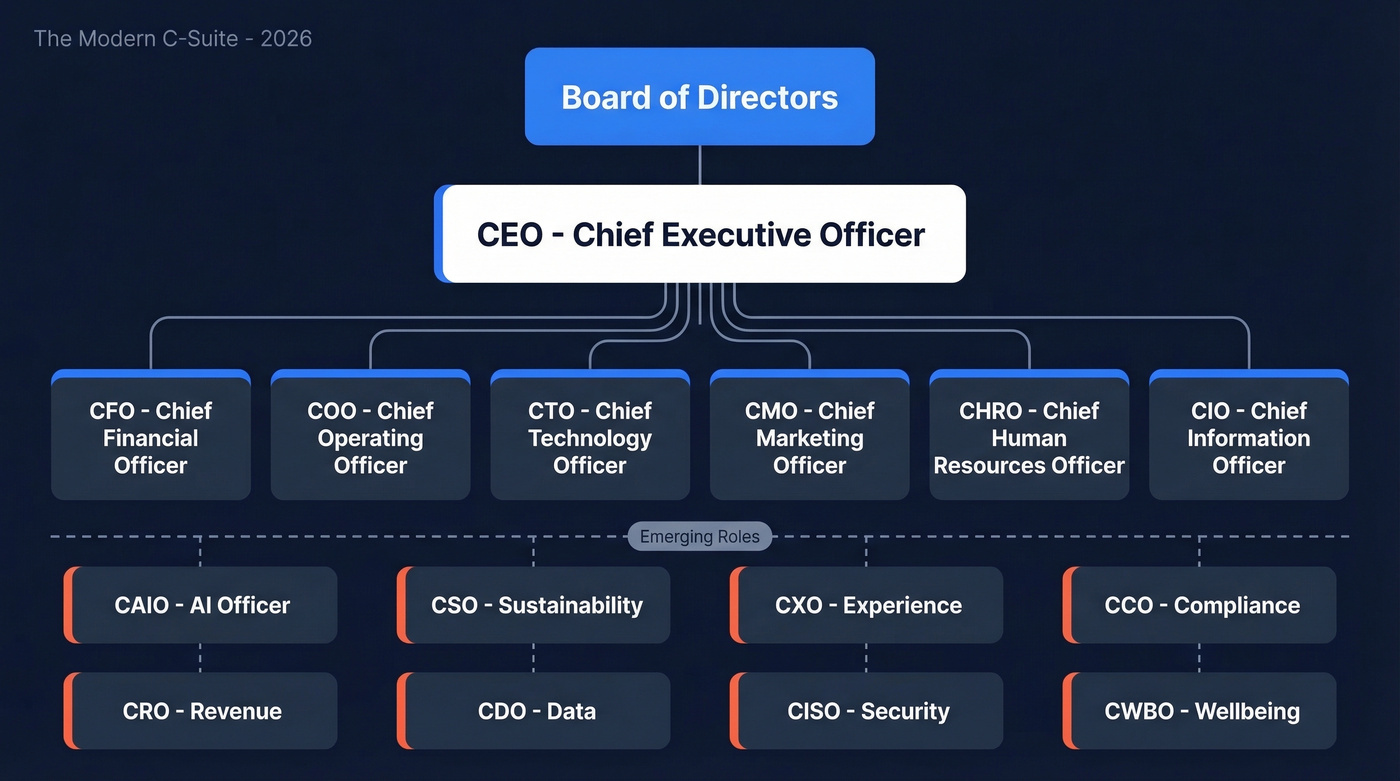
| Title | Full Name | What They Own | Reports To |
|---|---|---|---|
| CEO | Chief Executive Officer | Overall strategy, culture, board relations | Board of Directors |
| CFO | Chief Financial Officer | Financial planning, reporting, capital allocation | CEO |
| COO | Chief Operating Officer | Day-to-day operations, execution | CEO |
| CTO | Chief Technology Officer | Technology strategy, product engineering | CEO |
| CMO | Chief Marketing Officer | Brand, demand generation, market positioning | CEO |
| CHRO | Chief Human Resources Officer | Talent, culture, organizational design | CEO |
The CEO is the only role that reports directly to the board. Everyone else reports to or through the CEO, though in practice the CFO often has a dotted line to the audit committee.
The COO deserves a special note: it's the "make it work" role, responsible for translating strategy into operational reality. Many startups skip the COO entirely - the CEO handles operations until the company hits 200-500 employees and the complexity demands a dedicated operator. At larger companies, the COO is often the CEO's heir apparent.
One distinction that trips people up: CTO vs. CIO. In companies that have both, the CTO typically focuses on building and evolving product and engineering capabilities, while the CIO handles internal IT operations and enterprise systems.
Emerging Chief Officer Roles
The C-suite has been restructured over the last five years. Deloitte's analysis of Fortune 500 C-suite composition and 46,000 C-suite job postings (2018-2023) shows organizations adding more executive seats while expanding the scope of existing ones. Understanding the modern executive tier requires looking well beyond the traditional six.
| Title | Full Name | Why It Exists |
|---|---|---|
| CAIO | Chief AI Officer | AI strategy, ethics, ROI |
| CSO | Chief Sustainability Officer | ESG reporting, climate risk |
| CXO | Chief Experience Officer | Customer + employee experience |
| CCO | Chief Compliance Officer | Regulatory compliance, risk |
| CRO (Revenue) | Chief Revenue Officer | End-to-end revenue, sales + CS |
| CDO | Chief Data Officer | Data strategy, governance |
| CISO | Chief Information Security Officer | Cybersecurity, breach response |
| CWBO | Chief Wellbeing Officer | Employee health, culture |
A note on CRO: this title has a dual meaning depending on industry. In tech and SaaS, the CRO owns the full revenue engine - sales, customer success, sometimes marketing. In financial services and insurance, CRO means Chief Risk Officer. Context matters.
You'll also encounter niche titles like Chief Green Officer, Chief Trust Officer, and Chief Social Scientist. These are rare but signal where specific industries are heading. The proliferation isn't vanity. When a critical capability like data governance or AI ethics touches four functions simultaneously, someone needs to own it at the executive level - or nobody does.
The Chief AI Officer
The CAIO role is new, and it's already evolving faster than any other C-suite position. CIO.com's analysis frames it as two distinct phases:
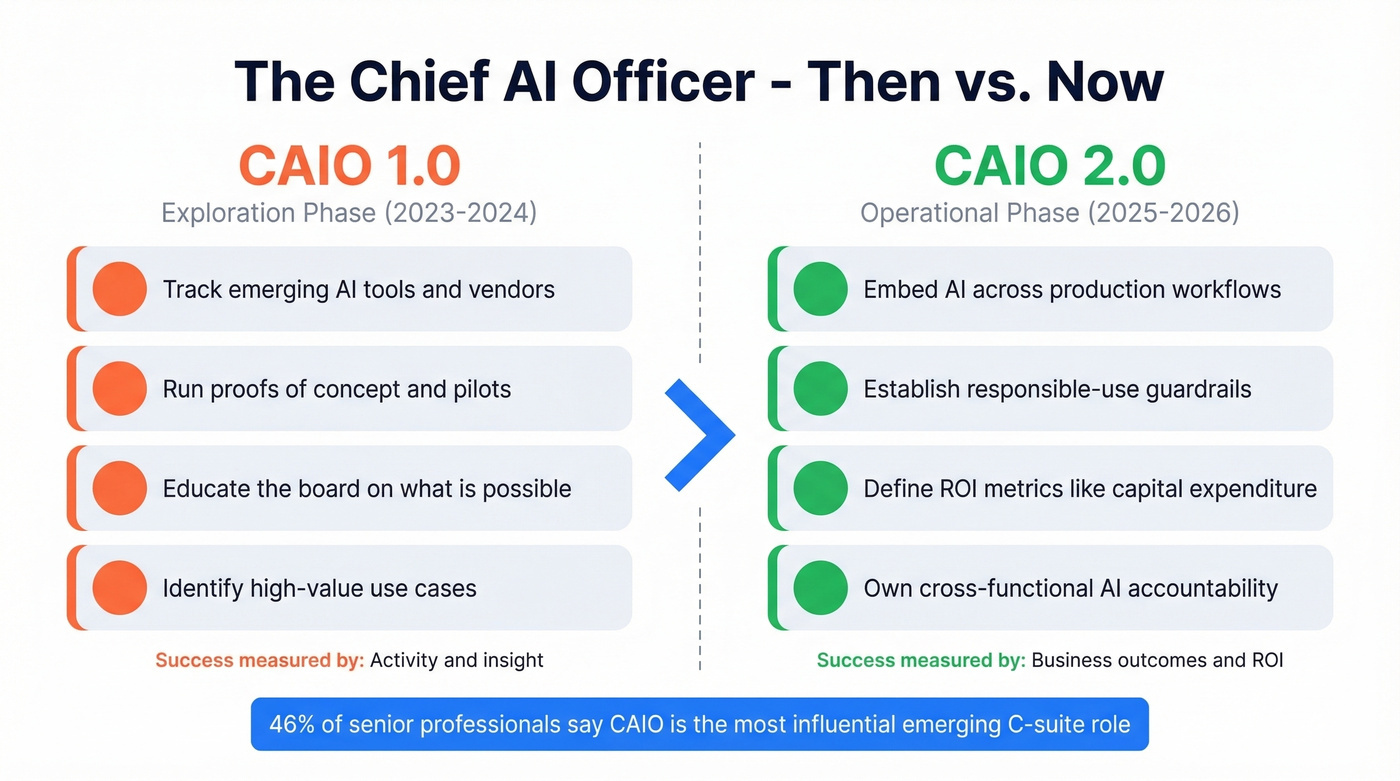
CAIO 1.0 was "go do AI." The mandate was exploratory: track emerging tools, run proofs of concept, educate the board on what's possible, and identify high-value use cases. Success was measured in activity and insight - presentations delivered, pilots launched, awareness raised.
CAIO 2.0 is operational. As AI moves from experimentation into production workflows, the CAIO's job shifts to embedding AI across the organization, establishing responsible-use guardrails, and defining ROI metrics with the same rigor as capital expenditure. This is a fundamentally harder job - and it's where most organizations are headed in 2026.
The org-structure question remains unresolved. Does the CAIO report to the CEO? The CTO? The COO? Some companies keep a distinct CAIO; others are already absorbing the responsibilities back into the CIO or CTO role as AI normalizes. A Hays survey found that 46% of senior professionals see the CAIO as the most influential emerging C-suite role.
Here's the thing: if your company doesn't have someone explicitly owning AI strategy at the executive level, you're already behind. Whether that person's title says "CAIO" or not matters less than whether the accountability exists.
C-Level vs. VP vs. Director
You just got promoted to VP and someone tells you "you're basically C-level now." You're not. The gap between VP and C-suite isn't a step - it's a chasm.
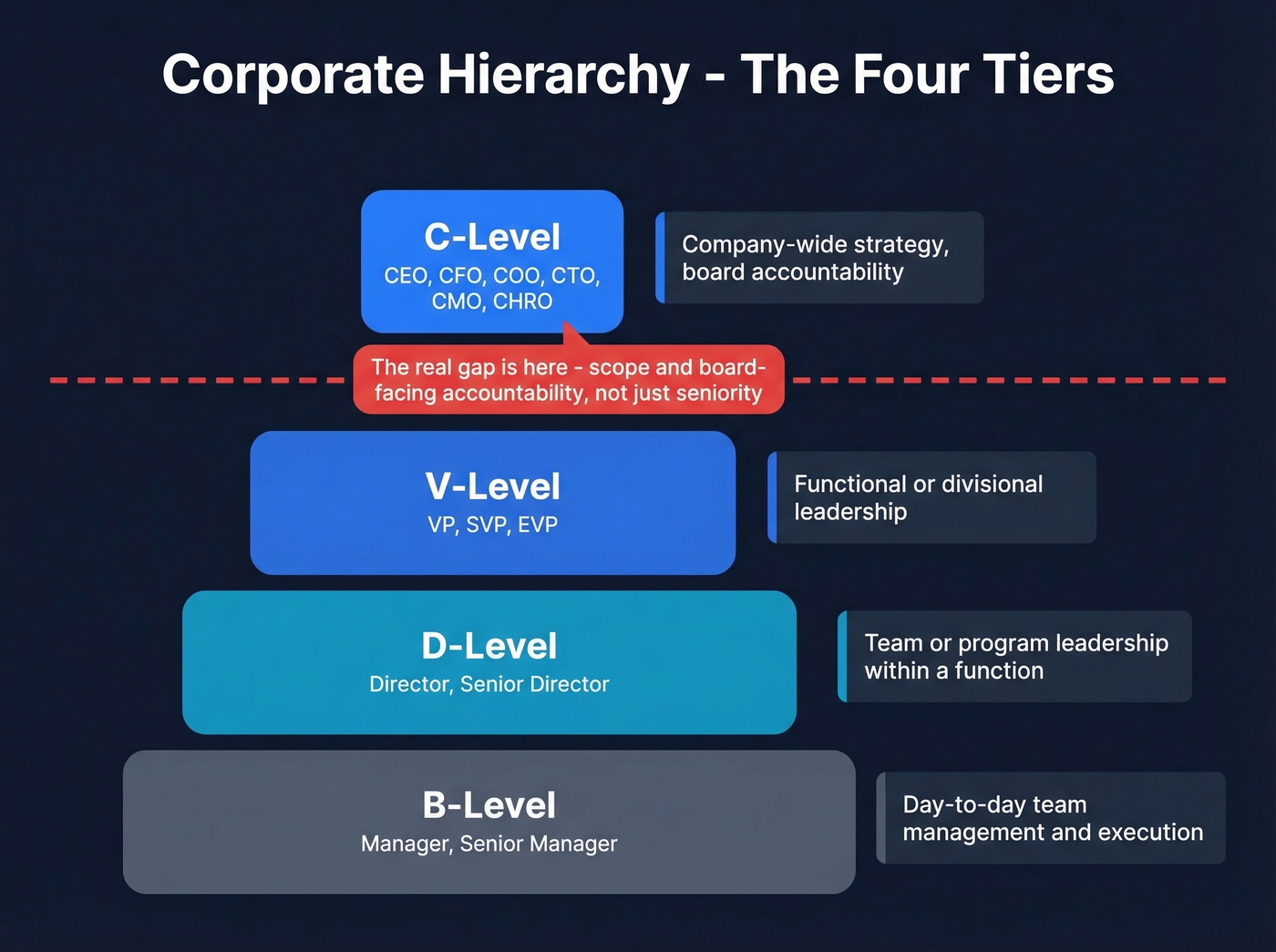
Corporate hierarchy follows a four-tier framework, and the full progression typically looks like this: Manager -> Senior Manager -> Director -> Senior Director -> VP -> SVP/EVP -> C-Level.
- C-Level (Chief Officers): Company-wide strategy, board accountability
- V-Level (VPs, SVPs, EVPs): Functional or divisional leadership, major initiative ownership
- D-Level (Directors, Senior Directors): Team or program leadership within a function
- B-Level (Managers, Senior Managers): Day-to-day team management, execution
The critical difference between chief officers and V-level executives isn't seniority - it's scope and accountability. A VP of Sales owns the sales function. A CRO owns the entire revenue engine and answers for it at the board level. A VP of Engineering owns the engineering team. A CTO owns the technology strategy for the entire company and makes decisions that affect every department.
VPs attend executive meetings, influence strategy, and carry significant authority. But they don't hold the same board-facing accountability, and they operate within a function rather than across the organization. That's the line.

Selling into the C-suite means reaching real decision-makers - not gatekeepers. Prospeo's 30+ search filters let you target by title, seniority, department headcount, funding stage, and buyer intent across 300M+ verified profiles. 98% email accuracy means your outreach actually lands.
Stop researching C-level titles and start reaching them.
C-Level Compensation
Pay Ratios That Matter
Most compensation articles throw out a Glassdoor average and call it useful. It's not. A "median CEO salary" that blends a 50-person startup with JPMorgan Chase tells you nothing actionable. Ratio data from corporate disclosures is far more useful - it shows you how the pie gets split regardless of company size.
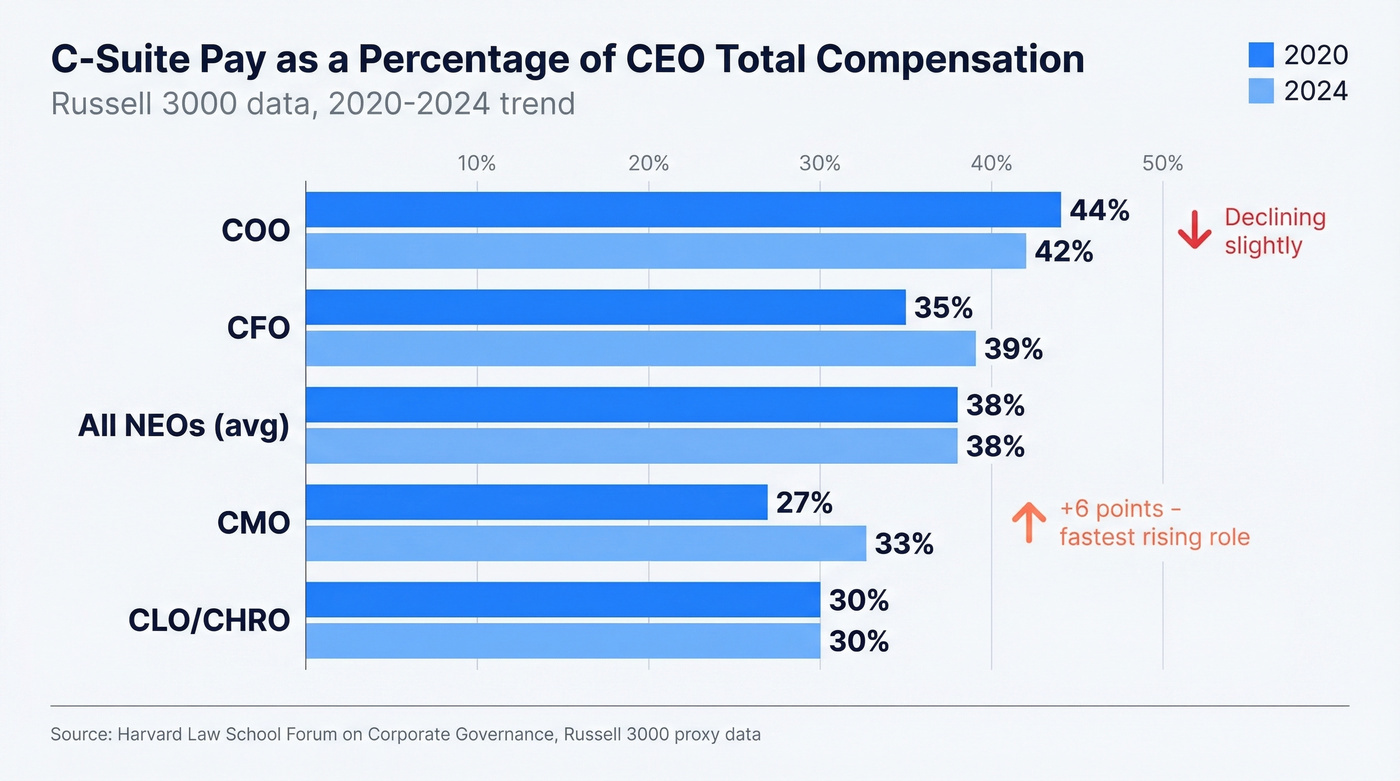
| Role | % of CEO Pay (Russell 3000) | % of CEO Pay (S&P 500) | Trend (2020-2024) |
|---|---|---|---|
| CFO | 37-39% | 33-35% | Rising |
| COO | 42% | 38% | Declining slightly |
| CMO | 30% | 27-33% | Rising fast |
| CLO/CHRO | 30% | 29% | Stable |
| All NEOs (avg) | 38% | 31% | Stable |
The CMO trend is the most interesting story here. In the S&P 500, CMO compensation jumped from 27% to 33% of CEO pay between 2020 and 2024. That's a massive shift - and it reflects the growing strategic importance of marketing in companies where customer acquisition cost and brand equity are board-level concerns.
For context on absolute numbers: S&P 500 CEO total compensation often reaches the mid-to-high eight figures ($15-20M) including equity. At smaller companies under 500 employees, executive leaders typically earn base salaries ranging from $150K-$400K, with equity packages varying wildly based on stage and funding.
How C-Suite Pay Is Structured
Modern executive compensation is increasingly built around multi-metric scorecards that blend financial performance with customer experience, employee retention, and organizational agility. Long-term equity remains the centerpiece - and in many public-company packages, equity represents the majority of total compensation.
Boards are tightening clawback provisions, leaning into say-on-pay shareholder votes, and demanding more transparency around how total compensation is calculated. Pay transparency is accelerating this trend, with more companies publishing total comp breakdowns and rationale in proxy statements. Gender pay differentials in the Russell 3000 generally run under $100K, while S&P 500 gaps are wider in absolute terms simply because the pay levels are higher.
Why the C-Suite Is Expanding
The expansion isn't cosmetic. It reflects a structural shift in how accountability flows through organizations.
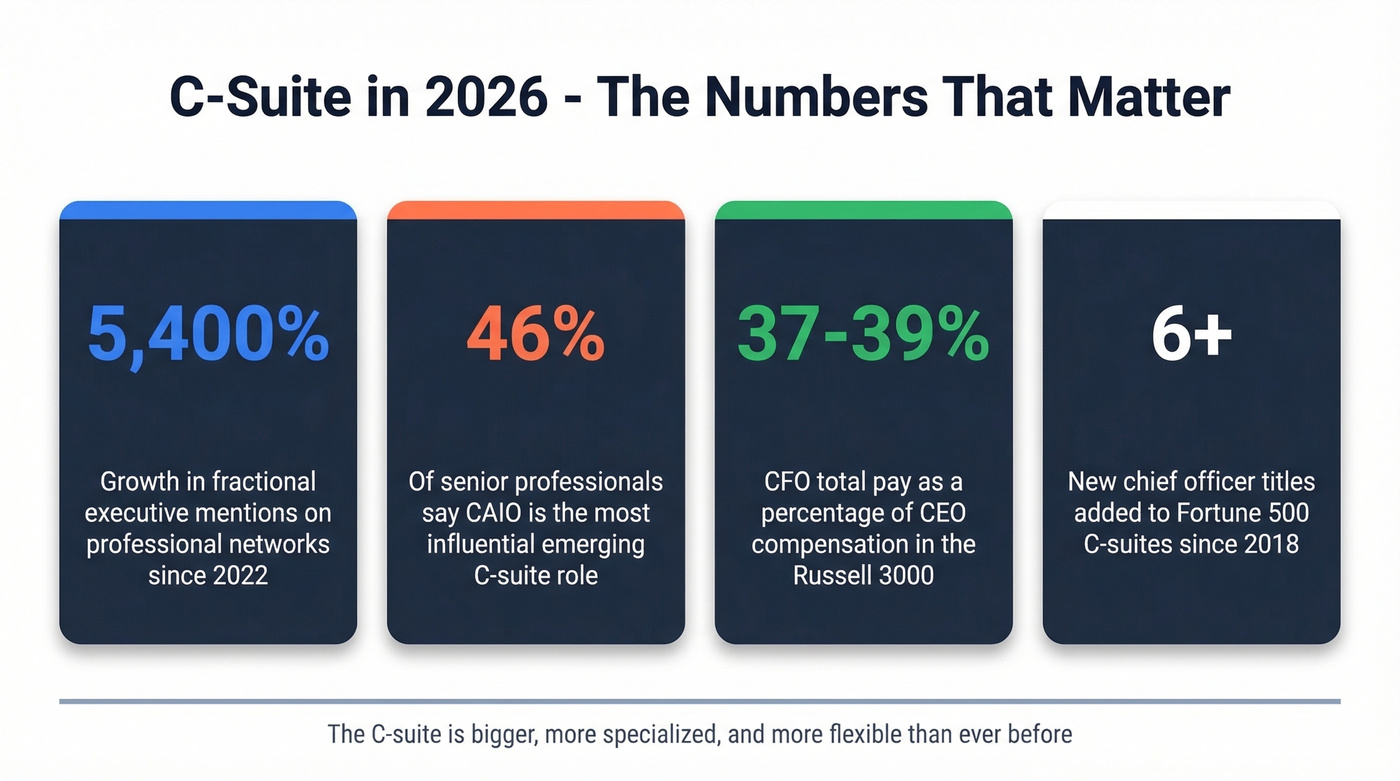
Deloitte's analysis of Fortune 500 companies and 46,000 C-suite job postings between 2018 and 2023 tells a clear story: organizations are both adding new C-suite roles and expanding the scope of existing ones. The result is more overlap, more ambiguity, and a greater need for coordination at the top.
The driver is responsibility diffusion. Take data governance: five years ago, that was the CIO's domain. Today, data and AI governance touches the CMO through privacy in personalization, the CHRO through employee data and AI in hiring, the CPO through product development, and the legal team through regulatory compliance. When a critical capability touches four functions, you either create a dedicated executive to own it or you accept that nobody does. VantEdge Search estimates that formalizing specialized C-suite ownership can improve governance agility by up to 30%.
The Fractional C-Suite
The fractional executive trend isn't a stopgap. It's becoming the default for companies under 500 employees.
The numbers are staggering: professional profiles mentioning fractional roles jumped from 2,000 in 2022 to 110,000 by early 2024 - a 5,400% increase. Gartner forecasts that by 2027, 30%+ of midsize enterprises will have at least one fractional executive on retainer.
The economics make sense. A fractional CFO or CMO typically works 15-20 hours per week and costs 40-60% less than a full-time hire. For an early-stage company that needs senior financial or go-to-market strategy but can't justify a full-time executive, fractional leadership delivers the expertise without the overhead.
We've seen this pattern constantly in the startup world: COO is absent until the company hits real operational complexity, and CFO is fractional until Series B or C. If your average deal size is under $25K and you have fewer than 200 employees, you probably don't need a full-time C-suite beyond CEO and maybe CTO. A fractional CFO and fractional CMO will outperform full-time hires at that stage because they bring pattern recognition from five companies instead of learning on the job at yours.
CMO tenure at leading US advertisers has dropped to under three years - the lowest since 2009. When the average tenure is that short, the traditional model of recruiting, onboarding, and hoping for a multi-year run starts looking inefficient compared to a fractional leader who's already seen the playbook at a dozen companies.
What C-Level Leaders Focus on in 2026
Four priorities dominate the C-suite agenda this year:
Agentic AI ROI
The experimentation phase is over. Boards want AI investments treated like capital allocation - with stage gates, measurable value, and kill criteria. 92% of companies are increasing AI investment, but only 1 in 4 CEOs feel prepared to manage it. That gap between spending and readiness is the defining tension of 2026.
Compliance as Proof
The shift from "we're preparing for compliance" to "we can demonstrate compliance" is real. Boards want proof of control, auditability, and accountability - especially around cybersecurity and operational resilience. The average cost per breach sits at $4.88M. That number concentrates minds.
Finance-Grade Sustainability
Narrative ESG reports are giving way to auditable, finance-grade systems. The ISSB standards (IFRS S1 and S2) are driving convergence globally, with the UK rolling in implementation requirements starting in 2026. CSOs who can't produce numbers that pass audit scrutiny won't last long.
Geopolitical De-Risking
This isn't new - it's a permanent operating condition. But the executive response is maturing from reactive crisis management to proactive cross-functional integration across strategy, legal, procurement, treasury, and government affairs. The companies that treat geopolitics as a standing agenda item, not a quarterly surprise, are the ones navigating it best.
Skills Every C-Level Exec Needs
The half-life of tech-specific skills is 2.5 years. Half of what a CTO knew about their stack in 2024 is already outdated. The skills that endure are different.
Human skills are 2.4x more in demand than digital skills at the executive level. An Oxford study found that 87% of strong leadership traits are interpersonal and character-driven, not technical. This doesn't mean technical literacy is optional - it means it's table stakes, not a differentiator.
AI literacy is the clearest example. Every executive in 2026 needs to understand what AI can and can't do, how to evaluate AI investments, and how to govern AI use across their organization. You don't need to write code. You do need to ask the right questions when your team proposes a $2M AI initiative.
Cyber risk awareness is non-negotiable. With breaches averaging $4.88M per incident, a CEO or CFO who can't engage meaningfully on cybersecurity is a liability. This isn't the CISO's problem alone - it's a board-level concern that every C-suite member needs to understand.
The hiring data reflects this shift: in 2024, 44% of new CEOs were sourced externally, up 12% from the prior year. Boards are looking outside their organizations for leaders who bring fresh perspectives, cross-functional experience, and the specific skill mix the moment demands.
How to Reach the C-Suite
The path to the top isn't always internal anymore. With 44% of new CEOs sourced externally, the "climb the ladder at one company" playbook is increasingly outdated.
What boards actually look for: P&L ownership, cross-functional experience, and the ability to communicate at the board level. If you've only ever managed a single function, you're not ready. The executives who get tapped for chief officer roles have typically run a business unit, managed a turnaround, or led a cross-functional initiative that touched multiple parts of the organization.
Look - the skill mix is shifting under everyone's feet. AI literacy, cyber risk awareness, and sustainability fluency are now expected alongside traditional strategic and financial acumen. A CFO candidate who can't discuss AI's impact on financial modeling is at a disadvantage. A CMO candidate who doesn't understand privacy regulation is a risk.
The fractional route is emerging as a legitimate alternative path. Instead of waiting for a single company to promote you, you can build a portfolio of executive engagements across multiple companies. It builds the breadth of experience that boards value - and it lets you prove you can operate at the highest level before anyone takes a $400K bet on you full-time.
Build board-level communication skills early. The difference between a great VP and a chief officer often comes down to whether they can distill complexity into a 10-minute board presentation that drives a decision. Practice that skill before you need it.
If you're building outbound to executives, your sales prospecting techniques and list quality matter more than volume. Pair that with intent data so you're not pitching cold accounts that aren't in-market, and use personalized outreach to earn replies from people who can actually say yes.
Whether you're targeting a CAIO, CRO, or fractional CFO, Prospeo delivers verified emails and 125M+ direct mobile numbers with a 30% pickup rate. Layer in intent data across 15,000 topics to find executives actively evaluating solutions like yours - all at $0.01 per email.
Get past the org chart and into the inbox that matters.
FAQ
Is VP a C-level position?
No. VP sits one tier below in corporate hierarchy. VPs report to C-suite executives and lack board-facing accountability. A VP can attend executive meetings and carry significant authority, but they operate within a single function rather than across the organization.
What's the difference between C-suite and C-level?
They're used interchangeably in practice. Technically, "C-level" describes the rank - you hold a Chief Officer title - while "C-suite" refers to the group of executives collectively. Both mean the same thing: the company's top leadership tier.
What is the highest C-level position?
The CEO (Chief Executive Officer). The CEO reports directly to the board of directors and holds ultimate authority over company strategy, operations, and culture. All other C-suite members report to or through the CEO.
How much do C-level executives make?
In the Russell 3000, CFOs earn 37-39% of CEO total compensation, COOs about 42%, and CMOs about 30%. S&P 500 CEO total comp often reaches $15-20M including equity. At companies under 500 employees, base salaries typically range from $150K-$400K before equity.
How do sales teams reach C-level decision-makers?
Through warm introductions, industry events, and B2B data platforms that provide verified direct contact information. Tools like Prospeo offer verified professional profiles with direct mobile numbers, letting reps bypass gatekeepers and connect with executives directly.