

The C-Suite Explained: Every Role, What They Earn, and How It's Changing in 2026
Most C-suite explainers describe the org chart from 2015. The CEO, CFO, COO trinity with a few supporting players. The C-suite of 2026 looks nothing like that - it's wider, more specialized, and increasingly shaped by AI governance and sustainability mandates.
The Short Version
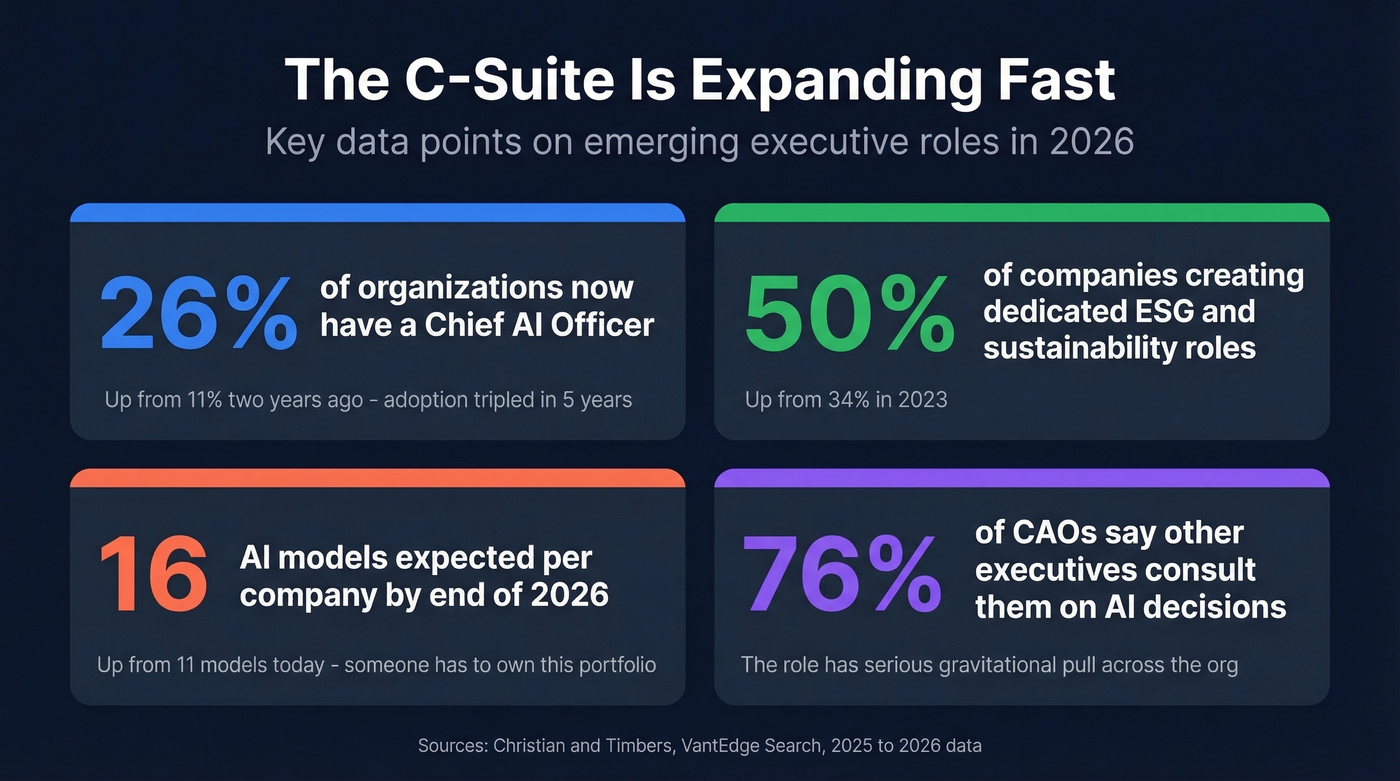
The C-suite is the group of a company's most senior executives - the "Chiefs." The core roster includes the CEO, CFO, COO, CTO, CIO, CMO, CHRO (or CPO), and CLO. But that list has expanded significantly. 26% of organizations now have a Chief AI Officer, up from 11% two years ago. Chief Sustainability Officers are growing fast. Chief Experience Officers, Chief Ethics Officers, and Chief Transformation Officers are showing up in Fortune 500 boardrooms that didn't have them five years ago.
The executive suite isn't shrinking. It's specializing.
What Does C-Suite Mean in Business?
The "C" stands for "Chief." It refers collectively to a company's highest-ranking executives - the people whose titles start with that word. Chief Executive Officer. Chief Financial Officer. Chief Operating Officer.
The term also carries a physical connotation: the executive floor, the corner offices, the suite where the big decisions get made. In practice, it's shorthand across every industry for "the people running the company." Whether you're at a 50-person SaaS startup or a Fortune 500 manufacturer, this leadership layer sets strategy, allocates capital, and answers to the board. Executive structures vary internationally - many European and Asian companies use two-tier board systems, and title conventions in Asia follow different hierarchies - but the core concept of a senior executive team is universal.
One of the most common questions on career forums and r/careeradvice is what these executives actually do all day. The answer is less glamorous than it sounds: most executive time gets consumed by meetings, stakeholder alignment, capital allocation decisions, and risk tradeoffs - not the strategic visioning that job descriptions emphasize.
Who's in the C-Suite?
The core roles you'll find at most mid-to-large companies:
- CEO - Chief Executive Officer
- CFO - Chief Financial Officer
- COO - Chief Operating Officer
- CTO - Chief Technology Officer
- CIO - Chief Information Officer
- CMO - Chief Marketing Officer
- CHRO / CPO - Chief Human Resources / People Officer
- CLO - Chief Legal Officer / General Counsel
- CCO - Chief Compliance Officer
Emerging titles now common in 2026: CAIO (Chief AI Officer), CSO (Chief Sustainability Officer), CXO (Chief Experience Officer), and Chief Ethics Officer.
Core Roles and Responsibilities
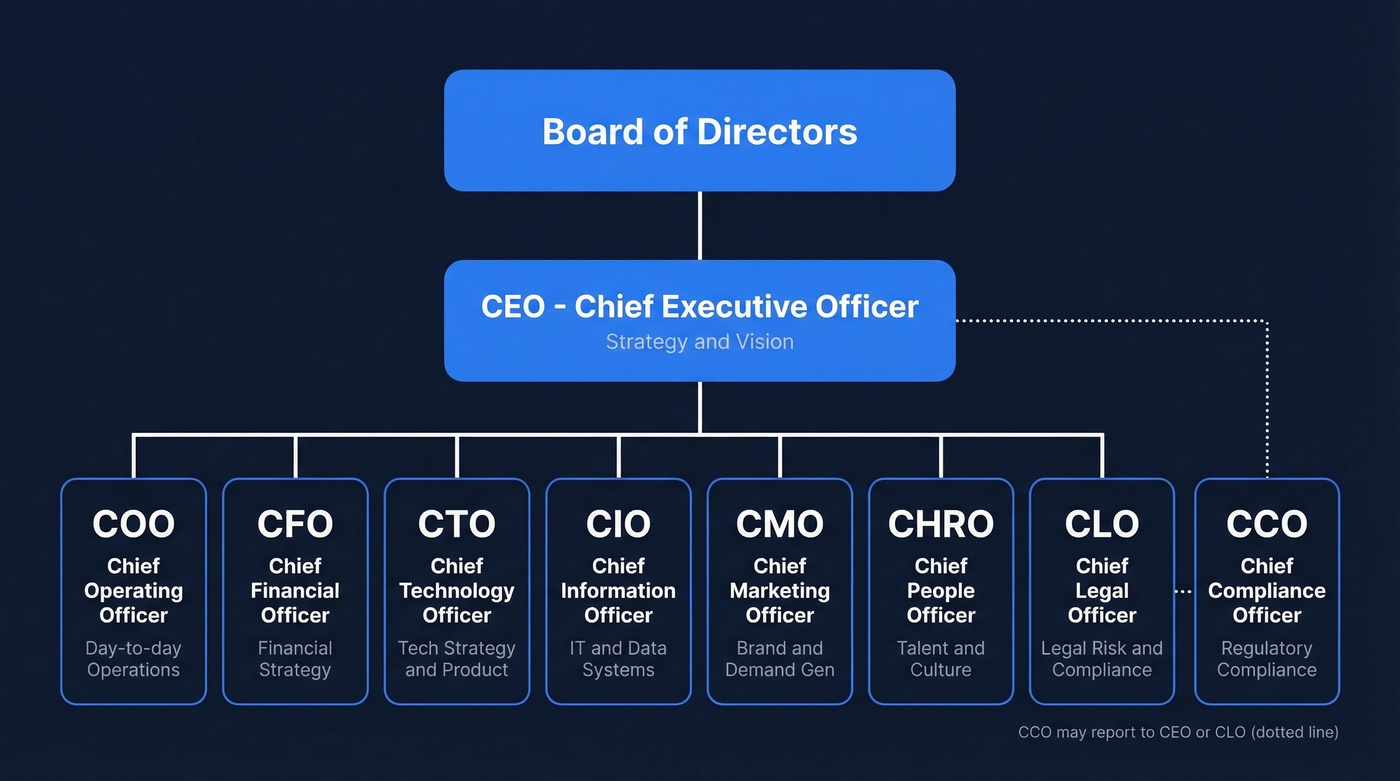
| Role | Full Title | Primary Focus | Reports To |
|---|---|---|---|
| CEO | Chief Executive Officer | Strategy & vision | Board |
| COO | Chief Operating Officer | Day-to-day operations | CEO |
| CFO | Chief Financial Officer | Financial strategy | CEO |
| CTO | Chief Technology Officer | Tech strategy & product | CEO |
| CIO | Chief Information Officer | IT & data systems | CEO |
| CMO | Chief Marketing Officer | Brand & demand gen | CEO |
| CHRO/CPO | Chief HR/People Officer | Talent & culture | CEO |
| CLO | Chief Legal Officer | Legal risk & compliance | CEO |
| CCO | Chief Compliance Officer | Regulatory compliance | CEO or CLO |
Let's talk about the roles people actually confuse.
The COO Problem
The COO is the most misunderstood role in the executive suite. Ask any COO what they do, and you'll get a different answer every time. That's not a bug - it's the defining feature of the role. At one company, the COO runs manufacturing and supply chain. At another, they're essentially the CEO's chief of staff. At a third, they own sales operations and customer success.
There's no standard job description. The COO's scope is whatever the CEO doesn't want to (or can't) handle personally, which is why COO tenure is often the shortest among senior executives: in the Fortune 500, average COO tenure sits at 3.2 years. When the CEO changes, the COO's mandate often evaporates with them.
CIO vs. CTO
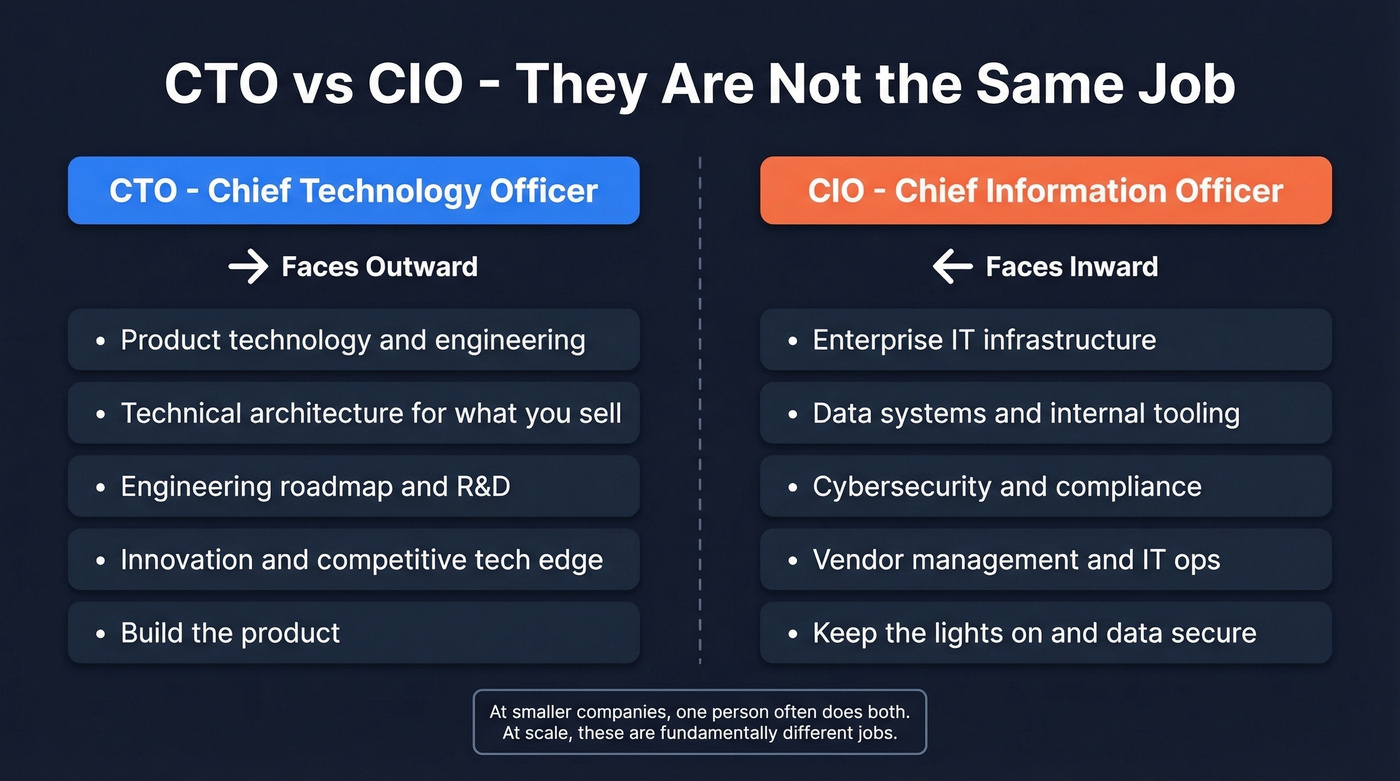
These two get conflated constantly. The CTO faces outward - product technology, engineering roadmap, technical architecture for what the company sells. The CIO faces inward - enterprise IT infrastructure, data systems, cybersecurity, internal tooling. At smaller companies, one person does both. But at scale, they're fundamentally different jobs. The CTO is building the product. The CIO is keeping the lights on and the data secure.
If you want the deeper breakdown, see CIO vs. CTO and how the split shows up in real org charts.
The CFO's Expanding Mandate
The CFO used to be the company's chief accountant. That era is over. Modern CFOs own financial planning, capital allocation, investor relations, and increasingly, data strategy. They're the second most powerful person in most organizations, and their compensation reflects it - CFOs earned 37-39% of CEO total comp in the Russell 3000 from 2020-2024.
CMO, CHRO, and CLO
The CMO owns brand, demand generation, and market positioning. The CHRO - increasingly called CPO, Chief People Officer - owns talent acquisition, culture, compensation, and workforce strategy. The CLO handles legal risk, regulatory compliance, M&A due diligence, and governance. The CCO often reports to the CLO and focuses specifically on regulatory compliance and risk management, a role that's grown substantially as regulatory environments have gotten more complex across nearly every sector.
Emerging C-Suite Roles in 2026
The executive leadership layer is expanding because business complexity is expanding. Half of companies now have four or more C-level technology roles alone.
Chief AI Officer (CAIO)
This is the role that's moved fastest. CAIO adoption has tripled in five years, with 26% of organizations now reporting one. Companies are running an average of 11 AI models today and expect to deploy 16 by end of 2026. Someone has to own that portfolio - the strategy, the governance, the vendor selection, the ethical guardrails.
The CAIO role has already evolved through two phases. The first wave was "go do AI" - a broad mandate to explore and pilot. CAIO 2.0 is about operational accountability: reliable value delivery in production, not the number of pilots launched. 76% of CAIOs say other executives consult them on AI decisions, which tells you something about the role's gravitational pull.
Here's the thing: if you've got 50+ employees and no one explicitly owns AI strategy, you're behind. The role might not carry the CAIO title - it could sit with the CTO or CIO - but someone needs to own it.
Chief Sustainability Officer (CSO)
50% of companies are now creating dedicated ESG and sustainability roles, up from 34% in 2023. The driver isn't just values - 30% of companies report cost reductions from sustainability initiatives, up from 12% in 2023. CSOs are increasingly operational leaders, not PR hires.
Chief Ethics Officer and Beyond
Salesforce, IBM, and Microsoft all have some version of a Chief AI Ethics Officer. The EU AI Act's operationalization is pushing more companies toward formal AI governance roles. Other emerging titles worth watching: Chief Experience Officer (CXO), who owns the end-to-end customer journey, and Chief Transformation Officer, who leads large-scale organizational change. Formalizing specialized executive ownership can improve governance agility by up to 30%.

Knowing C-suite roles is step one. Reaching them is step two. Prospeo gives you verified emails and direct mobile numbers for CEOs, CFOs, COOs, and every executive title covered in this guide - across 300M+ profiles with 98% email accuracy.
Stop mapping the org chart and start filling your pipeline.
Structure by Company Size
Not every company needs a full executive roster. The right structure depends on stage and scale.
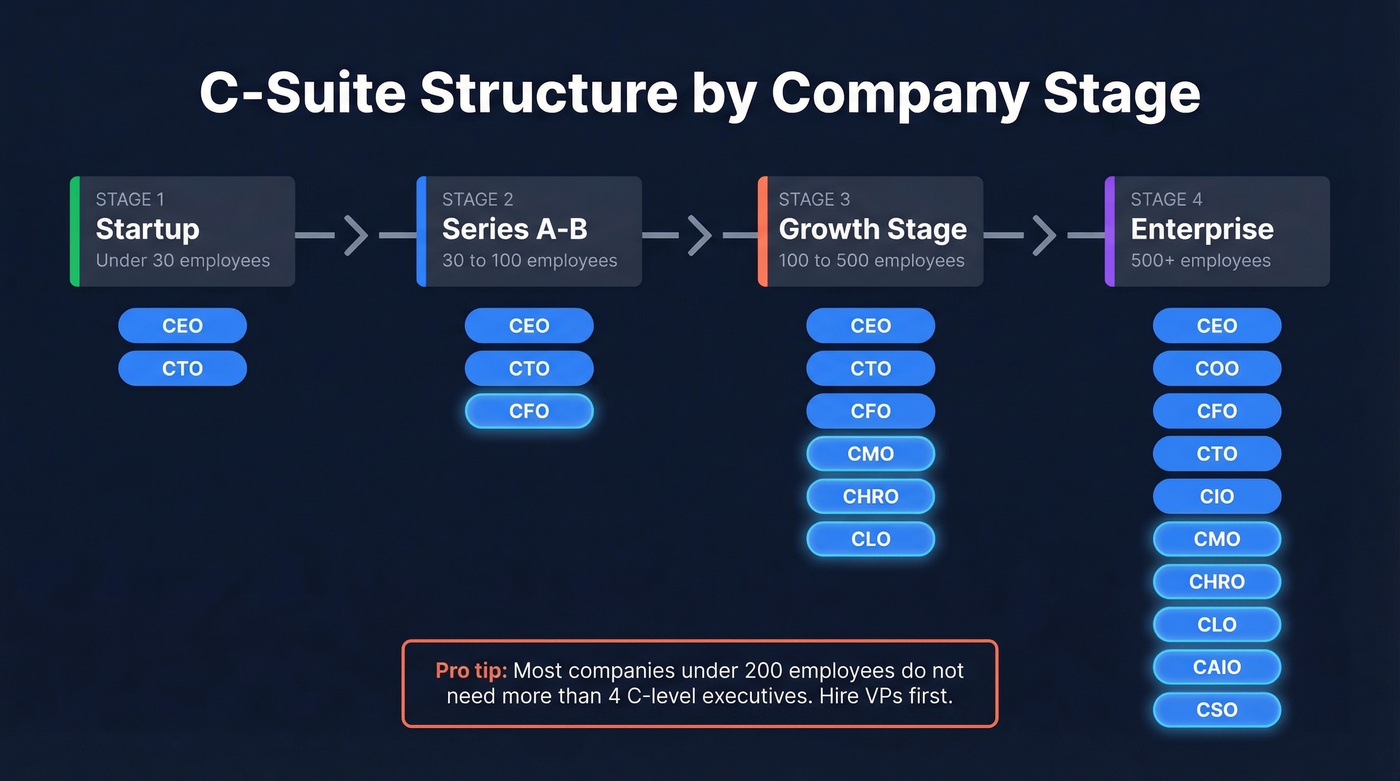
Startups (under 30 employees): Flat structure. The CEO and maybe a CTO. Everyone else has functional titles without "Chief" in them. Hierarchy at this stage creates overhead without value.
Series A-B (30-100 employees): Add a CFO. You need someone who isn't the CEO managing cash flow, fundraising prep, and financial controls. Some companies add a VP of Sales or VP of Marketing here, but true C-level hires usually wait.
Growth stage (100-500 employees): This is where the CMO and CHRO typically arrive. Marketing needs strategic leadership, not just execution. People operations become complex enough to warrant a dedicated chief. Companies selling into regulated industries often add a CLO here too.
Enterprise (500+ employees): Full suite. Seven or more C-level roles, including newer positions like CAIO and CSO. Major public companies typically need CEO, COO, CFO, CTO, CIO, CMO, and CLO at minimum.
We've seen companies skip the traditional COO hire entirely and go straight to a CAIO or Chief Revenue Officer based on what the business actually needs. There's no universal playbook - the right executive team reflects your strategy, not a template.
Real talk: most companies under 200 employees don't need more than four C-level executives. Every additional "Chief" title you hand out before you need it dilutes the authority of the ones you already have. Hire VPs. Promote to C-level when the complexity demands it.
C-Suite Compensation
Raw salary numbers are less useful than pay ratios. A CEO at a 200-person company and a CEO at a Fortune 500 company both carry the same title, but their compensation differs by orders of magnitude. Ratios tell you about organizational power dynamics.
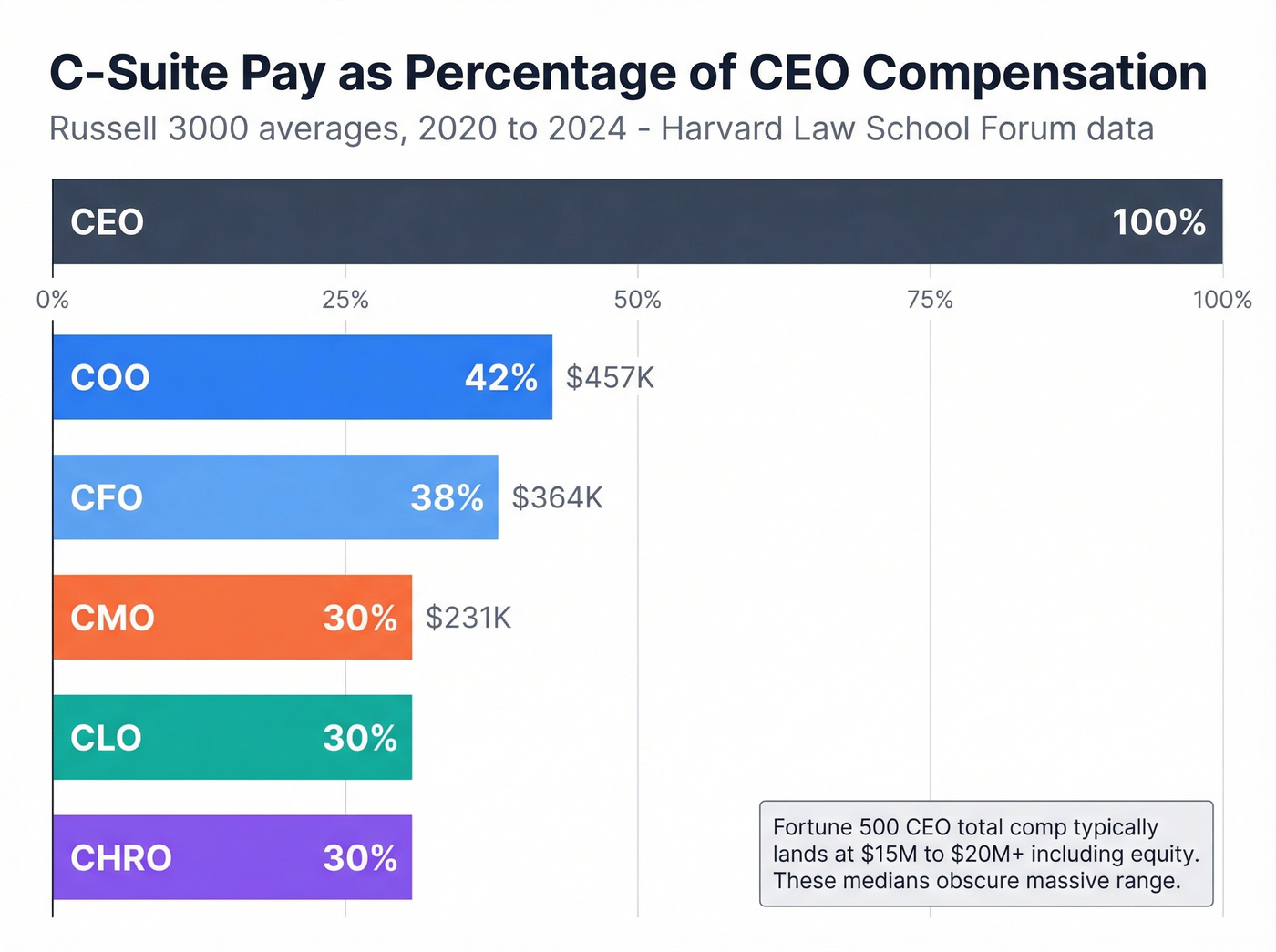
| Role | Russell 3000 (% of CEO) | S&P 500 (% of CEO) |
|---|---|---|
| CFO | 37-39% | 33-35% |
| COO | ~42% | ~38% |
| CMO | ~30% | ~33% |
| CLO | ~30% | ~25% |
| CHRO | ~30% | ~22% |
Data from Harvard Law School Forum / Conference Board analysis covering 2020-2024.
The COO commands the highest ratio after the CEO - roughly 42% in the Russell 3000 - which makes sense given the operational breadth of the role. The CFO's ratio in the S&P 500 rose from 33% to 35% between 2020 and 2024, reflecting the expanding scope of the modern CFO.
Industry variation is significant. CMOs in communication services earn 72% of CEO pay. CMOs in real estate earn 53%. The function matters, but the industry context matters more.
For absolute numbers as a rough benchmark: median CEO total compensation across all company sizes runs around $754K, with COOs at $457K, CFOs at $364K, CTOs at $235K, and CMOs at $231K. These medians obscure massive range - Fortune 500 CEO total comp typically lands in the $15-20M+ territory when you include equity. In our experience, pay ratios tell you far more about organizational power than raw salary numbers ever will.
Diversity - Current State
The numbers are moving, but slowly. Spencer Stuart's Fortune 500 snapshot shows 40% of functional C-suite roles held by women and 16% by ethnically diverse leaders. Combined representation of women and underrepresented groups ticked up from 49% to 50% year-over-year.
The pipeline problem is real. McKinsey's Women in the Workplace research - covering 124 organizations and roughly 3 million employees - identifies sponsorship as the single biggest predictor of promotion: employees with sponsors get promoted at nearly twice the rate of those without. But sponsorship access is uneven. At the entry level, 45% of men have sponsors versus 31% of women. At VP and above, the gap narrows (72% vs. 66%) but doesn't close. The bottleneck isn't ambition - 84% of senior-level women want a promotion - it's access to the relationships that convert ambition into advancement.
Some role-level trends: inclusion and diversity leadership positions in the Fortune 500 are up 9% to 321. CSO roles grew 2% to 294. But CMO and Chief Communications Officer roles are actually declining - down 8% and 6% respectively since 2023. The executive suite isn't just growing; it's reshuffling.
C-Suite vs. Board of Directors
People confuse these two constantly. The C-suite is the operational nerve center - they run the company day-to-day. The board of directors provides oversight - they don't run operations, they evaluate leadership and protect long-term shareholder interests.
In a crisis, the distinction sharpens. Executives activate the response plan, coordinate messaging, make real-time decisions, and maintain business continuity. They don't wait for board approval for immediate action. The board evaluates leadership performance, approves extraordinary measures like asset sales or executive transitions, and conducts post-crisis reviews.
The tension between these two groups is more significant than most people realize. Only 28% of executives think their board has the right combination of skills for future-ready governance. 92% of executives want at least one board member replaced - compared to just 45% of directors who feel the same way. And the stat that says everything: 69% of executives think at least one director serves on too many boards. Only 7% of directors agree.
That perception gap matters. When the board and executive team aren't aligned on capability and commitment, governance breaks down.
Career Paths to the C-Suite
Cassandra Frangos's framework identifies four archetypes: the Tenured Track (climb within one organization), the Free Agent (move across companies for bigger roles), the Leapfrog Leader (skip levels through high-impact moves), and the Founder (build your way to the top).
About 60% of functional leaders at the executive level are internal appointments, which means the Tenured Track is still the most common path. But the Leapfrog path is gaining ground - especially in tech, where a VP of Engineering at a high-growth startup can jump to CTO at a larger company based on demonstrated impact rather than years served.
Average tenure of sitting Fortune 500 executive leaders is 4.9 years, up from 4.5 in 2023. CEOs hold on longest at 7.4 years. COOs have the shortest tenure at 3.2 years - consistent with the role's inherent instability. CLOs are the most durable at 6.1 years, likely because legal expertise is harder to replace and less subject to strategic pivots.
How to Reach C-Suite Decision-Makers
If you're in sales, marketing, or business development, everything above is context. The practical question is: how do you actually get in front of these people?
Senior executives are shielded by gatekeepers. Their emails aren't on the company website. Generic databases are full of stale data - and with average Fortune 500 tenure at 4.9 years, the person you're emailing may have changed roles since your list was last updated. I've watched teams burn through entire outbound campaigns targeting executives who left six months prior. The biggest mistake in executive outreach is using old data.
Three steps that actually work:
1. Define your ICP by title, company size, and industry. "CEOs" isn't specific enough. "CFOs at Series B-C SaaS companies with 100-500 employees" is. If you need a scoring framework, start with an Ideal Customer Profile template.
2. Use a B2B data platform with title-level filtering and intent signals. Prospeo covers 300M+ professional profiles with 30+ search filters - search by job title, company size, industry, and buyer intent signals across 15,000 topics powered by Bombora. If you're building lists at scale, lead enrichment and data enrichment services can help keep records usable. Data refreshes every 7 days versus the 6-week industry average, so you're not emailing someone who left months ago.
3. Verify contact data before outreach. Bounced emails burn your domain reputation. A 5-step verification process delivering 98% email accuracy means fewer bounces and a cleaner sender reputation. If you're troubleshooting, use an email bounce rate guide and an email deliverability checklist. For tool comparisons, see Bouncer alternatives and Hunter alternatives.

New C-suite roles like CAIO and CSO mean more decision-makers to reach. Prospeo's 30+ search filters let you target executives by title, company size, tech stack, and even buyer intent across 15,000 topics - at $0.01 per verified email.
Every emerging executive role is already in our database.
FAQ
What does C-suite stand for?
The "C" stands for "Chief." It refers to the group of a company's most senior executives whose titles begin with "Chief" - Chief Executive Officer, Chief Financial Officer, Chief Operating Officer, and so on.
What's the highest position in the C-suite?
The CEO. They set company strategy, report to the board of directors, and have final authority over major decisions. The COO and CFO typically rank second and third, though the COO role doesn't exist at every company.
Is a VP considered C-suite?
No. Vice Presidents and Senior Vice Presidents sit below the executive suite in the corporate hierarchy. C-level is reserved for roles carrying "Chief" in the title that report directly to the CEO or the board.
How many C-suite positions does a company need?
A startup might have two (CEO and CTO). A Fortune 500 company typically has seven or more, including newer roles like Chief AI Officer and Chief Sustainability Officer. Skip this question if you're under 200 employees - four or fewer C-level executives is almost always the right answer.
How do you find contact information for C-suite executives?
Use a B2B data platform with title-level filtering, company size segmentation, and frequent data refreshes. Stale data is the biggest risk - Fortune 500 leaders change roles every 4.9 years on average, so weekly refresh cycles matter more than database size alone.