

C-Suite Level: What It Means, Who's In It, and What's Changing in 2026
You're at a conference and someone hands you a card that reads "Chief Revenue Officer." Are they C-suite? Maybe. Are they a VP with a rebrand? Also maybe. Title inflation has made C-suite level genuinely confusing, and in 2026 the confusion is only getting worse as companies bolt on new "Chief" titles faster than they can define the roles.
Let's cut through it.
The Short Version
C-suite level means enterprise-wide authority, board access, and final decision-making power - not just "chief" in your title. How many C-suite executives a company has depends on size: small companies typically have 2-3, midsize companies 7-8, and large enterprises 17 or more. Median base salary for private-company CEOs hit $323,500, with 68% expecting a raise in 2026. One of the fastest-growing roles is Chief AI Officer - 26% of global enterprises now have one.
What Does C-Suite Level Actually Mean?
The "C" stands for "chief," but the word alone doesn't qualify someone. A "Chief Happiness Officer" at a 12-person startup isn't sitting in the same room as a Fortune 500 CFO. The real test comes down to three things.
Enterprise-wide scope. C-suite executives set strategy across the entire organization. A VP of Marketing runs marketing. A CMO shapes how the company goes to market, period.
Board access. These leaders operate one step below the board of directors, and some sit on the board themselves. They're accountable at the highest level, not just to a functional manager.
Final decision-making authority. When a decision affects the whole company - a merger, a pivot, a layoff - C-suite executives make the call. Everyone else recommends.
The term emerged as shorthand for the cluster of "Chief _____ Officer" titles that sit at the top of a corporate org chart. It sounds simple, but the boundaries get blurry fast once you start comparing companies of different sizes and industries.
C-Suite vs. VP: Where's the Line?
Here's the thing: most companies have multiple layers of vice presidents - VP, SVP, EVP - and the titles mean different things at different companies. In banking, an Executive Director and SVP can sit at the same rank. In tech, a "VP of Engineering" at a 50-person startup might wield more actual authority than an SVP at a 10,000-person enterprise.
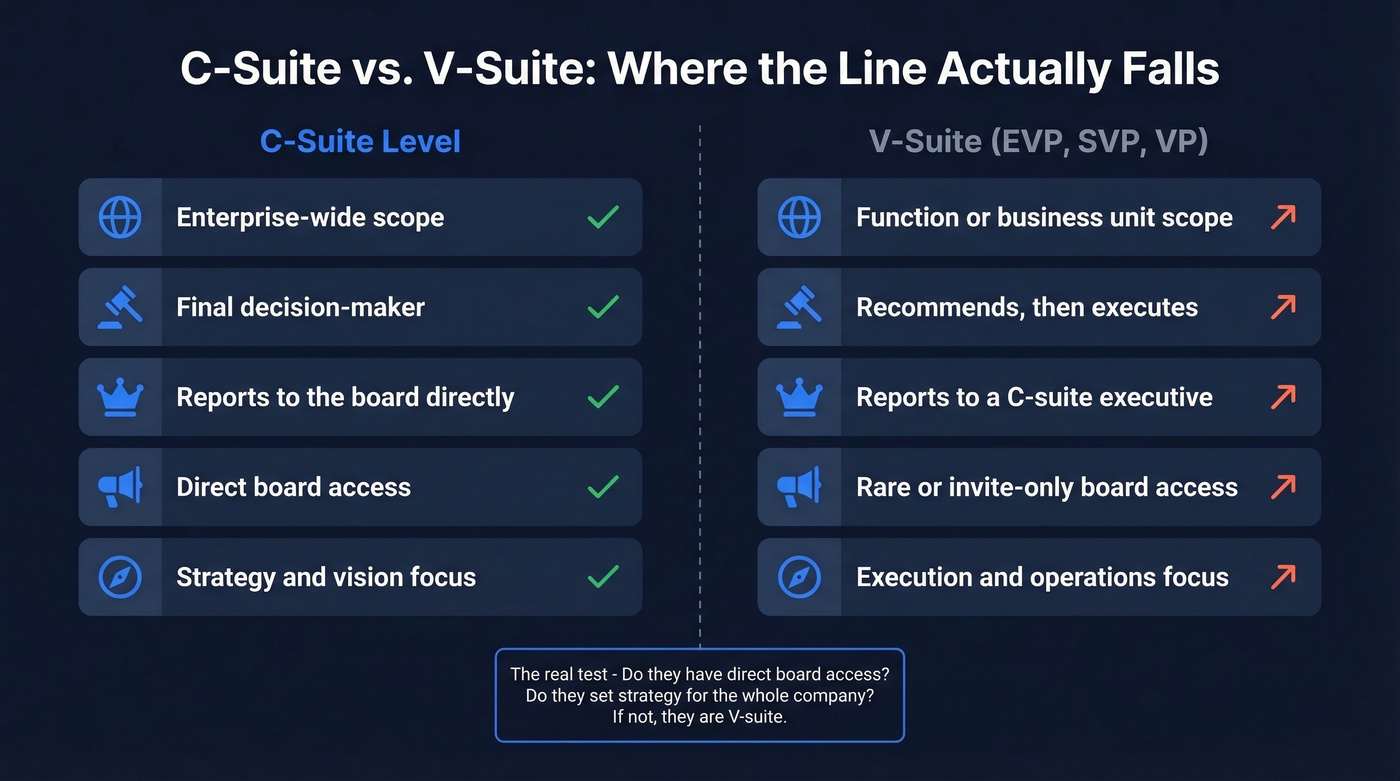
| Dimension | C-Suite | V-Suite (EVP/SVP/VP) |
|---|---|---|
| Scope | Enterprise-wide | Function or business unit |
| Authority | Final decision-maker | Recommends, then executes |
| Reports to | Board of directors | C-suite executive |
| Board access | Direct | Rare or by invitation |
| Focus | Strategy + vision | Execution + operations |
The multi-layer VP structure gives companies a career progression skeleton without creating a dozen new chief officer titles. But it also creates confusion. When someone tells you they're an "Executive Vice President," they could be the second-most-powerful person at the company or one of forty people with the same title.
If you're trying to figure out whether someone truly belongs at the top of the hierarchy, ask two questions: Do they have direct board access? Do they set strategy for the whole company? If either answer is no, they're V-suite - still senior, just not the top.
Every Core C-Suite Role Explained
CEO: The Top of the Hierarchy
The Chief Executive Officer reports directly to the board, sets the company's vision, and makes final calls on strategy. It's also a role with a steep learning curve - 3 in 5 new CEOs meet performance expectations in their first 18 months. That means 2 in 5 don't.
Median base salary for private-company CEOs sits at $323,500, but total comp with equity and bonuses can range from the high six figures at smaller firms to eight figures at public companies.
CFO: The Financial Gatekeeper
If you're selling into a company, the CFO is the person you need to understand. They own financial planning, risk management, and reporting - and they're increasingly a strategic partner to the CEO rather than just the person who signs off on budgets.
The CFO-CMO tension is real. In a McKinsey-cited 2019 survey, only half of CFOs said marketing delivers on the promise of driving growth, and 40% didn't think marketing investments should be protected during a downturn. That tension shapes how every dollar gets allocated.
COO: The Disappearing Role
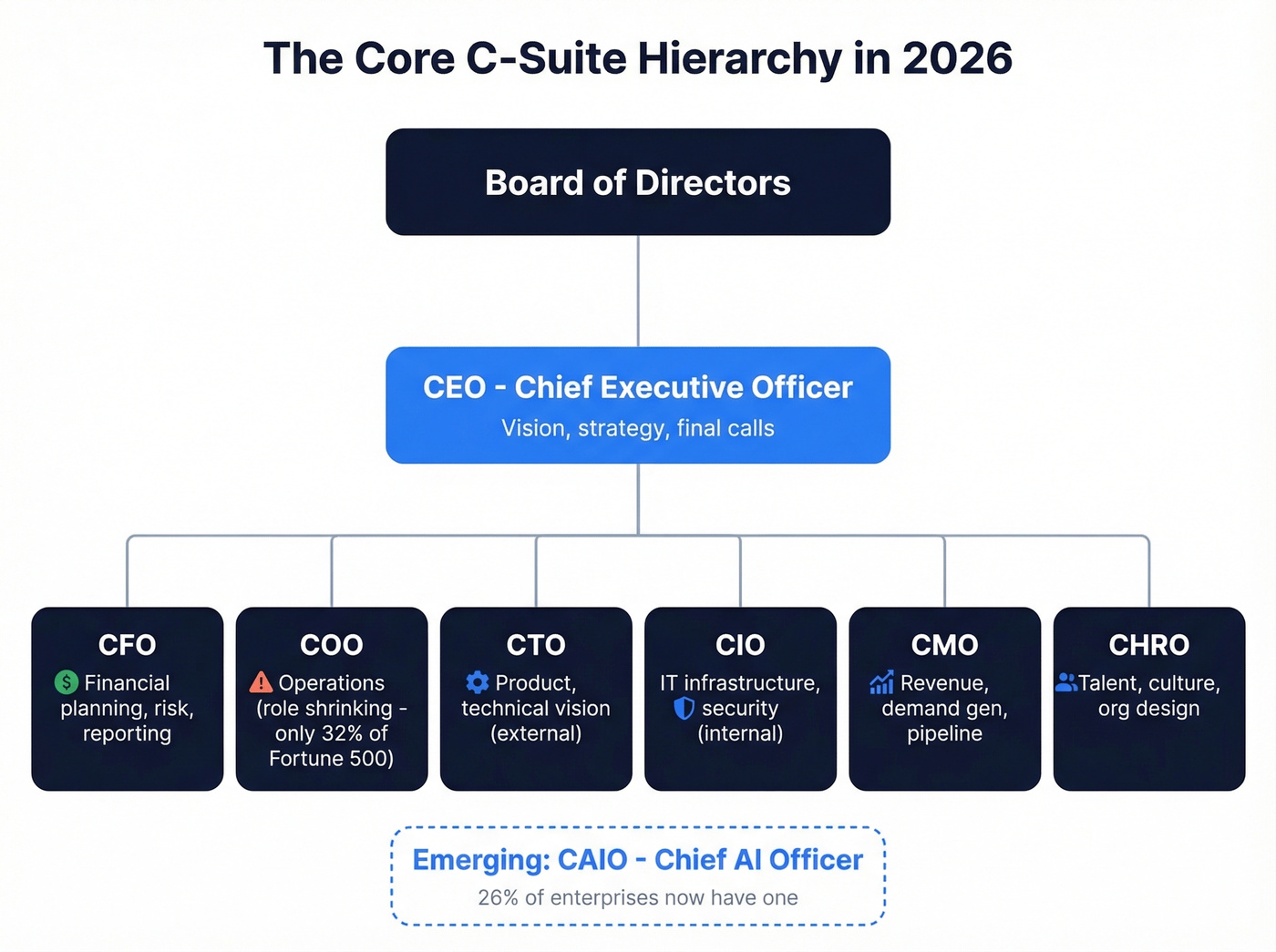
The COO used to be the CEO's right hand. Now the role is shrinking. 48% of Fortune 500/S&P 500 companies had a COO in 2000; by 2018, that number had dropped to 32%. Many companies now split COO responsibilities across other chief officers or push operational execution down to SVPs.
When the role does exist, it's often a signal that the CEO is externally focused - fundraising, M&A, public markets - and needs someone to run the inside.
CTO vs. CIO
These two get confused constantly. The CTO is typically external-facing: product development, technical vision, what the company builds. The CIO is internal-facing: IT infrastructure, security, internal systems, making sure the tech stack actually works. Some companies have both; smaller companies often combine them into one seat.
CMO: Revenue, Not Just Brand
The CMO in 2026 isn't just running brand campaigns. The modern CMO owns demand generation, pipeline contribution, and increasingly, revenue targets. The shift from "brand steward" to "revenue driver" has been happening for a decade, and it's now the baseline expectation. CMOs who can't tie marketing spend to pipeline don't last long.
If you're building pipeline, sales execution and pipeline health matter as much as positioning.
CHRO and CLO
The CHRO owns talent strategy, compensation, culture, and organizational design. The CLO or General Counsel manages legal risk, compliance, IP, and regulatory relationships. Both roles have grown in strategic importance - the CHRO because talent is a constraint for most companies, and the CLO because regulatory complexity around AI governance and data privacy keeps expanding year over year.

Knowing the C-suite hierarchy is step one. Reaching them is step two. Prospeo gives you verified emails and direct mobile numbers for C-suite decision-makers across 300M+ profiles - with 98% email accuracy and a 30% mobile pickup rate.
Skip the gatekeepers. Connect directly with the executives who sign off.
Compensation Benchmarks
The headline number: median base salary for private-company CEOs hit $323,500 in 2025, a 2% increase from $317,242 in 2024. For 2026, 68% of CEOs expect a base salary increase - and 21% of companies project increases above 5%.
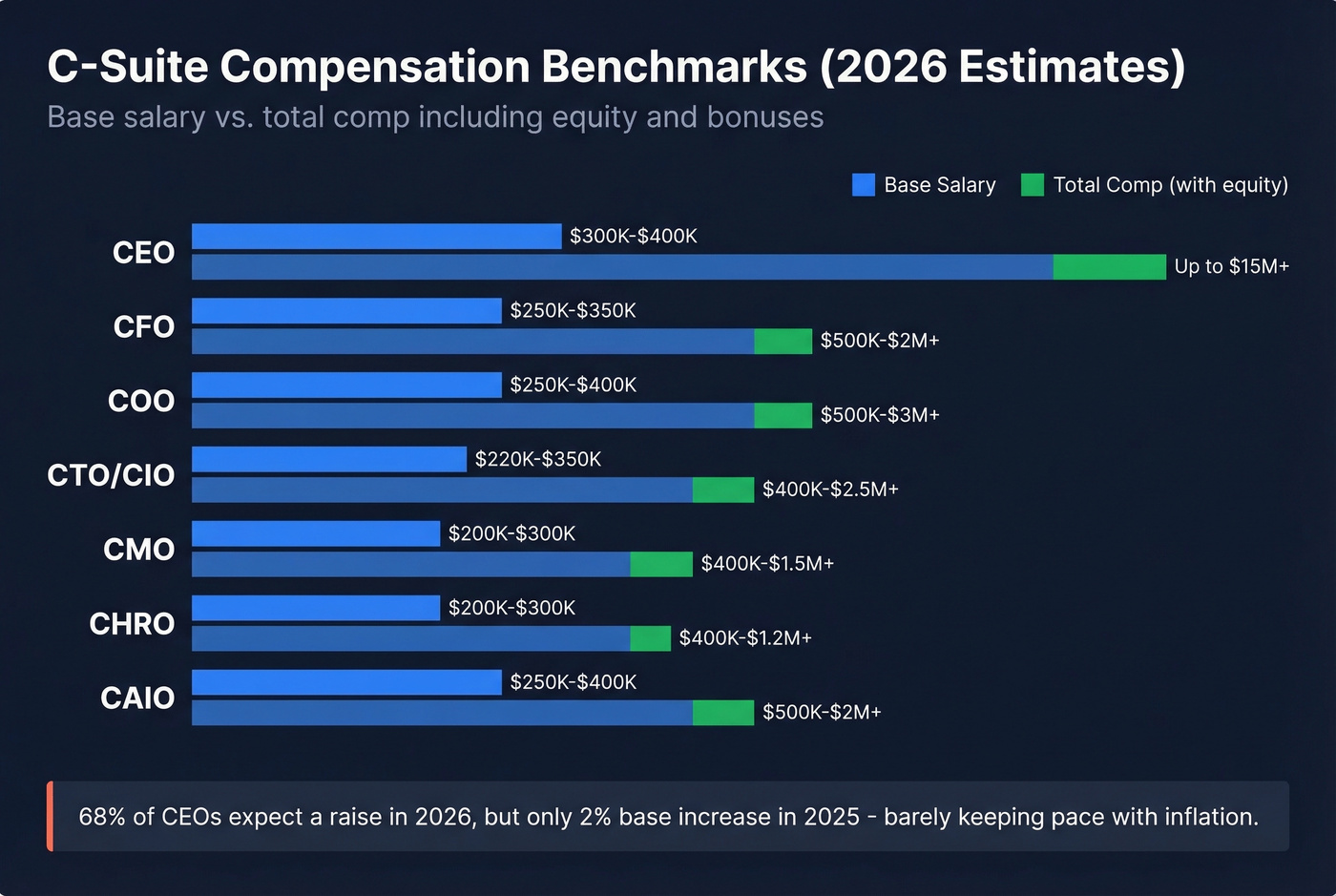
| Role | Est. Base Salary | Est. Total Comp |
|---|---|---|
| CEO | $300K-$400K | High six figures to $15M+ |
| CFO | $250K-$350K | $500K-$2M+ |
| COO | $250K-$400K | $500K-$3M+ |
| CTO / CIO | $220K-$350K | $400K-$2.5M+ |
| CMO | $200K-$300K | $400K-$1.5M+ |
| CHRO | $200K-$300K | $400K-$1.2M+ |
| CAIO | $250K-$400K | $500K-$2M+ |
Ranges reflect industry benchmarks across midsize to large companies. Total comp varies significantly with equity.
CEO base salary increases have lagged inflation for years. With 2025 inflation at 2.9% and private industry wage growth at 3.5%, that 2% CEO bump barely keeps pace. The real money at the top is in equity and bonuses - base salary is almost a formality at larger companies.
One interesting wrinkle: CEOs are the least likely group to expect a raise in 2026. Just 68% anticipate one, compared to 82% of other senior executives, 90% of mid-level managers, and 91% of frontline employees.
AI-Era C-Suite Roles
The biggest shift in executive composition right now is the rise of the Chief AI Officer. An IBM 2025 survey found that 26% of global enterprises now have a CAIO, up from 11% just two years earlier. And 57% of those CAIOs were promoted internally rather than hired from outside.
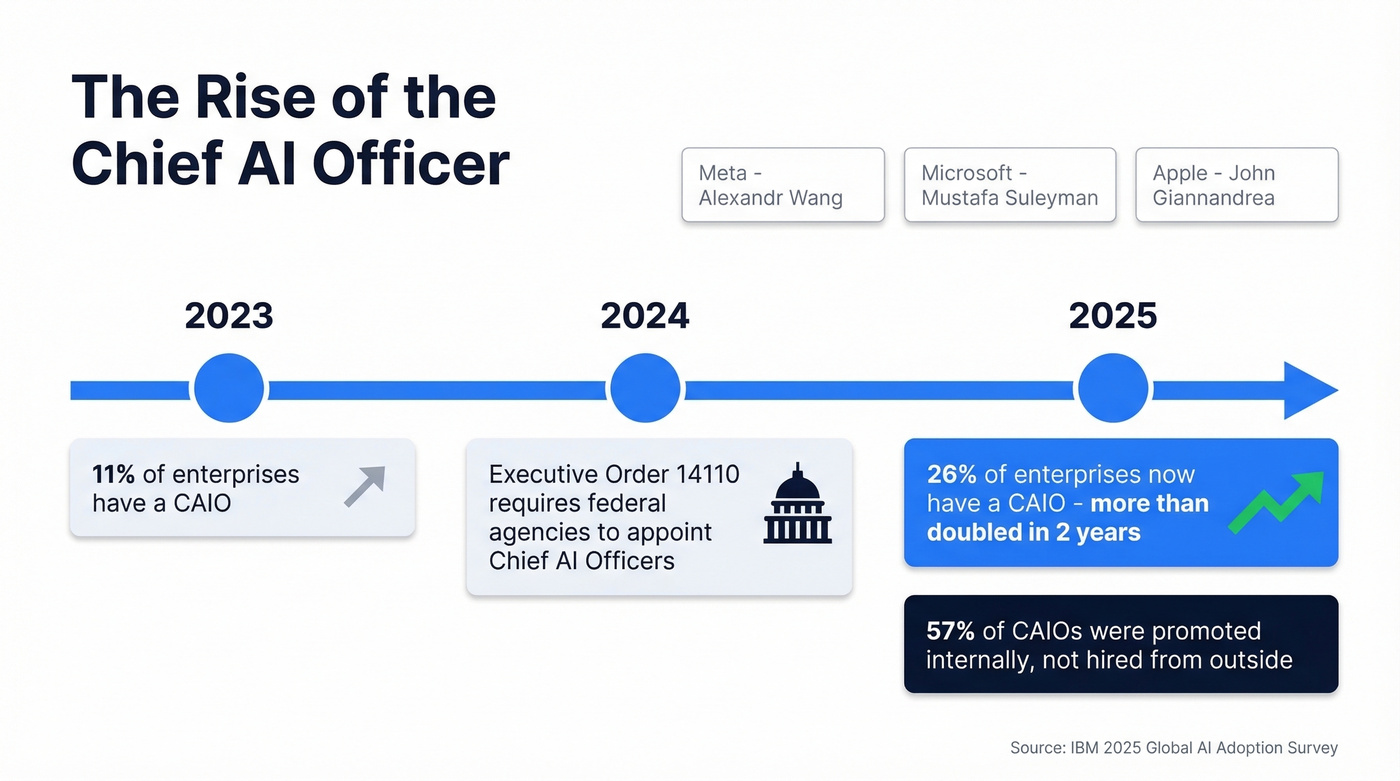
This isn't just a tech company thing. Meta brought in Alexandr Wang, Microsoft has Mustafa Suleyman, and Apple tapped John Giannandrea. But Lululemon and PwC have also added CAIOs. The U.S. government got in on it too - Executive Order 14110 required federal agencies to appoint a Chief AI Officer for governance and accountability.
What does a CAIO actually do? They're distinct from both the CIO and CTO. The CAIO focuses on AI governance, enterprise adoption strategy, delegating work to AI agents, and building the infrastructure for AI at scale. Think of it as the person who makes sure AI doesn't just get piloted in one team but actually transforms how the company operates - from procurement to product to customer success.
We've watched CAIO roles go from novelty to necessity in under two years, and the same trajectory is coming for Chief Sustainability Officers. The C-suite is expanding whether traditionalists like it or not. Only 11% of Fortune 200 CEOs have a supply chain background, which tells you something about the skills gaps that still exist at the top.
If you're selling into AI-led transformations, enterprise B2B sales requires a different motion than SMB.
Diversity: Where the Pipeline Breaks
The Women in the Workplace 2025 report makes the problem clear, and it's not where most people assume.
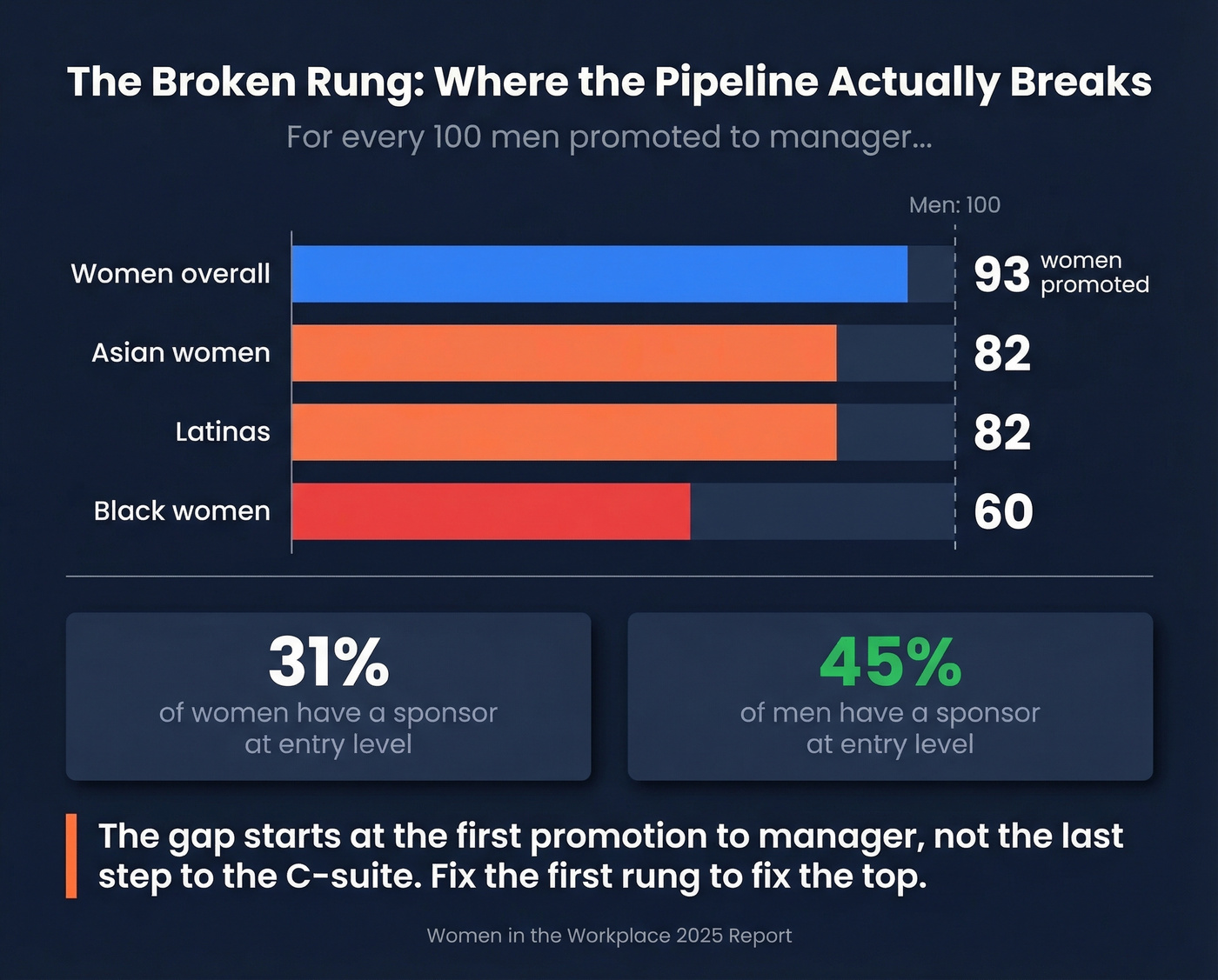
For every 100 men promoted to manager, 93 women get the same promotion. For Asian women and Latinas, that number drops to 82. For Black women, it's 60. This is the "broken rung" - it happens at the first step into management, not the last step into the C-suite. By the time you're looking at top-level representation, the math has already been done.
The sponsorship gap compounds everything. At the entry level, 31% of women have a sponsor compared to 45% of men. Without sponsors, high-potential women don't get the visibility, stretch assignments, or advocacy they need to advance. Six in ten senior-level women report frequently feeling burned out, compared to about half of men at the same level.
The takeaway isn't that women are less ambitious. It's that the system is exhausting, and the pipeline breaks at the first rung, not the last. Fixing executive diversity means fixing manager-level promotions, sponsorship access, and workload distribution - not just setting targets at the top.
What C-Suite Executives Actually Do Day-to-Day
The perception of executive work is predictable: "thinking and deciding, not doing." There's a kernel of truth. But the nature of the work is what matters.
A typical week includes board prep and investor calls, strategic planning sessions setting direction for the next 1-3 years, crisis management that can consume entire days without warning, talent reviews for senior leadership, cross-functional alignment meetings where competing priorities get resolved, and external representation at conferences and with regulators. The work is invisible because it's upstream - by the time a decision reaches the rest of the company, the leadership team has spent weeks, sometimes months, debating it, modeling it, and pressure-testing it.
In 2026, AI and digital fluency are expected across every chief officer role. A startup CEO needs to own AI strategy directly. At enterprise scale, the same CEO delegates AI execution to a CAIO but still needs enough fluency to evaluate what's working. A COO needs to build AI-first operations. A CMO needs to drive AI-powered personalization at scale. The days of delegating "the AI stuff" to the CTO are over.
If you're trying to quantify impact, track funnel metrics and align them to exec priorities.
How to Reach C-Suite Decision-Makers
Understanding these roles is step one. Reaching them is step two - and it's significantly harder.
C-suite executives are heavily gatekept. Executive assistants screen emails and calls. Generic info@ addresses go nowhere. And stale data gets especially expensive at this level. If you're emailing a VP who left three months ago, you get a bounce. If you're emailing a CEO who left three months ago, you've wasted your best shot at that account. Outreach to senior executives has zero margin for error.
In our experience, the single biggest factor in executive outreach success isn't the copy or the cadence - it's whether the contact data is current. The r/sales community echoes this constantly: bad data burns domains and kills reply rates before your messaging even gets a chance.
Skip this approach if you're only targeting a handful of named accounts - for five executives, manual research works fine. But the moment you're running outbound at any kind of scale, verified data isn't optional.
If you're scaling outbound, start with sales prospecting techniques and a clean lead generation workflow.

CEOs, CFOs, and CAIOs all have one thing in common: they ignore cold emails sent to generic inboxes. Prospeo's 30+ search filters let you target by title, seniority, company size, and buyer intent - then delivers verified contact data refreshed every 7 days, not 6 weeks.
Land in the right inbox at $0.01 per verified email.
FAQ
What is C-suite level?
C-suite level refers to the highest-ranking executive positions in a company - the "Chief" officers like CEO, CFO, COO, and CTO. These leaders have enterprise-wide authority, direct board access, and final decision-making power over company strategy. The "C" stands for "chief."
What level is below C-suite?
The V-suite - EVP, SVP, and VP - sits directly below C-suite executives. These leaders run functions or business units but don't have enterprise-wide decision-making authority and typically lack direct board access.
Is VP considered C-suite?
No. VP, SVP, and EVP are senior leadership but not C-suite. The key distinction: C-suite executives set enterprise-wide strategy and hold final decision-making authority. VPs recommend and execute within their function.
How many C-suite executives does a typical company have?
Small companies typically have 2-3, midsize companies 7-8, and large enterprises 17 or more. The number is growing as roles like Chief AI Officer and Chief Data Officer become standard.
How do you find verified contact info for C-suite executives?
Use a B2B data platform with title and seniority filters, verified emails, and direct dials. Prospeo covers 300M+ profiles with 98% email accuracy and a 7-day refresh cycle - critical when targeting executives who change roles frequently. The free tier (75 emails/month) lets you validate the data before scaling.